Writing SMART
learning outcomes
UWC INDUCTION WORKSHOP 18 - 20 MARCH 2015
Rita Kizito
kizitorita@gmail.com
How do you normally go about planning
your module?
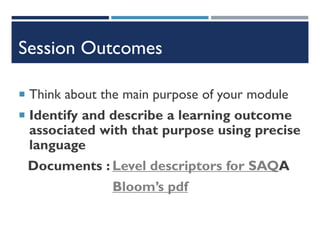
 Think about the main purpose of your module
 Identify and describe a learning outcome
associated with that purpose using precise
language
Documents : Level descriptors for SAQA
Bloom’s pdf
Session Outcomes
 Broad, generalized statements of what needs
to be learned in the module
 Often loosely defined
 Examples:
Students will understand….
Students will become familiar with or learn….
Students will know….
Purpose of your module - (Goals)
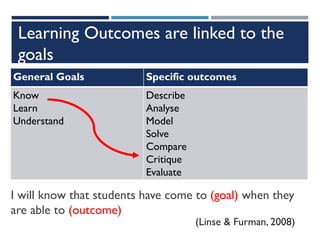
Learning Outcomes are linked to the
goals
General Goals Specific outcomes
Know
Learn
Understand
Describe
Analyse
Model
Solve
Compare
Critique
Evaluate
I will know that students have come to (goal) when they
are able to (outcome)
(Linse & Furman, 2008)
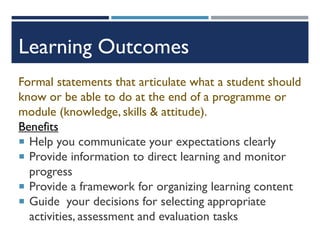
Formal statements that articulate what a student should
know or be able to do at the end of a programme or
module (knowledge, skills & attitude).
Benefits
 Help you communicate your expectations clearly
 Provide information to direct learning and monitor
progress
 Provide a framework for organizing learning content
 Guide your decisions for selecting appropriate
activities, assessment and evaluation tasks
Learning Outcomes
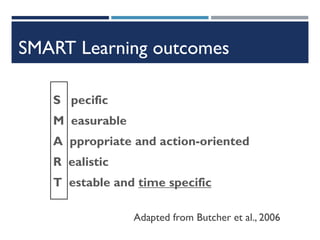
S pecific
M easurable
A ppropriate and action-oriented
R ealistic
T estable and time specific
SMART Learning outcomes
Adapted from Butcher et al., 2006
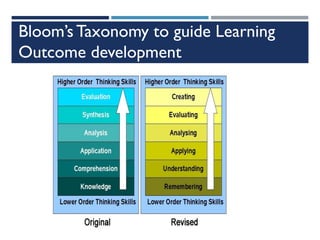
Bloom’s Taxonomy to guide Learning
Outcome development
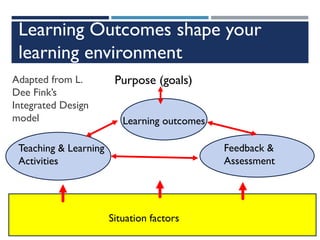
Learning Outcomes shape your
learning environment
Learning outcomes
Purpose (goals)
Teaching & Learning
Activities
Feedback &
Assessment
Situation factors
Adapted from L.
Dee Fink’s
Integrated Design
model
Knowing your students and your
context
Credits – how many hours are
available?
Do you have Tutorial support?
Is there Technological support?
• At what (SAQA) level is your
module pegged?
• How does your module fit in
with the other modules in
your department/programme ?
• Your student
needs
• Pre-requisite
knowledge
• Weaknesses?
Does the information
in your module
change rapidly?
What are the
module strengths and
weaknesses
according to the
evaluations?
Prioritize
Wiggins, Grant &
MacTighe, 2005
Enduring
Understanding
Important to know
Worth being familiar
with
Examples
 Explain the fundamental tasks performed by a
modern operating system [Computer Science 311]
 Formulate and solve counting problems in algebra and
graph theory [Discrete Mathematics, MAT232]
 Describe the physiology of muscular systems,
neuromuscular junction, blood and immune systems
[Structure and Function of the Human Body,
HUB127]
UWC Calendar, Faculty of Natural Sciences, 2015
Activity ( 15 minutes)
Consider one module that you are involved with
and:
• Identify a goal related to the module
• Construct (or refine) one learning outcome
from the module
• Spend 2-3 minutes sharing the learning
outcome with your partner. Your partner
should assess the learning outcomes using the
SMART criteria.
References
• Anderson, L.W., & Krathwohl, D. R. (Eds.). (2001) A taxonomy for learning,
teaching and assessing: a revision of Bloom’sTaxonomy of educational objectives:
Complete edition. NewYork: Longman,
• Bloom, B. D. and Krathwohl, D. R. (1956). Taxonomy of educational objectives:
The classification of educational goals by a committee of college and university
examiners. Handbook 1. Cognitive domain. NewYork:Addison Wesley.
• Butcher, C., Davies, C. & Highton, M. (2006). Designing Learning: From Module
Outline to EffectiveTeaching. London & NewYork: Routledge. Chapters 3 to 5.
• Fink, L. D. (2003).A self-directed guide to designing courses for significant
learning. University of Oklahoma, 1-35.
• Linse, R & Furman,T (2008).Assessment Initiatives Assessment Initiatives
at Penn State at Penn State Campus Academic Officers
• Wiggins, G. P., & McTighe, J. (2005). Understanding by design.Ascd.
 Thank - you

Writing SMART learning outcomes 2015

  • 1.
    Writing SMART learning outcomes UWCINDUCTION WORKSHOP 18 - 20 MARCH 2015 Rita Kizito kizitorita@gmail.com
  • 2.
    How do younormally go about planning your module?
  • 3.
     Think aboutthe main purpose of your module  Identify and describe a learning outcome associated with that purpose using precise language Documents : Level descriptors for SAQA Bloom’s pdf Session Outcomes
  • 4.
     Broad, generalizedstatements of what needs to be learned in the module  Often loosely defined  Examples: Students will understand…. Students will become familiar with or learn…. Students will know…. Purpose of your module - (Goals)
  • 5.
    Learning Outcomes arelinked to the goals General Goals Specific outcomes Know Learn Understand Describe Analyse Model Solve Compare Critique Evaluate I will know that students have come to (goal) when they are able to (outcome) (Linse & Furman, 2008)
  • 6.
    Formal statements thatarticulate what a student should know or be able to do at the end of a programme or module (knowledge, skills & attitude). Benefits  Help you communicate your expectations clearly  Provide information to direct learning and monitor progress  Provide a framework for organizing learning content  Guide your decisions for selecting appropriate activities, assessment and evaluation tasks Learning Outcomes
  • 7.
    S pecific M easurable Appropriate and action-oriented R ealistic T estable and time specific SMART Learning outcomes Adapted from Butcher et al., 2006
  • 8.
    Bloom’s Taxonomy toguide Learning Outcome development
  • 9.
    Learning Outcomes shapeyour learning environment Learning outcomes Purpose (goals) Teaching & Learning Activities Feedback & Assessment Situation factors Adapted from L. Dee Fink’s Integrated Design model
  • 10.
    Knowing your studentsand your context Credits – how many hours are available? Do you have Tutorial support? Is there Technological support? • At what (SAQA) level is your module pegged? • How does your module fit in with the other modules in your department/programme ? • Your student needs • Pre-requisite knowledge • Weaknesses? Does the information in your module change rapidly? What are the module strengths and weaknesses according to the evaluations?
  • 11.
    Prioritize Wiggins, Grant & MacTighe,2005 Enduring Understanding Important to know Worth being familiar with
  • 12.
    Examples  Explain thefundamental tasks performed by a modern operating system [Computer Science 311]  Formulate and solve counting problems in algebra and graph theory [Discrete Mathematics, MAT232]  Describe the physiology of muscular systems, neuromuscular junction, blood and immune systems [Structure and Function of the Human Body, HUB127] UWC Calendar, Faculty of Natural Sciences, 2015
  • 13.
    Activity ( 15minutes) Consider one module that you are involved with and: • Identify a goal related to the module • Construct (or refine) one learning outcome from the module • Spend 2-3 minutes sharing the learning outcome with your partner. Your partner should assess the learning outcomes using the SMART criteria.
  • 14.
    References • Anderson, L.W.,& Krathwohl, D. R. (Eds.). (2001) A taxonomy for learning, teaching and assessing: a revision of Bloom’sTaxonomy of educational objectives: Complete edition. NewYork: Longman, • Bloom, B. D. and Krathwohl, D. R. (1956). Taxonomy of educational objectives: The classification of educational goals by a committee of college and university examiners. Handbook 1. Cognitive domain. NewYork:Addison Wesley. • Butcher, C., Davies, C. & Highton, M. (2006). Designing Learning: From Module Outline to EffectiveTeaching. London & NewYork: Routledge. Chapters 3 to 5. • Fink, L. D. (2003).A self-directed guide to designing courses for significant learning. University of Oklahoma, 1-35. • Linse, R & Furman,T (2008).Assessment Initiatives Assessment Initiatives at Penn State at Penn State Campus Academic Officers • Wiggins, G. P., & McTighe, J. (2005). Understanding by design.Ascd.
  • 15.