Constructing Learning Outcomes for Library Instruction
What is a learning outcome?An expression of the learning that the student should achieve, or, what the student should be able to do  (and why) at the end of the instruction session.
How is this different from a learning objective?A learning objective is what the instructor intends to do, or what the students and instructor will do together.
Objectives vs. OutcomesLearning Objective:  Students will be introduced GIL, Academic Search Complete, and will be taught to distinguish between scholarly and popular sources.Learning Outcome:  Students will be able to find at least one relevant source on their research topic in GIL and Academic Search Complete and will be able to distinguish between scholarly and popular sources.
“Learning outcomes should be the basis for choosing curriculum content and instructional strategies.” Battersby p. 11
“A key element in the learning outcomes approach is the role of assessment.  Assessment choices give clear meaning to the more abstract formulations of the learning outcomes; stating learning outcomes clearly and providing evaluation based on explicit standards greatly facilitates student learning.”Battersby, p. 11
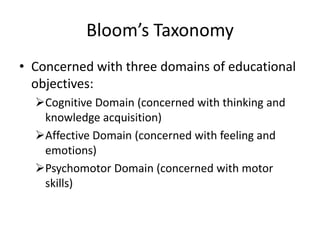
Bloom’s TaxonomyConcerned with three domains of educational objectives:Cognitive Domain (concerned with thinking and knowledge acquisition)
Affective Domain (concerned with feeling and emotions)
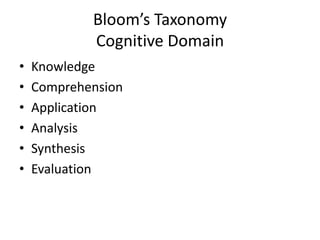
Psychomotor Domain (concerned with motor skills)Bloom’s Taxonomy Cognitive DomainKnowledgeComprehensionApplicationAnalysisSynthesisEvaluation

Constructing learning outcomes for library instruction

  • 1.
    Constructing Learning Outcomesfor Library Instruction
  • 2.
    What is alearning outcome?An expression of the learning that the student should achieve, or, what the student should be able to do (and why) at the end of the instruction session.
  • 3.
    How is thisdifferent from a learning objective?A learning objective is what the instructor intends to do, or what the students and instructor will do together.
  • 4.
    Objectives vs. OutcomesLearningObjective: Students will be introduced GIL, Academic Search Complete, and will be taught to distinguish between scholarly and popular sources.Learning Outcome: Students will be able to find at least one relevant source on their research topic in GIL and Academic Search Complete and will be able to distinguish between scholarly and popular sources.
  • 5.
    “Learning outcomes shouldbe the basis for choosing curriculum content and instructional strategies.” Battersby p. 11
  • 6.
    “A key elementin the learning outcomes approach is the role of assessment. Assessment choices give clear meaning to the more abstract formulations of the learning outcomes; stating learning outcomes clearly and providing evaluation based on explicit standards greatly facilitates student learning.”Battersby, p. 11
  • 7.
    Bloom’s TaxonomyConcerned withthree domains of educational objectives:Cognitive Domain (concerned with thinking and knowledge acquisition)
  • 8.
    Affective Domain (concernedwith feeling and emotions)
  • 9.
    Psychomotor Domain (concernedwith motor skills)Bloom’s Taxonomy Cognitive DomainKnowledgeComprehensionApplicationAnalysisSynthesisEvaluation

Editor's Notes

  • #2 Focusing on learning outcomes because this is the next step in outreach to CTW courses. We’ve identified the courses and made contact, now we need to begin to assess what we’re doing with the classes—how effective we are. Once we define learning outcomes, then we can begin to apply assessment tools, and in fact, our learning outcomes should help us to identify appropriate tools.
  • #3 What students should be able to do, rather than what knowledge they should possess.
  • #5 With learning outcomes, we are getting at the critical thinking skills, rather than surface knowledge. “`Useable learning’ is meant to contrast with learning that only results in the (often fleeting) ‘possession of knowledge’ (as shown by success on short answer tests) or learning characterized by superficial understanding” Battersby p. 7 (5).Learning outcomes are often a part of course objectives.
  • #9 Critical thinking is concerned with the last three categories.