Assessment and Learning OutcomesMake a difference, measure the impact.Amber Garrison DuncanUniversity of Oregon
Workshop Learning OutcomesDescribe how institution, division and department missions inform the planning and assessment processSummarize the planning and assessment processUnderstand the role of learning outcomes in shaping student learning experiencesUnderstand the learning outcomes formulaUnderstand levels of Blooms taxonomy Construct learning outcomes
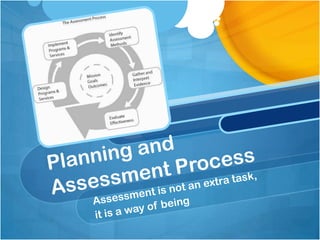
Planning and Assessment ProcessAssessment is not an extra task, it is a way of being
Let’s unpack the process
Mission, Goals and OutcomesWhere do we find these?What informs our mission, goals and outcomes?What should inform our mission, goals and outcomes?
Department OutcomesInformed by the Missions and Goals of the Institution, Student Affairs and Department.Written to demonstrate what the department will do to contribute to the Student Affairs mission, which then contributes to the Institutional Mission.Informs the development of programs and services within the department.Documented in the Department Strategic Plan
Program and Service OutcomesPrograms and Services are designed to fulfill the department mission.Specific outcomes are written for the particular program or service.
Program and Service AssessmentDesigned to measure the specific outcomes written for the program or service.Assessment provides documentation of impact of the program or serviceAssessment provides guidance and insight into successes and challenges that informs future planning
WritingLearning OutcomesMake a difference, measure the impact.
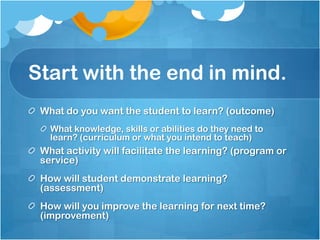
Start with the end in mind.What do you want the student to learn? (outcome)What knowledge, skills or abilities do they need to learn? (curriculum or what you intend to teach)What activity will facilitate the learning? (program or service)How will student demonstrate learning? (assessment)How will you improve the learning for next time? (improvement)
Designed to walk you, step by step, through the program planning and assessment processAssessment and Planning Guide
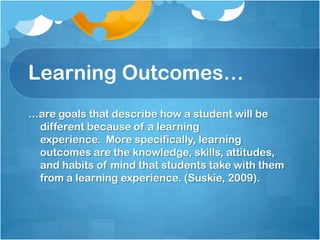
Learning Outcomes……are goals that describe how a student will be different because of a learning experience.  More specifically, learning outcomes are the knowledge, skills, attitudes, and habits of mind that students take with them from a learning experience. (Suskie, 2009).
BrainstormWhat do you want the student to be able to know or do as a result of participation?What knowledge, skill or ability should the ideal participant demonstrate?
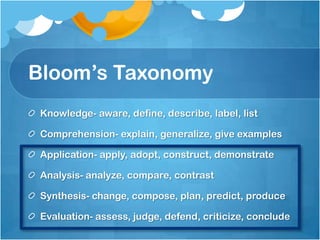
Bloom’s TaxonomyKnowledge- aware, define, describe, label, listComprehension- explain, generalize, give examplesApplication- apply, adopt, construct, demonstrateAnalysis- analyze, compare, contrastSynthesis- change, compose, plan, predict, produceEvaluation- assess, judge, defend, criticize, conclude
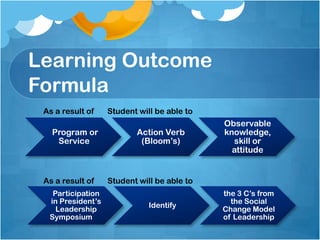
Learning Outcome FormulaAs a result of 	Student will be able toAs a result of 	Student will be able to
As a result of this program, student will…Bad Outcome StatementBe able to have confidence in their abilities, realize the HLC can benefit their learning process and enroll in three programs.Better Outcome StatementDemonstrate critical thinking skills as it relates to social issuesBest Outcome StatementDemonstrate the ability to analyze and respond to arguments about racial discrimination
TipsLimit yourself to 3-6 outcome statementsBe SMARTSpecific- focused on a specific learning areaMeasurable- you can collect data to measureAttainable- the outcome is attainable given the student learning level and program Results- program is aligned with department and division learning domainsTailored- outcome is specific to the program
We are taking a friend camping. What do they need to know? Let’s Try
Start with the end in mind.What do you want your friend to learn about camping? (outcomes)What specific knowledge, skills or abilities do they need to learn? (outcomes- remember 3-6 only!)What activity will facilitate the learning? (program, service or experiences)How will your friend demonstrate learning? (assessment)How will you improve the learning for next time? (improvement)
ResourcesAssessment Team MemberStudent VoiceStudent Affairs Assessment Websitehttp://sa-assessment.uoregon.edu

Assess and lo's 101

  • 1.
    Assessment and LearningOutcomesMake a difference, measure the impact.Amber Garrison DuncanUniversity of Oregon
  • 2.
    Workshop Learning OutcomesDescribehow institution, division and department missions inform the planning and assessment processSummarize the planning and assessment processUnderstand the role of learning outcomes in shaping student learning experiencesUnderstand the learning outcomes formulaUnderstand levels of Blooms taxonomy Construct learning outcomes
  • 3.
    Planning and AssessmentProcessAssessment is not an extra task, it is a way of being
  • 4.
  • 5.
    Mission, Goals andOutcomesWhere do we find these?What informs our mission, goals and outcomes?What should inform our mission, goals and outcomes?
  • 7.
    Department OutcomesInformed bythe Missions and Goals of the Institution, Student Affairs and Department.Written to demonstrate what the department will do to contribute to the Student Affairs mission, which then contributes to the Institutional Mission.Informs the development of programs and services within the department.Documented in the Department Strategic Plan
  • 9.
    Program and ServiceOutcomesPrograms and Services are designed to fulfill the department mission.Specific outcomes are written for the particular program or service.
  • 10.
    Program and ServiceAssessmentDesigned to measure the specific outcomes written for the program or service.Assessment provides documentation of impact of the program or serviceAssessment provides guidance and insight into successes and challenges that informs future planning
  • 11.
    WritingLearning OutcomesMake adifference, measure the impact.
  • 12.
    Start with theend in mind.What do you want the student to learn? (outcome)What knowledge, skills or abilities do they need to learn? (curriculum or what you intend to teach)What activity will facilitate the learning? (program or service)How will student demonstrate learning? (assessment)How will you improve the learning for next time? (improvement)
  • 13.
    Designed to walkyou, step by step, through the program planning and assessment processAssessment and Planning Guide
  • 14.
    Learning Outcomes……are goalsthat describe how a student will be different because of a learning experience.  More specifically, learning outcomes are the knowledge, skills, attitudes, and habits of mind that students take with them from a learning experience. (Suskie, 2009).
  • 15.
    BrainstormWhat do youwant the student to be able to know or do as a result of participation?What knowledge, skill or ability should the ideal participant demonstrate?
  • 16.
    Bloom’s TaxonomyKnowledge- aware,define, describe, label, listComprehension- explain, generalize, give examplesApplication- apply, adopt, construct, demonstrateAnalysis- analyze, compare, contrastSynthesis- change, compose, plan, predict, produceEvaluation- assess, judge, defend, criticize, conclude
  • 17.
    Learning Outcome FormulaAsa result of Student will be able toAs a result of Student will be able to
  • 18.
    As a resultof this program, student will…Bad Outcome StatementBe able to have confidence in their abilities, realize the HLC can benefit their learning process and enroll in three programs.Better Outcome StatementDemonstrate critical thinking skills as it relates to social issuesBest Outcome StatementDemonstrate the ability to analyze and respond to arguments about racial discrimination
  • 19.
    TipsLimit yourself to3-6 outcome statementsBe SMARTSpecific- focused on a specific learning areaMeasurable- you can collect data to measureAttainable- the outcome is attainable given the student learning level and program Results- program is aligned with department and division learning domainsTailored- outcome is specific to the program
  • 20.
    We are takinga friend camping. What do they need to know? Let’s Try
  • 21.
    Start with theend in mind.What do you want your friend to learn about camping? (outcomes)What specific knowledge, skills or abilities do they need to learn? (outcomes- remember 3-6 only!)What activity will facilitate the learning? (program, service or experiences)How will your friend demonstrate learning? (assessment)How will you improve the learning for next time? (improvement)
  • 22.
    ResourcesAssessment Team MemberStudentVoiceStudent Affairs Assessment Websitehttp://sa-assessment.uoregon.edu

Editor's Notes

  • #17 Lower levels are rote memorization or surface level learning. Procedural knowledge and answers can be found in materials provided.Higher levels are meaningful or deep learning. Students creative, original and critical thinking are required.