Writing learning objectives
Email ID: nazia.ashraf1536@gmail.com
Objectives
By the end of this one-hour workshop, participants will
be able to:
• Differentiate between learning outcomes and learning
objectives.
• Enlist the purpose of writing learning objectives.
• Describe the use of appropriate verbs while writing
learning objectives.
• Formulate learning objectives while using ABCD
technique.
Learning Objectives
What is Learning?
4
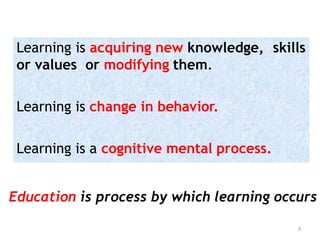
Learning is acquiring new knowledge, skills
or values or modifying them.
Learning is change in behavior.
Learning is a cognitive mental process.
Education is process by which learning occurs
What do we mean by
learning objectives?
5
6
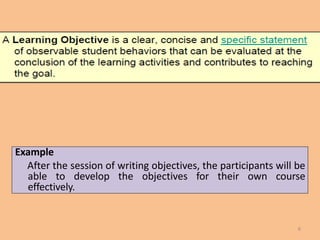
Example
After the session of writing objectives, the participants will be
able to develop the objectives for their own course
effectively.
• Describing to student what you value and
expect from students. (Selecting Content)
• Developing best possible instructional
strategy ( I.S.) (develop instructional
strategy)
• Developing efficient assessment tools
(linking to assessment)
Purpose of “Learning Objectives”
What is difference between Learning
objective and outcome ?
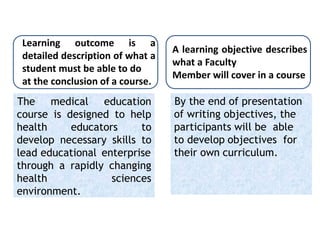
The medical education
course is designed to help
health educators to
develop necessary skills to
lead educational enterprise
through a rapidly changing
health sciences
environment.
By the end of presentation
of writing objectives, the
participants will be able
to develop objectives for
their own curriculum.
A learning objective describes
what a Faculty
Member will cover in a course
Learning outcome is a
detailed description of what a
student must be able to do
at the conclusion of a course.
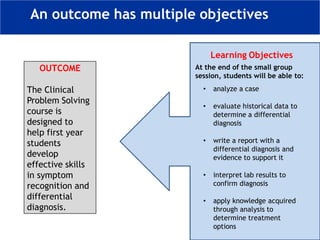
OUTCOME
The Clinical
Problem Solving
course is
designed to
help first year
students
develop
effective skills
in symptom
recognition and
differential
diagnosis.
Learning Objectives
At the end of the small group
session, students will be able to:
• analyze a case
• evaluate historical data to
determine a differential
diagnosis
• write a report with a
differential diagnosis and
evidence to support it
• interpret lab results to
confirm diagnosis
• apply knowledge acquired
through analysis to
determine treatment
options
An outcome has multiple objectives
11
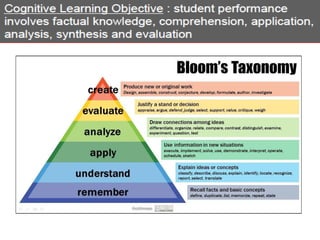
How to write Learning Objectives?
12
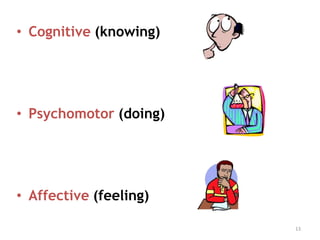
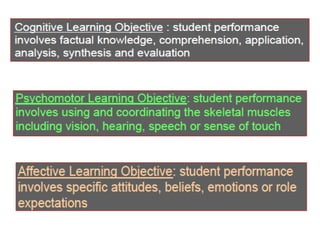
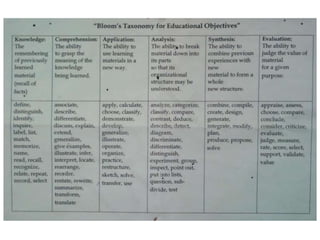
Domains of Learning Objectives ?
• Cognitive (knowing)
• Psychomotor (doing)
• Affective (feeling)
13
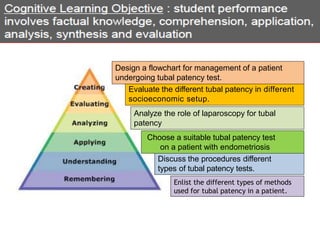
Evaluate the different tubal patency in different
socioeconomic setup.
Analyze the role of laparoscopy for tubal
patency
Choose a suitable tubal patency test
on a patient with endometriosis
Discuss the procedures different
types of tubal patency tests.
Enlist the different types of methods
used for tubal patency in a patient.
Design a flowchart for management of a patient
undergoing tubal patency test.
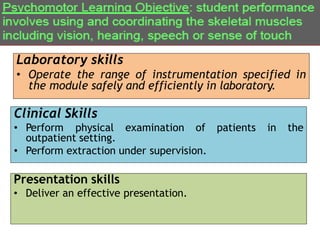
Laboratory skills
• Operate the range of instrumentation specified in
the module safely and efficiently in laboratory.
Clinical Skills
patients in the• Perform physical examination of
outpatient setting.
• Perform extraction under supervision.
Presentation skills
• Deliver an effective presentation.
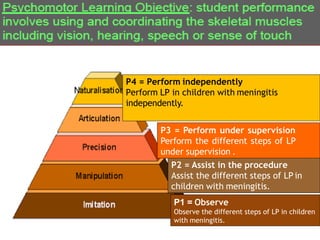
P4 = Perform independently
Perform LP in children with meningitis
independently.
P3 = Perform under supervision
Perform the different steps of LP
under supervision .
P2 = Assist in the procedure
Assist the different steps of LP in
children with meningitis.
P1 = Observe
Observe the different steps of LP in children
with meningitis.
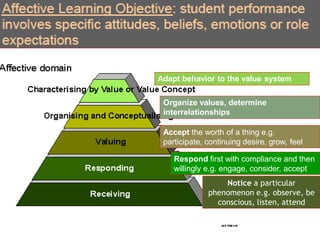
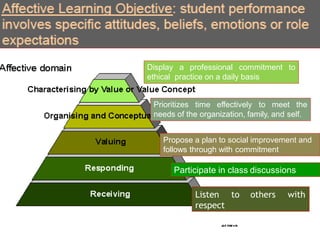
Organize values, determine
interrelationships
Accept the worth of a thing e.g.
participate, continuing desire, grow, feel
Respond first with compliance and then
willingly e.g. engage, consider, accept
Notice a particular
phenomenon e.g. observe, be
conscious, listen, attend
Adapt behavior to the value system
Propose a plan to social improvement and
follows through with commitment
Participate in class discussions
Listen to others with
respect
Prioritizes time effectively to meet the
needs of the organization, family, and self.
Display a professional commitment to
ethical practice on a daily basis
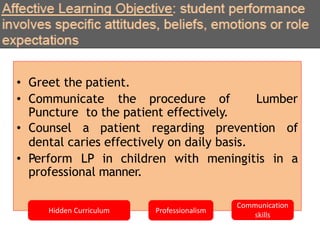
• Greet the patient.
• Communicate the procedure of Lumber
Puncture to the patient effectively.
• Counsel a patient regarding prevention of
dental caries effectively on daily basis.
• Perform LP in children with meningitis in a
professional manner.
Hidden Curriculum Professionalism
Communication
skills
Correct Use of Verbs
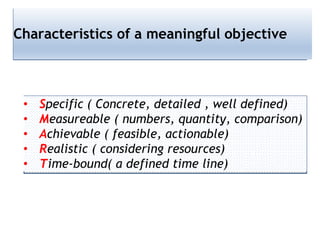
Characteristics of a meaningful objective
• Specific ( Concrete, detailed , well defined)
• Measureable ( numbers, quantity, comparison)
• Achievable ( feasible, actionable)
• Realistic ( considering resources)
• Time-bound( a defined time line)
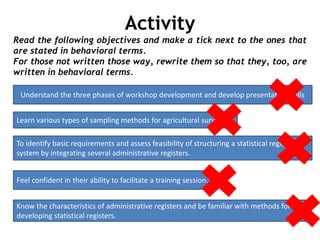
Activity
Read the following objectives and make a tick next to the ones that
are stated in behavioral terms.
For those not written those way, rewrite them so that they, too, are
written in behavioral terms.
Understand the three phases of workshop development and develop presentation skills
Learn various types of sampling methods for agricultural surveys.
To identify basic requirements and assess feasibility of structuring a statistical register
system by integrating several administrative registers.
Feel confident in their ability to facilitate a training session.
Know the characteristics of administrative registers and be familiar with methods for
developing statistical registers.
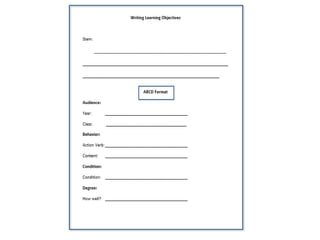
Writing Learning Objectives on
A+B+C+D Format
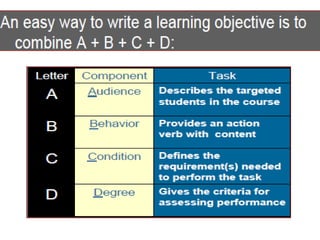
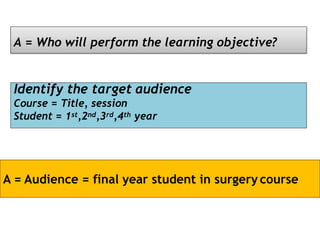
A = Who will perform the learning objective?
Identify the target audience
Course = Title, session
Student = 1st,2nd,3rd,4th year
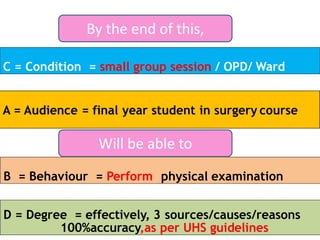
A = Audience = final year student in surgery course
B = what will they do ?
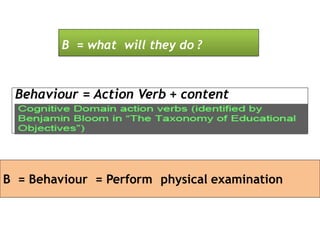
B = Behaviour = Perform physical examination
Behaviour = Action Verb + content
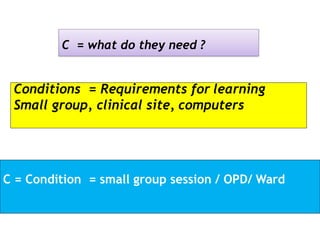
C = what do they need ?
Conditions = Requirements for learning
Small group, clinical site, computers
C = Condition = small group session / OPD/ Ward
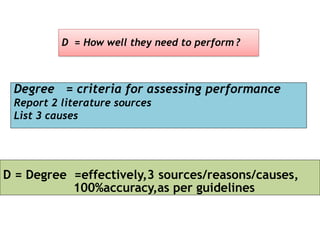
D = How well they need to perform ?
Degree = criteria for assessing performance
Report 2 literature sources
List 3 causes
D = Degree =effectively,3 sources/reasons/causes,
100%accuracy,as per guidelines
D = Degree = effectively, 3 sources/causes/reasons
100%accuracy,as per UHS guidelines
C = Condition = small group session / OPD/ Ward
B = Behaviour = Perform physical examination
By the end of this,
Will be able to
By the end of this presentation the
participants will be able to develop the
objectives of cognitive domain of their
specialties as per UHS syllabus.
• Moving towards a detailed, well-constructed
syllabus.
• Providing students with learning objectives at
start of lectures.
• Aligning assessment with course objectives.
Outcome
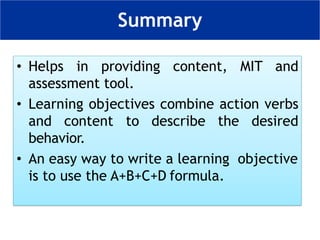
• Helps in providing content, MIT and
assessment tool.
• Learning objectives combine action verbs
and content to describe the desired
behavior.
• An easy way to write a learning objective
is to use the A+B+C+D formula.
Summary
Task
Please select a course of your own
specialty and develop objectives on
ABCD format
Please fill forms for My
performance and return 
Thank you for your time
Dr.Noor-i-Kiran Haris
noorikiran@yahoo.com
Any Questions?

Writing learning objectives

  • 1.
    Writing learning objectives EmailID: nazia.ashraf1536@gmail.com
  • 2.
    Objectives By the endof this one-hour workshop, participants will be able to: • Differentiate between learning outcomes and learning objectives. • Enlist the purpose of writing learning objectives. • Describe the use of appropriate verbs while writing learning objectives. • Formulate learning objectives while using ABCD technique. Learning Objectives
  • 3.
  • 4.
    4 Learning is acquiringnew knowledge, skills or values or modifying them. Learning is change in behavior. Learning is a cognitive mental process. Education is process by which learning occurs
  • 5.
    What do wemean by learning objectives? 5
  • 6.
    6 Example After the sessionof writing objectives, the participants will be able to develop the objectives for their own course effectively.
  • 7.
    • Describing tostudent what you value and expect from students. (Selecting Content) • Developing best possible instructional strategy ( I.S.) (develop instructional strategy) • Developing efficient assessment tools (linking to assessment) Purpose of “Learning Objectives”
  • 8.
    What is differencebetween Learning objective and outcome ?
  • 9.
    The medical education courseis designed to help health educators to develop necessary skills to lead educational enterprise through a rapidly changing health sciences environment. By the end of presentation of writing objectives, the participants will be able to develop objectives for their own curriculum. A learning objective describes what a Faculty Member will cover in a course Learning outcome is a detailed description of what a student must be able to do at the conclusion of a course.
  • 10.
    OUTCOME The Clinical Problem Solving courseis designed to help first year students develop effective skills in symptom recognition and differential diagnosis. Learning Objectives At the end of the small group session, students will be able to: • analyze a case • evaluate historical data to determine a differential diagnosis • write a report with a differential diagnosis and evidence to support it • interpret lab results to confirm diagnosis • apply knowledge acquired through analysis to determine treatment options An outcome has multiple objectives
  • 11.
    11 How to writeLearning Objectives?
  • 12.
  • 13.
    • Cognitive (knowing) •Psychomotor (doing) • Affective (feeling) 13
  • 16.
    Evaluate the differenttubal patency in different socioeconomic setup. Analyze the role of laparoscopy for tubal patency Choose a suitable tubal patency test on a patient with endometriosis Discuss the procedures different types of tubal patency tests. Enlist the different types of methods used for tubal patency in a patient. Design a flowchart for management of a patient undergoing tubal patency test.
  • 18.
    Laboratory skills • Operatethe range of instrumentation specified in the module safely and efficiently in laboratory. Clinical Skills patients in the• Perform physical examination of outpatient setting. • Perform extraction under supervision. Presentation skills • Deliver an effective presentation.
  • 19.
    P4 = Performindependently Perform LP in children with meningitis independently. P3 = Perform under supervision Perform the different steps of LP under supervision . P2 = Assist in the procedure Assist the different steps of LP in children with meningitis. P1 = Observe Observe the different steps of LP in children with meningitis.
  • 20.
    Organize values, determine interrelationships Acceptthe worth of a thing e.g. participate, continuing desire, grow, feel Respond first with compliance and then willingly e.g. engage, consider, accept Notice a particular phenomenon e.g. observe, be conscious, listen, attend Adapt behavior to the value system
  • 21.
    Propose a planto social improvement and follows through with commitment Participate in class discussions Listen to others with respect Prioritizes time effectively to meet the needs of the organization, family, and self. Display a professional commitment to ethical practice on a daily basis
  • 22.
    • Greet thepatient. • Communicate the procedure of Lumber Puncture to the patient effectively. • Counsel a patient regarding prevention of dental caries effectively on daily basis. • Perform LP in children with meningitis in a professional manner. Hidden Curriculum Professionalism Communication skills
  • 23.
  • 24.
    Characteristics of ameaningful objective • Specific ( Concrete, detailed , well defined) • Measureable ( numbers, quantity, comparison) • Achievable ( feasible, actionable) • Realistic ( considering resources) • Time-bound( a defined time line)
  • 25.
    Activity Read the followingobjectives and make a tick next to the ones that are stated in behavioral terms. For those not written those way, rewrite them so that they, too, are written in behavioral terms. Understand the three phases of workshop development and develop presentation skills Learn various types of sampling methods for agricultural surveys. To identify basic requirements and assess feasibility of structuring a statistical register system by integrating several administrative registers. Feel confident in their ability to facilitate a training session. Know the characteristics of administrative registers and be familiar with methods for developing statistical registers.
  • 26.
    Writing Learning Objectiveson A+B+C+D Format
  • 28.
    A = Whowill perform the learning objective? Identify the target audience Course = Title, session Student = 1st,2nd,3rd,4th year A = Audience = final year student in surgery course
  • 29.
    B = whatwill they do ? B = Behaviour = Perform physical examination Behaviour = Action Verb + content
  • 30.
    C = whatdo they need ? Conditions = Requirements for learning Small group, clinical site, computers C = Condition = small group session / OPD/ Ward
  • 31.
    D = Howwell they need to perform ? Degree = criteria for assessing performance Report 2 literature sources List 3 causes D = Degree =effectively,3 sources/reasons/causes, 100%accuracy,as per guidelines
  • 32.
    D = Degree= effectively, 3 sources/causes/reasons 100%accuracy,as per UHS guidelines C = Condition = small group session / OPD/ Ward B = Behaviour = Perform physical examination By the end of this, Will be able to
  • 33.
    By the endof this presentation the participants will be able to develop the objectives of cognitive domain of their specialties as per UHS syllabus.
  • 34.
    • Moving towardsa detailed, well-constructed syllabus. • Providing students with learning objectives at start of lectures. • Aligning assessment with course objectives. Outcome
  • 35.
    • Helps inproviding content, MIT and assessment tool. • Learning objectives combine action verbs and content to describe the desired behavior. • An easy way to write a learning objective is to use the A+B+C+D formula. Summary
  • 37.
    Task Please select acourse of your own specialty and develop objectives on ABCD format
  • 38.
    Please fill formsfor My performance and return  Thank you for your time Dr.Noor-i-Kiran Haris noorikiran@yahoo.com Any Questions?