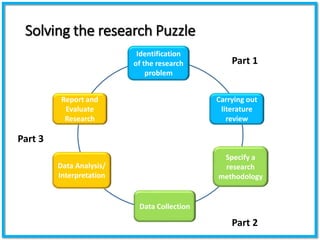
Solving the research Puzzle
Identification
of the research
problem
Specify a
research
methodology
Carrying out
literature
review
Data Collection
Data Analysis/
Interpretation
Report and
Evaluate
Research
Part 1
Part 2
Part 3
Solving the
Research Puzzle
Dr. Noor-i-Kiran Haris
MBBS, FCPS, CSRM, Dip ART, MSc.MEd.
Dr.Rehmatullah's Hospital, Gojra
Austrailian Concept fertility Centre,
Faisalabad
Aziz Fatimah Medical and Dental College,
Faisalabad.
Part 3b
How to write an article?
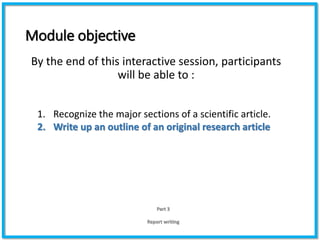
Module objective
By the end of this interactive session, participants
will be able to :
Part 3
Report writing
1. Recognize the major sections of a scientific article.
2. Write up an outline of an original research article
What are the Components of an
original research article?
Components of an original research
article
IMRAD structure
Introduction, Methods, Results And Discussion
International Committee of Medical Journal Editors. Uniform requirements for manuscripts submitted to biomedical journals:
writing and editing for biomedical publication. J Pharmacol Pharmacother. 2010 Jan;1(1):42–58.
International Committee of Medical Journal
Editors
Recommended in the “Uniform Requirements for Manuscripts Submitted to
Biomedical Journals”
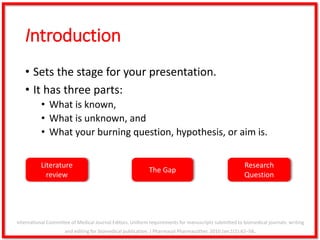
Introduction
• Sets the stage for your presentation.
• It has three parts:
• What is known,
• What is unknown, and
• What your burning question, hypothesis, or aim is.
Literature
review
The Gap
Research
Question
International Committee of Medical Journal Editors. Uniform requirements for manuscripts submitted to biomedical journals: writing
and editing for biomedical publication. J Pharmacol Pharmacother. 2010 Jan;1(1):42–58.
Methods
• Gives a clear overview of what you did.
• Give enough information that your readers can
evaluate the persuasiveness of your study.
• smaller sections with subheadings:
• context: when, where, authority or approval
• sample selection
• data collection (how)
• follow-up
• method of analysis
Results
• Summarizes what the data show.
• Point out relationships, and describe trends.
• Tables and figures
International Committee of Medical Journal Editors. Uniform requirements for manuscripts submitted to biomedical journals: writing
and editing for biomedical publication. J Pharmacol Pharmacother. 2010 Jan;1(1):42–58.
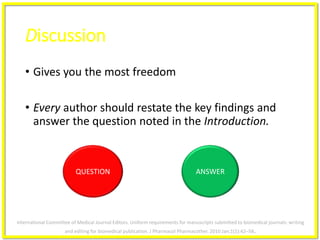
QUESTION
Discussion
• Gives you the most freedom
• Every author should restate the key findings and
answer the question noted in the Introduction.
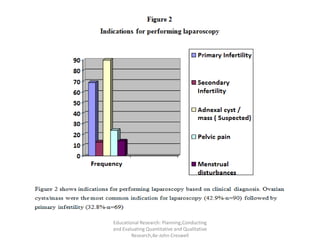
ANSWER
International Committee of Medical Journal Editors. Uniform requirements for manuscripts submitted to biomedical journals: writing
and editing for biomedical publication. J Pharmacol Pharmacother. 2010 Jan;1(1):42–58.
Conclusion
• Remember to give a final take-home message along
with implications.
• At times , the conclusion is built into the Discussion
International Committee of Medical Journal Editors. Uniform requirements for manuscripts submitted to biomedical journals: writing
and editing for biomedical publication. J Pharmacol Pharmacother. 2010 Jan;1(1):42–58.
Other parts of your research paper
independent of IMRAD
Other parts of research paper
• Abstracts
• Key words
• Title page
• Acknowledgements
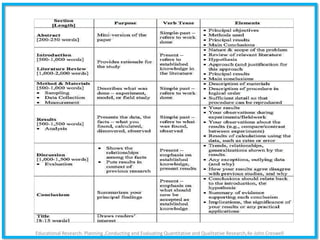
• References
Educational Research: Planning, Conducting and Evaluating Quantitative and
Qualitative Research,4e-John Creswell
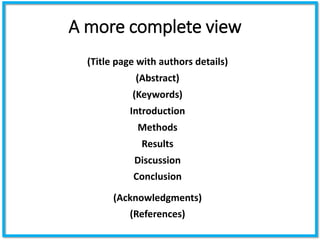
A more complete view
(Title page with authors details)
(Abstract)
(Keywords)
Introduction
Methods
Results
Discussion
Conclusion
(Acknowledgments)
(References)
https://www.someecards.com/usercards/viewcard/MjAxMy1kMzM0OWIwZjI2NTdhZDdm/
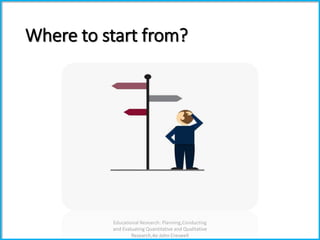
Where to start from?
Educational Research: Planning,Conducting
and Evaluating Quantitative and Qualitative
Research,4e-John Creswell
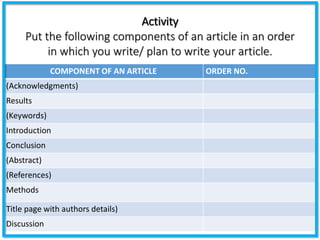
Activity
Put the following components of an article in an order
in which you write/ plan to write your article.
COMPONENT OF AN ARTICLE ORDER NO.
(Acknowledgments)
Results
(Keywords)
Introduction
Conclusion
(Abstract)
(References)
Methods
Title page with authors details)
Discussion
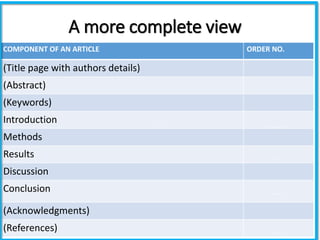
A more complete view
COMPONENT OF AN ARTICLE ORDER NO.
(Title page with authors details) 10
(Abstract) 6
(Keywords) 7
Introduction 3
Methods 2
Results 1
Discussion 4
Conclusion 5
(Acknowledgments) 9
(References) 8
The Results
Writing the Results Section of your
Article
What did you find?
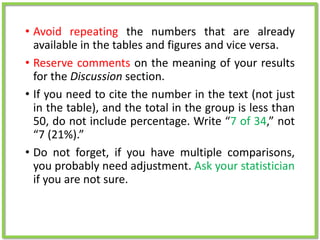
• Avoid repeating the numbers that are already
available in the tables and figures and vice versa.
• Reserve comments on the meaning of your results
for the Discussion section.
• If you need to cite the number in the text (not just
in the table), and the total in the group is less than
50, do not include percentage. Write “7 of 34,” not
“7 (21%).”
• Do not forget, if you have multiple comparisons,
you probably need adjustment. Ask your statistician
if you are not sure.
Components
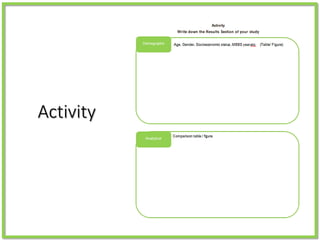
• Demographic data
• Participants: age, gender, class, habit, socioeconomic status
• Cross sectional surveys
• Analytical data ( if present)
• Comparison, correlation
• Analytical studies, experimental studies
Educational Research: Planning, Conducting and Evaluating Quantitative and Qualitative
Research,4e-John Creswell
• You have a demographic table with a row of ages,
and age was not significantly different among
groups, your text could say,
“The median age of all subjects was 47 years. There
was no significant difference between groups
(Table).”
VS
“The mean age of group 1 was 48.6 (7.5) years and
group 2 was 46.3 (5.8) years, a non-significant
difference.”
Comparison of the efficacy of letrozole and
clomiphen citrate gonadotropins in controlled
ovarian hyperstimulation
Comparison of the efficacy of the aromatase inhibitor letrozole and clomiphen citrate gonadotropins in controlled ovarian
hyperstimulation: a prospective, simply randomized, clinical trial
Ensieh Sh et al.J Assist Reprod Genet. 2008 May; 25(5): 187–190.
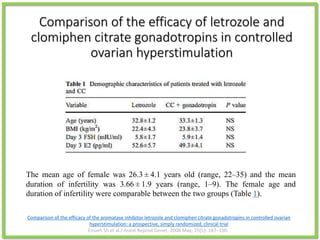
The mean age of female was 26.3 ± 4.1 years old (range, 22–35) and the mean
duration of infertility was 3.66 ± 1.9 years (range, 1–9). The female age and
duration of infertility were comparable between the two groups (Table 1).
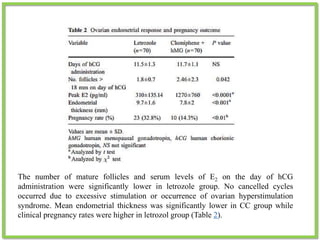
The number of mature follicles and serum levels of E2 on the day of hCG
administration were significantly lower in letrozole group. No cancelled cycles
occurred due to excessive stimulation or occurrence of ovarian hyperstimulation
syndrome. Mean endometrial thickness was significantly lower in CC group while
clinical pregnancy rates were higher in letrozol group (Table 2).
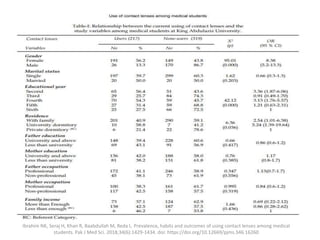
Ibrahim NK, Seraj H, Khan R, Baabdullah M, Reda L. Prevalence, habits and outcomes of using contact lenses among medical
students. Pak J Med Sci. 2018;34(6):1429-1434. doi: https://doi.org/10.12669/pjms.346.16260
Educational Research: Planning,Conducting
and Evaluating Quantitative and Qualitative
Research,4e-John Creswell
Activity
Educational Research: Planning,Conducting
and Evaluating Quantitative and Qualitative
Research,4e-John Creswell
The Methods
Writing the Methods Section of
your Article
How did you try to answer your research
question?
Educational Research: Planning,Conducting
and Evaluating Quantitative and Qualitative
Research,4e-John Creswell
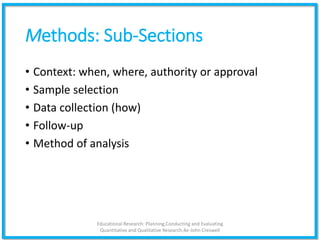
Methods: Sub-Sections
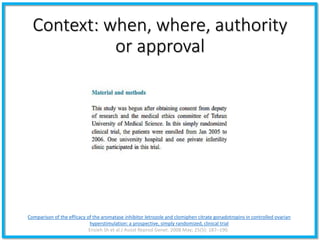
• Context: when, where, authority or approval
• Sample selection
• Data collection (how)
• Follow-up
• Method of analysis
Educational Research: Planning,Conducting and Evaluating
Quantitative and Qualitative Research,4e-John Creswell
Context: when, where, authority
or approval
Comparison of the efficacy of the aromatase inhibitor letrozole and clomiphen citrate gonadotropins in controlled ovarian
hyperstimulation: a prospective, simply randomized, clinical trial
Ensieh Sh et al.J Assist Reprod Genet. 2008 May; 25(5): 187–190.
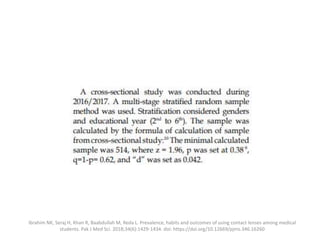
Ibrahim NK, Seraj H, Khan R, Baabdullah M, Reda L. Prevalence, habits and outcomes of using contact lenses among medical
students. Pak J Med Sci. 2018;34(6):1429-1434. doi: https://doi.org/10.12669/pjms.346.16260
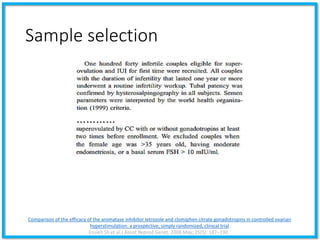
Sample selection
Comparison of the efficacy of the aromatase inhibitor letrozole and clomiphen citrate gonadotropins in controlled ovarian
hyperstimulation: a prospective, simply randomized, clinical trial
Ensieh Sh et al.J Assist Reprod Genet. 2008 May; 25(5): 187–190.
…………
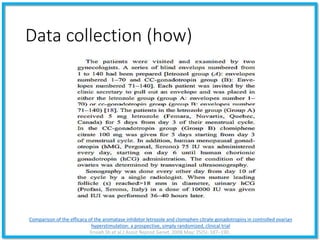
Data collection (how)
Comparison of the efficacy of the aromatase inhibitor letrozole and clomiphen citrate gonadotropins in controlled ovarian
hyperstimulation: a prospective, simply randomized, clinical trial
Ensieh Sh et al.J Assist Reprod Genet. 2008 May; 25(5): 187–190.
Follow-up
Educational Research: Planning,Conducting
and Evaluating Quantitative and Qualitative
Research,4e-John Creswell
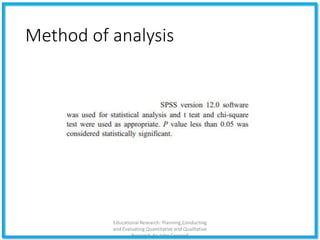
Method of analysis
Educational Research: Planning,Conducting
and Evaluating Quantitative and Qualitative
Research,4e-John Creswell
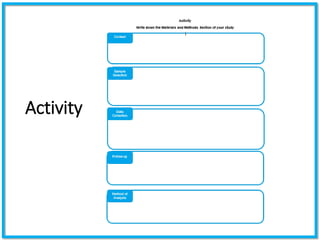
Activity
Educational Research: Planning,Conducting
and Evaluating Quantitative and Qualitative
Research,4e-John Creswell
The Introduction
Writing the Introduction of your
Article
What was the research question?
Educational Research: Planning,Conducting
and Evaluating Quantitative and Qualitative
Research,4e-John Creswell
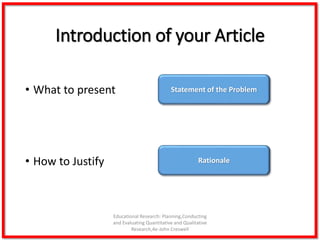
Introduction of your Article
• What to present
• How to Justify
Educational Research: Planning,Conducting
and Evaluating Quantitative and Qualitative
Research,4e-John Creswell
Statement of the Problem
Rationale
‘Statement of the Problem’
Introductory part of the study , containing the
research problem
Also called the Introduction
Educational Research: Planning,Conducting
and Evaluating Quantitative and Qualitative
Research,4e-John Creswell
Purpose of Problem
Statement/Introduction
• Introduce the reader to the importance of research
problem.
• Place the research problem in particular context in
which it is to be studied.
• Provide a frame work for reporting the results.
Educational Research: Planning,Conducting
and Evaluating Quantitative and Qualitative
Research,4e-John Creswell
Bryman, Alan. “The Research Question in Social
Research: What is its Role?” International Journal of
Social Research Methodology 10 (2007): 5-20
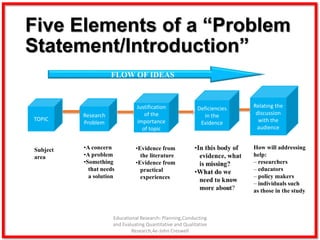
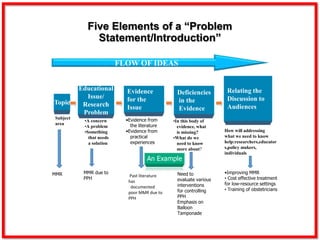
Five Elements of a “Problem
Statement/Introduction”
Educational Research: Planning,Conducting
and Evaluating Quantitative and Qualitative
Research,4e-John Creswell
FLOW OF IDEAS
Subject
area
•A concern
•A problem
•Something
that needs
a solution
•Evidence from
the literature
•Evidence from
practical
experiences
How will addressing
help:
– researchers
– educators
– policy makers
– individuals such
as those in the study
TOPIC
Relating the
discussion
with the
audience
Research
Problem
Justification
of the
importance
of topic
Deficiencies
in the
Evidence
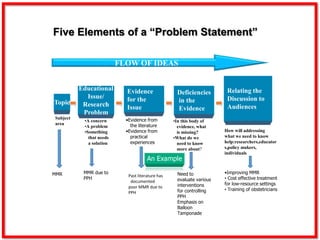
Five Elements of a “Problem Statement”
Topic
Evidence
for the
Issue
Deficiencies
in the
Evidence
Relating the
Discussion to
Audiences
FLOW OF IDEAS
Subject
area
Educational
Issue/
Research
Problem
•A concern
•A problem
•Something
that needs
a solution
•Evidence from
the literature
•Evidence from
practical
experiences
•In this body of
evidence, what
is missing?
•What do we
need to know
more about?
How will addressing
what we need to know
help:researchers,educator
s,policy makers,
individuals
MMR MMR due to
PPH
Past literature has
documented
poor MMR due to
PPH
Need to
evaluate various
interventions
for controlling
PPH
Emphasis on
Balloon
Tamponade
•Improving MMR
• Cost effective treatment
for low-resource settings
• Training of obstetricians
How to start an introduction?
Educational Research: Planning,Conducting
and Evaluating Quantitative and Qualitative
Research,4e-John Creswell
Educational Research: Planning,Conducting and Evaluating
Quantitative and Qualitative Research,4e-John Creswell
Writing the Statement of Problem:
The Narrative Hook
• The narrative hook should be the first sentence of the study.
• Functions of the narrative hook
• Causes the reader to pay attention
• Elicits an emotional or attitudinal response from the reader
• Causes the reader to continue reading
Educational Research: Planning,Conducting
and Evaluating Quantitative and Qualitative
Research,4e-John Creswell
Information that can be included
in the narrative hook
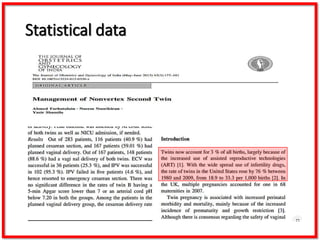
• Statistical data
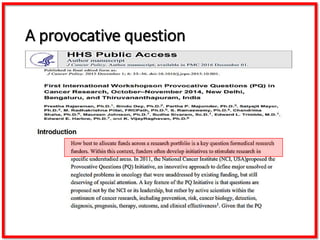
• A provocative question
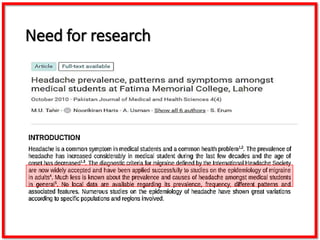
• Need for research
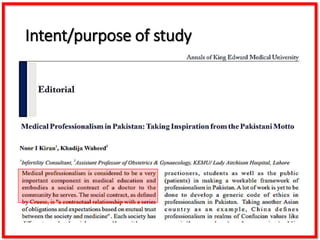
• Intent/purpose of the study
Educational Research: Planning,Conducting
and Evaluating Quantitative and Qualitative
Research,4e-John Creswell
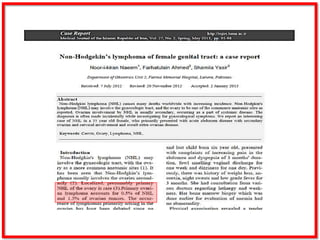
Statistical data
A provocative question
Need for research
Intent/purpose of study
Five Elements of a “Problem
Statement/Introduction”
Topic
Evidence
for the
Issue
Deficiencies
in the
Evidence
Relating the
Discussion to
Audiences
FLOW OF IDEAS
Subject
area
Educational
Issue/
Research
Problem
•A concern
•A problem
•Something
that needs
a solution
•Evidence from
the literature
•Evidence from
practical
experiences
•In this body of
evidence, what
is missing?
•What do we
need to know
more about?
How will addressing
what we need to know
help:researchers,educator
s,policy makers,
individuals
MMR MMR due to
PPH
Past literature
has
documented
poor MMR due to
PPH
Need to
evaluate various
interventions
for controlling
PPH
Emphasis on
Balloon
Tamponade
•Improving MMR
• Cost effective treatment
for low-resource settings
• Training of obstetricians
Writing the Statement of the
Problem/Introduction
• Include one paragraph for each of the five elements
• Use frequent references to the literature
throughout this introductory passage.
• Provide statistics to support trends to show
importance of research problem.
• Use quotes from participants (in moderation)
Educational Research: Planning,Conducting
and Evaluating Quantitative and Qualitative
Research,4e-John Creswell
Activity
Educational Research: Planning,Conducting
and Evaluating Quantitative and Qualitative
Research,4e-John Creswell
The Discussion
What do your results stand in the world?
Educational Research: Planning,Conducting
and Evaluating Quantitative and Qualitative
Research,4e-John Creswell
What does your results mean?
Discuss
• Focus on what your data prove, not what you
hoped they would prove.
• Start with “We found that…” (or something similar),
and explain what the data mean.
• Anticipate your readers' questions, and explain why
your results are of interest.
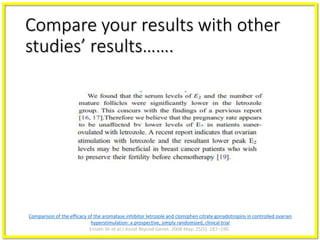
• Compare your results with other people's results.
• details, descriptions, speculations, and criticisms of
other studies
Educational Research: Planning,Conducting and Evaluating Quantitative and
Qualitative Research,4e-John Creswell
All are based on:
Comprehensive Literature Review
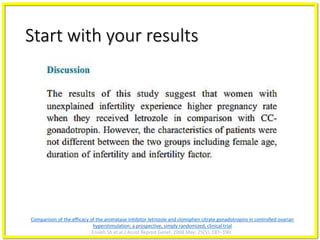
Start with your results
Comparison of the efficacy of the aromatase inhibitor letrozole and clomiphen citrate gonadotropins in controlled ovarian
hyperstimulation: a prospective, simply randomized, clinical trial
Ensieh Sh et al.J Assist Reprod Genet. 2008 May; 25(5): 187–190.
Compare your results with other
studies’ results…….
Comparison of the efficacy of the aromatase inhibitor letrozole and clomiphen citrate gonadotropins in controlled ovarian
hyperstimulation: a prospective, simply randomized, clinical trial
Ensieh Sh et al.J Assist Reprod Genet. 2008 May; 25(5): 187–190.
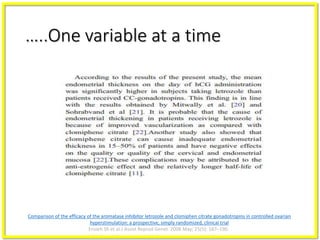
…..One variable at a time
Comparison of the efficacy of the aromatase inhibitor letrozole and clomiphen citrate gonadotropins in controlled ovarian
hyperstimulation: a prospective, simply randomized, clinical trial
Ensieh Sh et al.J Assist Reprod Genet. 2008 May; 25(5): 187–190.
Don’t forget to mention :
• Your study limitations
• Future Directions
• Any recommendation(s) on basis of your study
results.
Comparison of the efficacy of the aromatase inhibitor letrozole and clomiphen citrate gonadotropins in controlled ovarian
hyperstimulation: a prospective, simply randomized, clinical trial
Ensieh Sh et al.J Assist Reprod Genet. 2008 May; 25(5): 187–190.
The Conclusion
• Do not overreach your results. You can say
“………has the potential to,” or ‘may be beneficial..”
• Give the big-picture implications of your findings,
and tell your readers why they should care.
• End with the main findings of your study, and do
not travel too far from your data.
• Remember to give a final take-home message along
with implications.
Educational Research: Planning,Conducting
and Evaluating Quantitative and Qualitative
Research,4e-John Creswell
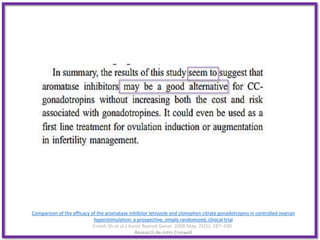
Comparison of the efficacy of the aromatase inhibitor letrozole and clomiphen citrate gonadotropins in controlled ovarian
hyperstimulation: a prospective, simply randomized, clinical trial
Ensieh Sh et al.J Assist Reprod Genet. 2008 May; 25(5): 187–190.
Research,4e-John Creswell
Other Components of an article
Acknowledgements
Educational Research: Planning,Conducting
and Evaluating Quantitative and Qualitative
Research,4e-John Creswell
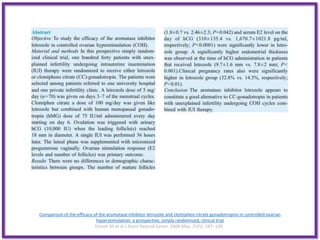
Abstract
• Mini-Version of the paper
• Free-form or structured with subheadings.
• Always follow the format indicated by the publisher
• Main parts of an abstract may include:
• introduction (background, question or hypothesis),
• methods,
• results,
• conclusions, and
• implications.
Educational Research: Planning,Conducting and Evaluating Quantitative and
Qualitative Research,4e-John Creswell
Comparison of the efficacy of the aromatase inhibitor letrozole and clomiphen citrate gonadotropins in controlled ovarian
hyperstimulation: a prospective, simply randomized, clinical trial
Ensieh Sh et al.J Assist Reprod Genet. 2008 May; 25(5): 187–190.
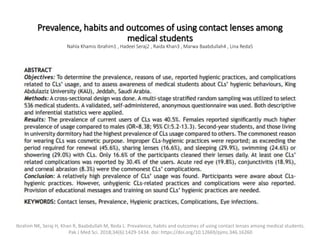
Prevalence, habits and outcomes of using contact lenses among
medical students
Nahla Khamis Ibrahim1 , Hadeel Seraj2 , Raida Khan3 , Marwa Baabdullah4 , Lina Reda5
Ibrahim NK, Seraj H, Khan R, Baabdullah M, Reda L. Prevalence, habits and outcomes of using contact lenses among medical students.
Pak J Med Sci. 2018;34(6):1429-1434. doi: https://doi.org/10.12669/pjms.346.16260
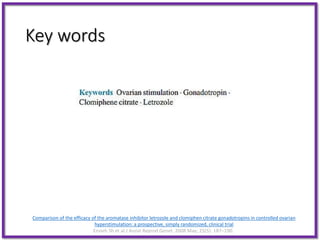
Key words
Comparison of the efficacy of the aromatase inhibitor letrozole and clomiphen citrate gonadotropins in controlled ovarian
hyperstimulation: a prospective, simply randomized, clinical trial
Ensieh Sh et al.J Assist Reprod Genet. 2008 May; 25(5): 187–190.
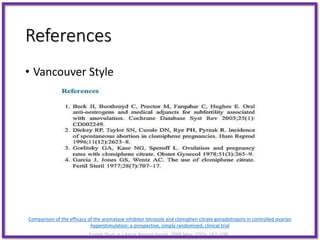
References
• Vancouver Style
Comparison of the efficacy of the aromatase inhibitor letrozole and clomiphen citrate gonadotropins in controlled ovarian
hyperstimulation: a prospective, simply randomized, clinical trial
Ensieh Sh et al.J Assist Reprod Genet. 2008 May; 25(5): 187–190.
Educational Research: Planning ,Conducting and Evaluating Quantitative and Qualitative Research,4e-John Creswell
Thank You for
your time
noorikiran@yahoo.com
https://www.pinterest.com/pin/484277766166544050/
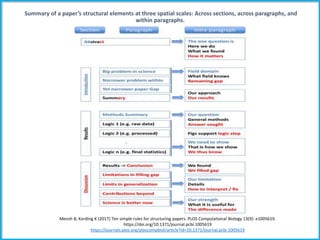
Summary of a paper’s structural elements at three spatial scales: Across sections, across paragraphs, and
within paragraphs.
Mensh B, Kording K (2017) Ten simple rules for structuring papers. PLOS Computational Biology 13(9): e1005619.
https://doi.org/10.1371/journal.pcbi.1005619
https://journals.plos.org/ploscompbiol/article?id=10.1371/journal.pcbi.1005619
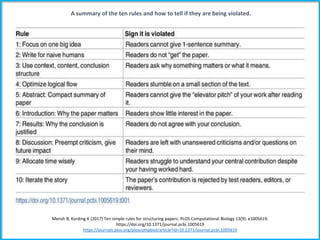
A summary of the ten rules and how to tell if they are being violated.
Mensh B, Kording K (2017) Ten simple rules for structuring papers. PLOS Computational Biology 13(9): e1005619.
https://doi.org/10.1371/journal.pcbi.1005619
https://journals.plos.org/ploscompbiol/article?id=10.1371/journal.pcbi.1005619

How to write an article

  • 2.
    Solving the researchPuzzle Identification of the research problem Specify a research methodology Carrying out literature review Data Collection Data Analysis/ Interpretation Report and Evaluate Research Part 1 Part 2 Part 3
  • 3.
    Solving the Research Puzzle Dr.Noor-i-Kiran Haris MBBS, FCPS, CSRM, Dip ART, MSc.MEd. Dr.Rehmatullah's Hospital, Gojra Austrailian Concept fertility Centre, Faisalabad Aziz Fatimah Medical and Dental College, Faisalabad. Part 3b How to write an article?
  • 4.
    Module objective By theend of this interactive session, participants will be able to : Part 3 Report writing 1. Recognize the major sections of a scientific article. 2. Write up an outline of an original research article
  • 5.
    What are theComponents of an original research article?
  • 6.
    Components of anoriginal research article IMRAD structure Introduction, Methods, Results And Discussion International Committee of Medical Journal Editors. Uniform requirements for manuscripts submitted to biomedical journals: writing and editing for biomedical publication. J Pharmacol Pharmacother. 2010 Jan;1(1):42–58. International Committee of Medical Journal Editors Recommended in the “Uniform Requirements for Manuscripts Submitted to Biomedical Journals”
  • 7.
    Introduction • Sets thestage for your presentation. • It has three parts: • What is known, • What is unknown, and • What your burning question, hypothesis, or aim is. Literature review The Gap Research Question International Committee of Medical Journal Editors. Uniform requirements for manuscripts submitted to biomedical journals: writing and editing for biomedical publication. J Pharmacol Pharmacother. 2010 Jan;1(1):42–58.
  • 8.
    Methods • Gives aclear overview of what you did. • Give enough information that your readers can evaluate the persuasiveness of your study. • smaller sections with subheadings: • context: when, where, authority or approval • sample selection • data collection (how) • follow-up • method of analysis
  • 9.
    Results • Summarizes whatthe data show. • Point out relationships, and describe trends. • Tables and figures International Committee of Medical Journal Editors. Uniform requirements for manuscripts submitted to biomedical journals: writing and editing for biomedical publication. J Pharmacol Pharmacother. 2010 Jan;1(1):42–58.
  • 10.
    QUESTION Discussion • Gives youthe most freedom • Every author should restate the key findings and answer the question noted in the Introduction. ANSWER International Committee of Medical Journal Editors. Uniform requirements for manuscripts submitted to biomedical journals: writing and editing for biomedical publication. J Pharmacol Pharmacother. 2010 Jan;1(1):42–58.
  • 11.
    Conclusion • Remember togive a final take-home message along with implications. • At times , the conclusion is built into the Discussion International Committee of Medical Journal Editors. Uniform requirements for manuscripts submitted to biomedical journals: writing and editing for biomedical publication. J Pharmacol Pharmacother. 2010 Jan;1(1):42–58.
  • 12.
    Other parts ofyour research paper independent of IMRAD
  • 13.
    Other parts ofresearch paper • Abstracts • Key words • Title page • Acknowledgements • References Educational Research: Planning, Conducting and Evaluating Quantitative and Qualitative Research,4e-John Creswell
  • 14.
    A more completeview (Title page with authors details) (Abstract) (Keywords) Introduction Methods Results Discussion Conclusion (Acknowledgments) (References)
  • 15.
  • 16.
    Where to startfrom? Educational Research: Planning,Conducting and Evaluating Quantitative and Qualitative Research,4e-John Creswell
  • 17.
    Activity Put the followingcomponents of an article in an order in which you write/ plan to write your article. COMPONENT OF AN ARTICLE ORDER NO. (Acknowledgments) Results (Keywords) Introduction Conclusion (Abstract) (References) Methods Title page with authors details) Discussion
  • 18.
    A more completeview COMPONENT OF AN ARTICLE ORDER NO. (Title page with authors details) 10 (Abstract) 6 (Keywords) 7 Introduction 3 Methods 2 Results 1 Discussion 4 Conclusion 5 (Acknowledgments) 9 (References) 8
  • 19.
  • 20.
    Writing the ResultsSection of your Article What did you find?
  • 21.
    • Avoid repeatingthe numbers that are already available in the tables and figures and vice versa. • Reserve comments on the meaning of your results for the Discussion section. • If you need to cite the number in the text (not just in the table), and the total in the group is less than 50, do not include percentage. Write “7 of 34,” not “7 (21%).” • Do not forget, if you have multiple comparisons, you probably need adjustment. Ask your statistician if you are not sure.
  • 22.
    Components • Demographic data •Participants: age, gender, class, habit, socioeconomic status • Cross sectional surveys • Analytical data ( if present) • Comparison, correlation • Analytical studies, experimental studies Educational Research: Planning, Conducting and Evaluating Quantitative and Qualitative Research,4e-John Creswell
  • 23.
    • You havea demographic table with a row of ages, and age was not significantly different among groups, your text could say, “The median age of all subjects was 47 years. There was no significant difference between groups (Table).” VS “The mean age of group 1 was 48.6 (7.5) years and group 2 was 46.3 (5.8) years, a non-significant difference.”
  • 24.
    Comparison of theefficacy of letrozole and clomiphen citrate gonadotropins in controlled ovarian hyperstimulation Comparison of the efficacy of the aromatase inhibitor letrozole and clomiphen citrate gonadotropins in controlled ovarian hyperstimulation: a prospective, simply randomized, clinical trial Ensieh Sh et al.J Assist Reprod Genet. 2008 May; 25(5): 187–190. The mean age of female was 26.3 ± 4.1 years old (range, 22–35) and the mean duration of infertility was 3.66 ± 1.9 years (range, 1–9). The female age and duration of infertility were comparable between the two groups (Table 1).
  • 25.
    The number ofmature follicles and serum levels of E2 on the day of hCG administration were significantly lower in letrozole group. No cancelled cycles occurred due to excessive stimulation or occurrence of ovarian hyperstimulation syndrome. Mean endometrial thickness was significantly lower in CC group while clinical pregnancy rates were higher in letrozol group (Table 2).
  • 26.
    Ibrahim NK, SerajH, Khan R, Baabdullah M, Reda L. Prevalence, habits and outcomes of using contact lenses among medical students. Pak J Med Sci. 2018;34(6):1429-1434. doi: https://doi.org/10.12669/pjms.346.16260
  • 27.
    Educational Research: Planning,Conducting andEvaluating Quantitative and Qualitative Research,4e-John Creswell
  • 28.
  • 29.
    Educational Research: Planning,Conducting andEvaluating Quantitative and Qualitative Research,4e-John Creswell The Methods
  • 30.
    Writing the MethodsSection of your Article How did you try to answer your research question? Educational Research: Planning,Conducting and Evaluating Quantitative and Qualitative Research,4e-John Creswell
  • 31.
    Methods: Sub-Sections • Context:when, where, authority or approval • Sample selection • Data collection (how) • Follow-up • Method of analysis Educational Research: Planning,Conducting and Evaluating Quantitative and Qualitative Research,4e-John Creswell
  • 32.
    Context: when, where,authority or approval Comparison of the efficacy of the aromatase inhibitor letrozole and clomiphen citrate gonadotropins in controlled ovarian hyperstimulation: a prospective, simply randomized, clinical trial Ensieh Sh et al.J Assist Reprod Genet. 2008 May; 25(5): 187–190.
  • 33.
    Ibrahim NK, SerajH, Khan R, Baabdullah M, Reda L. Prevalence, habits and outcomes of using contact lenses among medical students. Pak J Med Sci. 2018;34(6):1429-1434. doi: https://doi.org/10.12669/pjms.346.16260
  • 34.
    Sample selection Comparison ofthe efficacy of the aromatase inhibitor letrozole and clomiphen citrate gonadotropins in controlled ovarian hyperstimulation: a prospective, simply randomized, clinical trial Ensieh Sh et al.J Assist Reprod Genet. 2008 May; 25(5): 187–190. …………
  • 35.
    Data collection (how) Comparisonof the efficacy of the aromatase inhibitor letrozole and clomiphen citrate gonadotropins in controlled ovarian hyperstimulation: a prospective, simply randomized, clinical trial Ensieh Sh et al.J Assist Reprod Genet. 2008 May; 25(5): 187–190.
  • 36.
    Follow-up Educational Research: Planning,Conducting andEvaluating Quantitative and Qualitative Research,4e-John Creswell
  • 37.
    Method of analysis EducationalResearch: Planning,Conducting and Evaluating Quantitative and Qualitative Research,4e-John Creswell
  • 38.
  • 39.
    Educational Research: Planning,Conducting andEvaluating Quantitative and Qualitative Research,4e-John Creswell The Introduction
  • 40.
    Writing the Introductionof your Article What was the research question? Educational Research: Planning,Conducting and Evaluating Quantitative and Qualitative Research,4e-John Creswell
  • 41.
    Introduction of yourArticle • What to present • How to Justify Educational Research: Planning,Conducting and Evaluating Quantitative and Qualitative Research,4e-John Creswell Statement of the Problem Rationale
  • 42.
    ‘Statement of theProblem’ Introductory part of the study , containing the research problem Also called the Introduction Educational Research: Planning,Conducting and Evaluating Quantitative and Qualitative Research,4e-John Creswell
  • 43.
    Purpose of Problem Statement/Introduction •Introduce the reader to the importance of research problem. • Place the research problem in particular context in which it is to be studied. • Provide a frame work for reporting the results. Educational Research: Planning,Conducting and Evaluating Quantitative and Qualitative Research,4e-John Creswell Bryman, Alan. “The Research Question in Social Research: What is its Role?” International Journal of Social Research Methodology 10 (2007): 5-20
  • 44.
    Five Elements ofa “Problem Statement/Introduction” Educational Research: Planning,Conducting and Evaluating Quantitative and Qualitative Research,4e-John Creswell FLOW OF IDEAS Subject area •A concern •A problem •Something that needs a solution •Evidence from the literature •Evidence from practical experiences How will addressing help: – researchers – educators – policy makers – individuals such as those in the study TOPIC Relating the discussion with the audience Research Problem Justification of the importance of topic Deficiencies in the Evidence
  • 45.
    Five Elements ofa “Problem Statement” Topic Evidence for the Issue Deficiencies in the Evidence Relating the Discussion to Audiences FLOW OF IDEAS Subject area Educational Issue/ Research Problem •A concern •A problem •Something that needs a solution •Evidence from the literature •Evidence from practical experiences •In this body of evidence, what is missing? •What do we need to know more about? How will addressing what we need to know help:researchers,educator s,policy makers, individuals MMR MMR due to PPH Past literature has documented poor MMR due to PPH Need to evaluate various interventions for controlling PPH Emphasis on Balloon Tamponade •Improving MMR • Cost effective treatment for low-resource settings • Training of obstetricians
  • 46.
    How to startan introduction? Educational Research: Planning,Conducting and Evaluating Quantitative and Qualitative Research,4e-John Creswell
  • 47.
    Educational Research: Planning,Conductingand Evaluating Quantitative and Qualitative Research,4e-John Creswell
  • 48.
    Writing the Statementof Problem: The Narrative Hook • The narrative hook should be the first sentence of the study. • Functions of the narrative hook • Causes the reader to pay attention • Elicits an emotional or attitudinal response from the reader • Causes the reader to continue reading Educational Research: Planning,Conducting and Evaluating Quantitative and Qualitative Research,4e-John Creswell
  • 49.
    Information that canbe included in the narrative hook • Statistical data • A provocative question • Need for research • Intent/purpose of the study Educational Research: Planning,Conducting and Evaluating Quantitative and Qualitative Research,4e-John Creswell
  • 50.
  • 52.
  • 53.
  • 54.
  • 55.
    Five Elements ofa “Problem Statement/Introduction” Topic Evidence for the Issue Deficiencies in the Evidence Relating the Discussion to Audiences FLOW OF IDEAS Subject area Educational Issue/ Research Problem •A concern •A problem •Something that needs a solution •Evidence from the literature •Evidence from practical experiences •In this body of evidence, what is missing? •What do we need to know more about? How will addressing what we need to know help:researchers,educator s,policy makers, individuals MMR MMR due to PPH Past literature has documented poor MMR due to PPH Need to evaluate various interventions for controlling PPH Emphasis on Balloon Tamponade •Improving MMR • Cost effective treatment for low-resource settings • Training of obstetricians
  • 56.
    Writing the Statementof the Problem/Introduction • Include one paragraph for each of the five elements • Use frequent references to the literature throughout this introductory passage. • Provide statistics to support trends to show importance of research problem. • Use quotes from participants (in moderation) Educational Research: Planning,Conducting and Evaluating Quantitative and Qualitative Research,4e-John Creswell
  • 57.
  • 58.
    Educational Research: Planning,Conducting andEvaluating Quantitative and Qualitative Research,4e-John Creswell The Discussion
  • 59.
    What do yourresults stand in the world? Educational Research: Planning,Conducting and Evaluating Quantitative and Qualitative Research,4e-John Creswell What does your results mean?
  • 60.
    Discuss • Focus onwhat your data prove, not what you hoped they would prove. • Start with “We found that…” (or something similar), and explain what the data mean. • Anticipate your readers' questions, and explain why your results are of interest. • Compare your results with other people's results. • details, descriptions, speculations, and criticisms of other studies Educational Research: Planning,Conducting and Evaluating Quantitative and Qualitative Research,4e-John Creswell
  • 61.
    All are basedon: Comprehensive Literature Review
  • 62.
    Start with yourresults Comparison of the efficacy of the aromatase inhibitor letrozole and clomiphen citrate gonadotropins in controlled ovarian hyperstimulation: a prospective, simply randomized, clinical trial Ensieh Sh et al.J Assist Reprod Genet. 2008 May; 25(5): 187–190.
  • 63.
    Compare your resultswith other studies’ results……. Comparison of the efficacy of the aromatase inhibitor letrozole and clomiphen citrate gonadotropins in controlled ovarian hyperstimulation: a prospective, simply randomized, clinical trial Ensieh Sh et al.J Assist Reprod Genet. 2008 May; 25(5): 187–190.
  • 64.
    …..One variable ata time Comparison of the efficacy of the aromatase inhibitor letrozole and clomiphen citrate gonadotropins in controlled ovarian hyperstimulation: a prospective, simply randomized, clinical trial Ensieh Sh et al.J Assist Reprod Genet. 2008 May; 25(5): 187–190.
  • 65.
    Don’t forget tomention : • Your study limitations • Future Directions • Any recommendation(s) on basis of your study results. Comparison of the efficacy of the aromatase inhibitor letrozole and clomiphen citrate gonadotropins in controlled ovarian hyperstimulation: a prospective, simply randomized, clinical trial Ensieh Sh et al.J Assist Reprod Genet. 2008 May; 25(5): 187–190.
  • 66.
  • 67.
    • Do notoverreach your results. You can say “………has the potential to,” or ‘may be beneficial..” • Give the big-picture implications of your findings, and tell your readers why they should care. • End with the main findings of your study, and do not travel too far from your data. • Remember to give a final take-home message along with implications. Educational Research: Planning,Conducting and Evaluating Quantitative and Qualitative Research,4e-John Creswell
  • 68.
    Comparison of theefficacy of the aromatase inhibitor letrozole and clomiphen citrate gonadotropins in controlled ovarian hyperstimulation: a prospective, simply randomized, clinical trial Ensieh Sh et al.J Assist Reprod Genet. 2008 May; 25(5): 187–190. Research,4e-John Creswell
  • 69.
  • 70.
    Acknowledgements Educational Research: Planning,Conducting andEvaluating Quantitative and Qualitative Research,4e-John Creswell
  • 71.
    Abstract • Mini-Version ofthe paper • Free-form or structured with subheadings. • Always follow the format indicated by the publisher • Main parts of an abstract may include: • introduction (background, question or hypothesis), • methods, • results, • conclusions, and • implications. Educational Research: Planning,Conducting and Evaluating Quantitative and Qualitative Research,4e-John Creswell
  • 72.
    Comparison of theefficacy of the aromatase inhibitor letrozole and clomiphen citrate gonadotropins in controlled ovarian hyperstimulation: a prospective, simply randomized, clinical trial Ensieh Sh et al.J Assist Reprod Genet. 2008 May; 25(5): 187–190.
  • 73.
    Prevalence, habits andoutcomes of using contact lenses among medical students Nahla Khamis Ibrahim1 , Hadeel Seraj2 , Raida Khan3 , Marwa Baabdullah4 , Lina Reda5 Ibrahim NK, Seraj H, Khan R, Baabdullah M, Reda L. Prevalence, habits and outcomes of using contact lenses among medical students. Pak J Med Sci. 2018;34(6):1429-1434. doi: https://doi.org/10.12669/pjms.346.16260
  • 74.
    Key words Comparison ofthe efficacy of the aromatase inhibitor letrozole and clomiphen citrate gonadotropins in controlled ovarian hyperstimulation: a prospective, simply randomized, clinical trial Ensieh Sh et al.J Assist Reprod Genet. 2008 May; 25(5): 187–190.
  • 75.
    References • Vancouver Style Comparisonof the efficacy of the aromatase inhibitor letrozole and clomiphen citrate gonadotropins in controlled ovarian hyperstimulation: a prospective, simply randomized, clinical trial Ensieh Sh et al.J Assist Reprod Genet. 2008 May; 25(5): 187–190.
  • 76.
    Educational Research: Planning,Conducting and Evaluating Quantitative and Qualitative Research,4e-John Creswell
  • 77.
    Thank You for yourtime noorikiran@yahoo.com https://www.pinterest.com/pin/484277766166544050/
  • 78.
    Summary of apaper’s structural elements at three spatial scales: Across sections, across paragraphs, and within paragraphs. Mensh B, Kording K (2017) Ten simple rules for structuring papers. PLOS Computational Biology 13(9): e1005619. https://doi.org/10.1371/journal.pcbi.1005619 https://journals.plos.org/ploscompbiol/article?id=10.1371/journal.pcbi.1005619
  • 79.
    A summary ofthe ten rules and how to tell if they are being violated. Mensh B, Kording K (2017) Ten simple rules for structuring papers. PLOS Computational Biology 13(9): e1005619. https://doi.org/10.1371/journal.pcbi.1005619 https://journals.plos.org/ploscompbiol/article?id=10.1371/journal.pcbi.1005619

Editor's Notes

  • #3 So this course shall lead you through its six main modules. First one is the Identification of research problem followed by effective literature review and writing a problem statement.   Then we will work through devising research methodology for your research problem outlining the step by step process you intend to follow in order to identify your target population, recruit participants into your research, develop or apply instruments.   This will be followed by Data Collection procedures and data analysis for your research and finally writing up of your article, ready to be sent for publication.   I don’t just believe in letting you go through the course alone. Hence, a support through WhatsApp is present for you to use, if and when needed.  
  • #7  International Committee of Medical Journal Editors. Uniform requirements for manuscripts submitted to biomedical journals: writing and editing for biomedical publication. J Pharmacol Pharmacother. 2010 Jan;1(1):42–58. (Available from: < http://www.ncbi.nlm.nih.gov/pmc/articles/PMC3142758/?report=classic>. [cited 10 Nov 2014].) [PMC free article] [PubMed] [Google Scholar]
  • #8 The Introduction sets the stage for your presentation. It has three parts: what is known, what is unknown, and what your burning question, hypothesis, or aim is. Keep this section short, and write for a general audience (clear, concise, and as nontechnical as you can be). How would you explain to a distant colleague why and how you did the study? Take your readers through the three steps ending with your specific question. Emphasize how your study fills in the gaps (the unknown), and explicitly state your research question. Do not answer the research question. Remember to leave details, descriptions, speculations, and criticisms of other studies for the Discussion.
  • #9 The Methods section gives a clear overview of what you did. Give enough information that your readers can evaluate the persuasiveness of your study. Describe the steps you took, as in a recipe, but be wary of too much detail. If you are doing qualitative research, explain how you picked your subjects to be representative. You may want to break it into smaller sections with subheadings, for example, context: when, where, authority or approval, sample selection, data collection (how), follow-up, method of analysis. Cite a reference for commonly used methods or previously used methods rather than explaining all the details. Flow diagrams and tables can simplify explanations of methods. You may use first person voice when describing your methods.
  • #10 The Results section summarizes what the data show. Point out relationships, and describe trends. Avoid simply repeating the numbers that are already available in the tables and figures. Data should be restricted to tables as much as possible. Be the friendly narrator, and summarize the tables; do not write the data again in the text. For example, if you had a demographic table with a row of ages, and age was not significantly different among groups, your text could say, “The median age of all subjects was 47 years. There was no significant difference between groups (Table).” This is preferable to, “The mean age of group 1 was 48.6 (7.5) years and group 2 was 46.3 (5.8) years, a nonsignificant difference.” Break the Results section into subsections, with headings if needed. Complement the information that is already in the tables and figures. And remember to repeat and highlight in the text only the most important numbers. Use the active voice in the Results section, and make it lively. Information about what you did belongs in the Methods section, not here. And reserve comments on the meaning of your results for the Discussion section. Other tips to help you with the Results section: ▪ If you need to cite the number in the text (not just in the table), and the total in the group is less than 50, do not include percentage. Write “7 of 34,” not “7 (21%).” ▪ Do not forget, if you have multiple comparisons, you probably need adjustment. Ask your statistician if you are not sure.
  • #11 The Discussion section gives you the most freedom. Most authors begin with a brief reiteration of what they did. Every author should restate the key findings and answer the question noted in the Introduction. Focus on what your data prove, not what you hoped they would prove. Start with “We found that…” (or something similar), and explain what the data mean. Anticipate your readers' questions, and explain why your results are of interest. Then compare your results with other people's results. This is where that literature review you did comes in handy. Discuss how your findings support or challenge other studies. You do not need every article from your literature review listed in your paper or reference list, unless you are writing a narrative review or systematic review. Your manuscript is not intended to be an exhaustive review of the topic. Do not provide a long review of the literature—discuss only previous work that is directly pertinent to your findings. Contrary to some beliefs, having a long list in the References section does not mean the paper is more scholarly; it does suggest the author is trying to look scholarly. (If your article is a systematic review, the citation list might be long.)
  • #12 Do not overreach your results. Finding a perceived knowledge need, for example, does not necessarily mean that library colleges must immediately overhaul their curricula and that it will improve health care and save lives and money (unless your data show that, in which case give us a chance to publish it!). You can say “has the potential to,” though. Always note limitations that matter, not generic limitations. Point out unanswered questions and future directions. Give the big-picture implications of your findings, and tell your readers why they should care. End with the main findings of your study, and do not travel too far from your data. Remember to give a final take-home message along with implications. Notice that this format does not include a separate Conclusion section. The conclusion is built into the Discussion. For example, here is the last paragraph of the Discussion section in a recent NEJM article: In conclusion, our trial did not show the hypothesized benefit [of the intervention] in patients…who were at high risk for complications. However, a separate Conclusion section is usually appropriate for abstracts. Systematic reviews should have an Interpretation section.
  • #13 Other parts of your research paper independent of IMRAD include: Tables and figures are the foundation for your story. They are the story. Editors, reviewers, and readers usually look at titles, abstracts, and tables and figures first. Figures and tables should stand alone and tell a complete story. Your readers should not need to refer back to the main text.
  • #32 The Methods section gives a clear overview of what you did. Give enough information that your readers can evaluate the persuasiveness of your study. Describe the steps you took, as in a recipe, but be wary of too much detail. If you are doing qualitative research, explain how you picked your subjects to be representative. You may want to break it into smaller sections with subheadings, for example, context: when, where, authority or approval, sample selection, data collection (how), follow-up, method of analysis. Cite a reference for commonly used methods or previously used methods rather than explaining all the details. Flow diagrams and tables can simplify explanations of methods. You may use first person voice when describing your methods.
  • #44  Introduce the reader to the importance of the topic being studied. The reader is oriented to the significance of the study and the research questions, hypotheses, or assumptions to follow. Place the topic into a particular context that defines the parameters of what is to be investigated. Provide the framework for reporting the results and indicates what is probably necessary to conduct the study and explain how the findings will present this information. Reference: Bryman, Alan. “The Research Question in Social Research: What is its Role?” International Journal of Social Research Methodology 10 (2007): 5-20
  • #45  After you have identified your research problem, determined that it can and should be researched, and specified either the quantitative or qualitative approach, it is time to begin writing about the “problem” in a statement of the problem section that introduces your research study. The statement of the problem section includes the actual research problem as well as four other aspects: 1. The topic 2. The research problem 3. A justification of the importance of the problem as found in the past research and in practice 4. The deficiencies in our existing knowledge about the problem 5. The audiences that will benefit from a study of the problem 2.Stating the Research Problem: State the problem in the opening paragraph Identify an issue Research-based research problems Practical problems Reference the problem using the literature 3.Justification of evidence. 4.Identifying Deficiencies in the Evidence: A deficiency in the evidence means that the past literature or practical experiences of the researchers does not adequately address the research problem. What do we still need to know? What else do we need to know to improve practice? 5.Identify the Audience Ask the following question: “Who will profit from reading my study?” Other researchers Practitioners Policy makers Special populations (e.g., parents) Reference: Ellis, Timothy J. and Yair Levy Nova Framework of Problem-Based Research: A Guide for Novice Researchers on the Development of a Research-Worthy Problem.Informing Science:the international Journal of an Emerging Transdiscipline 11 (2008)
  • #49 The opening sentences of a “statement of the problem” section need to encourage readers to continue reading, to generate interest in the study, and to provide an initial frame of reference for understanding the entire research topic. An educational topic is the broad subject matter that a researcher wishes to address in a study and that creates initial interest for the reader The topic is introduced in the first paragraphs. The topic includes the general subject matter. The topic must be introduced so that the reader can relate to it.
  • #57 The use of references in your study will build credibility for your work Use of quotes is popular and frequently used in qualitative studies. However,Readers may not extract the same meaning from a quote as the researcher does.
  • #61 . Focus on what your data prove, not what you hoped they would prove. Start with “We found that…” (or something similar), and explain what the data mean. Anticipate your readers' questions, and explain why your results are of interest. Then compare your results with other people's results. This is where that literature review you did comes in handy. Discuss how your findings support or challenge other studies. You do not need every article from your literature review listed in your paper or reference list, unless you are writing a narrative review or systematic review. Your manuscript is not intended to be an exhaustive review of the topic. Do not provide a long review of the literature—discuss only previous work that is directly pertinent to your findings. Contrary to some beliefs, having a long list in the References section does not mean the paper is more scholarly; it does suggest the author is trying to look scholarly. (If your article is a systematic review, the citation list might be long.)
  • #72 Abstracts can be free-form or structured with subheadings. Always follow the format indicated by the publisher; the JMLA uses structured abstracts for research articles. The main parts of an abstract may include introduction (background, question or hypothesis), methods, results, conclusions, and implications. So begin your abstract with the background of your study, followed by the question asked. Next, give a quick summary of the methods used in your study. Key results come next with limited raw data if any, followed by the conclusion, which answers the questions asked (the take-home message).