FoundationsofEducatingHealthcareProviders
Objectives
• Describe the guiding principles of educating healthcare
providers
• Define core competencies and their role in curriculum
development and design
• List the challenges in educating healthcare providers.
Guiding Principles
The education of healthcare providers must:
• Address the priority health needs and problems
within a society
• Identify national policies, guidelines, and
standards that are relevant to those needs and
problems
• Define the expected role of healthcare providers.
Provider Roles
Education should prepare providers to function as:
Caregivers
Decision-makers
Communicators
Community leaders
Managers
ProfessionalDevelopmentContinuum
• Begins with undergraduate education
• Continues throughout professional practice
• Includes in service training and/or continuing
education
• Providers should be life-long learners
AcademicProgram
• A series of courses that have both theoretical and
practical components and are designed to prepare
students as a specific category of healthcare
provider.
• Academic programs typically involve several years
of study, allowing time and opportunities for
students to develop essential competencies that
encompass essential knowledge, skills, values, and
behaviours.
Core Competencies
• Aspects of a subject or discipline that are common
to all students, essential to practice, and essential
to master in order to graduate from an academic
program and enter into practice.
• Each core competency for an academic program
will encompass cognitive (knowledge),
psychomotor (skills) and affective (values and
behaviours) domains that are observable and can
be appraised.
DefiningCoreCompetencies
• What is the job description for the position the
student may hold after graduation?
• What knowledge, skills, and attitudes are
experienced health professionals in that cadre
applying in the workplace?
• What are the licensing requirements in the related
field?
What are the challenges in educating
healthcare providers????
Thechallengesineducatinghealthcare providers
Information overload (adding KSA to the curriculum)
Large numbers of students and insufficient numbers of teaching
staff Limited opportunities to practice and master skills.
Poor monitoring of students’ progress, leading to limited
opportunities for providing feedback to students
Facilities used for clinical practice that are not always
representative of the facilities, such as outpatient clinics, where
graduates will work.
The need to develop competencies that are difficult to teach,
such as decision-making, problem solving, ethics, and values. The
difference between the ideal world, where all resources are
available, and the real world, where resources and technology
are scarce.
Thechallengesineducatinghealthcareproviders….
Poor quality materials and equipment, and limited access to
computers and up-to-date reference materials
Little coordination between different teaching units and
different levels of study, and between theoretical and practical
portions of academic programs
Practical experiences that are separated from, and do not
always reflect, the associated theoretical experiences
High turnover of teaching staff
Teachers who have no formal training in educational theories
or methodologies
Lack of incentives for teachers to improve their own
performance
Instructional Objectives For Learning
Learning Objectives
On completion of this, students will be able to:
Define the objectives
Discuss importance of writing objectives.
Describe components of Objectives
Explain Domains and Levels of Learning Objectives
8/21
/202
3
11
Brainstorming
• What is an Objective?
• Objectives to the Teacher?
• Objectives to the Learner?
8/21
/202
3
12
Definition
• Educational objective is a statement describing the
expected results of learning as they should manifest
themselves in the performance or behaviour of the learner.
• Educational objectives state what the learner should be
able to do at the end of the learning course.
8/21
/202
3
13
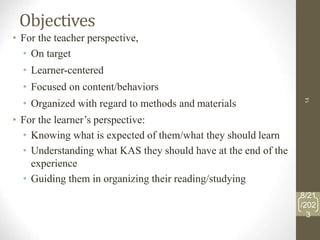
Objectives
• For the teacher perspective,
• On target
• Learner-centered
• Focused on content/behaviors
• Organized with regard to methods and materials
• For the learner’s perspective:
• Knowing what is expected of them/what they should learn
• Understanding what KAS they should have at the end of the
experience
• Guiding them in organizing their reading/studying
8/21
/202
3
14
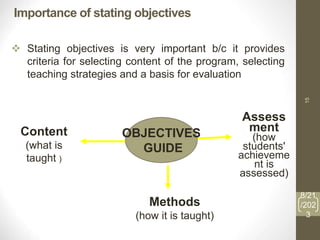
Importance of stating objectives
 Stating objectives is very important b/c it provides
criteria for selecting content of the program, selecting
teaching strategies and a basis for evaluation
Assess
ment
(how
students'
achieveme
nt is
assessed)
Content
(what is
taught )
Methods
(how it is taught)
OBJECTIVES
GUIDE
8/21
/202
3
15
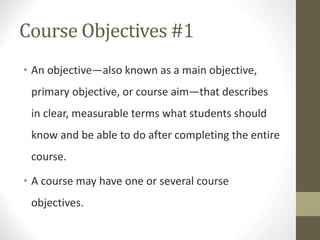
Course Objectives #1
• An objective—also known as a main objective,
primary objective, or course aim—that describes
in clear, measurable terms what students should
know and be able to do after completing the entire
course.
• A course may have one or several course
objectives.
Course Objectives #2
Course objectives often
encompass knowledge,
skill, and attitude areas
or domains, and should
relate to one or more
of the core
competencies for the
overall academic
program
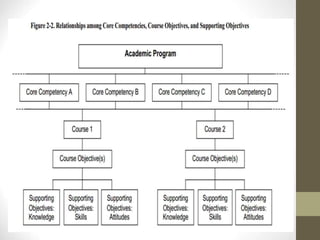
Supporting Objectives
• An objective (also known as a secondary, specific,
instructional, or enabling objective) that supports the
main objective by describing the specific knowledge,
skills, and attitudes that students must master to
achieve the main objective.
• Course objectives relate directly to the core
competencies required for an academic program.
• A course objective is fairly broad and may encompass
knowledge, skill, and attitude components.
• The specific instructional objectives or learning
objectives describe what the student/learner is
expected to learn in the three familiar domains,
namely :
Knowledge (cognitive, or domain of the mind)
Practical (psychomotor, or domain of the hands)
Attitudes (affective or domain of the heart).
Sample Course Objectives
• After completing this course, the
student will be able to assess,
classify, and treat a sick child in
an effective and integrated
manner
• After completion of this course
the medical student will have the
capacity to evaluate, diagnose,
prognosticate, and provide
appropriate care with preventive
methods for medical problems in
adults & adolescents.
Components of objective
Each objective will contain four parts.
It’s as easy as ABCD!
 Audience
 Behavior
 Condition
 Degree
8/21
/202
3
22
1.Audience/Performance (Who )
The course objective states the person who will
demonstrate competency.
This will usually be the student or trainee. This is the
heart of the course objective.
It describes what the learner will be able to do at the
end of instruction and be acceptable to the instructor as
a proof that learning has occurred.
 The statement should begin with an action verb.
Components of objective…….
8/21
/202
3
23
example
• after completing of maternal child health course the
student will be able to:
• Assist with a normal childbirth
• Assess and classify the sick child
• Administer the chosen family planning method
• Provide counseling and testing services for people
with HIV/AIDS.
Components of objective…….
8/21
/202
3
24
2.Observable Behavior :
What will the learner be able to do as a result of learning?
Example: The learner will define math terms.
Never use verbs like “learn, understand, comprehend” because
they are hard to measure.
3.Conditions :
What are the conditions under which the learners must
demonstrate their mastery of the objective?
(assist, administer, insert)
Example: After completing this course, the student will be
able to assist with a normal birth according to the checklist
for normal childbirth. 8/21
/202
3
25
Components of objective…….
4. Degree/Criteria of performance. (How)
 Quantitative or qualitative criteria against which learner's
performance will be measured to determine successful learning,
A criterion is a description of how well the performance must be
demonstrated, or the performance standard.
 Consider these examples of standards:
 According to the standards presented in the course materials
 According to the clinical protocol or checklist
 With at least 97% accuracy
• After completing this course, the student will be able to assist with a
normal birth according to the checklist for normal childbirth.
Components of objective…….
8/21
/202
3
26
Sample Course Objective
• At the end of the
course, the student will
be able to assess,
screen, diagnose, treat,
manage or refer
pregnant women with
pregnancy related
problems.
• See the “when” – the
“who” – and the
“what”?
Another Example
After completing this
course, the student will
be able to assist with a
normal birth according to
the checklist for normal
childbirth.
• At the end of the two-hour tutorial and using the
illustration, first year medical students will correctly
identify eight out of ten anatomical structures of the
heart.
First year medical students' is the audience
 Identify' is the measurable behaviour
 Using the illustration' is the condition
 Eight out of ten‘ anatomical structures of the heart is
the degree.
• This is also an example of educational objectives for
knowledge domain.
Activity
Providing preventive and curative care to the
individual and community, in health and in
sickness (Goals).
• Write course objectives
• Write supporting objectives
Domains and Levels of Learning Objectives
There are three types of learning domain
A. Cognitive Domain- what we know. it emphasizes intellectual
outcomes, such as knowledge, understanding, and thinking skills.
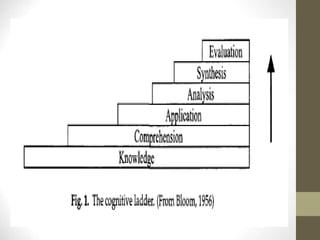
Levels in the cognitive Domain –Bloom’s taxonomy
1.Knowledge -recall of previously learned material
2.Comprehension - grasping the meaning of material
3.Application-ability to use learned material in new situations
4. Analysis- ability to break down material into its component parts
5. Synthesis - ability to put parts together to form new whole
6. Evaluation- ability to judge value of material for given purpose.
8/21
/202
3
31
B. Affective/Attitude Domain
 How we feel about what we know and do.
 Includes those objectives that emphasize feeling and
emotion
Levels in the Affective Domain
1. Receiving --Willingness to attend to particular phenomena or
stimuli
2. Responding-- active participation on the part of the student.
3. Valuing--the worth or value student attaches to a particular
object, phenomenon, or behavior
4.Commitment - building an internally consistent value system
and freely living by it.
8/21
/202
3
33
C. Psychomotor /skill Domain
What we do or perform.(Generally includes cognitive and
affective elements as well).
Levels in the psychomotor Domain
1.Imitation -refers to the ability to carry out the basic
essentials of a skill when given directions
2.Manipulation- refers to the ability to perform a skill
independently.
3.Precision- refers to the ability to perform an act accurately,
efficiently, and harmoniously
8/21
/202
3
34
Examples
• Label a diagram with the organs of the male and
female reproductive systems
• Describe how to counsel an adolescent about STIs
• Demonstrate how to put a condom on a penis
model
• Counsel patients about sexual risk reduction using
non-judgmental attitude
Organize Supporting Objectives
• Simple to complex
• Performance order
• Related objectives

Lesson 2 Instructional Objective.ppt

  • 1.
    FoundationsofEducatingHealthcareProviders Objectives • Describe theguiding principles of educating healthcare providers • Define core competencies and their role in curriculum development and design • List the challenges in educating healthcare providers.
  • 2.
    Guiding Principles The educationof healthcare providers must: • Address the priority health needs and problems within a society • Identify national policies, guidelines, and standards that are relevant to those needs and problems • Define the expected role of healthcare providers.
  • 3.
    Provider Roles Education shouldprepare providers to function as: Caregivers Decision-makers Communicators Community leaders Managers
  • 4.
    ProfessionalDevelopmentContinuum • Begins withundergraduate education • Continues throughout professional practice • Includes in service training and/or continuing education • Providers should be life-long learners
  • 5.
    AcademicProgram • A seriesof courses that have both theoretical and practical components and are designed to prepare students as a specific category of healthcare provider. • Academic programs typically involve several years of study, allowing time and opportunities for students to develop essential competencies that encompass essential knowledge, skills, values, and behaviours.
  • 6.
    Core Competencies • Aspectsof a subject or discipline that are common to all students, essential to practice, and essential to master in order to graduate from an academic program and enter into practice. • Each core competency for an academic program will encompass cognitive (knowledge), psychomotor (skills) and affective (values and behaviours) domains that are observable and can be appraised.
  • 7.
    DefiningCoreCompetencies • What isthe job description for the position the student may hold after graduation? • What knowledge, skills, and attitudes are experienced health professionals in that cadre applying in the workplace? • What are the licensing requirements in the related field?
  • 8.
    What are thechallenges in educating healthcare providers????
  • 9.
    Thechallengesineducatinghealthcare providers Information overload(adding KSA to the curriculum) Large numbers of students and insufficient numbers of teaching staff Limited opportunities to practice and master skills. Poor monitoring of students’ progress, leading to limited opportunities for providing feedback to students Facilities used for clinical practice that are not always representative of the facilities, such as outpatient clinics, where graduates will work. The need to develop competencies that are difficult to teach, such as decision-making, problem solving, ethics, and values. The difference between the ideal world, where all resources are available, and the real world, where resources and technology are scarce.
  • 10.
    Thechallengesineducatinghealthcareproviders…. Poor quality materialsand equipment, and limited access to computers and up-to-date reference materials Little coordination between different teaching units and different levels of study, and between theoretical and practical portions of academic programs Practical experiences that are separated from, and do not always reflect, the associated theoretical experiences High turnover of teaching staff Teachers who have no formal training in educational theories or methodologies Lack of incentives for teachers to improve their own performance
  • 11.
    Instructional Objectives ForLearning Learning Objectives On completion of this, students will be able to: Define the objectives Discuss importance of writing objectives. Describe components of Objectives Explain Domains and Levels of Learning Objectives 8/21 /202 3 11
  • 12.
    Brainstorming • What isan Objective? • Objectives to the Teacher? • Objectives to the Learner? 8/21 /202 3 12
  • 13.
    Definition • Educational objectiveis a statement describing the expected results of learning as they should manifest themselves in the performance or behaviour of the learner. • Educational objectives state what the learner should be able to do at the end of the learning course. 8/21 /202 3 13
  • 14.
    Objectives • For theteacher perspective, • On target • Learner-centered • Focused on content/behaviors • Organized with regard to methods and materials • For the learner’s perspective: • Knowing what is expected of them/what they should learn • Understanding what KAS they should have at the end of the experience • Guiding them in organizing their reading/studying 8/21 /202 3 14
  • 15.
    Importance of statingobjectives  Stating objectives is very important b/c it provides criteria for selecting content of the program, selecting teaching strategies and a basis for evaluation Assess ment (how students' achieveme nt is assessed) Content (what is taught ) Methods (how it is taught) OBJECTIVES GUIDE 8/21 /202 3 15
  • 17.
    Course Objectives #1 •An objective—also known as a main objective, primary objective, or course aim—that describes in clear, measurable terms what students should know and be able to do after completing the entire course. • A course may have one or several course objectives.
  • 18.
    Course Objectives #2 Courseobjectives often encompass knowledge, skill, and attitude areas or domains, and should relate to one or more of the core competencies for the overall academic program
  • 19.
    Supporting Objectives • Anobjective (also known as a secondary, specific, instructional, or enabling objective) that supports the main objective by describing the specific knowledge, skills, and attitudes that students must master to achieve the main objective. • Course objectives relate directly to the core competencies required for an academic program. • A course objective is fairly broad and may encompass knowledge, skill, and attitude components.
  • 20.
    • The specificinstructional objectives or learning objectives describe what the student/learner is expected to learn in the three familiar domains, namely : Knowledge (cognitive, or domain of the mind) Practical (psychomotor, or domain of the hands) Attitudes (affective or domain of the heart).
  • 21.
    Sample Course Objectives •After completing this course, the student will be able to assess, classify, and treat a sick child in an effective and integrated manner • After completion of this course the medical student will have the capacity to evaluate, diagnose, prognosticate, and provide appropriate care with preventive methods for medical problems in adults & adolescents.
  • 22.
    Components of objective Eachobjective will contain four parts. It’s as easy as ABCD!  Audience  Behavior  Condition  Degree 8/21 /202 3 22
  • 23.
    1.Audience/Performance (Who ) Thecourse objective states the person who will demonstrate competency. This will usually be the student or trainee. This is the heart of the course objective. It describes what the learner will be able to do at the end of instruction and be acceptable to the instructor as a proof that learning has occurred.  The statement should begin with an action verb. Components of objective……. 8/21 /202 3 23
  • 24.
    example • after completingof maternal child health course the student will be able to: • Assist with a normal childbirth • Assess and classify the sick child • Administer the chosen family planning method • Provide counseling and testing services for people with HIV/AIDS. Components of objective……. 8/21 /202 3 24
  • 25.
    2.Observable Behavior : Whatwill the learner be able to do as a result of learning? Example: The learner will define math terms. Never use verbs like “learn, understand, comprehend” because they are hard to measure. 3.Conditions : What are the conditions under which the learners must demonstrate their mastery of the objective? (assist, administer, insert) Example: After completing this course, the student will be able to assist with a normal birth according to the checklist for normal childbirth. 8/21 /202 3 25 Components of objective…….
  • 26.
    4. Degree/Criteria ofperformance. (How)  Quantitative or qualitative criteria against which learner's performance will be measured to determine successful learning, A criterion is a description of how well the performance must be demonstrated, or the performance standard.  Consider these examples of standards:  According to the standards presented in the course materials  According to the clinical protocol or checklist  With at least 97% accuracy • After completing this course, the student will be able to assist with a normal birth according to the checklist for normal childbirth. Components of objective……. 8/21 /202 3 26
  • 27.
    Sample Course Objective •At the end of the course, the student will be able to assess, screen, diagnose, treat, manage or refer pregnant women with pregnancy related problems. • See the “when” – the “who” – and the “what”?
  • 28.
    Another Example After completingthis course, the student will be able to assist with a normal birth according to the checklist for normal childbirth.
  • 29.
    • At theend of the two-hour tutorial and using the illustration, first year medical students will correctly identify eight out of ten anatomical structures of the heart. First year medical students' is the audience  Identify' is the measurable behaviour  Using the illustration' is the condition  Eight out of ten‘ anatomical structures of the heart is the degree. • This is also an example of educational objectives for knowledge domain.
  • 30.
    Activity Providing preventive andcurative care to the individual and community, in health and in sickness (Goals). • Write course objectives • Write supporting objectives
  • 31.
    Domains and Levelsof Learning Objectives There are three types of learning domain A. Cognitive Domain- what we know. it emphasizes intellectual outcomes, such as knowledge, understanding, and thinking skills. Levels in the cognitive Domain –Bloom’s taxonomy 1.Knowledge -recall of previously learned material 2.Comprehension - grasping the meaning of material 3.Application-ability to use learned material in new situations 4. Analysis- ability to break down material into its component parts 5. Synthesis - ability to put parts together to form new whole 6. Evaluation- ability to judge value of material for given purpose. 8/21 /202 3 31
  • 33.
    B. Affective/Attitude Domain How we feel about what we know and do.  Includes those objectives that emphasize feeling and emotion Levels in the Affective Domain 1. Receiving --Willingness to attend to particular phenomena or stimuli 2. Responding-- active participation on the part of the student. 3. Valuing--the worth or value student attaches to a particular object, phenomenon, or behavior 4.Commitment - building an internally consistent value system and freely living by it. 8/21 /202 3 33
  • 34.
    C. Psychomotor /skillDomain What we do or perform.(Generally includes cognitive and affective elements as well). Levels in the psychomotor Domain 1.Imitation -refers to the ability to carry out the basic essentials of a skill when given directions 2.Manipulation- refers to the ability to perform a skill independently. 3.Precision- refers to the ability to perform an act accurately, efficiently, and harmoniously 8/21 /202 3 34
  • 36.
    Examples • Label adiagram with the organs of the male and female reproductive systems • Describe how to counsel an adolescent about STIs • Demonstrate how to put a condom on a penis model • Counsel patients about sexual risk reduction using non-judgmental attitude
  • 37.
    Organize Supporting Objectives •Simple to complex • Performance order • Related objectives