The Dalhousie University Writing CentreAcademic writing: Composing an analytical essay that incorporates a literature review
OverviewIntroduction to the Writing CentreThe Elements of a Good PaperKey Features of Academic WritingContentThesis StatementLiterature ReviewFormEssay StructureParagraphs (topic sentences and transitional statements)SentencingAPAAdditional Resources
The Dalhousie Writing CentreKillam Library Learning Commons, G40CContact 494-1963 or writingcentre@dal.caAll students, regardless of year of study or writing experience, are welcome at the centre.We can help withAny piece of writing (essays, lab reports, proposals, etc.)
Any phase of the writing process (brainstorming, developing thesis statements, crafting the final draft, revising)
Organization and structure of your writing
Referencing.Appointments  are 30 or 60 minutes. You will be asked to bring a hard copy of your writing.
You will be asked to describe your assignment and identify the aspect of your writing you would like to address.
The tutor will provide feedback and offer suggestions for improvement (but will not edit) and may refer you to other writing resources or university services.The Elements of a Good PaperThe type of academic paper you write will inform both the content and form of your work.Carefully read the assignment criteria and ask for clarification if necessary.
For many assignments, you will be using the course material as well as other secondary sources to analyze a topic. You therefore need to
1) have a clear sense of the readings;
2) synthesize the readings;
3) apply the readings to your topic
4) articulate the significance of this application.Key Features of Academic WritingSeveral key features distinguish academic writing. These features, adapted from Gillet (2011), includeAccuracy– Vocabulary, facts, and figures are used accurately and are consistent with the standards of your field.Explicitness– The relationship between ideas is clarified through the use of signaling words and transitions.Complexity– Academic writing incorporates language particular to your audience and field and addresses more intricate issues than other types of texts. Formality– Academic writing should be free of contractions, slang, and abbreviations.Responsibility– You are responsible for the claims you make and for understanding the sources from which you draw. These sources should be reputable. You are also responsible to the people whose work you draw on to make your claims. This responsibility is reflected in proper in-text citations and proper reference list form.Objectivity-- The emphasis of the writing is on the information you are conveying or the argument you are making rather than on you.
The Elements of a Good PaperContent and FormContent  includes the context, ideas, concepts, theories, analysis, and evidence that you present.Adhering to the key features of academic writing, your arguments should be made clearly and linearly, the links should be made explicit, and the language should be formal and accurate.
Use your own words. Avoid excessive reliance on direct quotations. Quotations are useful elements for support of your assertions; they should not speak for you.
Cite properly and include a reference list.Form refers to the structure and organization of your paper– how your paper flows from one idea to the next, one sentence to the next, one paragraph to the next, and one section to the next. The form (organization + flow) should enhance your content.Create grammatically correct sentences. 	Enhance flow through the use of transitional words and phrases.Clearly establish the purpose of each paragraph (introduction, body paragraphs, conclusion).	Enhance flow through topic sentences (the frame of each paragraph) and transitional phrases (phrases that summarize and link to the next paragraph).
The Elements of a Good PaperContent: The Thesis StatementThe thesis statement offers the point of argument or purpose.The thesis statement must be arguable. It is not simply an observation; it is not a question; it is not simply an announcement of the topic.For example, I think that universal health care is important. (This statement is a statement of opinion and it can not, therefore, be argued.)Currently there is no federally funded universal health care program that includes subsidized day care. (This statement is a fact and is therefore not arguable. It may, however, be the problem; the proposed solution would be the thesis.) To redress inequality between men and women, the federal government should develop and implement a universal health care program that includes subsidized day care. (This statement can be debated and is, therefore, an appropriate thesis statement.)
Content: Literature ReviewLiterature reviews provide an analytical synthesis of key issues and themes on a topic. They are not summaries; rather, literature reviews offer an overview of the themes, approaches, perspectives, and conclusions of the literature on a subject.Literature reviews enable us to 	demonstrate familiarity with an area of study;	participate in the ongoing academic dialogue;	establish the relationships between ideas;	identify points of tension in the academic dialogue;	identify gaps in current knowledge;	establish the need for further research.
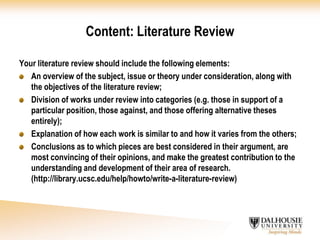
Content: Literature ReviewYour literature review should include the following elements:An overview of the subject, issue or theory under consideration, along with the objectives of the literature review; Division of works under review into categories (e.g. those in support of a particular position, those against, and those offering alternative theses entirely);Explanation of how each work is similar to and how it varies from the others; Conclusions as to which pieces are best considered in their argument, are most convincing of their opinions, and make the greatest contribution to the understanding and development of their area of research. (http://library.ucsc.edu/help/howto/write-a-literature-review)

Academic Writing

  • 1.
    The Dalhousie UniversityWriting CentreAcademic writing: Composing an analytical essay that incorporates a literature review
  • 2.
    OverviewIntroduction to theWriting CentreThe Elements of a Good PaperKey Features of Academic WritingContentThesis StatementLiterature ReviewFormEssay StructureParagraphs (topic sentences and transitional statements)SentencingAPAAdditional Resources
  • 3.
    The Dalhousie WritingCentreKillam Library Learning Commons, G40CContact 494-1963 or writingcentre@dal.caAll students, regardless of year of study or writing experience, are welcome at the centre.We can help withAny piece of writing (essays, lab reports, proposals, etc.)
  • 4.
    Any phase ofthe writing process (brainstorming, developing thesis statements, crafting the final draft, revising)
  • 5.
  • 6.
    Referencing.Appointments are30 or 60 minutes. You will be asked to bring a hard copy of your writing.
  • 7.
    You will beasked to describe your assignment and identify the aspect of your writing you would like to address.
  • 8.
    The tutor willprovide feedback and offer suggestions for improvement (but will not edit) and may refer you to other writing resources or university services.The Elements of a Good PaperThe type of academic paper you write will inform both the content and form of your work.Carefully read the assignment criteria and ask for clarification if necessary.
  • 9.
    For many assignments,you will be using the course material as well as other secondary sources to analyze a topic. You therefore need to
  • 10.
    1) have aclear sense of the readings;
  • 11.
  • 12.
    3) apply thereadings to your topic
  • 13.
    4) articulate thesignificance of this application.Key Features of Academic WritingSeveral key features distinguish academic writing. These features, adapted from Gillet (2011), includeAccuracy– Vocabulary, facts, and figures are used accurately and are consistent with the standards of your field.Explicitness– The relationship between ideas is clarified through the use of signaling words and transitions.Complexity– Academic writing incorporates language particular to your audience and field and addresses more intricate issues than other types of texts. Formality– Academic writing should be free of contractions, slang, and abbreviations.Responsibility– You are responsible for the claims you make and for understanding the sources from which you draw. These sources should be reputable. You are also responsible to the people whose work you draw on to make your claims. This responsibility is reflected in proper in-text citations and proper reference list form.Objectivity-- The emphasis of the writing is on the information you are conveying or the argument you are making rather than on you.
  • 14.
    The Elements ofa Good PaperContent and FormContent includes the context, ideas, concepts, theories, analysis, and evidence that you present.Adhering to the key features of academic writing, your arguments should be made clearly and linearly, the links should be made explicit, and the language should be formal and accurate.
  • 15.
    Use your ownwords. Avoid excessive reliance on direct quotations. Quotations are useful elements for support of your assertions; they should not speak for you.
  • 16.
    Cite properly andinclude a reference list.Form refers to the structure and organization of your paper– how your paper flows from one idea to the next, one sentence to the next, one paragraph to the next, and one section to the next. The form (organization + flow) should enhance your content.Create grammatically correct sentences. Enhance flow through the use of transitional words and phrases.Clearly establish the purpose of each paragraph (introduction, body paragraphs, conclusion). Enhance flow through topic sentences (the frame of each paragraph) and transitional phrases (phrases that summarize and link to the next paragraph).
  • 17.
    The Elements ofa Good PaperContent: The Thesis StatementThe thesis statement offers the point of argument or purpose.The thesis statement must be arguable. It is not simply an observation; it is not a question; it is not simply an announcement of the topic.For example, I think that universal health care is important. (This statement is a statement of opinion and it can not, therefore, be argued.)Currently there is no federally funded universal health care program that includes subsidized day care. (This statement is a fact and is therefore not arguable. It may, however, be the problem; the proposed solution would be the thesis.) To redress inequality between men and women, the federal government should develop and implement a universal health care program that includes subsidized day care. (This statement can be debated and is, therefore, an appropriate thesis statement.)
  • 18.
    Content: Literature ReviewLiteraturereviews provide an analytical synthesis of key issues and themes on a topic. They are not summaries; rather, literature reviews offer an overview of the themes, approaches, perspectives, and conclusions of the literature on a subject.Literature reviews enable us to demonstrate familiarity with an area of study; participate in the ongoing academic dialogue; establish the relationships between ideas; identify points of tension in the academic dialogue; identify gaps in current knowledge; establish the need for further research.
  • 19.
    Content: Literature ReviewYourliterature review should include the following elements:An overview of the subject, issue or theory under consideration, along with the objectives of the literature review; Division of works under review into categories (e.g. those in support of a particular position, those against, and those offering alternative theses entirely);Explanation of how each work is similar to and how it varies from the others; Conclusions as to which pieces are best considered in their argument, are most convincing of their opinions, and make the greatest contribution to the understanding and development of their area of research. (http://library.ucsc.edu/help/howto/write-a-literature-review)