
THE
CLASSIFICATION ESSAY

               Prof. Mara Luna
                    ENGL 3104
Marketing and Advertising

• Advertising is everywhere.

• We see it on television; we hear it on the radio. There are
  print ads in every newspaper and magazine we read, on
  billboards, on the sides of buses and on many Internet sites.

• Advertising, however, is just part of the marketing effort that
  companies (and governments, candidates, and other groups)
  put forth to further their cause of getting us to buy a product,
  change our minds about an issue, change our behavior, or
  vote for a candidate.

• The reading in this chapter explore the question: “What is
  marketing and why does it work?
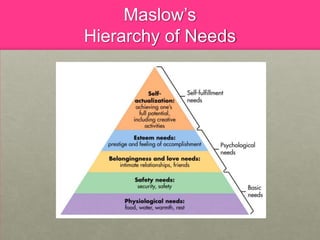
Maslow’s
Hierarchy of Needs
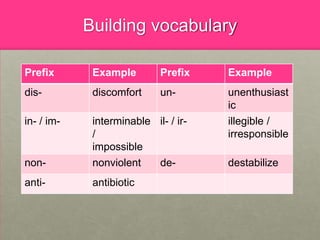
Building vocabulary

• A prefix is a letter or group of letters that are
  attached to the beginning of a word to change the
  word’s meaning.
• Studying prefixes is a good way to improve your
  reading comprehension, but it is also a good way
  to help you increase the number of words you can
  use productively –in your speaking and writing.
• Some of the most common prefixes give the root
  word a negative meaning.
Building vocabulary

Prefix       Example        Prefix    Example
dis-         discomfort     un-       unenthusiast
                                      ic
in- / im-    interminable il- / ir-   illegible /
             /                        irresponsible
             impossible
non-         nonviolent   de-         destabilize
anti-        antibiotic
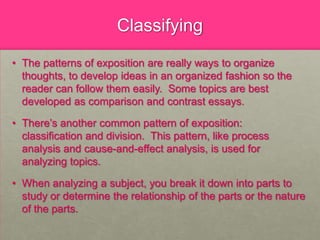
Classifying
• The patterns of exposition are really ways to organize
  thoughts, to develop ideas in an organized fashion so the
  reader can follow them easily. Some topics are best
  developed as comparison and contrast essays.

• There’s another common pattern of exposition:
  classification and division. This pattern, like process
  analysis and cause-and-effect analysis, is used for
  analyzing topics.

• When analyzing a subject, you break it down into parts to
  study or determine the relationship of the parts or the nature
  of the parts.
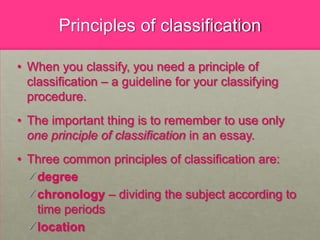
Principles of classification

• When you classify, you need a principle of
  classification – a guideline for your classifying
  procedure.
• The important thing is to remember to use only
  one principle of classification in an essay.
• Three common principles of classification are:
  degree
  chronology – dividing the subject according to
   time periods
  location
Making the Classification
            Complete
• Once you have decided on a principle of
  classification, check to see if the
  classification includes all members of the
  group.
• To avoid omitting members and
  oversimplifying the analysis, then, it is
  generally a good idea to divide the group into
  more than two categories.
• For most college essays, three or four
  categories are the average.
Organizing the Classification
                essay

• After deciding on the principle of classification
  and dividing the group into categories, you need
  to discuss each of those categories.
• Plan on devoting at least one paragraph to each
  category.
Organizing the Classification
                    Essay
 For each category include the following:

1)Identify the group. If it has a special name, identify the name.

2)Describe or define the category. What are the general
  characteristics of the members of this category?

3)Illustrate the generalizations you make by giving one or two
  examples of typical members of the category.

4)In the second and subsequent developmental paragraphs,
  distinguish the new category from the other categories.
  Discuss the characteristics of the second category by
  comparing and contrasting them with those of the first
  category.
Introducing Categories

• In an introductory paragraph it is often a good
  idea to introduce the categories by mentioning
  the names of the groups.
• The thesis statement for the classification essay
  can be one that simply introduces the
  classification and the categories.
• When you name the categories in the
  introduction, express them in parallel structure:
  that is, express them in the same parts of
  speech.
Introductory Paragraphs

In Chapter 6 you learned about the Funnel.

• Like the Funnel, the Turnabout opens generally and
  congenially, but unlike the Funnel, the Turnabout
  has a dramatic shift in ideas.

• In the Turnabout, the writer sets up the opponent’s
  view for attack.
Transitions
                           for Classification
  • A classification essay is really a combination of the
    example and comparison-contrast essays.

  • Therefore, expect the transitions for this type of essay to
    be generally the same as those for the example and
    comparison-contrast essays.
Type                         Explanation                      Examples
to introduce categories      these are generally              The first group…
                             additive transitions             The next group…
                                                              The last category…
to show similarities and     it is important to clarify the   Unlike…
differences                  distinctions between the         However…
                             categories.                      In contrast to…

to introduce examples                                         A good example of…
                                                              An excellent example of…
Additional Resources

• http://writing.wikinut.com/How-to-Write-a-Well-
  Developed-And-Organized-Classification-Essay-5-
  Paragraphs/nb3g58w_/

• http://www.ehow.com/about_4597015_what-
  classification-essay.html

• http://www.ehow.com/video_4757585_what-
  classification-essay.html

Classification essay

  • 1.
    THE CLASSIFICATION ESSAY Prof. Mara Luna ENGL 3104
  • 2.
    Marketing and Advertising •Advertising is everywhere. • We see it on television; we hear it on the radio. There are print ads in every newspaper and magazine we read, on billboards, on the sides of buses and on many Internet sites. • Advertising, however, is just part of the marketing effort that companies (and governments, candidates, and other groups) put forth to further their cause of getting us to buy a product, change our minds about an issue, change our behavior, or vote for a candidate. • The reading in this chapter explore the question: “What is marketing and why does it work?
  • 3.
  • 4.
    Building vocabulary • Aprefix is a letter or group of letters that are attached to the beginning of a word to change the word’s meaning. • Studying prefixes is a good way to improve your reading comprehension, but it is also a good way to help you increase the number of words you can use productively –in your speaking and writing. • Some of the most common prefixes give the root word a negative meaning.
  • 5.
    Building vocabulary Prefix Example Prefix Example dis- discomfort un- unenthusiast ic in- / im- interminable il- / ir- illegible / / irresponsible impossible non- nonviolent de- destabilize anti- antibiotic
  • 6.
    Classifying • The patternsof exposition are really ways to organize thoughts, to develop ideas in an organized fashion so the reader can follow them easily. Some topics are best developed as comparison and contrast essays. • There’s another common pattern of exposition: classification and division. This pattern, like process analysis and cause-and-effect analysis, is used for analyzing topics. • When analyzing a subject, you break it down into parts to study or determine the relationship of the parts or the nature of the parts.
  • 7.
    Principles of classification •When you classify, you need a principle of classification – a guideline for your classifying procedure. • The important thing is to remember to use only one principle of classification in an essay. • Three common principles of classification are: degree chronology – dividing the subject according to time periods location
  • 8.
    Making the Classification Complete • Once you have decided on a principle of classification, check to see if the classification includes all members of the group. • To avoid omitting members and oversimplifying the analysis, then, it is generally a good idea to divide the group into more than two categories. • For most college essays, three or four categories are the average.
  • 9.
    Organizing the Classification essay • After deciding on the principle of classification and dividing the group into categories, you need to discuss each of those categories. • Plan on devoting at least one paragraph to each category.
  • 10.
    Organizing the Classification Essay For each category include the following: 1)Identify the group. If it has a special name, identify the name. 2)Describe or define the category. What are the general characteristics of the members of this category? 3)Illustrate the generalizations you make by giving one or two examples of typical members of the category. 4)In the second and subsequent developmental paragraphs, distinguish the new category from the other categories. Discuss the characteristics of the second category by comparing and contrasting them with those of the first category.
  • 11.
    Introducing Categories • Inan introductory paragraph it is often a good idea to introduce the categories by mentioning the names of the groups. • The thesis statement for the classification essay can be one that simply introduces the classification and the categories. • When you name the categories in the introduction, express them in parallel structure: that is, express them in the same parts of speech.
  • 12.
    Introductory Paragraphs In Chapter6 you learned about the Funnel. • Like the Funnel, the Turnabout opens generally and congenially, but unlike the Funnel, the Turnabout has a dramatic shift in ideas. • In the Turnabout, the writer sets up the opponent’s view for attack.
  • 13.
    Transitions for Classification • A classification essay is really a combination of the example and comparison-contrast essays. • Therefore, expect the transitions for this type of essay to be generally the same as those for the example and comparison-contrast essays. Type Explanation Examples to introduce categories these are generally The first group… additive transitions The next group… The last category… to show similarities and it is important to clarify the Unlike… differences distinctions between the However… categories. In contrast to… to introduce examples A good example of… An excellent example of…
  • 14.
    Additional Resources • http://writing.wikinut.com/How-to-Write-a-Well- Developed-And-Organized-Classification-Essay-5- Paragraphs/nb3g58w_/ • http://www.ehow.com/about_4597015_what- classification-essay.html • http://www.ehow.com/video_4757585_what- classification-essay.html