ARGUMENT AND
DISCUSSION
ESSAY
TFL 207 - ACADEMIC WRITING
MA, Senior Lecturer
Ulzhan URAZALIYEVA
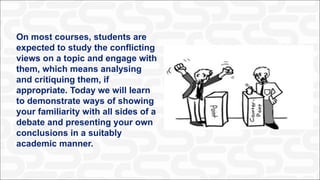
On most courses, students are
expected to study the conflicting
views on a topic and engage with
them, which means analysing
and critiquing them, if
appropriate. Today we will learn
to demonstrate ways of showing
your familiarity with all sides of a
debate and presenting your own
conclusions in a suitably
academic manner.
Discussion vocabulary
Essay titles commonly ask students to ‘discuss’ a topic:
‘Children will learn a foreign language more easily if it is integrated with
another subject – Discuss.’
This requires an evaluation of both the benefits and disadvantages of the
topic, with a section of the essay, sometimes headed ‘Discussion’, in which
a summary of these is made.
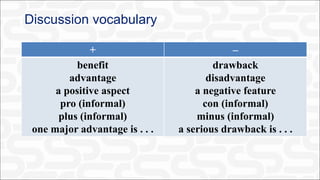
Discussion vocabulary
+ –
benefit
advantage
a positive aspect
pro (informal)
plus (informal)
one major advantage is . . .
drawback
disadvantage
a negative feature
con (informal)
minus (informal)
a serious drawback is . . .
Ex 1: Write a paragraph of about 100 words on
the benefits and drawbacks of studying in
another country.
Example:
One drawback to integrating content and language is the demand it places
on the teacher.
A significant benefit of teaching a subject through a language is the
increased motivation to master the language.
Organisation
The following essay title can be discussed in the two ways as shown:
‘Prisons do little to reform criminals and their use should be limited –
Discuss.’
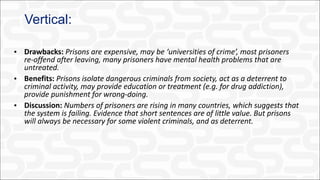
Vertical:
• Drawbacks: Prisons are expensive, may be ‘universities of crime’, most prisoners
re-offend after leaving, many prisoners have mental health problems that are
untreated.
• Benefits: Prisons isolate dangerous criminals from society, act as a deterrent to
criminal activity, may provide education or treatment (e.g. for drug addiction),
provide punishment for wrong-doing.
• Discussion: Numbers of prisoners are rising in many countries, which suggests that
the system is failing. Evidence that short sentences are of little value. But prisons
will always be necessary for some violent criminals, and as deterrent.
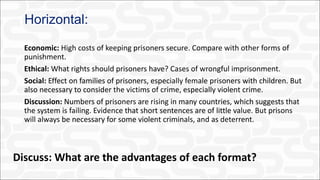
Horizontal:
Economic: High costs of keeping prisoners secure. Compare with other forms of
punishment.
Ethical: What rights should prisoners have? Cases of wrongful imprisonment.
Social: Effect on families of prisoners, especially female prisoners with children. But
also necessary to consider the victims of crime, especially violent crime.
Discussion: Numbers of prisoners are rising in many countries, which suggests that
the system is failing. Evidence that short sentences are of little value. But prisons
will always be necessary for some violent criminals, and as deterrent.
Discuss: What are the advantages of each format?
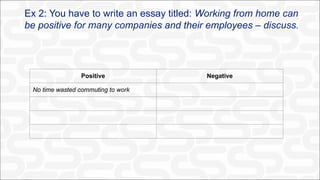
Ex 2: You have to write an essay titled: Working from home can
be positive for many companies and their employees – discuss.
Positive Negative
No time wasted commuting to work
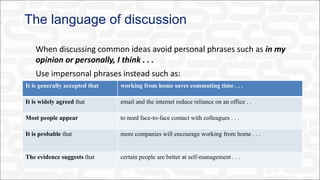
The language of discussion
When discussing common ideas avoid personal phrases such as in my
opinion or personally, I think . . .
Use impersonal phrases instead such as:
It is generally accepted that working from home saves commuting time . . .
It is widely agreed that email and the internet reduce reliance on an office . .
Most people appear to need face-to-face contact with colleagues . . .
It is probable that more companies will encourage working from home . . .
The evidence suggests that certain people are better at self-management . . .
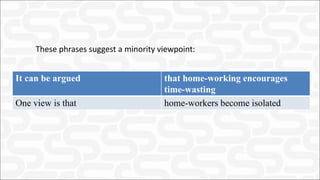
These phrases suggest a minority viewpoint:
It can be argued that home-working encourages
time-wasting
One view is that home-workers become isolated
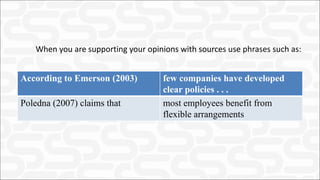
When you are supporting your opinions with sources use phrases such as:
According to Emerson (2003) few companies have developed
clear policies . . .
Poledna (2007) claims that most employees benefit from
flexible arrangements
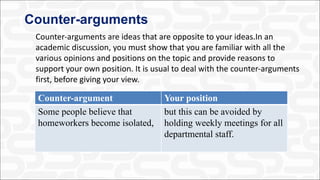
Counter-arguments
Counter-arguments are ideas that are opposite to your ideas.In an
academic discussion, you must show that you are familiar with all the
various opinions and positions on the topic and provide reasons to
support your own position. It is usual to deal with the counter-arguments
first, before giving your view.
Counter-argument Your position
Some people believe that
homeworkers become isolated,
but this can be avoided by
holding weekly meetings for all
departmental staff.
What is the writer’s position in the following
example on the topic of prisons?
It is claimed that prisons are needed to isolate dangerous
criminals from society, and to provide punishment for
wrongdoing. But while this may be true in a minority of cases,
more commonly prisons act as ‘universities of crime’, which
serve to reinforce criminal behaviour. The majority of prisoners
are not dangerous and could be dealt with more effectively by
other means.
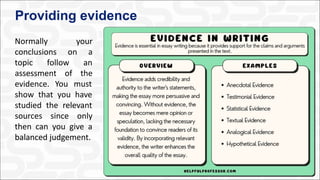
Providing evidence
Normally your
conclusions on a
topic follow an
assessment of the
evidence. You must
show that you have
studied the relevant
sources since only
then can you give a
balanced judgement.
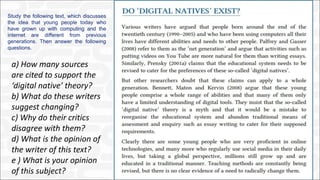
Study the following text, which discusses
the idea that young people today who
have grown up with computing and the
internet are different from previous
generations. Then answer the following
questions.
a) How many sources
are cited to support the
‘digital native’ theory?
b) What do these writers
suggest changing?
c) Why do their critics
disagree with them?
d) What is the opinion of
the writer of this text?
e ) What is your opinion
of this subject?
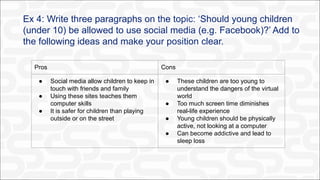
Ex 4: Write three paragraphs on the topic: ‘Should young children
(under 10) be allowed to use social media (e.g. Facebook)?’ Add to
the following ideas and make your position clear.
Pros Cons
● Social media allow children to keep in
touch with friends and family
● Using these sites teaches them
computer skills
● It is safer for children than playing
outside or on the street
● These children are too young to
understand the dangers of the virtual
world
● Too much screen time diminishes
real-life experience
● Young children should be physically
active, not looking at a computer
● Can become addictive and lead to
sleep loss
INTRODUCTION
The title should normally be a general statement, or even a question, that
draws attention to a specific issue.
For example: Should cellphones be banned in schools?
It should be relatively brief and open with a brief statement on the issue and
provide some background to the issue.
Developing Strong Thesis Statements
The thesis statement or main claim must be debatable. In other words, the thesis must be
something that people could reasonably have differing opinions on.
Example of a non-debatable thesis statement:
Pollution is bad for the environment.
Example of a debatable thesis statement:
At least 25 percent of the federal budget should be spent on limiting pollution.
Another example of a debatable thesis statement:
America's anti-pollution efforts should focus on privately owned cars.
Developing Strong Thesis Statements
The thesis needs to be narrow. Although the scope of your paper might seem overwhelming at the start, generally the
narrower the thesis the more effective your argument will be. Your thesis or claim must be supported by evidence.
Example of a thesis that is too broad:
Drug use is detrimental to society.
● There are several reasons this statement is too broad to argue.
● First, what is included in the category "drugs"?
● Is the author talking about illegal drug use, recreational drug use (which might include alcohol and cigarettes), or all
uses of medication in general?
● Second, in what ways are drugs detrimental?
● Is drug use causing deaths (and is the author equating deaths from overdoses and deaths from drug related
violence)?
● Is drug use changing the moral climate or causing the economy to decline?
● Finally, what does the author mean by "society"? Is the author referring only to America or to the global population?
● Does the author make any distinction between the effects on children and adults?
Developing Strong Thesis Statements
Example of a narrow or focused thesis:
Illegal drug use is detrimental because it encourages gang violence.
In this example the topic of drugs has been narrowed down to illegal drugs and the detriment has been
narrowed down to gang violence. This is a much more manageable topic.
● We could narrow each debatable thesis from the previous examples in the following way:
● Narrowed debatable thesis:
At least 25 percent of the federal budget should be spent on helping upgrade
business to clean technologies, researching renewable energy sources, and
planting more trees in order to control or eliminate pollution.
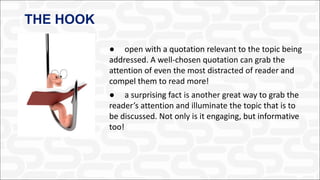
THE HOOK
● open with a quotation relevant to the topic being
addressed. A well-chosen quotation can grab the
attention of even the most distracted of reader and
compel them to read more!
● a surprising fact is another great way to grab the
reader’s attention and illuminate the topic that is to
be discussed. Not only is it engaging, but informative
too!
THE ARGUMENTS
Adverbs of time, such as firstly, secondly, next, then etc and
phrases such as, in addition to, therefore etc can be a great help
for students to structure their information chronologically and
coherently.
It is important to remind students that in the presentation of a
balanced argument they should not express their own bias, or
even their own point of view, rather they are laying out both
sides of the argument for the reader and should give equal
weight to each point of view.
THE ARGUMENTS
When exploring each point, whether for or against, the PEE method can be a
helpful way to aid students in structuring their paragraphs and to give their
arguments direction:
P = Point (Student makes their point at the beginning of the paragraph)
E = Evidence (Student provides evidence that underpins this point)
E = Explain (Student explores point further and ties back to the central issue)
● Use words and phrases that set up contrast, for
example, however, contrastingly, on the other hand, etc.
CONCLUSION
◻ In the conclusion, the student reviews the information, provides a
summary of the arguments made, and weighs up the issue in
light of the available evidence. It is at this point that students
can offer their own opinion in favor or against the issue at
hand, but only if it is appropriate to the genre of the discussion
text.
◻ Students often find it difficult to know how to end their writing.
One excellent way to finish their discussion is to end it with a
question, a challenge to the readers to form their own opinion
on the issue in light of the evidence that has been presented.
The structure of the argumentative essay is held together by the following.
1. A clear, concise, and defined thesis statement that occurs in the first paragraph of the
essay.
2. Clear and logical transitions between the introduction, body, and conclusion.
3. Evidential support (whether factual, logical, statistical, or anecdotal).
4. A conclusion that does not simply restate the thesis, but readdresses it in light of the
evidence provided.
5. The argumentative essay must be complete, and logically so, leaving no doubt as to
its intent or argument.
HOMEWORK
TO WRITE ESSAY ON ONE OF THE FOLLOWING TOPICS:
Write a 4–5 paragraph argumentative essay (approximately 600–800 words) on one of the following
topics:
1. Should technology (such as AI or VR) be integrated into English language teaching?
2. Is it better for students to learn English in a fully immersive environment (only English) or through
bilingual instruction?
3. Do standardized tests accurately measure students’ English proficiency?
4. Is online learning as effective as face-to-face instruction in English language teaching?
5. Should students be required to learn English starting from primary school?
6. Does the dominance of English as a global language threaten local cultures and languages?
7. Will AI replace human teachers in the future?

Formatting
● Typed, double-spaced, Times New Roman, 12 pt font.
● Length: 600–800 words.
● Include references.
Evaluation Criteria (10 points total)
● Thesis statement & organization (2 points)
● Quality of arguments & evidence (3 points)
● Counterargument & refutation (2 points)
● Clarity, grammar, and style (2 points)
● Conclusion strength (1 point)
Submission deadline: 10P - 02.09.2025 ; 12P - 05.09.2025; 13P - 05.09.2025; 14P - 06.09.2025

How to Write Argument and Discussion Essay PPT.pdf

  • 1.
    ARGUMENT AND DISCUSSION ESSAY TFL 207- ACADEMIC WRITING MA, Senior Lecturer Ulzhan URAZALIYEVA
  • 2.
    On most courses,students are expected to study the conflicting views on a topic and engage with them, which means analysing and critiquing them, if appropriate. Today we will learn to demonstrate ways of showing your familiarity with all sides of a debate and presenting your own conclusions in a suitably academic manner.
  • 3.
    Discussion vocabulary Essay titlescommonly ask students to ‘discuss’ a topic: ‘Children will learn a foreign language more easily if it is integrated with another subject – Discuss.’ This requires an evaluation of both the benefits and disadvantages of the topic, with a section of the essay, sometimes headed ‘Discussion’, in which a summary of these is made.
  • 4.
    Discussion vocabulary + – benefit advantage apositive aspect pro (informal) plus (informal) one major advantage is . . . drawback disadvantage a negative feature con (informal) minus (informal) a serious drawback is . . .
  • 5.
    Ex 1: Writea paragraph of about 100 words on the benefits and drawbacks of studying in another country. Example: One drawback to integrating content and language is the demand it places on the teacher. A significant benefit of teaching a subject through a language is the increased motivation to master the language.
  • 6.
    Organisation The following essaytitle can be discussed in the two ways as shown: ‘Prisons do little to reform criminals and their use should be limited – Discuss.’
  • 7.
    Vertical: • Drawbacks: Prisonsare expensive, may be ‘universities of crime’, most prisoners re-offend after leaving, many prisoners have mental health problems that are untreated. • Benefits: Prisons isolate dangerous criminals from society, act as a deterrent to criminal activity, may provide education or treatment (e.g. for drug addiction), provide punishment for wrong-doing. • Discussion: Numbers of prisoners are rising in many countries, which suggests that the system is failing. Evidence that short sentences are of little value. But prisons will always be necessary for some violent criminals, and as deterrent.
  • 8.
    Horizontal: Economic: High costsof keeping prisoners secure. Compare with other forms of punishment. Ethical: What rights should prisoners have? Cases of wrongful imprisonment. Social: Effect on families of prisoners, especially female prisoners with children. But also necessary to consider the victims of crime, especially violent crime. Discussion: Numbers of prisoners are rising in many countries, which suggests that the system is failing. Evidence that short sentences are of little value. But prisons will always be necessary for some violent criminals, and as deterrent. Discuss: What are the advantages of each format?
  • 9.
    Ex 2: Youhave to write an essay titled: Working from home can be positive for many companies and their employees – discuss. Positive Negative No time wasted commuting to work
  • 10.
    The language ofdiscussion When discussing common ideas avoid personal phrases such as in my opinion or personally, I think . . . Use impersonal phrases instead such as: It is generally accepted that working from home saves commuting time . . . It is widely agreed that email and the internet reduce reliance on an office . . Most people appear to need face-to-face contact with colleagues . . . It is probable that more companies will encourage working from home . . . The evidence suggests that certain people are better at self-management . . .
  • 11.
    These phrases suggesta minority viewpoint: It can be argued that home-working encourages time-wasting One view is that home-workers become isolated
  • 12.
    When you aresupporting your opinions with sources use phrases such as: According to Emerson (2003) few companies have developed clear policies . . . Poledna (2007) claims that most employees benefit from flexible arrangements
  • 13.
    Counter-arguments Counter-arguments are ideasthat are opposite to your ideas.In an academic discussion, you must show that you are familiar with all the various opinions and positions on the topic and provide reasons to support your own position. It is usual to deal with the counter-arguments first, before giving your view. Counter-argument Your position Some people believe that homeworkers become isolated, but this can be avoided by holding weekly meetings for all departmental staff.
  • 14.
    What is thewriter’s position in the following example on the topic of prisons? It is claimed that prisons are needed to isolate dangerous criminals from society, and to provide punishment for wrongdoing. But while this may be true in a minority of cases, more commonly prisons act as ‘universities of crime’, which serve to reinforce criminal behaviour. The majority of prisoners are not dangerous and could be dealt with more effectively by other means.
  • 15.
    Providing evidence Normally your conclusionson a topic follow an assessment of the evidence. You must show that you have studied the relevant sources since only then can you give a balanced judgement.
  • 16.
    Study the followingtext, which discusses the idea that young people today who have grown up with computing and the internet are different from previous generations. Then answer the following questions. a) How many sources are cited to support the ‘digital native’ theory? b) What do these writers suggest changing? c) Why do their critics disagree with them? d) What is the opinion of the writer of this text? e ) What is your opinion of this subject?
  • 17.
    Ex 4: Writethree paragraphs on the topic: ‘Should young children (under 10) be allowed to use social media (e.g. Facebook)?’ Add to the following ideas and make your position clear. Pros Cons ● Social media allow children to keep in touch with friends and family ● Using these sites teaches them computer skills ● It is safer for children than playing outside or on the street ● These children are too young to understand the dangers of the virtual world ● Too much screen time diminishes real-life experience ● Young children should be physically active, not looking at a computer ● Can become addictive and lead to sleep loss
  • 18.
    INTRODUCTION The title shouldnormally be a general statement, or even a question, that draws attention to a specific issue. For example: Should cellphones be banned in schools? It should be relatively brief and open with a brief statement on the issue and provide some background to the issue.
  • 19.
    Developing Strong ThesisStatements The thesis statement or main claim must be debatable. In other words, the thesis must be something that people could reasonably have differing opinions on. Example of a non-debatable thesis statement: Pollution is bad for the environment. Example of a debatable thesis statement: At least 25 percent of the federal budget should be spent on limiting pollution. Another example of a debatable thesis statement: America's anti-pollution efforts should focus on privately owned cars.
  • 20.
    Developing Strong ThesisStatements The thesis needs to be narrow. Although the scope of your paper might seem overwhelming at the start, generally the narrower the thesis the more effective your argument will be. Your thesis or claim must be supported by evidence. Example of a thesis that is too broad: Drug use is detrimental to society. ● There are several reasons this statement is too broad to argue. ● First, what is included in the category "drugs"? ● Is the author talking about illegal drug use, recreational drug use (which might include alcohol and cigarettes), or all uses of medication in general? ● Second, in what ways are drugs detrimental? ● Is drug use causing deaths (and is the author equating deaths from overdoses and deaths from drug related violence)? ● Is drug use changing the moral climate or causing the economy to decline? ● Finally, what does the author mean by "society"? Is the author referring only to America or to the global population? ● Does the author make any distinction between the effects on children and adults?
  • 21.
    Developing Strong ThesisStatements Example of a narrow or focused thesis: Illegal drug use is detrimental because it encourages gang violence. In this example the topic of drugs has been narrowed down to illegal drugs and the detriment has been narrowed down to gang violence. This is a much more manageable topic. ● We could narrow each debatable thesis from the previous examples in the following way: ● Narrowed debatable thesis: At least 25 percent of the federal budget should be spent on helping upgrade business to clean technologies, researching renewable energy sources, and planting more trees in order to control or eliminate pollution.
  • 22.
    THE HOOK ● openwith a quotation relevant to the topic being addressed. A well-chosen quotation can grab the attention of even the most distracted of reader and compel them to read more! ● a surprising fact is another great way to grab the reader’s attention and illuminate the topic that is to be discussed. Not only is it engaging, but informative too!
  • 23.
    THE ARGUMENTS Adverbs oftime, such as firstly, secondly, next, then etc and phrases such as, in addition to, therefore etc can be a great help for students to structure their information chronologically and coherently. It is important to remind students that in the presentation of a balanced argument they should not express their own bias, or even their own point of view, rather they are laying out both sides of the argument for the reader and should give equal weight to each point of view.
  • 24.
    THE ARGUMENTS When exploringeach point, whether for or against, the PEE method can be a helpful way to aid students in structuring their paragraphs and to give their arguments direction: P = Point (Student makes their point at the beginning of the paragraph) E = Evidence (Student provides evidence that underpins this point) E = Explain (Student explores point further and ties back to the central issue) ● Use words and phrases that set up contrast, for example, however, contrastingly, on the other hand, etc.
  • 25.
    CONCLUSION ◻ In theconclusion, the student reviews the information, provides a summary of the arguments made, and weighs up the issue in light of the available evidence. It is at this point that students can offer their own opinion in favor or against the issue at hand, but only if it is appropriate to the genre of the discussion text. ◻ Students often find it difficult to know how to end their writing. One excellent way to finish their discussion is to end it with a question, a challenge to the readers to form their own opinion on the issue in light of the evidence that has been presented.
  • 26.
    The structure ofthe argumentative essay is held together by the following. 1. A clear, concise, and defined thesis statement that occurs in the first paragraph of the essay. 2. Clear and logical transitions between the introduction, body, and conclusion. 3. Evidential support (whether factual, logical, statistical, or anecdotal). 4. A conclusion that does not simply restate the thesis, but readdresses it in light of the evidence provided. 5. The argumentative essay must be complete, and logically so, leaving no doubt as to its intent or argument.
  • 27.
    HOMEWORK TO WRITE ESSAYON ONE OF THE FOLLOWING TOPICS: Write a 4–5 paragraph argumentative essay (approximately 600–800 words) on one of the following topics: 1. Should technology (such as AI or VR) be integrated into English language teaching? 2. Is it better for students to learn English in a fully immersive environment (only English) or through bilingual instruction? 3. Do standardized tests accurately measure students’ English proficiency? 4. Is online learning as effective as face-to-face instruction in English language teaching? 5. Should students be required to learn English starting from primary school? 6. Does the dominance of English as a global language threaten local cultures and languages? 7. Will AI replace human teachers in the future?
  • 28.
    Formatting ● Typed, double-spaced,Times New Roman, 12 pt font. ● Length: 600–800 words. ● Include references. Evaluation Criteria (10 points total) ● Thesis statement & organization (2 points) ● Quality of arguments & evidence (3 points) ● Counterargument & refutation (2 points) ● Clarity, grammar, and style (2 points) ● Conclusion strength (1 point) Submission deadline: 10P - 02.09.2025 ; 12P - 05.09.2025; 13P - 05.09.2025; 14P - 06.09.2025