Section 3
Short Film Production
              Project
             Editing Techniques
   This section will have 3 parts
       A = the development of editing
       B = the principles of editing
       C = conventions & techniques of editing
               Grading Criteria
PASS – Describe the development of editing
MERIT – Explain the development of editing
        with use of illustrative examples
DISTINCTION – Critically assess the
                development of editing with
               use of detailed examples that
               you have analysed


Section 3 - Editing
 This is the first part of section 3.
 In this section you must discuss the following;
   ◦ In early films, what was editing like? Did it exist at all? Why did they
     start to do it and when? Can you identify, explain and analyse some
     examples of early forms of editing?
   ◦ How and when did it start to get more sophisticated? Why did it
     change – was it due to technology or theory or a bit of both? What
     effect did the early use of editing have on filmmakers and the
     audience? Can you identify, explain and analyse some examples of the
     evolution of editing?
   ◦ Mini case study of 2 important people in film editing. You should
     research Lev Kuleshov and Sergei Eisenstein – who are they, where did
     they work, what did they do in terms of the development of editing
     that was so important? Can you identify, explain and analyse some
     examples of what they did? What lasting effect did they have on
     filmmaking?
   ◦ NOTE – if you want to aim for a DISTINCTION you should most
     definitely give detailed examples and analyse them also you could
     carry out another mini case study of a modern director and their use of
     editing in their films.
Section 3A – The development of
editing
 Obviously being in the lesson will have
  helped you to understand all of this but a
  great resource to START with is –
www.filmreference.com/encyclopedia/Critici
  sm-Ideology/Editing-THE-DEVELOPMENT-
  OF-EDITING/htm
 You should also be searching for and
  using sources of your own research


Section 3A - Sources
In this section you are basically discussing
 and analysing the purposes of editing.
               Grading Criteria
PASS – Describe the principles of editing
MERIT – Explain the principles of editing
         with use of illustrative examples
DISTINCTION – Critically assess the
           principles of editing with
           use of detailed examples that
           you have analysed

Section 3B – The principles of
editing
 A good starting point is to think about this
  question;
             Why do we edit film?
 In class you came up with 3 key reasons
  that you think all forms of editing link to;
     Storytelling
     Engaging the viewer
     Creating meaning


Section 3B – The principles of
editing
Storytelling
   Storytelling is all about the narrative of the film and how the editing helps to move the
    narrative forward or help the viewer to understand the narrative better.
   When discussing this you need to think about the different types of narrative that can be
    used in filmmaking and the tricks used by the editor to help move these narratives
    forward.
   Think about – linear or non-linear narrative, use of flashbacks and flashforwards, use of
    dream sequences.
   A very important thing to discuss would be how editing manipulates time. For example,
    most films are 90 minutes or more yet some films will tell a narrative which spans the
    period of days or weeks and even months of years. So the editor has to use tricks to
    portray the progression of time to the viewer in the shortest way possible.
   Another example of the manipulation of time in film is by cutting out unnecessary parts of
    story and allowing the viewer to make inferences instead. For example, imagine as part of
    your narrative your characters are going to church. Actually showing your characters
    travelling to the church might not move the story forward so the editor would connect
    together a shot of the characters leaving their home and a shot of the characters arriving
    at the church. The audience can then use inference to assume how the characters got
    from one place to the other.


Section 3B – The principles of
editing
Engaging the viewer
   Engaging the viewer is all about keeping them interested and involved in the film, its story
    and characters.
   When discussing this you need to think about different genres of film and how they use
    editing to keep the viewer interested.
   A good tip here is to talk about examples from two very different genres and compare clips
    from these genres that are very different. For example I might use a clip from an action
    film and a clip from a drama or romance film. When comparing these I would be able to
    highlight the differences in editing styles and how even though they are different they are
    both used to engage the viewer.
   For example if I were to analyse a clip from an action film I might pick a chase scene or a
    fight scene. The filmmaker wants the audience to be on the edge of their seat with
    excitement and also to emphasise the chaos and speed of a fight or chase scene. In order
    to do this they might use very fast paced editing and lots of close up shots mixed with a
    sprinkle of high angle long shots or crane shots. This would give the audience a sense of
    the intensity, chaos and speed of the scene as well as allowing them to feel part of it all.
   In contrast the use of editing to engage the viewer in a drama film might be almost the
    opposite. Imagine I am going to analyse a scene from a drama where two characters who
    are at odds with one another are having a conversation. The filmmaker wants the
    audience to be aware of the tension between the characters and maybe to feel
    uncomfortable about what might happen between them, however this is all about the
    verbal conversation not a physical confrontation. The editor might decide to use lots of
    long, lingering shots of close-ups of the characters, faces and hands. These would give the
    audience a sense of the tension between the characters because they would be able to pick
    up on the body language of the characters.

Section 3B – The principles of
editing
Making meaning
 Making meaning is all about using editing to create subtle meaning or meaning
  which is not explicit/obvious to the viewer – the viewer would have to make
  connections and assumptions to pick up on it.
 A good starting point for your discussion of this would be to refer back to your
  section on Lev Kuleshov and the Kuleshov Effect. The Kulesov Effect is all
  about giving the audience clues or pointers to use to make assumptions or
  connections about the characters emotions or motivations.
 Another way you could discuss this is by talking about juxtaposition.
  Juxtaposition is the placement of two things (usually totally opposite) next to
  each other to create meaning or highlight the obvious differences or unfairness
  between the two.
 For example, imagine I were making a charity video for comic relief asking
  people to donate money to those in need. Rather than using words I might
  edit together two clips, one of starving African children crying and straight next
  to it I might cut in a clip of healthy, happy English children in a McDonalds
  eating burgers – what feelings might this create in the audience? What
  meaning could you read into it?

Section 3B – The principles of
editing
In this section you will be discussing the actual
 tricks or types of editing that can be carried out
 – this will be the most in-depth part of section 3.
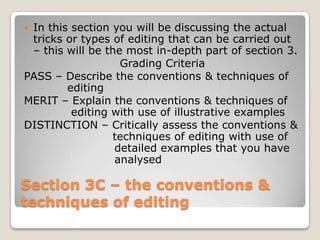
                   Grading Criteria
PASS – Describe the conventions & techniques of
        editing
MERIT – Explain the conventions & techniques of
         editing with use of illustrative examples
DISTINCTION – Critically assess the conventions &
                 techniques of editing with use of
                  detailed examples that you have
                  analysed

Section 3C – the conventions &
techniques of editing
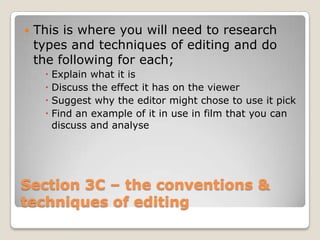
   This is where you will need to research
    types and techniques of editing and do
    the following for each;
      Explain what it is
      Discuss the effect it has on the viewer
      Suggest why the editor might chose to use it pick
      Find an example of it in use in film that you can
       discuss and analyse


Section 3C – the conventions &
techniques of editing
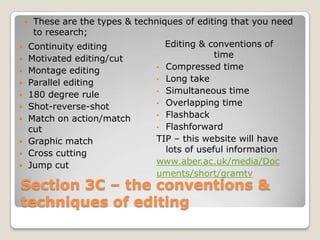
    These are the types & techniques of editing that you need
         to research;
       Continuity editing            Editing & conventions of
       Motivated editing/cut                     time
                                    • Compressed time
       Montage editing
                                    • Long take
       Parallel editing
                                    • Simultaneous time
       180 degree rule
                                    • Overlapping time
       Shot-reverse-shot
                                    • Flashback
       Match on action/match
        cut                         • Flashforward

       Graphic match               TIP – this website will have
       Cross cutting                 lots of useful information
       Jump cut                    www.aber.ac.uk/media/Doc
                                    uments/short/gramtv
Section 3C – the conventions &
techniques of editing
Short film production Section 3

Short film production Section 3

  • 1.
    Section 3 Short FilmProduction Project Editing Techniques
  • 2.
    This section will have 3 parts  A = the development of editing  B = the principles of editing  C = conventions & techniques of editing Grading Criteria PASS – Describe the development of editing MERIT – Explain the development of editing with use of illustrative examples DISTINCTION – Critically assess the development of editing with use of detailed examples that you have analysed Section 3 - Editing
  • 3.
     This isthe first part of section 3.  In this section you must discuss the following; ◦ In early films, what was editing like? Did it exist at all? Why did they start to do it and when? Can you identify, explain and analyse some examples of early forms of editing? ◦ How and when did it start to get more sophisticated? Why did it change – was it due to technology or theory or a bit of both? What effect did the early use of editing have on filmmakers and the audience? Can you identify, explain and analyse some examples of the evolution of editing? ◦ Mini case study of 2 important people in film editing. You should research Lev Kuleshov and Sergei Eisenstein – who are they, where did they work, what did they do in terms of the development of editing that was so important? Can you identify, explain and analyse some examples of what they did? What lasting effect did they have on filmmaking? ◦ NOTE – if you want to aim for a DISTINCTION you should most definitely give detailed examples and analyse them also you could carry out another mini case study of a modern director and their use of editing in their films. Section 3A – The development of editing
  • 4.
     Obviously beingin the lesson will have helped you to understand all of this but a great resource to START with is – www.filmreference.com/encyclopedia/Critici sm-Ideology/Editing-THE-DEVELOPMENT- OF-EDITING/htm  You should also be searching for and using sources of your own research Section 3A - Sources
  • 5.
    In this sectionyou are basically discussing and analysing the purposes of editing. Grading Criteria PASS – Describe the principles of editing MERIT – Explain the principles of editing with use of illustrative examples DISTINCTION – Critically assess the principles of editing with use of detailed examples that you have analysed Section 3B – The principles of editing
  • 6.
     A goodstarting point is to think about this question; Why do we edit film?  In class you came up with 3 key reasons that you think all forms of editing link to;  Storytelling  Engaging the viewer  Creating meaning Section 3B – The principles of editing
  • 7.
    Storytelling  Storytelling is all about the narrative of the film and how the editing helps to move the narrative forward or help the viewer to understand the narrative better.  When discussing this you need to think about the different types of narrative that can be used in filmmaking and the tricks used by the editor to help move these narratives forward.  Think about – linear or non-linear narrative, use of flashbacks and flashforwards, use of dream sequences.  A very important thing to discuss would be how editing manipulates time. For example, most films are 90 minutes or more yet some films will tell a narrative which spans the period of days or weeks and even months of years. So the editor has to use tricks to portray the progression of time to the viewer in the shortest way possible.  Another example of the manipulation of time in film is by cutting out unnecessary parts of story and allowing the viewer to make inferences instead. For example, imagine as part of your narrative your characters are going to church. Actually showing your characters travelling to the church might not move the story forward so the editor would connect together a shot of the characters leaving their home and a shot of the characters arriving at the church. The audience can then use inference to assume how the characters got from one place to the other. Section 3B – The principles of editing
  • 8.
    Engaging the viewer  Engaging the viewer is all about keeping them interested and involved in the film, its story and characters.  When discussing this you need to think about different genres of film and how they use editing to keep the viewer interested.  A good tip here is to talk about examples from two very different genres and compare clips from these genres that are very different. For example I might use a clip from an action film and a clip from a drama or romance film. When comparing these I would be able to highlight the differences in editing styles and how even though they are different they are both used to engage the viewer.  For example if I were to analyse a clip from an action film I might pick a chase scene or a fight scene. The filmmaker wants the audience to be on the edge of their seat with excitement and also to emphasise the chaos and speed of a fight or chase scene. In order to do this they might use very fast paced editing and lots of close up shots mixed with a sprinkle of high angle long shots or crane shots. This would give the audience a sense of the intensity, chaos and speed of the scene as well as allowing them to feel part of it all.  In contrast the use of editing to engage the viewer in a drama film might be almost the opposite. Imagine I am going to analyse a scene from a drama where two characters who are at odds with one another are having a conversation. The filmmaker wants the audience to be aware of the tension between the characters and maybe to feel uncomfortable about what might happen between them, however this is all about the verbal conversation not a physical confrontation. The editor might decide to use lots of long, lingering shots of close-ups of the characters, faces and hands. These would give the audience a sense of the tension between the characters because they would be able to pick up on the body language of the characters. Section 3B – The principles of editing
  • 9.
    Making meaning  Makingmeaning is all about using editing to create subtle meaning or meaning which is not explicit/obvious to the viewer – the viewer would have to make connections and assumptions to pick up on it.  A good starting point for your discussion of this would be to refer back to your section on Lev Kuleshov and the Kuleshov Effect. The Kulesov Effect is all about giving the audience clues or pointers to use to make assumptions or connections about the characters emotions or motivations.  Another way you could discuss this is by talking about juxtaposition. Juxtaposition is the placement of two things (usually totally opposite) next to each other to create meaning or highlight the obvious differences or unfairness between the two.  For example, imagine I were making a charity video for comic relief asking people to donate money to those in need. Rather than using words I might edit together two clips, one of starving African children crying and straight next to it I might cut in a clip of healthy, happy English children in a McDonalds eating burgers – what feelings might this create in the audience? What meaning could you read into it? Section 3B – The principles of editing
  • 10.
    In this sectionyou will be discussing the actual tricks or types of editing that can be carried out – this will be the most in-depth part of section 3. Grading Criteria PASS – Describe the conventions & techniques of editing MERIT – Explain the conventions & techniques of editing with use of illustrative examples DISTINCTION – Critically assess the conventions & techniques of editing with use of detailed examples that you have analysed Section 3C – the conventions & techniques of editing
  • 11.
    This is where you will need to research types and techniques of editing and do the following for each;  Explain what it is  Discuss the effect it has on the viewer  Suggest why the editor might chose to use it pick  Find an example of it in use in film that you can discuss and analyse Section 3C – the conventions & techniques of editing
  • 12.
    These are the types & techniques of editing that you need to research;  Continuity editing Editing & conventions of  Motivated editing/cut time • Compressed time  Montage editing • Long take  Parallel editing • Simultaneous time  180 degree rule • Overlapping time  Shot-reverse-shot • Flashback  Match on action/match cut • Flashforward  Graphic match TIP – this website will have  Cross cutting lots of useful information  Jump cut www.aber.ac.uk/media/Doc uments/short/gramtv Section 3C – the conventions & techniques of editing