Critical Thinking
Goals for today's presentation
•
By the end of the presentation, teachers will be able to...
•
1. Define critical thinking.
•
2. Identify and explain four components of critical thinking.
•
3. Apply critical thinking concepts to their English language
classrooms.
Foldable
Foldable: Critical Thinking and its
components
•
What is critical thinking?
•
Critical thinking is a dynamic, purposeful, analytic process
that results in reasoned decisions and judgements.
Foldable: Critical Thinking and its
components
•
Here are four components of critical thinking:
•
Interpretation
•
Analysis
•
Inference
•
Explanation
•
Interpretation is identifying and understanding problems.
•
Inference is making an informed decision.
•
Explanation is the ability to answer “how” and “why.”
•
Analysis is organizing data or ideas.
Critical thinking in ESL/EFL classes
•
What critical thinking activities do Mongolian students do in
their NON-ENGLISH classes?
•
What critical thinking activities do Mongolian students do in
their ENGLISH classes?
Critical thinking in ESL/EFL classes
•
Each group will have 4 members.
•
One person will be the writer. This person writes down ideas
from the group.
•
One person will be the facilitator. This person will lead the
group discussion.
•
One person will be the speaker. This person will present their
group's ideas to the other groups.
•
One person will be the checker. They will keep track of time
and make sure each critical thinking component is used in an
activity.
•
Each group will take one skill: READING, WRITING,
LISTENING, or SPEAKING. Make a short list of activities you
can do that include critical thinking.
Writing and Critical Thinking
•
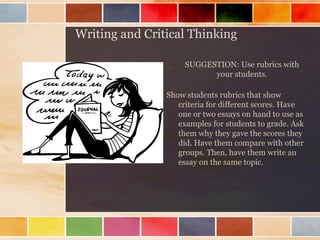
SUGGESTION: Use rubrics with
your students.
Show students rubrics that show
criteria for different scores. Have
one or two essays on hand to use as
examples for students to grade. Ask
them why they gave the scores they
did. Have them compare with other
groups. Then, have them write an
essay on the same topic.
Reading and Critical Thinking
•
SUGGESTION: Do a pattern
recognition activity.
Give students a text or group of
sentences with the grammar for the
lesson, but do not explain the
meaning of the grammar or how to
use it. Ask them, in groups, to read
the sentences and look for
similarities among the sentences.
Have them create their own
explanation for the pattern they
have found.
Listening and Critical Thinking
•
SUGGESTION: Have students
create a summary.
Have students listen to a sentence
or small group of sentences
that contain a clear main idea.
Then, using their own words,
students will have to create a
summary that contains the
main ideas and examples
spoken by the audio
file/teacher.
Speaking and Critical Thinking
•
SUGGESTION: Engage students
with modern issues.
Have students, in groups, discuss an
issue that the Mongolian
government faces (mining,
immigration, poverty, public health,
etc.). Each group will make a list of
pros and cons, and will have to
reference that list when giving the
whole class what their “parliament”
has decided (they must explain why
they made their choice, and how
they came to that decision). Other
groups and the teacher can ask
follow-up questions about their
decisions.
Sources
California State University, Fullerton. 2014. The
Critical Thinking Process. Retrieved from
http://www.fullerton.edu/deanofstudents/Judicial/Critical%20Thinking%20Process.pdf
on March 23, 2014.
Template Provided By
www.animationfactory.com
500,000 Downloadable PowerPoint Templates,
Animated Clip Art, Backgrounds and Videos

Critical thinking presentation

  • 1.
  • 2.
    Goals for today'spresentation • By the end of the presentation, teachers will be able to... • 1. Define critical thinking. • 2. Identify and explain four components of critical thinking. • 3. Apply critical thinking concepts to their English language classrooms.
  • 3.
  • 4.
    Foldable: Critical Thinkingand its components • What is critical thinking? • Critical thinking is a dynamic, purposeful, analytic process that results in reasoned decisions and judgements.
  • 5.
    Foldable: Critical Thinkingand its components • Here are four components of critical thinking: • Interpretation • Analysis • Inference • Explanation • Interpretation is identifying and understanding problems. • Inference is making an informed decision. • Explanation is the ability to answer “how” and “why.” • Analysis is organizing data or ideas.
  • 6.
    Critical thinking inESL/EFL classes • What critical thinking activities do Mongolian students do in their NON-ENGLISH classes? • What critical thinking activities do Mongolian students do in their ENGLISH classes?
  • 7.
    Critical thinking inESL/EFL classes • Each group will have 4 members. • One person will be the writer. This person writes down ideas from the group. • One person will be the facilitator. This person will lead the group discussion. • One person will be the speaker. This person will present their group's ideas to the other groups. • One person will be the checker. They will keep track of time and make sure each critical thinking component is used in an activity. • Each group will take one skill: READING, WRITING, LISTENING, or SPEAKING. Make a short list of activities you can do that include critical thinking.
  • 8.
    Writing and CriticalThinking • SUGGESTION: Use rubrics with your students. Show students rubrics that show criteria for different scores. Have one or two essays on hand to use as examples for students to grade. Ask them why they gave the scores they did. Have them compare with other groups. Then, have them write an essay on the same topic.
  • 9.
    Reading and CriticalThinking • SUGGESTION: Do a pattern recognition activity. Give students a text or group of sentences with the grammar for the lesson, but do not explain the meaning of the grammar or how to use it. Ask them, in groups, to read the sentences and look for similarities among the sentences. Have them create their own explanation for the pattern they have found.
  • 10.
    Listening and CriticalThinking • SUGGESTION: Have students create a summary. Have students listen to a sentence or small group of sentences that contain a clear main idea. Then, using their own words, students will have to create a summary that contains the main ideas and examples spoken by the audio file/teacher.
  • 11.
    Speaking and CriticalThinking • SUGGESTION: Engage students with modern issues. Have students, in groups, discuss an issue that the Mongolian government faces (mining, immigration, poverty, public health, etc.). Each group will make a list of pros and cons, and will have to reference that list when giving the whole class what their “parliament” has decided (they must explain why they made their choice, and how they came to that decision). Other groups and the teacher can ask follow-up questions about their decisions.
  • 12.
    Sources California State University,Fullerton. 2014. The Critical Thinking Process. Retrieved from http://www.fullerton.edu/deanofstudents/Judicial/Critical%20Thinking%20Process.pdf on March 23, 2014.
  • 13.
    Template Provided By www.animationfactory.com 500,000Downloadable PowerPoint Templates, Animated Clip Art, Backgrounds and Videos