Argumentative
Writing
Course Coordinator: Resa R. Noel
Contact: resa_noel@hotmail.com
Course: English Language
Centre: Learning for Living
Date: November 2015
Overview:
 Elements of argumentative
essay
 Organising your argument
 Presenting an argument in
writing
ARGUMENTATIVE WRITING
 An argumentative essay uses
evidence and facts to prove whether
or not a thesis is true.
 It presents two sides of a single issue
and covers the most important
arguments for and against.
Argumentative Writing
 Makes claims based on factual evidence
(research)
 Makes counterclaims – the author
neutralizes or “defeats” opposing ideas
 Logic-based - convinces audience through
the merit and rationality of the claim and
evidence offered
Elements of
Argumentation
Elements of Argumentation
6
Argument/Claim
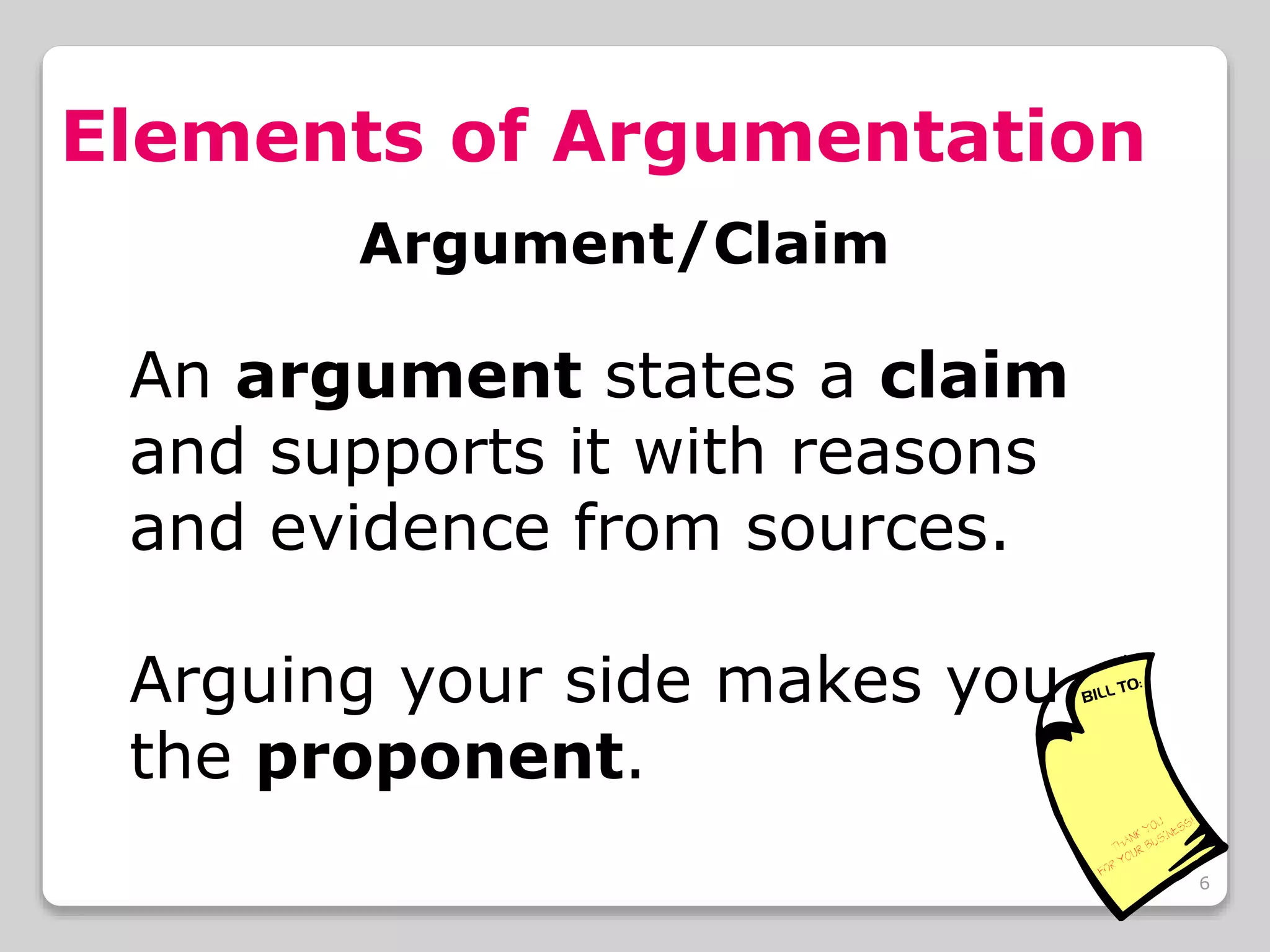
An argument states a claim
and supports it with reasons
and evidence from sources.
Arguing your side makes you
the proponent.
7
Counterargument/Counterclaim
An argument that stands in opposition
to your argument/claim. The
counterargument is your opponent’s
(the other side’s) argument that tries
to explains why you are wrong.
Elements of Argumentation
8
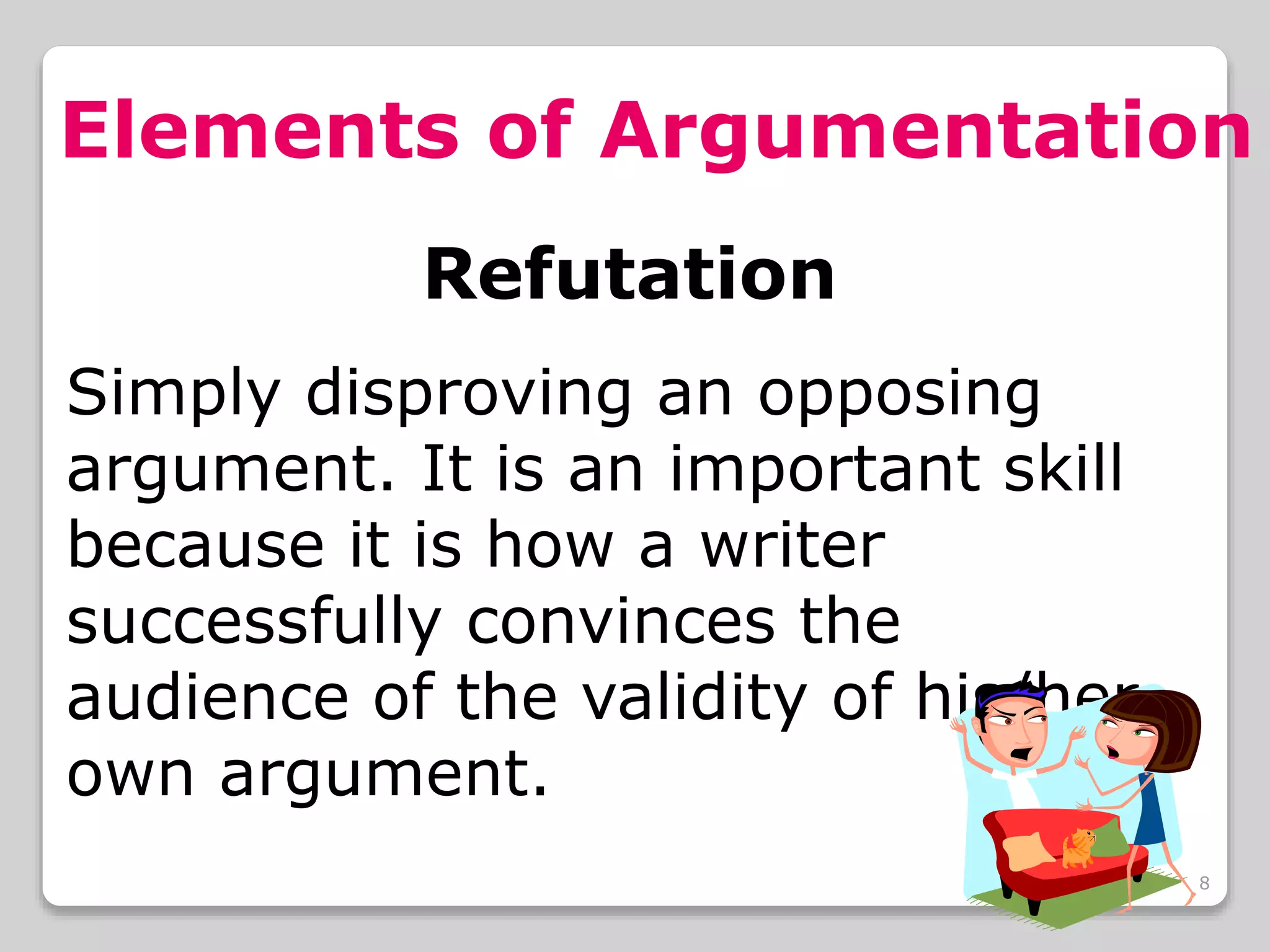
Refutation
Simply disproving an opposing
argument. It is an important skill
because it is how a writer
successfully convinces the
audience of the validity of his/her
own argument.
Elements of Argumentation
9
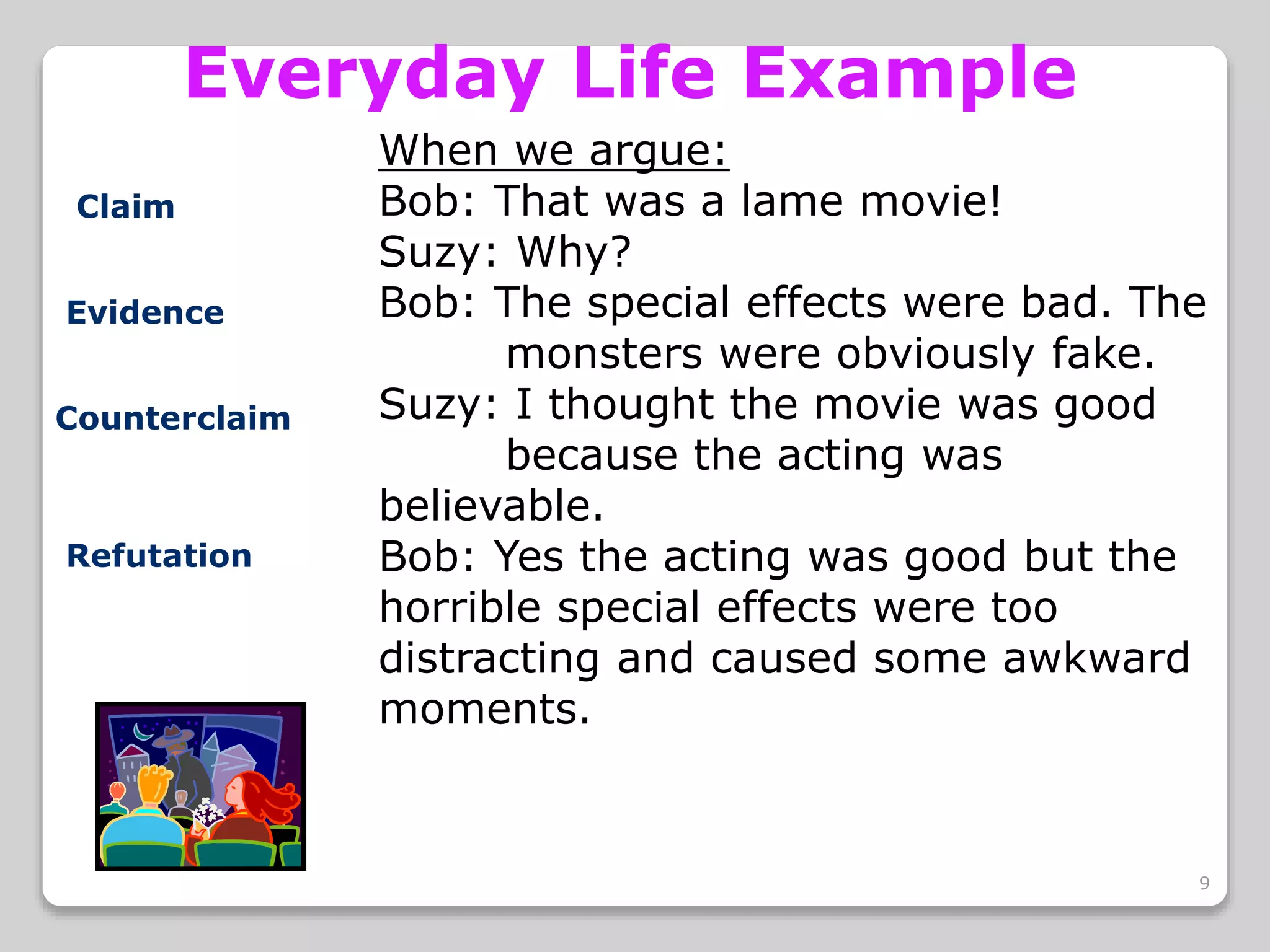
Everyday Life Example
When we argue:
Bob: That was a lame movie!
Suzy: Why?
Bob: The special effects were bad. The
monsters were obviously fake.
Suzy: I thought the movie was good
because the acting was
believable.
Bob: Yes the acting was good but the
horrible special effects were too
distracting and caused some awkward
moments.
Claim
Evidence
Counterclaim
Refutation
10
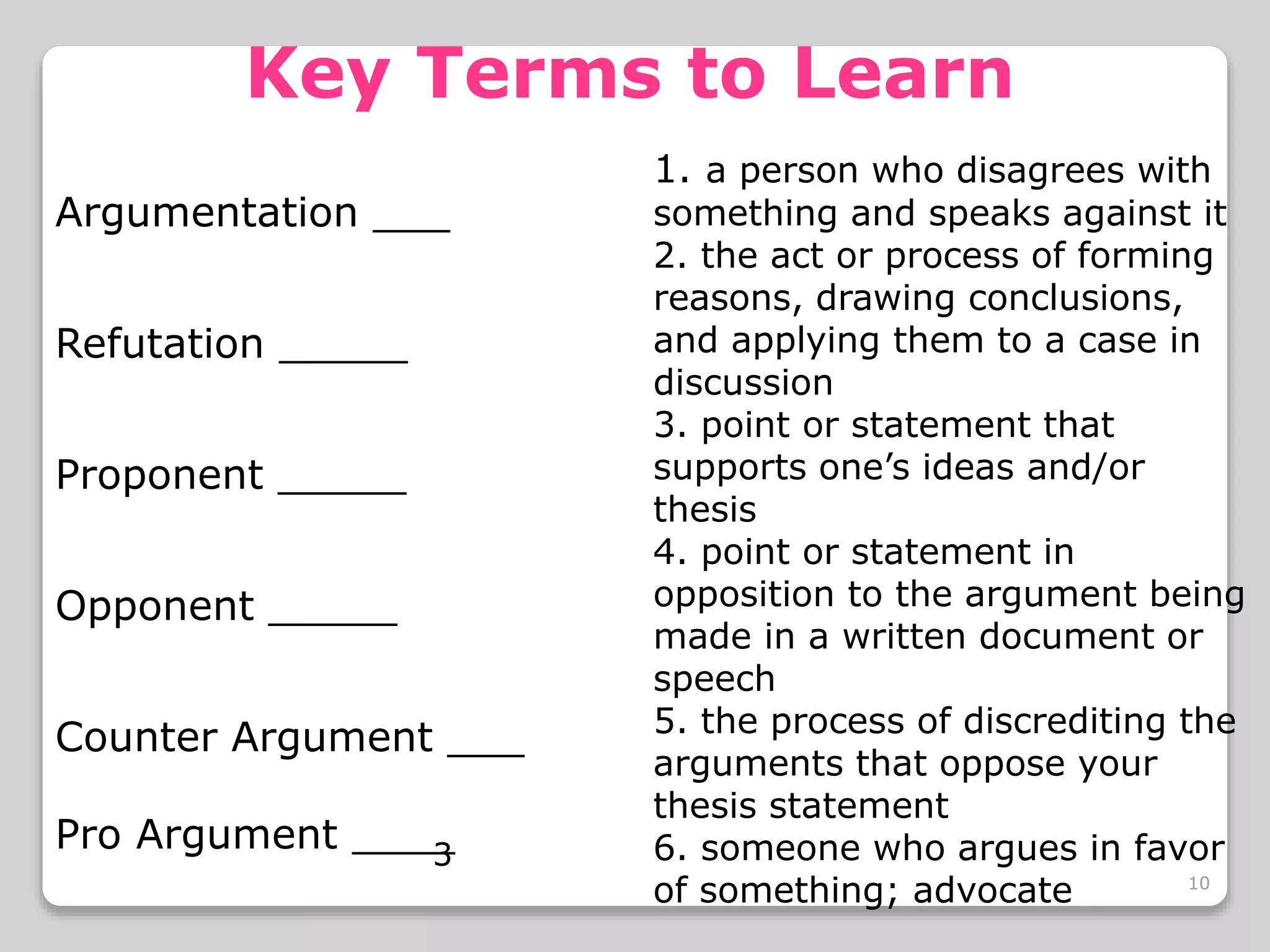
Key Terms to Learn
1. a person who disagrees with
something and speaks against it
2. the act or process of forming
reasons, drawing conclusions,
and applying them to a case in
discussion
3. point or statement that
supports one’s ideas and/or
thesis
4. point or statement in
opposition to the argument being
made in a written document or
speech
5. the process of discrediting the
arguments that oppose your
thesis statement
6. someone who argues in favor
of something; advocate
Argumentation ___
Refutation _____
Proponent _____
Opponent _____
Counter Argument ___
Pro Argument ____3
11
Practice
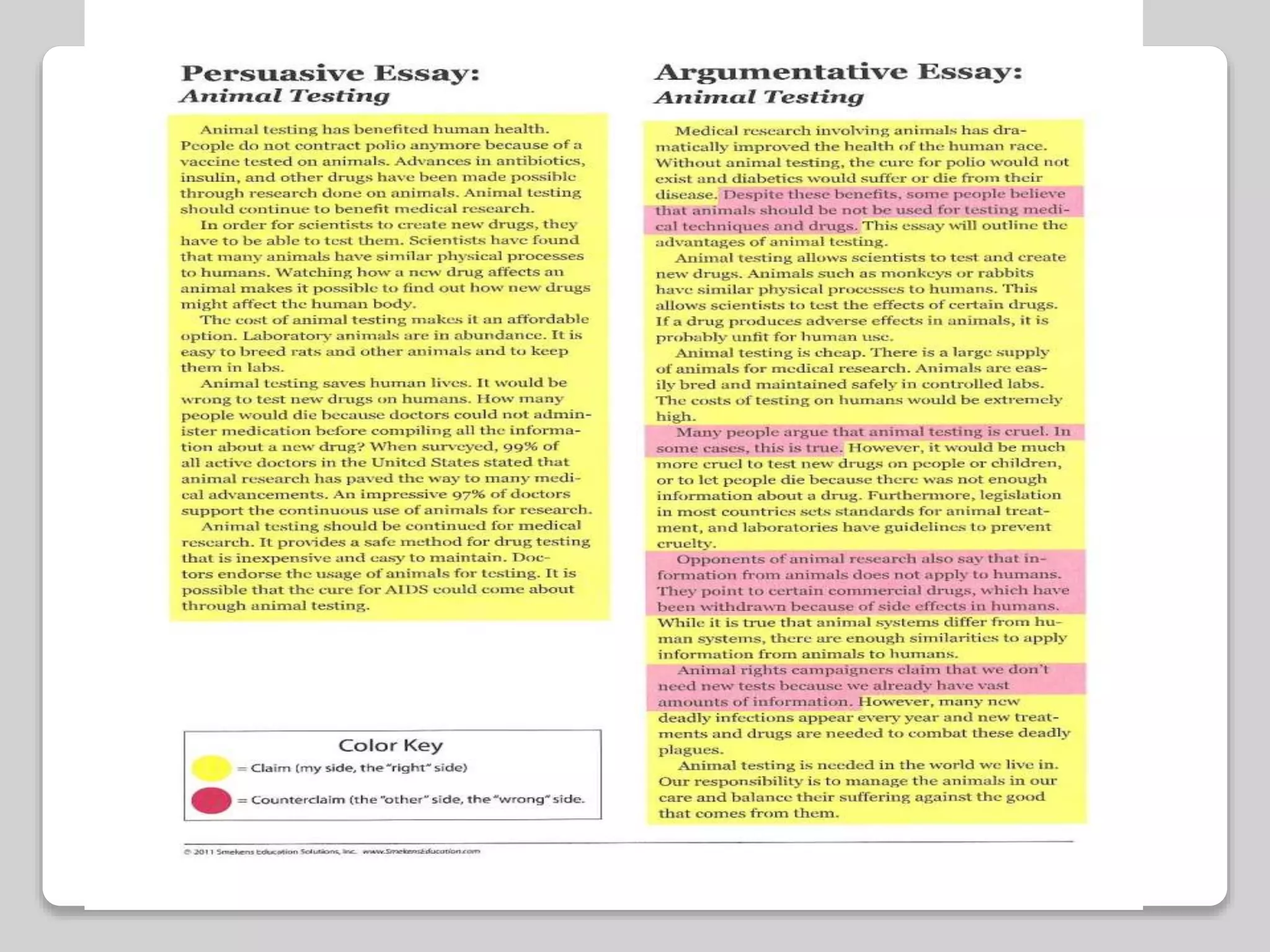
Close Read the Model Argument Essay.
While marking the text, specifically
highlight the
Claim
Counterarguments/Counterclaims
Refutation
 Does the conclusion meet the
requirements? What changes, if any,
would you make?
PRACTICE
PRACTICE:
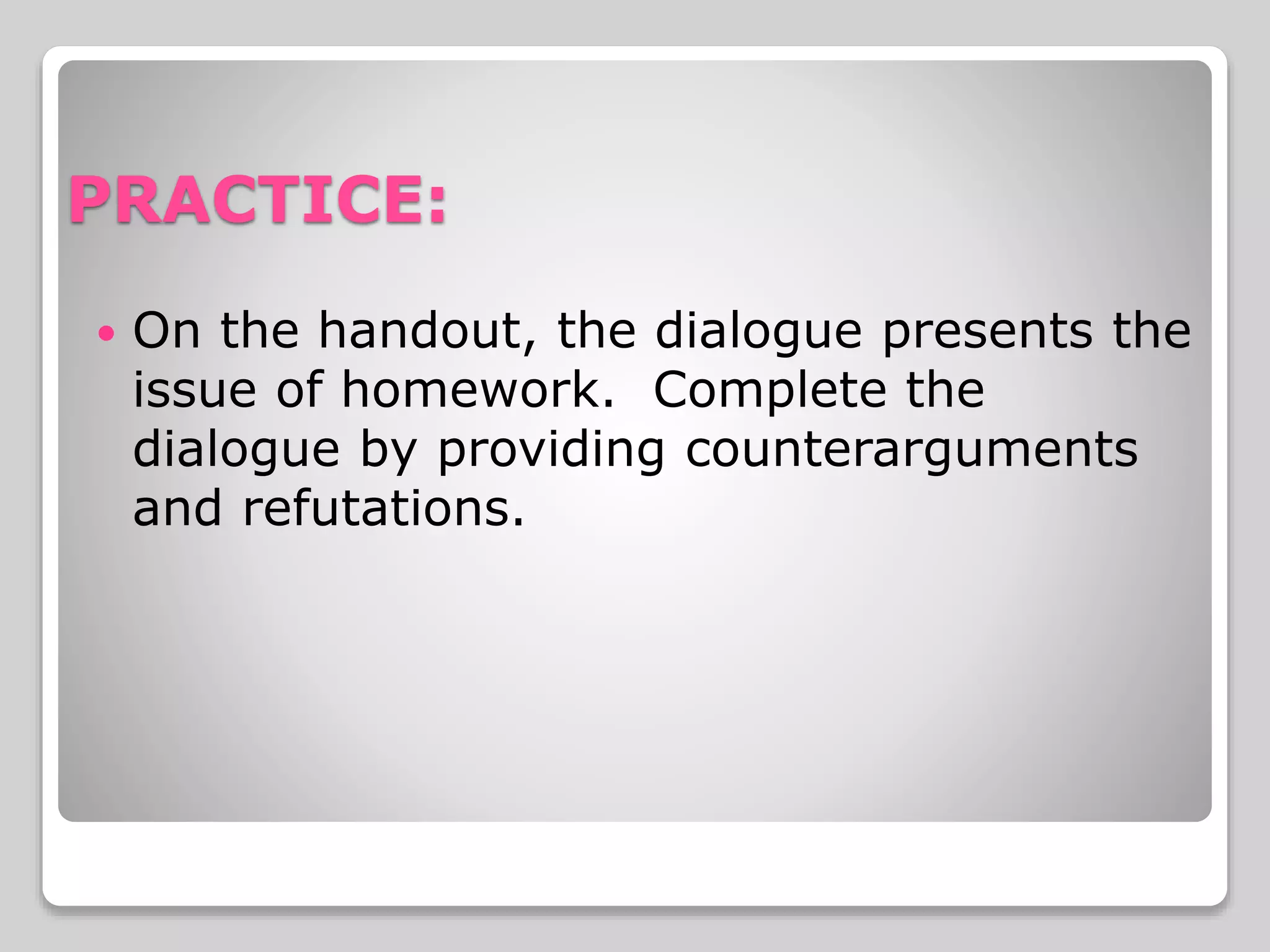
 On the handout, the dialogue presents the
issue of homework. Complete the
dialogue by providing counterarguments
and refutations.
Organizing Your
Argument
17
 Guides an audience through your
reasoning process
 Offers a clear explanation of each
argued point
 Demonstrates the credibility of the
writer
Why is Organization Important
in Argument Writing?
18
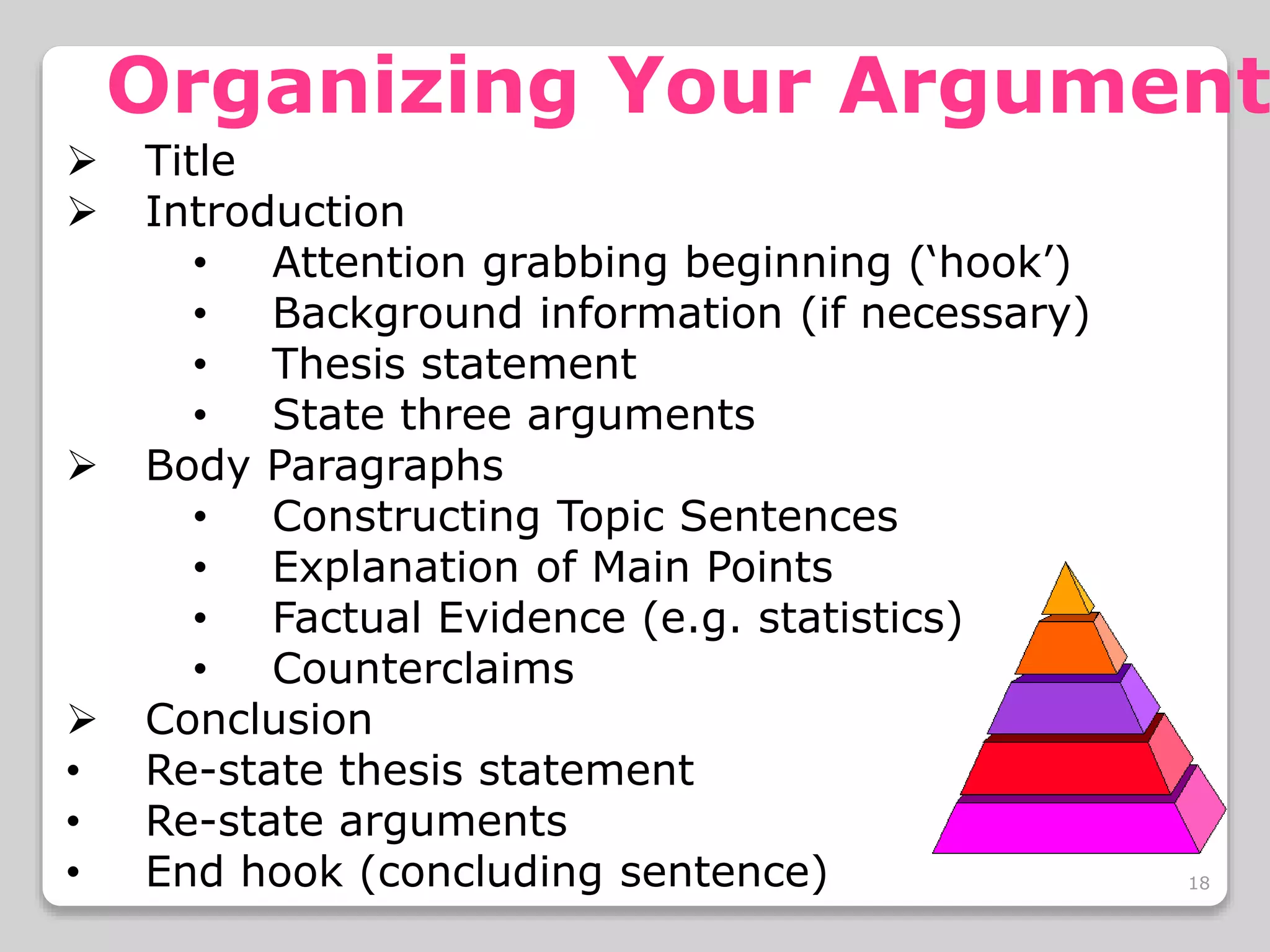
Organizing Your Argument
 Title
 Introduction
• Attention grabbing beginning (‘hook’)
• Background information (if necessary)
• Thesis statement
• State three arguments
 Body Paragraphs
• Constructing Topic Sentences
• Explanation of Main Points
• Factual Evidence (e.g. statistics)
• Counterclaims
 Conclusion
• Re-state thesis statement
• Re-state arguments
• End hook (concluding sentence)
19
What is an Introduction?
 Acquaints the reader with the topic and
purpose of the paper
 Generates the audience’s interest in the
topic
 Offers a plan for the ensuing argument:
Introduction: Tell them what you’re
going to tell them
Body: Tell them
Conclusion: Tell them what you told
them
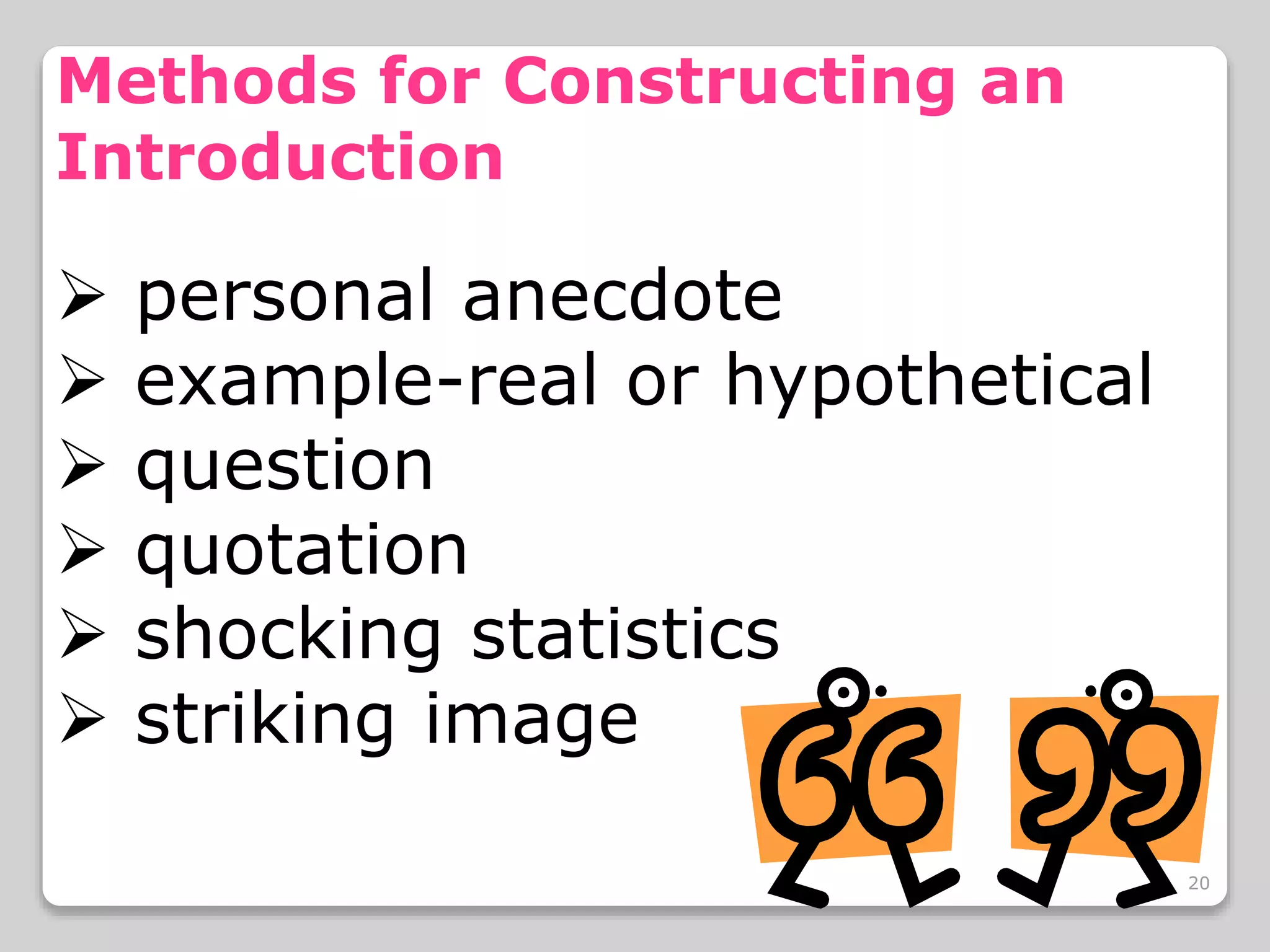
20
 personal anecdote
 example-real or hypothetical
 question
 quotation
 shocking statistics
 striking image
Methods for Constructing an
Introduction
21
Look at the Model Argument
Essay.
Read the Introduction.
After reading the introduction,
do you know what the writer
plans to tell you in his argument
essay?
Practice
22
What is a Thesis Statement?
 Lets the reader know the main
idea of the paper
 Answers the question: “What am I
trying to prove?”
 Not a factual statement, but a
claim that has to be proven
throughout the paper
23
Practice
 Take your Model Argument Essay.
 Close read the first paragraph.
 Identify and highlight the Thesis Statement
 Does the thesis statement
- Let you know the main idea of the paper?
- Answer the question: “What am I trying to
prove?”
- Is the thesis statement not a factual
statement, but a claim that has to be proven
throughout the paper?
 Be prepared to share your answer with your
partner or class.
24
 Body paragraphs build upon the claims made
in the introductory paragraph(s).
 Organize with the use of topic sentences that
illustrate the main idea of each paragraph.
Body Paragraphs and
Topic Sentences
25
Offering a Counterargument
 Addressing the claims of the opposition
is an important component in building a
convincing argument.
 It shows you have considered other
points of view – that other points of
view are valid and reasonable.
26
 Counterarguments may be located at
various locations within your body
paragraphs.
 You may choose to:
• build each of your main points as
contrast to opposing claims.
• offer a counterargument after you
have articulated your main claims.
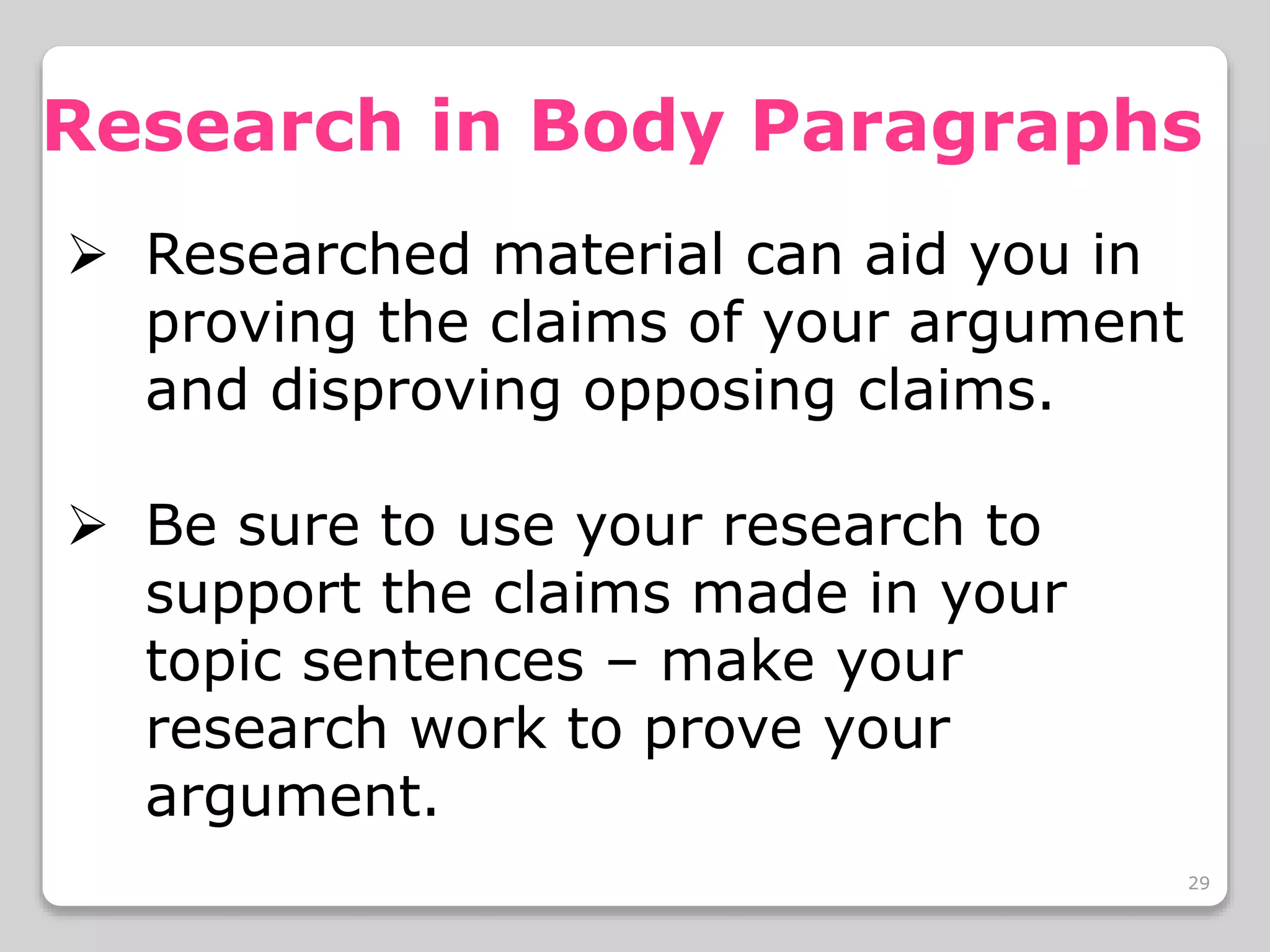
Placement of a
Counterargument
27
 Counterarguments may be located at
various locations within your body
paragraphs.
 You may choose to:
• build each of your main points as a
contrast to
oppositional claims.
• offer a counterargument after you
have articulated your main claims.
Placement of a
Counterargument
28
 Counterarguments may be located at
various locations within your body
paragraphs.
 You may choose to:
• build each of your main points as a
contrast to
oppositional claims.
• offer a counterargument after you
have articulated your main claims.
Placement of a
Counterargument
29
Research in Body Paragraphs
 Researched material can aid you in
proving the claims of your argument
and disproving opposing claims.
 Be sure to use your research to
support the claims made in your
topic sentences – make your
research work to prove your
argument.
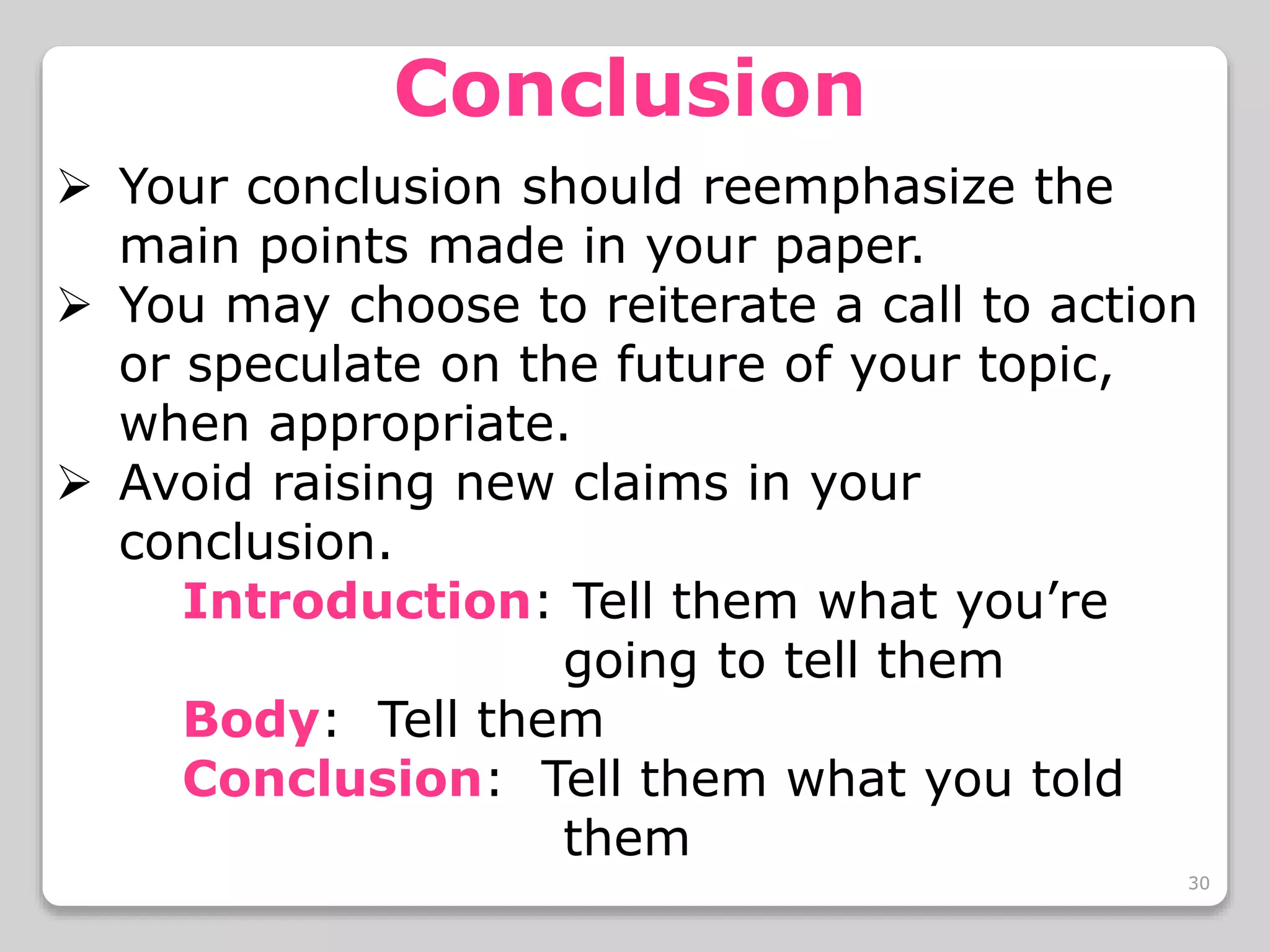
30
Conclusion
 Your conclusion should reemphasize the
main points made in your paper.
 You may choose to reiterate a call to action
or speculate on the future of your topic,
when appropriate.
 Avoid raising new claims in your
conclusion.
Introduction: Tell them what you’re
going to tell them
Body: Tell them
Conclusion: Tell them what you told
them
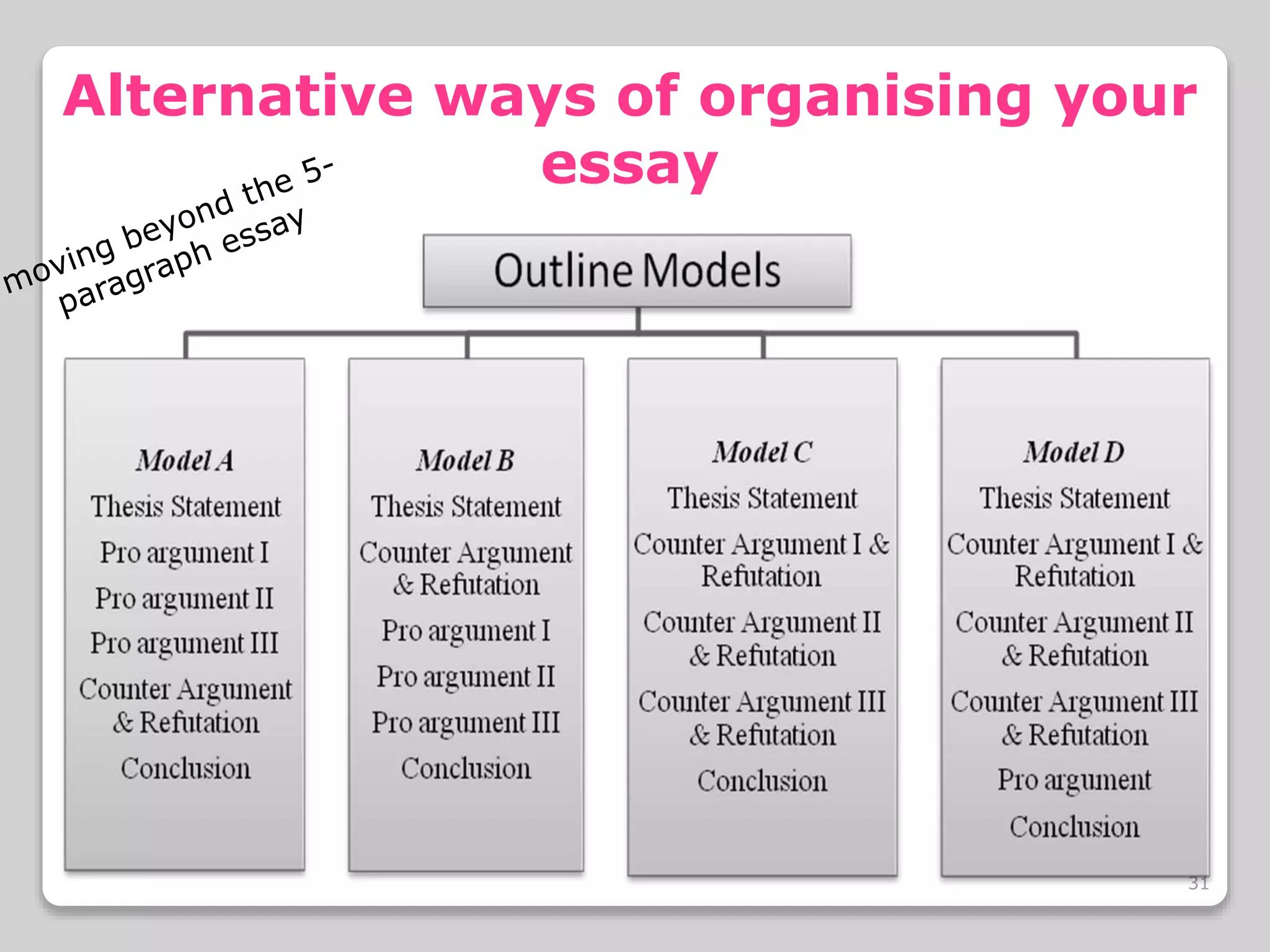
31
Alternative ways of organising your
essay
Wrapping up:
PRESENTING AN ARGUMENT IN WRITING
Write an essay on the topic:
Local food production and distribution can
assist in fostering a culture of healthy living.
Useful links: http://mikienglish.com/locavore-
pros-cons-eating-local/
http://www.gbb.org/news/buying-local-
understand-the-pros-and-cons-of-striving-to-
purchase-your-goods-locally/
Argumentative
Writing
Course Coordinator: Resa R. Noel
Contact: resa_noel@hotmail.com
Course: English
Centre: Learning for Living
Date: November 2015

Argumentative Writing ppt - Grades 10-11 / Forms 4 - 5

  • 1.
    Argumentative Writing Course Coordinator: ResaR. Noel Contact: resa_noel@hotmail.com Course: English Language Centre: Learning for Living Date: November 2015
  • 2.
    Overview:  Elements ofargumentative essay  Organising your argument  Presenting an argument in writing
  • 3.
    ARGUMENTATIVE WRITING  Anargumentative essay uses evidence and facts to prove whether or not a thesis is true.  It presents two sides of a single issue and covers the most important arguments for and against.
  • 4.
    Argumentative Writing  Makesclaims based on factual evidence (research)  Makes counterclaims – the author neutralizes or “defeats” opposing ideas  Logic-based - convinces audience through the merit and rationality of the claim and evidence offered
  • 5.
  • 6.
    Elements of Argumentation 6 Argument/Claim Anargument states a claim and supports it with reasons and evidence from sources. Arguing your side makes you the proponent.
  • 7.
    7 Counterargument/Counterclaim An argument thatstands in opposition to your argument/claim. The counterargument is your opponent’s (the other side’s) argument that tries to explains why you are wrong. Elements of Argumentation
  • 8.
    8 Refutation Simply disproving anopposing argument. It is an important skill because it is how a writer successfully convinces the audience of the validity of his/her own argument. Elements of Argumentation
  • 9.
    9 Everyday Life Example Whenwe argue: Bob: That was a lame movie! Suzy: Why? Bob: The special effects were bad. The monsters were obviously fake. Suzy: I thought the movie was good because the acting was believable. Bob: Yes the acting was good but the horrible special effects were too distracting and caused some awkward moments. Claim Evidence Counterclaim Refutation
  • 10.
    10 Key Terms toLearn 1. a person who disagrees with something and speaks against it 2. the act or process of forming reasons, drawing conclusions, and applying them to a case in discussion 3. point or statement that supports one’s ideas and/or thesis 4. point or statement in opposition to the argument being made in a written document or speech 5. the process of discrediting the arguments that oppose your thesis statement 6. someone who argues in favor of something; advocate Argumentation ___ Refutation _____ Proponent _____ Opponent _____ Counter Argument ___ Pro Argument ____3
  • 11.
    11 Practice Close Read theModel Argument Essay. While marking the text, specifically highlight the Claim Counterarguments/Counterclaims Refutation  Does the conclusion meet the requirements? What changes, if any, would you make?
  • 12.
  • 14.
    PRACTICE:  On thehandout, the dialogue presents the issue of homework. Complete the dialogue by providing counterarguments and refutations.
  • 16.
  • 17.
    17  Guides anaudience through your reasoning process  Offers a clear explanation of each argued point  Demonstrates the credibility of the writer Why is Organization Important in Argument Writing?
  • 18.
    18 Organizing Your Argument Title  Introduction • Attention grabbing beginning (‘hook’) • Background information (if necessary) • Thesis statement • State three arguments  Body Paragraphs • Constructing Topic Sentences • Explanation of Main Points • Factual Evidence (e.g. statistics) • Counterclaims  Conclusion • Re-state thesis statement • Re-state arguments • End hook (concluding sentence)
  • 19.
    19 What is anIntroduction?  Acquaints the reader with the topic and purpose of the paper  Generates the audience’s interest in the topic  Offers a plan for the ensuing argument: Introduction: Tell them what you’re going to tell them Body: Tell them Conclusion: Tell them what you told them
  • 20.
    20  personal anecdote example-real or hypothetical  question  quotation  shocking statistics  striking image Methods for Constructing an Introduction
  • 21.
    21 Look at theModel Argument Essay. Read the Introduction. After reading the introduction, do you know what the writer plans to tell you in his argument essay? Practice
  • 22.
    22 What is aThesis Statement?  Lets the reader know the main idea of the paper  Answers the question: “What am I trying to prove?”  Not a factual statement, but a claim that has to be proven throughout the paper
  • 23.
    23 Practice  Take yourModel Argument Essay.  Close read the first paragraph.  Identify and highlight the Thesis Statement  Does the thesis statement - Let you know the main idea of the paper? - Answer the question: “What am I trying to prove?” - Is the thesis statement not a factual statement, but a claim that has to be proven throughout the paper?  Be prepared to share your answer with your partner or class.
  • 24.
    24  Body paragraphsbuild upon the claims made in the introductory paragraph(s).  Organize with the use of topic sentences that illustrate the main idea of each paragraph. Body Paragraphs and Topic Sentences
  • 25.
    25 Offering a Counterargument Addressing the claims of the opposition is an important component in building a convincing argument.  It shows you have considered other points of view – that other points of view are valid and reasonable.
  • 26.
    26  Counterarguments maybe located at various locations within your body paragraphs.  You may choose to: • build each of your main points as contrast to opposing claims. • offer a counterargument after you have articulated your main claims. Placement of a Counterargument
  • 27.
    27  Counterarguments maybe located at various locations within your body paragraphs.  You may choose to: • build each of your main points as a contrast to oppositional claims. • offer a counterargument after you have articulated your main claims. Placement of a Counterargument
  • 28.
    28  Counterarguments maybe located at various locations within your body paragraphs.  You may choose to: • build each of your main points as a contrast to oppositional claims. • offer a counterargument after you have articulated your main claims. Placement of a Counterargument
  • 29.
    29 Research in BodyParagraphs  Researched material can aid you in proving the claims of your argument and disproving opposing claims.  Be sure to use your research to support the claims made in your topic sentences – make your research work to prove your argument.
  • 30.
    30 Conclusion  Your conclusionshould reemphasize the main points made in your paper.  You may choose to reiterate a call to action or speculate on the future of your topic, when appropriate.  Avoid raising new claims in your conclusion. Introduction: Tell them what you’re going to tell them Body: Tell them Conclusion: Tell them what you told them
  • 31.
    31 Alternative ways oforganising your essay
  • 32.
  • 33.
    PRESENTING AN ARGUMENTIN WRITING Write an essay on the topic: Local food production and distribution can assist in fostering a culture of healthy living. Useful links: http://mikienglish.com/locavore- pros-cons-eating-local/ http://www.gbb.org/news/buying-local- understand-the-pros-and-cons-of-striving-to- purchase-your-goods-locally/
  • 34.
    Argumentative Writing Course Coordinator: ResaR. Noel Contact: resa_noel@hotmail.com Course: English Centre: Learning for Living Date: November 2015

Editor's Notes

  • #3 Teacher activity: Let students note these sub-topics in their own books. N/B:Slides will be emailed to students AT THE END of the Argumentative Writing Unit. I.e. after all sub-topics are completed.
  • #10 Teacher activity: Presenting slide. Instruct students to write a short dialogue of an everyday life example of an argument in their own books. Student activity: 3 volunteers EACH provide an everyday life example of an argument. This should be written on the board. The example must contain a CLAIM, EVIDENCE, COUNTERCLAIM, REFUTATION. **STUDENT VOLUNTEER SHOULD NOT fill in claim/evidence/counterclaim/refutation until AFTER class discussion. Teacher activity: Teacher can ask students some question. What is the CLAIM/EVIDENCE/COUNTERCLAIM/REFUTATION? Is the COUNTERCLAIM effective (strong)? How can we make it stronger?
  • #13 Teacher activity: Teacher will distribute handout and ask students to read both essays, noting any differences between the two. Teacher can show the previous slide on projector while students read handout. Student activity: Students should 1) state the main differences between the two essays, using the table on the previous slide as a guide.
  • #16 Teacher activity: Teacher will ask students to share what they learned from today’s lesson. Student activity: While sharing their ideas, students should use the terms learned in today’s lesson.
  • #33 Teacher activity: Teacher will ask students to share what they learned from today’s lesson. Student activity: While sharing their ideas, students should use the terms learned in today’s lesson.