SCGH Wound Care Products and
General Advice
Nicole Walsh,
Nurse Practitioner Wound
Management
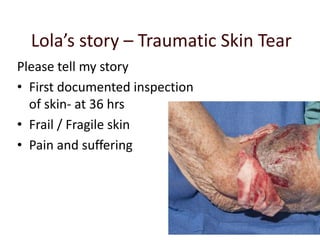
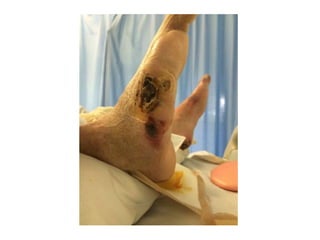
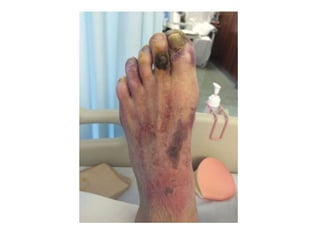
Lola’s story – Traumatic Skin Tear
Please tell my story
• First documented inspection
of skin- at 36 hrs
• Frail / Fragile skin
• Pain and suffering
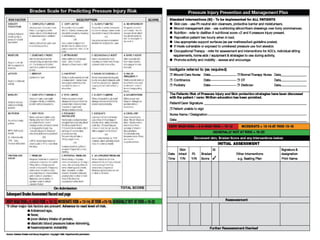
Identification of Risk of Injury
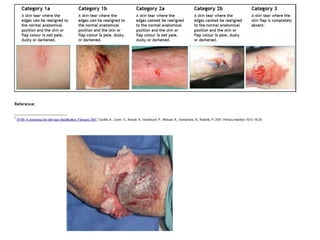
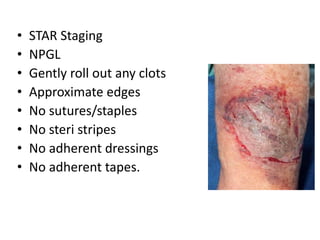
• STAR Staging
• NPGL
• Gently roll out any clots
• Approximate edges
• No sutures/staples
• No steri stripes
• No adherent dressings
• No adherent tapes.
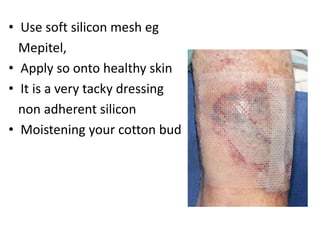
• Use soft silicon mesh eg
Mepitel,
• Apply so onto healthy skin
• It is a very tacky dressing
non adherent silicon
• Moistening your cotton bud
Calcuim Alginate
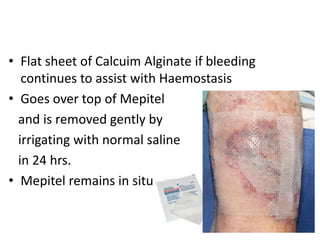
• Flat sheet of Calcuim Alginate if bleeding
continues to assist with Haemostasis
• Goes over top of Mepitel
and is removed gently by
irrigating with normal saline
in 24 hrs.
• Mepitel remains in situ
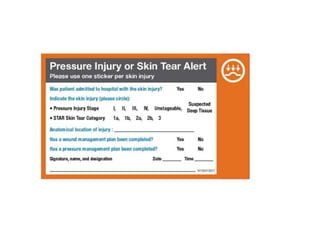
Pressure Injury or Skin Tear Alert Sticker
It has been introduced to:
• Alert staff of an identified pressure injury or skin
tear
• Ensure each injury is appropriately classified and
clearly documented in the notes – to support
clinical coders.
• Ensure injuries are accurately coded so that the
hospital does not lose funds in relation to the
ABM/ABF model.
• Improve reporting of injuries to inform
prevention strategies for the future
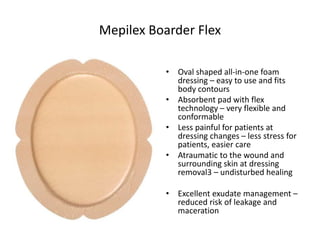
Mepilex Boarder Flex
• Oval shaped all-in-one foam
dressing – easy to use and fits
body contours
• Absorbent pad with flex
technology – very flexible and
conformable
• Less painful for patients at
dressing changes – less stress for
patients, easier care
• Atraumatic to the wound and
surrounding skin at dressing
removal3 – undisturbed healing
• Excellent exudate management –
reduced risk of leakage and
maceration
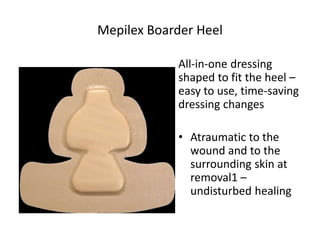
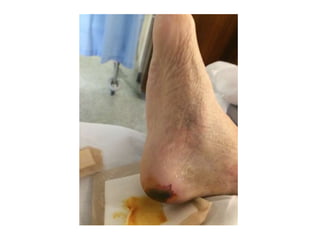
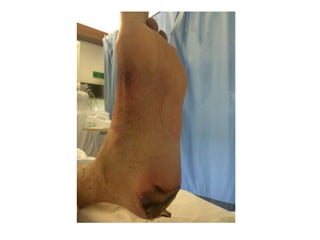
Mepilex Boarder Heel
All-in-one dressing
shaped to fit the heel –
easy to use, time-saving
dressing changes
• Atraumatic to the
wound and to the
surrounding skin at
removal1 –
undisturbed healing
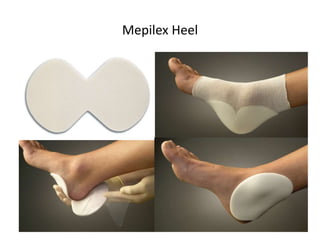
Mepilex Heel
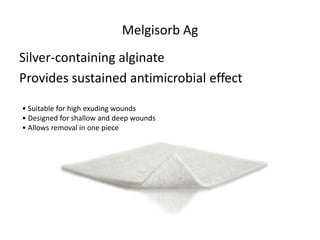
Melgisorb Ag
Silver-containing alginate
Provides sustained antimicrobial effect
• Suitable for high exuding wounds
• Designed for shallow and deep wounds
• Allows removal in one piece
0
5
10
15
20
25
30
35
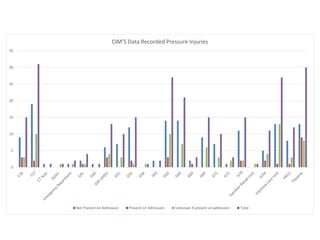
CIM'S Data Recorded Pressure Injuries
Not Present on Admission Present on Admission Unknown if present on admission Total
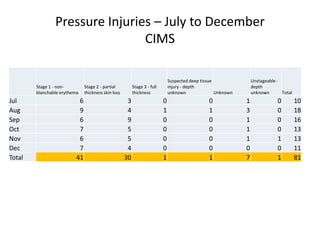
Pressure Injuries – July to December
CIMS
Stage 1 - non-
blanchable erythema
Stage 2 - partial
thickness skin loss
Stage 3 - full
thickness
Suspected deep tissue
injury - depth
unknown Unknown
Unstageable -
depth
unknown Total
Jul 6 3 0 0 1 0 10
Aug 9 4 1 1 3 0 18
Sep 6 9 0 0 1 0 16
Oct 7 5 0 0 1 0 13
Nov 6 5 0 0 1 1 13
Dec 7 4 0 0 0 0 11
Total 41 30 1 1 7 1 81
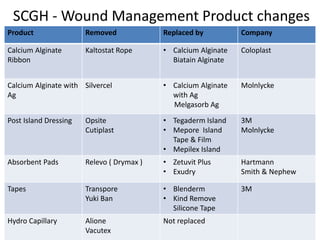
SCGH - Wound Management Product changes
Product Removed Replaced by Company
Calcium Alginate
Ribbon
Kaltostat Rope • Calcium Alginate
Biatain Alginate
Coloplast
Calcium Alginate with
Ag
Silvercel • Calcium Alginate
with Ag
Melgasorb Ag
Molnlycke
Post Island Dressing Opsite
Cutiplast
• Tegaderm Island
• Mepore Island
Tape & Film
• Mepilex Island
3M
Molnlycke
Absorbent Pads Relevo ( Drymax ) • Zetuvit Plus
• Exudry
Hartmann
Smith & Nephew
Tapes Transpore
Yuki Ban
• Blenderm
• Kind Remove
Silicone Tape
3M
Hydro Capillary Alione
Vacutex
Not replaced
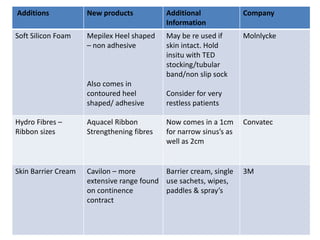
Additions New products Additional
Information
Company
Soft Silicon Foam Mepilex Heel shaped
– non adhesive
Also comes in
contoured heel
shaped/ adhesive
May be re used if
skin intact. Hold
insitu with TED
stocking/tubular
band/non slip sock
Consider for very
restless patients
Molnlycke
Hydro Fibres –
Ribbon sizes
Aquacel Ribbon
Strengthening fibres
Now comes in a 1cm
for narrow sinus’s as
well as 2cm
Convatec
Skin Barrier Cream Cavilon – more
extensive range found
on continence
contract
Barrier cream, single
use sachets, wipes,
paddles & spray’s
3M
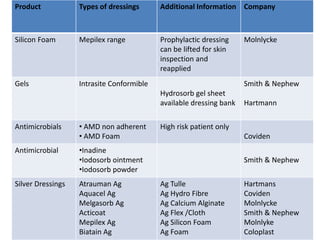
Product Types of dressings Additional Information Company
Silicon Foam Mepilex range Prophylactic dressing
can be lifted for skin
inspection and
reapplied
Molnlycke
Gels Intrasite Conformible
Hydrosorb gel sheet
available dressing bank
Smith & Nephew
Hartmann
Antimicrobials • AMD non adherent
• AMD Foam
High risk patient only
Coviden
Antimicrobial •Inadine
•Iodosorb ointment
•Iodosorb powder
Smith & Nephew
Silver Dressings Atrauman Ag
Aquacel Ag
Melgasorb Ag
Acticoat
Mepilex Ag
Biatain Ag
Ag Tulle
Ag Hydro Fibre
Ag Calcium Alginate
Ag Flex /Cloth
Ag Silicon Foam
Ag Foam
Hartmans
Coviden
Molnlycke
Smith & Nephew
Molnlyke
Coloplast
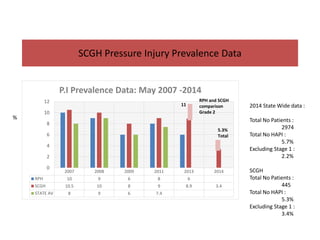
SCGH Pressure Injury Prevalence Data
2007 2008 2009 2011 2013 2014
RPH 10 9 6 8 6
SCGH 10.5 10 8 9 8.9 3.4
STATE AV 8 9 6 7.4
0
2
4
6
8
10
12
P.I Prevalence Data: May 2007 -2014
RPH and SCGH
comparison
Grade 2
5.3%
Total
11
%
2014 State Wide data :
Total No Patients :
2974
Total No HAPI :
5.7%
Excluding Stage 1 :
2.2%
SCGH
Total No Patients :
445
Total No HAPI :
5.3%
Excluding Stage 1 :
3.4%
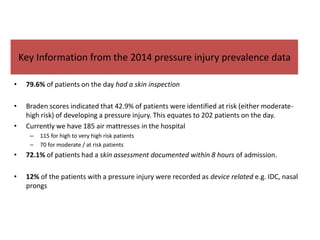
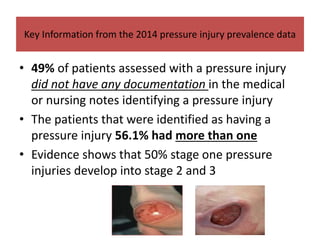
Key Information from the 2014 pressure injury prevalence data
• 79.6% of patients on the day had a skin inspection
• Braden scores indicated that 42.9% of patients were identified at risk (either moderate-
high risk) of developing a pressure injury. This equates to 202 patients on the day.
• Currently we have 185 air mattresses in the hospital
– 115 for high to very high risk patients
– 70 for moderate / at risk patients
• 72.1% of patients had a skin assessment documented within 8 hours of admission.
• 12% of the patients with a pressure injury were recorded as device related e.g. IDC, nasal
prongs
Key Information from the 2014 pressure injury prevalence data
• 49% of patients assessed with a pressure injury
did not have any documentation in the medical
or nursing notes identifying a pressure injury
• The patients that were identified as having a
pressure injury 56.1% had more than one
• Evidence shows that 50% stage one pressure
injuries develop into stage 2 and 3
Wound Care SCGH
Wound Care SCGH
Wound Care SCGH
Wound Care SCGH
Wound Care SCGH

Wound Care SCGH

  • 1.
    SCGH Wound CareProducts and General Advice Nicole Walsh, Nurse Practitioner Wound Management
  • 2.
    Lola’s story –Traumatic Skin Tear Please tell my story • First documented inspection of skin- at 36 hrs • Frail / Fragile skin • Pain and suffering
  • 3.
  • 4.
    • STAR Staging •NPGL • Gently roll out any clots • Approximate edges • No sutures/staples • No steri stripes • No adherent dressings • No adherent tapes.
  • 5.
    • Use softsilicon mesh eg Mepitel, • Apply so onto healthy skin • It is a very tacky dressing non adherent silicon • Moistening your cotton bud
  • 6.
    Calcuim Alginate • Flatsheet of Calcuim Alginate if bleeding continues to assist with Haemostasis • Goes over top of Mepitel and is removed gently by irrigating with normal saline in 24 hrs. • Mepitel remains in situ
  • 9.
    Pressure Injury orSkin Tear Alert Sticker It has been introduced to: • Alert staff of an identified pressure injury or skin tear • Ensure each injury is appropriately classified and clearly documented in the notes – to support clinical coders. • Ensure injuries are accurately coded so that the hospital does not lose funds in relation to the ABM/ABF model. • Improve reporting of injuries to inform prevention strategies for the future
  • 10.
    Mepilex Boarder Flex •Oval shaped all-in-one foam dressing – easy to use and fits body contours • Absorbent pad with flex technology – very flexible and conformable • Less painful for patients at dressing changes – less stress for patients, easier care • Atraumatic to the wound and surrounding skin at dressing removal3 – undisturbed healing • Excellent exudate management – reduced risk of leakage and maceration
  • 11.
    Mepilex Boarder Heel All-in-onedressing shaped to fit the heel – easy to use, time-saving dressing changes • Atraumatic to the wound and to the surrounding skin at removal1 – undisturbed healing
  • 12.
  • 13.
    Melgisorb Ag Silver-containing alginate Providessustained antimicrobial effect • Suitable for high exuding wounds • Designed for shallow and deep wounds • Allows removal in one piece
  • 14.
    0 5 10 15 20 25 30 35 CIM'S Data RecordedPressure Injuries Not Present on Admission Present on Admission Unknown if present on admission Total
  • 15.
    Pressure Injuries –July to December CIMS Stage 1 - non- blanchable erythema Stage 2 - partial thickness skin loss Stage 3 - full thickness Suspected deep tissue injury - depth unknown Unknown Unstageable - depth unknown Total Jul 6 3 0 0 1 0 10 Aug 9 4 1 1 3 0 18 Sep 6 9 0 0 1 0 16 Oct 7 5 0 0 1 0 13 Nov 6 5 0 0 1 1 13 Dec 7 4 0 0 0 0 11 Total 41 30 1 1 7 1 81
  • 16.
    SCGH - WoundManagement Product changes Product Removed Replaced by Company Calcium Alginate Ribbon Kaltostat Rope • Calcium Alginate Biatain Alginate Coloplast Calcium Alginate with Ag Silvercel • Calcium Alginate with Ag Melgasorb Ag Molnlycke Post Island Dressing Opsite Cutiplast • Tegaderm Island • Mepore Island Tape & Film • Mepilex Island 3M Molnlycke Absorbent Pads Relevo ( Drymax ) • Zetuvit Plus • Exudry Hartmann Smith & Nephew Tapes Transpore Yuki Ban • Blenderm • Kind Remove Silicone Tape 3M Hydro Capillary Alione Vacutex Not replaced
  • 17.
    Additions New productsAdditional Information Company Soft Silicon Foam Mepilex Heel shaped – non adhesive Also comes in contoured heel shaped/ adhesive May be re used if skin intact. Hold insitu with TED stocking/tubular band/non slip sock Consider for very restless patients Molnlycke Hydro Fibres – Ribbon sizes Aquacel Ribbon Strengthening fibres Now comes in a 1cm for narrow sinus’s as well as 2cm Convatec Skin Barrier Cream Cavilon – more extensive range found on continence contract Barrier cream, single use sachets, wipes, paddles & spray’s 3M
  • 18.
    Product Types ofdressings Additional Information Company Silicon Foam Mepilex range Prophylactic dressing can be lifted for skin inspection and reapplied Molnlycke Gels Intrasite Conformible Hydrosorb gel sheet available dressing bank Smith & Nephew Hartmann Antimicrobials • AMD non adherent • AMD Foam High risk patient only Coviden Antimicrobial •Inadine •Iodosorb ointment •Iodosorb powder Smith & Nephew Silver Dressings Atrauman Ag Aquacel Ag Melgasorb Ag Acticoat Mepilex Ag Biatain Ag Ag Tulle Ag Hydro Fibre Ag Calcium Alginate Ag Flex /Cloth Ag Silicon Foam Ag Foam Hartmans Coviden Molnlycke Smith & Nephew Molnlyke Coloplast
  • 19.
    SCGH Pressure InjuryPrevalence Data 2007 2008 2009 2011 2013 2014 RPH 10 9 6 8 6 SCGH 10.5 10 8 9 8.9 3.4 STATE AV 8 9 6 7.4 0 2 4 6 8 10 12 P.I Prevalence Data: May 2007 -2014 RPH and SCGH comparison Grade 2 5.3% Total 11 % 2014 State Wide data : Total No Patients : 2974 Total No HAPI : 5.7% Excluding Stage 1 : 2.2% SCGH Total No Patients : 445 Total No HAPI : 5.3% Excluding Stage 1 : 3.4%
  • 20.
    Key Information fromthe 2014 pressure injury prevalence data • 79.6% of patients on the day had a skin inspection • Braden scores indicated that 42.9% of patients were identified at risk (either moderate- high risk) of developing a pressure injury. This equates to 202 patients on the day. • Currently we have 185 air mattresses in the hospital – 115 for high to very high risk patients – 70 for moderate / at risk patients • 72.1% of patients had a skin assessment documented within 8 hours of admission. • 12% of the patients with a pressure injury were recorded as device related e.g. IDC, nasal prongs
  • 21.
    Key Information fromthe 2014 pressure injury prevalence data • 49% of patients assessed with a pressure injury did not have any documentation in the medical or nursing notes identifying a pressure injury • The patients that were identified as having a pressure injury 56.1% had more than one • Evidence shows that 50% stage one pressure injuries develop into stage 2 and 3