Dressing Materials in Burns
Dr. Hardik Dodia
• Burns Wound Basics
• Dressing materials
• Older Concepts VS Newer
concepts
Topics Discussed
IDEAL DRESSING MATERIAL
• Moist environment
• Bacterial barrier
• Prevent loss of body fluid & blood protein
• Allows for gaseous exchange
• Reduction of heat dispersion
• Enhance early physiological closure
IDEAL DRESSING MATERIAL
• Eliminate dead space
• Protect against trauma, pressure and shear
• Prevent particulate contamination
• Nontraumatic
• Easy to use
• Cost-effective
 Four basic principles involved in choosing the optimal dressing
for any individual wound
 If a wound is desiccated, it needs to be hydrated (third degree burns).
 If a wound has excessive exudate, the fluid needs to be absorbed
(Second to Third Degree Burns).
 If a wound has necrotic tissue or foreign debris, it needs to be
debrided- mechanical/ chemical/ autolytic.
 If a wound is infected, it needs to be treated with an antimicrobial
agent.
As the situation in the wound changes, the dressing
must change as well
CLASSIFICATION
- Conventional dressing
- Synthetic occlusive dressings
CONVENTIONAL DRESSINGS
• TYPES
 DRY
 WET TO DRY
 WET TO MOIST
 IMPREGNATED
 SILVER SULPHADIAZINE
Dry dressing
 Gauze
• Inexpensive, reliable, widely available, highly absorbent .
• Used as a primary dressing over ointments and
secondary dressing over wound fillers and hydrogels.
• Don’t use on partial/ full thickness wound.
• Permeable to exogenous bacteria and is associated with
a higher infection rate.
Wet to dry dressing
 Gauze and saline
• To debride tissue, fill cavities, absorb exudate and wick
drainage
• Local tissue cooling during the evaporation of saline–
causes wound dessication.
• Nonselective debridement and injury to healthy tissue
• Used for full thickness and open wound
• Don’t use on partial thickness wound
Wet-to-moist gauze
 Gauze and saline
• To maintain a moist environment.
• To debride most necrotic wounds.
• Requiring up to three dressing changes or manipulations per day
if used correctly.
• Partial-thickness, open and infected wounds.
• Not useful for highly exudative wounds / severe maceration of
surrounding tissue.
• Difficult to use correctly since Wet To Moist often becomes Wet
To Dry, achieving opposite of desired effect.
Impregnated dressings
• Impregnated gauze with petroleum, iodine, zinc or antibacterial
compound.
• Non adhesive
• Help reduce bacterial proliferation.
• Add moisture to wounds.
• First degree burns and partial second degree burns wound.
• Skin grafts and donor sites with minimal to moderate exudate,
abrasions and lacerations.
• Not useful in heavily exudating wounds.
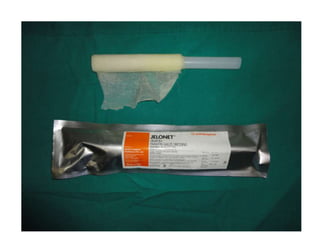
• Jelonet (Petroleum based paraffin gauze)
• Bactigras (0.5% chlorhexidine)
• Sofra Tulle (framycetin)
• Fucidin Intertulle (fusidic acid)
• Xeroform (3% bismuth tribromophenate).
SILVER SULPHADIAZINE
• Most commonly used topical agent in burns.
• Silver Sulfadiazine Cream, USP 1% is a soft, white, water
dispersible cream containing the antimicrobial agent
silver sulfadiazine in micronized form for topical
application. Each gram of Silver Cream contains 10mg of
micronized silver sulfadiazine.
• Sulfadiazine Silver sulfadiazine has broad antimicrobial
activity. (gram-negative, gram-positive bacteria, yeast)
• Mechanism of action:-
• Silver ion kills bacteria by destroying cell wall of bacteria
and also kills by direct DNA inhibiton and breakdown.
• Sulfadiazine is PABA inhibitor. There by cutting of
bacterial replication of the bacteria.
• Indication
• Silver Sulfadiazine Cream, USP 1% is a topical
antimicrobial drug indicated as an adjunct for the
prevention and treatment of wound sepsis in patients
with second and third degree burns.
• Contraindications:-
• Hypersensitive to silver sulfadiazine or any of the other
ingredients in the preparation.
• Pregnant women approaching or at term
• Premature infants
• Newborn infants during the first 2 months of life.
• Adverse Reactions:-
• Transient leukopenia.
• Leukopenia (decreased neutrophil count)
• Skin necrosis, erythema multiforme, skin discoloration, burning
sensation, rashes, and interstitial nephritis.
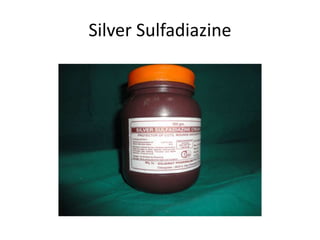
Silver Sulfadiazine
SYNTHETIC OCCLUSIVE DRESSINGS
 Types:
– Semipermeable films
– Hydrogels
– Hydrocolloids
– Foams
– Alginates
– Hydrofibers
– Silver dressings
– Collagen dressings
FILMS
• Semipermeable dressing material
• Polyurethane/ Polyethylene
• Adhesive coating on one side
• Allows water vapor, O2, and other gases permeation
• Impermeable to water and bacteria
• May be combined with more absorptive dressings
(e.g., gauze) and antimicrobial agents.
Advantages:-
 Reduce pain by keeping wound moist
 Allows inspection of wound
 Elastic property- conform to the surface and prevent shear- tear
 Infrequent changing
 Good compliance
Drawback:-
 Nonabsorbent, not for exudative wounds and infected wounds
 Removal may strip off newly formed epithelium
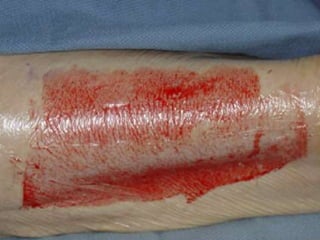
Use:
– Superficial to partial dermal burns
– Primarily closed surgical wounds
– Skin graft donor site
Application :
• At least one inch of surrounding skin should be utilized for proper
sticking which can be aided by the use of tincture benzoin.
• Can be left in place for several days but must be changed earlier if
exudate leaks into surrounding skin.
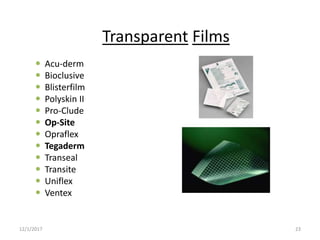
Transparent Films
 Acu-derm
 Bioclusive
 Blisterfilm
 Polyskin II
 Pro-Clude
 Op-Site
 Opraflex
 Tegaderm
 Transeal
 Transite
 Uniflex
 Ventex
12/1/2017 23
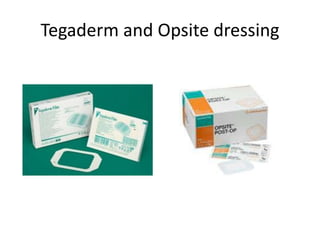
Tegaderm and Opsite dressing
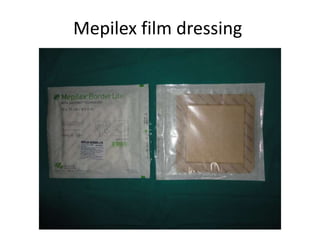
Mepilex film dressing
HYDROGELS
 Transparent polyethylene membranes with water as 90%
composition
 Sheets and fillers
 Nonadhesive and need cover dressing
 Promote autolytic debridement (water is donated from gel to
rehydrate and soften necrotic tissue),however overuse may
cause wound maceration.
 Immediate cooling effect on wound
Use:
– Dry, necrotic or minimally exudative wounds.
– 2nd degree partial burns, blisters
– Shallow, noninfected pressure ulcers
– Radiation injuries
– Donor sites
 Do not use on moderate to heavily exudating
wounds, full-thickness burns, intact skin.
Disadvantage:
– Requires secondary dressing as gauze or tranparent film
– As it requires fixation, not allowed bathing
– Wound need to be inspected regularly
Application:
– Sheets should be used on superficial wounds <5mm in
depth and fillers for deeper wounds.
– Can’t be left for > 1-2 days, it dries out and lose
effectiveness, may get colonised in infective environment.
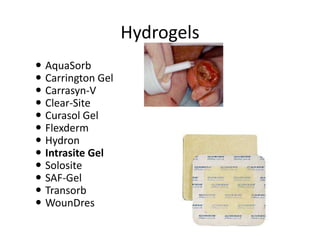
Hydrogels
 AquaSorb
 Carrington Gel
 Carrasyn-V
 Clear-Site
 Curasol Gel
 Flexderm
 Hydron
 Intrasite Gel
 Solosite
 SAF-Gel
 Transorb
 WounDres
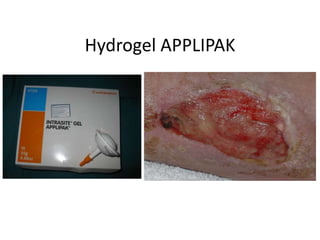
Hydrogel APPLIPAK
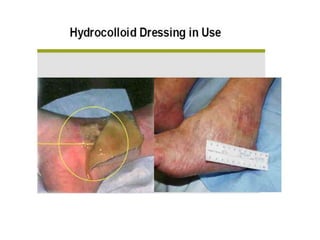
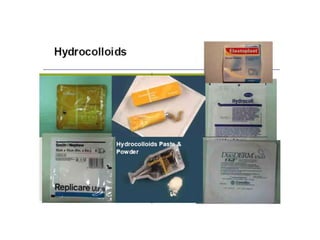
HYDROCOLLOIDS
 Composed of hydrophilic, self-adhesive, gel-forming particles-
gelatin/ pactin, covered by outer film/ foam layer.
 Opaque, impermeable to bacteria, absorbent to exudate.
 Adhere to surface, without sticking to wound bed, waterproof
and relatively painless.
 On absorption of exudate, form swollen gel, act as sponge and
conform to wound contour.
 Faster autolytic debridement of wound- may cause initial
enlargement of wound.
 Encourage granulation & reepithelialization.
 Require infrequent removal
 “Gel and smell phenomenon”- removal of
hydrocolloid leaves odorous residue of adhesive
mixed with wound exudate
Uses:
 Partial- or full-thickness wounds with minimal
exudate
 Minimal exudate/ slough and granulation tissue
 Do not use on infected wounds, heavily exudating
wounds, wounds with friable surrounding skin, full-
thickness burns
Application:
– At least one inch of surrounding skin should be covered to
ensure adherence
– Can remain in place for up to 7 days or until exudate leaks
and comes within one cm of the dressing edges
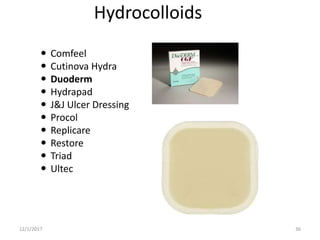
Hydrocolloids
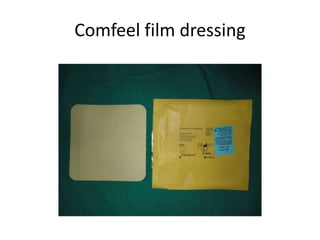
 Comfeel
 Cutinova Hydra
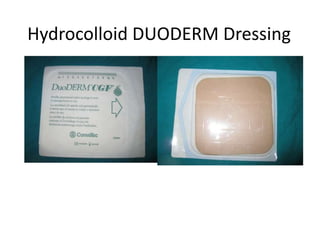
 Duoderm
 Hydrapad
 J&J Ulcer Dressing
 Procol
 Replicare
 Restore
 Triad
 Ultec
12/1/2017 36
Comfeel film dressing
Hydrocolloid DUODERM Dressing
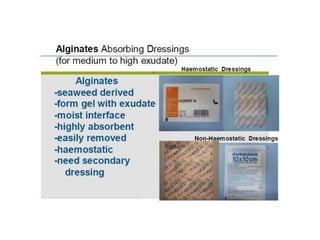
Alginates
• Calcium salts of alginic acid- derived from seaweeds
• Applied to wounds, sodium and calcium ions interact to
form a hydrophilic gel and conform to the wound, thereby
functioning to absorb exudate and fill dead space
• Manufactured in fiber sheets, packing ribbon, pastes,
granules and powders
• Capable of absorbing fluid up to 20 times their weight
• Provide a moist environment, are highly absorptive, and
prevent microbial contamination
• Combined with charcoal or silver to increase
beneficial effects
• Indicated for wounds with moderate to high
exudate, and may be used on partial- or full-
thickness, and granulating or necrotic wounds
• Should not be used on dry/ minimally exudative
wounds because they will adhere to the wound
and cause damage when removedy
Application :-
• Sheets are used on shallow wounds and pastes/powders to fill deep
wounds and require secondary dressing
• Should not be packed into very deep or tunneling wounds, as they
may easily be left behind leaving a residual nidus for infection
• Should only fill one-third to one-half of the wound since they will
expand with time
• May be left in place for up to 7 days or until the exudate reaches the
secondary dressing
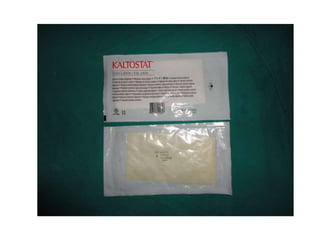
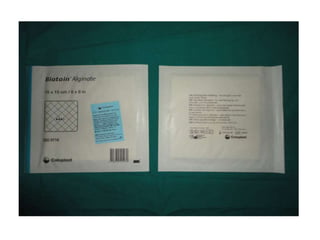
• Nu-derm, kaltostat, curasorb, sorbsan
Hydrofibers
• Consist of sodium carboxymethylcellulose
and manufactured in ribbons and sheets
• Structurally similar to alginates and have same
properties
• Excellent ability to absorb exudate
• Require cover dressing
• May stay on up to 7 days
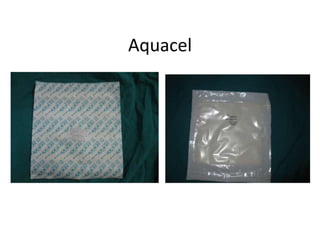
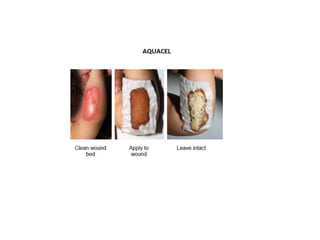
• Aquacel
Aquacel
Foams
• Composed of polyurethane polymers
• Absorb wound exudate
• Thin and thick foams, adhesive and nonadhesive foams and
foams used to pack wounds
• Facilitate autolytic debridement
• Not as useful as alginates or hydrocolloids for debridement
• Can be combined with silver for antimicrobial property
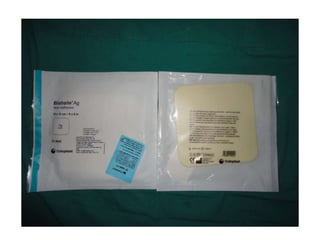
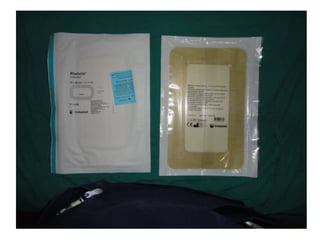
• Allevyn , Lyofoam, Biatin Ag
– Used for wounds with moderate to high exudate, partial- or
full-thickness wounds and granulating wounds
– Do not use on dry or low exudating wounds as this will cause
dryness and scabbing
Application :-
– At least one inch of surrounding skin should be covered
– Can be left on the wound surface for up to seven days
– Can be used on infected wounds if changed daily
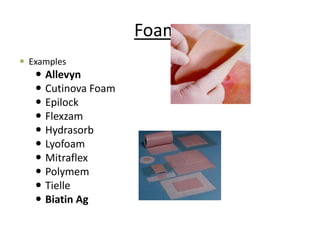
Foams
 Examples
 Allevyn
 Cutinova Foam
 Epilock
 Flexzam
 Hydrasorb
 Lyofoam
 Mitraflex
 Polymem
 Tielle
 Biatin Ag
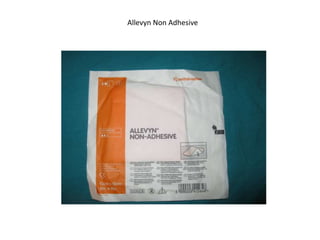
Allevyn Non Adhesive
Silver dressings
• Dressings have become available that release charge silver atoms (ionic
Ag+) on contact with the wound fluid. One free radicle kills one pathogen.
• Silver ion has property to penetrate biofilms (resistant layer formed by
microbes to antibiotics).
• The amount/rate of ionic silver release from different dressings is variable.
• Initial release of high levels followed by sustained release appears to aid
reduction in bacterial numbers and a wide spectrum of activity.
• Ag ions are available in nanocrystalline form.
• Staining of the wound bed or surrounding skin by ionic silver dressings
may occur occasionally and is usually reversible
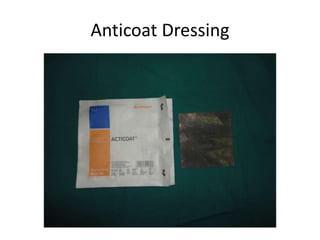
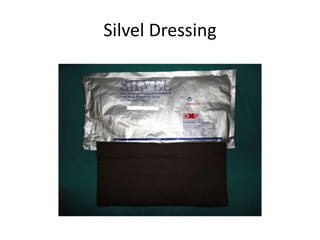
Eg ACTICOAT, SILVEL
Anticoat Dressing
Silvel Dressing
Advantages of occlusive dressings
• Protect wound
• Decrease risk of infection
• Trapping moisture in wound bed
• Prevent drying, cracking and dessication of wound- Pain
free, comfortable
• Infrequent change
• Decreases healing time
• Don’t retard healing by stripping away epithelium
SKIN SUBSTITUTES
 Classification based on Composition
– Class I: Temporary dressings
A. Single Layer Materials:
i. Biological/Naturally occuring:
Amniotic membrane
Potato peel
ii.Synthetic:
Polymer sheet: Tegaderm, Opsite
Polymer foam/spray.
B.Bilayered tissue engineered: Transcyte
 Classification based on Composition
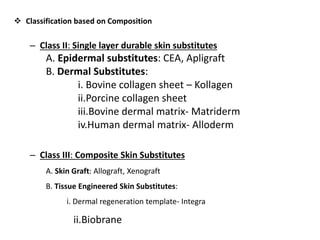
– Class II: Single layer durable skin substitutes
A. Epidermal substitutes: CEA, Apligraft
B. Dermal Substitutes:
i. Bovine collagen sheet – Kollagen
ii.Porcine collagen sheet
iii.Bovine dermal matrix- Matriderm
iv.Human dermal matrix- Alloderm
– Class III: Composite Skin Substitutes
A. Skin Graft: Allograft, Xenograft
B. Tissue Engineered Skin Substitutes:
i. Dermal regeneration template- Integra
ii.Biobrane
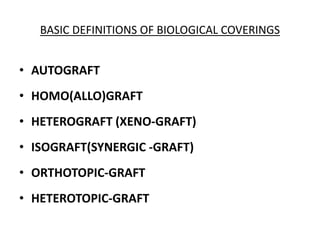
BASIC DEFINITIONS OF BIOLOGICAL COVERINGS
• AUTOGRAFT
• HOMO(ALLO)GRAFT
• HETEROGRAFT (XENO-GRAFT)
• ISOGRAFT(SYNERGIC -GRAFT)
• ORTHOTOPIC-GRAFT
• HETEROTOPIC-GRAFT
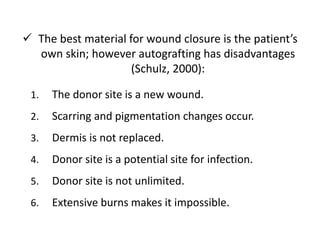
 The best material for wound closure is the patient’s
own skin; however autografting has disadvantages
(Schulz, 2000):
1. The donor site is a new wound.
2. Scarring and pigmentation changes occur.
3. Dermis is not replaced.
4. Donor site is a potential site for infection.
5. Donor site is not unlimited.
6. Extensive burns makes it impossible.
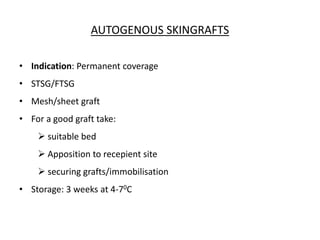
AUTOGENOUS SKINGRAFTS
• Indication: Permanent coverage
• STSG/FTSG
• Mesh/sheet graft
• For a good graft take:
 suitable bed
 Apposition to recepient site
 securing grafts/immobilisation
• Storage: 3 weeks at 4-70C
ALLOGRAFT
• History: GURDNER(1881): 1st described
BROWN & FRYER(1953): popularized
• Function: temporary cover
vascularisation
preparation of wound bed for autograft
• Types: Live donor allograft
Cadaver allograft
Cryopreserved
Glycerol preserved
ALLOGRAFT
• Live donor allograft.
• Largely been abandoned now d/t scarring of
the donor area & associated morbidity.
– Extensive wounds when autologous tissue is not available
– Coverage of widely meshed skin autografts
– Extensive partial thickness burns
– Extensive epidermal slough
Stevens-Johnson Syndrome
TEN
SSSS
– Testing wound bed to accept autograft
– Template for delayed application of keratinocytes
ALLOGRAFT
Indications for use:
• ↓ Water, electrolyte & Protein loss
• Prevents tissue dessication
• ↓ bacterial proliferation
• ↓ wound pain
• ↓ energy requirements
• ↑ epithelialization
• Prepare wound for definitive closure
• Provide dermal template for epidermal grafts
ALLOGRAFT
Advantages
• Disease transmission : Bacterial, HIV,CMV (discard if
pathogenic bacteria/fungi are present[AATB])
• Rejection: Contains Langerhans cells(Class II HLA)
• Lack of availability
ALLOGRAFT
Disadvantages:-
HETEROGRAFT
PORCINE SKIN HETEROGRAFT : (Bromerg & Song; 1965)
– 3 forms: i. fresh
ii. Refrigerated frozen
iii. lyophilized
– No vascularization→ Only used as dressing
– Application: any denuded surface → Vascularisation /Classic rejection
doesn’t occur
AMNIOTIC MEMBRANE
History:
1960: J Pigeon : 1st used
1973:Robson & Kreizek: ↓ bacterial count
1970: Glask & Snyder: contains lysozyme, E, P
1981:Thomson & Parks/1987: Haberal et al:
promotes epithelialisation
• BOVINE AMNIOTIC MEMBRANE-
- Thin & transparent, pores
• HUMAN AMNIOTIC MEMBRANE
How it is obtained?
– from placenta
– from Sero -Ve
– cleaned in NS, cotyledons removed
Storage: 0.25% Sod Hypochlorite at – 300C to – 900C in deep
freezer for any length of time
Immediate use: treated with gentamicin
Derived from: Ectoderm/ Type IV collagen
AMNIOTIC MEMBRANE
• Advantages:
Very thin/easily adherant/easy to spread/ conforms to
contour
↓ pain
Moist environment
Helps epithelialisation
Exudation of discharge can occur(pores)
 Disadvantages:
cumbersome to separate/prepare/store
infection transmission
AMNIOTIC MEMBRANE
• Uses:
II0 burns (superficial & deep)
AMNIOTIC MEMBRANE
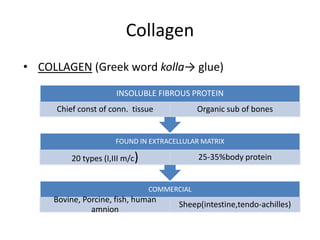
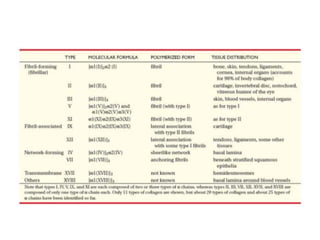
Collagen
• COLLAGEN (Greek word kolla→ glue)
COMMERCIAL
Bovine, Porcine, fish, human
amnion
Sheep(intestine,tendo-achilles)
FOUND IN EXTRACELLULAR MATRIX
20 types (I,III m/c) 25-35%body protein
INSOLUBLE FIBROUS PROTEIN
Chief const of conn. tissue Organic sub of bones
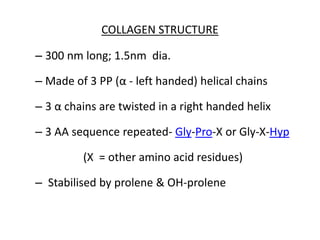
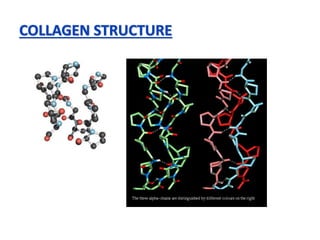
COLLAGEN STRUCTURE
– 300 nm long; 1.5nm dia.
– Made of 3 PP (α - left handed) helical chains
– 3 α chains are twisted in a right handed helix
– 3 AA sequence repeated- Gly-Pro-X or Gly-X-Hyp
(X = other amino acid residues)
– Stabilised by prolene & OH-prolene
COLLAGEN
• Reconstituted collagen
1st →solubilized & purified
2nd → reformed & repolymerizeed (drug)
3rd → thin form
Collagen (Kollagen)
– They are type 1 collagen bovine derived.
– Dressings come in pads, gels or particles.
– Promote the deposit of newly formed collagen in the wound bed.
– Absorb exudate and provide a moist environment.
– Consists of a porous collagen membrane attached to a unique
composite nylon mesh. The collagen sheet remains in close
contact with the wound, enabling a faster absorption and better
recovery, after the nylon mesh is detached from the sheet.
– Provides a collagen fibrous network similar to the dermis.
Common uses of collagen sheets:
– First and Second Degree Burns
– Donor sites
– Partial thickness wounds
Precautions:
– Should not be used on infected or contaminated spaces.
– Not to be used on patients sensitive to materials of bovine origin.
– Transitory pain, bleeding, blistering, edema and erythema have
occasionally been reported in isolated cases
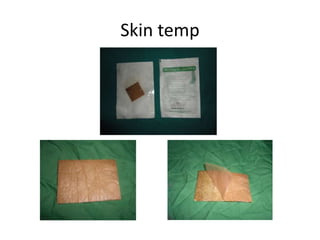
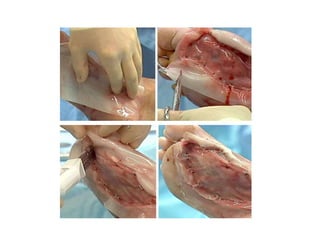
Skin temp
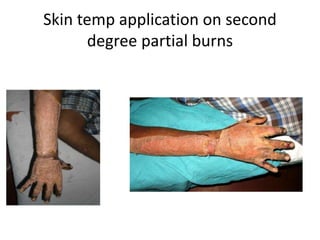
Skin temp application on second
degree partial burns
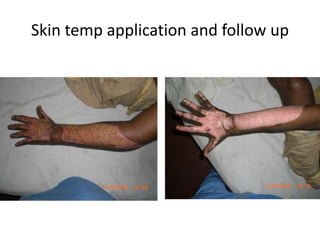
Skin temp application and follow up
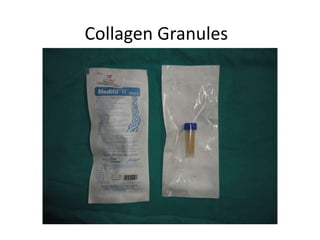
Collagen Granules
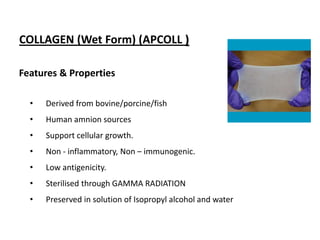
COLLAGEN (Wet Form) (APCOLL )
• Derived from bovine/porcine/fish
• Human amnion sources
• Support cellular growth.
• Non - inflammatory, Non – immunogenic.
• Low antigenicity.
• Sterilised through GAMMA RADIATION
• Preserved in solution of Isopropyl alcohol and water
Features & Properties
BIOSYNTHETIC SKIN SUBSTITUTES
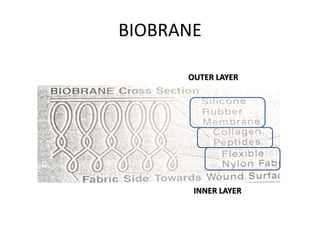
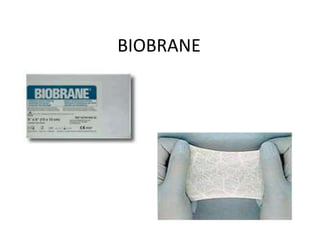
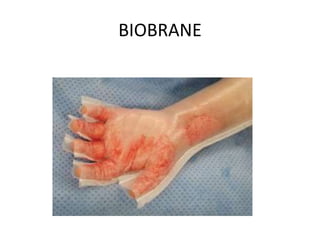
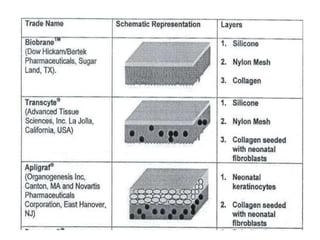
1. Biobrane :-
• Bilaminate membrane → Nylon mesh + silicone rubber
• Nylon mesh coated with porcine peptides from type I
collagen
• Silicone rubber:- semipermeable, passage of H2O
BIOSYNTHETIC SKIN SUBSTITUTES
1. Biobrane :-
– Application: within 72hrs
– Indications:
- Full thickness burns after excision of wound. While
preparing for autograft
- Superficial partial thickness burns
– C/I: Gross purulence, devitalised tissue
BIOBRANE
OUTER LAYER
INNER LAYER
BIOBRANE
BIOBRANE
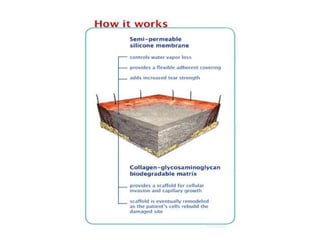
(INTEGRA)
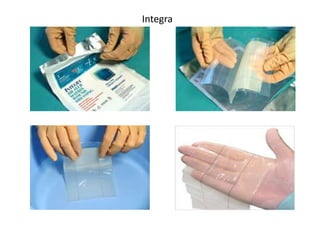
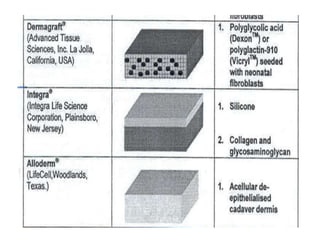
[Burkes & Yannas Artificial skin]
inner biodegradable memb.
[bovine collagen+
chondroitin SO4]
(dermal component)
Gets vascularised,
Fibroblasts migrate
Outer silicone(100μm)
[temporary]
(epiderm. component)
Protects wound from
dessication/infection
Removed after 3 wks
Integra
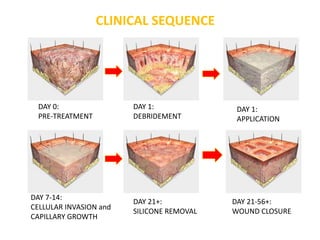
CLINICAL SEQUENCE
DAY 0:
PRE-TREATMENT
DAY 7-14:
CELLULAR INVASION and
CAPILLARY GROWTH
DAY 21+:
SILICONE REMOVAL
DAY 1:
DEBRIDEMENT
DAY 1:
APPLICATION
DAY 21-56+:
WOUND CLOSURE
INTEGRA
• After 2/3 wk
- outer silicone layer excised
- inner neodermis is biodegradble
• Disadvantage:- 1) very expensive
2) surgical procedures
BIOLOGICAL PERMANENT SKIN SUBSTITUTES
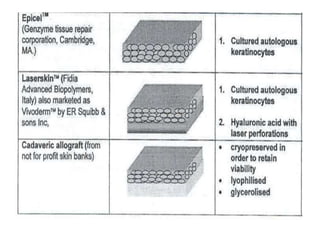
 CULTURED EPIDERMAL AUTOGRAFT(CEA)
1981: 1st clinical use
• Cultured: in vitro culture of human keratinocyte
• Epidermal: No dermal component
• Autograft: Host’s own cellular component
• Advantages:
Avoids donor site morbidity
Avoids the mesh aspect of STG
Disadvantages:
– Culture process require 21 days
– Fragile: difficult to handle
– Unpredictable take rate
– High cost
– Poor quality of healing & frequent breakdown
(Epidermal component only)
DERMAL SUBSTITUES
1) ACELLULAR DERMAL MATRIX (ADM) (alloderm)
– Derived from cadaver homograft - after removal of
epithelial/dermal cellular component
– 3 PROPERTIES
– very low antigenicity
– capacity for rapid vascularization
– stability as dermal template
• Uses: to support –thin STG & CEA
DERMAL SUBSTITUES
DERMAL EQUIVALENT (DERMAGRAFT)
– Bioabsorbable polygalactin mesh seeded with
allogenic neonatal fibroblast
– Indications:
- Burns/Chronic wounds
• Advantages:
No adv. Reactions/No rejection/No safety issues
Results as good as allograft
EPIDERMAL-DERMAL COMPOSITE CULTURED GRAFTS
(APLIGRAFT)
• BILAYERED LIVING SKIN EQUIVALENT
• Composition:
- Type I Bovine collagen+ Allogenic Keratinocyte +
Neonatal fibroblast
 epidermal layer of autologus epidermal cells
 dermal layer of allogenic fibroblasts & collagen
• Indications:
Partial/full thickness burns
Donor site of STG
Chronic wounds
• Not available for general clinical use
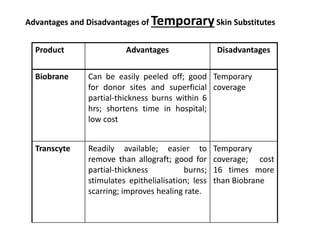
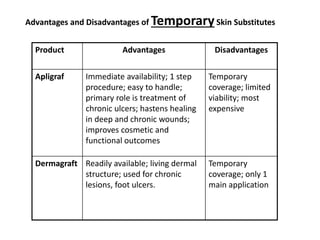
Advantages and Disadvantages of TemporarySkin Substitutes
Product Advantages Disadvantages
Biobrane Can be easily peeled off; good
for donor sites and superficial
partial-thickness burns within 6
hrs; shortens time in hospital;
low cost
Temporary
coverage
Transcyte Readily available; easier to
remove than allograft; good for
partial-thickness burns;
stimulates epithelialisation; less
scarring; improves healing rate.
Temporary
coverage; cost
16 times more
than Biobrane
Product Advantages Disadvantages
Apligraf Immediate availability; 1 step
procedure; easy to handle;
primary role is treatment of
chronic ulcers; hastens healing
in deep and chronic wounds;
improves cosmetic and
functional outcomes
Temporary
coverage; limited
viability; most
expensive
Dermagraft Readily available; living dermal
structure; used for chronic
lesions, foot ulcers.
Temporary
coverage; only 1
main application
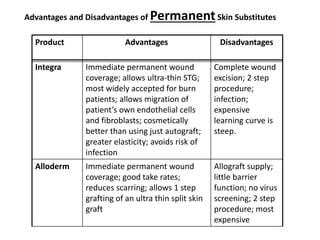
Advantages and Disadvantages of TemporarySkin Substitutes
Product Advantages Disadvantages
Integra Immediate permanent wound
coverage; allows ultra-thin STG;
most widely accepted for burn
patients; allows migration of
patient’s own endothelial cells
and fibroblasts; cosmetically
better than using just autograft;
greater elasticity; avoids risk of
infection
Complete wound
excision; 2 step
procedure;
infection;
expensive
learning curve is
steep.
Alloderm Immediate permanent wound
coverage; good take rates;
reduces scarring; allows 1 step
grafting of an ultra thin split skin
graft
Allograft supply;
little barrier
function; no virus
screening; 2 step
procedure; most
expensive
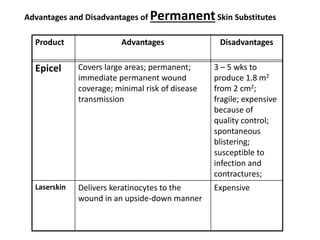
Advantages and Disadvantages of PermanentSkin Substitutes
Product Advantages Disadvantages
Epicel Covers large areas; permanent;
immediate permanent wound
coverage; minimal risk of disease
transmission
3 – 5 wks to
produce 1.8 m2
from 2 cm2;
fragile; expensive
because of
quality control;
spontaneous
blistering;
susceptible to
infection and
contractures;
Laserskin Delivers keratinocytes to the
wound in an upside-down manner
Expensive
Advantages and Disadvantages of PermanentSkin Substitutes
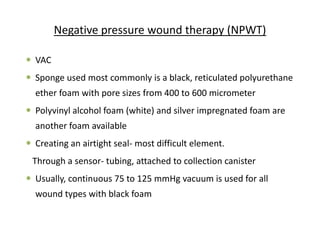
Negative pressure wound therapy (NPWT)
 VAC
 Sponge used most commonly is a black, reticulated polyurethane
ether foam with pore sizes from 400 to 600 micrometer
 Polyvinyl alcohol foam (white) and silver impregnated foam are
another foam available
 Creating an airtight seal- most difficult element.
Through a sensor- tubing, attached to collection canister
 Usually, continuous 75 to 125 mmHg vacuum is used for all
wound types with black foam
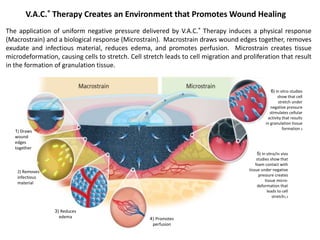
V.A.C.® Therapy Creates an Environment that Promotes Wound Healing
3) Reduces
edema
1) Draws
wound
edges
together
2) Removes
infectious
material
4) Promotes
perfusion
6) In vitro studies
show that cell
stretch under
negative pressure
stimulates cellular
activity that results
in granulation tissue
formation 2
5) In vitro/in vivo
studies show that
foam contact with
tissue under negative
pressure creates
tissue micro-
deformation that
leads to cell
stretch1,3
The application of uniform negative pressure delivered by V.A.C.® Therapy induces a physical response
(Macrostrain) and a biological response (Microstrain). Macrostrain draws wound edges together, removes
exudate and infectious material, reduces edema, and promotes perfusion. Microstrain creates tissue
microdeformation, causing cells to stretch. Cell stretch leads to cell migration and proliferation that result
in the formation of granulation tissue.
Application
• Acute wounds
• Chronic wounds
• Fasciotomy sites/extravasation injuries
• Skin grafts/artificial skin
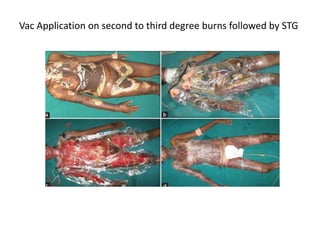
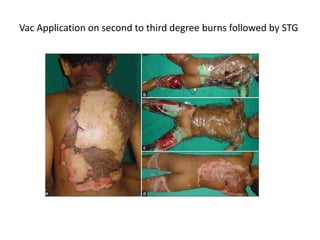
• 2nd and 3rd degree Burns
Contraindications and complications
• Uncleaned and undebrided wounds
• Thick exudates, necrotic material, and pus (clog the
sponge)
• Exposed vital structures (should be covered with
petroleum-impregnated gauze)
• Sponge is left for more than 3 days in growth of tissue
into the sponge material. These problems have been
tackled with some new technologies
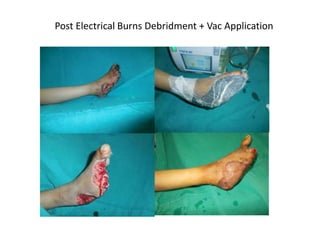
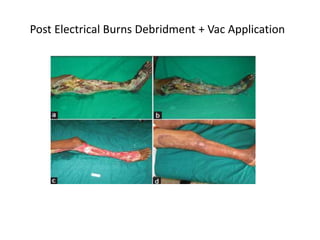
Post Electrical Burns Debridment + Vac Application
Vac Application on second to third degree burns followed by STG
Post Electrical Burns Debridment + Vac Application
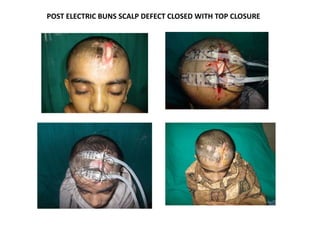
WOUND CLOSURE DEVICES
• Prior to any surgical procedure during which direct skin closure is
anticipated to take place under excessive tension, the system is used
to temporarily stretch skin tissues, thereby, avoiding the need for
tissue expanders, providing a non-invasive means of external tissue
expansion and avoiding excessive surgery with associated
complications.
• Closure of any wound without undermining without tension.
• Top Closure devices are one such system.
• Extensively used for electrical burns defect.
POST ELECTRIC BUNS SCALP DEFECT CLOSED WITH TOP CLOSURE
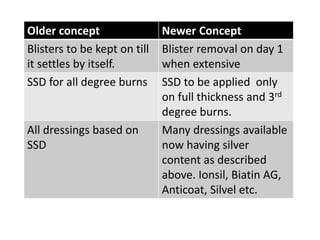
Older concept Newer Concept
Blisters to be kept on till
it settles by itself.
Blister removal on day 1
when extensive
SSD for all degree burns SSD to be applied only
on full thickness and 3rd
degree burns.
All dressings based on
SSD
Many dressings available
now having silver
content as described
above. Ionsil, Biatin AG,
Anticoat, Silvel etc.
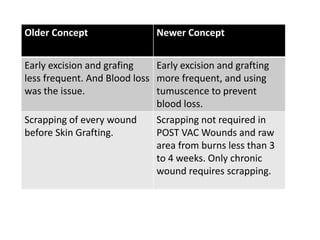
Older Concept Newer Concept
Early excision and grafing
less frequent. And Blood loss
was the issue.
Early excision and grafting
more frequent, and using
tumuscence to prevent
blood loss.
Scrapping of every wound
before Skin Grafting.
Scrapping not required in
POST VAC Wounds and raw
area from burns less than 3
to 4 weeks. Only chronic
wound requires scrapping.
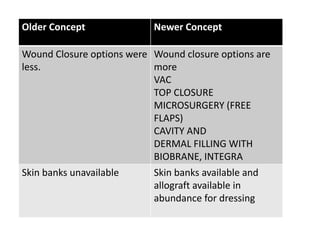
Older Concept Newer Concept
Wound Closure options were
less.
Wound closure options are
more
VAC
TOP CLOSURE
MICROSURGERY (FREE
FLAPS)
CAVITY AND
DERMAL FILLING WITH
BIOBRANE, INTEGRA
Skin banks unavailable Skin banks available and
allograft available in
abundance for dressing
THANK YOU

Dressing materials in burns

  • 1.
    Dressing Materials inBurns Dr. Hardik Dodia
  • 2.
    • Burns WoundBasics • Dressing materials • Older Concepts VS Newer concepts Topics Discussed
  • 4.
    IDEAL DRESSING MATERIAL •Moist environment • Bacterial barrier • Prevent loss of body fluid & blood protein • Allows for gaseous exchange • Reduction of heat dispersion • Enhance early physiological closure
  • 5.
    IDEAL DRESSING MATERIAL •Eliminate dead space • Protect against trauma, pressure and shear • Prevent particulate contamination • Nontraumatic • Easy to use • Cost-effective
  • 6.
     Four basicprinciples involved in choosing the optimal dressing for any individual wound  If a wound is desiccated, it needs to be hydrated (third degree burns).  If a wound has excessive exudate, the fluid needs to be absorbed (Second to Third Degree Burns).  If a wound has necrotic tissue or foreign debris, it needs to be debrided- mechanical/ chemical/ autolytic.  If a wound is infected, it needs to be treated with an antimicrobial agent. As the situation in the wound changes, the dressing must change as well
  • 7.
    CLASSIFICATION - Conventional dressing -Synthetic occlusive dressings
  • 8.
    CONVENTIONAL DRESSINGS • TYPES DRY  WET TO DRY  WET TO MOIST  IMPREGNATED  SILVER SULPHADIAZINE
  • 9.
    Dry dressing  Gauze •Inexpensive, reliable, widely available, highly absorbent . • Used as a primary dressing over ointments and secondary dressing over wound fillers and hydrogels. • Don’t use on partial/ full thickness wound. • Permeable to exogenous bacteria and is associated with a higher infection rate.
  • 10.
    Wet to drydressing  Gauze and saline • To debride tissue, fill cavities, absorb exudate and wick drainage • Local tissue cooling during the evaporation of saline– causes wound dessication. • Nonselective debridement and injury to healthy tissue • Used for full thickness and open wound • Don’t use on partial thickness wound
  • 11.
    Wet-to-moist gauze  Gauzeand saline • To maintain a moist environment. • To debride most necrotic wounds. • Requiring up to three dressing changes or manipulations per day if used correctly. • Partial-thickness, open and infected wounds. • Not useful for highly exudative wounds / severe maceration of surrounding tissue. • Difficult to use correctly since Wet To Moist often becomes Wet To Dry, achieving opposite of desired effect.
  • 12.
    Impregnated dressings • Impregnatedgauze with petroleum, iodine, zinc or antibacterial compound. • Non adhesive • Help reduce bacterial proliferation. • Add moisture to wounds. • First degree burns and partial second degree burns wound. • Skin grafts and donor sites with minimal to moderate exudate, abrasions and lacerations. • Not useful in heavily exudating wounds.
  • 13.
    • Jelonet (Petroleumbased paraffin gauze) • Bactigras (0.5% chlorhexidine) • Sofra Tulle (framycetin) • Fucidin Intertulle (fusidic acid) • Xeroform (3% bismuth tribromophenate).
  • 15.
    SILVER SULPHADIAZINE • Mostcommonly used topical agent in burns. • Silver Sulfadiazine Cream, USP 1% is a soft, white, water dispersible cream containing the antimicrobial agent silver sulfadiazine in micronized form for topical application. Each gram of Silver Cream contains 10mg of micronized silver sulfadiazine. • Sulfadiazine Silver sulfadiazine has broad antimicrobial activity. (gram-negative, gram-positive bacteria, yeast)
  • 16.
    • Mechanism ofaction:- • Silver ion kills bacteria by destroying cell wall of bacteria and also kills by direct DNA inhibiton and breakdown. • Sulfadiazine is PABA inhibitor. There by cutting of bacterial replication of the bacteria. • Indication • Silver Sulfadiazine Cream, USP 1% is a topical antimicrobial drug indicated as an adjunct for the prevention and treatment of wound sepsis in patients with second and third degree burns.
  • 17.
    • Contraindications:- • Hypersensitiveto silver sulfadiazine or any of the other ingredients in the preparation. • Pregnant women approaching or at term • Premature infants • Newborn infants during the first 2 months of life. • Adverse Reactions:- • Transient leukopenia. • Leukopenia (decreased neutrophil count) • Skin necrosis, erythema multiforme, skin discoloration, burning sensation, rashes, and interstitial nephritis.
  • 18.
  • 19.
    SYNTHETIC OCCLUSIVE DRESSINGS Types: – Semipermeable films – Hydrogels – Hydrocolloids – Foams – Alginates – Hydrofibers – Silver dressings – Collagen dressings
  • 20.
    FILMS • Semipermeable dressingmaterial • Polyurethane/ Polyethylene • Adhesive coating on one side • Allows water vapor, O2, and other gases permeation • Impermeable to water and bacteria • May be combined with more absorptive dressings (e.g., gauze) and antimicrobial agents.
  • 21.
    Advantages:-  Reduce painby keeping wound moist  Allows inspection of wound  Elastic property- conform to the surface and prevent shear- tear  Infrequent changing  Good compliance Drawback:-  Nonabsorbent, not for exudative wounds and infected wounds  Removal may strip off newly formed epithelium
  • 22.
    Use: – Superficial topartial dermal burns – Primarily closed surgical wounds – Skin graft donor site Application : • At least one inch of surrounding skin should be utilized for proper sticking which can be aided by the use of tincture benzoin. • Can be left in place for several days but must be changed earlier if exudate leaks into surrounding skin.
  • 23.
    Transparent Films  Acu-derm Bioclusive  Blisterfilm  Polyskin II  Pro-Clude  Op-Site  Opraflex  Tegaderm  Transeal  Transite  Uniflex  Ventex 12/1/2017 23
  • 24.
  • 25.
  • 27.
    HYDROGELS  Transparent polyethylenemembranes with water as 90% composition  Sheets and fillers  Nonadhesive and need cover dressing  Promote autolytic debridement (water is donated from gel to rehydrate and soften necrotic tissue),however overuse may cause wound maceration.  Immediate cooling effect on wound
  • 28.
    Use: – Dry, necroticor minimally exudative wounds. – 2nd degree partial burns, blisters – Shallow, noninfected pressure ulcers – Radiation injuries – Donor sites  Do not use on moderate to heavily exudating wounds, full-thickness burns, intact skin.
  • 29.
    Disadvantage: – Requires secondarydressing as gauze or tranparent film – As it requires fixation, not allowed bathing – Wound need to be inspected regularly Application: – Sheets should be used on superficial wounds <5mm in depth and fillers for deeper wounds. – Can’t be left for > 1-2 days, it dries out and lose effectiveness, may get colonised in infective environment.
  • 30.
    Hydrogels  AquaSorb  CarringtonGel  Carrasyn-V  Clear-Site  Curasol Gel  Flexderm  Hydron  Intrasite Gel  Solosite  SAF-Gel  Transorb  WounDres
  • 31.
  • 32.
    HYDROCOLLOIDS  Composed ofhydrophilic, self-adhesive, gel-forming particles- gelatin/ pactin, covered by outer film/ foam layer.  Opaque, impermeable to bacteria, absorbent to exudate.  Adhere to surface, without sticking to wound bed, waterproof and relatively painless.  On absorption of exudate, form swollen gel, act as sponge and conform to wound contour.  Faster autolytic debridement of wound- may cause initial enlargement of wound.  Encourage granulation & reepithelialization.
  • 33.
     Require infrequentremoval  “Gel and smell phenomenon”- removal of hydrocolloid leaves odorous residue of adhesive mixed with wound exudate Uses:  Partial- or full-thickness wounds with minimal exudate  Minimal exudate/ slough and granulation tissue
  • 34.
     Do notuse on infected wounds, heavily exudating wounds, wounds with friable surrounding skin, full- thickness burns Application: – At least one inch of surrounding skin should be covered to ensure adherence – Can remain in place for up to 7 days or until exudate leaks and comes within one cm of the dressing edges
  • 36.
    Hydrocolloids  Comfeel  CutinovaHydra  Duoderm  Hydrapad  J&J Ulcer Dressing  Procol  Replicare  Restore  Triad  Ultec 12/1/2017 36
  • 37.
  • 39.
  • 40.
    Alginates • Calcium saltsof alginic acid- derived from seaweeds • Applied to wounds, sodium and calcium ions interact to form a hydrophilic gel and conform to the wound, thereby functioning to absorb exudate and fill dead space • Manufactured in fiber sheets, packing ribbon, pastes, granules and powders • Capable of absorbing fluid up to 20 times their weight • Provide a moist environment, are highly absorptive, and prevent microbial contamination
  • 41.
    • Combined withcharcoal or silver to increase beneficial effects • Indicated for wounds with moderate to high exudate, and may be used on partial- or full- thickness, and granulating or necrotic wounds • Should not be used on dry/ minimally exudative wounds because they will adhere to the wound and cause damage when removedy
  • 42.
    Application :- • Sheetsare used on shallow wounds and pastes/powders to fill deep wounds and require secondary dressing • Should not be packed into very deep or tunneling wounds, as they may easily be left behind leaving a residual nidus for infection • Should only fill one-third to one-half of the wound since they will expand with time • May be left in place for up to 7 days or until the exudate reaches the secondary dressing • Nu-derm, kaltostat, curasorb, sorbsan
  • 46.
    Hydrofibers • Consist ofsodium carboxymethylcellulose and manufactured in ribbons and sheets • Structurally similar to alginates and have same properties • Excellent ability to absorb exudate • Require cover dressing • May stay on up to 7 days • Aquacel
  • 47.
  • 49.
    Foams • Composed ofpolyurethane polymers • Absorb wound exudate • Thin and thick foams, adhesive and nonadhesive foams and foams used to pack wounds • Facilitate autolytic debridement • Not as useful as alginates or hydrocolloids for debridement • Can be combined with silver for antimicrobial property • Allevyn , Lyofoam, Biatin Ag
  • 50.
    – Used forwounds with moderate to high exudate, partial- or full-thickness wounds and granulating wounds – Do not use on dry or low exudating wounds as this will cause dryness and scabbing Application :- – At least one inch of surrounding skin should be covered – Can be left on the wound surface for up to seven days – Can be used on infected wounds if changed daily
  • 51.
    Foams  Examples  Allevyn Cutinova Foam  Epilock  Flexzam  Hydrasorb  Lyofoam  Mitraflex  Polymem  Tielle  Biatin Ag
  • 52.
  • 55.
    Silver dressings • Dressingshave become available that release charge silver atoms (ionic Ag+) on contact with the wound fluid. One free radicle kills one pathogen. • Silver ion has property to penetrate biofilms (resistant layer formed by microbes to antibiotics). • The amount/rate of ionic silver release from different dressings is variable. • Initial release of high levels followed by sustained release appears to aid reduction in bacterial numbers and a wide spectrum of activity. • Ag ions are available in nanocrystalline form. • Staining of the wound bed or surrounding skin by ionic silver dressings may occur occasionally and is usually reversible Eg ACTICOAT, SILVEL
  • 56.
  • 57.
  • 58.
    Advantages of occlusivedressings • Protect wound • Decrease risk of infection • Trapping moisture in wound bed • Prevent drying, cracking and dessication of wound- Pain free, comfortable • Infrequent change • Decreases healing time • Don’t retard healing by stripping away epithelium
  • 60.
    SKIN SUBSTITUTES  Classificationbased on Composition – Class I: Temporary dressings A. Single Layer Materials: i. Biological/Naturally occuring: Amniotic membrane Potato peel ii.Synthetic: Polymer sheet: Tegaderm, Opsite Polymer foam/spray. B.Bilayered tissue engineered: Transcyte
  • 61.
     Classification basedon Composition – Class II: Single layer durable skin substitutes A. Epidermal substitutes: CEA, Apligraft B. Dermal Substitutes: i. Bovine collagen sheet – Kollagen ii.Porcine collagen sheet iii.Bovine dermal matrix- Matriderm iv.Human dermal matrix- Alloderm – Class III: Composite Skin Substitutes A. Skin Graft: Allograft, Xenograft B. Tissue Engineered Skin Substitutes: i. Dermal regeneration template- Integra ii.Biobrane
  • 62.
    BASIC DEFINITIONS OFBIOLOGICAL COVERINGS • AUTOGRAFT • HOMO(ALLO)GRAFT • HETEROGRAFT (XENO-GRAFT) • ISOGRAFT(SYNERGIC -GRAFT) • ORTHOTOPIC-GRAFT • HETEROTOPIC-GRAFT
  • 63.
     The bestmaterial for wound closure is the patient’s own skin; however autografting has disadvantages (Schulz, 2000): 1. The donor site is a new wound. 2. Scarring and pigmentation changes occur. 3. Dermis is not replaced. 4. Donor site is a potential site for infection. 5. Donor site is not unlimited. 6. Extensive burns makes it impossible.
  • 64.
    AUTOGENOUS SKINGRAFTS • Indication:Permanent coverage • STSG/FTSG • Mesh/sheet graft • For a good graft take:  suitable bed  Apposition to recepient site  securing grafts/immobilisation • Storage: 3 weeks at 4-70C
  • 65.
    ALLOGRAFT • History: GURDNER(1881):1st described BROWN & FRYER(1953): popularized • Function: temporary cover vascularisation preparation of wound bed for autograft • Types: Live donor allograft Cadaver allograft Cryopreserved Glycerol preserved
  • 66.
    ALLOGRAFT • Live donorallograft. • Largely been abandoned now d/t scarring of the donor area & associated morbidity.
  • 67.
    – Extensive woundswhen autologous tissue is not available – Coverage of widely meshed skin autografts – Extensive partial thickness burns – Extensive epidermal slough Stevens-Johnson Syndrome TEN SSSS – Testing wound bed to accept autograft – Template for delayed application of keratinocytes ALLOGRAFT Indications for use:
  • 68.
    • ↓ Water,electrolyte & Protein loss • Prevents tissue dessication • ↓ bacterial proliferation • ↓ wound pain • ↓ energy requirements • ↑ epithelialization • Prepare wound for definitive closure • Provide dermal template for epidermal grafts ALLOGRAFT Advantages
  • 69.
    • Disease transmission: Bacterial, HIV,CMV (discard if pathogenic bacteria/fungi are present[AATB]) • Rejection: Contains Langerhans cells(Class II HLA) • Lack of availability ALLOGRAFT Disadvantages:-
  • 70.
    HETEROGRAFT PORCINE SKIN HETEROGRAFT: (Bromerg & Song; 1965) – 3 forms: i. fresh ii. Refrigerated frozen iii. lyophilized – No vascularization→ Only used as dressing – Application: any denuded surface → Vascularisation /Classic rejection doesn’t occur
  • 71.
    AMNIOTIC MEMBRANE History: 1960: JPigeon : 1st used 1973:Robson & Kreizek: ↓ bacterial count 1970: Glask & Snyder: contains lysozyme, E, P 1981:Thomson & Parks/1987: Haberal et al: promotes epithelialisation • BOVINE AMNIOTIC MEMBRANE- - Thin & transparent, pores
  • 72.
    • HUMAN AMNIOTICMEMBRANE How it is obtained? – from placenta – from Sero -Ve – cleaned in NS, cotyledons removed Storage: 0.25% Sod Hypochlorite at – 300C to – 900C in deep freezer for any length of time Immediate use: treated with gentamicin Derived from: Ectoderm/ Type IV collagen AMNIOTIC MEMBRANE
  • 73.
    • Advantages: Very thin/easilyadherant/easy to spread/ conforms to contour ↓ pain Moist environment Helps epithelialisation Exudation of discharge can occur(pores)  Disadvantages: cumbersome to separate/prepare/store infection transmission AMNIOTIC MEMBRANE
  • 74.
    • Uses: II0 burns(superficial & deep) AMNIOTIC MEMBRANE
  • 75.
    Collagen • COLLAGEN (Greekword kolla→ glue) COMMERCIAL Bovine, Porcine, fish, human amnion Sheep(intestine,tendo-achilles) FOUND IN EXTRACELLULAR MATRIX 20 types (I,III m/c) 25-35%body protein INSOLUBLE FIBROUS PROTEIN Chief const of conn. tissue Organic sub of bones
  • 77.
    COLLAGEN STRUCTURE – 300nm long; 1.5nm dia. – Made of 3 PP (α - left handed) helical chains – 3 α chains are twisted in a right handed helix – 3 AA sequence repeated- Gly-Pro-X or Gly-X-Hyp (X = other amino acid residues) – Stabilised by prolene & OH-prolene
  • 79.
    COLLAGEN • Reconstituted collagen 1st→solubilized & purified 2nd → reformed & repolymerizeed (drug) 3rd → thin form
  • 80.
    Collagen (Kollagen) – Theyare type 1 collagen bovine derived. – Dressings come in pads, gels or particles. – Promote the deposit of newly formed collagen in the wound bed. – Absorb exudate and provide a moist environment. – Consists of a porous collagen membrane attached to a unique composite nylon mesh. The collagen sheet remains in close contact with the wound, enabling a faster absorption and better recovery, after the nylon mesh is detached from the sheet. – Provides a collagen fibrous network similar to the dermis.
  • 81.
    Common uses ofcollagen sheets: – First and Second Degree Burns – Donor sites – Partial thickness wounds Precautions: – Should not be used on infected or contaminated spaces. – Not to be used on patients sensitive to materials of bovine origin. – Transitory pain, bleeding, blistering, edema and erythema have occasionally been reported in isolated cases
  • 82.
  • 83.
    Skin temp applicationon second degree partial burns
  • 84.
    Skin temp applicationand follow up
  • 85.
  • 86.
    COLLAGEN (Wet Form)(APCOLL ) • Derived from bovine/porcine/fish • Human amnion sources • Support cellular growth. • Non - inflammatory, Non – immunogenic. • Low antigenicity. • Sterilised through GAMMA RADIATION • Preserved in solution of Isopropyl alcohol and water Features & Properties
  • 87.
    BIOSYNTHETIC SKIN SUBSTITUTES 1.Biobrane :- • Bilaminate membrane → Nylon mesh + silicone rubber • Nylon mesh coated with porcine peptides from type I collagen • Silicone rubber:- semipermeable, passage of H2O
  • 88.
    BIOSYNTHETIC SKIN SUBSTITUTES 1.Biobrane :- – Application: within 72hrs – Indications: - Full thickness burns after excision of wound. While preparing for autograft - Superficial partial thickness burns – C/I: Gross purulence, devitalised tissue
  • 89.
  • 90.
  • 91.
  • 92.
    (INTEGRA) [Burkes & YannasArtificial skin] inner biodegradable memb. [bovine collagen+ chondroitin SO4] (dermal component) Gets vascularised, Fibroblasts migrate Outer silicone(100μm) [temporary] (epiderm. component) Protects wound from dessication/infection Removed after 3 wks
  • 93.
  • 94.
    CLINICAL SEQUENCE DAY 0: PRE-TREATMENT DAY7-14: CELLULAR INVASION and CAPILLARY GROWTH DAY 21+: SILICONE REMOVAL DAY 1: DEBRIDEMENT DAY 1: APPLICATION DAY 21-56+: WOUND CLOSURE
  • 97.
    INTEGRA • After 2/3wk - outer silicone layer excised - inner neodermis is biodegradble • Disadvantage:- 1) very expensive 2) surgical procedures
  • 98.
    BIOLOGICAL PERMANENT SKINSUBSTITUTES  CULTURED EPIDERMAL AUTOGRAFT(CEA) 1981: 1st clinical use • Cultured: in vitro culture of human keratinocyte • Epidermal: No dermal component • Autograft: Host’s own cellular component • Advantages: Avoids donor site morbidity Avoids the mesh aspect of STG
  • 99.
    Disadvantages: – Culture processrequire 21 days – Fragile: difficult to handle – Unpredictable take rate – High cost – Poor quality of healing & frequent breakdown (Epidermal component only)
  • 100.
    DERMAL SUBSTITUES 1) ACELLULARDERMAL MATRIX (ADM) (alloderm) – Derived from cadaver homograft - after removal of epithelial/dermal cellular component – 3 PROPERTIES – very low antigenicity – capacity for rapid vascularization – stability as dermal template • Uses: to support –thin STG & CEA
  • 101.
    DERMAL SUBSTITUES DERMAL EQUIVALENT(DERMAGRAFT) – Bioabsorbable polygalactin mesh seeded with allogenic neonatal fibroblast – Indications: - Burns/Chronic wounds • Advantages: No adv. Reactions/No rejection/No safety issues Results as good as allograft
  • 102.
    EPIDERMAL-DERMAL COMPOSITE CULTUREDGRAFTS (APLIGRAFT) • BILAYERED LIVING SKIN EQUIVALENT • Composition: - Type I Bovine collagen+ Allogenic Keratinocyte + Neonatal fibroblast  epidermal layer of autologus epidermal cells  dermal layer of allogenic fibroblasts & collagen • Indications: Partial/full thickness burns Donor site of STG Chronic wounds • Not available for general clinical use
  • 106.
    Advantages and Disadvantagesof TemporarySkin Substitutes Product Advantages Disadvantages Biobrane Can be easily peeled off; good for donor sites and superficial partial-thickness burns within 6 hrs; shortens time in hospital; low cost Temporary coverage Transcyte Readily available; easier to remove than allograft; good for partial-thickness burns; stimulates epithelialisation; less scarring; improves healing rate. Temporary coverage; cost 16 times more than Biobrane
  • 107.
    Product Advantages Disadvantages ApligrafImmediate availability; 1 step procedure; easy to handle; primary role is treatment of chronic ulcers; hastens healing in deep and chronic wounds; improves cosmetic and functional outcomes Temporary coverage; limited viability; most expensive Dermagraft Readily available; living dermal structure; used for chronic lesions, foot ulcers. Temporary coverage; only 1 main application Advantages and Disadvantages of TemporarySkin Substitutes
  • 108.
    Product Advantages Disadvantages IntegraImmediate permanent wound coverage; allows ultra-thin STG; most widely accepted for burn patients; allows migration of patient’s own endothelial cells and fibroblasts; cosmetically better than using just autograft; greater elasticity; avoids risk of infection Complete wound excision; 2 step procedure; infection; expensive learning curve is steep. Alloderm Immediate permanent wound coverage; good take rates; reduces scarring; allows 1 step grafting of an ultra thin split skin graft Allograft supply; little barrier function; no virus screening; 2 step procedure; most expensive Advantages and Disadvantages of PermanentSkin Substitutes
  • 109.
    Product Advantages Disadvantages EpicelCovers large areas; permanent; immediate permanent wound coverage; minimal risk of disease transmission 3 – 5 wks to produce 1.8 m2 from 2 cm2; fragile; expensive because of quality control; spontaneous blistering; susceptible to infection and contractures; Laserskin Delivers keratinocytes to the wound in an upside-down manner Expensive Advantages and Disadvantages of PermanentSkin Substitutes
  • 110.
    Negative pressure woundtherapy (NPWT)  VAC  Sponge used most commonly is a black, reticulated polyurethane ether foam with pore sizes from 400 to 600 micrometer  Polyvinyl alcohol foam (white) and silver impregnated foam are another foam available  Creating an airtight seal- most difficult element. Through a sensor- tubing, attached to collection canister  Usually, continuous 75 to 125 mmHg vacuum is used for all wound types with black foam
  • 111.
    V.A.C.® Therapy Createsan Environment that Promotes Wound Healing 3) Reduces edema 1) Draws wound edges together 2) Removes infectious material 4) Promotes perfusion 6) In vitro studies show that cell stretch under negative pressure stimulates cellular activity that results in granulation tissue formation 2 5) In vitro/in vivo studies show that foam contact with tissue under negative pressure creates tissue micro- deformation that leads to cell stretch1,3 The application of uniform negative pressure delivered by V.A.C.® Therapy induces a physical response (Macrostrain) and a biological response (Microstrain). Macrostrain draws wound edges together, removes exudate and infectious material, reduces edema, and promotes perfusion. Microstrain creates tissue microdeformation, causing cells to stretch. Cell stretch leads to cell migration and proliferation that result in the formation of granulation tissue.
  • 112.
    Application • Acute wounds •Chronic wounds • Fasciotomy sites/extravasation injuries • Skin grafts/artificial skin • 2nd and 3rd degree Burns
  • 113.
    Contraindications and complications •Uncleaned and undebrided wounds • Thick exudates, necrotic material, and pus (clog the sponge) • Exposed vital structures (should be covered with petroleum-impregnated gauze) • Sponge is left for more than 3 days in growth of tissue into the sponge material. These problems have been tackled with some new technologies
  • 114.
    Post Electrical BurnsDebridment + Vac Application
  • 115.
    Vac Application onsecond to third degree burns followed by STG
  • 116.
    Vac Application onsecond to third degree burns followed by STG
  • 117.
    Post Electrical BurnsDebridment + Vac Application
  • 118.
    WOUND CLOSURE DEVICES •Prior to any surgical procedure during which direct skin closure is anticipated to take place under excessive tension, the system is used to temporarily stretch skin tissues, thereby, avoiding the need for tissue expanders, providing a non-invasive means of external tissue expansion and avoiding excessive surgery with associated complications. • Closure of any wound without undermining without tension. • Top Closure devices are one such system. • Extensively used for electrical burns defect.
  • 119.
    POST ELECTRIC BUNSSCALP DEFECT CLOSED WITH TOP CLOSURE
  • 120.
    Older concept NewerConcept Blisters to be kept on till it settles by itself. Blister removal on day 1 when extensive SSD for all degree burns SSD to be applied only on full thickness and 3rd degree burns. All dressings based on SSD Many dressings available now having silver content as described above. Ionsil, Biatin AG, Anticoat, Silvel etc.
  • 121.
    Older Concept NewerConcept Early excision and grafing less frequent. And Blood loss was the issue. Early excision and grafting more frequent, and using tumuscence to prevent blood loss. Scrapping of every wound before Skin Grafting. Scrapping not required in POST VAC Wounds and raw area from burns less than 3 to 4 weeks. Only chronic wound requires scrapping.
  • 122.
    Older Concept NewerConcept Wound Closure options were less. Wound closure options are more VAC TOP CLOSURE MICROSURGERY (FREE FLAPS) CAVITY AND DERMAL FILLING WITH BIOBRANE, INTEGRA Skin banks unavailable Skin banks available and allograft available in abundance for dressing
  • 123.

Editor's Notes

  • #13 Do not use on heavily exudating wounds
  • #28 IntraSite, Saf-Gel, Curasol, Tegagel
  • #112  The V.A.C.® Therapy System is an integrated wound management system* for use in acute, extended and home care settings. It is intended to create an environment that promotes wound healing by secondary or tertiary (delayed primary) intention by preparing the wound bed for closure, reducing edema, promoting granulation tissue formation and perfusion, drawing wound edges together, and removing exudates and infectious material. It is indicated for patients with chronic, acute, traumatic, sub-acute and dehisced wounds, partial-thickness burns, ulcers (such as diabetic, pressure or venous insufficiency), flaps and grafts. Saxena SM, et al. Vacuum Assisted Closure: Microdeformations of Wounds and Cell Proliferation. Plastic & Reconstructive Surgery, 2004;114(5):1086-1095 McNulty: AK, et al. Effects of negative pressure wound therapy on the fibroblast viability, chemotactic signaling and proliferation in a provisional wound (fibrin) matrix. Wound, 2007; 15:838-846 McNulty AK, et al. Effects of negative pressure wound therapy on cellular energetics in fibroblasts grown in a provisional wound (fibrin) matrix. Wound Repair and Regeneration. 2009 Mar;17(3):192-9.   *Includes the ActiV.A.C.® , InfoV.A.C.®, V.A.C.® Freedom, V.A.C. ATS® and V.A.C.Via™ Therapy Systems (DOES NOT include V.A.C. Instill®, V.A.C.Ulta ™ (when using installation therapy) and Prevena™ Systems)