Electrical Injuries
Andy Steval 04/02/2015
Contents
 Pathophysiology
 Epidemiology
 Types of Electrical injury
 Organ effects
 Management in the ED
 Common pitfalls
Pathophysiology
Current (I)
Resistance (R)
Voltage (V)
 I = V/R (Ohm’s law)
 Extent of damaged based on:
 Voltage
 Current
 Resistance to tissues
 Duration of contact
 Type of current (AC or DC)
 Path of current flow
 Alternating current (AC) and Direct Current (DC)
 The Amperage at which the human body is able to
withdraw from an electrical stimulus
 Once this is surpassed:
 Tetany
 Respiratory arrest
 Ventricular fibrillation
 Occurs more readily at higher currents, and alternating
current (AC)
The ‘let go current’
Types of electrical injury
Low-voltage High-voltage Lightning strike
• <1000 volts
• Alternating current
• Prolonged contact
• Ventricular Fibrillation
• Tetanic contraction
• Superficial Burns
• Rhabdo unlikely
• >1000 volts
• AC or DC
• Brief Contact
• Asystole
• Tetanic Sometimes
• Deep Burns
• Rhabdo Likely
• Up to 2 billions volts
• Direct Current
• Several milliseconds
• Asystole
• No tetany
• Variable tissue
damage
• Rhabdo unlikely
Organ effects
CNS
Cardiac
Orthopaedic
Dermatological
Abdominal
Ocular
Auditory
Respiratory
Cardiac
 Incidence of arrhythmia ranging from 4–17%
 VF more common in low voltage DC shocks. Asystole
more common in High voltage events.
 Virtually any abnormality possible: Increased PR/QT,
Ectopics, St segment, bundle branch blocks, etc
 Also: Direct myocardial injury
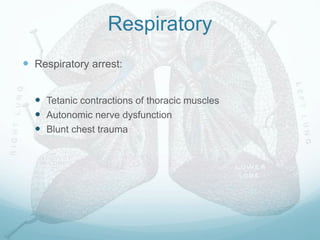
Respiratory
 Respiratory arrest:
 Tetanic contractions of thoracic muscles
 Autonomic nerve dysfunction
 Blunt chest trauma
Neurological
 CNS damage: High voltage injuries
 Loss of consciousness, agitation, coma, seizures
 Spinal cord damage
 PNS damage: Low voltage injuries
 Parasthesiae, Brachial plexus injuries
Orthopaedic
 Direct thermal energy leading to coagulation necrosis
 Secondary rhabdomyolysis, compartment syndrome
 Osteonecrosis
 Secondary fractures/dislocations from tetany and falls
Dermatological
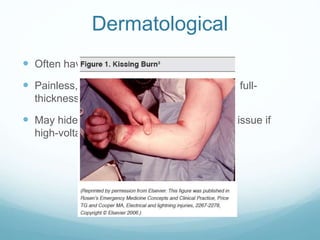
 Often have entry and exit burns
 Painless, grey to yellow depressed areas if full-
thickness
 May hide extensive underlying damage to tissue if
high-voltage injury
Others
 Abdominal: Stress (Curling) ulcer, abdominal
perforation
 Renal: AKI secondary to rhabdomyolysis
 Ocular: Delayed onset cataracts in 6% high voltage
injuries, higher in lightning strike
 Auditory: Perforated TM, cochlear damage, VIII CN
damage
Management in the ED
 Low voltage injuries <240 volts:
 Asymptomatic patients with a normal ECG on arrival
and no abnormal clinical findings on examination
can be discharged with advice
 No other investigations needed
 Not even cardiac monitoring
 Not even a urine dip
 Just go home please (with advice)
Management in the ED
 Red flags in the history and exam for more serious
injury (if low voltage patient):
 chest pain, palpations
 loss of consciousness, altered mental status,
confusion, weakness
 dyspnea, abdominal pain, weakness, burn with
subcutaneous damage
 vascular compromise, or abnormal results on ECG
Management in the ED
 Further investigations in red flag patients:
 Urinary and serum myoglobin
 CK
 FBCs, U&Es, LFTS, Lipase, Coag studies
 Imaging where appropriate
 Admit these patients
Management in the ED
 Admit all high voltage (>600 volts) injuries
 These patients will likely need transfer to a burns
centre if not immediate life threatening injuries
Management in the ED
 Cutaneous injuries:
 Basic burns treatment for cutaneous burns
 Liaison with burns centre for more extensive injury
 Tetanus Prophylaxis
Management in the ED
 Injuries to extremities:
 Close monitoring for signs of compartment syndrome
 Elevation of limb and splinting
 Fracture and dislocation reduction
Management in the ED
 Myoglobinuria
 Places patients in high risk of renal failure
 Treat with aggressive fluid resuscitation until urine is
clear and any acidosis is corrected
 Consider bicarbonate and mannitol
Special considerations
 Lightning strikes:
 Virtually anyone who is struck by lightning who does
not suffer immediate cardiac or respiratory arrest will
survive
 Therefore at the scene, patients who appear dead
should be treated first. Often young patients with a
good change of surviving CPR
 Multiple delayed injuries: Neurological demyelination,
cataracts – need careful follow up after discharge
Common Pitfalls
(Taken from Emergency Medicine Practice, electrical injuries review)1
 “Results from the patient’s eye examination were
normal when he presented to the ED after a
lightning injury last month. I don’t know why he’s
back now weeks later complaining of decreased
vision.”
 Delayed onset cataracts
Common Pitfalls
(Taken from Emergency Medicine Practice, electrical injuries review)1
 “The patient’s shoulder appeared normal on
examination and an anteroposterior (AP) radio-
graph looked fine to me. I don’t know how I missed
a posterior dislocation.”
 Tetany causes posterior dislocations
Common Pitfalls
(Taken from Emergency Medicine Practice, electrical injuries review)1
 “I saw this patient in the ED 3 months ago with a
minor electrical injury to her hand. I don’t know
why she’s back now complaining of diffuse pain,
swelling, and coolness of her entire forearm.”
 CRPS
Common Pitfalls
(Taken from Emergency Medicine Practice, electrical injuries review)1
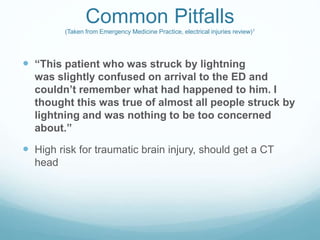
 “This patient who was struck by lightning
was slightly confused on arrival to the ED and
couldn’t remember what had happened to him. I
thought this was true of almost all people struck by
lightning and was nothing to be too concerned
about.”
 High risk for traumatic brain injury, should get a CT
head
Common Pitfalls
(Taken from Emergency Medicine Practice, electrical injuries review)1
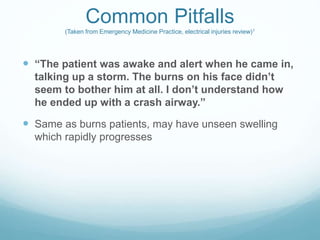
 “The patient was awake and alert when he came in,
talking up a storm. The burns on his face didn’t
seem to bother him at all. I don’t understand how
he ended up with a crash airway.”
 Same as burns patients, may have unseen swelling
which rapidly progresses
Common Pitfalls
(Taken from Emergency Medicine Practice, electrical injuries review)1
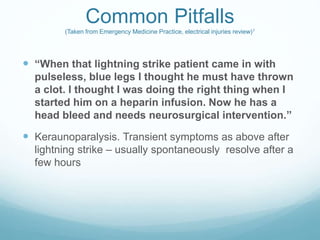
 “When that lightning strike patient came in with
pulseless, blue legs I thought he must have thrown
a clot. I thought I was doing the right thing when I
started him on a heparin infusion. Now he has a
head bleed and needs neurosurgical intervention.”
 Keraunoparalysis. Transient symptoms as above after
lightning strike – usually spontaneously resolve after a
few hours
Common Pitfalls
(Taken from Emergency Medicine Practice, electrical injuries review)1
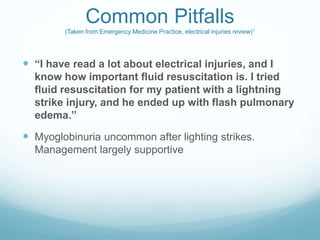
 “I have read a lot about electrical injuries, and I
know how important fluid resuscitation is. I tried
fluid resuscitation for my patient with a lightning
strike injury, and he ended up with flash pulmonary
edema.”
 Myoglobinuria uncommon after lighting strikes.
Management largely supportive
Common Pitfalls
(Taken from Emergency Medicine Practice, electrical injuries review)1
 “I took care of this 3–year-old girl 2 weeks ago
when she presented with an oral arc burn. She was
healing well. I don’t understand why she is back
now with severe bleeding.”
 Common after children bite into electrical cords.
Delayed bleeding can occur when eschar separates at
2 weeks and labial artery tears (5-10%)
References
 1.) Emergency Medicine Practice - Electrical injuries, a Review for the Emergency
Clinician. Oct 2009
 2.)Tintinalli’s Emergency Medicine
 3.) Leesa ‘The Squid’ Equid

Electrical injuries

  • 1.
  • 2.
    Contents  Pathophysiology  Epidemiology Types of Electrical injury  Organ effects  Management in the ED  Common pitfalls
  • 3.
  • 4.
     I =V/R (Ohm’s law)  Extent of damaged based on:  Voltage  Current  Resistance to tissues  Duration of contact  Type of current (AC or DC)  Path of current flow  Alternating current (AC) and Direct Current (DC)
  • 5.
     The Amperageat which the human body is able to withdraw from an electrical stimulus  Once this is surpassed:  Tetany  Respiratory arrest  Ventricular fibrillation  Occurs more readily at higher currents, and alternating current (AC) The ‘let go current’
  • 6.
    Types of electricalinjury Low-voltage High-voltage Lightning strike • <1000 volts • Alternating current • Prolonged contact • Ventricular Fibrillation • Tetanic contraction • Superficial Burns • Rhabdo unlikely • >1000 volts • AC or DC • Brief Contact • Asystole • Tetanic Sometimes • Deep Burns • Rhabdo Likely • Up to 2 billions volts • Direct Current • Several milliseconds • Asystole • No tetany • Variable tissue damage • Rhabdo unlikely
  • 7.
  • 8.
    Cardiac  Incidence ofarrhythmia ranging from 4–17%  VF more common in low voltage DC shocks. Asystole more common in High voltage events.  Virtually any abnormality possible: Increased PR/QT, Ectopics, St segment, bundle branch blocks, etc  Also: Direct myocardial injury
  • 9.
    Respiratory  Respiratory arrest: Tetanic contractions of thoracic muscles  Autonomic nerve dysfunction  Blunt chest trauma
  • 10.
    Neurological  CNS damage:High voltage injuries  Loss of consciousness, agitation, coma, seizures  Spinal cord damage  PNS damage: Low voltage injuries  Parasthesiae, Brachial plexus injuries
  • 11.
    Orthopaedic  Direct thermalenergy leading to coagulation necrosis  Secondary rhabdomyolysis, compartment syndrome  Osteonecrosis  Secondary fractures/dislocations from tetany and falls
  • 12.
    Dermatological  Often haveentry and exit burns  Painless, grey to yellow depressed areas if full- thickness  May hide extensive underlying damage to tissue if high-voltage injury
  • 13.
    Others  Abdominal: Stress(Curling) ulcer, abdominal perforation  Renal: AKI secondary to rhabdomyolysis  Ocular: Delayed onset cataracts in 6% high voltage injuries, higher in lightning strike  Auditory: Perforated TM, cochlear damage, VIII CN damage
  • 14.
    Management in theED  Low voltage injuries <240 volts:  Asymptomatic patients with a normal ECG on arrival and no abnormal clinical findings on examination can be discharged with advice  No other investigations needed  Not even cardiac monitoring  Not even a urine dip  Just go home please (with advice)
  • 15.
    Management in theED  Red flags in the history and exam for more serious injury (if low voltage patient):  chest pain, palpations  loss of consciousness, altered mental status, confusion, weakness  dyspnea, abdominal pain, weakness, burn with subcutaneous damage  vascular compromise, or abnormal results on ECG
  • 16.
    Management in theED  Further investigations in red flag patients:  Urinary and serum myoglobin  CK  FBCs, U&Es, LFTS, Lipase, Coag studies  Imaging where appropriate  Admit these patients
  • 17.
    Management in theED  Admit all high voltage (>600 volts) injuries  These patients will likely need transfer to a burns centre if not immediate life threatening injuries
  • 18.
    Management in theED  Cutaneous injuries:  Basic burns treatment for cutaneous burns  Liaison with burns centre for more extensive injury  Tetanus Prophylaxis
  • 19.
    Management in theED  Injuries to extremities:  Close monitoring for signs of compartment syndrome  Elevation of limb and splinting  Fracture and dislocation reduction
  • 20.
    Management in theED  Myoglobinuria  Places patients in high risk of renal failure  Treat with aggressive fluid resuscitation until urine is clear and any acidosis is corrected  Consider bicarbonate and mannitol
  • 21.
    Special considerations  Lightningstrikes:  Virtually anyone who is struck by lightning who does not suffer immediate cardiac or respiratory arrest will survive  Therefore at the scene, patients who appear dead should be treated first. Often young patients with a good change of surviving CPR  Multiple delayed injuries: Neurological demyelination, cataracts – need careful follow up after discharge
  • 22.
    Common Pitfalls (Taken fromEmergency Medicine Practice, electrical injuries review)1  “Results from the patient’s eye examination were normal when he presented to the ED after a lightning injury last month. I don’t know why he’s back now weeks later complaining of decreased vision.”  Delayed onset cataracts
  • 23.
    Common Pitfalls (Taken fromEmergency Medicine Practice, electrical injuries review)1  “The patient’s shoulder appeared normal on examination and an anteroposterior (AP) radio- graph looked fine to me. I don’t know how I missed a posterior dislocation.”  Tetany causes posterior dislocations
  • 24.
    Common Pitfalls (Taken fromEmergency Medicine Practice, electrical injuries review)1  “I saw this patient in the ED 3 months ago with a minor electrical injury to her hand. I don’t know why she’s back now complaining of diffuse pain, swelling, and coolness of her entire forearm.”  CRPS
  • 25.
    Common Pitfalls (Taken fromEmergency Medicine Practice, electrical injuries review)1  “This patient who was struck by lightning was slightly confused on arrival to the ED and couldn’t remember what had happened to him. I thought this was true of almost all people struck by lightning and was nothing to be too concerned about.”  High risk for traumatic brain injury, should get a CT head
  • 26.
    Common Pitfalls (Taken fromEmergency Medicine Practice, electrical injuries review)1  “The patient was awake and alert when he came in, talking up a storm. The burns on his face didn’t seem to bother him at all. I don’t understand how he ended up with a crash airway.”  Same as burns patients, may have unseen swelling which rapidly progresses
  • 27.
    Common Pitfalls (Taken fromEmergency Medicine Practice, electrical injuries review)1  “When that lightning strike patient came in with pulseless, blue legs I thought he must have thrown a clot. I thought I was doing the right thing when I started him on a heparin infusion. Now he has a head bleed and needs neurosurgical intervention.”  Keraunoparalysis. Transient symptoms as above after lightning strike – usually spontaneously resolve after a few hours
  • 28.
    Common Pitfalls (Taken fromEmergency Medicine Practice, electrical injuries review)1  “I have read a lot about electrical injuries, and I know how important fluid resuscitation is. I tried fluid resuscitation for my patient with a lightning strike injury, and he ended up with flash pulmonary edema.”  Myoglobinuria uncommon after lighting strikes. Management largely supportive
  • 29.
    Common Pitfalls (Taken fromEmergency Medicine Practice, electrical injuries review)1  “I took care of this 3–year-old girl 2 weeks ago when she presented with an oral arc burn. She was healing well. I don’t understand why she is back now with severe bleeding.”  Common after children bite into electrical cords. Delayed bleeding can occur when eschar separates at 2 weeks and labial artery tears (5-10%)
  • 30.
    References  1.) EmergencyMedicine Practice - Electrical injuries, a Review for the Emergency Clinician. Oct 2009  2.)Tintinalli’s Emergency Medicine  3.) Leesa ‘The Squid’ Equid