RECENT ADJUNCTS TO
WOUND HEALING
Dr.E.Kaushik Kumar
Department of General Surgery
Stanley Medical College Hospital,Chennai
• என்பி லதனை வெயில்பபோலக் கோயுபே
அன்பி லதனை அறம்.
• Virtue will burn up the soul which is without love,
even as the sun burns up the creature which is
without bone
Introduction
• Tried and True treatments
• Updated and improved variations of previous
treatments
• Entirely new fields of study
Advances in Wound Healing
• Silver
• Negative Pressure Therapy
• Advanced Dressings
• Skin Substitutes
• Growth Factors and Biologic wound products
• Hyperbaric Oxygen Therapy
Silver
• Time honored in wound care-69 BC
• New forms of delivery aim to increase the efficacy
while minimizing side effects
• Favourable broad spectrum coverage- Antibiotic
resistant organisms
• Highly reactive charged silver ion (Ag+) negatively
charged particles such as proteins, DNA, RNA, and
chloride ions.
• Bactericidal material-kills on contact
• Inhibiting the respiratory chain at the cytochrome level
• Interfering with electron transport
• Denaturing nucleic acids
• Inhibiting DNA replication
• Altering cell membrane permeability
• ↓ MMP activity because of its inhibitory effect on
zinc activity
• Inhibitory effect on release of proinflammatory
cytokines and tumour necrosis factor–alpha
Ideal Delivery System
• Adequate concentration of silver
• Long enough residual activity.
• Gauze
• Hydrocolloids,
• Alginates
• Foams
• Creams
• Gels but each of them differ in the way in which
silver ions are released
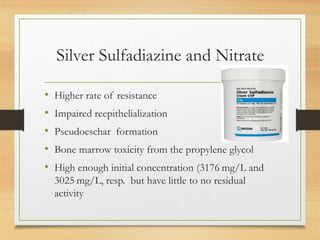
Silver Sulfadiazine and Nitrate
• Higher rate of resistance
• Impaired reepithelialization
• Pseudoeschar formation
• Bone marrow toxicity from the propylene glycol
• High enough initial concentration (3176 mg/L and
3025 mg/L, resp. but have little to no residual
activity
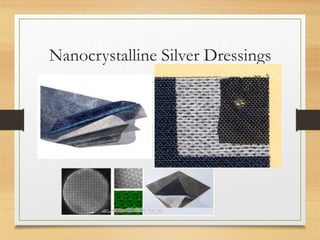
Nanocrystalline Silver Dressings
Nanocrystalline Silver dressings
• Two layers of high-density polyethylene net sandwiching a
layer of rayon/polyester gauze
• Outer layer is coated with a nanocrystalline (<20 nm),
noncharged form of silver (Ag0), and the inner layer helps
maintain a moist environment for wound healing
• Noncharged silver is less reactive with negatively
charged particles in the wound, it is deactivated much
more slowly and provides an initial large bolus of
silver followed by a sustained release into the wound.
• Maintain adequate concentrations (at least 70 mg/L)
with good residual activity, keeping levels elevated
over longer periods of time.
Spectrum
• Yeast
• Fungi
• Mold
• Methicillin-resistant Staph aureus (MRSA)
• vancomycin-resistant enterococci (VRE)
Resistance
• E. coli
• Enterobacter cloacae
• Klebsiella pneumoniae
• Acinetobacter baumannii
• Salmonella typhimurium
• Pseudomonas stutzeri
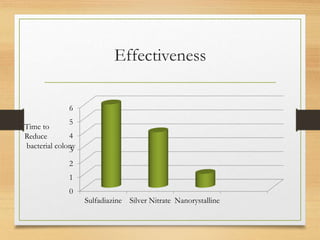
Effectiveness
0
1
2
3
4
5
6
Sulfadiazine Silver Nitrate Nanorystalline
Time to
Reduce
bacterial colony
• Left in place for up to 5-7 days
• Avoids trauma to the new epithelial growth.
Caution
• Negative impact on fibroblasts
• Inhibition of keratinocyte growth
• Delay in reepithelialization
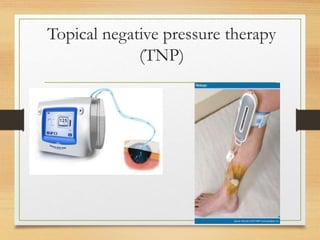
Topical negative pressure therapy
(TNP)
• Vacuum assisted closure (VAC)
• Sub-atmospheric pressure dressing (SPD)
• Vacuum sealing technique (VST)
• Sealed surface wound suction (SSS)
• Negative pressure therapy (NPT)
• Bridge to reconstruction
• Promotes active wound healing at the cellular level
through negative pressure.
• Wound is compartmentalised by an airtight seal
around it and through a dressing interface
• Compartment is connected to an external suction
apparatus
• Continuous or intermittent.
• Pressures used range between -100 to -125 mmHg.
• Macro strain (physical response) and micro strain
(biological response) and subsequently removes
exudates by an electromechanical pump
• Dressings are usually changed every 48-72h
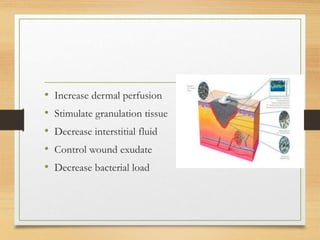
• Increase dermal perfusion
• Stimulate granulation tissue
• Decrease interstitial fluid
• Control wound exudate
• Decrease bacterial load
Clinical indications
• Ulcers
• Burns
• Wound dehiscences
• Fistulae
• Adjunct in tissue salvage in reconstructive surgery,
burns and trauma
• preserving the vitality of tissues and flaps of borderline
viability
• Trauma patients undergoing damage-control
laparotomy and abdominal compartment syndrome
patients
• Traumatic orthopedic injuries
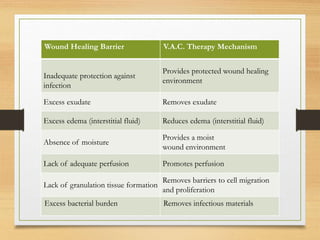
Wound Healing Barrier V.A.C. Therapy Mechanism
Inadequate protection against
infection
Provides protected wound healing
environment
Excess exudate Removes exudate
Excess edema (interstitial fluid) Reduces edema (interstitial fluid)
Absence of moisture
Provides a moist
wound environment
Lack of adequate perfusion Promotes perfusion
Lack of granulation tissue formation
Removes barriers to cell migration
and proliferation
Excess bacterial burden Removes infectious materials
Disadvantages
• Pain
• Fluid loss especially in large wounds
• Risk of bleeding
Recent dressings
• Hydrocolloids
• Alginates
• Foams
• Hydrogels
• Hydrofibers
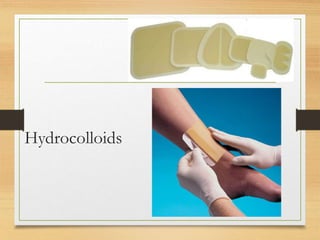
Hydrocolloids
Hydrocolloids
• Gelatin, pectin and or carboxymethylcellulose
• Serve as occlusive or semi-occlusive dressings
• Impermeable to water, bacteria and other
contaminants but permeable to water vapour
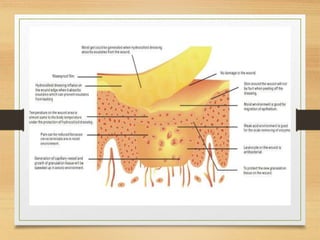
• Absorb wound exudates to form a hydrophilic gel.
• Most important advantage is their long wear time,
which decreases the cost, inconvenience and local
trauma associated with dressing changes.
• Promote fibrinolysis
• Angiogenesis
• Wound healing
• Without causing softening and breaking down of
tissue.
• Not indicated
• Arterial/neuropathic ulcers
• Infected or heavily exuding wounds because of risk of
periwound maceration.
• Malodorous exudates, which can be mistaken for
infection
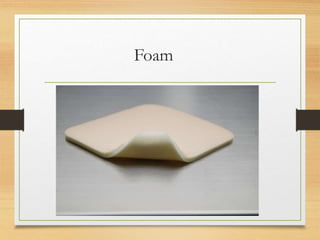
Foam
Foam
• Highly absorbent polyurethane dressings, available as
pads, sheets and cavity dressings
• Moist environment and provide thermal insulation to
the wound
• Nonadherent, easy to apply and remove and are
meant for highly exuding wounds
• Layered in combination with other materials with
overlying compression bandages.
• Fluid absorption capacity varies with foam thickness
• Cushioning effect but they are not a substitute for
pressure relieving devices
• Comparable to hydrocolloids according to some
studies
• Foams may produce excessive malodorous drainage
necessitating frequent dressing change
Alginates
Alginates
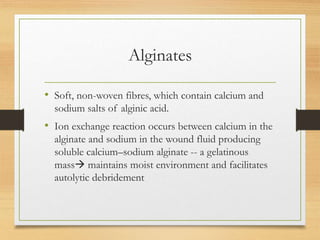
• Soft, non-woven fibres, which contain calcium and
sodium salts of alginic acid.
• Ion exchange reaction occurs between calcium in the
alginate and sodium in the wound fluid producing
soluble calcium–sodium alginate -- a gelatinous
mass maintains moist environment and facilitates
autolytic debridement
• Fillers for undermined and tunnelled wounds
• Highly absorbent-absorbs 20 times its weight
• Periwound maceration-Lateral wicking
• May leave fibrous debris in the wound-biodegraded
(reports of them causing long-term foreign body
type reactions)
• Inhibitory to keratinocytes
• Accelerate wound healing when compared to control
dressing
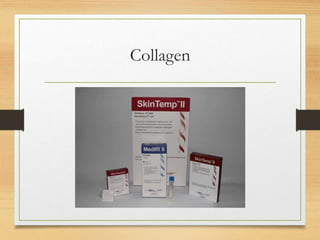
Collagen
• Important constituent of connective tissue
• Type I is mostly seen in healing tissues
• Chronic wounds -laying down a matrix which favours
deposition of new tissue and attracts cells necessary
for healing
• Chemotactic for fibroblasts and macrophages and
also provide a temporary scaffold to allow in growth
of tissue
• Human , porcine or bovine origin and are available as
particle or sheet form
• Absorb wound exudates to form a soft
biodegradable gel over the wound surface, which
maintains wound moisture
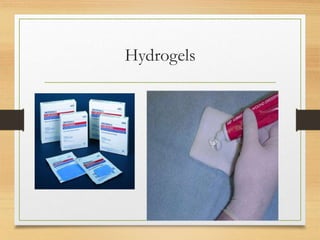
Hydrogels
Hydrogel
• Polymers, glycerine or water-based gels, impregnated
gauzes or sheet dressings
• High water content does not allow them to absorb
large amount of exudates heavy exuding wounds.
• Gentle yet effective debriding and desloughing
action
• rehydrating necrotic tissue
• removing without damaging healthy tissue
• Rehydrate the wound bed
• Reduce pain because of their cooling effect
• Non-adhesive
• Fill dead spaces
• Easy to apply and remove
• Best suited for dry wounds or those with minimal
exudates.
• Require a secondary dressing.
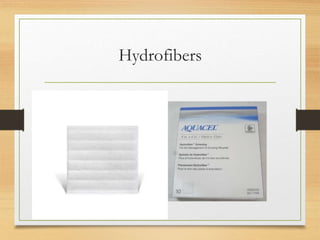
Hydrofibers
Hydrofibers
• Sterile sodium carboxymethyl cellulose fibres
• Conform to the wound surface, highly absorbent
and interact with wound exudates to form a gel.
• Maintain a moist environment and allow autolytic
debridement
Uses
• Pressure ulcers
• Lower limb ulcers
• Surgical wounds
Skin Substitutes
• Biosynthetic skin substitutes and cultured autologous
engineered skin, are available to provide temporary or
permanent coverage, with the advantages of
availability in large quantities and negligible risk of
infection or immunologic issues.
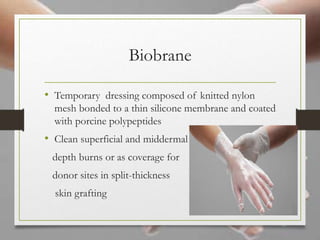
Biobrane
• Temporary dressing composed of knitted nylon
mesh bonded to a thin silicone membrane and coated
with porcine polypeptides
• Clean superficial and middermal
depth burns or as coverage for
donor sites in split-thickness
skin grafting
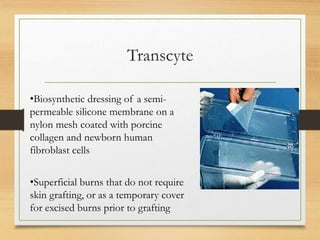
Transcyte
•Biosynthetic dressing of a semi-
permeable silicone membrane on a
nylon mesh coated with porcine
collagen and newborn human
fibroblast cells
•Superficial burns that do not require
skin grafting, or as a temporary cover
for excised burns prior to grafting
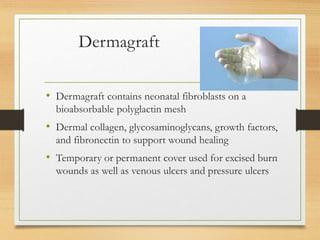
Dermagraft
• Dermagraft contains neonatal fibroblasts on a
bioabsorbable polyglactin mesh
• Dermal collagen, glycosaminoglycans, growth factors,
and fibronectin to support wound healing
• Temporary or permanent cover used for excised burn
wounds as well as venous ulcers and pressure ulcers
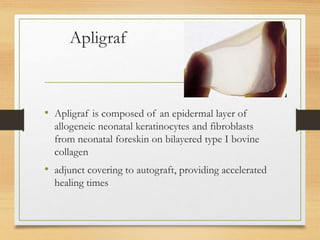
Apligraf
• Apligraf is composed of an epidermal layer of
allogeneic neonatal keratinocytes and fibroblasts
from neonatal foreskin on bilayered type I bovine
collagen
• adjunct covering to autograft, providing accelerated
healing times
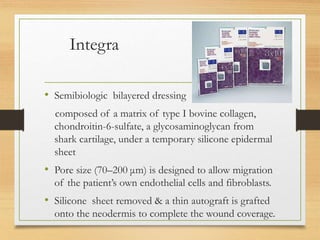
Integra
• Semibiologic bilayered dressing
composed of a matrix of type I bovine collagen,
chondroitin-6-sulfate, a glycosaminoglycan from
shark cartilage, under a temporary silicone epidermal
sheet
• Pore size (70–200 μm) is designed to allow migration
of the patient’s own endothelial cells and fibroblasts.
• Silicone sheet removed & a thin autograft is grafted
onto the neodermis to complete the wound coverage.
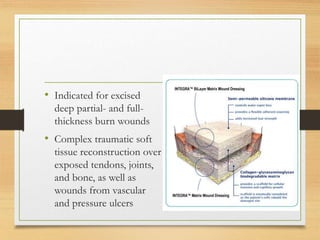
• Indicated for excised
deep partial- and full-
thickness burn wounds
• Complex traumatic soft
tissue reconstruction over
exposed tendons, joints,
and bone, as well as
wounds from vascular
and pressure ulcers
Growth Factors and Biologic
Wound Products
• Biologic wound products aims to accelerate healing
by augmenting or modulating inflammatory
mediators
• Prostaglandin E1
• Cytokines-Chemokines , lymphokines, monokines,
interleukins, colony-stimulating factors, and
interferons.
• Becaplermin(Regranex)rhPDGF & EGF-FDA-
approved products in the growth factor family
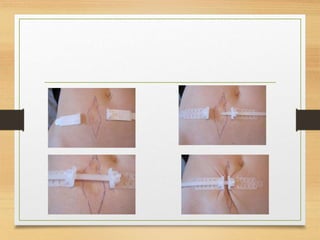
Top Closure System
• An innovative new technology created for skin
stretching and secure wound closure
• Post traumatic
• Surgical
• Acute and chronic skin wounds, which do not
respond to conventional wound care.
• Avoiding the need for tissue expanders
• Substitute for tension sutures
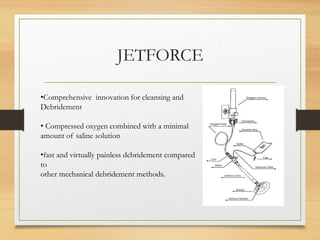
JETFORCE
•Comprehensive innovation for cleansing and
Debridement
• Compressed oxygen combined with a minimal
amount of saline solution
•fast and virtually painless debridement compared
to
other mechanical debridement methods.
Other methods
• Stem cell therapy
• Biodebridement- Maggots
• Topical Insulin
• Topical Anti0oxidant
• Hyperbaric oxygen(HBO)
References
• Advances in Wound Healing: A Review of Current Wound Healing Products
Patrick Murphy and Gregory R. D. Evans,Aesthetic and Plastic Surgery
Institute, University of California Irvine Medical Center, 200 S. Manchester
Avenue, Suite 650, Orange, CA 92868, USA
• M. Trop, M. Novak, S. Rodl, B. Hellbom, W. Kroell, and W. Goessler, “Silver-
coated dressing acticoat caused raised liver enzymes and argyria-like symptoms
in burn patient,” Journal of Trauma, vol. 60, no. 3, pp. 648–652, 2006.
• E. K. Mooney, C. Lippitt, and J. Friedman, “Silver dressings [safety and efficacy
reports],” Plastic and Reconstructive Surgery, vol. 117, no. 2, pp. 666–669, 2006.
• W. Stanford, B. W. Rappole, and C. L. Fox, “Clinical experience with silver
sulfadiazine, a new topical agent for control of pseudomonas infections in
burns,” Journal of Trauma, vol. 9, no. 5, pp. 377–388, 1969.
• R. Warriner and R. Burrell, “Infection and the chronic wound: a focus on
silver,” Advances in skin &amp; wound care., vol. 18, pp. 2–12, 2005.
• B. S. Atiyeh, M. Costagliola, S. N. Hayek, and S. A. Dibo, “Effect of silver on
burn wound infection control and healing: review of the literature,” Burns, vol.
33, no. 2, pp. 139–148, 2007.
• R. Khundkar, C. Malic, and T. Burge, “Use of Acticoat dressings in burns: what
is the evidence?” Burns, vol. 36, no. 6, pp. 751–758, 2010.
• Winter GD. Formation of scab and rate of epithelialization of superficial
wounds in the skin of the young domestic pig. Nature. 1962;193:293–4.
• Cho CY, Lo JS. Excision and repair: Dressing the
part. DermatolClin. 1998;16:25–47. [PubMed]
• Moon CH, Crabtree TG. New wound dressing techniques to accelerate
healing. Curr Treat Options Infect Dis. 2003;5:251–60.
• Varghese MC, Balin AK, Carter DM, Caldwell D. Local environment of chronic
wounds under synthetic dressings. Arch Dermatol. 1986;122:52–7.
• Alvarez OM, Mertz PM, Eaglstein WH. The effect of occlusive dressings on
collagen synthesis and re-epithelialization in superficial wounds. J Surg
Res. 1983;35:142–8.
• Rubio PA. Use of semiocclusive, transparent film dressings for surgical wound
protection: An experience in 3637 cases. Int Surg. 1991;76:253–4.
• Jones AM, San Miguel L. Are modern wound dressings a clinical and cost
effective alternative to the use of gauze? J Wound Care. 2006;15:65–9.
Recent advances in wound healing

Recent advances in wound healing

  • 1.
    RECENT ADJUNCTS TO WOUNDHEALING Dr.E.Kaushik Kumar Department of General Surgery Stanley Medical College Hospital,Chennai
  • 2.
    • என்பி லதனைவெயில்பபோலக் கோயுபே அன்பி லதனை அறம். • Virtue will burn up the soul which is without love, even as the sun burns up the creature which is without bone
  • 3.
    Introduction • Tried andTrue treatments • Updated and improved variations of previous treatments • Entirely new fields of study
  • 4.
    Advances in WoundHealing • Silver • Negative Pressure Therapy • Advanced Dressings • Skin Substitutes • Growth Factors and Biologic wound products • Hyperbaric Oxygen Therapy
  • 5.
    Silver • Time honoredin wound care-69 BC • New forms of delivery aim to increase the efficacy while minimizing side effects • Favourable broad spectrum coverage- Antibiotic resistant organisms
  • 6.
    • Highly reactivecharged silver ion (Ag+) negatively charged particles such as proteins, DNA, RNA, and chloride ions. • Bactericidal material-kills on contact • Inhibiting the respiratory chain at the cytochrome level • Interfering with electron transport • Denaturing nucleic acids • Inhibiting DNA replication • Altering cell membrane permeability
  • 7.
    • ↓ MMPactivity because of its inhibitory effect on zinc activity • Inhibitory effect on release of proinflammatory cytokines and tumour necrosis factor–alpha
  • 8.
    Ideal Delivery System •Adequate concentration of silver • Long enough residual activity.
  • 9.
    • Gauze • Hydrocolloids, •Alginates • Foams • Creams • Gels but each of them differ in the way in which silver ions are released
  • 10.
    Silver Sulfadiazine andNitrate • Higher rate of resistance • Impaired reepithelialization • Pseudoeschar formation • Bone marrow toxicity from the propylene glycol • High enough initial concentration (3176 mg/L and 3025 mg/L, resp. but have little to no residual activity
  • 11.
  • 12.
    Nanocrystalline Silver dressings •Two layers of high-density polyethylene net sandwiching a layer of rayon/polyester gauze • Outer layer is coated with a nanocrystalline (<20 nm), noncharged form of silver (Ag0), and the inner layer helps maintain a moist environment for wound healing
  • 13.
    • Noncharged silveris less reactive with negatively charged particles in the wound, it is deactivated much more slowly and provides an initial large bolus of silver followed by a sustained release into the wound. • Maintain adequate concentrations (at least 70 mg/L) with good residual activity, keeping levels elevated over longer periods of time.
  • 14.
    Spectrum • Yeast • Fungi •Mold • Methicillin-resistant Staph aureus (MRSA) • vancomycin-resistant enterococci (VRE)
  • 15.
    Resistance • E. coli •Enterobacter cloacae • Klebsiella pneumoniae • Acinetobacter baumannii • Salmonella typhimurium • Pseudomonas stutzeri
  • 16.
    Effectiveness 0 1 2 3 4 5 6 Sulfadiazine Silver NitrateNanorystalline Time to Reduce bacterial colony
  • 17.
    • Left inplace for up to 5-7 days • Avoids trauma to the new epithelial growth.
  • 18.
    Caution • Negative impacton fibroblasts • Inhibition of keratinocyte growth • Delay in reepithelialization
  • 19.
  • 20.
    • Vacuum assistedclosure (VAC) • Sub-atmospheric pressure dressing (SPD) • Vacuum sealing technique (VST) • Sealed surface wound suction (SSS) • Negative pressure therapy (NPT)
  • 21.
    • Bridge toreconstruction • Promotes active wound healing at the cellular level through negative pressure. • Wound is compartmentalised by an airtight seal around it and through a dressing interface • Compartment is connected to an external suction apparatus
  • 22.
    • Continuous orintermittent. • Pressures used range between -100 to -125 mmHg. • Macro strain (physical response) and micro strain (biological response) and subsequently removes exudates by an electromechanical pump • Dressings are usually changed every 48-72h
  • 23.
    • Increase dermalperfusion • Stimulate granulation tissue • Decrease interstitial fluid • Control wound exudate • Decrease bacterial load
  • 24.
    Clinical indications • Ulcers •Burns • Wound dehiscences • Fistulae • Adjunct in tissue salvage in reconstructive surgery, burns and trauma • preserving the vitality of tissues and flaps of borderline viability
  • 25.
    • Trauma patientsundergoing damage-control laparotomy and abdominal compartment syndrome patients • Traumatic orthopedic injuries
  • 26.
    Wound Healing BarrierV.A.C. Therapy Mechanism Inadequate protection against infection Provides protected wound healing environment Excess exudate Removes exudate Excess edema (interstitial fluid) Reduces edema (interstitial fluid) Absence of moisture Provides a moist wound environment Lack of adequate perfusion Promotes perfusion Lack of granulation tissue formation Removes barriers to cell migration and proliferation Excess bacterial burden Removes infectious materials
  • 27.
    Disadvantages • Pain • Fluidloss especially in large wounds • Risk of bleeding
  • 28.
    Recent dressings • Hydrocolloids •Alginates • Foams • Hydrogels • Hydrofibers
  • 29.
  • 30.
    Hydrocolloids • Gelatin, pectinand or carboxymethylcellulose • Serve as occlusive or semi-occlusive dressings • Impermeable to water, bacteria and other contaminants but permeable to water vapour • Absorb wound exudates to form a hydrophilic gel. • Most important advantage is their long wear time, which decreases the cost, inconvenience and local trauma associated with dressing changes.
  • 31.
    • Promote fibrinolysis •Angiogenesis • Wound healing • Without causing softening and breaking down of tissue.
  • 33.
    • Not indicated •Arterial/neuropathic ulcers • Infected or heavily exuding wounds because of risk of periwound maceration. • Malodorous exudates, which can be mistaken for infection
  • 34.
  • 35.
    Foam • Highly absorbentpolyurethane dressings, available as pads, sheets and cavity dressings • Moist environment and provide thermal insulation to the wound • Nonadherent, easy to apply and remove and are meant for highly exuding wounds • Layered in combination with other materials with overlying compression bandages.
  • 36.
    • Fluid absorptioncapacity varies with foam thickness • Cushioning effect but they are not a substitute for pressure relieving devices • Comparable to hydrocolloids according to some studies • Foams may produce excessive malodorous drainage necessitating frequent dressing change
  • 37.
  • 38.
    Alginates • Soft, non-wovenfibres, which contain calcium and sodium salts of alginic acid. • Ion exchange reaction occurs between calcium in the alginate and sodium in the wound fluid producing soluble calcium–sodium alginate -- a gelatinous mass maintains moist environment and facilitates autolytic debridement
  • 39.
    • Fillers forundermined and tunnelled wounds • Highly absorbent-absorbs 20 times its weight • Periwound maceration-Lateral wicking • May leave fibrous debris in the wound-biodegraded (reports of them causing long-term foreign body type reactions)
  • 40.
    • Inhibitory tokeratinocytes • Accelerate wound healing when compared to control dressing
  • 41.
  • 42.
    • Important constituentof connective tissue • Type I is mostly seen in healing tissues • Chronic wounds -laying down a matrix which favours deposition of new tissue and attracts cells necessary for healing • Chemotactic for fibroblasts and macrophages and also provide a temporary scaffold to allow in growth of tissue
  • 43.
    • Human ,porcine or bovine origin and are available as particle or sheet form • Absorb wound exudates to form a soft biodegradable gel over the wound surface, which maintains wound moisture
  • 44.
  • 45.
    Hydrogel • Polymers, glycerineor water-based gels, impregnated gauzes or sheet dressings • High water content does not allow them to absorb large amount of exudates heavy exuding wounds. • Gentle yet effective debriding and desloughing action • rehydrating necrotic tissue • removing without damaging healthy tissue
  • 46.
    • Rehydrate thewound bed • Reduce pain because of their cooling effect • Non-adhesive • Fill dead spaces • Easy to apply and remove • Best suited for dry wounds or those with minimal exudates. • Require a secondary dressing.
  • 47.
  • 48.
    Hydrofibers • Sterile sodiumcarboxymethyl cellulose fibres • Conform to the wound surface, highly absorbent and interact with wound exudates to form a gel. • Maintain a moist environment and allow autolytic debridement
  • 49.
    Uses • Pressure ulcers •Lower limb ulcers • Surgical wounds
  • 50.
    Skin Substitutes • Biosyntheticskin substitutes and cultured autologous engineered skin, are available to provide temporary or permanent coverage, with the advantages of availability in large quantities and negligible risk of infection or immunologic issues.
  • 51.
    Biobrane • Temporary dressingcomposed of knitted nylon mesh bonded to a thin silicone membrane and coated with porcine polypeptides • Clean superficial and middermal depth burns or as coverage for donor sites in split-thickness skin grafting
  • 52.
    Transcyte •Biosynthetic dressing ofa semi- permeable silicone membrane on a nylon mesh coated with porcine collagen and newborn human fibroblast cells •Superficial burns that do not require skin grafting, or as a temporary cover for excised burns prior to grafting
  • 53.
    Dermagraft • Dermagraft containsneonatal fibroblasts on a bioabsorbable polyglactin mesh • Dermal collagen, glycosaminoglycans, growth factors, and fibronectin to support wound healing • Temporary or permanent cover used for excised burn wounds as well as venous ulcers and pressure ulcers
  • 54.
    Apligraf • Apligraf iscomposed of an epidermal layer of allogeneic neonatal keratinocytes and fibroblasts from neonatal foreskin on bilayered type I bovine collagen • adjunct covering to autograft, providing accelerated healing times
  • 55.
    Integra • Semibiologic bilayereddressing composed of a matrix of type I bovine collagen, chondroitin-6-sulfate, a glycosaminoglycan from shark cartilage, under a temporary silicone epidermal sheet • Pore size (70–200 μm) is designed to allow migration of the patient’s own endothelial cells and fibroblasts. • Silicone sheet removed & a thin autograft is grafted onto the neodermis to complete the wound coverage.
  • 56.
    • Indicated forexcised deep partial- and full- thickness burn wounds • Complex traumatic soft tissue reconstruction over exposed tendons, joints, and bone, as well as wounds from vascular and pressure ulcers
  • 57.
    Growth Factors andBiologic Wound Products • Biologic wound products aims to accelerate healing by augmenting or modulating inflammatory mediators • Prostaglandin E1 • Cytokines-Chemokines , lymphokines, monokines, interleukins, colony-stimulating factors, and interferons. • Becaplermin(Regranex)rhPDGF & EGF-FDA- approved products in the growth factor family
  • 58.
    Top Closure System •An innovative new technology created for skin stretching and secure wound closure • Post traumatic • Surgical • Acute and chronic skin wounds, which do not respond to conventional wound care.
  • 60.
    • Avoiding theneed for tissue expanders • Substitute for tension sutures
  • 61.
    JETFORCE •Comprehensive innovation forcleansing and Debridement • Compressed oxygen combined with a minimal amount of saline solution •fast and virtually painless debridement compared to other mechanical debridement methods.
  • 62.
    Other methods • Stemcell therapy • Biodebridement- Maggots • Topical Insulin • Topical Anti0oxidant • Hyperbaric oxygen(HBO)
  • 63.
    References • Advances inWound Healing: A Review of Current Wound Healing Products Patrick Murphy and Gregory R. D. Evans,Aesthetic and Plastic Surgery Institute, University of California Irvine Medical Center, 200 S. Manchester Avenue, Suite 650, Orange, CA 92868, USA • M. Trop, M. Novak, S. Rodl, B. Hellbom, W. Kroell, and W. Goessler, “Silver- coated dressing acticoat caused raised liver enzymes and argyria-like symptoms in burn patient,” Journal of Trauma, vol. 60, no. 3, pp. 648–652, 2006. • E. K. Mooney, C. Lippitt, and J. Friedman, “Silver dressings [safety and efficacy reports],” Plastic and Reconstructive Surgery, vol. 117, no. 2, pp. 666–669, 2006. • W. Stanford, B. W. Rappole, and C. L. Fox, “Clinical experience with silver sulfadiazine, a new topical agent for control of pseudomonas infections in burns,” Journal of Trauma, vol. 9, no. 5, pp. 377–388, 1969.
  • 64.
    • R. Warrinerand R. Burrell, “Infection and the chronic wound: a focus on silver,” Advances in skin &amp; wound care., vol. 18, pp. 2–12, 2005. • B. S. Atiyeh, M. Costagliola, S. N. Hayek, and S. A. Dibo, “Effect of silver on burn wound infection control and healing: review of the literature,” Burns, vol. 33, no. 2, pp. 139–148, 2007. • R. Khundkar, C. Malic, and T. Burge, “Use of Acticoat dressings in burns: what is the evidence?” Burns, vol. 36, no. 6, pp. 751–758, 2010. • Winter GD. Formation of scab and rate of epithelialization of superficial wounds in the skin of the young domestic pig. Nature. 1962;193:293–4. • Cho CY, Lo JS. Excision and repair: Dressing the part. DermatolClin. 1998;16:25–47. [PubMed]
  • 65.
    • Moon CH,Crabtree TG. New wound dressing techniques to accelerate healing. Curr Treat Options Infect Dis. 2003;5:251–60. • Varghese MC, Balin AK, Carter DM, Caldwell D. Local environment of chronic wounds under synthetic dressings. Arch Dermatol. 1986;122:52–7. • Alvarez OM, Mertz PM, Eaglstein WH. The effect of occlusive dressings on collagen synthesis and re-epithelialization in superficial wounds. J Surg Res. 1983;35:142–8. • Rubio PA. Use of semiocclusive, transparent film dressings for surgical wound protection: An experience in 3637 cases. Int Surg. 1991;76:253–4. • Jones AM, San Miguel L. Are modern wound dressings a clinical and cost effective alternative to the use of gauze? J Wound Care. 2006;15:65–9.