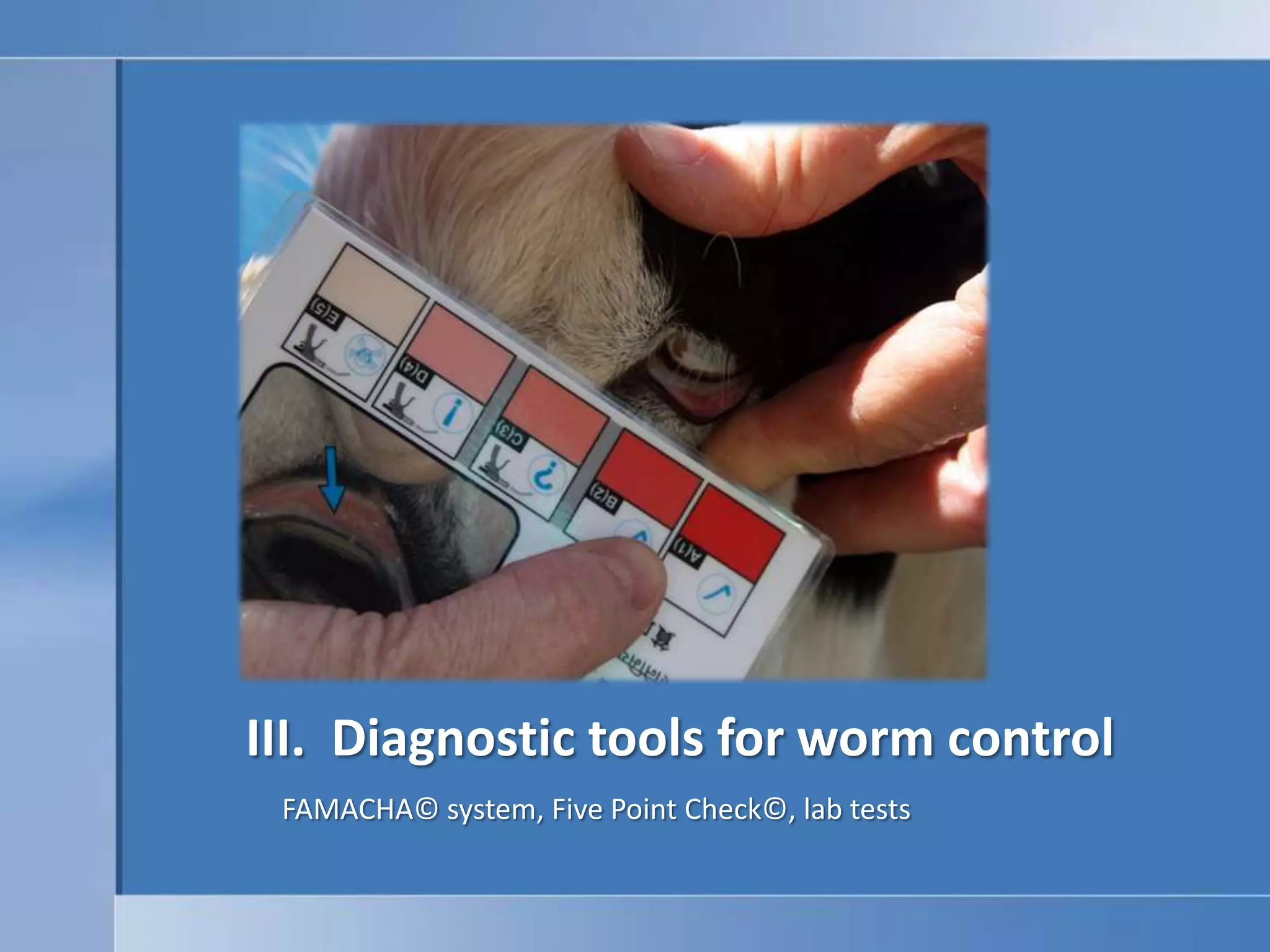
III.  Diagnostic tools for worm controlFAMACHA© system, Five Point Check©, lab tests
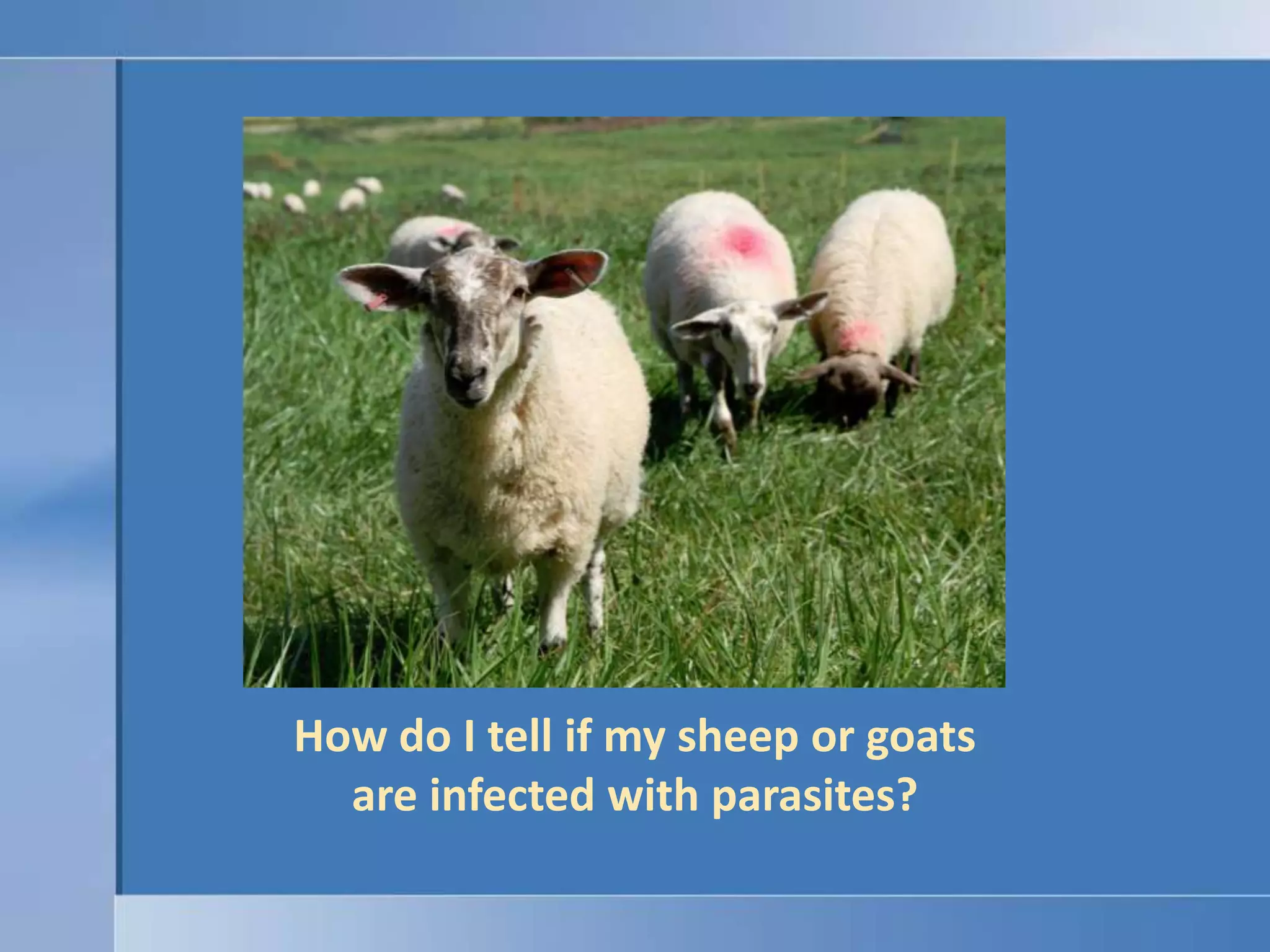
How do I tell if my sheep or goats are infected with parasites?
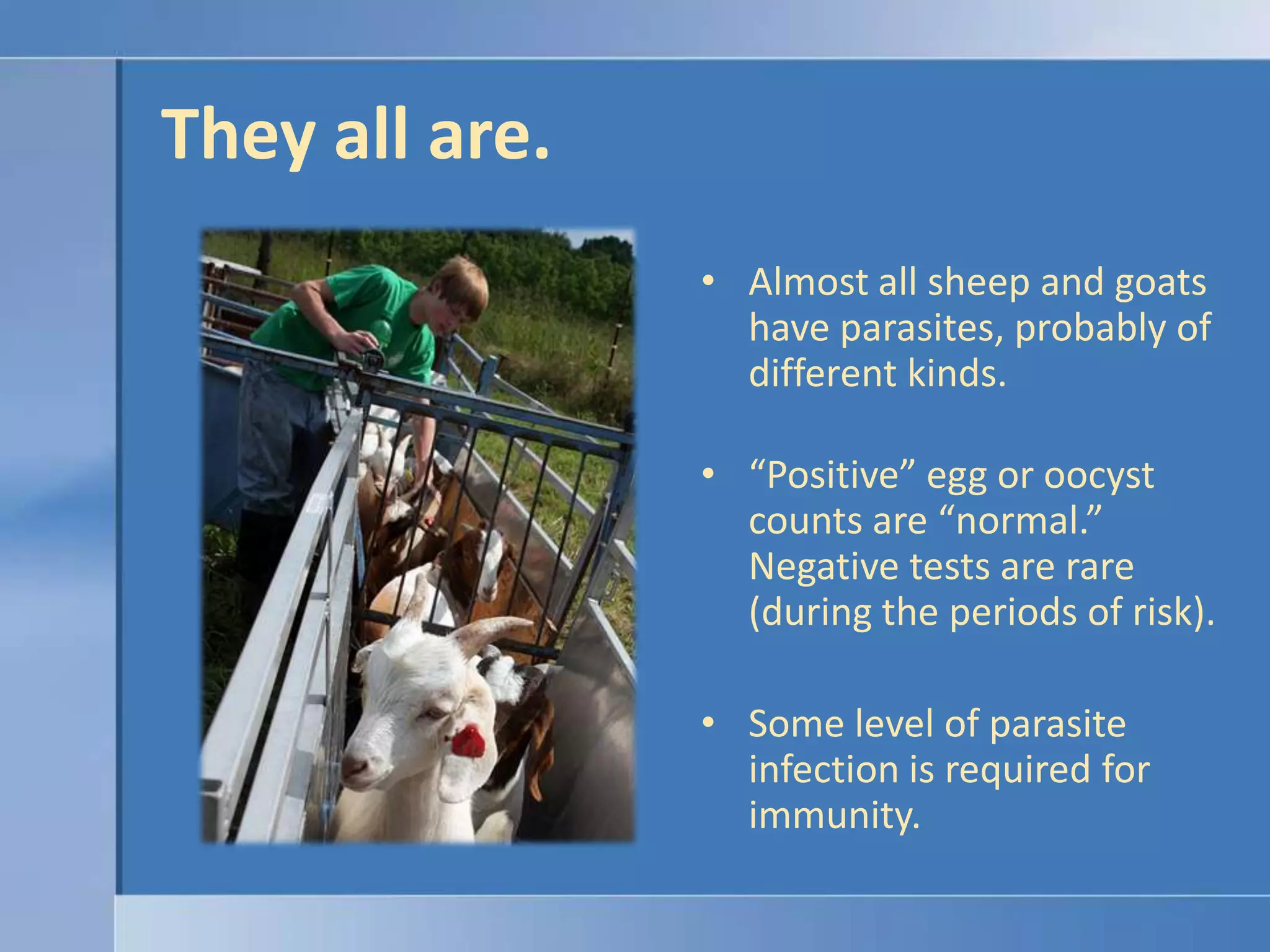
They all are.    Almost all sheep and goats have parasites, probably of different kinds.“Positive” egg or oocyst counts are “normal.”  Negative tests are rare (during the periods of risk).Some level of parasite infection is required for immunity.
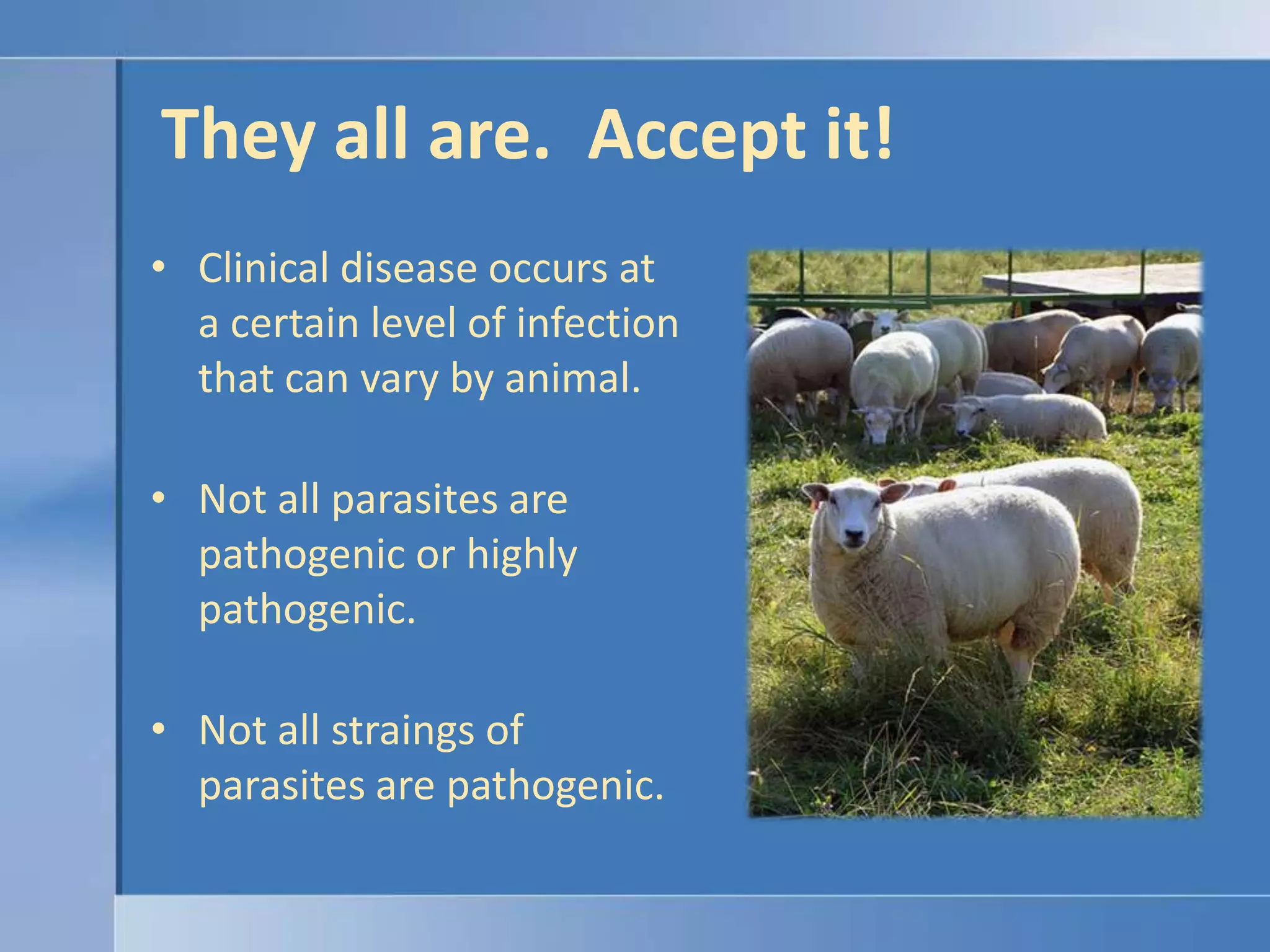
They all are.  Accept it!Clinical disease occurs at a certain level of infection that can vary by animal.Not all parasites are pathogenic or highly pathogenic.Not all straingsof parasites are pathogenic.
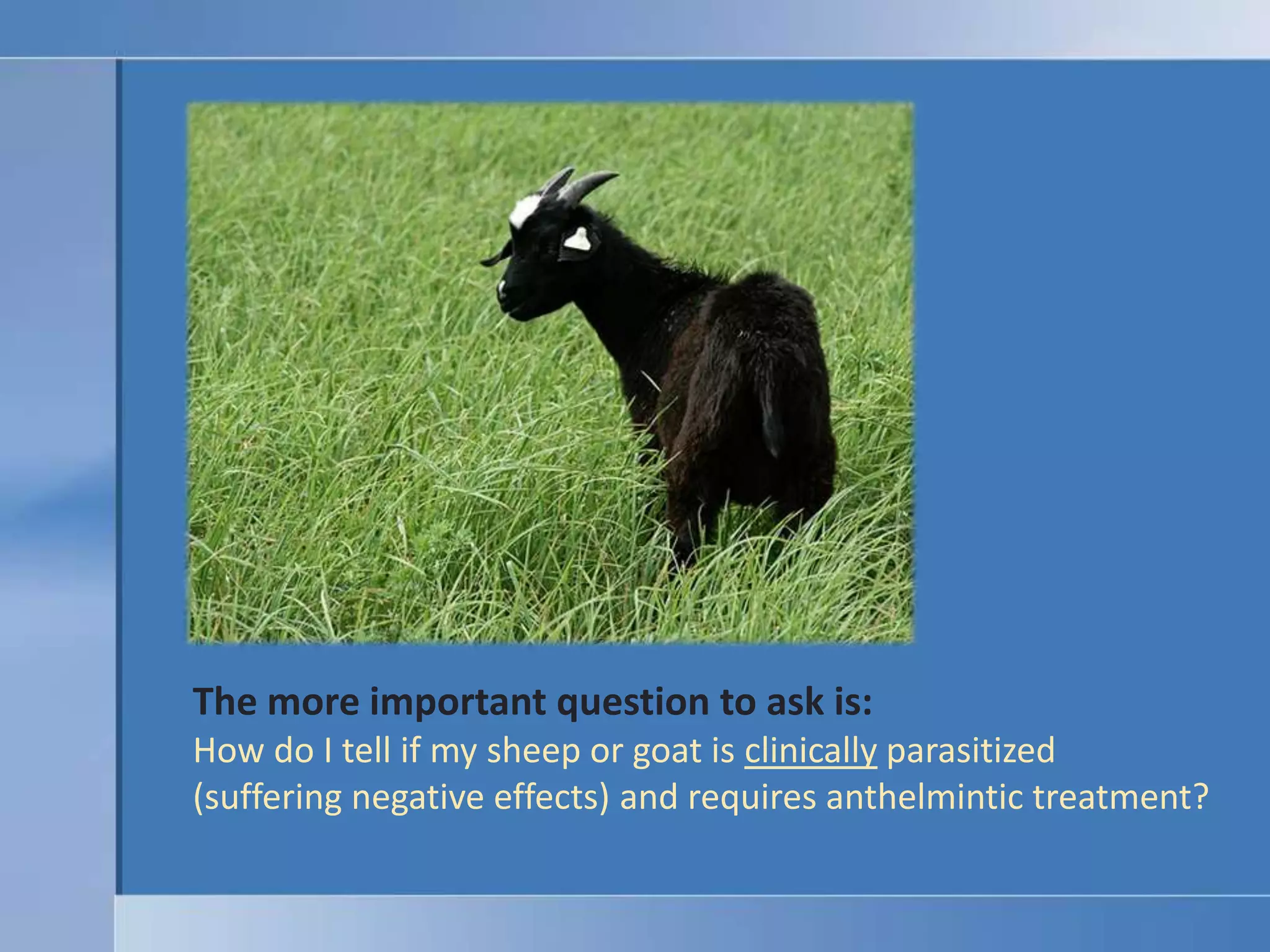
The more important question to ask is:How do I tell if my sheep or goat is clinically parasitized (suffering negative effects) and requires anthelmintic treatment?
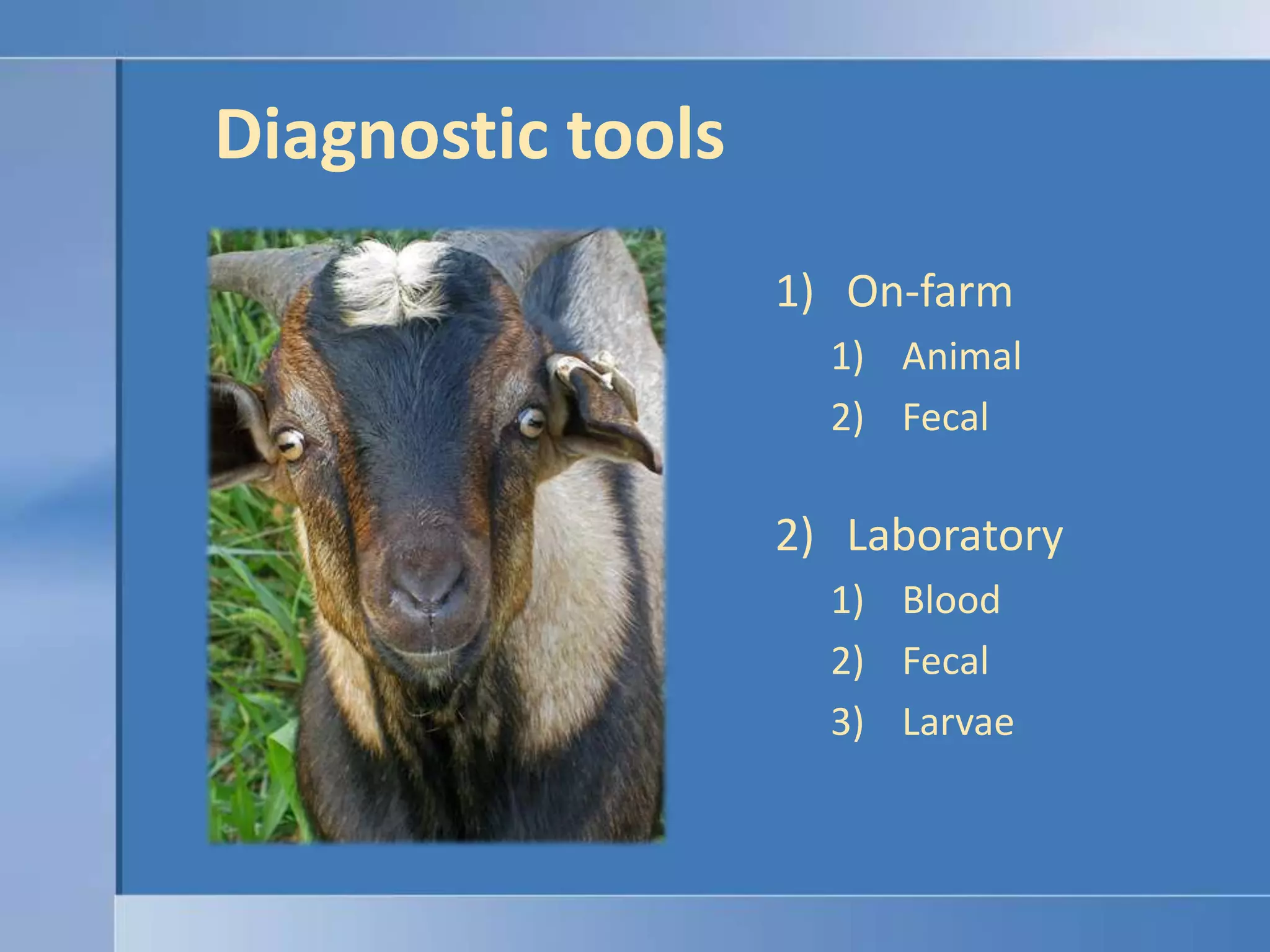
Diagnostic toolsOn-farmAnimalFecalLaboratoryBloodFecalLarvae
Diagnostic toolsON FARMLABORATORYAnimalFAMACHA©Five Point Check®  NEW!FecalSimple flotationFecal egg countsFecal egg count reduction test (FECRT)DipstickCarla® saliva testBloodPacked cell volumeFecalSimple flotationFecal egg countsFECRTLectin staining test   NEW!LarvaeLarvae cultureLarval development assay[DrenchRite®]Pasture
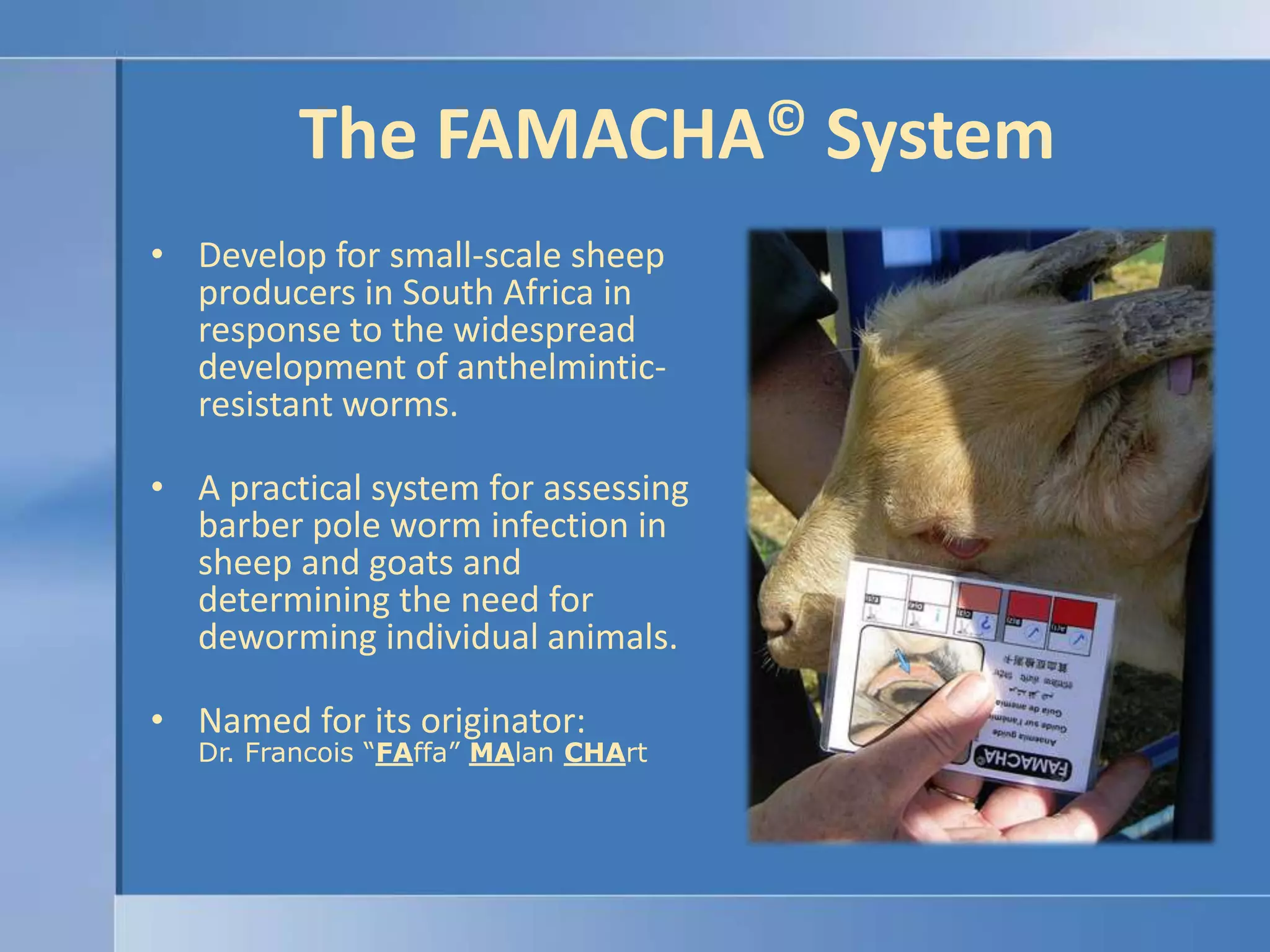
The FAMACHA© SystemDevelop for small-scale sheep producers in South Africa in response to the widespread development of anthelmintic-resistant worms. A practical system for assessing barber pole worm infection in sheep and goats and determining the need for deworming individual animals.Named for its originator:Dr. Francois “FAffa” MAlanCHArt
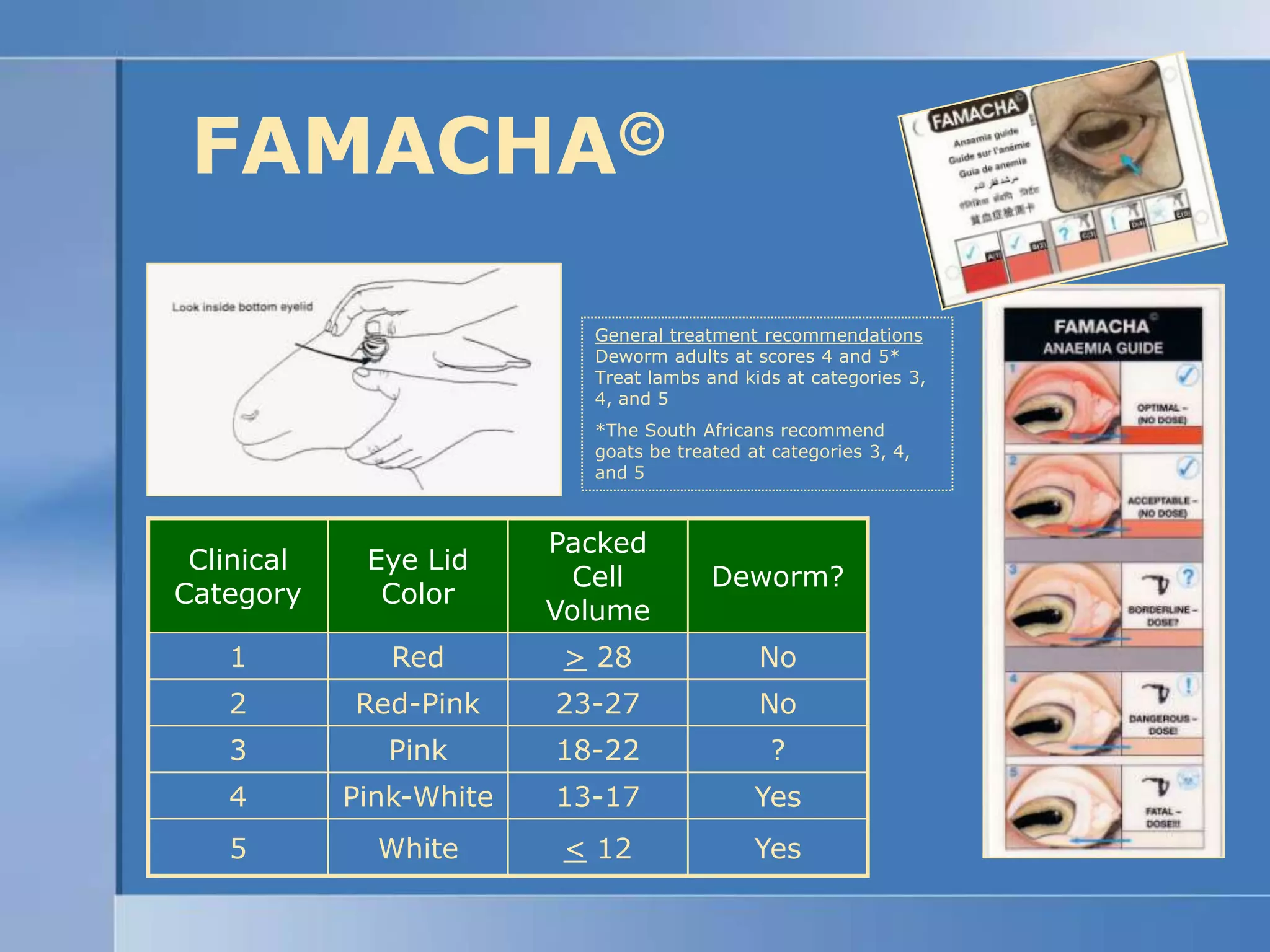
FAMACHA©General treatment recommendationsDeworm adults at scores 4 and 5*Treat lambs and kids at categories 3, 4, and 5*The South Africans recommend goats be treated at categories 3, 4, and 5
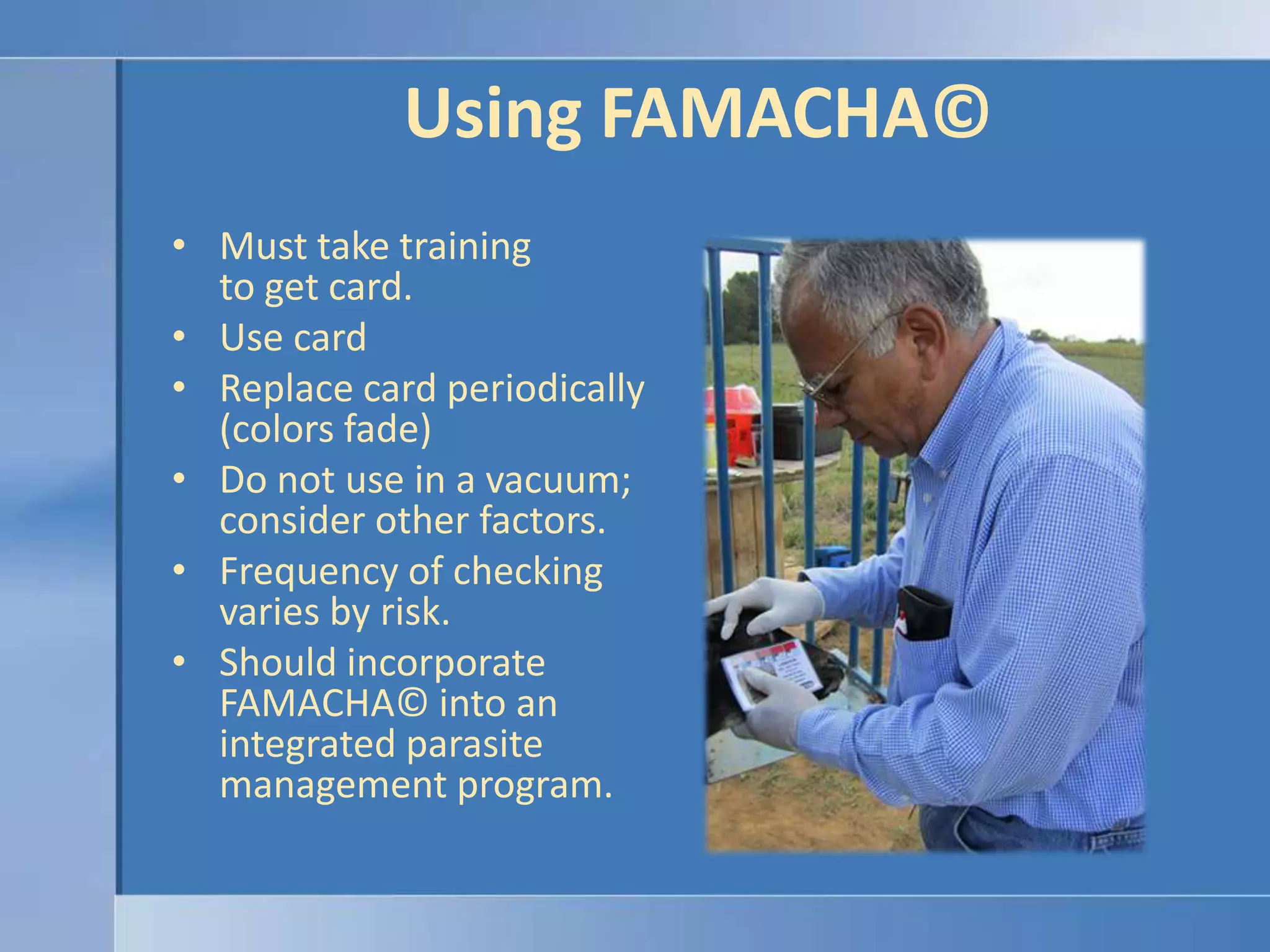
Using FAMACHA© Must take training to get card.Use cardReplace card periodically(colors fade)Do not use in a vacuum; consider other factors.Frequency of checking varies by risk.Should incorporate FAMACHA© into an integrated parasite management program.
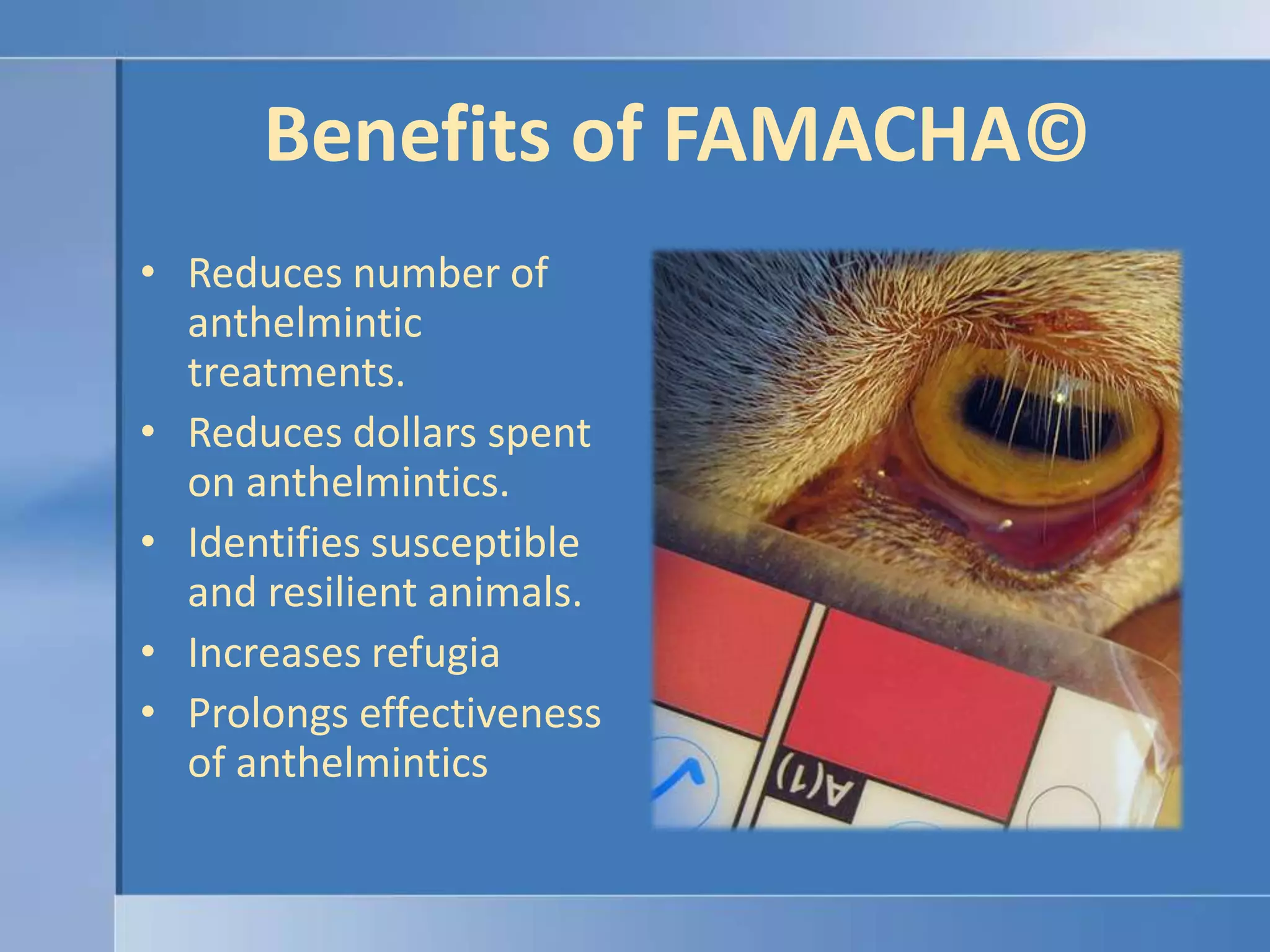
Benefits of FAMACHA©Reduces number of anthelmintic treatments.  Reduces dollars spent on anthelmintics.Identifies susceptible and resilient animals.Increases refugia Prolongs effectiveness of anthelmintics
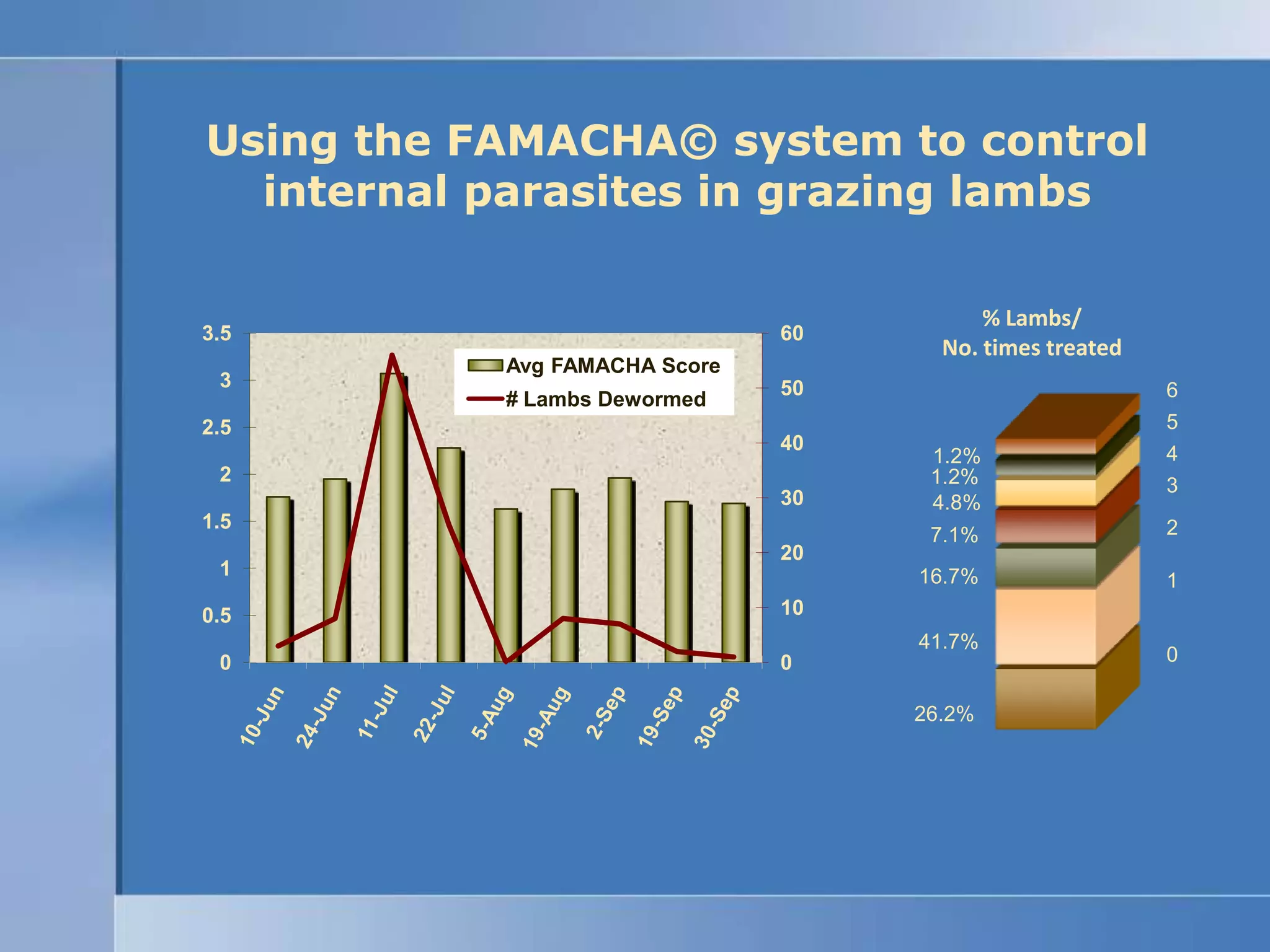
6541.2%1.2%34.8%27.1%16.7%141.7%026.2%Using the FAMACHA© system to control internal parasites in grazing lambs% Lambs/No. times treated
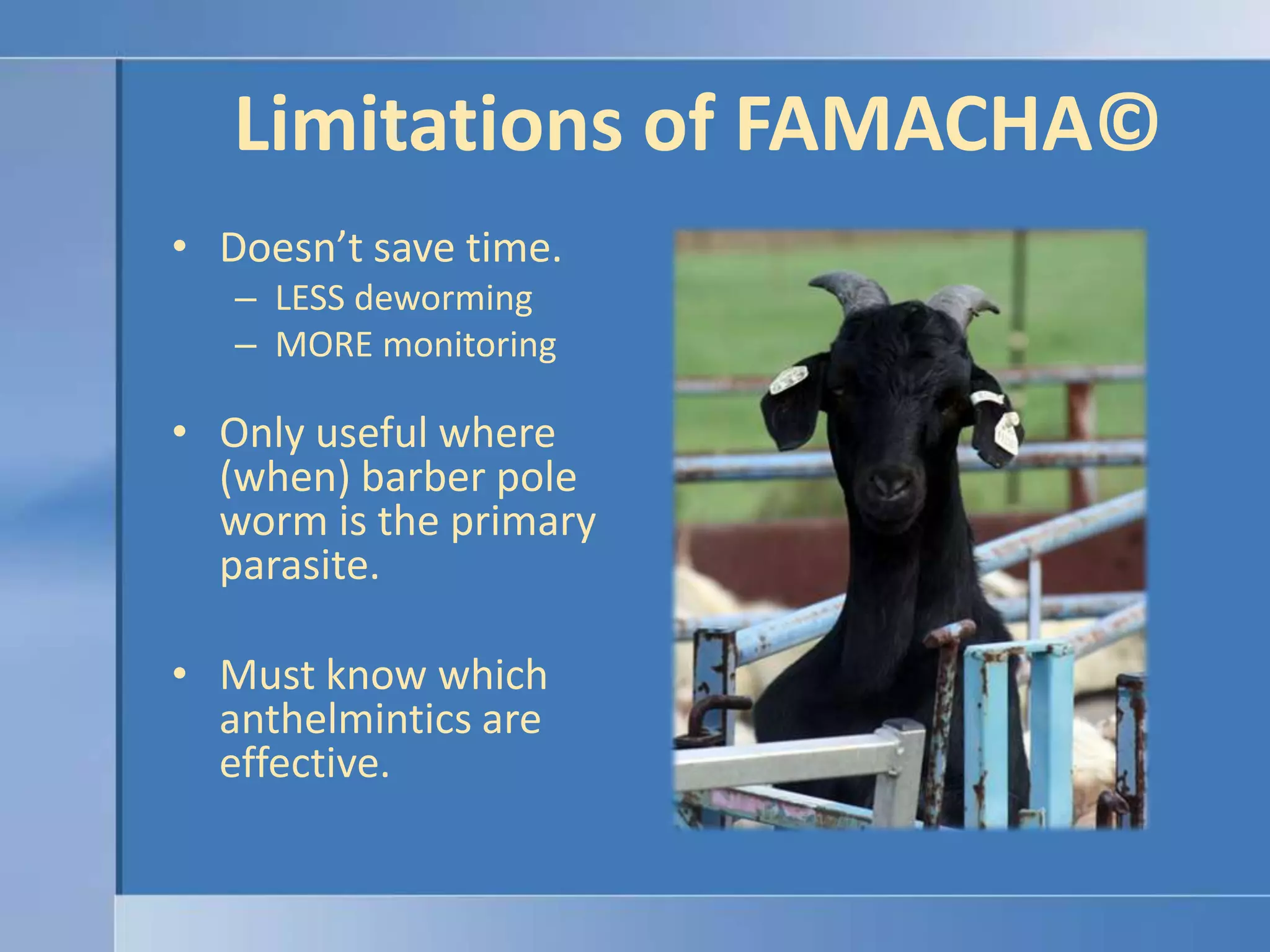
Limitations of FAMACHA©Doesn’t save time.LESS dewormingMORE monitoringOnly useful where (when) barber pole worm is the primary parasite.Must know which anthelmintics are effective.
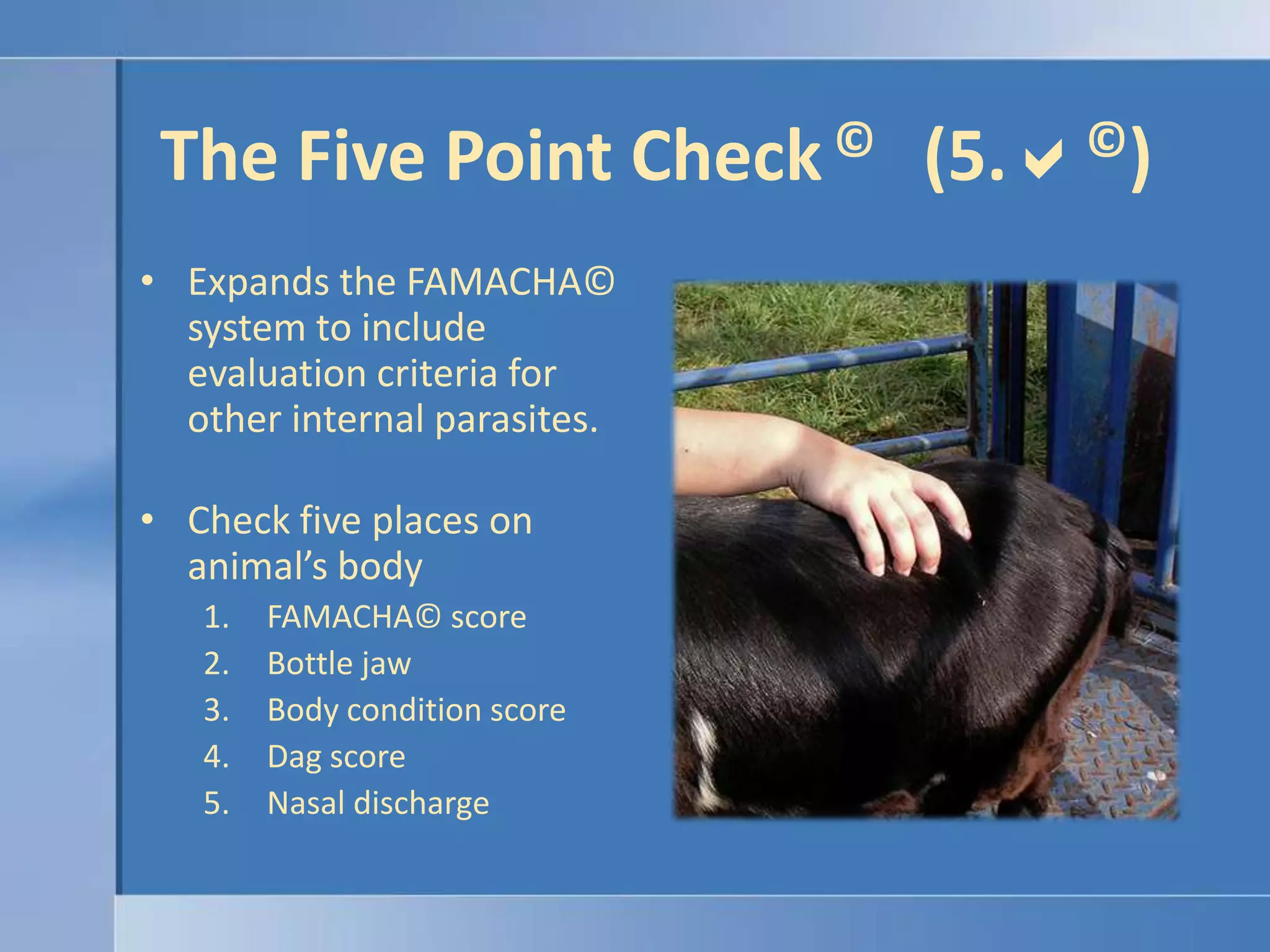
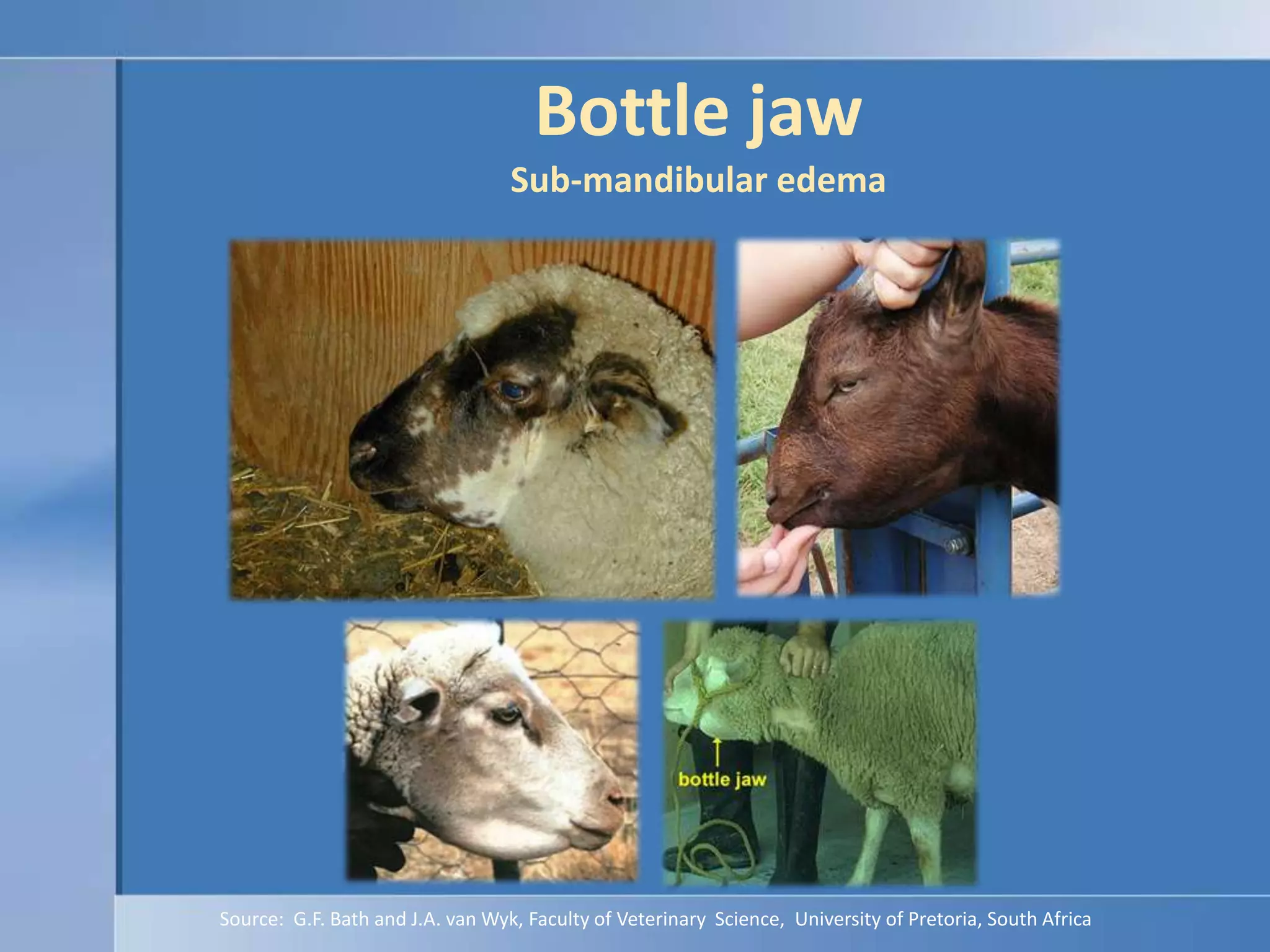
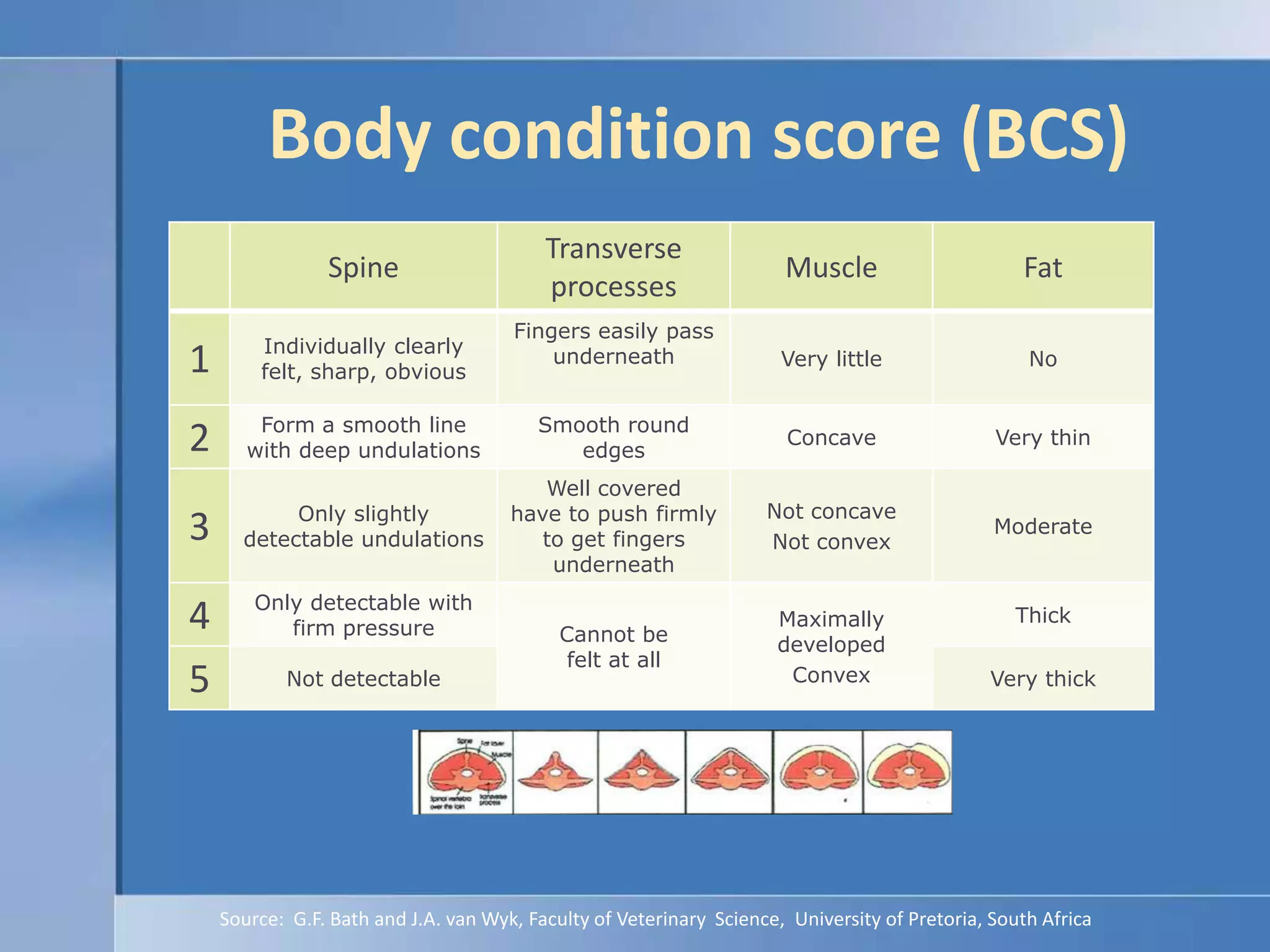
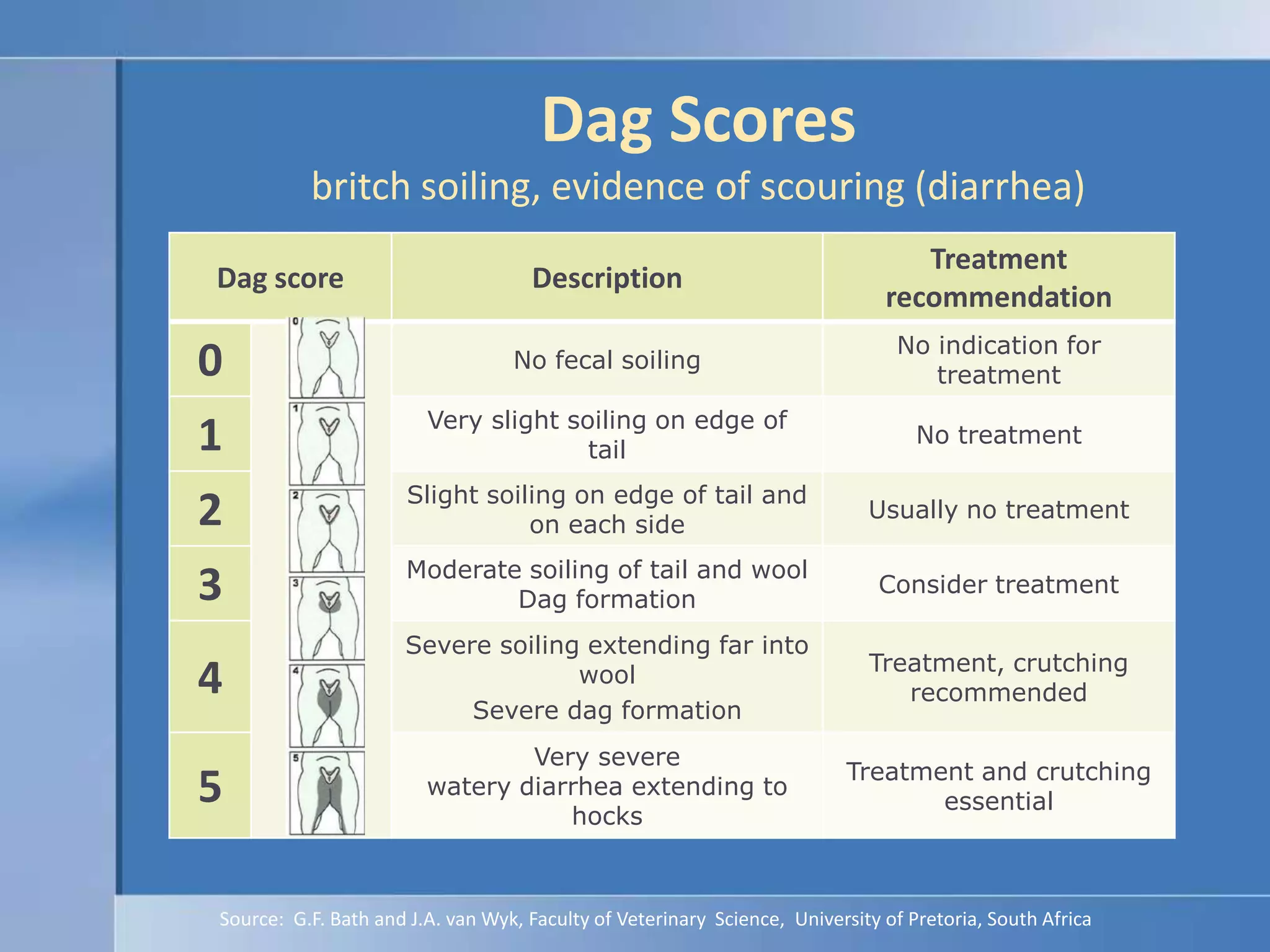
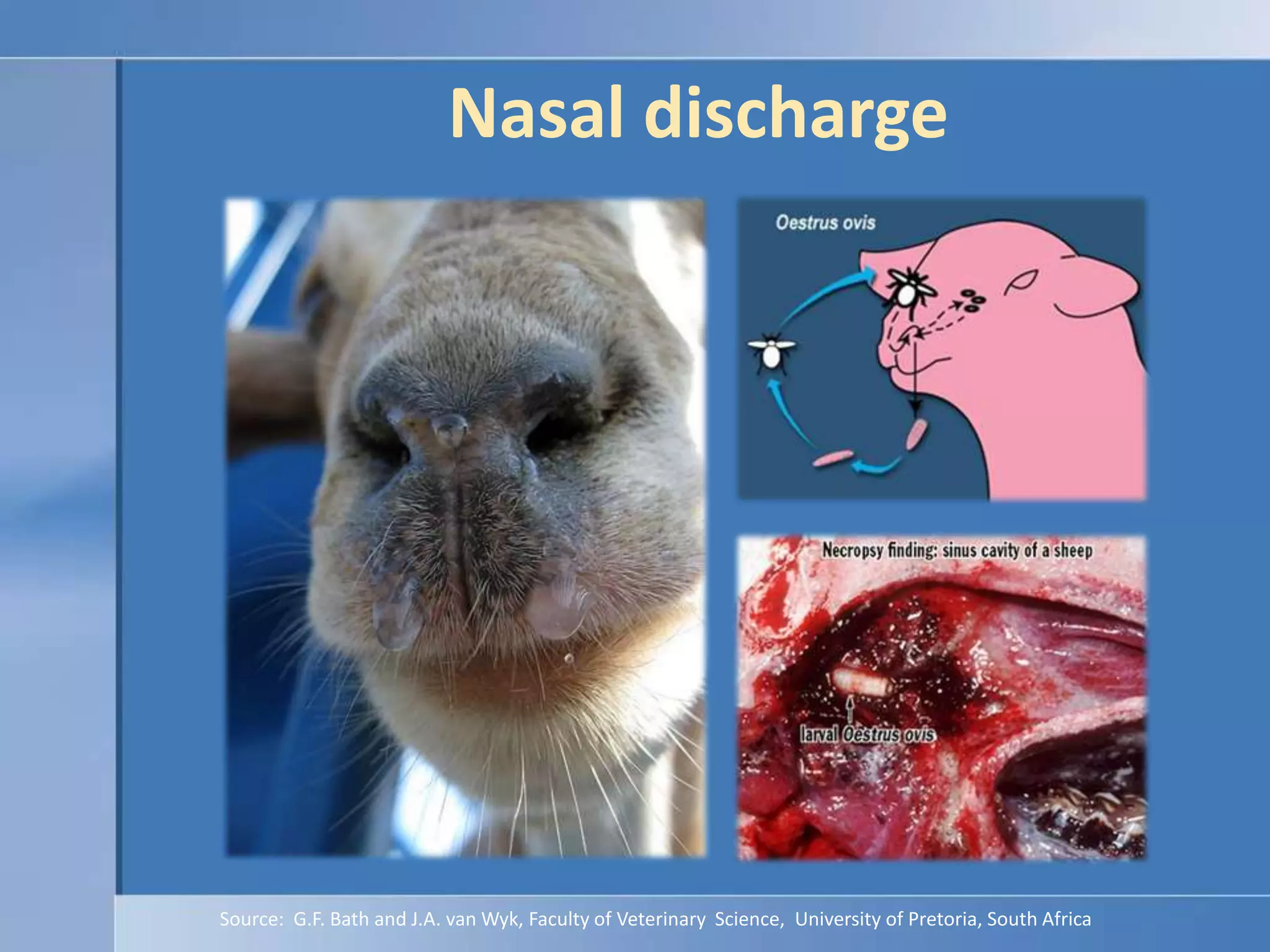
The Five Point Check ©    (5.©)Expands the FAMACHA© system to include evaluation criteria for other internal parasites.Check five places on animal’s bodyFAMACHA© scoreBottle jawBody condition scoreDag scoreNasal discharge
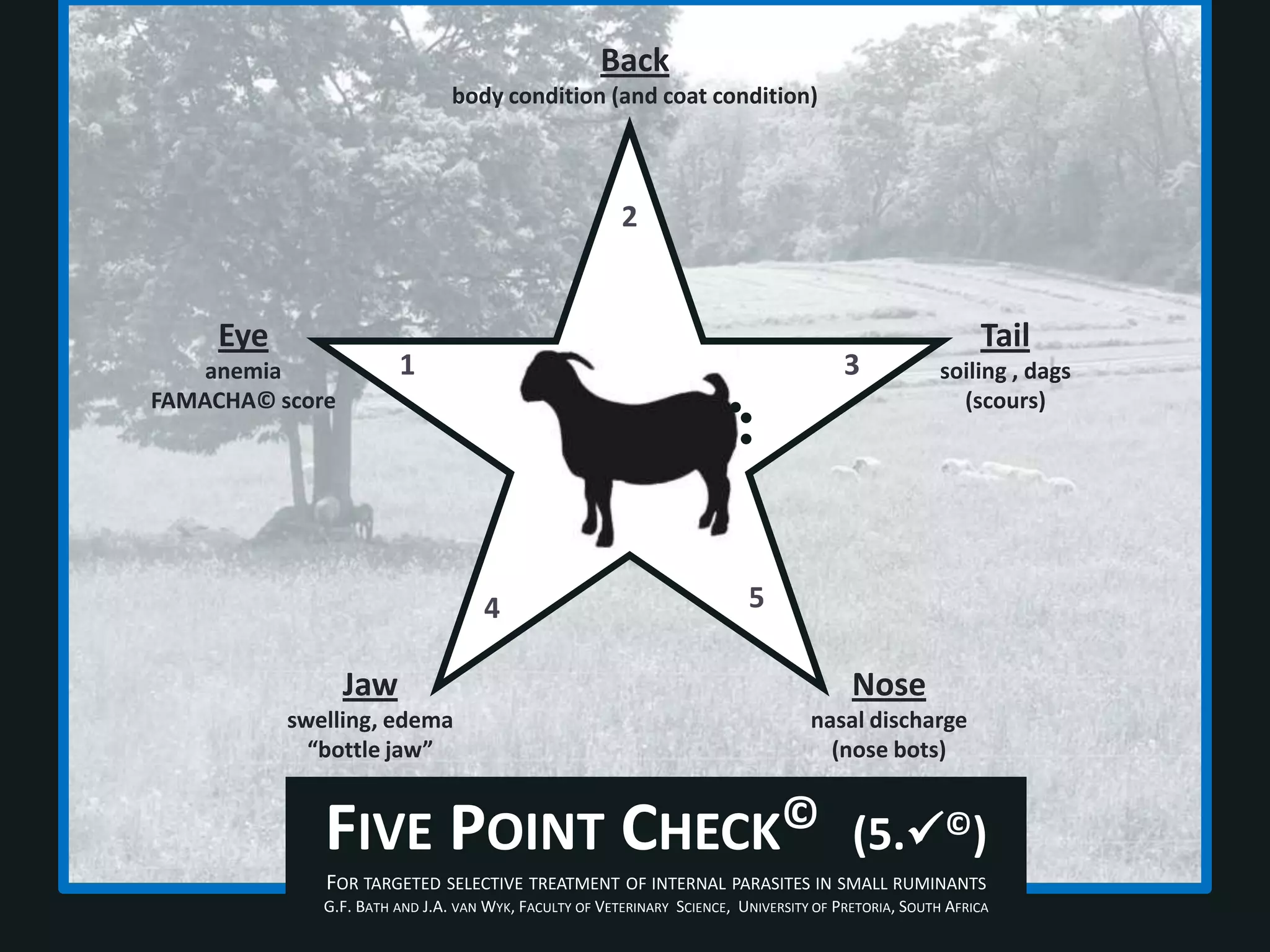
Backbody condition (and coat condition)2Tailsoiling , dags(scours)EyeanemiaFAMACHA© score1354Nosenasal discharge(nose bots)Jawswelling, edema “bottle jaw”Five Point Check©   (5.©)For targeted selective treatment of internal parasites in small ruminantsG.F. Bath and J.A. van Wyk, Faculty of Veterinary  Science,  University of Pretoria, South Africa
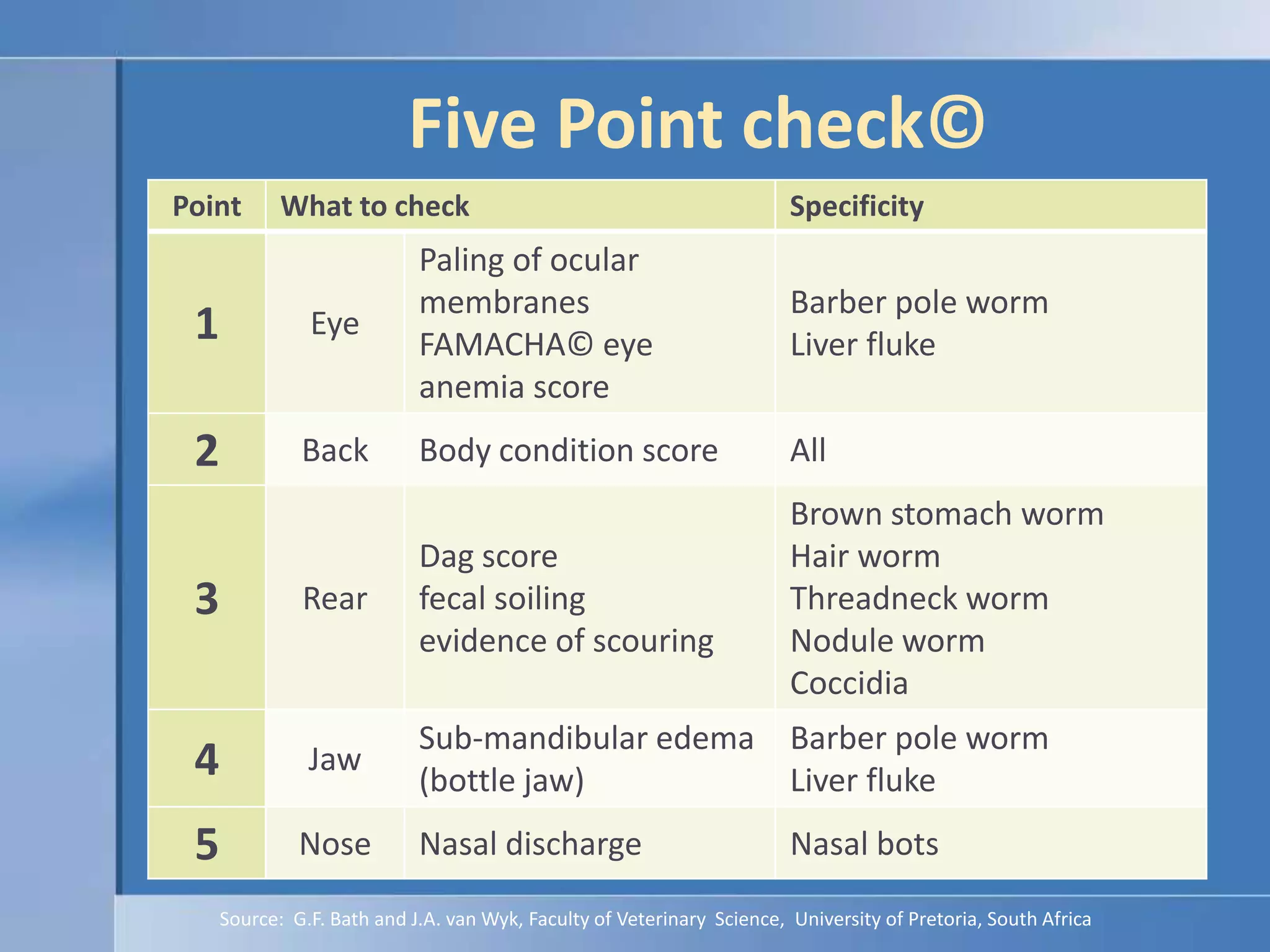
Five Point check©Source:  G.F. Bath and J.A. van Wyk, Faculty of Veterinary  Science,  University of Pretoria, South Africa
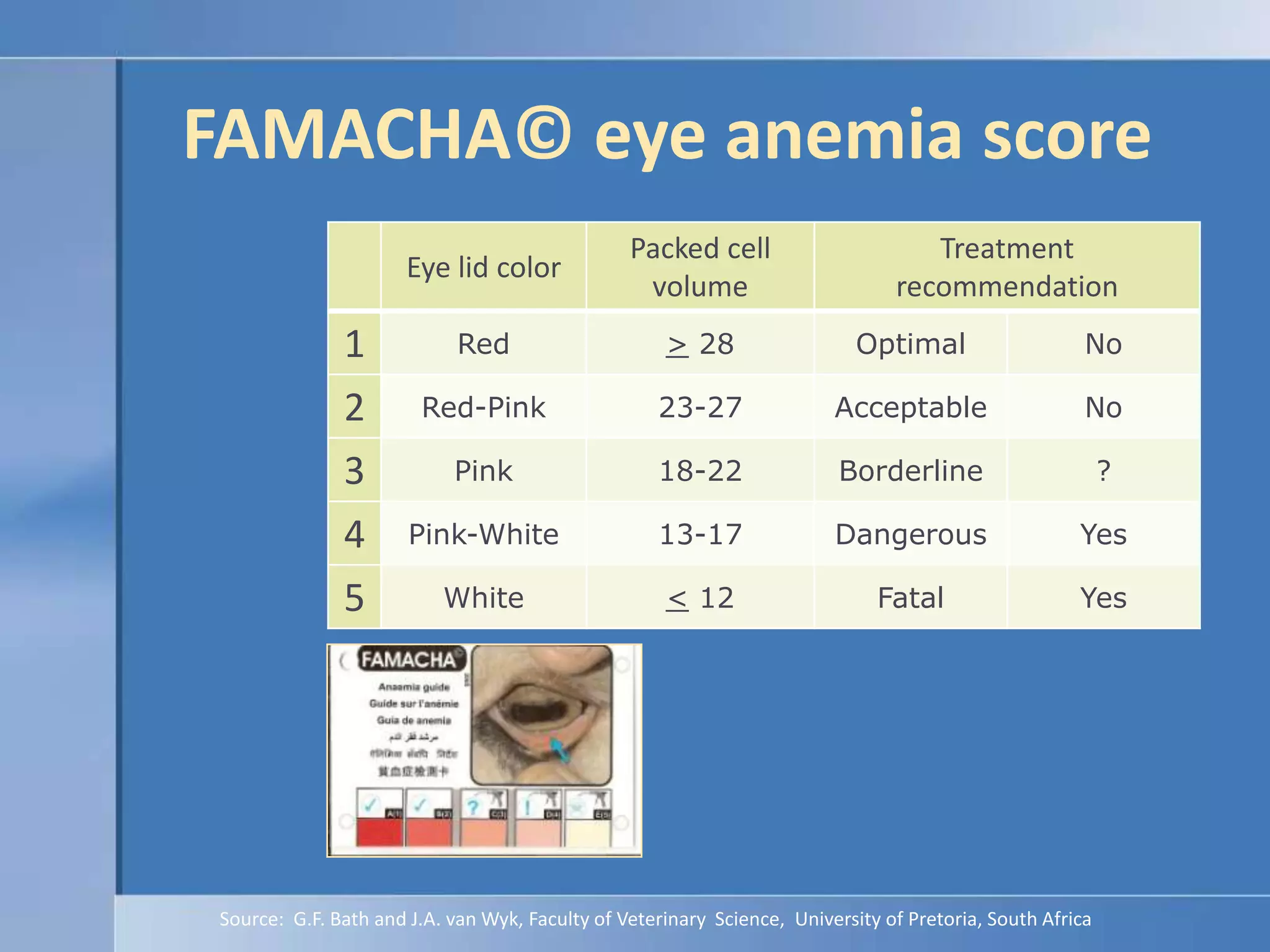
FAMACHA© eye anemia scoreSource:  G.F. Bath and J.A. van Wyk, Faculty of Veterinary  Science,  University of Pretoria, South Africa
Bottle jawSub-mandibular edemaSource:  G.F. Bath and J.A. van Wyk, Faculty of Veterinary  Science,  University of Pretoria, South Africa
Body condition score (BCS)Source:  G.F. Bath and J.A. van Wyk, Faculty of Veterinary  Science,  University of Pretoria, South Africa
Dag Scoresbritch soiling, evidence of scouring (diarrhea)Source:  G.F. Bath and J.A. van Wyk, Faculty of Veterinary  Science,  University of Pretoria, South Africa
Nasal dischargeSource:  G.F. Bath and J.A. van Wyk, Faculty of Veterinary  Science,  University of Pretoria, South Africa
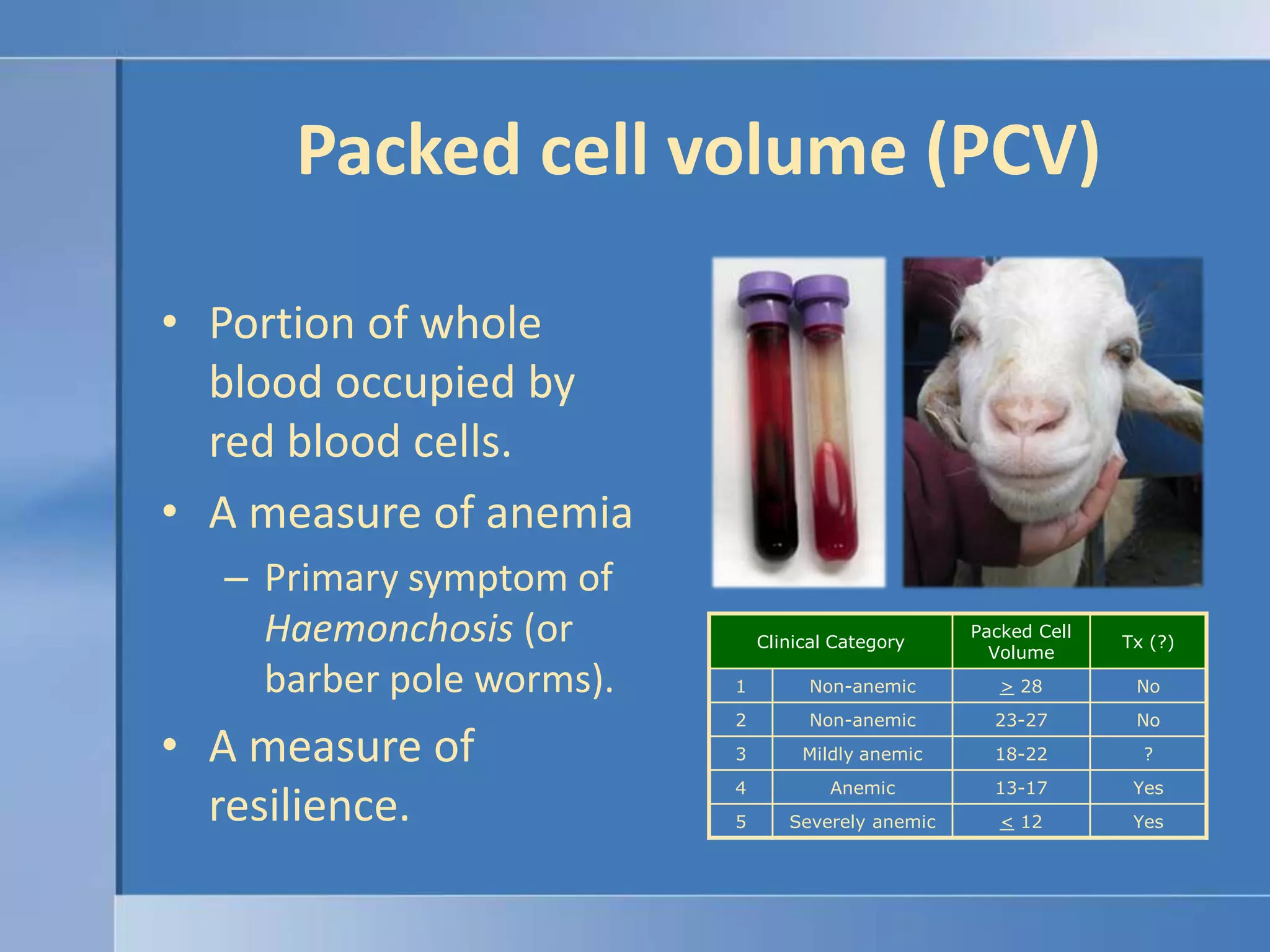
Packed cell volume (PCV)Portion of whole blood occupied by red blood cells.A measure of anemia Primary symptom of Haemonchosis(or barber pole worms).A measure of resilience.
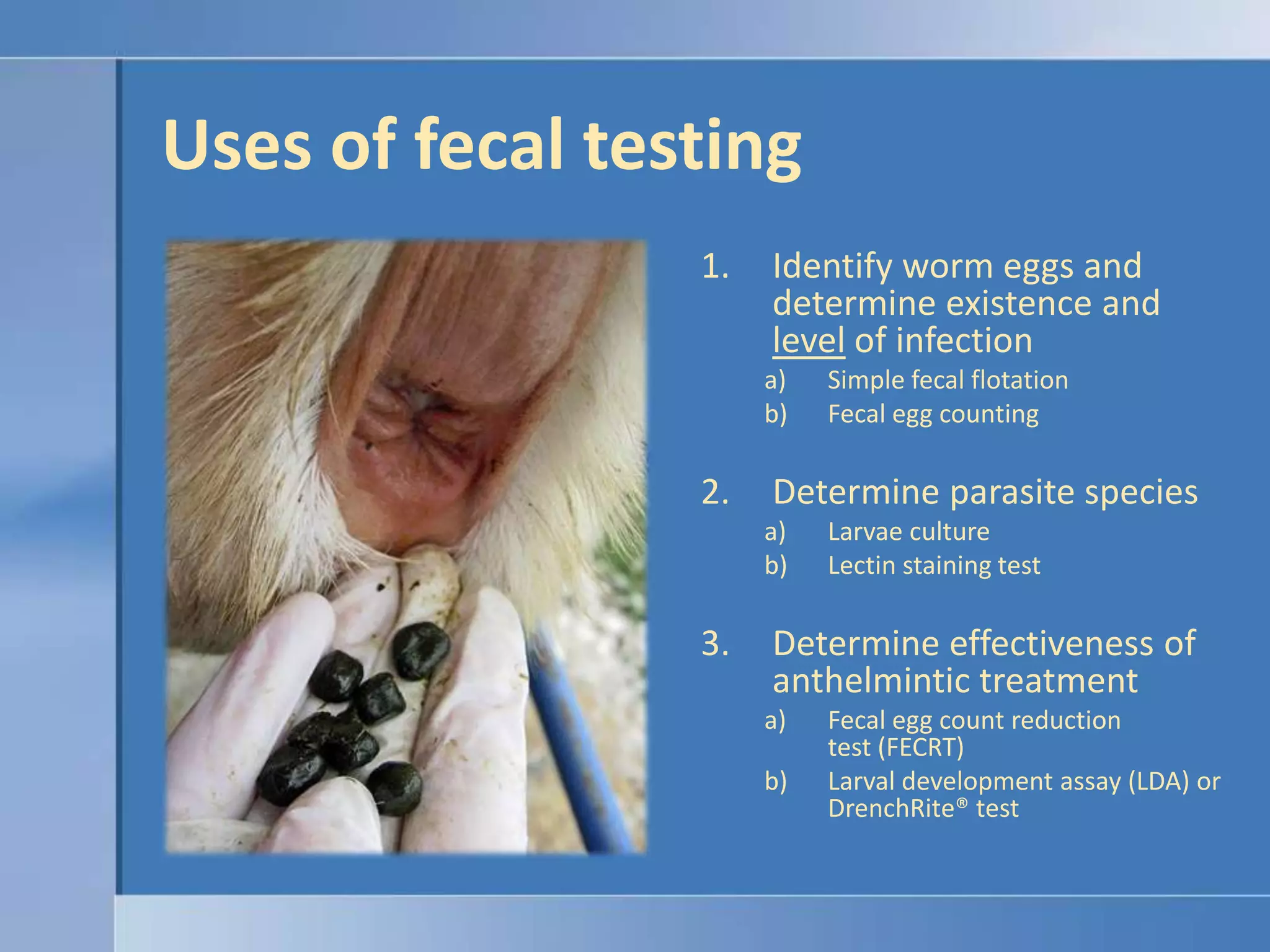
Uses of fecal testingIdentify worm eggs and determine existence and levelof infectionSimple fecal flotationFecal egg countingDetermine parasite species Larvae cultureLectin staining testDetermine effectiveness of anthelmintic treatmentFecal egg count reduction test (FECRT)Larval development assay (LDA) or DrenchRite® test
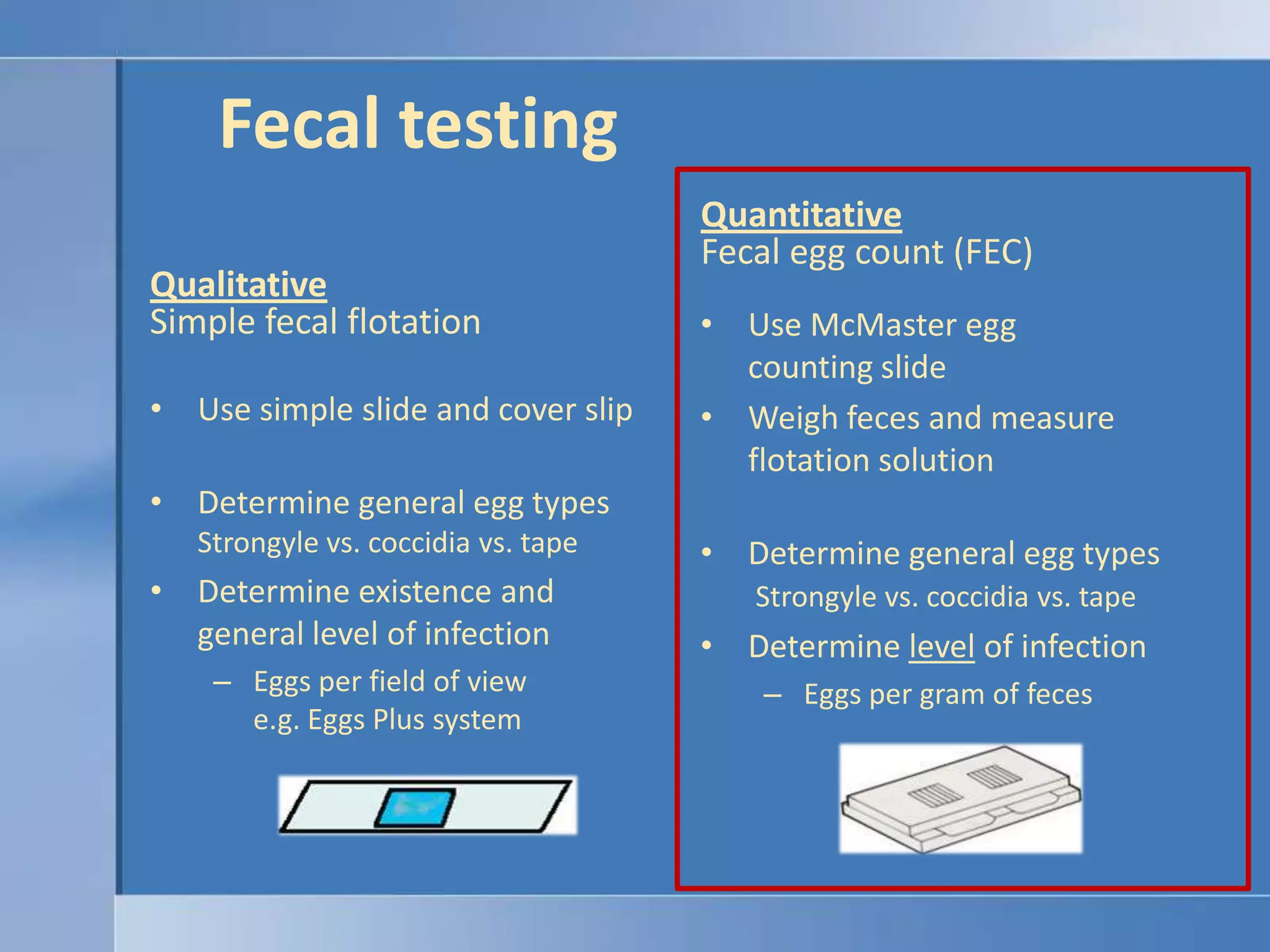
Fecal testingQuantitativeFecal egg count (FEC)QualitativeSimple fecal flotationUse McMaster egg counting slideWeigh feces and measure flotation solutionDetermine general egg typesStrongyle vs. coccidia vs. tapeDetermine level of infectionEggs per gram of fecesUse simple slide and cover slipDetermine general egg typesStrongyle vs. coccidia vs. tape Determine existence and general level of infectionEggs per field of viewe.g. Eggs Plus system
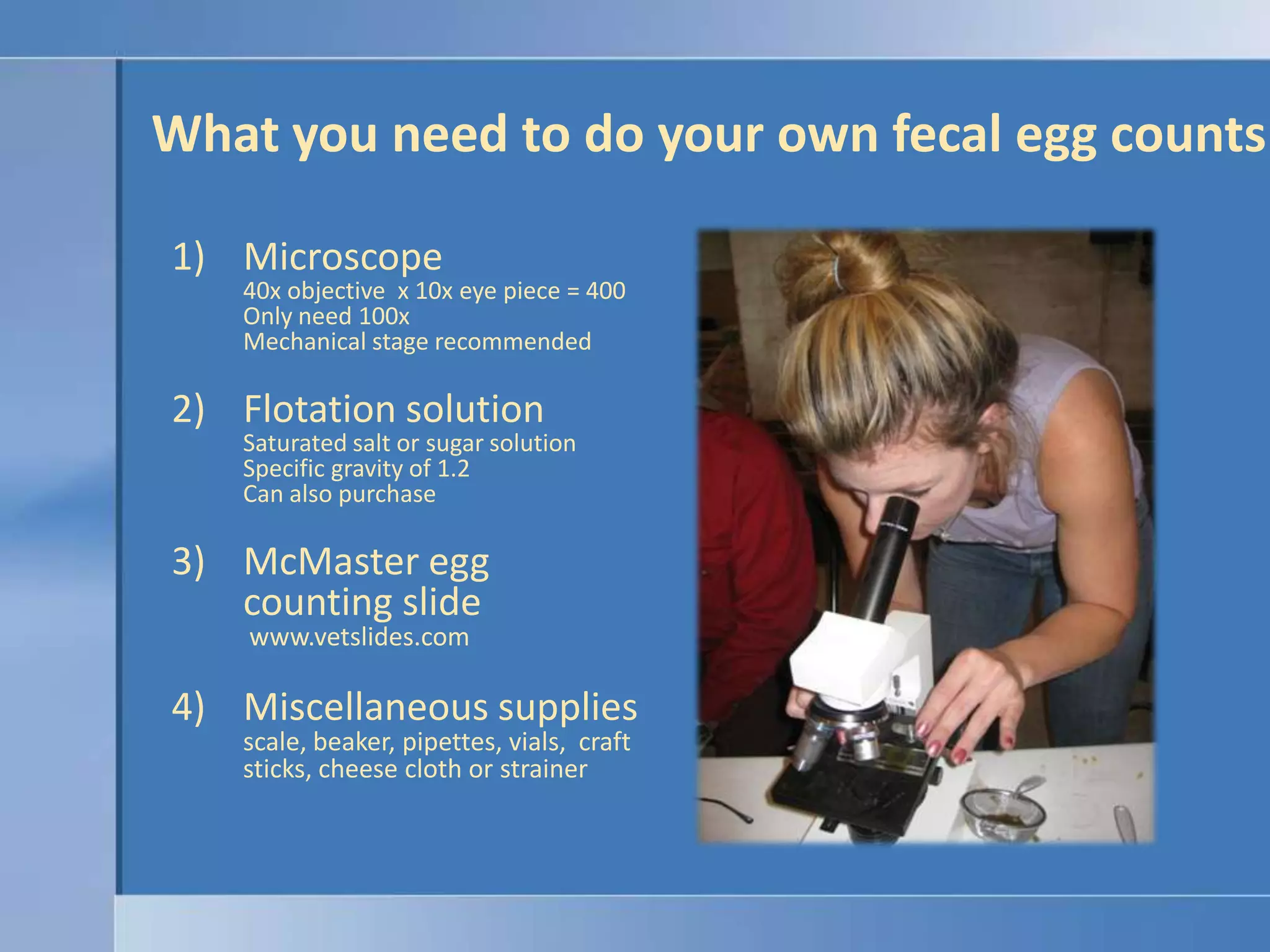
What you need to do your own fecal egg countsMicroscope40x objective  x 10x eye piece = 400Only need 100xMechanical stage recommendedFlotation solutionSaturated salt or sugar solutionSpecific gravity of 1.2Can also purchaseMcMaster egg counting slide www.vetslides.comMiscellaneous suppliesscale, beaker, pipettes, vials,  craft sticks, cheese cloth or strainer
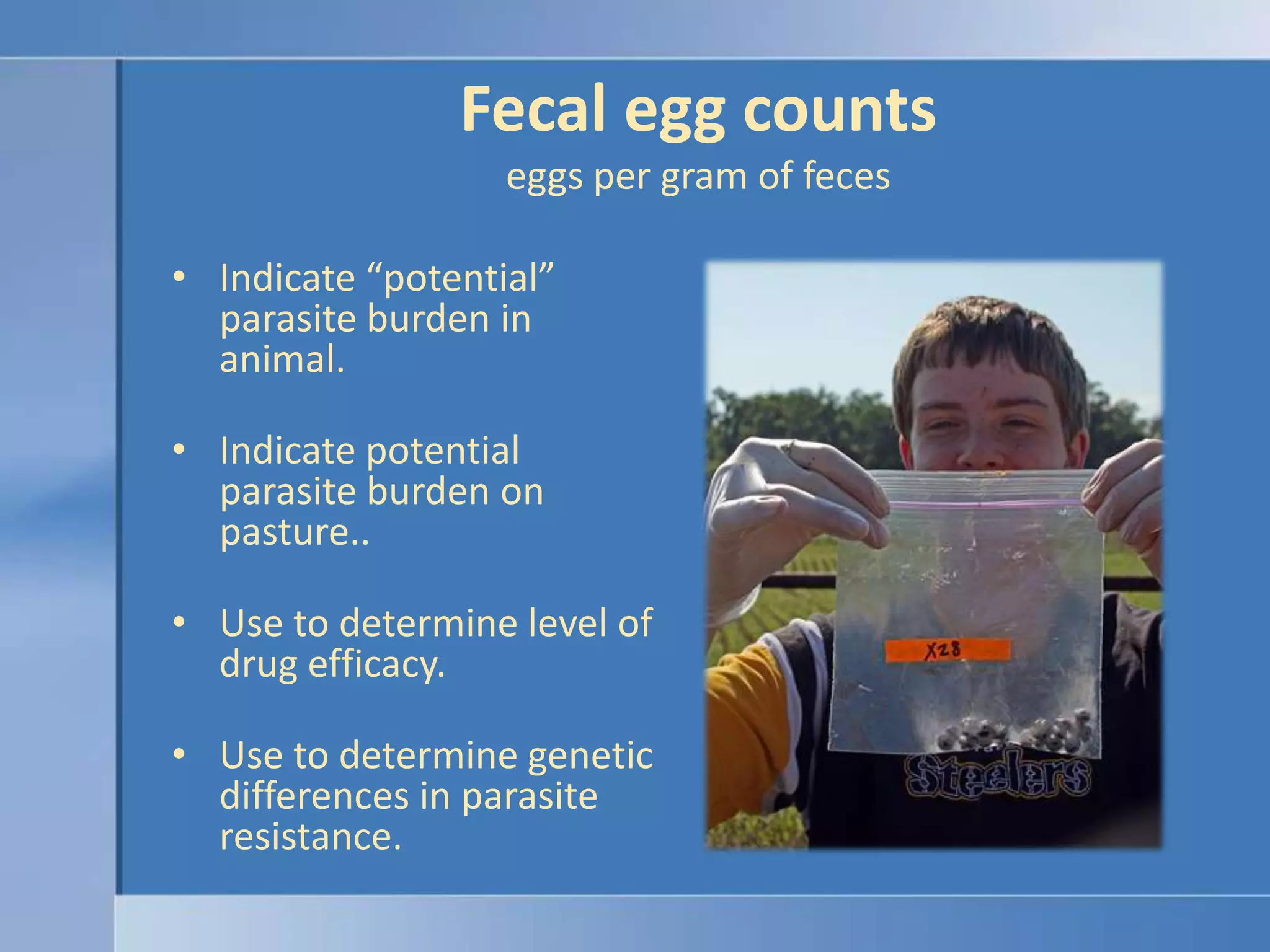
Fecal egg countseggs per gram of fecesIndicate “potential” parasite burden in animal.Indicate potential parasite burden on pasture..Use to determine level of drug efficacy.Use to determine genetic differences in parasite resistance.
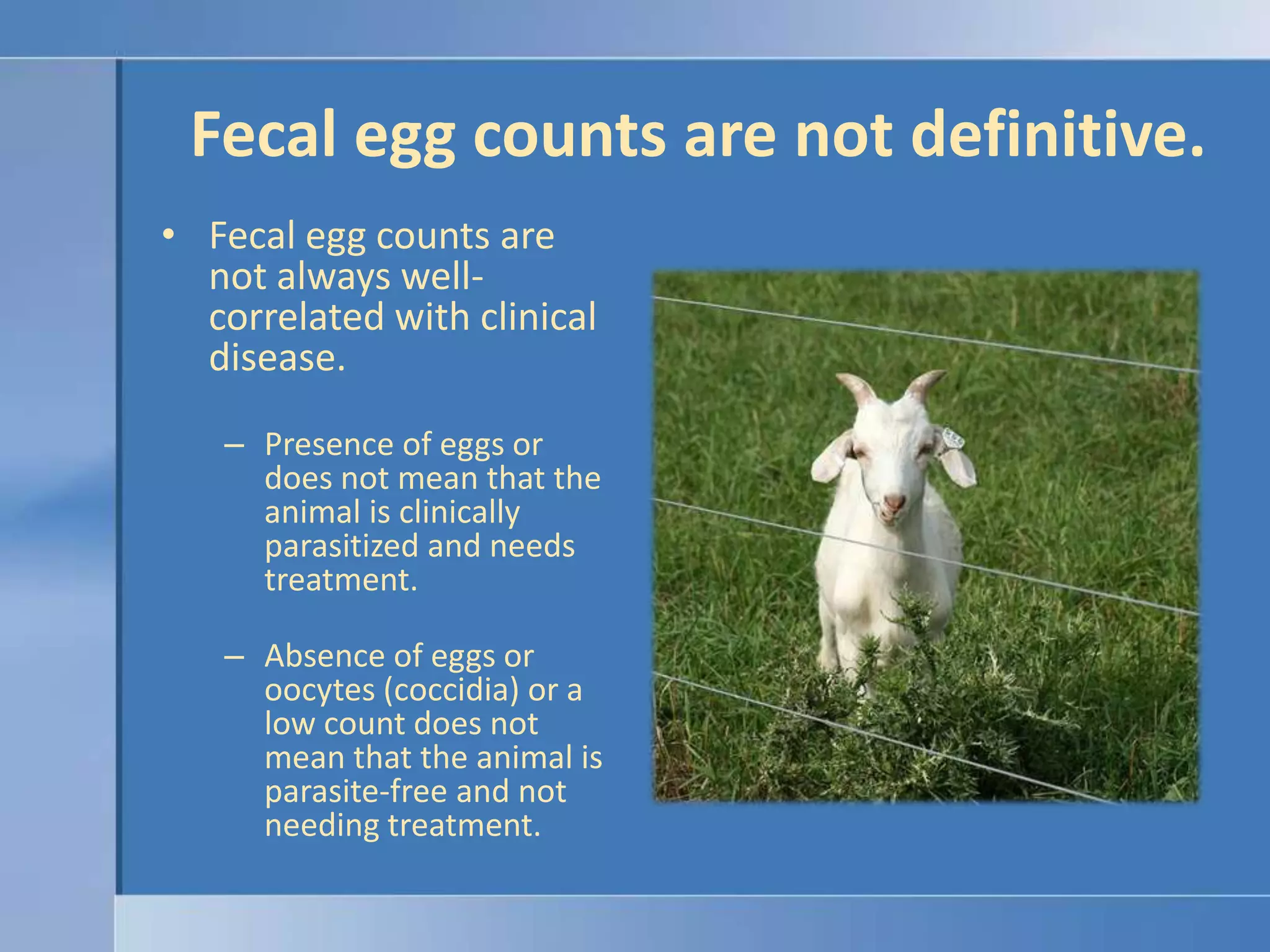
Fecal egg counts are not definitive.Fecal egg counts are not always well-correlated with clinical disease.Presence of eggs or does not mean that the animal is clinically parasitized and needs treatment.Absence of eggs or oocytes (coccidia) or a low count does not mean that the animal is parasite-free and not needing treatment.
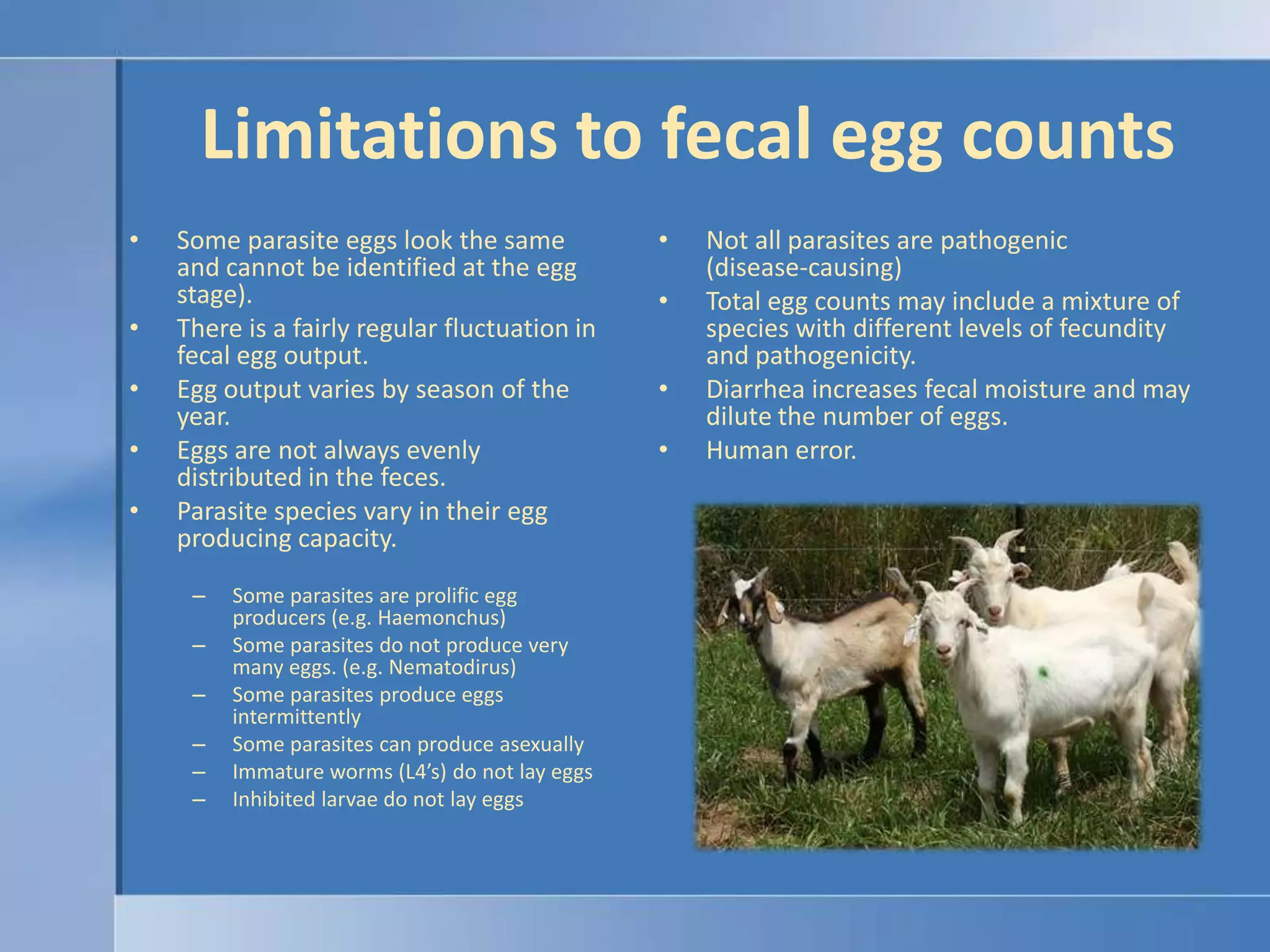
Limitations to fecal egg countsSome parasite eggs look the same and cannot be identified at the egg stage).There is a fairly regular fluctuation in fecal egg output.Egg output varies by season of the year.Eggs are not always evenly distributed in the feces.Parasite species vary in their egg producing capacity.Some parasites are prolific egg producers (e.g. Haemonchus)Some parasites do not produce very many eggs. (e.g. Nematodirus)Some parasites produce eggs intermittentlySome parasites can produce asexuallyImmature worms (L4’s) do not lay eggsInhibited larvae do not lay eggsNot all parasites are pathogenic (disease-causing)Total egg counts may include a mixture of species with different levels of fecundity and pathogenicity.Diarrhea increases fecal moisture and may dilute the number of eggs.Human error.
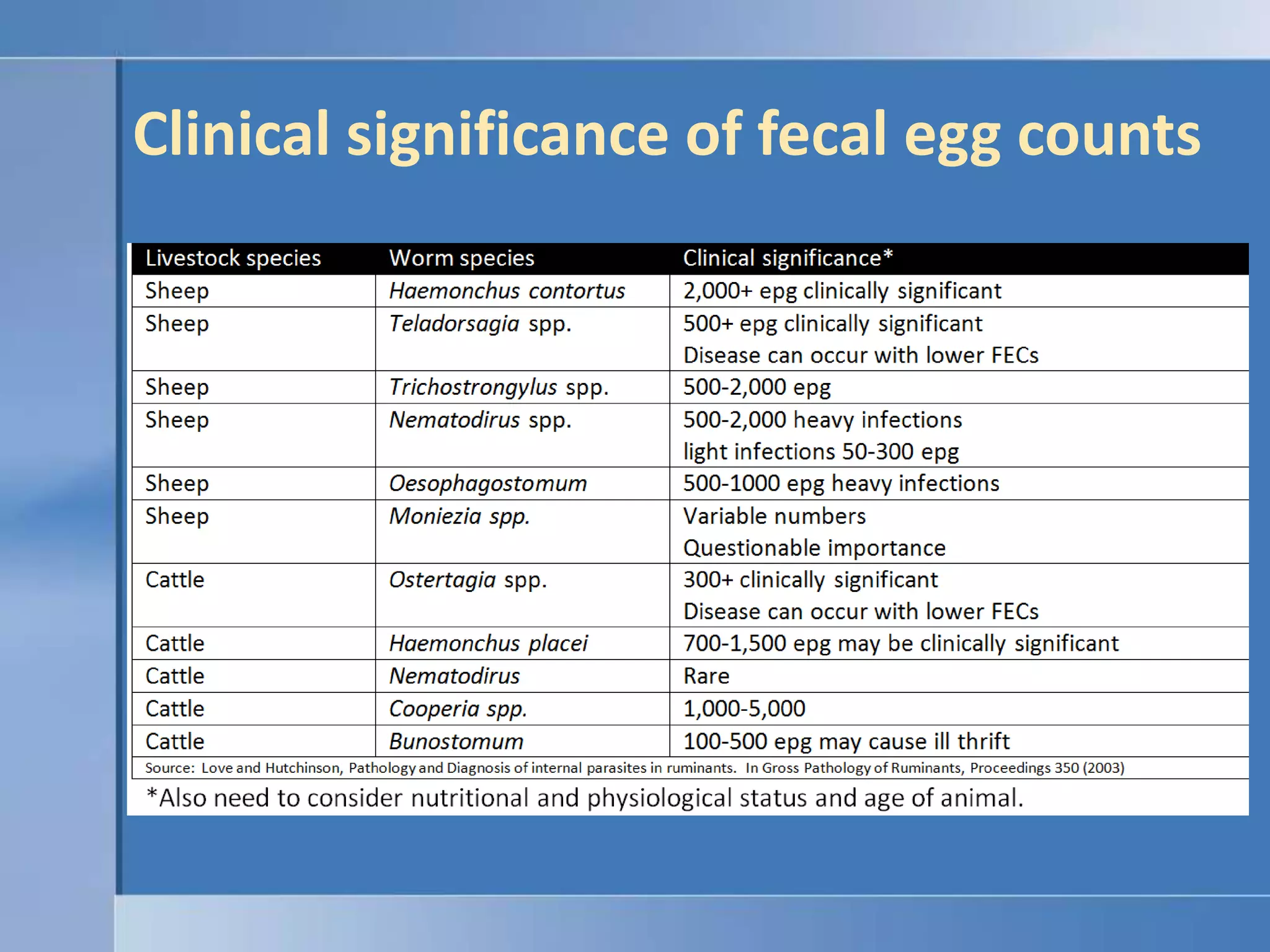
Clinical significance of fecal egg counts
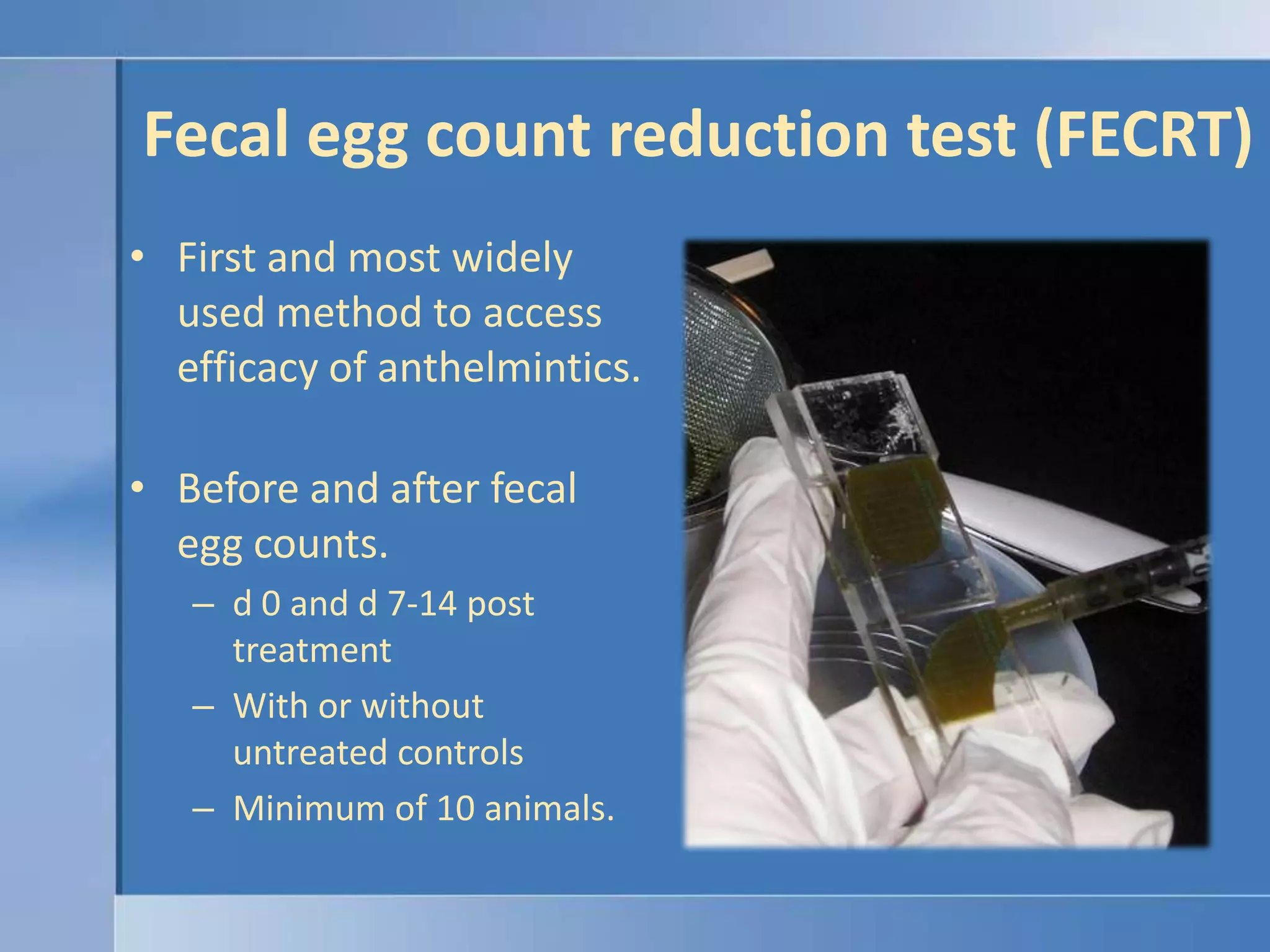
Fecal egg count reduction test (FECRT)First and most widely used method to access efficacy of anthelmintics.Before and after fecal egg counts.d 0 and d 7-14 post treatmentWith or without untreated controls Minimum of 10 animals.
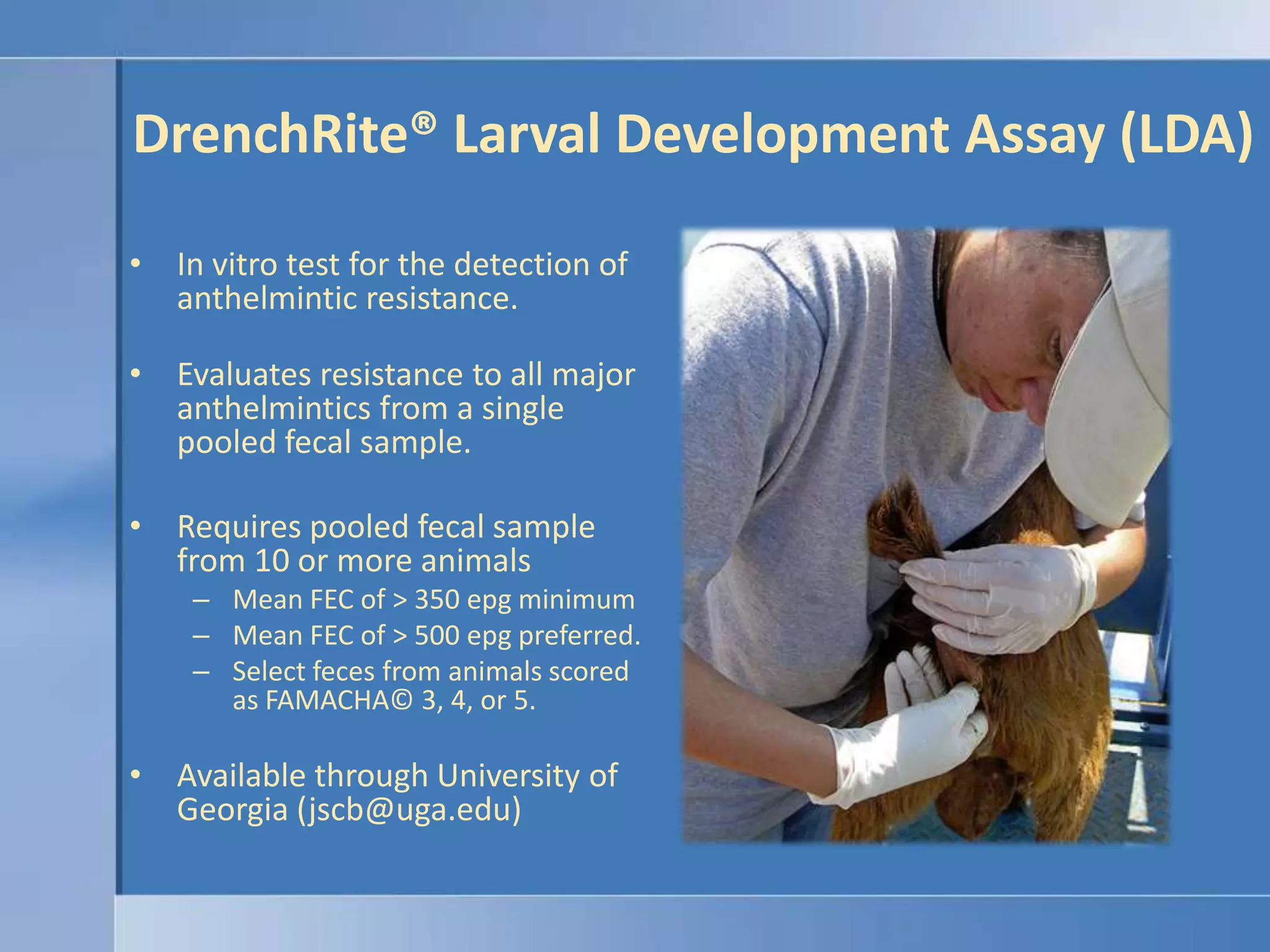
DrenchRite® Larval Development Assay (LDA)In vitro test for the detection of anthelmintic resistance.Evaluates resistance to all major anthelmintics from a single pooled fecal sample.Requires pooled fecal sample from 10 or more animals Mean FEC of > 350 epg minimumMean FEC of > 500 epg preferred.Select feces from animals scored as FAMACHA© 3, 4, or 5.Available through University of Georgia (jscb@uga.edu)
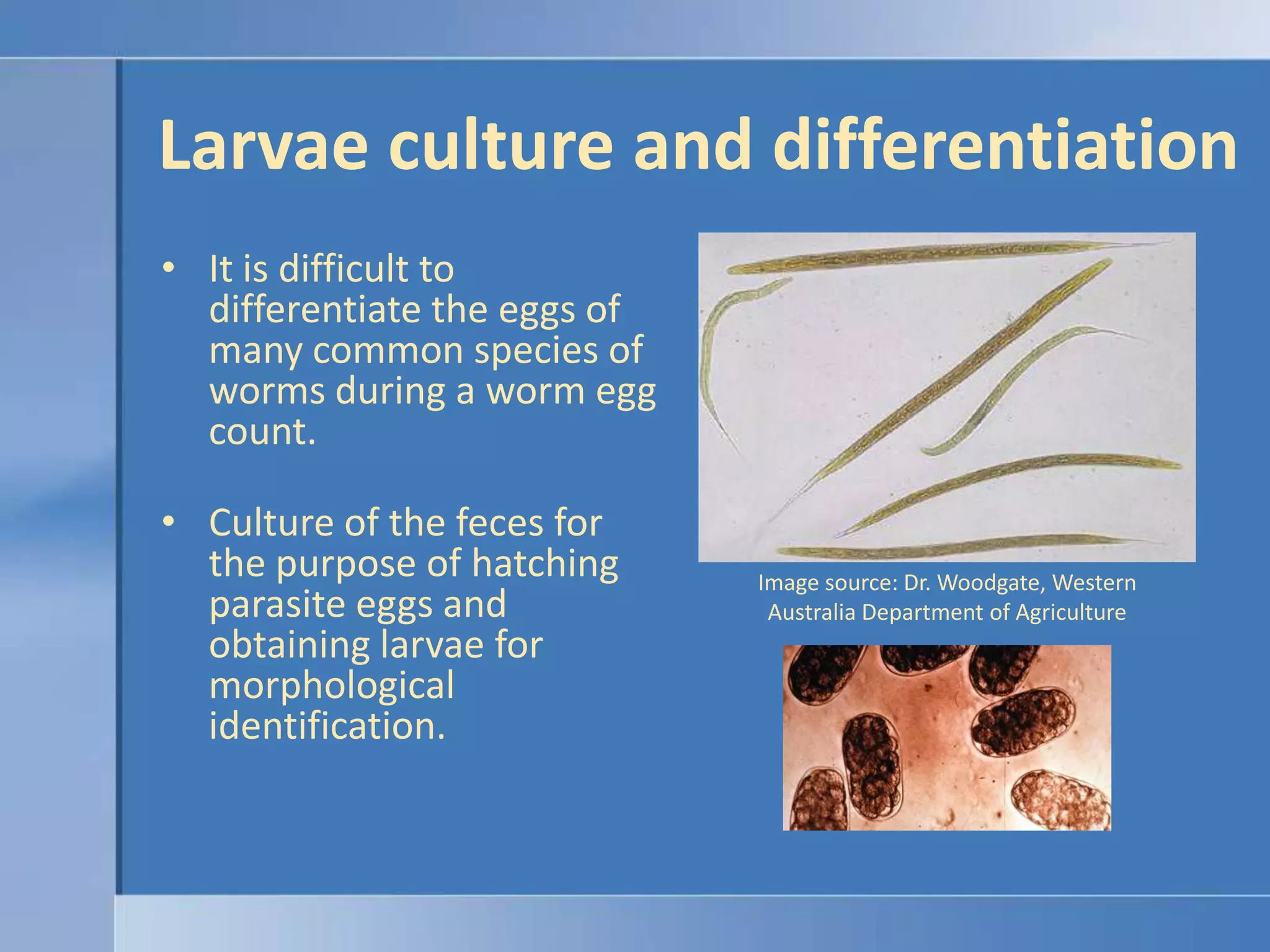
Larvae culture and differentiationIt is difficult to differentiate the eggs of many common species of worms during a worm egg count. Culture of the feces for the purpose of hatching parasite eggs and obtaining larvae for morphological identification.Image source: Dr. Woodgate, Western Australia Department of Agriculture
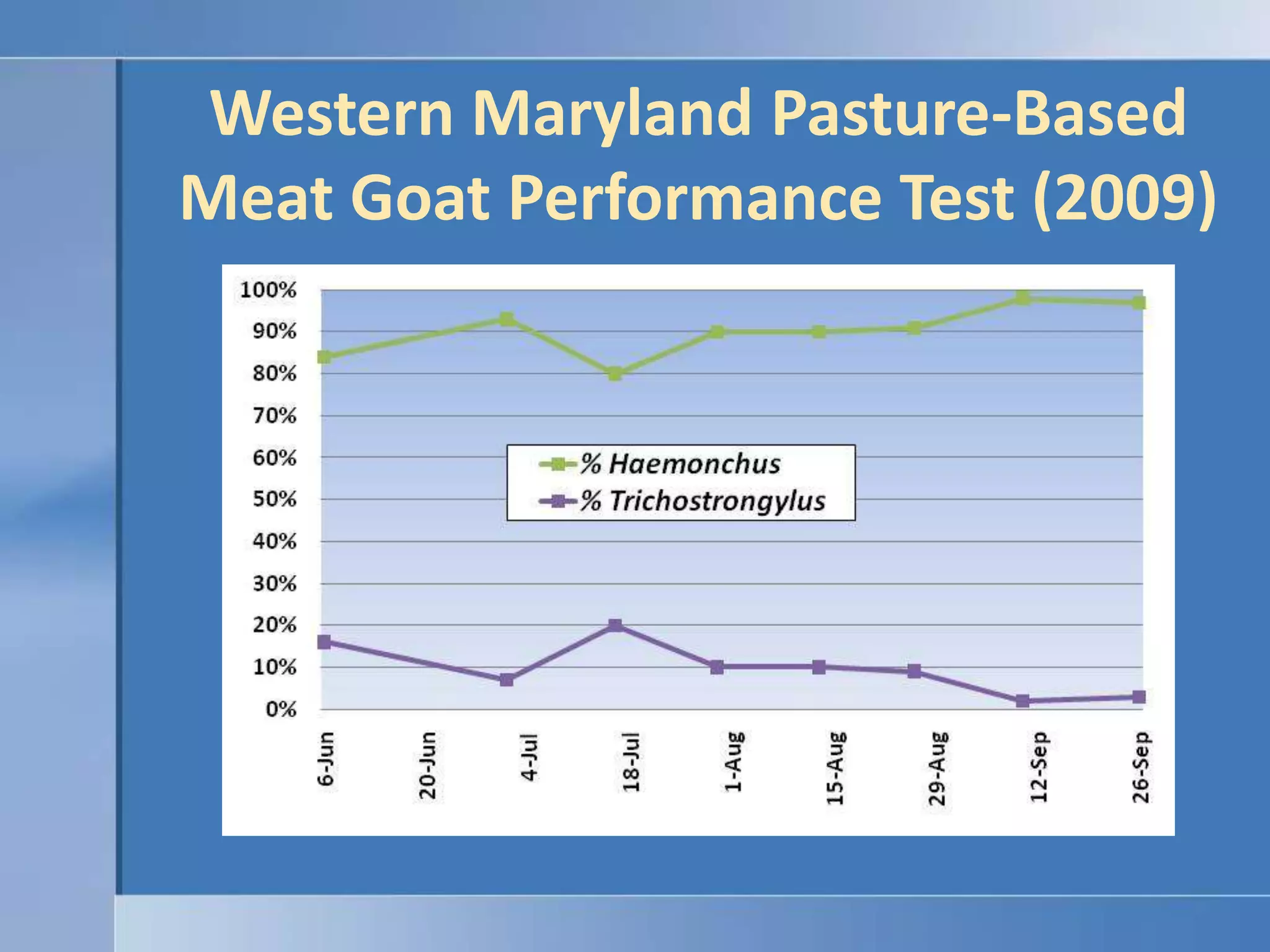
Western Maryland Pasture-Based Meat Goat Performance Test (2009)
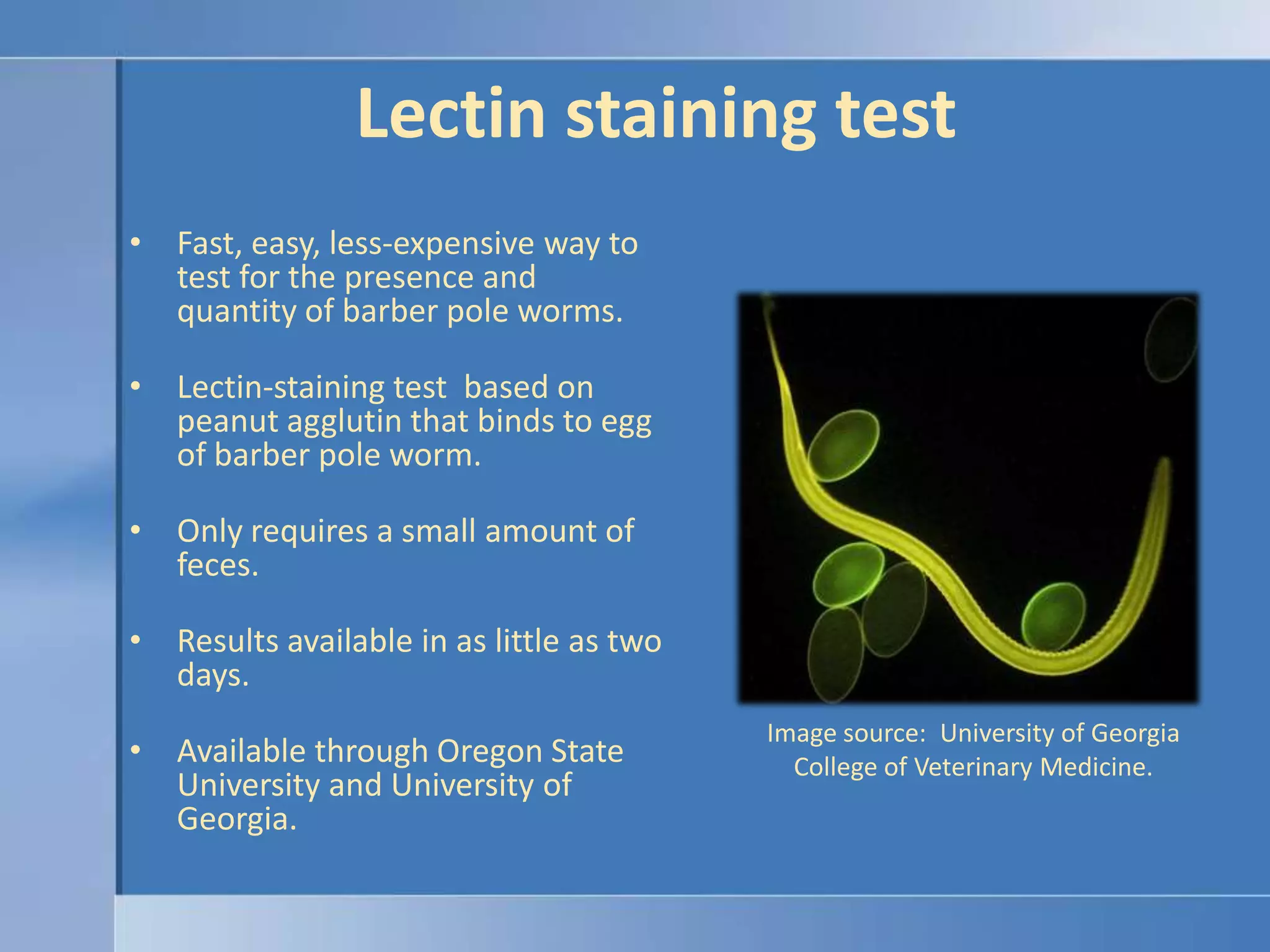
Lectin staining testFast, easy, less-expensive way to  test for the presence and quantity of barber pole worms.Lectin-staining test  based on peanut agglutin that binds to egg of barber pole worm.Only requires a small amount of feces.Results available in as little as two days.Available through Oregon State University and University of Georgia.Image source:  University of Georgia College of Veterinary Medicine.
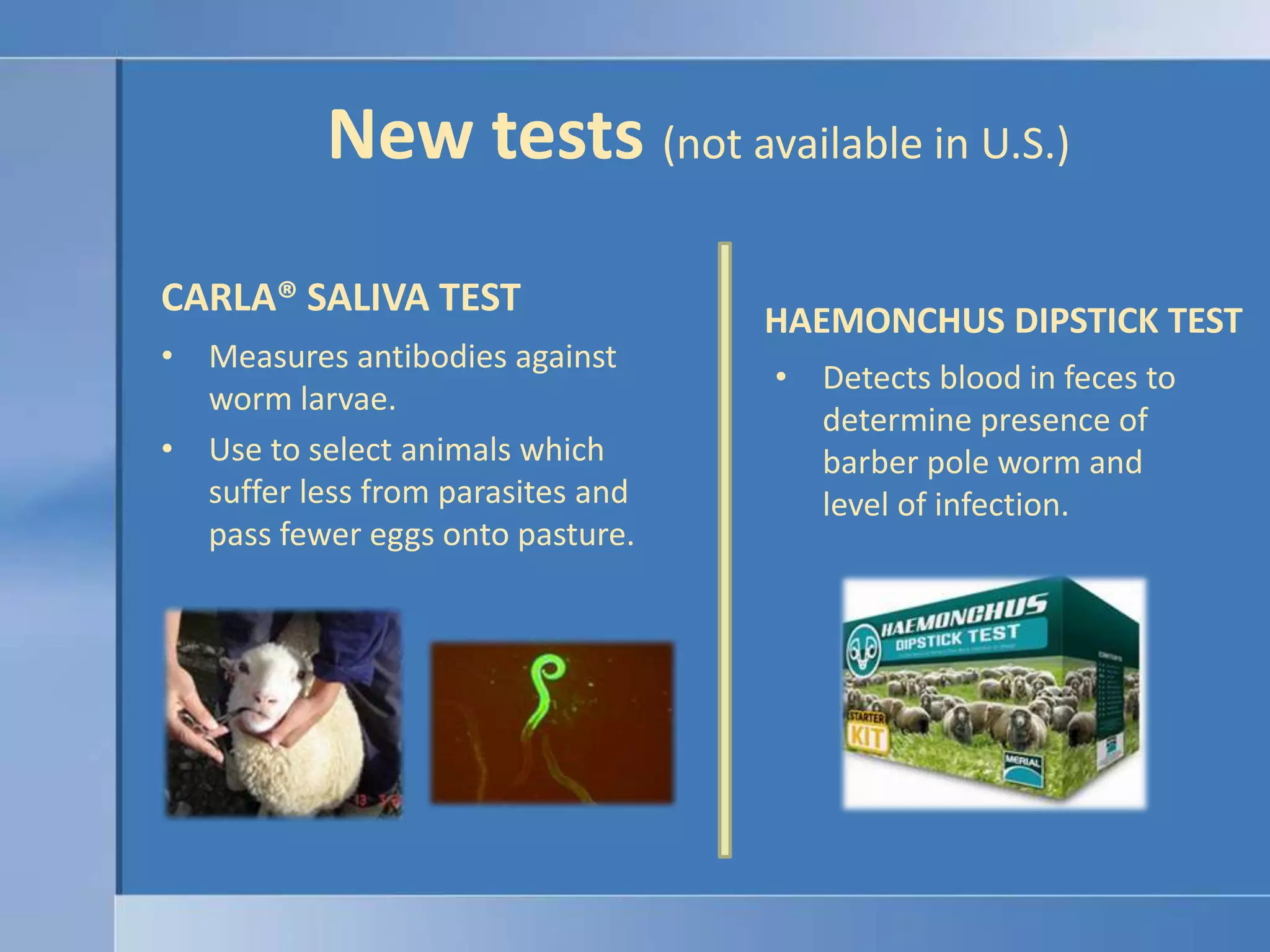
New tests (not available in U.S.)CARLA® SALIVA TESTHAEMONCHUS DIPSTICK TESTMeasures antibodies against worm larvae.Use to select animals which suffer less from parasites and pass fewer eggs onto pasture.Detects blood in feces to determine presence of barber pole worm and level of infection.
Small Ruminant ProgramThank you for your attention.Any questions?SUSAN SCHOENIANsschoen@umd.eduwww.sheepandgoat.comNext webinar (last) :  Using anthelmintics effectively - May 26

Worm diagnostics

  • 1.
    III. Diagnostictools for worm controlFAMACHA© system, Five Point Check©, lab tests
  • 2.
    How do Itell if my sheep or goats are infected with parasites?
  • 3.
    They all are. Almost all sheep and goats have parasites, probably of different kinds.“Positive” egg or oocyst counts are “normal.” Negative tests are rare (during the periods of risk).Some level of parasite infection is required for immunity.
  • 4.
    They all are. Accept it!Clinical disease occurs at a certain level of infection that can vary by animal.Not all parasites are pathogenic or highly pathogenic.Not all straingsof parasites are pathogenic.
  • 5.
    The more importantquestion to ask is:How do I tell if my sheep or goat is clinically parasitized (suffering negative effects) and requires anthelmintic treatment?
  • 6.
  • 7.
    Diagnostic toolsON FARMLABORATORYAnimalFAMACHA©FivePoint Check® NEW!FecalSimple flotationFecal egg countsFecal egg count reduction test (FECRT)DipstickCarla® saliva testBloodPacked cell volumeFecalSimple flotationFecal egg countsFECRTLectin staining test NEW!LarvaeLarvae cultureLarval development assay[DrenchRite®]Pasture
  • 8.
    The FAMACHA© SystemDevelopfor small-scale sheep producers in South Africa in response to the widespread development of anthelmintic-resistant worms. A practical system for assessing barber pole worm infection in sheep and goats and determining the need for deworming individual animals.Named for its originator:Dr. Francois “FAffa” MAlanCHArt
  • 9.
    FAMACHA©General treatment recommendationsDewormadults at scores 4 and 5*Treat lambs and kids at categories 3, 4, and 5*The South Africans recommend goats be treated at categories 3, 4, and 5
  • 10.
    Using FAMACHA© Musttake training to get card.Use cardReplace card periodically(colors fade)Do not use in a vacuum; consider other factors.Frequency of checking varies by risk.Should incorporate FAMACHA© into an integrated parasite management program.
  • 11.
    Benefits of FAMACHA©Reducesnumber of anthelmintic treatments. Reduces dollars spent on anthelmintics.Identifies susceptible and resilient animals.Increases refugia Prolongs effectiveness of anthelmintics
  • 12.
    6541.2%1.2%34.8%27.1%16.7%141.7%026.2%Using the FAMACHA©system to control internal parasites in grazing lambs% Lambs/No. times treated
  • 13.
    Limitations of FAMACHA©Doesn’tsave time.LESS dewormingMORE monitoringOnly useful where (when) barber pole worm is the primary parasite.Must know which anthelmintics are effective.
  • 14.
    The Five PointCheck © (5.©)Expands the FAMACHA© system to include evaluation criteria for other internal parasites.Check five places on animal’s bodyFAMACHA© scoreBottle jawBody condition scoreDag scoreNasal discharge
  • 15.
    Backbody condition (andcoat condition)2Tailsoiling , dags(scours)EyeanemiaFAMACHA© score1354Nosenasal discharge(nose bots)Jawswelling, edema “bottle jaw”Five Point Check© (5.©)For targeted selective treatment of internal parasites in small ruminantsG.F. Bath and J.A. van Wyk, Faculty of Veterinary Science, University of Pretoria, South Africa
  • 16.
    Five Point check©Source: G.F. Bath and J.A. van Wyk, Faculty of Veterinary Science, University of Pretoria, South Africa
  • 17.
    FAMACHA© eye anemiascoreSource: G.F. Bath and J.A. van Wyk, Faculty of Veterinary Science, University of Pretoria, South Africa
  • 18.
    Bottle jawSub-mandibular edemaSource: G.F. Bath and J.A. van Wyk, Faculty of Veterinary Science, University of Pretoria, South Africa
  • 19.
    Body condition score(BCS)Source: G.F. Bath and J.A. van Wyk, Faculty of Veterinary Science, University of Pretoria, South Africa
  • 20.
    Dag Scoresbritch soiling,evidence of scouring (diarrhea)Source: G.F. Bath and J.A. van Wyk, Faculty of Veterinary Science, University of Pretoria, South Africa
  • 21.
    Nasal dischargeSource: G.F. Bath and J.A. van Wyk, Faculty of Veterinary Science, University of Pretoria, South Africa
  • 22.
    Packed cell volume(PCV)Portion of whole blood occupied by red blood cells.A measure of anemia Primary symptom of Haemonchosis(or barber pole worms).A measure of resilience.
  • 23.
    Uses of fecaltestingIdentify worm eggs and determine existence and levelof infectionSimple fecal flotationFecal egg countingDetermine parasite species Larvae cultureLectin staining testDetermine effectiveness of anthelmintic treatmentFecal egg count reduction test (FECRT)Larval development assay (LDA) or DrenchRite® test
  • 24.
    Fecal testingQuantitativeFecal eggcount (FEC)QualitativeSimple fecal flotationUse McMaster egg counting slideWeigh feces and measure flotation solutionDetermine general egg typesStrongyle vs. coccidia vs. tapeDetermine level of infectionEggs per gram of fecesUse simple slide and cover slipDetermine general egg typesStrongyle vs. coccidia vs. tape Determine existence and general level of infectionEggs per field of viewe.g. Eggs Plus system
  • 25.
    What you needto do your own fecal egg countsMicroscope40x objective x 10x eye piece = 400Only need 100xMechanical stage recommendedFlotation solutionSaturated salt or sugar solutionSpecific gravity of 1.2Can also purchaseMcMaster egg counting slide www.vetslides.comMiscellaneous suppliesscale, beaker, pipettes, vials, craft sticks, cheese cloth or strainer
  • 26.
    Fecal egg countseggsper gram of fecesIndicate “potential” parasite burden in animal.Indicate potential parasite burden on pasture..Use to determine level of drug efficacy.Use to determine genetic differences in parasite resistance.
  • 27.
    Fecal egg countsare not definitive.Fecal egg counts are not always well-correlated with clinical disease.Presence of eggs or does not mean that the animal is clinically parasitized and needs treatment.Absence of eggs or oocytes (coccidia) or a low count does not mean that the animal is parasite-free and not needing treatment.
  • 28.
    Limitations to fecalegg countsSome parasite eggs look the same and cannot be identified at the egg stage).There is a fairly regular fluctuation in fecal egg output.Egg output varies by season of the year.Eggs are not always evenly distributed in the feces.Parasite species vary in their egg producing capacity.Some parasites are prolific egg producers (e.g. Haemonchus)Some parasites do not produce very many eggs. (e.g. Nematodirus)Some parasites produce eggs intermittentlySome parasites can produce asexuallyImmature worms (L4’s) do not lay eggsInhibited larvae do not lay eggsNot all parasites are pathogenic (disease-causing)Total egg counts may include a mixture of species with different levels of fecundity and pathogenicity.Diarrhea increases fecal moisture and may dilute the number of eggs.Human error.
  • 29.
    Clinical significance offecal egg counts
  • 30.
    Fecal egg countreduction test (FECRT)First and most widely used method to access efficacy of anthelmintics.Before and after fecal egg counts.d 0 and d 7-14 post treatmentWith or without untreated controls Minimum of 10 animals.
  • 31.
    DrenchRite® Larval DevelopmentAssay (LDA)In vitro test for the detection of anthelmintic resistance.Evaluates resistance to all major anthelmintics from a single pooled fecal sample.Requires pooled fecal sample from 10 or more animals Mean FEC of > 350 epg minimumMean FEC of > 500 epg preferred.Select feces from animals scored as FAMACHA© 3, 4, or 5.Available through University of Georgia (jscb@uga.edu)
  • 32.
    Larvae culture anddifferentiationIt is difficult to differentiate the eggs of many common species of worms during a worm egg count. Culture of the feces for the purpose of hatching parasite eggs and obtaining larvae for morphological identification.Image source: Dr. Woodgate, Western Australia Department of Agriculture
  • 33.
    Western Maryland Pasture-BasedMeat Goat Performance Test (2009)
  • 34.
    Lectin staining testFast,easy, less-expensive way to test for the presence and quantity of barber pole worms.Lectin-staining test based on peanut agglutin that binds to egg of barber pole worm.Only requires a small amount of feces.Results available in as little as two days.Available through Oregon State University and University of Georgia.Image source: University of Georgia College of Veterinary Medicine.
  • 35.
    New tests (notavailable in U.S.)CARLA® SALIVA TESTHAEMONCHUS DIPSTICK TESTMeasures antibodies against worm larvae.Use to select animals which suffer less from parasites and pass fewer eggs onto pasture.Detects blood in feces to determine presence of barber pole worm and level of infection.
  • 36.
    Small Ruminant ProgramThankyou for your attention.Any questions?SUSAN SCHOENIANsschoen@umd.eduwww.sheepandgoat.comNext webinar (last) : Using anthelmintics effectively - May 26