To Deworm or not
On-farm decision-making tools for
deciding who to treat and when
SUSAN SCHOENIAN  SHEEP & GOAT SPECIALIST  SSCHOEN@UMD.EDU
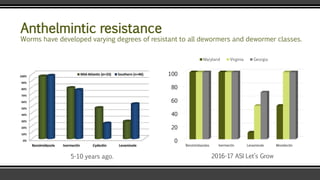
Anthelmintic resistance
Worms have developed varying degrees of resistant to all dewormers and dewormer classes.
0
20
40
60
80
100
Benzimidazoles Ivermectin Levamisole Moxidectin
Maryland Virginia Georgia
5-10 years ago. 2016-17 ASI Let’s Grow
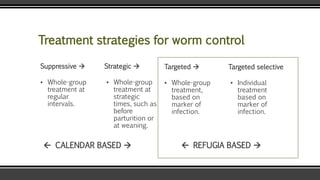
Treatment strategies for worm control
Suppressive 
▪ Whole-group
treatment at
regular
intervals.
Strategic 
▪ Whole-group
treatment at
strategic
times, such as
before
parturition or
at weaning.
Targeted 
▪ Whole-group
treatment,
based on
marker of
infection.
Targeted selective
▪ Individual
treatment
based on
marker of
infection.
 REFUGIA BASED  CALENDAR BASED 
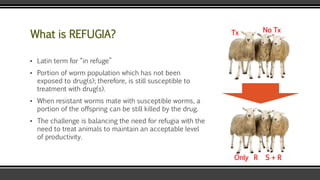
What is REFUGIA?
▪ Latin term for “in refuge”
▪ Portion of worm population which has not been
exposed to drug(s); therefore, is still susceptible to
treatment with drug(s).
▪ When resistant worms mate with susceptible worms, a
portion of the offspring can be still killed by the drug.
▪ The challenge is balancing the need for refugia with the
need to treat animals to maintain an acceptable level
of productivity.
Only R S + R
Tx No Tx
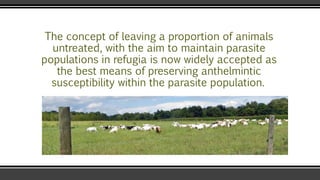
The concept of leaving a proportion of animals
untreated, with the aim to maintain parasite
populations in refugia is now widely accepted as
the best means of preserving anthelmintic
susceptibility within the parasite population.
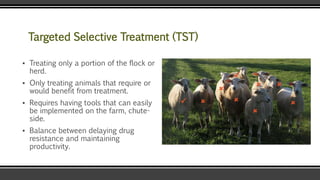
Targeted Selective Treatment (TST)
▪ Treating only a portion of the flock or
herd.
▪ Only treating animals that require or
would benefit from treatment.
▪ Requires having tools that can easily
be implemented on the farm, chute-
side.
▪ Balance between delaying drug
resistance and maintaining
productivity.
 

 




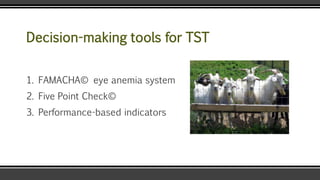
Decision-making tools for TST
1. FAMACHA© eye anemia system
2. Five Point Check©
3. Performance-based indicators
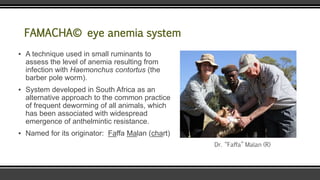
FAMACHA© eye anemia system
▪ A technique used in small ruminants to
assess the level of anemia resulting from
infection with Haemonchus contortus (the
barber pole worm).
▪ System developed in South Africa as an
alternative approach to the common practice
of frequent deworming of all animals, which
has been associated with widespread
emergence of anthelmintic resistance.
▪ Named for its originator: Faffa Malan (chart)
Dr. “Faffa” Malan (R)
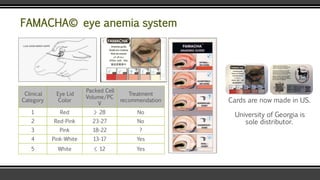
FAMACHA© eye anemia system
Clinical
Category
Eye Lid
Color
Packed Cell
Volume/PC
V
Treatment
recommendation
1 Red > 28 No
2 Red-Pink 23-27 No
3 Pink 18-22 ?
4 Pink-White 13-17 Yes
5 White < 12 Yes
Cards are now made in US.
University of Georgia is
sole distributor.
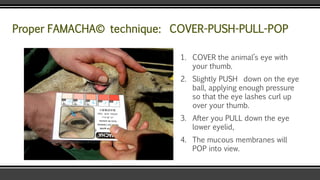
Proper FAMACHA© technique: COVER-PUSH-PULL-POP
1. COVER the animal’s eye with
your thumb.
2. Slightly PUSH down on the eye
ball, applying enough pressure
so that the eye lashes curl up
over your thumb.
3. After you PULL down the eye
lower eyelid,
4. The mucous membranes will
POP into view.
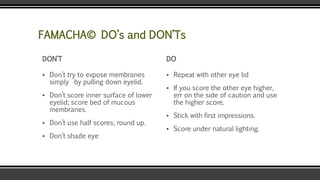
FAMACHA© DO’s and DON’Ts
DON’T
▪ Don’t try to expose membranes
simply by pulling down eyelid.
▪ Don’t score inner surface of lower
eyelid; score bed of mucous
membranes.
▪ Don’t use half scores; round up.
▪ Don’t shade eye
DO
▪ Repeat with other eye lid
▪ If you score the other eye higher,
err on the side of caution and use
the higher score.
▪ Stick with first impressions.
▪ Score under natural lighting.
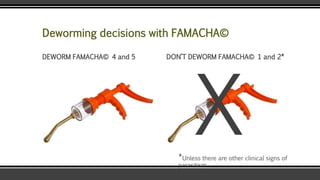
Deworming decisions with FAMACHA©
DEWORM FAMACHA© 4 and 5 DON’T DEWORM FAMACHA© 1 and 2*
*Unless there are other clinical signs of
parasitism
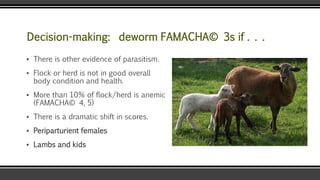
Decision-making: deworm FAMACHA© 3s if . . .
▪ There is other evidence of parasitism.
▪ Flock or herd is not in good overall
body condition and health.
▪ More than 10% of flock/herd is anemic
(FAMACHA© 4, 5)
▪ There is a dramatic shift in scores.
▪ Periparturient females
▪ Lambs and kids
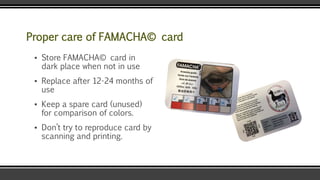
Proper care of FAMACHA© card
▪ Store FAMACHA© card in
dark place when not in use
▪ Replace after 12-24 months of
use
▪ Keep a spare card (unused)
for comparison of colors.
▪ Don’t try to reproduce card by
scanning and printing.
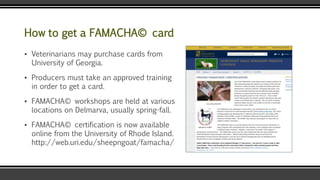
How to get a FAMACHA© card
▪ Veterinarians may purchase cards from
University of Georgia.
▪ Producers must take an approved training
in order to get a card.
▪ FAMACHA© workshops are held at various
locations on Delmarva, usually spring-fall.
▪ FAMACHA© certification is now available
online from the University of Rhode Island.
http://web.uri.edu/sheepngoat/famacha/
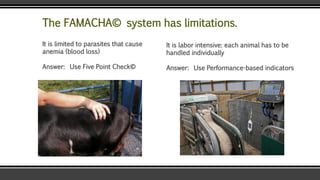
The FAMACHA© system has limitations.
It is limited to parasites that cause
anemia (blood loss)
Answer: Use Five Point Check©
It is labor intensive: each animal has to be
handled individually
Answer: Use Performance-based indicators
Five Point Check® 5.
▪ Simple extension of the FAMACHA© system,
which allows assessment of animal for other
parasites, especially those causing loss of
condition and weight and scours.
▪ Includes five check points on animal’s body.
1. Nose
2. Eye
3. Jaw
4. Back
5. Tail
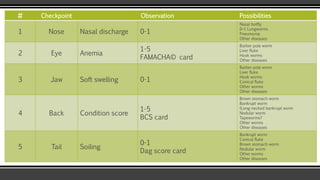
# Checkpoint Observation Possibilities
1 Nose Nasal discharge 0-1
Nasal botfly
0–1 Lungworms
Pneumonia
Other diseases
2 Eye Anemia
1-5
FAMACHA© card
Barber pole worm
Liver fluke
Hook worms
Other diseases
3 Jaw Soft swelling 0-1
Barber pole worm
Liver fluke
Hook worms
Conical fluke
Other worms
Other diseases
4 Back Condition score
1-5
BCS card
Brown stomach worm
Bankrupt worm
(Long-necked bankrupt worm
Nodular worm
Tapeworms?
Other worms
Other diseases
5 Tail Soiling
0-1
Dag score card
Bankrupt worm
Conical fluke
Brown stomach worm
Nodular worm
Other worms
Other diseases
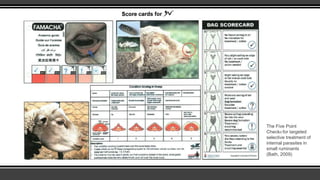
The Five Point
Check© for targeted
selective treatment of
internal parasites in
small ruminants
(Bath, 2009)
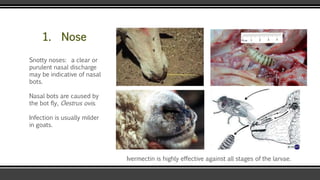
1. Nose
Snotty noses: a clear or
purulent nasal discharge
may be indicative of nasal
bots.
Nasal bots are caused by
the bot fly, Oestrus ovis.
Infection is usually milder
in goats.
Ivermectin is highly effective against all stages of the larvae.
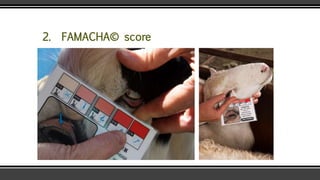
2. FAMACHA© score
3. Jaw
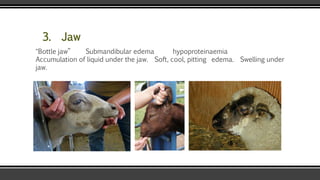
“Bottle jaw” Submandibular edema hypoproteinaemia
Accumulation of liquid under the jaw. Soft, cool, pitting edema. Swelling under
jaw.
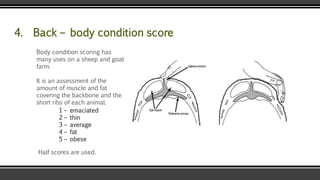
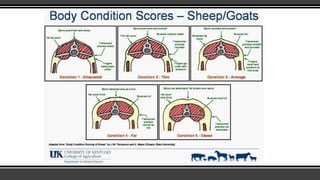
4. Back – body condition score
1 – emaciated
2 – thin
3 – average
4 – fat
5 – obese
Body condition scoring has
many uses on a sheep and goat
farm.
It is an assessment of the
amount of muscle and fat
covering the backbone and the
short ribs of each animal.
Half scores are used.
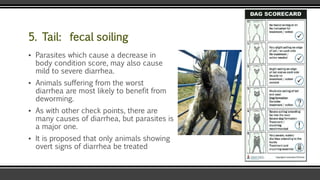
5. Tail: fecal soiling
▪ Parasites which cause a decrease in
body condition score, may also cause
mild to severe diarrhea.
▪ Animals suffering from the worst
diarrhea are most likely to benefit from
deworming.
▪ As with other check points, there are
many causes of diarrhea, but parasites is
a major one.
▪ It is proposed that only animals showing
overt signs of diarrhea be treated
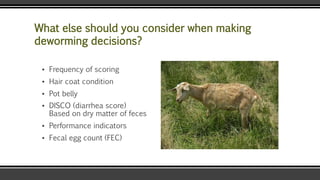
What else should you consider when making
deworming decisions?
▪ Frequency of scoring
▪ Hair coat condition
▪ Pot belly
▪ DISCO (diarrhea score)
Based on dry matter of feces
▪ Performance indicators
▪ Fecal egg count (FEC)
Performance-Based Indicators
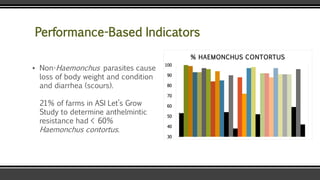
▪ Non-Haemonchus parasites cause
loss of body weight and condition
and diarrhea (scours).
21% of farms in ASI Let’s Grow
Study to determine anthelmintic
resistance had < 60%
Haemonchus contortus.
30
40
50
60
70
80
90
100
% HAEMONCHUS CONTORTUS
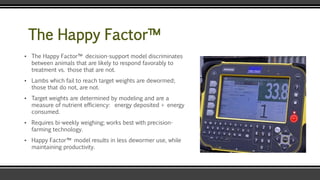
The Happy Factor™
▪ The Happy Factor™ decision-support model discriminates
between animals that are likely to respond favorably to
treatment vs. those that are not.
▪ Lambs which fail to reach target weights are dewormed;
those that do not, are not.
▪ Target weights are determined by modeling and are a
measure of nutrient efficiency: energy deposited ÷ energy
consumed.
▪ Requires bi-weekly weighing; works best with precision-
farming technology.
▪ Happy Factor™ model results in less dewormer use, while
maintaining productivity.
Will the Happy Factor™ concept work on Delmarva?
▪ The Happy Factor™ has only been
evaluated in temperate climates
where non-Haemonchus worms
predominate (UK, NZ).
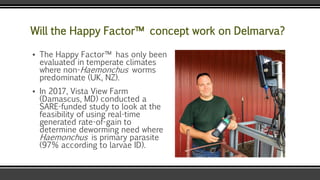
▪ In 2017, Vista View Farm
(Damascus, MD) conducted a
SARE-funded study to look at the
feasibility of using real-time
generated rate-of-gain to
determine deworming need where
Haemonchus is primary parasite
(97% according to larvae ID).
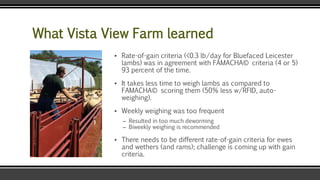
What Vista View Farm learned
▪ Rate-of-gain criteria (<0.3 lb/day for Bluefaced Leicester
lambs) was in agreement with FAMACHA© criteria (4 or 5)
93 percent of the time.
▪ It takes less time to weigh lambs as compared to
FAMACHA© scoring them (50% less w/RFID, auto-
weighing).
▪ Weekly weighing was too frequent
– Resulted in too much deworming
– Biweekly weighing is recommended
▪ There needs to be different rate-of-gain criteria for ewes
and wethers (and rams); challenge is coming up with gain
criteria.
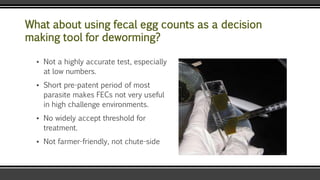
What about using fecal egg counts as a decision
making tool for deworming?
▪ Not a highly accurate test, especially
at low numbers.
▪ Short pre-patent period of most
parasite makes FECs not very useful
in high challenge environments.
▪ No widely accept threshold for
treatment.
▪ Not farmer-friendly, not chute-side
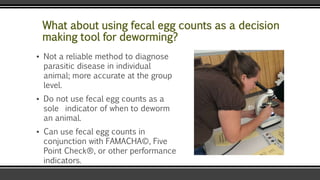
What about using fecal egg counts as a decision
making tool for deworming?
▪ Not a reliable method to diagnose
parasitic disease in individual
animal; more accurate at the group
level.
▪ Do not use fecal egg counts as a
sole indicator of when to deworm
an animal.
▪ Can use fecal egg counts in
conjunction with FAMACHA©, Five
Point Check®, or other performance
indicators.
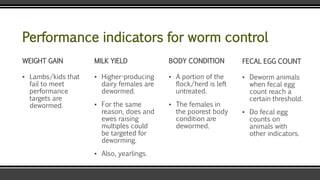
Performance indicators for worm control
WEIGHT GAIN
▪ Lambs/kids that
fail to meet
performance
targets are
dewormed.
MILK YIELD
▪ Higher-producing
dairy females are
dewormed.
▪ For the same
reason, does and
ewes raising
multiples could
be targeted for
deworming.
▪ Also, yearlings.
BODY CONDITION
▪ A portion of the
flock/herd is left
untreated.
▪ The females in
the poorest body
condition are
dewormed.
FECAL EGG COUNT
▪ Deworm animals
when fecal egg
count reach a
certain threshold.
▪ Do fecal egg
counts on
animals with
other indicators.
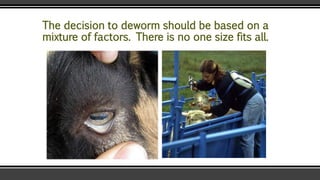
The decision to deworm should be based on a
mixture of factors. There is no one size fits all.
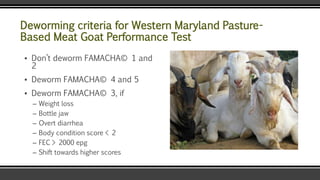
Deworming criteria for Western Maryland Pasture-
Based Meat Goat Performance Test
▪ Don’t deworm FAMACHA© 1 and
2
▪ Deworm FAMACHA© 4 and 5
▪ Deworm FAMACHA© 3, if
– Weight loss
– Bottle jaw
– Overt diarrhea
– Body condition score < 2
– FEC > 2000 epg
– Shift towards higher scores
SUSAN SCHOENIAN
Sheep & Goat Specialist
sschoen@umd.edu
www.sheepandgoat.com
www.wormx.info

Decision making tools for deworming

  • 1.
    To Deworm ornot On-farm decision-making tools for deciding who to treat and when SUSAN SCHOENIAN  SHEEP & GOAT SPECIALIST  SSCHOEN@UMD.EDU
  • 2.
    Anthelmintic resistance Worms havedeveloped varying degrees of resistant to all dewormers and dewormer classes. 0 20 40 60 80 100 Benzimidazoles Ivermectin Levamisole Moxidectin Maryland Virginia Georgia 5-10 years ago. 2016-17 ASI Let’s Grow
  • 3.
    Treatment strategies forworm control Suppressive  ▪ Whole-group treatment at regular intervals. Strategic  ▪ Whole-group treatment at strategic times, such as before parturition or at weaning. Targeted  ▪ Whole-group treatment, based on marker of infection. Targeted selective ▪ Individual treatment based on marker of infection.  REFUGIA BASED  CALENDAR BASED 
  • 4.
    What is REFUGIA? ▪Latin term for “in refuge” ▪ Portion of worm population which has not been exposed to drug(s); therefore, is still susceptible to treatment with drug(s). ▪ When resistant worms mate with susceptible worms, a portion of the offspring can be still killed by the drug. ▪ The challenge is balancing the need for refugia with the need to treat animals to maintain an acceptable level of productivity. Only R S + R Tx No Tx
  • 5.
    The concept ofleaving a proportion of animals untreated, with the aim to maintain parasite populations in refugia is now widely accepted as the best means of preserving anthelmintic susceptibility within the parasite population.
  • 6.
    Targeted Selective Treatment(TST) ▪ Treating only a portion of the flock or herd. ▪ Only treating animals that require or would benefit from treatment. ▪ Requires having tools that can easily be implemented on the farm, chute- side. ▪ Balance between delaying drug resistance and maintaining productivity.         
  • 7.
    Decision-making tools forTST 1. FAMACHA© eye anemia system 2. Five Point Check© 3. Performance-based indicators
  • 8.
    FAMACHA© eye anemiasystem ▪ A technique used in small ruminants to assess the level of anemia resulting from infection with Haemonchus contortus (the barber pole worm). ▪ System developed in South Africa as an alternative approach to the common practice of frequent deworming of all animals, which has been associated with widespread emergence of anthelmintic resistance. ▪ Named for its originator: Faffa Malan (chart) Dr. “Faffa” Malan (R)
  • 9.
    FAMACHA© eye anemiasystem Clinical Category Eye Lid Color Packed Cell Volume/PC V Treatment recommendation 1 Red > 28 No 2 Red-Pink 23-27 No 3 Pink 18-22 ? 4 Pink-White 13-17 Yes 5 White < 12 Yes Cards are now made in US. University of Georgia is sole distributor.
  • 10.
    Proper FAMACHA© technique:COVER-PUSH-PULL-POP 1. COVER the animal’s eye with your thumb. 2. Slightly PUSH down on the eye ball, applying enough pressure so that the eye lashes curl up over your thumb. 3. After you PULL down the eye lower eyelid, 4. The mucous membranes will POP into view.
  • 11.
    FAMACHA© DO’s andDON’Ts DON’T ▪ Don’t try to expose membranes simply by pulling down eyelid. ▪ Don’t score inner surface of lower eyelid; score bed of mucous membranes. ▪ Don’t use half scores; round up. ▪ Don’t shade eye DO ▪ Repeat with other eye lid ▪ If you score the other eye higher, err on the side of caution and use the higher score. ▪ Stick with first impressions. ▪ Score under natural lighting.
  • 12.
    Deworming decisions withFAMACHA© DEWORM FAMACHA© 4 and 5 DON’T DEWORM FAMACHA© 1 and 2* *Unless there are other clinical signs of parasitism
  • 13.
    Decision-making: deworm FAMACHA©3s if . . . ▪ There is other evidence of parasitism. ▪ Flock or herd is not in good overall body condition and health. ▪ More than 10% of flock/herd is anemic (FAMACHA© 4, 5) ▪ There is a dramatic shift in scores. ▪ Periparturient females ▪ Lambs and kids
  • 14.
    Proper care ofFAMACHA© card ▪ Store FAMACHA© card in dark place when not in use ▪ Replace after 12-24 months of use ▪ Keep a spare card (unused) for comparison of colors. ▪ Don’t try to reproduce card by scanning and printing.
  • 15.
    How to geta FAMACHA© card ▪ Veterinarians may purchase cards from University of Georgia. ▪ Producers must take an approved training in order to get a card. ▪ FAMACHA© workshops are held at various locations on Delmarva, usually spring-fall. ▪ FAMACHA© certification is now available online from the University of Rhode Island. http://web.uri.edu/sheepngoat/famacha/
  • 16.
    The FAMACHA© systemhas limitations. It is limited to parasites that cause anemia (blood loss) Answer: Use Five Point Check© It is labor intensive: each animal has to be handled individually Answer: Use Performance-based indicators
  • 17.
    Five Point Check®5. ▪ Simple extension of the FAMACHA© system, which allows assessment of animal for other parasites, especially those causing loss of condition and weight and scours. ▪ Includes five check points on animal’s body. 1. Nose 2. Eye 3. Jaw 4. Back 5. Tail
  • 18.
    # Checkpoint ObservationPossibilities 1 Nose Nasal discharge 0-1 Nasal botfly 0–1 Lungworms Pneumonia Other diseases 2 Eye Anemia 1-5 FAMACHA© card Barber pole worm Liver fluke Hook worms Other diseases 3 Jaw Soft swelling 0-1 Barber pole worm Liver fluke Hook worms Conical fluke Other worms Other diseases 4 Back Condition score 1-5 BCS card Brown stomach worm Bankrupt worm (Long-necked bankrupt worm Nodular worm Tapeworms? Other worms Other diseases 5 Tail Soiling 0-1 Dag score card Bankrupt worm Conical fluke Brown stomach worm Nodular worm Other worms Other diseases
  • 19.
    The Five Point Check©for targeted selective treatment of internal parasites in small ruminants (Bath, 2009)
  • 20.
    1. Nose Snotty noses:a clear or purulent nasal discharge may be indicative of nasal bots. Nasal bots are caused by the bot fly, Oestrus ovis. Infection is usually milder in goats. Ivermectin is highly effective against all stages of the larvae.
  • 21.
  • 22.
    3. Jaw “Bottle jaw”Submandibular edema hypoproteinaemia Accumulation of liquid under the jaw. Soft, cool, pitting edema. Swelling under jaw.
  • 23.
    4. Back –body condition score 1 – emaciated 2 – thin 3 – average 4 – fat 5 – obese Body condition scoring has many uses on a sheep and goat farm. It is an assessment of the amount of muscle and fat covering the backbone and the short ribs of each animal. Half scores are used.
  • 25.
    5. Tail: fecalsoiling ▪ Parasites which cause a decrease in body condition score, may also cause mild to severe diarrhea. ▪ Animals suffering from the worst diarrhea are most likely to benefit from deworming. ▪ As with other check points, there are many causes of diarrhea, but parasites is a major one. ▪ It is proposed that only animals showing overt signs of diarrhea be treated
  • 26.
    What else shouldyou consider when making deworming decisions? ▪ Frequency of scoring ▪ Hair coat condition ▪ Pot belly ▪ DISCO (diarrhea score) Based on dry matter of feces ▪ Performance indicators ▪ Fecal egg count (FEC)
  • 27.
    Performance-Based Indicators ▪ Non-Haemonchusparasites cause loss of body weight and condition and diarrhea (scours). 21% of farms in ASI Let’s Grow Study to determine anthelmintic resistance had < 60% Haemonchus contortus. 30 40 50 60 70 80 90 100 % HAEMONCHUS CONTORTUS
  • 28.
    The Happy Factor™ ▪The Happy Factor™ decision-support model discriminates between animals that are likely to respond favorably to treatment vs. those that are not. ▪ Lambs which fail to reach target weights are dewormed; those that do not, are not. ▪ Target weights are determined by modeling and are a measure of nutrient efficiency: energy deposited ÷ energy consumed. ▪ Requires bi-weekly weighing; works best with precision- farming technology. ▪ Happy Factor™ model results in less dewormer use, while maintaining productivity.
  • 29.
    Will the HappyFactor™ concept work on Delmarva? ▪ The Happy Factor™ has only been evaluated in temperate climates where non-Haemonchus worms predominate (UK, NZ). ▪ In 2017, Vista View Farm (Damascus, MD) conducted a SARE-funded study to look at the feasibility of using real-time generated rate-of-gain to determine deworming need where Haemonchus is primary parasite (97% according to larvae ID).
  • 30.
    What Vista ViewFarm learned ▪ Rate-of-gain criteria (<0.3 lb/day for Bluefaced Leicester lambs) was in agreement with FAMACHA© criteria (4 or 5) 93 percent of the time. ▪ It takes less time to weigh lambs as compared to FAMACHA© scoring them (50% less w/RFID, auto- weighing). ▪ Weekly weighing was too frequent – Resulted in too much deworming – Biweekly weighing is recommended ▪ There needs to be different rate-of-gain criteria for ewes and wethers (and rams); challenge is coming up with gain criteria.
  • 31.
    What about usingfecal egg counts as a decision making tool for deworming? ▪ Not a highly accurate test, especially at low numbers. ▪ Short pre-patent period of most parasite makes FECs not very useful in high challenge environments. ▪ No widely accept threshold for treatment. ▪ Not farmer-friendly, not chute-side
  • 32.
    What about usingfecal egg counts as a decision making tool for deworming? ▪ Not a reliable method to diagnose parasitic disease in individual animal; more accurate at the group level. ▪ Do not use fecal egg counts as a sole indicator of when to deworm an animal. ▪ Can use fecal egg counts in conjunction with FAMACHA©, Five Point Check®, or other performance indicators.
  • 33.
    Performance indicators forworm control WEIGHT GAIN ▪ Lambs/kids that fail to meet performance targets are dewormed. MILK YIELD ▪ Higher-producing dairy females are dewormed. ▪ For the same reason, does and ewes raising multiples could be targeted for deworming. ▪ Also, yearlings. BODY CONDITION ▪ A portion of the flock/herd is left untreated. ▪ The females in the poorest body condition are dewormed. FECAL EGG COUNT ▪ Deworm animals when fecal egg count reach a certain threshold. ▪ Do fecal egg counts on animals with other indicators.
  • 34.
    The decision todeworm should be based on a mixture of factors. There is no one size fits all.
  • 35.
    Deworming criteria forWestern Maryland Pasture- Based Meat Goat Performance Test ▪ Don’t deworm FAMACHA© 1 and 2 ▪ Deworm FAMACHA© 4 and 5 ▪ Deworm FAMACHA© 3, if – Weight loss – Bottle jaw – Overt diarrhea – Body condition score < 2 – FEC > 2000 epg – Shift towards higher scores
  • 36.
    SUSAN SCHOENIAN Sheep &Goat Specialist sschoen@umd.edu www.sheepandgoat.com www.wormx.info