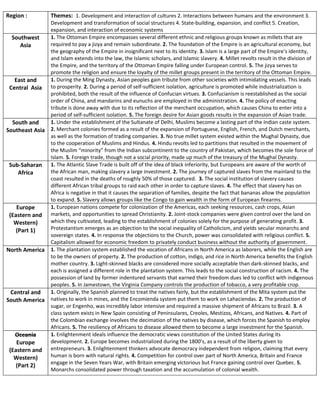
Region :         Themes: 1. Development and interaction of cultures 2. Interactions between humans and the environment 3.
                 Development and transformation of social structures 4. State-building, expansion, and conflict 5. Creation,
                 expansion, and interaction of economic systems
  Southwest      1. The Ottoman Empire encompasses several different ethnic and religious groups known as millets that are
     Asia        required to pay a jizya and remain subordinate. 2. The foundation of the Empire is an agricultural economy, but
                 the geography of the Empire in insignificant next to its identity. 3. Islam is a large part of the Empire’s identity,
                 and Islam extends into the law, the Islamic scholars, and Islamic slavery. 4. Millet revolts result in the division of
                 the Empire, and the territory of the Ottoman Empire falling under European control. 5. The jizya serves to
                 promote the religion and ensure the loyalty of the millet groups present in the territory of the Ottoman Empire.
   East and      1. During the Ming Dynasty, Asian peoples gain tribute from other societies with intimidating vessels. This leads
 Central Asia    to prosperity. 2. During a period of self-sufficient isolation, agriculture is promoted while industrialization is
                 prohibited, both the result of the influence of Confucian virtues. 3. Confucianism is reestablished as the social
                 order of China, and mandarins and eunuchs are employed in the administration. 4. The policy of enacting
                 tribute is done away with due to its reflection of the merchant occupation, which causes China to enter into a
                 period of self-sufficient isolation. 5. The foreign desire for Asian goods results in the expansion of Asian trade.
  South and      1. Under the establishment of the Sultanate of Delhi, Muslims become a lasting part of the Indian caste system.
Southeast Asia   2. Merchant colonies formed as a result of the expansion of Portuguese, English, French, and Dutch merchants,
                 as well as the formation of trading companies. 3. No true millet system existed within the Mughal Dynasty, due
                 to the cooperation of Muslims and Hindus. 4. Hindu revolts led to partitions that resulted in the movement of
                 the Muslim “minority” from the Indian subcontinent to the country of Pakistan, which becomes the sole force of
                 Islam. 5. Foreign trade, though not a social priority, made up much of the treasury of the Mughal Dynasty.
 Sub-Saharan     1. The Atlantic Slave Trade is built off of the idea of black inferiority, but Europeans are aware of the worth of
    Africa       the African man, making slavery a large investment. 2. The journey of captured slaves from the mainland to the
                 coast resulted in the deaths of roughly 50% of those captured. 3. The social institution of slavery causes
                 different African tribal groups to raid each other in order to capture slaves. 4. The effect that slavery has on
                 Africa is negative in that it causes the separation of families, despite the fact that bananas allow the population
                 to expand. 5. Slavery allows groups like the Congo to gain wealth in the form of European firearms.
    Europe       1. European nations compete for colonization of the Americas, each seeking resources, cash crops, Asian
 (Eastern and    markets, and opportunities to spread Christianity. 2. Joint-stock companies were given control over the land on
   Western)      which they cultivated, leading to the establishment of colonies solely for the purpose of generating profit. 3.
    (Part 1)     Protestantism emerges as an objection to the social inequality of Catholicism, and yields secular monarchs and
                 sovereign states. 4. In response the objections to the Church, power was consolidated with religious conflict. 5.
                 Capitalism allowed for economic freedom to privately conduct business without the authority of government.
North America    1. The plantation system established the vocation of Africans in North America as laborers, while the English are
                 to be the owners of property. 2. The production of cotton, indigo, and rice in North America benefits the English
                 mother country. 3. Light-skinned blacks are considered more socially acceptable than dark-skinned blacks, and
                 each is assigned a different role in the plantation system. This leads to the social construction of racism. 4. The
                 possession of land by former indentured servants that earned their freedom dues led to conflict with indigenous
                 peoples. 5. In Jamestown, the Virginia Company controls the production of tobacco, a very profitable crop.
 Central and     1. Originally, the Spanish planned to treat the natives fairly, but the establishment of the Mita system put the
South America    natives to work in mines, and the Encomienda system put them to work on Lahaciendas. 2. The production of
                 sugar, or Engenho, was incredibly labor intensive and required a massive shipment of Africans to Brazil. 3. A
                 class system exists in New Spain consisting of Peninsulares, Creoles, Mestizos, Africans, and Natives. 4. Part of
                 the Colombian exchange involves the decimation of the natives by disease, which forces the Spanish to employ
                 Africans. 5. The resiliency of Africans to disease allowed them to become a large investment for the Spanish.
   Oceania       1. Enlightenment ideals influence the democratic views constitution of the United States during its
    Europe       development. 2. Europe becomes industrialized during the 1800’s, as a result of the liberty given to
 (Eastern and    entrepreneurs. 3. Enlightenment thinkers advocate democracy independent from religion, claiming that every
   Western)      human is born with natural rights. 4. Competition for control over part of North America, Britain and France
                 engage in the Seven Years War, with Britain emerging victorious but France gaining control over Quebec. 5.
    (Part 2)
                 Monarchs consolidated power through taxation and the accumulation of colonial wealth.

Ap chart2

  • 1.
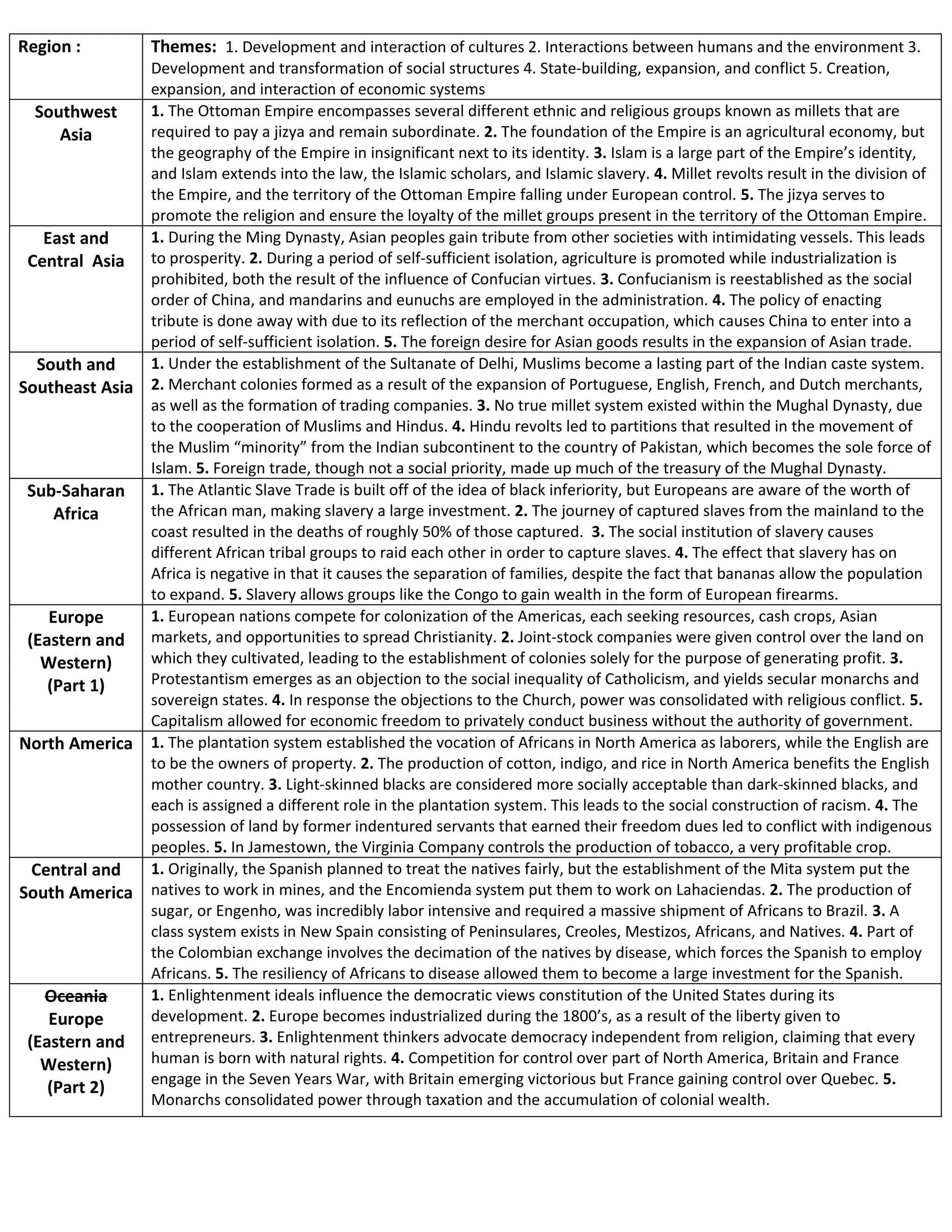
    Region : Themes: 1. Development and interaction of cultures 2. Interactions between humans and the environment 3. Development and transformation of social structures 4. State-building, expansion, and conflict 5. Creation, expansion, and interaction of economic systems Southwest 1. The Ottoman Empire encompasses several different ethnic and religious groups known as millets that are Asia required to pay a jizya and remain subordinate. 2. The foundation of the Empire is an agricultural economy, but the geography of the Empire in insignificant next to its identity. 3. Islam is a large part of the Empire’s identity, and Islam extends into the law, the Islamic scholars, and Islamic slavery. 4. Millet revolts result in the division of the Empire, and the territory of the Ottoman Empire falling under European control. 5. The jizya serves to promote the religion and ensure the loyalty of the millet groups present in the territory of the Ottoman Empire. East and 1. During the Ming Dynasty, Asian peoples gain tribute from other societies with intimidating vessels. This leads Central Asia to prosperity. 2. During a period of self-sufficient isolation, agriculture is promoted while industrialization is prohibited, both the result of the influence of Confucian virtues. 3. Confucianism is reestablished as the social order of China, and mandarins and eunuchs are employed in the administration. 4. The policy of enacting tribute is done away with due to its reflection of the merchant occupation, which causes China to enter into a period of self-sufficient isolation. 5. The foreign desire for Asian goods results in the expansion of Asian trade. South and 1. Under the establishment of the Sultanate of Delhi, Muslims become a lasting part of the Indian caste system. Southeast Asia 2. Merchant colonies formed as a result of the expansion of Portuguese, English, French, and Dutch merchants, as well as the formation of trading companies. 3. No true millet system existed within the Mughal Dynasty, due to the cooperation of Muslims and Hindus. 4. Hindu revolts led to partitions that resulted in the movement of the Muslim “minority” from the Indian subcontinent to the country of Pakistan, which becomes the sole force of Islam. 5. Foreign trade, though not a social priority, made up much of the treasury of the Mughal Dynasty. Sub-Saharan 1. The Atlantic Slave Trade is built off of the idea of black inferiority, but Europeans are aware of the worth of Africa the African man, making slavery a large investment. 2. The journey of captured slaves from the mainland to the coast resulted in the deaths of roughly 50% of those captured. 3. The social institution of slavery causes different African tribal groups to raid each other in order to capture slaves. 4. The effect that slavery has on Africa is negative in that it causes the separation of families, despite the fact that bananas allow the population to expand. 5. Slavery allows groups like the Congo to gain wealth in the form of European firearms. Europe 1. European nations compete for colonization of the Americas, each seeking resources, cash crops, Asian (Eastern and markets, and opportunities to spread Christianity. 2. Joint-stock companies were given control over the land on Western) which they cultivated, leading to the establishment of colonies solely for the purpose of generating profit. 3. (Part 1) Protestantism emerges as an objection to the social inequality of Catholicism, and yields secular monarchs and sovereign states. 4. In response the objections to the Church, power was consolidated with religious conflict. 5. Capitalism allowed for economic freedom to privately conduct business without the authority of government. North America 1. The plantation system established the vocation of Africans in North America as laborers, while the English are to be the owners of property. 2. The production of cotton, indigo, and rice in North America benefits the English mother country. 3. Light-skinned blacks are considered more socially acceptable than dark-skinned blacks, and each is assigned a different role in the plantation system. This leads to the social construction of racism. 4. The possession of land by former indentured servants that earned their freedom dues led to conflict with indigenous peoples. 5. In Jamestown, the Virginia Company controls the production of tobacco, a very profitable crop. Central and 1. Originally, the Spanish planned to treat the natives fairly, but the establishment of the Mita system put the South America natives to work in mines, and the Encomienda system put them to work on Lahaciendas. 2. The production of sugar, or Engenho, was incredibly labor intensive and required a massive shipment of Africans to Brazil. 3. A class system exists in New Spain consisting of Peninsulares, Creoles, Mestizos, Africans, and Natives. 4. Part of the Colombian exchange involves the decimation of the natives by disease, which forces the Spanish to employ Africans. 5. The resiliency of Africans to disease allowed them to become a large investment for the Spanish. Oceania 1. Enlightenment ideals influence the democratic views constitution of the United States during its Europe development. 2. Europe becomes industrialized during the 1800’s, as a result of the liberty given to (Eastern and entrepreneurs. 3. Enlightenment thinkers advocate democracy independent from religion, claiming that every Western) human is born with natural rights. 4. Competition for control over part of North America, Britain and France engage in the Seven Years War, with Britain emerging victorious but France gaining control over Quebec. 5. (Part 2) Monarchs consolidated power through taxation and the accumulation of colonial wealth.