Liberalism
What is liberalism?
• Liberalism is the most commonly accepted alternative
theoretical perspective to realism
• Liberalism emphasizes interdependence between
states: Ties and relationships between states have
decreased the usefulness of military power.
• Liberalism was developed in the 1970s as many experts began to
argue that realism was an old concept
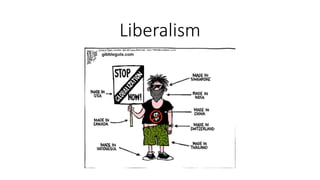
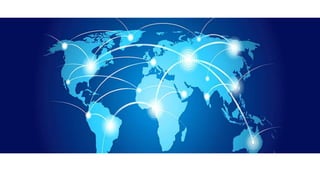
• Due to globalization, the rise of global communications and an
increase in international trade meant that states could no longer rely
on simple power politics to decide matters
• Cosmopolitan morality rather than balance of power
• Humanity benefits from a peaceful international order – nations can
develop and trade which leads to progress
States aren’t the only important actors in
International Relations
• International organizations: EU, UN and African Union
• Societies and states have become so connected by the end of the 20th
century that the way they relate to each other has changed in
significant ways
Interdependence
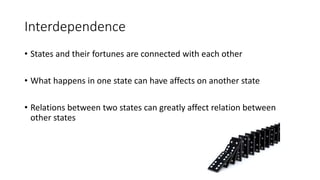
• States and their fortunes are connected with each other
• What happens in one state can have affects on another state
• Relations between two states can greatly affect relation between
other states
Haven’t states always been connected?
• Liberalism suggests a particular and specific kind of
interdependence characterized by modern
international system
Complex interdependence
Robert Keohane & Joseph Nye
• Multiple channels
• In international politics there are multiple channels connecting the societies,
including all the interstate, trans-governmental, and transnational transactions
• Multiple issues
• Security is not the most important issue. State and non-state actors deal with a
variety issues in a world with the line between domestic and foreign policy is
blurred. Any issue can be the most important for a state
• Decline in use and effectiveness of military force
• Due to military cost being very costly and uncertain, it has begun to decline in
importance. It cannot be completely ignored, but it is not the ultimate necessity
to achieve survival
Non-state actors in global politics
• Transnational corporations e.g. McDonalds, Apple, Nike
• NGO’s e.g. Catholic Church, Red Cross, Amnesty International
• Intergovernmental organisations e.g. United Nations (UN), European
Union (EU), African Union (AU)
• All important international connections across state boundaries
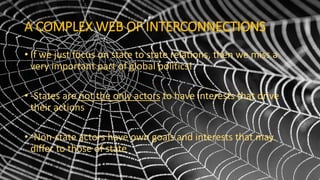
A COMPLEX WEB OF INTERCONNECTIONS
• If we just focus on state to state relations, then we miss a
very important part of global politics!
• -States are not the only actors to have interests that drive
their actions
• -Non-state actors have own goals and interests that may
differ to those of state
These global actors have a variety of interests
• States are not only interested in military security
• Economic, ideological, religious and cultural issues are part of the global
agenda
• Even issues that realists would see as purely domestic can have an effect on
the global system
• e.g. Environmental regulations may be adopted by a state to protect its
own citizens but may affect trading partners if imports must meet new
regulations
• So domestic policy can become foreign policy as a result of connections
between issues, channels and interdependence between actors
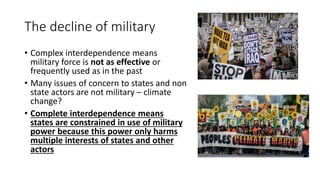
The decline of military
• Complex interdependence means
military force is not as effective or
frequently used as in the past
• Many issues of concern to states and non
state actors are not military – climate
change?
• Complete interdependence means
states are constrained in use of military
power because this power only harms
multiple interests of states and other
actors
Multiple channels, multiple issues and decline
in military mean that…
States cooperate because it’s
in their interests to do so!
• States realise that hostile actions are likely to harm their
interests as much as those of any potential rival
• The multiple channels that connect non-state actors
constrain states
• Even if leaders recognise security threats and want to
employ conflictual means, they often face resistance from
public or powerful interest groups
The relationship between Liberalism and
democracy
• In democracies, where opposition is legal and citizens
can hold their leaders to account, multiple channels
are more likely to constrain leaders from conflict
• According to liberal theory, the effects of complex
interdependence will be more significant in a more
democratic world
Other factors for increased complex
interdependence are…
• Spread of democracy – decolonisation
• Nuclear weapons – the risk!
• End of WW2 – The end of facism in Germany and Japan
• Wealth redistribution – Asian Tigers (Hong Kong, Singapore, South Korea
and Taiwan), MNC’s
• Technological developments as a result of globalisation