Nauman ALi
World System Theory
By
Immanuel Wallerstein
What is a theory?
World system theory also known as world system
analysis, developed by American sociologist Immanuel
Wallerstein in 1976 which is an approach to World
history and social change that suggests there is a World
economic system in which some countries benefit while
other are exploited. This Theory emphasizes the social
structure of global inequality.
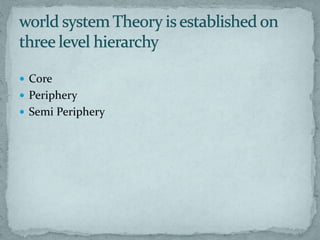
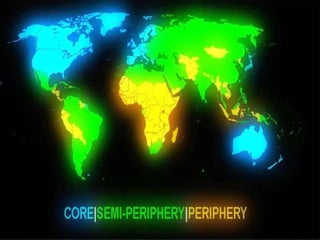
 Core
 Periphery
 Semi Periphery
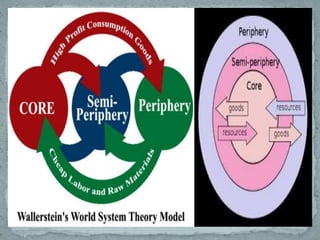
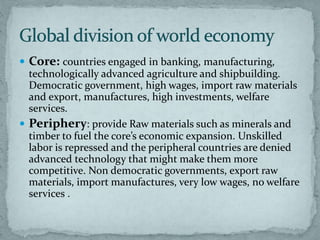
 Core: countries engaged in banking, manufacturing,
technologically advanced agriculture and shipbuilding.
Democratic government, high wages, import raw materials
and export, manufactures, high investments, welfare
services.
 Periphery: provide Raw materials such as minerals and
timber to fuel the core’s economic expansion. Unskilled
labor is repressed and the peripheral countries are denied
advanced technology that might make them more
competitive. Non democratic governments, export raw
materials, import manufactures, very low wages, no welfare
services .
 Semi periphery: involved in a mix of production
activities some associated with core areas and other
with peripheral areas. Authoritarian governments,
export raw materials, low wages and low welfare
services.
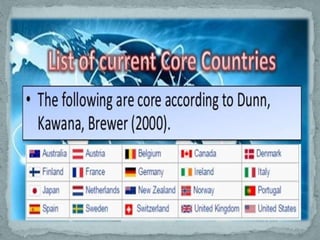
 Core countries
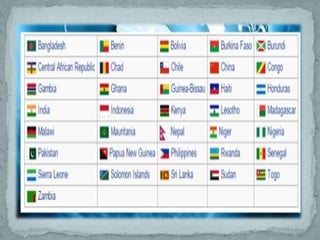
 Peripheral countries
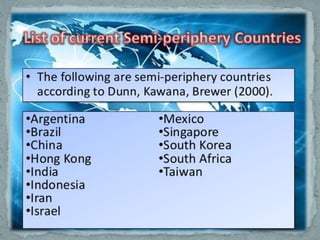
 Sami peripheral countries
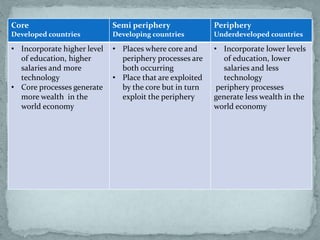
Core
Developed countries
Semi periphery
Developing countries
Periphery
Underdeveloped countries
• Incorporate higher level
of education, higher
salaries and more
technology
• Core processes generate
more wealth in the
world economy
• Places where core and
periphery processes are
both occurring
• Place that are exploited
by the core but in turn
exploit the periphery
• Incorporate lower levels
of education, lower
salaries and less
technology
periphery processes
generate less wealth in the
world economy
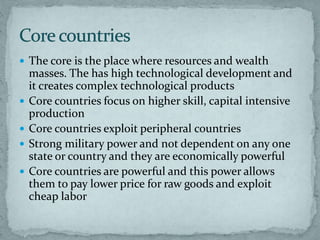
 The core is the place where resources and wealth
masses. The has high technological development and
it creates complex technological products
 Core countries focus on higher skill, capital intensive
production
 Core countries exploit peripheral countries
 Strong military power and not dependent on any one
state or country and they are economically powerful
 Core countries are powerful and this power allows
them to pay lower price for raw goods and exploit
cheap labor
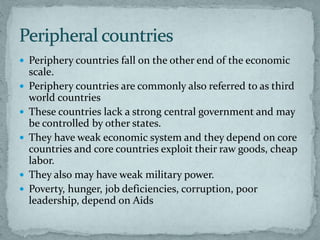
 Periphery countries fall on the other end of the economic
scale.
 Periphery countries are commonly also referred to as third
world countries
 These countries lack a strong central government and may
be controlled by other states.
 They have weak economic system and they depend on core
countries and core countries exploit their raw goods, cheap
labor.
 They also may have weak military power.
 Poverty, hunger, job deficiencies, corruption, poor
leadership, depend on Aids
 Sami periphery countries fall in the middle of the economic spectrum.
 These countries share characteristic of both core and periphery countries.
 These are core regions in decline or periphery regions attempting to improve
their economic position.
 These countries are sometimes exploited by core countries, but they also may
exploit periphery countries themselves.
 Sami peripheral country adopt protectionist theory and they are most
aggressive among three categories.
 They tend towards industrialization and more diversified economy but are not
dominant in international system.
 They tend to export more to periphery and import more form core
 Sami periphery states can come into existence form developing peripheries
Any questions ?
World system theory

World system theory

  • 2.
  • 3.
  • 4.
    What is atheory?
  • 5.
    World system theoryalso known as world system analysis, developed by American sociologist Immanuel Wallerstein in 1976 which is an approach to World history and social change that suggests there is a World economic system in which some countries benefit while other are exploited. This Theory emphasizes the social structure of global inequality.
  • 6.
  • 8.
     Core: countriesengaged in banking, manufacturing, technologically advanced agriculture and shipbuilding. Democratic government, high wages, import raw materials and export, manufactures, high investments, welfare services.  Periphery: provide Raw materials such as minerals and timber to fuel the core’s economic expansion. Unskilled labor is repressed and the peripheral countries are denied advanced technology that might make them more competitive. Non democratic governments, export raw materials, import manufactures, very low wages, no welfare services .
  • 9.
     Semi periphery:involved in a mix of production activities some associated with core areas and other with peripheral areas. Authoritarian governments, export raw materials, low wages and low welfare services.
  • 10.
     Core countries Peripheral countries  Sami peripheral countries
  • 11.
    Core Developed countries Semi periphery Developingcountries Periphery Underdeveloped countries • Incorporate higher level of education, higher salaries and more technology • Core processes generate more wealth in the world economy • Places where core and periphery processes are both occurring • Place that are exploited by the core but in turn exploit the periphery • Incorporate lower levels of education, lower salaries and less technology periphery processes generate less wealth in the world economy
  • 12.
     The coreis the place where resources and wealth masses. The has high technological development and it creates complex technological products  Core countries focus on higher skill, capital intensive production  Core countries exploit peripheral countries  Strong military power and not dependent on any one state or country and they are economically powerful  Core countries are powerful and this power allows them to pay lower price for raw goods and exploit cheap labor
  • 14.
     Periphery countriesfall on the other end of the economic scale.  Periphery countries are commonly also referred to as third world countries  These countries lack a strong central government and may be controlled by other states.  They have weak economic system and they depend on core countries and core countries exploit their raw goods, cheap labor.  They also may have weak military power.  Poverty, hunger, job deficiencies, corruption, poor leadership, depend on Aids
  • 16.
     Sami peripherycountries fall in the middle of the economic spectrum.  These countries share characteristic of both core and periphery countries.  These are core regions in decline or periphery regions attempting to improve their economic position.  These countries are sometimes exploited by core countries, but they also may exploit periphery countries themselves.  Sami peripheral country adopt protectionist theory and they are most aggressive among three categories.  They tend towards industrialization and more diversified economy but are not dominant in international system.  They tend to export more to periphery and import more form core  Sami periphery states can come into existence form developing peripheries
  • 19.