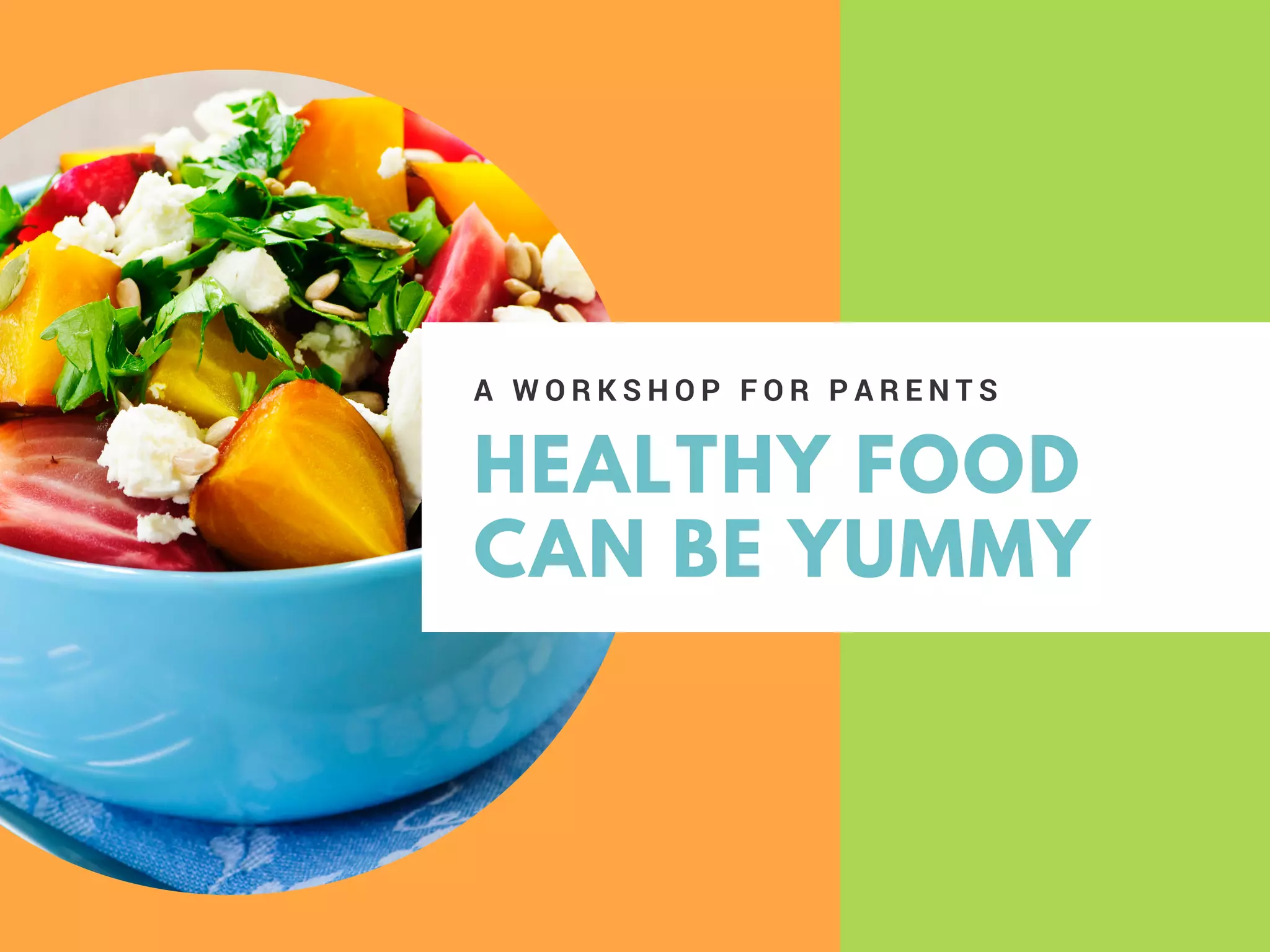
HEALTHY FOOD
CAN BE YUMMY
A W O R K S H O P F O R P A R E N T S
WHO ARE WE?
Diploma in Early Childhood
Education
OBJECTIVES OF
WORKSHOP
Understand the various benefits of
different food items.
01
Sort different food items into the
respective categories of the healthy
plate.
02
Use different healthy ingredients to
make a dish.
03
PROGRAMME
OUTLINE
1
Getting to Know You!
2
Presentation on Healthy
Eating
3
Sorting Activity - "Where do I
belong?"
4
Cookery Fun - Onigiri Making
GETTING TO
KNOW YOU
PRESENTATION
TOPICS
1
Introduction to
Healthy Eating
2
Importance of
Healthy Eating
3
My Healthy
Plate
4
Food Categories
5
Healthy Meals
in Preschool
WHAT IS HEALTHY
EATING ?
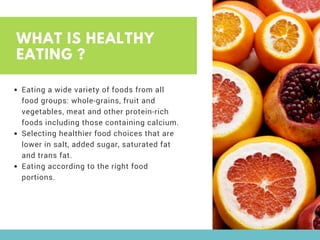
Eating a wide variety of foods from all
food groups: whole-grains, fruit and
vegetables, meat and other protein-rich
foods including those containing calcium.
Selecting healthier food choices that are
lower in salt, added sugar, saturated fat
and trans fat.
Eating according to the right food
portions.
WHY SHOULD WE EAT
HEALTHILY?
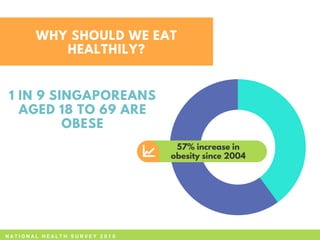
1 IN 9 SINGAPOREANS
AGED 18 TO 69 ARE
OBESE
Item
40%
Item 2
60%
57% increase in
obesity since 2004
N A T I O N A L H E A L T H S U R V E Y 2 0 1 0
HEALTHY MEALS IN
PRESCHOOLS
PROGRAMME
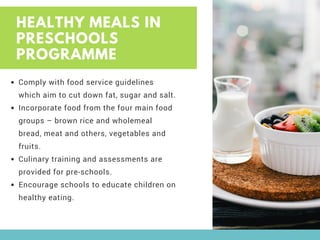
Comply with food service guidelines
which aim to cut down fat, sugar and salt.
Incorporate food from the four main food
groups – brown rice and wholemeal
bread, meat and others, vegetables and
fruits.
Culinary training and assessments are
provided for pre-schools.
Encourage schools to educate children on
healthy eating.
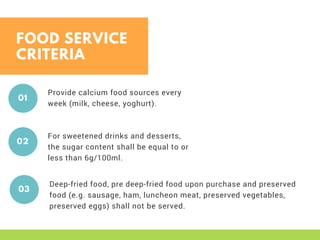
FOOD SERVICE
CRITERIA
Provide calcium food sources every
week (milk, cheese, yoghurt).
01
For sweetened drinks and desserts,
the sugar content shall be equal to or
less than 6g/100ml.
02
Deep-fried food, pre deep-fried food upon purchase and preserved
food (e.g. sausage, ham, luncheon meat, preserved vegetables,
preserved eggs) shall not be served.
03
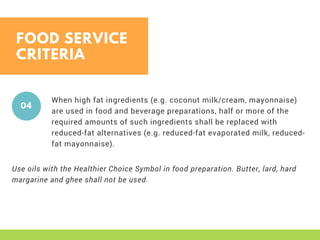
FOOD SERVICE
CRITERIA
When high fat ingredients (e.g. coconut milk/cream, mayonnaise)
are used in food and beverage preparations, half or more of the
required amounts of such ingredients shall be replaced with
reduced-fat alternatives (e.g. reduced-fat evaporated milk, reduced-
fat mayonnaise). 
04
Use oils with the Healthier Choice Symbol in food preparation. Butter, lard, hard
margarine and ghee shall not be used. 
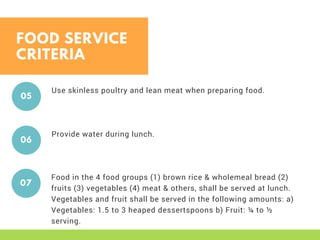
FOOD SERVICE
CRITERIA
Use skinless poultry and lean meat when preparing food.
05
Provide water during lunch. 
06
Food in the 4 food groups (1) brown rice & wholemeal bread (2)
fruits (3) vegetables (4) meat & others, shall be served at lunch.
Vegetables and fruit shall be served in the following amounts: a)
Vegetables: 1.5 to 3 heaped dessertspoons b) Fruit: ¼ to ½
serving.
 
07
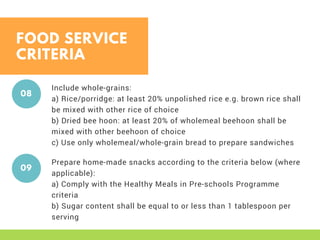
FOOD SERVICE
CRITERIA
Include whole-grains:
a) Rice/porridge: at least 20% unpolished rice e.g. brown rice shall
be mixed with other rice of choice
b) Dried bee hoon: at least 20% of wholemeal beehoon shall be
mixed with other beehoon of choice
c) Use only wholemeal/whole-grain bread to prepare sandwiches 
08
Prepare home-made snacks according to the criteria below (where
applicable):
a) Comply with the Healthy Meals in Pre-schools Programme
criteria
b) Sugar content shall be equal to or less than 1 tablespoon per
serving
09
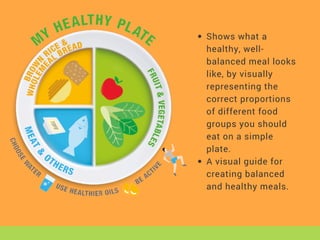
Shows what a
healthy, well-
balanced meal looks
like, by visually
representing the
correct proportions
of different food
groups you should
eat on a simple
plate.
A visual guide for
creating balanced
and healthy meals.
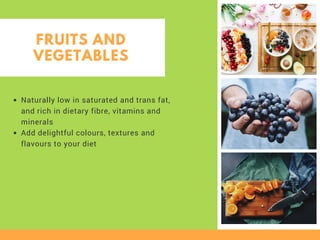
FRUITS AND
VEGETABLES
Naturally low in saturated and trans fat,
and rich in dietary fibre, vitamins and
minerals
Add delightful colours, textures and
flavours to your diet
Do you know
the different
benefits of
our nutrients?
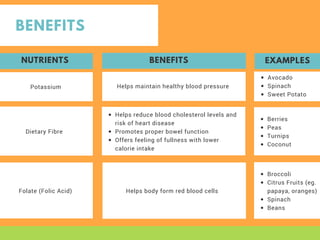
BENEFITS
NUTRIENTS BENEFITS
Potassium Helps maintain healthy blood pressure
Dietary Fibre
Helps reduce blood cholesterol levels and
risk of heart disease
Promotes proper bowel function
Offers feeling of fullness with lower
calorie intake
Folate (Folic Acid)
EXAMPLES
Avocado
Spinach
Sweet Potato
Berries
Peas
Turnips
Coconut
Helps body form red blood cells
Broccoli
Citrus Fruits (eg.
papaya, oranges)
Spinach
Beans
BENEFITS
NUTRIENTS BENEFITS EXAMPLES
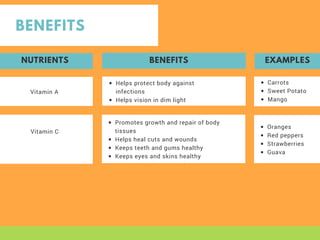
Vitamin A
Helps protect body against
infections
Helps vision in dim light
Promotes growth and repair of body
tissues
Helps heal cuts and wounds
Keeps teeth and gums healthy
Keeps eyes and skins healthy
Vitamin C
Carrots
Sweet Potato
Mango
Oranges
Red peppers
Strawberries
Guava
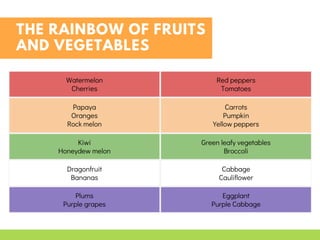
THE RAINBOW OF FRUITS
AND VEGETABLES
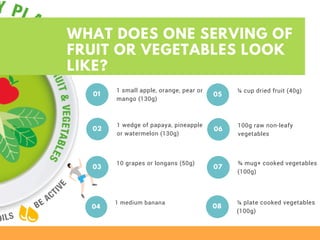
WHAT DOES ONE SERVING OF
FRUIT OR VEGETABLES LOOK
LIKE?
1 small apple, orange, pear or
mango (130g)
01
1 wedge of papaya, pineapple
or watermelon (130g)
02
10 grapes or longans (50g)
03
1 medium banana
04
¼ cup dried fruit (40g)
05
100g raw non-leafy
vegetables
06
¾ mug+ cooked vegetables
(100g)
07
¼ plate cooked vegetables
(100g)
08
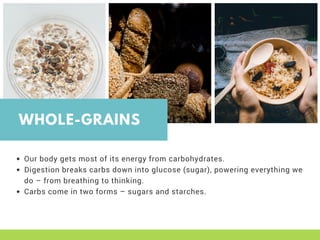
WHOLE-GRAINS
Our body gets most of its energy from carbohydrates. 
Digestion breaks carbs down into glucose (sugar), powering everything we
do – from breathing to thinking. 
Carbs come in two forms – sugars and starches.
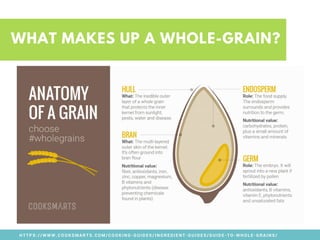
WHAT MAKES UP A WHOLE-GRAIN?
H T T P S : / / W W W . C O O K S M A R T S . C O M / C O O K I N G - G U I D E S / I N G R E D I E N T - G U I D E S / G U I D E - T O - W H O L E - G R A I N S /
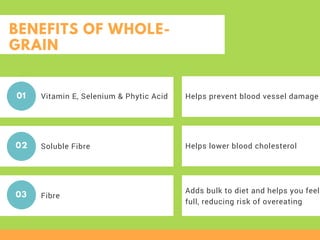
Vitamin E, Selenium & Phytic Acid01
BENEFITS OF WHOLE-
GRAIN
Soluble Fibre02
Fibre03
Helps prevent blood vessel damage
Helps lower blood cholesterol
Adds bulk to diet and helps you feel
full, reducing risk of overeating
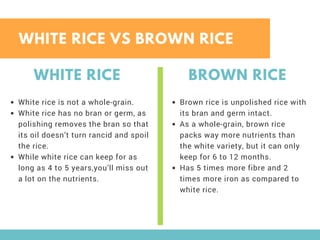
WHITE RICE VS BROWN RICE
White rice is not a whole-grain.
White rice has no bran or germ, as
polishing removes the bran so that
its oil doesn’t turn rancid and spoil
the rice. 
While white rice can keep for as
long as 4 to 5 years,you’ll miss out
a lot on the nutrients.
WHITE RICE BROWN RICE
Brown rice is unpolished rice with
its bran and germ intact.
As a whole-grain, brown rice
packs way more nutrients than
the white variety, but it can only
keep for 6 to 12 months.
Has 5 times more fibre and 2
times more iron as compared to
white rice.
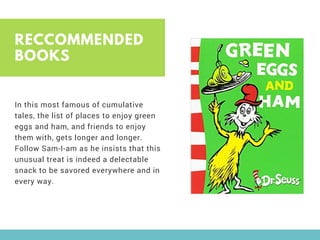
RECCOMMENDED
BOOKS
In this most famous of cumulative
tales, the list of places to enjoy green
eggs and ham, and friends to enjoy
them with, gets longer and longer.
Follow Sam-I-am as he insists that this
unusual treat is indeed a delectable
snack to be savored everywhere and in
every way. 
RECCOMMENDED
BOOKS
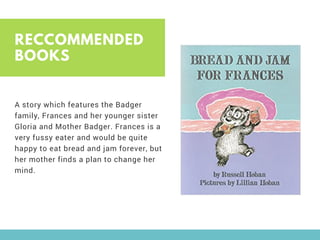
A story which features the Badger
family, Frances and her younger sister
Gloria and Mother Badger. Frances is a
very fussy eater and would be quite
happy to eat bread and jam forever, but
her mother finds a plan to change her
mind.
RECCOMMENDED
BOOKS
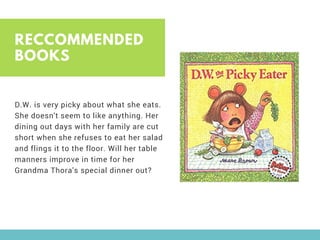
D.W. is very picky about what she eats.
She doesn't seem to like anything. Her
dining out days with her family are cut
short when she refuses to eat her salad
and flings it to the floor. Will her table
manners improve in time for her
Grandma Thora's special dinner out?
"WHERE DO I
BELONG?"
INSTRUCTIONS
1
Each participant will be
given a tag each.
2
Move around and sort yourselves according
to the different categories of the healthy
plate.
3
Find the mat with the correct
heading of the food category!
COOKERY FUN -
ONIGIRI MAKING
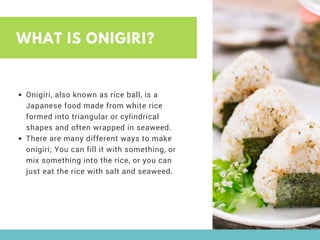
WHAT IS ONIGIRI?
Onigiri, also known as rice ball, is a
Japanese food made from white rice
formed into triangular or cylindrical
shapes and often wrapped in seaweed.
There are many different ways to make
onigiri; You can fill it with something, or
mix something into the rice, or you can
just eat the rice with salt and seaweed.
White Rice
Brown Rice
Seaweed
Shredded Chicken
Tuna Fish
Tofu
Cucumber
Mixed Vegetables
Hard boiled eggs
Spinach
INGREDIENTS USED
CLOSURE
LET'S RECAP!
01
Healthy eating is not just about eating
the right foods but also ensuring the
right portions but also selecting
healthier food choices
Importance of Healthy Eating
02
Different criteria under Healthy Meals
in Preschools Programme
03
LET'S RECAP!
04
My Healthy Plate - purpose and
proportions
Benefits of the different nutrients
05
Different food categories
06
BEFORE LEAVING,
REMEMBER TO
1
Fill up the Feedback Form
2
Pass the Feedback Form to
Ms Zana 
3
Collect your Takeaway Kit
from Ms Syah
4
Remember to take all your
belongings with you
CONTENTS OF THE
TAKEAWAY KIT
PPT Slides
01
Brochure
02
My Healthy Recipe Book
03
REFERENCES
Health Promotion Board. (n.d.). A Toolkit for Healthy Meals in Pre-schools Programme.            
Ministry of Health (n.d.) Fruits and Veggies. Retrieved from                                                              
   
Ministry of Health (n.d.) Guide to Carbs. Retrieved from                                     
Ministry of Health (n.d.) My Healthy Plate. Retrieved from 
https://www.healthhub.sg/programmes/55/my-healthy-plate
https://www.healthhub.sg/programmes/58/a-guide-to-carbs
https://www.healthhub.sg/programmes/56/fruits-and-veggies
Retrieved from https://www.hpb.gov.sg/docs/default-source/default-document-
library/healthy-meals-in-pre-schools-programme-toolkit-2017.pdf?sfvrsn=4d4f372_0

Workshop Presentation Slides on Healthy Eating

  • 1.
    HEALTHY FOOD CAN BEYUMMY A W O R K S H O P F O R P A R E N T S
  • 2.
    WHO ARE WE? Diplomain Early Childhood Education
  • 3.
    OBJECTIVES OF WORKSHOP Understand thevarious benefits of different food items. 01 Sort different food items into the respective categories of the healthy plate. 02 Use different healthy ingredients to make a dish. 03
  • 4.
    PROGRAMME OUTLINE 1 Getting to KnowYou! 2 Presentation on Healthy Eating 3 Sorting Activity - "Where do I belong?" 4 Cookery Fun - Onigiri Making
  • 5.
  • 6.
  • 7.
    TOPICS 1 Introduction to Healthy Eating 2 Importanceof Healthy Eating 3 My Healthy Plate 4 Food Categories 5 Healthy Meals in Preschool
  • 8.
    WHAT IS HEALTHY EATING? Eating a wide variety of foods from all food groups: whole-grains, fruit and vegetables, meat and other protein-rich foods including those containing calcium. Selecting healthier food choices that are lower in salt, added sugar, saturated fat and trans fat. Eating according to the right food portions.
  • 9.
    WHY SHOULD WEEAT HEALTHILY? 1 IN 9 SINGAPOREANS AGED 18 TO 69 ARE OBESE Item 40% Item 2 60% 57% increase in obesity since 2004 N A T I O N A L H E A L T H S U R V E Y 2 0 1 0
  • 10.
    HEALTHY MEALS IN PRESCHOOLS PROGRAMME Complywith food service guidelines which aim to cut down fat, sugar and salt. Incorporate food from the four main food groups – brown rice and wholemeal bread, meat and others, vegetables and fruits. Culinary training and assessments are provided for pre-schools. Encourage schools to educate children on healthy eating.
  • 11.
    FOOD SERVICE CRITERIA Provide calciumfood sources every week (milk, cheese, yoghurt). 01 For sweetened drinks and desserts, the sugar content shall be equal to or less than 6g/100ml. 02 Deep-fried food, pre deep-fried food upon purchase and preserved food (e.g. sausage, ham, luncheon meat, preserved vegetables, preserved eggs) shall not be served. 03
  • 12.
    FOOD SERVICE CRITERIA When highfat ingredients (e.g. coconut milk/cream, mayonnaise) are used in food and beverage preparations, half or more of the required amounts of such ingredients shall be replaced with reduced-fat alternatives (e.g. reduced-fat evaporated milk, reduced- fat mayonnaise).  04 Use oils with the Healthier Choice Symbol in food preparation. Butter, lard, hard margarine and ghee shall not be used. 
  • 13.
    FOOD SERVICE CRITERIA Use skinlesspoultry and lean meat when preparing food. 05 Provide water during lunch.  06 Food in the 4 food groups (1) brown rice & wholemeal bread (2) fruits (3) vegetables (4) meat & others, shall be served at lunch. Vegetables and fruit shall be served in the following amounts: a) Vegetables: 1.5 to 3 heaped dessertspoons b) Fruit: ¼ to ½ serving.   07
  • 14.
    FOOD SERVICE CRITERIA Include whole-grains: a)Rice/porridge: at least 20% unpolished rice e.g. brown rice shall be mixed with other rice of choice b) Dried bee hoon: at least 20% of wholemeal beehoon shall be mixed with other beehoon of choice c) Use only wholemeal/whole-grain bread to prepare sandwiches  08 Prepare home-made snacks according to the criteria below (where applicable): a) Comply with the Healthy Meals in Pre-schools Programme criteria b) Sugar content shall be equal to or less than 1 tablespoon per serving 09
  • 15.
    Shows what a healthy,well- balanced meal looks like, by visually representing the correct proportions of different food groups you should eat on a simple plate. A visual guide for creating balanced and healthy meals.
  • 16.
    FRUITS AND VEGETABLES Naturally lowin saturated and trans fat, and rich in dietary fibre, vitamins and minerals Add delightful colours, textures and flavours to your diet
  • 17.
    Do you know thedifferent benefits of our nutrients?
  • 18.
    BENEFITS NUTRIENTS BENEFITS Potassium Helpsmaintain healthy blood pressure Dietary Fibre Helps reduce blood cholesterol levels and risk of heart disease Promotes proper bowel function Offers feeling of fullness with lower calorie intake Folate (Folic Acid) EXAMPLES Avocado Spinach Sweet Potato Berries Peas Turnips Coconut Helps body form red blood cells Broccoli Citrus Fruits (eg. papaya, oranges) Spinach Beans
  • 19.
    BENEFITS NUTRIENTS BENEFITS EXAMPLES VitaminA Helps protect body against infections Helps vision in dim light Promotes growth and repair of body tissues Helps heal cuts and wounds Keeps teeth and gums healthy Keeps eyes and skins healthy Vitamin C Carrots Sweet Potato Mango Oranges Red peppers Strawberries Guava
  • 20.
    THE RAINBOW OFFRUITS AND VEGETABLES
  • 21.
    WHAT DOES ONESERVING OF FRUIT OR VEGETABLES LOOK LIKE? 1 small apple, orange, pear or mango (130g) 01 1 wedge of papaya, pineapple or watermelon (130g) 02 10 grapes or longans (50g) 03 1 medium banana 04 ¼ cup dried fruit (40g) 05 100g raw non-leafy vegetables 06 ¾ mug+ cooked vegetables (100g) 07 ¼ plate cooked vegetables (100g) 08
  • 22.
    WHOLE-GRAINS Our body getsmost of its energy from carbohydrates.  Digestion breaks carbs down into glucose (sugar), powering everything we do – from breathing to thinking.  Carbs come in two forms – sugars and starches.
  • 23.
    WHAT MAKES UPA WHOLE-GRAIN? H T T P S : / / W W W . C O O K S M A R T S . C O M / C O O K I N G - G U I D E S / I N G R E D I E N T - G U I D E S / G U I D E - T O - W H O L E - G R A I N S /
  • 24.
    Vitamin E, Selenium& Phytic Acid01 BENEFITS OF WHOLE- GRAIN Soluble Fibre02 Fibre03 Helps prevent blood vessel damage Helps lower blood cholesterol Adds bulk to diet and helps you feel full, reducing risk of overeating
  • 25.
    WHITE RICE VSBROWN RICE White rice is not a whole-grain. White rice has no bran or germ, as polishing removes the bran so that its oil doesn’t turn rancid and spoil the rice.  While white rice can keep for as long as 4 to 5 years,you’ll miss out a lot on the nutrients. WHITE RICE BROWN RICE Brown rice is unpolished rice with its bran and germ intact. As a whole-grain, brown rice packs way more nutrients than the white variety, but it can only keep for 6 to 12 months. Has 5 times more fibre and 2 times more iron as compared to white rice.
  • 26.
    RECCOMMENDED BOOKS In this mostfamous of cumulative tales, the list of places to enjoy green eggs and ham, and friends to enjoy them with, gets longer and longer. Follow Sam-I-am as he insists that this unusual treat is indeed a delectable snack to be savored everywhere and in every way. 
  • 27.
    RECCOMMENDED BOOKS A story whichfeatures the Badger family, Frances and her younger sister Gloria and Mother Badger. Frances is a very fussy eater and would be quite happy to eat bread and jam forever, but her mother finds a plan to change her mind.
  • 28.
    RECCOMMENDED BOOKS D.W. is verypicky about what she eats. She doesn't seem to like anything. Her dining out days with her family are cut short when she refuses to eat her salad and flings it to the floor. Will her table manners improve in time for her Grandma Thora's special dinner out?
  • 29.
  • 30.
    INSTRUCTIONS 1 Each participant willbe given a tag each. 2 Move around and sort yourselves according to the different categories of the healthy plate. 3 Find the mat with the correct heading of the food category!
  • 31.
  • 32.
    WHAT IS ONIGIRI? Onigiri,also known as rice ball, is a Japanese food made from white rice formed into triangular or cylindrical shapes and often wrapped in seaweed. There are many different ways to make onigiri; You can fill it with something, or mix something into the rice, or you can just eat the rice with salt and seaweed.
  • 33.
    White Rice Brown Rice Seaweed ShreddedChicken Tuna Fish Tofu Cucumber Mixed Vegetables Hard boiled eggs Spinach INGREDIENTS USED
  • 34.
  • 35.
    LET'S RECAP! 01 Healthy eatingis not just about eating the right foods but also ensuring the right portions but also selecting healthier food choices Importance of Healthy Eating 02 Different criteria under Healthy Meals in Preschools Programme 03
  • 36.
    LET'S RECAP! 04 My HealthyPlate - purpose and proportions Benefits of the different nutrients 05 Different food categories 06
  • 37.
    BEFORE LEAVING, REMEMBER TO 1 Fillup the Feedback Form 2 Pass the Feedback Form to Ms Zana  3 Collect your Takeaway Kit from Ms Syah 4 Remember to take all your belongings with you
  • 38.
    CONTENTS OF THE TAKEAWAYKIT PPT Slides 01 Brochure 02 My Healthy Recipe Book 03
  • 39.
    REFERENCES Health Promotion Board.(n.d.). A Toolkit for Healthy Meals in Pre-schools Programme.             Ministry of Health (n.d.) Fruits and Veggies. Retrieved from                                                                   Ministry of Health (n.d.) Guide to Carbs. Retrieved from                                      Ministry of Health (n.d.) My Healthy Plate. Retrieved from  https://www.healthhub.sg/programmes/55/my-healthy-plate https://www.healthhub.sg/programmes/58/a-guide-to-carbs https://www.healthhub.sg/programmes/56/fruits-and-veggies Retrieved from https://www.hpb.gov.sg/docs/default-source/default-document- library/healthy-meals-in-pre-schools-programme-toolkit-2017.pdf?sfvrsn=4d4f372_0