FASTERSTRONGERHIGHERAn Introduction to:Fitness Principles and Testing
You hear the words ‘fit’ or ‘fitness’ used almost every day in conversation, on television, on the radio, in newspapers or in magazines, yet probably you are not quite sure of:The actual meanings of the wordsHow to get fitWhether you should bother to get fit
Does ‘fit’ or ‘fitness’ mean just one thing?
What is Fitness??Physical Fitness is the body’s ability to function efficiently and effectively. It consists of Health Related Fitness and Skill Related Fitness, which have different components, each of which contributes to total quality of life.
Health Related FitnessBody CompositionAerobic Endurance/FitnessFlexibilityMuscular StrengthMuscular Endurance
Skill Related FitnessSpeedAgilityBalanceCoordinationReaction Time
Physical Activity Pyramid
How Much Is Enough?FITTFrequencyHow often. 3 or 4 sessions per week.IntensityHow hard. It is important to get the heart rate up (within a safe range) for improvement to occur.TimeHow long. To get any real benefit you must exercise for at least 20 minute and continuously.TypeFor aerobic fitness choose aerobic type training eg. Running, swimming, cycling, etc.
The StatsOnly half (49.8%) of Australian adults aged 25 years and over (55.6% males and 44.3% females) were undertaking “sufficient” physical activity to maintain good health.“Sufficient” was defined as at least 150 minutes of physical activity time a week.Approximately 1 in 6 (15.6%) reported no participation at all.
Why Bother?If you are active and fit, you decrease your risk of: dying of heart failureAdult onset diabetesOsteoporosisOther hypokinetic diseasesBeing overweight is largely determined by your level of physical activity (as well as your nutritional habits).
FITNESS TESTING
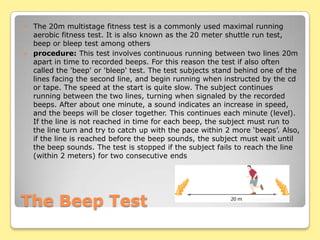
The Beep TestThe 20m multistage fitness test is a commonly used maximal running aerobic fitness test. It is also known as the 20 meter shuttle run test, beep or bleep test among othersprocedure: This test involves continuous running between two lines 20m apart in time to recorded beeps. For this reason the test if also often called the 'beep' or 'bleep' test. The test subjects stand behind one of the lines facing the second line, and begin running when instructed by the cd or tape. The speed at the start is quite slow. The subject continues running between the two lines, turning when signaled by the recorded beeps. After about one minute, a sound indicates an increase in speed, and the beeps will be closer together. This continues each minute (level). If the line is not reached in time for each beep, the subject must run to the line turn and try to catch up with the pace within 2 more ‘beeps’. Also, if the line is reached before the beep sounds, the subject must wait until the beep sounds. The test is stopped if the subject fails to reach the line (within 2 meters) for two consecutive ends
The Beep Test
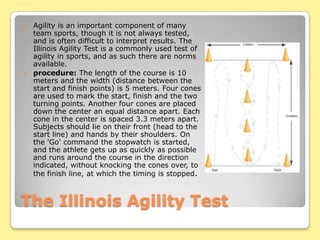
The Illinois Agility TestAgility is an important component of many team sports, though it is not always tested, and is often difficult to interpret results. The Illinois Agility Test is a commonly used test of agility in sports, and as such there are norms available.procedure: The length of the course is 10 meters and the width (distance between the start and finish points) is 5 meters. Four cones are used to mark the start, finish and the two turning points. Another four cones are placed down the center an equal distance apart. Each cone in the center is spaced 3.3 meters apart. Subjects should lie on their front (head to the start line) and hands by their shoulders. On the 'Go' command the stopwatch is started, and the athlete gets up as quickly as possible and runs around the course in the direction indicated, without knocking the cones over, to the finish line, at which the timing is stopped.
Illinois Agility Test
ActivitiesSet up the beep test and an Illinois agility test (instructions in booklets).Split into groups and complete each fitness test, recording your result.We will discuss individual results and work out your approximate fitness level(required for assignment)

Fitness powerpoint

  • 1.
  • 2.
    You hear thewords ‘fit’ or ‘fitness’ used almost every day in conversation, on television, on the radio, in newspapers or in magazines, yet probably you are not quite sure of:The actual meanings of the wordsHow to get fitWhether you should bother to get fit
  • 3.
    Does ‘fit’ or‘fitness’ mean just one thing?
  • 4.
    What is Fitness??PhysicalFitness is the body’s ability to function efficiently and effectively. It consists of Health Related Fitness and Skill Related Fitness, which have different components, each of which contributes to total quality of life.
  • 5.
    Health Related FitnessBodyCompositionAerobic Endurance/FitnessFlexibilityMuscular StrengthMuscular Endurance
  • 6.
  • 7.
  • 8.
  • 9.
    How Much IsEnough?FITTFrequencyHow often. 3 or 4 sessions per week.IntensityHow hard. It is important to get the heart rate up (within a safe range) for improvement to occur.TimeHow long. To get any real benefit you must exercise for at least 20 minute and continuously.TypeFor aerobic fitness choose aerobic type training eg. Running, swimming, cycling, etc.
  • 10.
    The StatsOnly half(49.8%) of Australian adults aged 25 years and over (55.6% males and 44.3% females) were undertaking “sufficient” physical activity to maintain good health.“Sufficient” was defined as at least 150 minutes of physical activity time a week.Approximately 1 in 6 (15.6%) reported no participation at all.
  • 11.
    Why Bother?If youare active and fit, you decrease your risk of: dying of heart failureAdult onset diabetesOsteoporosisOther hypokinetic diseasesBeing overweight is largely determined by your level of physical activity (as well as your nutritional habits).
  • 12.
  • 13.
    The Beep TestThe20m multistage fitness test is a commonly used maximal running aerobic fitness test. It is also known as the 20 meter shuttle run test, beep or bleep test among othersprocedure: This test involves continuous running between two lines 20m apart in time to recorded beeps. For this reason the test if also often called the 'beep' or 'bleep' test. The test subjects stand behind one of the lines facing the second line, and begin running when instructed by the cd or tape. The speed at the start is quite slow. The subject continues running between the two lines, turning when signaled by the recorded beeps. After about one minute, a sound indicates an increase in speed, and the beeps will be closer together. This continues each minute (level). If the line is not reached in time for each beep, the subject must run to the line turn and try to catch up with the pace within 2 more ‘beeps’. Also, if the line is reached before the beep sounds, the subject must wait until the beep sounds. The test is stopped if the subject fails to reach the line (within 2 meters) for two consecutive ends
  • 14.
  • 15.
    The Illinois AgilityTestAgility is an important component of many team sports, though it is not always tested, and is often difficult to interpret results. The Illinois Agility Test is a commonly used test of agility in sports, and as such there are norms available.procedure: The length of the course is 10 meters and the width (distance between the start and finish points) is 5 meters. Four cones are used to mark the start, finish and the two turning points. Another four cones are placed down the center an equal distance apart. Each cone in the center is spaced 3.3 meters apart. Subjects should lie on their front (head to the start line) and hands by their shoulders. On the 'Go' command the stopwatch is started, and the athlete gets up as quickly as possible and runs around the course in the direction indicated, without knocking the cones over, to the finish line, at which the timing is stopped.
  • 16.
  • 17.
    ActivitiesSet up thebeep test and an Illinois agility test (instructions in booklets).Split into groups and complete each fitness test, recording your result.We will discuss individual results and work out your approximate fitness level(required for assignment)