Diploma in Early Childhood Education
Field Practicum 3.2
Task 2: Observation of Routine Care - Mentoring
	
	 1	
Mentor’s Observation Checklist
Observation of Routine Care – Mentoring
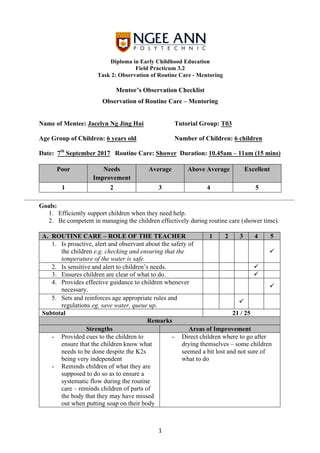
Name of Mentee: Jacelyn Ng Jing Hui Tutorial Group: T03
Age Group of Children: 6 years old Number of Children: 6 children
Date: 7th
September 2017 Routine Care: Shower Duration: 10.45am – 11am (15 mins)
Poor Needs
Improvement
Average Above Average Excellent
1 2 3 4 5
Goals:
1. Efficiently support children when they need help.
2. Be competent in managing the children effectively during routine care (shower time).
	
A. ROUTINE CARE – ROLE OF THE TEACHER 1 2 3 4 5
1. Is proactive, alert and observant about the safety of
the children e.g. checking and ensuring that the
temperature of the water is safe.
ü
2. Is sensitive and alert to children’s needs. ü
3. Ensures children are clear of what to do. ü
4. Provides effective guidance to children whenever
necessary.
ü
5. Sets and reinforces age appropriate rules and
regulations eg. save water, queue up.
ü
Subtotal 21 / 25
Remarks
Strengths Areas of Improvement
- Provided cues to the children to
ensure that the children know what
needs to be done despite the K2s
being very independent
- Reminds children of what they are
supposed to do so as to ensure a
systematic flow during the routine
care – reminds children of parts of
the body that they may have missed
out when putting soap on their body
- Direct children where to go after
drying themselves – some children
seemed a bit lost and not sure of
what to do
Diploma in Early Childhood Education
Field Practicum 3.2
Task 2: Observation of Routine Care - Mentoring
	
	 2	
- Is wary of the safety of children –
checks for temperature of water
twice and checking again with the
children
- Alert to the children’s needs –
ensuring the right soap is used for
the right children
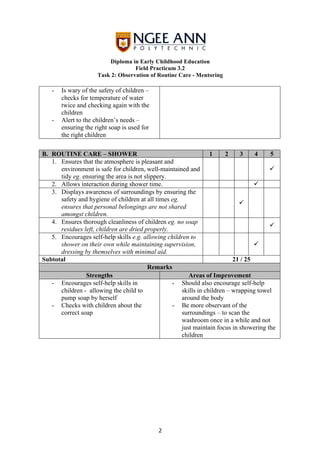
B. ROUTINE CARE – SHOWER 1 2 3 4 5
1. Ensures that the atmosphere is pleasant and
environment is safe for children, well-maintained and
tidy eg. ensuring the area is not slippery.
ü
2. Allows interaction during shower time. ü
3. Displays awareness of surroundings by ensuring the
safety and hygiene of children at all times eg.
ensures that personal belongings are not shared
amongst children.
ü
4. Ensures thorough cleanliness of children eg. no soap
residues left, children are dried properly.
ü
5. Encourages self-help skills e.g. allowing children to
shower on their own while maintaining supervision,
dressing by themselves with minimal aid.
ü
Subtotal 21 / 25
Remarks
Strengths Areas of Improvement
- Encourages self-help skills in
children - allowing the child to
pump soap by herself
- Checks with children about the
correct soap
- Should also encourage self-help
skills in children – wrapping towel
around the body
- Be more observant of the
surroundings – to scan the
washroom once in a while and not
just maintain focus in showering the
children
Diploma in Early Childhood Education
Field Practicum 3.2
Task 2: Observation of Routine Care - Mentoring
	
	 3	
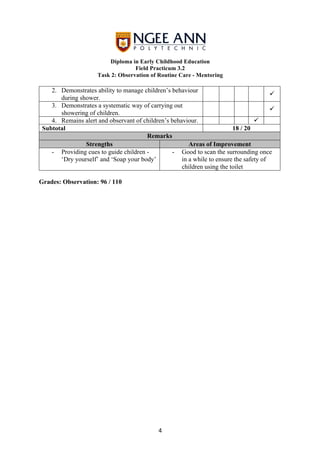
C. HANDLING TRANSITIONS 1 2 3 4 5
1. Able to manage smooth and orderly transition before
and after shower.
ü
2. Effectively manages flow of children between turns. ü
3. Uses positive techniques and strategies to ensure a
smooth transition.
ü
Subtotal 13 / 15
Remarks
Strengths Areas of Improvement
- Transitions were really smooth and
there were no hiccups during the
routine care
D. COMMUNICATION SKILLS 1 2 3 4 5
1. Displays good and positive communication skills
(verbal and non-verbal) e.g. Maintaining eye level
when communicating with children and going down
to children’s eye level, smiles, nods.
ü
2. Demonstrate active listening skills and acknowledges
children’s thoughts, feelings and ideas.
ü
3. Communicates with children in a positive and
respectful manner by using an encouraging tone to
ensure children feels confident, assured and secure.
E.g. positive language.
ü
4. Uses good English and language that is appropriate
to children’s developmental level when
communicating with children.
ü
5. Gives clear instructions to communicate expectations
and rules.
ü
Subtotal 23 / 25
Remarks
Strengths Areas of Improvement
- Maintains eye level when talking to
children
- Give off a very positive vibe to
children – smiles and nods
- Listens to children attentively
- Give more praises to children after
successfully accomplishing a task
- Provide instructions to children –
telling children where to go
E. MANAGEMENT SKILLS 1 2 3 4 5
1. Uses positive discipline techniques to reinforce
positive behaviours.
ü
Diploma in Early Childhood Education
Field Practicum 3.2
Task 2: Observation of Routine Care - Mentoring
	
	 4	
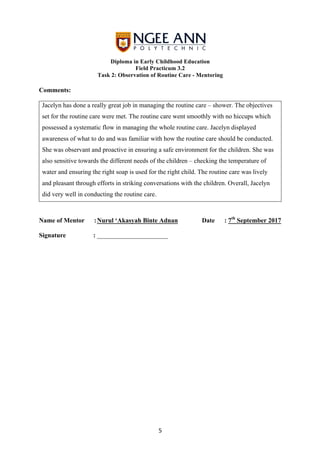
2. Demonstrates ability to manage children’s behaviour
during shower.
ü
3. Demonstrates a systematic way of carrying out
showering of children.
ü
4. Remains alert and observant of children’s behaviour. ü
Subtotal 18 / 20
Remarks
Strengths Areas of Improvement
- Providing cues to guide children -
‘Dry yourself’ and ‘Soap your body’
- Good to scan the surrounding once
in a while to ensure the safety of
children using the toilet
Grades: Observation: 96 / 110
Diploma in Early Childhood Education
Field Practicum 3.2
Task 2: Observation of Routine Care - Mentoring
	
	 5	
Comments:
Jacelyn has done a really great job in managing the routine care – shower. The objectives
set for the routine care were met. The routine care went smoothly with no hiccups which
possessed a systematic flow in managing the whole routine care. Jacelyn displayed
awareness of what to do and was familiar with how the routine care should be conducted.
She was observant and proactive in ensuring a safe environment for the children. She was
also sensitive towards the different needs of the children – checking the temperature of
water and ensuring the right soap is used for the right child. The routine care was lively
and pleasant through efforts in striking conversations with the children. Overall, Jacelyn
did very well in conducting the routine care.
Name of Mentor :Nurul ‘Akasyah Binte Adnan Date : 7th
September 2017
Signature : ______________________

Mentor's Observation Checklist

  • 1.
    Diploma in EarlyChildhood Education Field Practicum 3.2 Task 2: Observation of Routine Care - Mentoring 1 Mentor’s Observation Checklist Observation of Routine Care – Mentoring Name of Mentee: Jacelyn Ng Jing Hui Tutorial Group: T03 Age Group of Children: 6 years old Number of Children: 6 children Date: 7th September 2017 Routine Care: Shower Duration: 10.45am – 11am (15 mins) Poor Needs Improvement Average Above Average Excellent 1 2 3 4 5 Goals: 1. Efficiently support children when they need help. 2. Be competent in managing the children effectively during routine care (shower time). A. ROUTINE CARE – ROLE OF THE TEACHER 1 2 3 4 5 1. Is proactive, alert and observant about the safety of the children e.g. checking and ensuring that the temperature of the water is safe. ü 2. Is sensitive and alert to children’s needs. ü 3. Ensures children are clear of what to do. ü 4. Provides effective guidance to children whenever necessary. ü 5. Sets and reinforces age appropriate rules and regulations eg. save water, queue up. ü Subtotal 21 / 25 Remarks Strengths Areas of Improvement - Provided cues to the children to ensure that the children know what needs to be done despite the K2s being very independent - Reminds children of what they are supposed to do so as to ensure a systematic flow during the routine care – reminds children of parts of the body that they may have missed out when putting soap on their body - Direct children where to go after drying themselves – some children seemed a bit lost and not sure of what to do
  • 2.
    Diploma in EarlyChildhood Education Field Practicum 3.2 Task 2: Observation of Routine Care - Mentoring 2 - Is wary of the safety of children – checks for temperature of water twice and checking again with the children - Alert to the children’s needs – ensuring the right soap is used for the right children B. ROUTINE CARE – SHOWER 1 2 3 4 5 1. Ensures that the atmosphere is pleasant and environment is safe for children, well-maintained and tidy eg. ensuring the area is not slippery. ü 2. Allows interaction during shower time. ü 3. Displays awareness of surroundings by ensuring the safety and hygiene of children at all times eg. ensures that personal belongings are not shared amongst children. ü 4. Ensures thorough cleanliness of children eg. no soap residues left, children are dried properly. ü 5. Encourages self-help skills e.g. allowing children to shower on their own while maintaining supervision, dressing by themselves with minimal aid. ü Subtotal 21 / 25 Remarks Strengths Areas of Improvement - Encourages self-help skills in children - allowing the child to pump soap by herself - Checks with children about the correct soap - Should also encourage self-help skills in children – wrapping towel around the body - Be more observant of the surroundings – to scan the washroom once in a while and not just maintain focus in showering the children
  • 3.
    Diploma in EarlyChildhood Education Field Practicum 3.2 Task 2: Observation of Routine Care - Mentoring 3 C. HANDLING TRANSITIONS 1 2 3 4 5 1. Able to manage smooth and orderly transition before and after shower. ü 2. Effectively manages flow of children between turns. ü 3. Uses positive techniques and strategies to ensure a smooth transition. ü Subtotal 13 / 15 Remarks Strengths Areas of Improvement - Transitions were really smooth and there were no hiccups during the routine care D. COMMUNICATION SKILLS 1 2 3 4 5 1. Displays good and positive communication skills (verbal and non-verbal) e.g. Maintaining eye level when communicating with children and going down to children’s eye level, smiles, nods. ü 2. Demonstrate active listening skills and acknowledges children’s thoughts, feelings and ideas. ü 3. Communicates with children in a positive and respectful manner by using an encouraging tone to ensure children feels confident, assured and secure. E.g. positive language. ü 4. Uses good English and language that is appropriate to children’s developmental level when communicating with children. ü 5. Gives clear instructions to communicate expectations and rules. ü Subtotal 23 / 25 Remarks Strengths Areas of Improvement - Maintains eye level when talking to children - Give off a very positive vibe to children – smiles and nods - Listens to children attentively - Give more praises to children after successfully accomplishing a task - Provide instructions to children – telling children where to go E. MANAGEMENT SKILLS 1 2 3 4 5 1. Uses positive discipline techniques to reinforce positive behaviours. ü
  • 4.
    Diploma in EarlyChildhood Education Field Practicum 3.2 Task 2: Observation of Routine Care - Mentoring 4 2. Demonstrates ability to manage children’s behaviour during shower. ü 3. Demonstrates a systematic way of carrying out showering of children. ü 4. Remains alert and observant of children’s behaviour. ü Subtotal 18 / 20 Remarks Strengths Areas of Improvement - Providing cues to guide children - ‘Dry yourself’ and ‘Soap your body’ - Good to scan the surrounding once in a while to ensure the safety of children using the toilet Grades: Observation: 96 / 110
  • 5.
    Diploma in EarlyChildhood Education Field Practicum 3.2 Task 2: Observation of Routine Care - Mentoring 5 Comments: Jacelyn has done a really great job in managing the routine care – shower. The objectives set for the routine care were met. The routine care went smoothly with no hiccups which possessed a systematic flow in managing the whole routine care. Jacelyn displayed awareness of what to do and was familiar with how the routine care should be conducted. She was observant and proactive in ensuring a safe environment for the children. She was also sensitive towards the different needs of the children – checking the temperature of water and ensuring the right soap is used for the right child. The routine care was lively and pleasant through efforts in striking conversations with the children. Overall, Jacelyn did very well in conducting the routine care. Name of Mentor :Nurul ‘Akasyah Binte Adnan Date : 7th September 2017 Signature : ______________________