THE FOOD PYRAMID
 
EAT A VARIED DIET VARIETY  The six color bands represent the five food groups, plus oils. Foods from all groups are needed daily. Grains Vegetables Fruit OILS Milk Meat & Beans
THE MAIN FOOD GROUPS
GRAIN GROUP
WHOLE GRAINS Whole- wheat flour Oatmeal Rice Barley Corn Lentil Bread Pasta
USES OF GRAIN GROUP These are all from plants and form a staple part our diet. Grains and pulses give us energy and proteins. We should substitute whole grains for refined in our recipes. Add whole grains to our mixed dishes.
HOW MANY DAILY SERVINGS SHOULD WE EAT? Servings Daily:  3-10 ounces Major Nutrient:  Carbohydrates, Fiber Serving:  1 oz = 1 slice bread – 1 cup dry cereal = ½ cup pasta  or rice Tips:  eat at least 3 oz  of whole grains each day
VEGETABLE GROUP
VARY YOUR VEGGIES We should enjoy : Dark green vegetables Orange vegetables Legumes Starchy vegetables Other vegetables
HOW TO USE VEGGIES Buy fresh veggies in season Have cut veggies available for snacks Have salad with dinner every night Add your veggies to breads, pasta, burgers, etc. Choose dark green salads
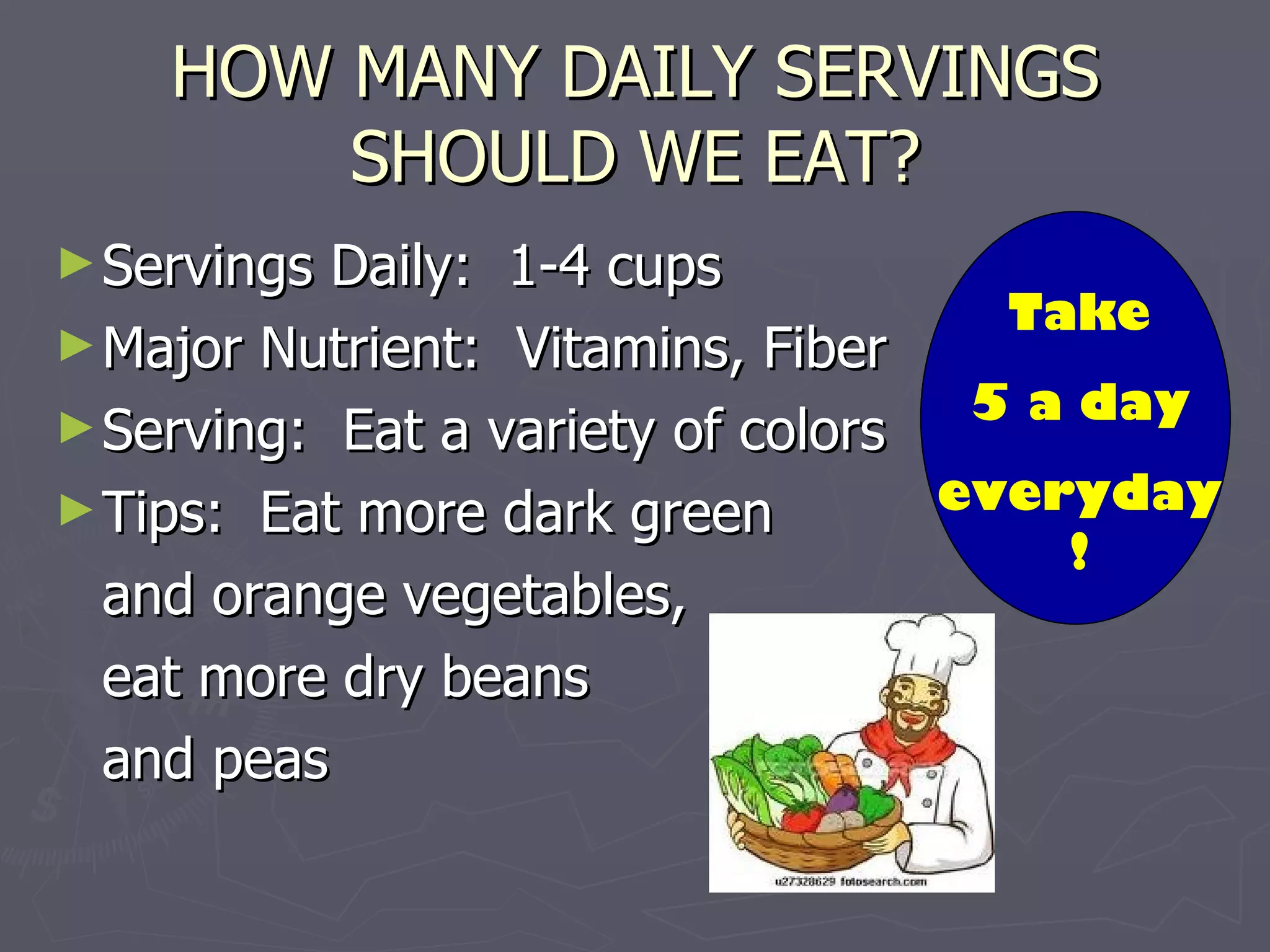
HOW MANY DAILY SERVINGS SHOULD WE EAT? Servings Daily:  1-4 cups Major Nutrient:  Vitamins, Fiber Serving:  Eat a variety of colors Tips:  Eat more dark green  and orange vegetables,  eat more dry beans  and peas Take 5 a day everyday!
FRUIT GROUP
FOCUS ON FRUITS Use fruits in salads, side dishes, main dishes, desserts and for snacks. Keep fresh and dried fruits handy for snacks. Cut up fruit on cereal, pancakes, and waffles. Buy in season. Choose fruits more often than juice.
HOW MANY DAILY SERVINGS SHOULD WE EAT? Fruits and vegetables grow on plants: underground, on the ground or in trees.  Every day we should eat at least  5 portions  of fruit and vegetables.  (A  portion is about a handful.) Fruit and vegetables give us  fibre  and  vitamins and minerals .
MILK GROUP
GET YOUR CALCIUM RICH FOODS Drink fat-free or low-fat milk. Use milk to make hot cereals. Have yoghurts as a snack.
Dairy Products Dairy foods are made from milk (usually cow’s milk, but can be from other animals like goats or sheep). Dairy foods give us  proteins  and  fats .  They are also a good source of  calcium  which is good for bones and teeth. These foods include: Cheese (hard, soft, cottage); Yogurt; Food high in milk or milk products.
HOW MANY DAILY SERVINGS SHOULD WE HAVE? Children 2 to 8 years: 2 cups milk or equivalent Young people 9 to 18 years: 3 cups  milk or equivalent.
MEAT AND BEAN GROUP
GO LEAN WITH PROTEIN Select leanest cuts of meat.  Trim all fat and remove skin from poultry. Prepare with no added fat. Choose lean meats.  Eat beans as main dishes. Eat fatty fish in moderation. Include nuts in snacks, salads, and main dishes.
MEAT, FISH, AND EGGS The main nutrients derived from meat are  proteins , but it also gives us fats and some minerals. The meat and fish group includes: Chicken and all poultry; Fish and shellfish; Beef, pork and lamb. Eggs are included in this group too. Athletes eat lots of protein; they help to build  muscles .
HOW MANY DAILY SERVINGS SHOULD WE HAVE? Servings Daily:  2-7 ounces Major Nutrient:  Protein Serving:  1 oz meat = 1 egg = 1 T peanut butter = ¼ cup cooked beans = ½ oz nuts or seeds Tips:  choose low fat or lean  meats, bake, broil or grill.  Vary protein.
OILS: TIPS FOR HEALTHY CHOICES Use vegetable oils and soft margarine rather than solid fats. Substitute nuts for meat or cheese as snack or in a meal sometimes. Use Nutrition Facts to select foods low in saturated fat,  trans  fat and cholesterol. Select foods prepared with little or no fat. Select lean or low-fat foods most often.
OILS: RECOMMENDED INTAKE Children 4 to 8 years:   4 teaspoons Females 9 to 18 years:  5 teaspoons Males 9 to 13 years:  5 teaspoons 14 to 18 years:  6 teaspoons
SUGAR Keep sugar within the discretionary calorie allowance. Choose water or fat free milk  to drink. Limit sweet snacks and  desserts. Select unsweetened cereals.
VITAMINS AND MINERALS Our bodies need all sorts of chemicals (vitamins and minerals) to be healthy.  The most common are: Vitamin A Helps maintain eyesight Sweet potatoes, carrots Vitamin B Help body make protein Green leafy vegetables Vitamin C Healing skin, preventing colds Citrus fruit, tomatoes Vitamin D Strengthen bones Milk Sunlight Vitamin E Helps strengthen cells Vegetable oils, nuts Iron Healthy blood Green leafy vegetables
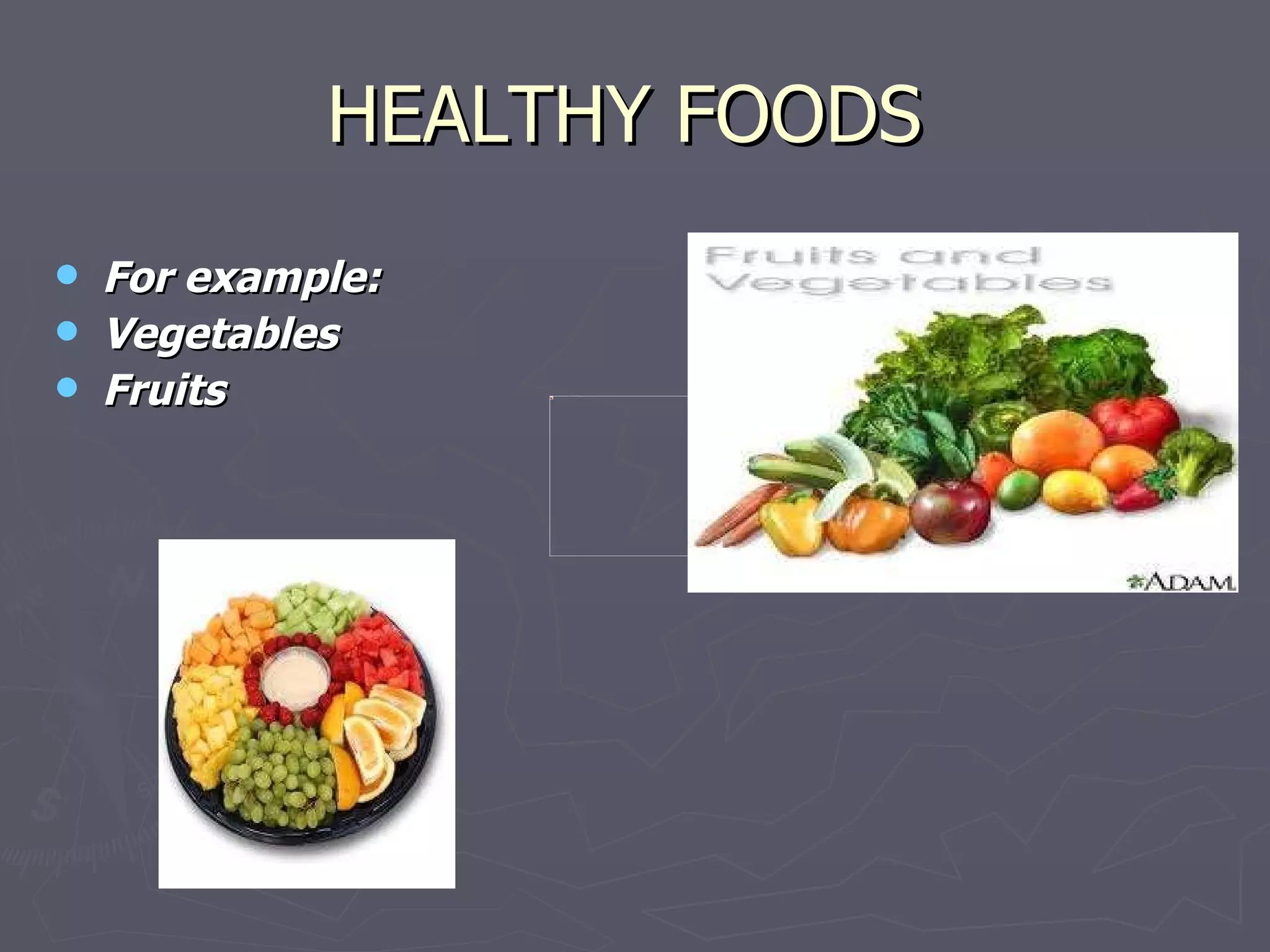
HEALTHY FOODS For example: Vegetables Fruits
UNHEALTHY FOODS For Example: Fast food…
RESULTS OF UNHEALTHY EATING short term long term get fat get  pimples get bad  teeth get high blood pressure get heart disease
BE ACTIVE
PHYSICAL ACTIVITY At least 60 minutes of physical activity most (preferably all) days of the week.
MODERATE PHYSICAL ACTIVITIES Walking briskly (about 3½ mph)  Hiking  Gardening/yard work  Dancing  Golf (walking and carrying clubs)  Bicycling (less than 10 mph)  Weight training (general light workout)
VIGOROUS PHYSICAL ACTIVITIES Running/jogging (5 mph)  Bicycling (more than 10 mph) Swimming (freestyle laps)  Aerobics  Walking very fast (4½ mph)  Heavy yard work, such as chopping wood  Weight lifting (vigorous effort) Basketball (competitive)
MY DAILY ACTIVITY PLAN Stretch and/or lift weights while watching TV –  20 minutes Team sport in gym class or after school –  30 minutes Walk the dog – 10 minutes DAILY GOAL:  60 min
BE PHYSICALLY ACTIVE EACH DAY
HEALTHY EATING MYTHS It doesn’t matter what I eat as long as I do lots of exercise.
HEALTHY EATING MYTHS It doesn’t matter what I eat as long as I do lots of exercise. Wrong!  Exercise is good for you, but it still matters what you eat.  Eating the right foods means we can learn better and exercise better too!
HEALTHY EATING MYTHS Chocolate is bad for you!
HEALTHY EATING MYTHS Chocolate is bad for you! It’s true that chocolate isn’t the healthiest snack – but it isn’t innately bad either!  So, some chocolate can be part of a  balanced  diet.  Plain (dark) chocolate is better for you thank milk; it is higher in iron.
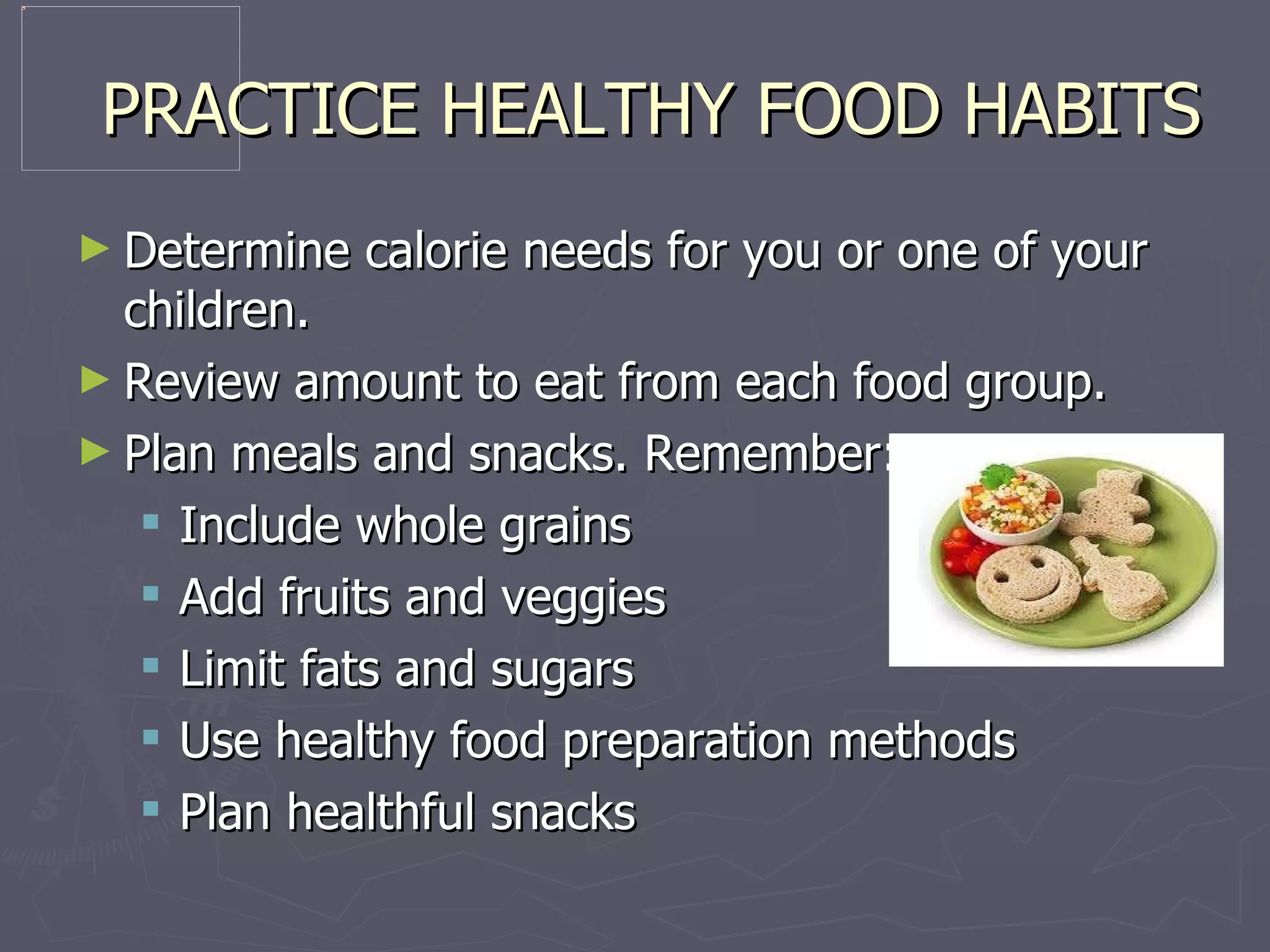
PRACTICE HEALTHY FOOD HABITS Determine calorie needs for you or one of your children. Review amount to eat from each food group. Plan meals and snacks. Remember: Include whole grains Add fruits and veggies Limit fats and sugars Use healthy food preparation methods Plan healthful snacks
GET REAL WITH PORTIONS Children and adults eat more when served larger portions! Be aware of portion distortion. Choose reasonable portion sizes. Use smaller plates. Eat slowly and stop when comfortably full.
MORE TIPS FOR PARENTS It may take many tastes for children  to enjoy a new food …  give it time! Don’t be a short-order cook!  Never force children to clean  their plates!  Enjoy fruit for “dessert.” Turn off the TV during meals. Have pleasant conversations at mealtime.

healthy eating

  • 1.
  • 2.
  • 3.
    EAT A VARIEDDIET VARIETY The six color bands represent the five food groups, plus oils. Foods from all groups are needed daily. Grains Vegetables Fruit OILS Milk Meat & Beans
  • 4.
  • 5.
  • 6.
    WHOLE GRAINS Whole-wheat flour Oatmeal Rice Barley Corn Lentil Bread Pasta
  • 7.
    USES OF GRAINGROUP These are all from plants and form a staple part our diet. Grains and pulses give us energy and proteins. We should substitute whole grains for refined in our recipes. Add whole grains to our mixed dishes.
  • 8.
    HOW MANY DAILYSERVINGS SHOULD WE EAT? Servings Daily: 3-10 ounces Major Nutrient: Carbohydrates, Fiber Serving: 1 oz = 1 slice bread – 1 cup dry cereal = ½ cup pasta or rice Tips: eat at least 3 oz of whole grains each day
  • 9.
  • 10.
    VARY YOUR VEGGIESWe should enjoy : Dark green vegetables Orange vegetables Legumes Starchy vegetables Other vegetables
  • 11.
    HOW TO USEVEGGIES Buy fresh veggies in season Have cut veggies available for snacks Have salad with dinner every night Add your veggies to breads, pasta, burgers, etc. Choose dark green salads
  • 12.
    HOW MANY DAILYSERVINGS SHOULD WE EAT? Servings Daily: 1-4 cups Major Nutrient: Vitamins, Fiber Serving: Eat a variety of colors Tips: Eat more dark green and orange vegetables, eat more dry beans and peas Take 5 a day everyday!
  • 13.
  • 14.
    FOCUS ON FRUITSUse fruits in salads, side dishes, main dishes, desserts and for snacks. Keep fresh and dried fruits handy for snacks. Cut up fruit on cereal, pancakes, and waffles. Buy in season. Choose fruits more often than juice.
  • 15.
    HOW MANY DAILYSERVINGS SHOULD WE EAT? Fruits and vegetables grow on plants: underground, on the ground or in trees. Every day we should eat at least 5 portions of fruit and vegetables. (A portion is about a handful.) Fruit and vegetables give us fibre and vitamins and minerals .
  • 16.
  • 17.
    GET YOUR CALCIUMRICH FOODS Drink fat-free or low-fat milk. Use milk to make hot cereals. Have yoghurts as a snack.
  • 18.
    Dairy Products Dairyfoods are made from milk (usually cow’s milk, but can be from other animals like goats or sheep). Dairy foods give us proteins and fats . They are also a good source of calcium which is good for bones and teeth. These foods include: Cheese (hard, soft, cottage); Yogurt; Food high in milk or milk products.
  • 19.
    HOW MANY DAILYSERVINGS SHOULD WE HAVE? Children 2 to 8 years: 2 cups milk or equivalent Young people 9 to 18 years: 3 cups milk or equivalent.
  • 20.
  • 21.
    GO LEAN WITHPROTEIN Select leanest cuts of meat. Trim all fat and remove skin from poultry. Prepare with no added fat. Choose lean meats. Eat beans as main dishes. Eat fatty fish in moderation. Include nuts in snacks, salads, and main dishes.
  • 22.
    MEAT, FISH, ANDEGGS The main nutrients derived from meat are proteins , but it also gives us fats and some minerals. The meat and fish group includes: Chicken and all poultry; Fish and shellfish; Beef, pork and lamb. Eggs are included in this group too. Athletes eat lots of protein; they help to build muscles .
  • 23.
    HOW MANY DAILYSERVINGS SHOULD WE HAVE? Servings Daily: 2-7 ounces Major Nutrient: Protein Serving: 1 oz meat = 1 egg = 1 T peanut butter = ¼ cup cooked beans = ½ oz nuts or seeds Tips: choose low fat or lean meats, bake, broil or grill. Vary protein.
  • 24.
    OILS: TIPS FORHEALTHY CHOICES Use vegetable oils and soft margarine rather than solid fats. Substitute nuts for meat or cheese as snack or in a meal sometimes. Use Nutrition Facts to select foods low in saturated fat, trans fat and cholesterol. Select foods prepared with little or no fat. Select lean or low-fat foods most often.
  • 25.
    OILS: RECOMMENDED INTAKEChildren 4 to 8 years: 4 teaspoons Females 9 to 18 years: 5 teaspoons Males 9 to 13 years: 5 teaspoons 14 to 18 years: 6 teaspoons
  • 26.
    SUGAR Keep sugarwithin the discretionary calorie allowance. Choose water or fat free milk to drink. Limit sweet snacks and desserts. Select unsweetened cereals.
  • 27.
    VITAMINS AND MINERALSOur bodies need all sorts of chemicals (vitamins and minerals) to be healthy. The most common are: Vitamin A Helps maintain eyesight Sweet potatoes, carrots Vitamin B Help body make protein Green leafy vegetables Vitamin C Healing skin, preventing colds Citrus fruit, tomatoes Vitamin D Strengthen bones Milk Sunlight Vitamin E Helps strengthen cells Vegetable oils, nuts Iron Healthy blood Green leafy vegetables
  • 28.
    HEALTHY FOODS Forexample: Vegetables Fruits
  • 29.
    UNHEALTHY FOODS ForExample: Fast food…
  • 30.
    RESULTS OF UNHEALTHYEATING short term long term get fat get pimples get bad teeth get high blood pressure get heart disease
  • 31.
  • 32.
    PHYSICAL ACTIVITY Atleast 60 minutes of physical activity most (preferably all) days of the week.
  • 33.
    MODERATE PHYSICAL ACTIVITIESWalking briskly (about 3½ mph) Hiking Gardening/yard work Dancing Golf (walking and carrying clubs) Bicycling (less than 10 mph) Weight training (general light workout)
  • 34.
    VIGOROUS PHYSICAL ACTIVITIESRunning/jogging (5 mph) Bicycling (more than 10 mph) Swimming (freestyle laps) Aerobics Walking very fast (4½ mph) Heavy yard work, such as chopping wood Weight lifting (vigorous effort) Basketball (competitive)
  • 35.
    MY DAILY ACTIVITYPLAN Stretch and/or lift weights while watching TV – 20 minutes Team sport in gym class or after school – 30 minutes Walk the dog – 10 minutes DAILY GOAL: 60 min
  • 36.
  • 37.
    HEALTHY EATING MYTHSIt doesn’t matter what I eat as long as I do lots of exercise.
  • 38.
    HEALTHY EATING MYTHSIt doesn’t matter what I eat as long as I do lots of exercise. Wrong! Exercise is good for you, but it still matters what you eat. Eating the right foods means we can learn better and exercise better too!
  • 39.
    HEALTHY EATING MYTHSChocolate is bad for you!
  • 40.
    HEALTHY EATING MYTHSChocolate is bad for you! It’s true that chocolate isn’t the healthiest snack – but it isn’t innately bad either! So, some chocolate can be part of a balanced diet. Plain (dark) chocolate is better for you thank milk; it is higher in iron.
  • 41.
    PRACTICE HEALTHY FOODHABITS Determine calorie needs for you or one of your children. Review amount to eat from each food group. Plan meals and snacks. Remember: Include whole grains Add fruits and veggies Limit fats and sugars Use healthy food preparation methods Plan healthful snacks
  • 42.
    GET REAL WITHPORTIONS Children and adults eat more when served larger portions! Be aware of portion distortion. Choose reasonable portion sizes. Use smaller plates. Eat slowly and stop when comfortably full.
  • 43.
    MORE TIPS FORPARENTS It may take many tastes for children to enjoy a new food … give it time! Don’t be a short-order cook! Never force children to clean their plates! Enjoy fruit for “dessert.” Turn off the TV during meals. Have pleasant conversations at mealtime.