Physics 111: Mechanics
Lecture 7
Wenda Cao
NJIT Physics Department
November 3, 2008
Potential Energy and
Energy Conservation
 Work
 Kinetic Energy
 Work-Kinetic Energy Theorem
 Gravitational Potential Energy
 Elastic Potential Energy
 Work-Energy Theorem
 Conservative and
Non-conservative Forces
 Conservation of Energy
November 3, 2008
Definition of Work W
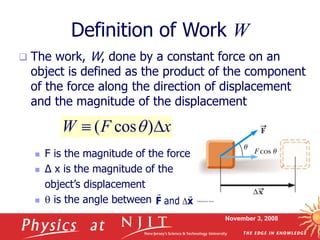
 The work, W, done by a constant force on an
object is defined as the product of the component
of the force along the direction of displacement
and the magnitude of the displacement
 F is the magnitude of the force
 Δ x is the magnitude of the
object’s displacement
 q is the angle between
x
F
W 
 )
cos
( q
and 
F x
November 3, 2008
Work Done by Multiple Forces
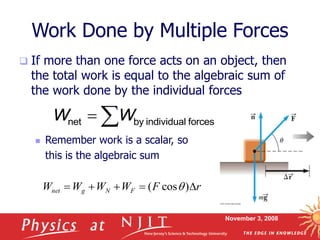
 If more than one force acts on an object, then
the total work is equal to the algebraic sum of
the work done by the individual forces
 Remember work is a scalar, so
this is the algebraic sum
 
net by individual forces
W W
r
F
W
W
W
W F
N
g
net 



 )
cos
( q
November 3, 2008
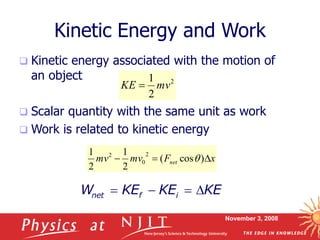
Kinetic Energy and Work
 Kinetic energy associated with the motion of
an object
 Scalar quantity with the same unit as work
 Work is related to kinetic energy
2
2
1
mv
KE 
x
F
mv
mv net 

 )
cos
(
2
1
2
1 2
0
2
q
net f i
W KE KE KE
   
November 3, 2008
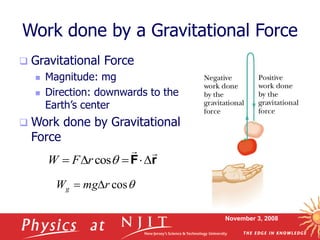
Work done by a Gravitational Force
 Gravitational Force
 Magnitude: mg
 Direction: downwards to the
Earth’s center
 Work done by Gravitational
Force
2
0
2
2
1
2
1
mv
mv
Wnet 

cos
W F r q
   
F r
q
cos
r
mg
Wg 

November 3, 2008
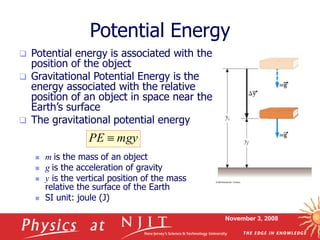
Potential Energy
 Potential energy is associated with the
position of the object
 Gravitational Potential Energy is the
energy associated with the relative
position of an object in space near the
Earth’s surface
 The gravitational potential energy
 m is the mass of an object
 g is the acceleration of gravity
 y is the vertical position of the mass
relative the surface of the Earth
 SI unit: joule (J)
mgy
PE 
November 3, 2008
Reference Levels
 A location where the gravitational potential
energy is zero must be chosen for each
problem
 The choice is arbitrary since the change in the
potential energy is the important quantity
 Choose a convenient location for the zero
reference height
 often the Earth’s surface
 may be some other point suggested by the problem
 Once the position is chosen, it must remain fixed
for the entire problem
November 3, 2008
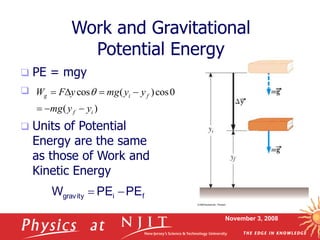
Work and Gravitational
Potential Energy
 PE = mgy

 Units of Potential
Energy are the same
as those of Work and
Kinetic Energy
f
i
gravity PE
PE
W 

)
(
0
cos
)
(
cos
i
f
f
i
g
y
y
mg
y
y
mg
y
F
W






 q
November 3, 2008
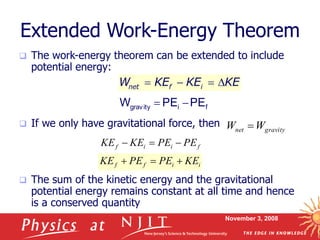
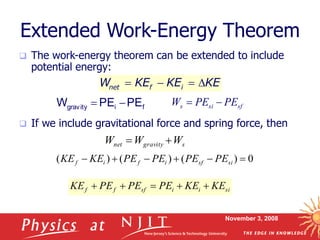
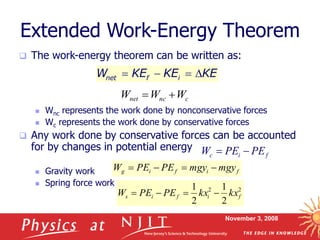
Extended Work-Energy Theorem
 The work-energy theorem can be extended to include
potential energy:
 If we only have gravitational force, then
 The sum of the kinetic energy and the gravitational
potential energy remains constant at all time and hence
is a conserved quantity
net f i
W KE KE KE
   
f
i
gravity PE
PE
W 

gravity
net W
W 
f
i
i
f PE
PE
KE
KE 


i
i
f
f KE
PE
PE
KE 


November 3, 2008
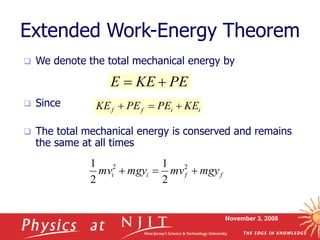
Extended Work-Energy Theorem
 We denote the total mechanical energy by
 Since
 The total mechanical energy is conserved and remains
the same at all times
PE
KE
E 

i
i
f
f KE
PE
PE
KE 


f
f
i
i mgy
mv
mgy
mv 

 2
2
2
1
2
1
November 3, 2008
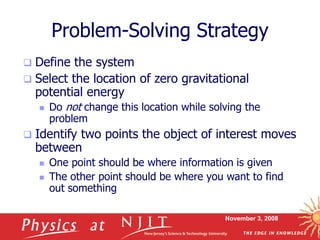
Problem-Solving Strategy
 Define the system
 Select the location of zero gravitational
potential energy
 Do not change this location while solving the
problem
 Identify two points the object of interest moves
between
 One point should be where information is given
 The other point should be where you want to find
out something
November 3, 2008
Platform Diver
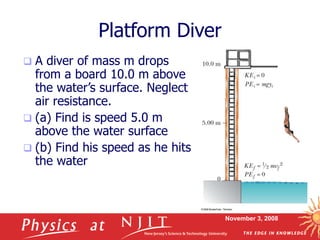
 A diver of mass m drops
from a board 10.0 m above
the water’s surface. Neglect
air resistance.
 (a) Find is speed 5.0 m
above the water surface
 (b) Find his speed as he hits
the water
November 3, 2008
Platform Diver
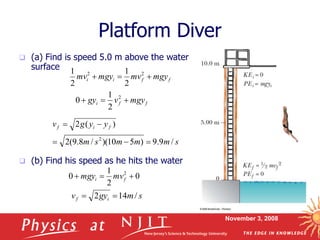
 (a) Find is speed 5.0 m above the water
surface
 (b) Find his speed as he hits the water
f
f
i
i mgy
mv
mgy
mv 

 2
2
2
1
2
1
f
f
i mgy
v
gy 

 2
2
1
0
s
m
gy
v i
f /
14
2 

0
2
1
0 2


 f
i mv
mgy
s
m
m
m
s
m
y
y
g
v f
i
f
/
9
.
9
)
5
10
)(
/
8
.
9
(
2
)
(
2
2





November 3, 2008
Spring Force
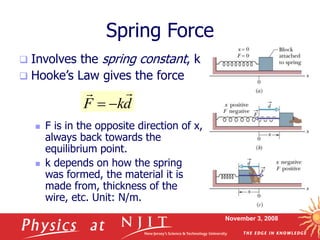
 Involves the spring constant, k
 Hooke’s Law gives the force
 F is in the opposite direction of x,
always back towards the
equilibrium point.
 k depends on how the spring
was formed, the material it is
made from, thickness of the
wire, etc. Unit: N/m.
d
k
F




November 3, 2008
Potential Energy in a Spring
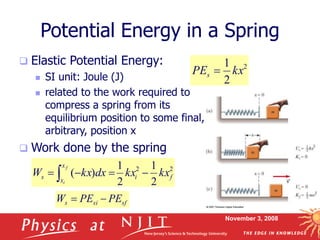
 Elastic Potential Energy:
 SI unit: Joule (J)
 related to the work required to
compress a spring from its
equilibrium position to some final,
arbitrary, position x
 Work done by the spring
2
2
2
1
2
1
)
( f
i
x
x
s kx
kx
dx
kx
W
f
i



 
2
2
1
kx
PEs 
sf
si
s PE
PE
W 

November 3, 2008
Extended Work-Energy Theorem
 The work-energy theorem can be extended to include
potential energy:
 If we include gravitational force and spring force, then
net f i
W KE KE KE
   
f
i
gravity PE
PE
W 

s
gravity
net W
W
W 

0
)
(
)
(
)
( 




 si
sf
i
f
i
f PE
PE
PE
PE
KE
KE
si
i
i
sf
f
f KE
KE
PE
PE
PE
KE 




sf
si
s PE
PE
W 

November 3, 2008
Extended Work-Energy Theorem
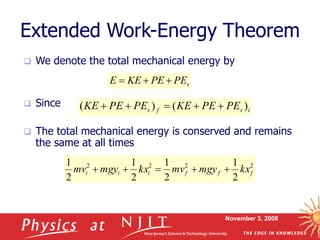
 We denote the total mechanical energy by
 Since
 The total mechanical energy is conserved and remains
the same at all times
s
PE
PE
KE
E 


i
s
f
s PE
PE
KE
PE
PE
KE )
(
)
( 




2
2
2
2
2
1
2
1
2
1
2
1
f
f
f
i
i
i kx
mgy
mv
kx
mgy
mv 




November 3, 2008
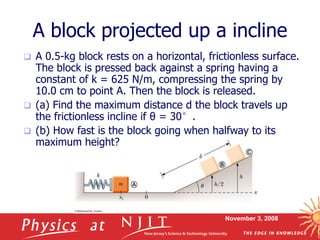
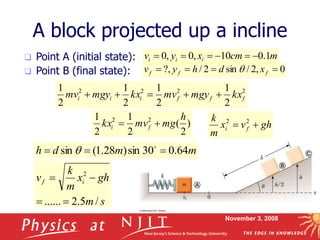
A block projected up a incline
 A 0.5-kg block rests on a horizontal, frictionless surface.
The block is pressed back against a spring having a
constant of k = 625 N/m, compressing the spring by
10.0 cm to point A. Then the block is released.
 (a) Find the maximum distance d the block travels up
the frictionless incline if θ = 30°.
 (b) How fast is the block going when halfway to its
maximum height?
November 3, 2008
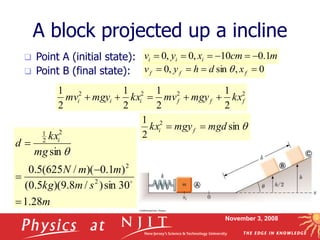
A block projected up a incline
 Point A (initial state):
 Point B (final state):
m
cm
x
y
v i
i
i 1
.
0
10
,
0
,
0 





m
s
m
kg
m
m
N
mg
kx
d i
28
.
1
30
sin
)
/
8
.
9
)(
5
.
0
(
)
1
.
0
)(
/
625
(
5
.
0
sin
2
2
2
2
1





q
2
2
2
2
2
1
2
1
2
1
2
1
f
f
f
i
i
i kx
mgy
mv
kx
mgy
mv 




0
,
sin
,
0 


 f
f
f x
d
h
y
v q
q
sin
2
1 2
mgd
mgy
kx f
i 

November 3, 2008
A block projected up a incline
 Point A (initial state):
 Point B (final state):
m
cm
x
y
v i
i
i 1
.
0
10
,
0
,
0 





s
m
gh
x
m
k
v i
f
/
5
.
2
......
2




2
2
2
2
2
1
2
1
2
1
2
1
f
f
f
i
i
i kx
mgy
mv
kx
mgy
mv 




0
,
2
/
sin
2
/
?, 


 f
f
f x
d
h
y
v q
)
2
(
2
1
2
1 2
2 h
mg
mv
kx f
i 
 gh
v
x
m
k
f
i 
 2
2
m
m
d
h 64
.
0
30
sin
)
28
.
1
(
sin 

 
q
November 3, 2008
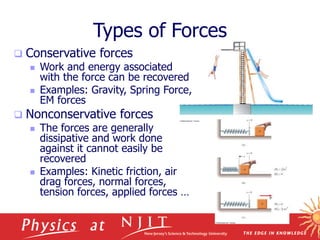
Types of Forces
 Conservative forces
 Work and energy associated
with the force can be recovered
 Examples: Gravity, Spring Force,
EM forces
 Nonconservative forces
 The forces are generally
dissipative and work done
against it cannot easily be
recovered
 Examples: Kinetic friction, air
drag forces, normal forces,
tension forces, applied forces …
November 3, 2008
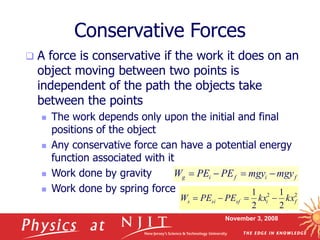
Conservative Forces
 A force is conservative if the work it does on an
object moving between two points is
independent of the path the objects take
between the points
 The work depends only upon the initial and final
positions of the object
 Any conservative force can have a potential energy
function associated with it
 Work done by gravity
 Work done by spring force
f
i
f
i
g mgy
mgy
PE
PE
W 



2
2
2
1
2
1
f
i
sf
si
s kx
kx
PE
PE
W 



November 3, 2008
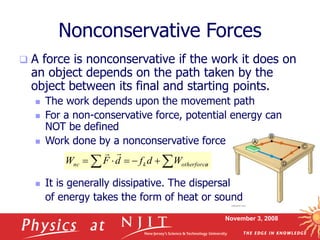
Nonconservative Forces
 A force is nonconservative if the work it does on
an object depends on the path taken by the
object between its final and starting points.
 The work depends upon the movement path
 For a non-conservative force, potential energy can
NOT be defined
 Work done by a nonconservative force
 It is generally dissipative. The dispersal
of energy takes the form of heat or sound

 



 s
otherforce
k
nc W
d
f
d
F
W


November 3, 2008
Extended Work-Energy Theorem
 The work-energy theorem can be written as:
 Wnc represents the work done by nonconservative forces
 Wc represents the work done by conservative forces
 Any work done by conservative forces can be accounted
for by changes in potential energy
 Gravity work
 Spring force work
net f i
W KE KE KE
   
c
nc
net W
W
W 

2
2
2
1
2
1
f
i
f
i
s kx
kx
PE
PE
W 



f
i
f
i
g mgy
mgy
PE
PE
W 



f
i
c PE
PE
W 

November 3, 2008
Extended Work-Energy Theorem
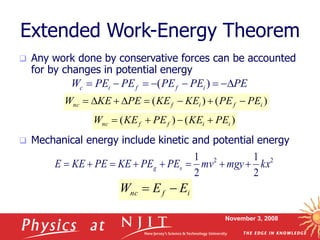
 Any work done by conservative forces can be accounted
for by changes in potential energy
 Mechanical energy include kinetic and potential energy
2
2
2
1
2
1
kx
mgy
mv
PE
PE
KE
PE
KE
E s
g 







)
(
)
( i
i
f
f
nc PE
KE
PE
KE
W 



)
(
)
( i
f
i
f
nc PE
PE
KE
KE
PE
KE
W 







PE
PE
PE
PE
PE
W i
f
f
i
c 






 )
(
i
f
nc E
E
W 

November 3, 2008
Problem-Solving Strategy
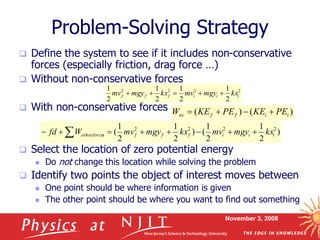
 Define the system to see if it includes non-conservative
forces (especially friction, drag force …)
 Without non-conservative forces
 With non-conservative forces
 Select the location of zero potential energy
 Do not change this location while solving the problem
 Identify two points the object of interest moves between
 One point should be where information is given
 The other point should be where you want to find out something
2
2
2
2
2
1
2
1
2
1
2
1
i
i
i
f
f
f kx
mgy
mv
kx
mgy
mv 




)
(
)
( i
i
f
f
nc PE
KE
PE
KE
W 



)
2
1
2
1
(
)
2
1
2
1
( 2
2
2
2
i
i
i
f
f
f
s
otherforce kx
mgy
mv
kx
mgy
mv
W
fd 






 
November 3, 2008
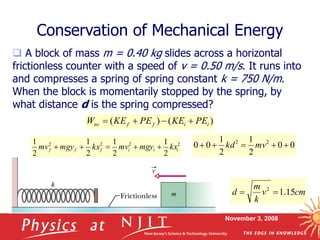
 A block of mass m = 0.40 kg slides across a horizontal
frictionless counter with a speed of v = 0.50 m/s. It runs into
and compresses a spring of spring constant k = 750 N/m.
When the block is momentarily stopped by the spring, by
what distance d is the spring compressed?
Conservation of Mechanical Energy
)
(
)
( i
i
f
f
nc PE
KE
PE
KE
W 



2
2
2
2
2
1
2
1
2
1
2
1
i
i
i
f
f
f kx
mgy
mv
kx
mgy
mv 




0
0
2
1
2
1
0
0 2
2




 mv
kd
cm
v
k
m
d 15
.
1
2


0
0
2
1
2
1
0
0 2
2




 mv
kd
November 3, 2008
Changes in Mechanical Energy for conservative forces
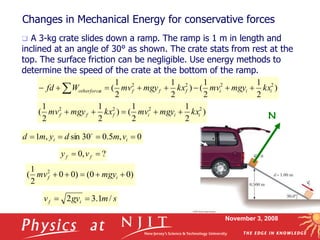
 A 3-kg crate slides down a ramp. The ramp is 1 m in length and
inclined at an angle of 30° as shown. The crate stats from rest at the
top. The surface friction can be negligible. Use energy methods to
determine the speed of the crate at the bottom of the ramp.
N
)
2
1
2
1
(
)
2
1
2
1
( 2
2
2
2
i
i
i
f
f
f kx
mgy
mv
kx
mgy
mv 




)
0
0
(
)
0
0
2
1
( 2




 i
f mgy
mv
0
,
5
.
0
30
sin
,
1 


 i
i v
m
d
y
m
d 
s
m
gy
v i
f /
1
.
3
2 

?
,
0 
 f
f v
y
)
2
1
2
1
(
)
2
1
2
1
( 2
2
2
2
i
i
i
f
f
f
s
otherforce kx
mgy
mv
kx
mgy
mv
W
fd 






 
November 3, 2008
Changes in Mechanical Energy for Non-conservative forces
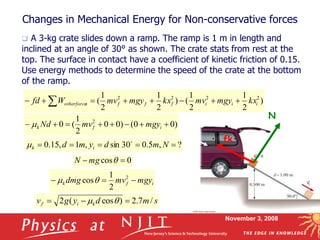
 A 3-kg crate slides down a ramp. The ramp is 1 m in length and
inclined at an angle of 30° as shown. The crate stats from rest at the
top. The surface in contact have a coefficient of kinetic friction of 0.15.
Use energy methods to determine the speed of the crate at the bottom
of the ramp.
N
fk
)
2
1
2
1
(
)
2
1
2
1
( 2
2
2
2
i
i
i
f
f
f
s
otherforce kx
mgy
mv
kx
mgy
mv
W
fd 






 
)
0
0
(
)
0
0
2
1
(
0 2







 i
f
k mgy
mv
Nd

?
,
5
.
0
30
sin
,
1
,
15
.
0 



 N
m
d
y
m
d i
k


0
cos 
 q
mg
N
i
f
k mgy
mv
dmg 

 2
2
1
cosq

s
m
d
y
g
v k
i
f /
7
.
2
)
cos
(
2 

 q

November 3, 2008
Changes in Mechanical Energy for Non-conservative forces
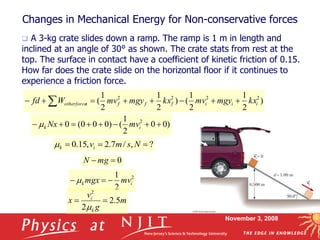
 A 3-kg crate slides down a ramp. The ramp is 1 m in length and
inclined at an angle of 30° as shown. The crate stats from rest at the
top. The surface in contact have a coefficient of kinetic friction of 0.15.
How far does the crate slide on the horizontal floor if it continues to
experience a friction force.
)
2
1
2
1
(
)
2
1
2
1
( 2
2
2
2
i
i
i
f
f
f
s
otherforce kx
mgy
mv
kx
mgy
mv
W
fd 






 
)
0
0
2
1
(
)
0
0
0
(
0 2







 i
k mv
Nx

?
,
/
7
.
2
,
15
.
0 

 N
s
m
vi
k

0

 mg
N
2
2
1
i
k mv
mgx 

 
m
g
v
x
k
i
5
.
2
2
2



November 3, 2008
Block-Spring Collision
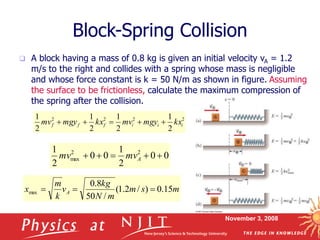
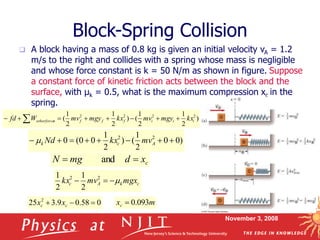
 A block having a mass of 0.8 kg is given an initial velocity vA = 1.2
m/s to the right and collides with a spring whose mass is negligible
and whose force constant is k = 50 N/m as shown in figure. Assuming
the surface to be frictionless, calculate the maximum compression of
the spring after the collision.
m
s
m
m
N
kg
v
k
m
x A 15
.
0
)
/
2
.
1
(
/
50
8
.
0
max 


0
0
2
1
0
0
2
1 2
2
max 



 A
mv
mv
2
2
2
2
2
1
2
1
2
1
2
1
i
i
i
f
f
f kx
mgy
mv
kx
mgy
mv 




November 3, 2008
Block-Spring Collision
 A block having a mass of 0.8 kg is given an initial velocity vA = 1.2
m/s to the right and collides with a spring whose mass is negligible
and whose force constant is k = 50 N/m as shown in figure. Suppose
a constant force of kinetic friction acts between the block and the
surface, with µk = 0.5, what is the maximum compression xc in the
spring.
)
0
0
2
1
(
)
2
1
0
0
(
0 2
2







 A
c
k mv
kx
Nd

)
2
1
2
1
(
)
2
1
2
1
( 2
2
2
2
i
i
i
f
f
f
s
otherforce kx
mgy
mv
kx
mgy
mv
W
fd 






 
c
k
A
c mgx
mv
kx 


 2
2
2
1
2
1
c
x
d
mg
N 
 and
0
58
.
0
9
.
3
25 2


 c
c x
x m
xc 093
.
0

November 3, 2008
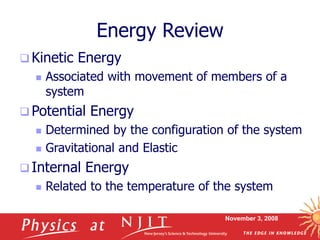
Energy Review
 Kinetic Energy
 Associated with movement of members of a
system
 Potential Energy
 Determined by the configuration of the system
 Gravitational and Elastic
 Internal Energy
 Related to the temperature of the system
November 3, 2008
Conservation of Energy
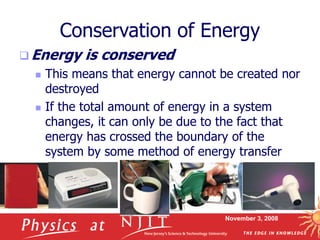
 Energy is conserved
 This means that energy cannot be created nor
destroyed
 If the total amount of energy in a system
changes, it can only be due to the fact that
energy has crossed the boundary of the
system by some method of energy transfer
November 3, 2008
Practical Case
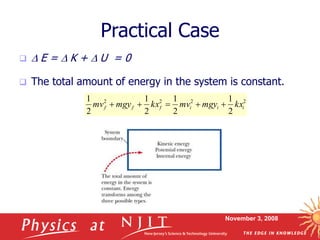
  E =  K +  U = 0
 The total amount of energy in the system is constant.
2
2
2
2
2
1
2
1
2
1
2
1
i
i
i
f
f
f kx
mgy
mv
kx
mgy
mv 




November 3, 2008
Practical Case
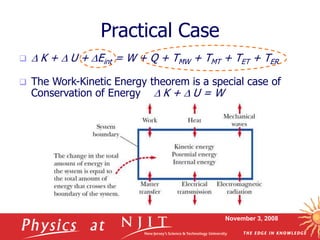
  K +  U + Eint = W + Q + TMW + TMT + TET + TER
 The Work-Kinetic Energy theorem is a special case of
Conservation of Energy  K +  U = W
November 3, 2008
Ways to Transfer Energy
Into or Out of A System
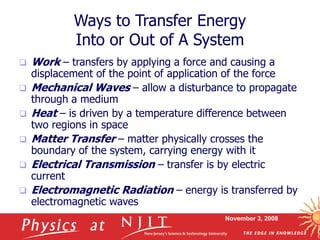
 Work – transfers by applying a force and causing a
displacement of the point of application of the force
 Mechanical Waves – allow a disturbance to propagate
through a medium
 Heat – is driven by a temperature difference between
two regions in space
 Matter Transfer – matter physically crosses the
boundary of the system, carrying energy with it
 Electrical Transmission – transfer is by electric
current
 Electromagnetic Radiation – energy is transferred by
electromagnetic waves
November 3, 2008
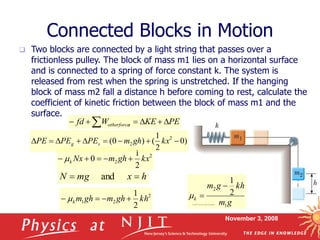
Connected Blocks in Motion
 Two blocks are connected by a light string that passes over a
frictionless pulley. The block of mass m1 lies on a horizontal surface
and is connected to a spring of force constant k. The system is
released from rest when the spring is unstretched. If the hanging
block of mass m2 fall a distance h before coming to rest, calculate the
coefficient of kinetic friction between the block of mass m1 and the
surface.
2
2
2
1
0 kx
gh
m
Nx
k 



 
PE
KE
W
fd s
otherforce 




 
h
x
mg
N 
 and
)
0
2
1
(
)
0
( 2
2 







 kx
gh
m
PE
PE
PE s
g
2
2
1
2
1
kh
gh
m
gh
m
k 


  g
m
kh
g
m
k
1
2
2
1



November 3, 2008
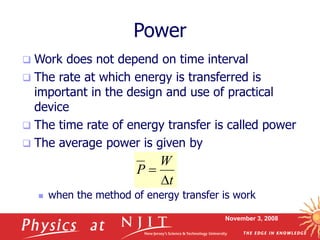
Power
 Work does not depend on time interval
 The rate at which energy is transferred is
important in the design and use of practical
device
 The time rate of energy transfer is called power
 The average power is given by
 when the method of energy transfer is work
W
P
t


November 3, 2008
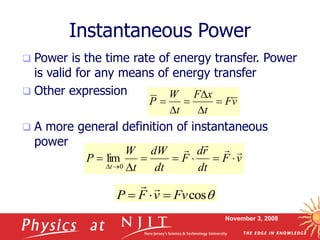
Instantaneous Power
 Power is the time rate of energy transfer. Power
is valid for any means of energy transfer
 Other expression
 A more general definition of instantaneous
power
v
F
t
x
F
t
W
P 





v
F
dt
r
d
F
dt
dW
t
W
P
t












 0
lim
q
cos
Fv
v
F
P 




November 3, 2008
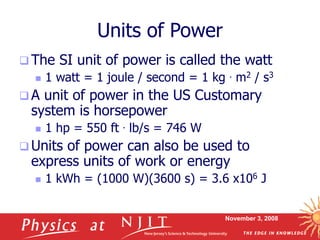
Units of Power
 The SI unit of power is called the watt
 1 watt = 1 joule / second = 1 kg . m2 / s3
 A unit of power in the US Customary
system is horsepower
 1 hp = 550 ft . lb/s = 746 W
 Units of power can also be used to
express units of work or energy
 1 kWh = (1000 W)(3600 s) = 3.6 x10⁶ J
November 3, 2008
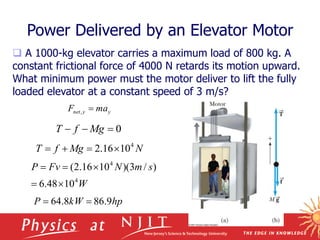
 A 1000-kg elevator carries a maximum load of 800 kg. A
constant frictional force of 4000 N retards its motion upward.
What minimum power must the motor deliver to lift the fully
loaded elevator at a constant speed of 3 m/s?
Power Delivered by an Elevator Motor
y
y
net ma
F 
,
0


 Mg
f
T
N
Mg
f
T 4
10
16
.
2 



W
s
m
N
Fv
P
4
4
10
48
.
6
)
/
3
)(
10
16
.
2
(





hp
kW
P 9
.
86
8
.
64 


3367297.ppt

  • 1.
    Physics 111: Mechanics Lecture7 Wenda Cao NJIT Physics Department
  • 2.
    November 3, 2008 PotentialEnergy and Energy Conservation  Work  Kinetic Energy  Work-Kinetic Energy Theorem  Gravitational Potential Energy  Elastic Potential Energy  Work-Energy Theorem  Conservative and Non-conservative Forces  Conservation of Energy
  • 3.
    November 3, 2008 Definitionof Work W  The work, W, done by a constant force on an object is defined as the product of the component of the force along the direction of displacement and the magnitude of the displacement  F is the magnitude of the force  Δ x is the magnitude of the object’s displacement  q is the angle between x F W   ) cos ( q and  F x
  • 4.
    November 3, 2008 WorkDone by Multiple Forces  If more than one force acts on an object, then the total work is equal to the algebraic sum of the work done by the individual forces  Remember work is a scalar, so this is the algebraic sum   net by individual forces W W r F W W W W F N g net      ) cos ( q
  • 5.
    November 3, 2008 KineticEnergy and Work  Kinetic energy associated with the motion of an object  Scalar quantity with the same unit as work  Work is related to kinetic energy 2 2 1 mv KE  x F mv mv net    ) cos ( 2 1 2 1 2 0 2 q net f i W KE KE KE    
  • 6.
    November 3, 2008 Workdone by a Gravitational Force  Gravitational Force  Magnitude: mg  Direction: downwards to the Earth’s center  Work done by Gravitational Force 2 0 2 2 1 2 1 mv mv Wnet   cos W F r q     F r q cos r mg Wg  
  • 7.
    November 3, 2008 PotentialEnergy  Potential energy is associated with the position of the object  Gravitational Potential Energy is the energy associated with the relative position of an object in space near the Earth’s surface  The gravitational potential energy  m is the mass of an object  g is the acceleration of gravity  y is the vertical position of the mass relative the surface of the Earth  SI unit: joule (J) mgy PE 
  • 8.
    November 3, 2008 ReferenceLevels  A location where the gravitational potential energy is zero must be chosen for each problem  The choice is arbitrary since the change in the potential energy is the important quantity  Choose a convenient location for the zero reference height  often the Earth’s surface  may be some other point suggested by the problem  Once the position is chosen, it must remain fixed for the entire problem
  • 9.
    November 3, 2008 Workand Gravitational Potential Energy  PE = mgy   Units of Potential Energy are the same as those of Work and Kinetic Energy f i gravity PE PE W   ) ( 0 cos ) ( cos i f f i g y y mg y y mg y F W        q
  • 10.
    November 3, 2008 ExtendedWork-Energy Theorem  The work-energy theorem can be extended to include potential energy:  If we only have gravitational force, then  The sum of the kinetic energy and the gravitational potential energy remains constant at all time and hence is a conserved quantity net f i W KE KE KE     f i gravity PE PE W   gravity net W W  f i i f PE PE KE KE    i i f f KE PE PE KE   
  • 11.
    November 3, 2008 ExtendedWork-Energy Theorem  We denote the total mechanical energy by  Since  The total mechanical energy is conserved and remains the same at all times PE KE E   i i f f KE PE PE KE    f f i i mgy mv mgy mv    2 2 2 1 2 1
  • 12.
    November 3, 2008 Problem-SolvingStrategy  Define the system  Select the location of zero gravitational potential energy  Do not change this location while solving the problem  Identify two points the object of interest moves between  One point should be where information is given  The other point should be where you want to find out something
  • 13.
    November 3, 2008 PlatformDiver  A diver of mass m drops from a board 10.0 m above the water’s surface. Neglect air resistance.  (a) Find is speed 5.0 m above the water surface  (b) Find his speed as he hits the water
  • 14.
    November 3, 2008 PlatformDiver  (a) Find is speed 5.0 m above the water surface  (b) Find his speed as he hits the water f f i i mgy mv mgy mv    2 2 2 1 2 1 f f i mgy v gy    2 2 1 0 s m gy v i f / 14 2   0 2 1 0 2    f i mv mgy s m m m s m y y g v f i f / 9 . 9 ) 5 10 )( / 8 . 9 ( 2 ) ( 2 2     
  • 15.
    November 3, 2008 SpringForce  Involves the spring constant, k  Hooke’s Law gives the force  F is in the opposite direction of x, always back towards the equilibrium point.  k depends on how the spring was formed, the material it is made from, thickness of the wire, etc. Unit: N/m. d k F    
  • 16.
    November 3, 2008 PotentialEnergy in a Spring  Elastic Potential Energy:  SI unit: Joule (J)  related to the work required to compress a spring from its equilibrium position to some final, arbitrary, position x  Work done by the spring 2 2 2 1 2 1 ) ( f i x x s kx kx dx kx W f i      2 2 1 kx PEs  sf si s PE PE W  
  • 17.
    November 3, 2008 ExtendedWork-Energy Theorem  The work-energy theorem can be extended to include potential energy:  If we include gravitational force and spring force, then net f i W KE KE KE     f i gravity PE PE W   s gravity net W W W   0 ) ( ) ( ) (       si sf i f i f PE PE PE PE KE KE si i i sf f f KE KE PE PE PE KE      sf si s PE PE W  
  • 18.
    November 3, 2008 ExtendedWork-Energy Theorem  We denote the total mechanical energy by  Since  The total mechanical energy is conserved and remains the same at all times s PE PE KE E    i s f s PE PE KE PE PE KE ) ( ) (      2 2 2 2 2 1 2 1 2 1 2 1 f f f i i i kx mgy mv kx mgy mv     
  • 19.
    November 3, 2008 Ablock projected up a incline  A 0.5-kg block rests on a horizontal, frictionless surface. The block is pressed back against a spring having a constant of k = 625 N/m, compressing the spring by 10.0 cm to point A. Then the block is released.  (a) Find the maximum distance d the block travels up the frictionless incline if θ = 30°.  (b) How fast is the block going when halfway to its maximum height?
  • 20.
    November 3, 2008 Ablock projected up a incline  Point A (initial state):  Point B (final state): m cm x y v i i i 1 . 0 10 , 0 , 0       m s m kg m m N mg kx d i 28 . 1 30 sin ) / 8 . 9 )( 5 . 0 ( ) 1 . 0 )( / 625 ( 5 . 0 sin 2 2 2 2 1      q 2 2 2 2 2 1 2 1 2 1 2 1 f f f i i i kx mgy mv kx mgy mv      0 , sin , 0     f f f x d h y v q q sin 2 1 2 mgd mgy kx f i  
  • 21.
    November 3, 2008 Ablock projected up a incline  Point A (initial state):  Point B (final state): m cm x y v i i i 1 . 0 10 , 0 , 0       s m gh x m k v i f / 5 . 2 ...... 2     2 2 2 2 2 1 2 1 2 1 2 1 f f f i i i kx mgy mv kx mgy mv      0 , 2 / sin 2 / ?,     f f f x d h y v q ) 2 ( 2 1 2 1 2 2 h mg mv kx f i   gh v x m k f i   2 2 m m d h 64 . 0 30 sin ) 28 . 1 ( sin     q
  • 22.
    November 3, 2008 Typesof Forces  Conservative forces  Work and energy associated with the force can be recovered  Examples: Gravity, Spring Force, EM forces  Nonconservative forces  The forces are generally dissipative and work done against it cannot easily be recovered  Examples: Kinetic friction, air drag forces, normal forces, tension forces, applied forces …
  • 23.
    November 3, 2008 ConservativeForces  A force is conservative if the work it does on an object moving between two points is independent of the path the objects take between the points  The work depends only upon the initial and final positions of the object  Any conservative force can have a potential energy function associated with it  Work done by gravity  Work done by spring force f i f i g mgy mgy PE PE W     2 2 2 1 2 1 f i sf si s kx kx PE PE W    
  • 24.
    November 3, 2008 NonconservativeForces  A force is nonconservative if the work it does on an object depends on the path taken by the object between its final and starting points.  The work depends upon the movement path  For a non-conservative force, potential energy can NOT be defined  Work done by a nonconservative force  It is generally dissipative. The dispersal of energy takes the form of heat or sound        s otherforce k nc W d f d F W  
  • 25.
    November 3, 2008 ExtendedWork-Energy Theorem  The work-energy theorem can be written as:  Wnc represents the work done by nonconservative forces  Wc represents the work done by conservative forces  Any work done by conservative forces can be accounted for by changes in potential energy  Gravity work  Spring force work net f i W KE KE KE     c nc net W W W   2 2 2 1 2 1 f i f i s kx kx PE PE W     f i f i g mgy mgy PE PE W     f i c PE PE W  
  • 26.
    November 3, 2008 ExtendedWork-Energy Theorem  Any work done by conservative forces can be accounted for by changes in potential energy  Mechanical energy include kinetic and potential energy 2 2 2 1 2 1 kx mgy mv PE PE KE PE KE E s g         ) ( ) ( i i f f nc PE KE PE KE W     ) ( ) ( i f i f nc PE PE KE KE PE KE W         PE PE PE PE PE W i f f i c         ) ( i f nc E E W  
  • 27.
    November 3, 2008 Problem-SolvingStrategy  Define the system to see if it includes non-conservative forces (especially friction, drag force …)  Without non-conservative forces  With non-conservative forces  Select the location of zero potential energy  Do not change this location while solving the problem  Identify two points the object of interest moves between  One point should be where information is given  The other point should be where you want to find out something 2 2 2 2 2 1 2 1 2 1 2 1 i i i f f f kx mgy mv kx mgy mv      ) ( ) ( i i f f nc PE KE PE KE W     ) 2 1 2 1 ( ) 2 1 2 1 ( 2 2 2 2 i i i f f f s otherforce kx mgy mv kx mgy mv W fd         
  • 28.
    November 3, 2008 A block of mass m = 0.40 kg slides across a horizontal frictionless counter with a speed of v = 0.50 m/s. It runs into and compresses a spring of spring constant k = 750 N/m. When the block is momentarily stopped by the spring, by what distance d is the spring compressed? Conservation of Mechanical Energy ) ( ) ( i i f f nc PE KE PE KE W     2 2 2 2 2 1 2 1 2 1 2 1 i i i f f f kx mgy mv kx mgy mv      0 0 2 1 2 1 0 0 2 2      mv kd cm v k m d 15 . 1 2   0 0 2 1 2 1 0 0 2 2      mv kd
  • 29.
    November 3, 2008 Changesin Mechanical Energy for conservative forces  A 3-kg crate slides down a ramp. The ramp is 1 m in length and inclined at an angle of 30° as shown. The crate stats from rest at the top. The surface friction can be negligible. Use energy methods to determine the speed of the crate at the bottom of the ramp. N ) 2 1 2 1 ( ) 2 1 2 1 ( 2 2 2 2 i i i f f f kx mgy mv kx mgy mv      ) 0 0 ( ) 0 0 2 1 ( 2      i f mgy mv 0 , 5 . 0 30 sin , 1     i i v m d y m d  s m gy v i f / 1 . 3 2   ? , 0   f f v y ) 2 1 2 1 ( ) 2 1 2 1 ( 2 2 2 2 i i i f f f s otherforce kx mgy mv kx mgy mv W fd         
  • 30.
    November 3, 2008 Changesin Mechanical Energy for Non-conservative forces  A 3-kg crate slides down a ramp. The ramp is 1 m in length and inclined at an angle of 30° as shown. The crate stats from rest at the top. The surface in contact have a coefficient of kinetic friction of 0.15. Use energy methods to determine the speed of the crate at the bottom of the ramp. N fk ) 2 1 2 1 ( ) 2 1 2 1 ( 2 2 2 2 i i i f f f s otherforce kx mgy mv kx mgy mv W fd          ) 0 0 ( ) 0 0 2 1 ( 0 2         i f k mgy mv Nd  ? , 5 . 0 30 sin , 1 , 15 . 0      N m d y m d i k   0 cos   q mg N i f k mgy mv dmg    2 2 1 cosq  s m d y g v k i f / 7 . 2 ) cos ( 2    q 
  • 31.
    November 3, 2008 Changesin Mechanical Energy for Non-conservative forces  A 3-kg crate slides down a ramp. The ramp is 1 m in length and inclined at an angle of 30° as shown. The crate stats from rest at the top. The surface in contact have a coefficient of kinetic friction of 0.15. How far does the crate slide on the horizontal floor if it continues to experience a friction force. ) 2 1 2 1 ( ) 2 1 2 1 ( 2 2 2 2 i i i f f f s otherforce kx mgy mv kx mgy mv W fd          ) 0 0 2 1 ( ) 0 0 0 ( 0 2         i k mv Nx  ? , / 7 . 2 , 15 . 0    N s m vi k  0   mg N 2 2 1 i k mv mgx     m g v x k i 5 . 2 2 2   
  • 32.
    November 3, 2008 Block-SpringCollision  A block having a mass of 0.8 kg is given an initial velocity vA = 1.2 m/s to the right and collides with a spring whose mass is negligible and whose force constant is k = 50 N/m as shown in figure. Assuming the surface to be frictionless, calculate the maximum compression of the spring after the collision. m s m m N kg v k m x A 15 . 0 ) / 2 . 1 ( / 50 8 . 0 max    0 0 2 1 0 0 2 1 2 2 max      A mv mv 2 2 2 2 2 1 2 1 2 1 2 1 i i i f f f kx mgy mv kx mgy mv     
  • 33.
    November 3, 2008 Block-SpringCollision  A block having a mass of 0.8 kg is given an initial velocity vA = 1.2 m/s to the right and collides with a spring whose mass is negligible and whose force constant is k = 50 N/m as shown in figure. Suppose a constant force of kinetic friction acts between the block and the surface, with µk = 0.5, what is the maximum compression xc in the spring. ) 0 0 2 1 ( ) 2 1 0 0 ( 0 2 2         A c k mv kx Nd  ) 2 1 2 1 ( ) 2 1 2 1 ( 2 2 2 2 i i i f f f s otherforce kx mgy mv kx mgy mv W fd          c k A c mgx mv kx     2 2 2 1 2 1 c x d mg N   and 0 58 . 0 9 . 3 25 2    c c x x m xc 093 . 0 
  • 34.
    November 3, 2008 EnergyReview  Kinetic Energy  Associated with movement of members of a system  Potential Energy  Determined by the configuration of the system  Gravitational and Elastic  Internal Energy  Related to the temperature of the system
  • 35.
    November 3, 2008 Conservationof Energy  Energy is conserved  This means that energy cannot be created nor destroyed  If the total amount of energy in a system changes, it can only be due to the fact that energy has crossed the boundary of the system by some method of energy transfer
  • 36.
    November 3, 2008 PracticalCase   E =  K +  U = 0  The total amount of energy in the system is constant. 2 2 2 2 2 1 2 1 2 1 2 1 i i i f f f kx mgy mv kx mgy mv     
  • 37.
    November 3, 2008 PracticalCase   K +  U + Eint = W + Q + TMW + TMT + TET + TER  The Work-Kinetic Energy theorem is a special case of Conservation of Energy  K +  U = W
  • 38.
    November 3, 2008 Waysto Transfer Energy Into or Out of A System  Work – transfers by applying a force and causing a displacement of the point of application of the force  Mechanical Waves – allow a disturbance to propagate through a medium  Heat – is driven by a temperature difference between two regions in space  Matter Transfer – matter physically crosses the boundary of the system, carrying energy with it  Electrical Transmission – transfer is by electric current  Electromagnetic Radiation – energy is transferred by electromagnetic waves
  • 39.
    November 3, 2008 ConnectedBlocks in Motion  Two blocks are connected by a light string that passes over a frictionless pulley. The block of mass m1 lies on a horizontal surface and is connected to a spring of force constant k. The system is released from rest when the spring is unstretched. If the hanging block of mass m2 fall a distance h before coming to rest, calculate the coefficient of kinetic friction between the block of mass m1 and the surface. 2 2 2 1 0 kx gh m Nx k       PE KE W fd s otherforce        h x mg N   and ) 0 2 1 ( ) 0 ( 2 2          kx gh m PE PE PE s g 2 2 1 2 1 kh gh m gh m k      g m kh g m k 1 2 2 1   
  • 40.
    November 3, 2008 Power Work does not depend on time interval  The rate at which energy is transferred is important in the design and use of practical device  The time rate of energy transfer is called power  The average power is given by  when the method of energy transfer is work W P t  
  • 41.
    November 3, 2008 InstantaneousPower  Power is the time rate of energy transfer. Power is valid for any means of energy transfer  Other expression  A more general definition of instantaneous power v F t x F t W P       v F dt r d F dt dW t W P t              0 lim q cos Fv v F P     
  • 42.
    November 3, 2008 Unitsof Power  The SI unit of power is called the watt  1 watt = 1 joule / second = 1 kg . m2 / s3  A unit of power in the US Customary system is horsepower  1 hp = 550 ft . lb/s = 746 W  Units of power can also be used to express units of work or energy  1 kWh = (1000 W)(3600 s) = 3.6 x10⁶ J
  • 43.
    November 3, 2008 A 1000-kg elevator carries a maximum load of 800 kg. A constant frictional force of 4000 N retards its motion upward. What minimum power must the motor deliver to lift the fully loaded elevator at a constant speed of 3 m/s? Power Delivered by an Elevator Motor y y net ma F  , 0    Mg f T N Mg f T 4 10 16 . 2     W s m N Fv P 4 4 10 48 . 6 ) / 3 )( 10 16 . 2 (      hp kW P 9 . 86 8 . 64  