
Symmetry in nature


        Made by:-Abhay goyal
                   X-B
                    754
INTRODUCTION
  Mathematics is all around us. As we discover more and more about
     our environment and our surroundings we see that nature can be
    described mathematically. The beauty of a flower, the majesty of a
  tree, even the rocks upon which we walk can exhibit nature's sense
       of symmetry. Although there are other examples to be found in
     crystallography or even at a microscopic level of nature, we have
chosen representations within objects in our field of view that exhibit
                                    many different types of symmetry.
      1.Bilateral symmetry
      2. Radial symmetry
      3. Strip patterns
      4.Wallpaper patterns
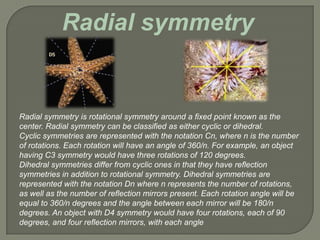
Radial symmetry


Radial symmetry is rotational symmetry around a fixed point known as the
center. Radial symmetry can be classified as either cyclic or dihedral.
Cyclic symmetries are represented with the notation Cn, where n is the number
of rotations. Each rotation will have an angle of 360/n. For example, an object
having C3 symmetry would have three rotations of 120 degrees.
Dihedral symmetries differ from cyclic ones in that they have reflection
symmetries in addition to rotational symmetry. Dihedral symmetries are
represented with the notation Dn where n represents the number of rotations,
as well as the number of reflection mirrors present. Each rotation angle will be
equal to 360/n degrees and the angle between each mirror will be 180/n
degrees. An object with D4 symmetry would have four rotations, each of 90
degrees, and four reflection mirrors, with each angle
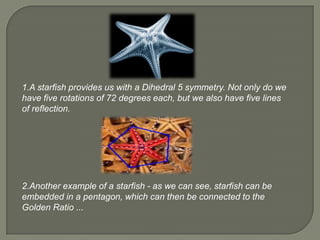
1.A starfish provides us with a Dihedral 5 symmetry. Not only do we
have five rotations of 72 degrees each, but we also have five lines
of reflection.


2.Another example of a starfish - as we can see, starfish can be
embedded in a pentagon, which can then be connected to the
Golden Ratio ...
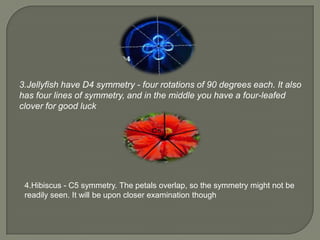
3.Jellyfish have D4 symmetry - four rotations of 90 degrees each. It also
has four lines of symmetry, and in the middle you have a four-leafed
clover for good luck


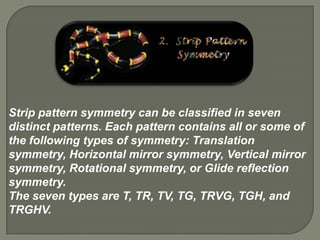
 4.Hibiscus - C5 symmetry. The petals overlap, so the symmetry might not be
 readily seen. It will be upon closer examination though
Strip pattern symmetry can be classified in seven
distinct patterns. Each pattern contains all or some of
the following types of symmetry: Translation
symmetry, Horizontal mirror symmetry, Vertical mirror
symmetry, Rotational symmetry, or Glide reflection
symmetry.
The seven types are T, TR, TV, TG, TRVG, TGH, and
TRGHV.
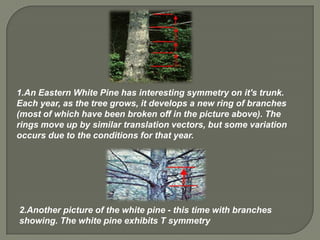
1.An Eastern White Pine has interesting symmetry on it's trunk.
Each year, as the tree grows, it develops a new ring of branches
(most of which have been broken off in the picture above). The
rings move up by similar translation vectors, but some variation
occurs due to the conditions for that year.


2.Another picture of the white pine - this time with branches
showing. The white pine exhibits T symmetry
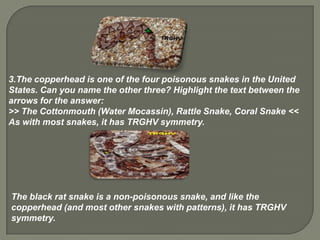
3.The copperhead is one of the four poisonous snakes in the United
States. Can you name the other three? Highlight the text between the
arrows for the answer:
>> The Cottonmouth (Water Mocassin), Rattle Snake, Coral Snake <<
As with most snakes, it has TRGHV symmetry.


The black rat snake is a non-poisonous snake, and like the
copperhead (and most other snakes with patterns), it has TRGHV
symmetry.
Wallpaper patterns are patterns of symmetry that
tessellate the plane from a given fundamental region.
There are seventeen different types of wallpaper
patterns. In the examples below, you will see the
fundamental regions highlighted, as well as the
translation vector generators that can be used to
complete the pattern by translation, after the other
isometries of the pattern are completed
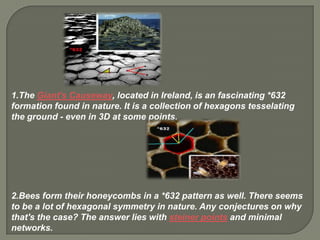
1.The Giant's Causeway, located in Ireland, is an fascinating *632
formation found in nature. It is a collection of hexagons tesselating
the ground - even in 3D at some points.


2.Bees form their honeycombs in a *632 pattern as well. There seems
to be a lot of hexagonal symmetry in nature. Any conjectures on why
that's the case? The answer lies with steiner points and minimal
networks.
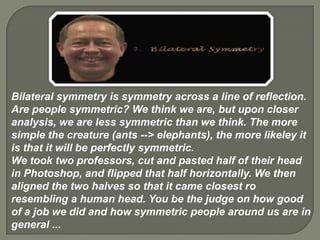
Bilateral symmetry is symmetry across a line of reflection.
Are people symmetric? We think we are, but upon closer
analysis, we are less symmetric than we think. The more
simple the creature (ants --> elephants), the more likeley it
is that it will be perfectly symmetric.
We took two professors, cut and pasted half of their head
in Photoshop, and flipped that half horizontally. We then
aligned the two halves so that it came closest ro
resembling a human head. You be the judge on how good
of a job we did and how symmetric people around us are in
general ...
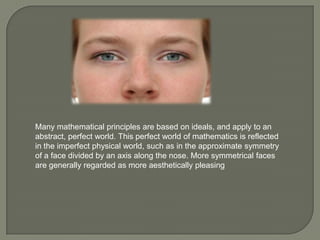
Many mathematical principles are based on ideals, and apply to an
abstract, perfect world. This perfect world of mathematics is reflected
in the imperfect physical world, such as in the approximate symmetry
of a face divided by an axis along the nose. More symmetrical faces
are generally regarded as more aesthetically pleasing
conclusion
Symmetry is the ordering principle in nature that
represents the center of balance between two or more
opposing sides. As a fundamental design principle, it
permeates everything: from man-made architecture to
natural crystalline formations. In nature, symmetry
exists with such precision and beauty that we can't
help but attribute it to intelligence-such equal
proportions and organization would seem to be
created only on purpose. Consequently, humans have
borrowed this principle for its most iconic creations
and symbols.
Maths in nature (complete)

Maths in nature (complete)

  • 1.
    Symmetry in nature Made by:-Abhay goyal X-B 754
  • 2.
    INTRODUCTION Mathematicsis all around us. As we discover more and more about our environment and our surroundings we see that nature can be described mathematically. The beauty of a flower, the majesty of a tree, even the rocks upon which we walk can exhibit nature's sense of symmetry. Although there are other examples to be found in crystallography or even at a microscopic level of nature, we have chosen representations within objects in our field of view that exhibit many different types of symmetry. 1.Bilateral symmetry 2. Radial symmetry 3. Strip patterns 4.Wallpaper patterns
  • 3.
    Radial symmetry Radial symmetryis rotational symmetry around a fixed point known as the center. Radial symmetry can be classified as either cyclic or dihedral. Cyclic symmetries are represented with the notation Cn, where n is the number of rotations. Each rotation will have an angle of 360/n. For example, an object having C3 symmetry would have three rotations of 120 degrees. Dihedral symmetries differ from cyclic ones in that they have reflection symmetries in addition to rotational symmetry. Dihedral symmetries are represented with the notation Dn where n represents the number of rotations, as well as the number of reflection mirrors present. Each rotation angle will be equal to 360/n degrees and the angle between each mirror will be 180/n degrees. An object with D4 symmetry would have four rotations, each of 90 degrees, and four reflection mirrors, with each angle
  • 4.
    1.A starfish providesus with a Dihedral 5 symmetry. Not only do we have five rotations of 72 degrees each, but we also have five lines of reflection. 2.Another example of a starfish - as we can see, starfish can be embedded in a pentagon, which can then be connected to the Golden Ratio ...
  • 5.
    3.Jellyfish have D4symmetry - four rotations of 90 degrees each. It also has four lines of symmetry, and in the middle you have a four-leafed clover for good luck 4.Hibiscus - C5 symmetry. The petals overlap, so the symmetry might not be readily seen. It will be upon closer examination though
  • 6.
    Strip pattern symmetrycan be classified in seven distinct patterns. Each pattern contains all or some of the following types of symmetry: Translation symmetry, Horizontal mirror symmetry, Vertical mirror symmetry, Rotational symmetry, or Glide reflection symmetry. The seven types are T, TR, TV, TG, TRVG, TGH, and TRGHV.
  • 7.
    1.An Eastern WhitePine has interesting symmetry on it's trunk. Each year, as the tree grows, it develops a new ring of branches (most of which have been broken off in the picture above). The rings move up by similar translation vectors, but some variation occurs due to the conditions for that year. 2.Another picture of the white pine - this time with branches showing. The white pine exhibits T symmetry
  • 8.
    3.The copperhead isone of the four poisonous snakes in the United States. Can you name the other three? Highlight the text between the arrows for the answer: >> The Cottonmouth (Water Mocassin), Rattle Snake, Coral Snake << As with most snakes, it has TRGHV symmetry. The black rat snake is a non-poisonous snake, and like the copperhead (and most other snakes with patterns), it has TRGHV symmetry.
  • 9.
    Wallpaper patterns arepatterns of symmetry that tessellate the plane from a given fundamental region. There are seventeen different types of wallpaper patterns. In the examples below, you will see the fundamental regions highlighted, as well as the translation vector generators that can be used to complete the pattern by translation, after the other isometries of the pattern are completed
  • 10.
    1.The Giant's Causeway,located in Ireland, is an fascinating *632 formation found in nature. It is a collection of hexagons tesselating the ground - even in 3D at some points. 2.Bees form their honeycombs in a *632 pattern as well. There seems to be a lot of hexagonal symmetry in nature. Any conjectures on why that's the case? The answer lies with steiner points and minimal networks.
  • 11.
    Bilateral symmetry issymmetry across a line of reflection. Are people symmetric? We think we are, but upon closer analysis, we are less symmetric than we think. The more simple the creature (ants --> elephants), the more likeley it is that it will be perfectly symmetric. We took two professors, cut and pasted half of their head in Photoshop, and flipped that half horizontally. We then aligned the two halves so that it came closest ro resembling a human head. You be the judge on how good of a job we did and how symmetric people around us are in general ...
  • 12.
    Many mathematical principlesare based on ideals, and apply to an abstract, perfect world. This perfect world of mathematics is reflected in the imperfect physical world, such as in the approximate symmetry of a face divided by an axis along the nose. More symmetrical faces are generally regarded as more aesthetically pleasing
  • 13.
    conclusion Symmetry is theordering principle in nature that represents the center of balance between two or more opposing sides. As a fundamental design principle, it permeates everything: from man-made architecture to natural crystalline formations. In nature, symmetry exists with such precision and beauty that we can't help but attribute it to intelligence-such equal proportions and organization would seem to be created only on purpose. Consequently, humans have borrowed this principle for its most iconic creations and symbols.