Physics 2
Distance
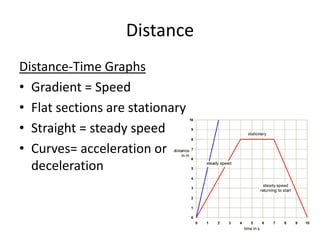
Distance-Time Graphs
• Gradient = Speed
• Flat sections are stationary
• Straight = steady speed
• Curves= acceleration or
deceleration
Velocity and Acceleration
Acceleration is how quickly velocity is changing
Acceleration=Change in Velocity/Time Taken
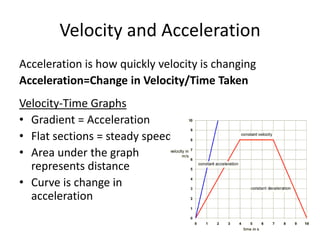
Velocity-Time Graphs
• Gradient = Acceleration
• Flat sections = steady speed
• Area under the graph
represents distance
• Curve is change in
acceleration
Weight
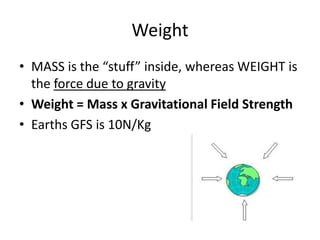
• MASS is the “stuff” inside, whereas WEIGHT is
the force due to gravity
• Weight = Mass x Gravitational Field Strength
• Earths GFS is 10N/Kg
Resultant Forces
• It is the overall FORCE
• The overall effect of forces which will decide
the motion of an object
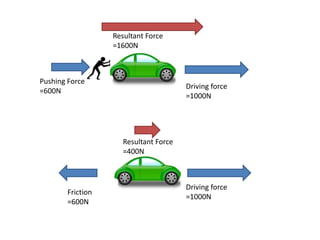
• If two forces are acting in the same
direction, the resultant force is the sum of
those two
• If two forces are acting along the same
line, then the resultant force is found by
subtracting them
Driving force
=1000N
Pushing Force
=600N
Resultant Force
=1600N
Driving force
=1000N
Friction
=600N
Resultant Force
=400N
Acceleration
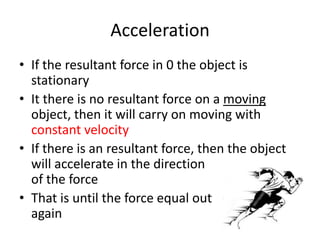
• If the resultant force in 0 the object is
stationary
• It there is no resultant force on a moving
object, then it will carry on moving with
constant velocity
• If there is an resultant force, then the object
will accelerate in the direction
of the force
• That is until the force equal out
again
• Force = Mass x Acceleration
Or Acceleration = Force / Mass
• When two object interact, the forces they put
(exert) upon each other are equal and
opposite
• This is called a reaction force, so if you push
against something it will push back against
you with equal force
Friction
• It acts against movement
• If you travel at a steady speed, the driving
force needs to equal the frictional force
• Streamlining reduces drag or air resistance
• Drag increases as speed increases, as you
accelerate you hit more air particles with
more force. This created more drag
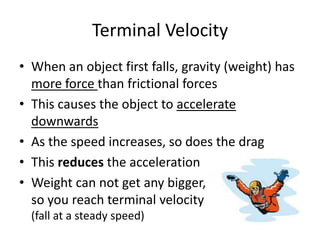
Terminal Velocity
• When an object first falls, gravity (weight) has
more force than frictional forces
• This causes the object to accelerate
downwards
• As the speed increases, so does the drag
• This reduces the acceleration
• Weight can not get any bigger,
so you reach terminal velocity
(fall at a steady speed)
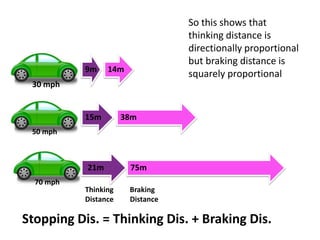
Stopping Distance
Thinking Distance
• Faster you are going = Further you will go
• Your Reactions- Tiredness, drugs, alcohol, bad
visibility and distractions
Braking Distance
• Faster you are going = Further you will go
• The Car- the condition of Tyres and condition of
Brakes
• The Road- road surface and weather condition
30 mph
50 mph
70 mph
9m
15m
21m
14m
38m
75m
So this shows that
thinking distance is
directionally proportional
but braking distance is
squarely proportional
Thinking Braking
Distance Distance
Stopping Dis. = Thinking Dis. + Braking Dis.
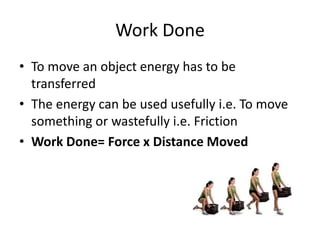
Work Done
• To move an object energy has to be
transferred
• The energy can be used usefully i.e. To move
something or wastefully i.e. Friction
• Work Done= Force x Distance Moved
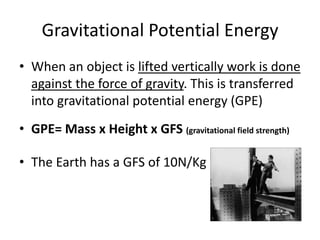
Gravitational Potential Energy
• When an object is lifted vertically work is done
against the force of gravity. This is transferred
into gravitational potential energy (GPE)
• GPE= Mass x Height x GFS (gravitational field strength)
• The Earth has a GFS of 10N/Kg
Kinetic Energy
• Any thing that moves has kinetic energy
• Kinetic Energy = ½ Mass x Speed²
• Moving car has lots of KE so to slow it down
energy is lost i.e. Heat energy
• Work done = KE
F x d = ½ mv²
• Falling objects have the potential energy lost and
they gain kinetic energy
Elasticity
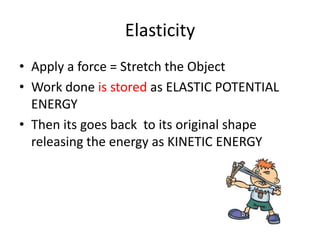
• Apply a force = Stretch the Object
• Work done is stored as ELASTIC POTENTIAL
ENERGY
• Then its goes back to its original shape
releasing the energy as KINETIC ENERGY
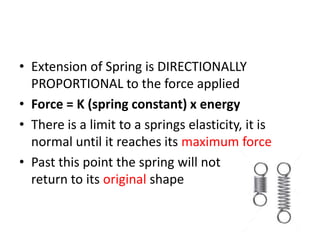
• Extension of Spring is DIRECTIONALLY
PROPORTIONAL to the force applied
• Force = K (spring constant) x energy
• There is a limit to a springs elasticity, it is
normal until it reaches its maximum force
• Past this point the spring will not
return to its original shape
Power
• It is the rate of doing work
• Power = Work Done / Time Taken
• Measured in Watts, which means 1 Watt is 1
joule of energy transferred every second
Momentum
• It’s a property of a moving object
• Momentum = Mass x Velocity
• Also P before = P after
• Momentum is a vector, so has direction
• When a force acts upon an object it changes
its momentum
• The bigger the force the faster the change of
momentum
Car Safety
• Brakes transform the kinetic energy of the car
into thermal energy on the road
• Regenerative brakes don’t transform into heat
the transform into electrical energy
• Big change in Momentum in a short time =
MASSIVE
END OF FIRST HALF
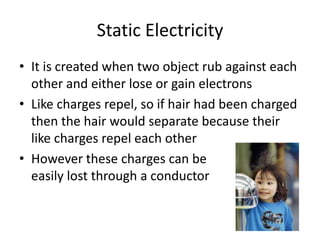
Static Electricity
• It is created when two object rub against each
other and either lose or gain electrons
• Like charges repel, so if hair had been charged
then the hair would separate because their
like charges repel each other
• However these charges can be
easily lost through a conductor
Current and Voltage
• Current is the rate of flow of charge
• Current= Charge / Time
• The Potential Difference is the work done per
coulomb of charge
• Voltage = Work Done / Charge
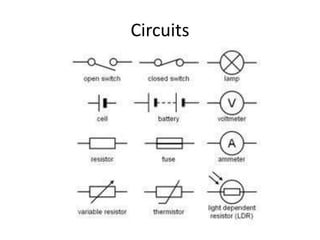
Circuits
Resistance
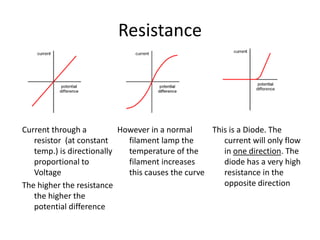
Current through a
resistor (at constant
temp.) is directionally
proportional to
Voltage
The higher the resistance
the higher the
potential difference
However in a normal
filament lamp the
temperature of the
filament increases
this causes the curve
This is a Diode. The
current will only flow
in one direction. The
diode has a very high
resistance in the
opposite direction
Series
• All or nothing, if one component breaks ao
does the circuit
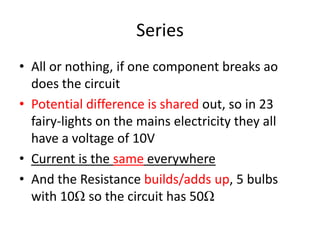
• Potential difference is shared out, so in 23
fairy-lights on the mains electricity they all
have a voltage of 10V
• Current is the same everywhere
• And the Resistance builds/adds up, 5 bulbs
with 10Ω so the circuit has 50Ω
Parallel
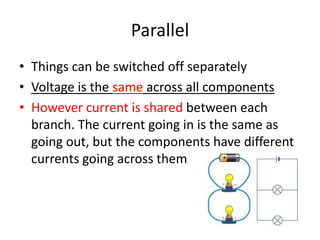
• Things can be switched off separately
• Voltage is the same across all components
• However current is shared between each
branch. The current going in is the same as
going out, but the components have different
currents going across them
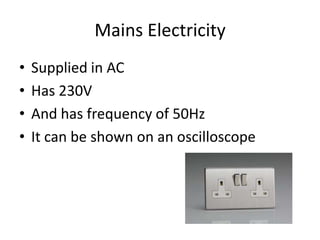
Mains Electricity
• Supplied in AC
• Has 230V
• And has frequency of 50Hz
• It can be shown on an oscilloscope
Electricity in the Home
Hazards: Long Cables; Frayed cables; damaged
plugs; too many plugs in 1 socket; water near
sockets
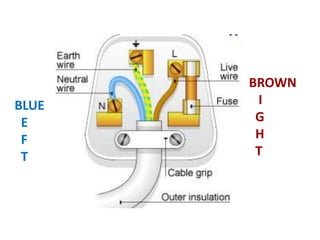
The wires: Live wire carries the alternating
current; Neutral has 0V and Earth is attached
to metal casing
BLUE
E
F
T
BROWN
I
G
H
T
Fuses and Earthing
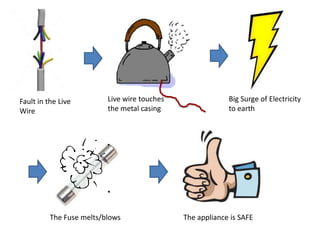
• Fault in the LIVE WIRE causes it to touch the
metal case
• This causes a larger current to flow through
the circuit
• This surge cause the FUSE to MELT
• This cuts of the live supply and breaks the
circuit, THUS saving the appliance and the
user
Live wire touches
the metal casing
Big Surge of Electricity
to earth
Fault in the Live
Wire
The Fuse melts/blows The appliance is SAFE
Energy and Power
• All resistors produce heat when a current
flows through them. The more current the
more heat
• To be energy efficient they have to transfer
more of their total electrical energy to a useful
source
• Energy Transferred= Power Rating x Time
Atomic Structure- Rutherford
• In 1909 Rutherford fired alpha particles at gold
foil to discover more about particles
• He found most went straight through, this shows
particles are mostly empty space
• Some came straight back, the shows that most of
the mass is concentration in a central nucleus
• Some were deflected, this shows the
nucleus is positive and there must be
negative electrons not in the nucleus
Radiation
• Isotopes are atoms of the same element but are
slightly different, they have the same number of
protons but different numbers of neutrons
• Radioactivity is entirely random, it comes from an
unstable and decaying nuclei. This emits alpha,
beta or gamma radiation
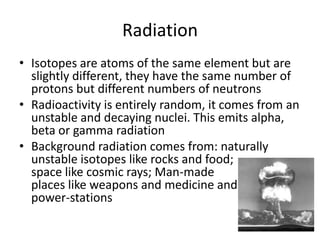
• Background radiation comes from: naturally
unstable isotopes like rocks and food;
space like cosmic rays; Man-made
places like weapons and medicine and
power-stations
Types of Radiation
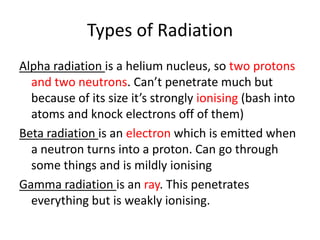
Alpha radiation is a helium nucleus, so two protons
and two neutrons. Can’t penetrate much but
because of its size it’s strongly ionising (bash into
atoms and knock electrons off of them)
Beta radiation is an electron which is emitted when
a neutron turns into a proton. Can go through
some things and is mildly ionising
Gamma radiation is an ray. This penetrates
everything but is weakly ionising.
Radiation Safety
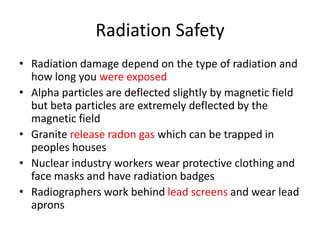
• Radiation damage depend on the type of radiation and
how long you were exposed
• Alpha particles are deflected slightly by magnetic field
but beta particles are extremely deflected by the
magnetic field
• Granite release radon gas which can be trapped in
peoples houses
• Nuclear industry workers wear protective clothing and
face masks and have radiation badges
• Radiographers work behind lead screens and wear lead
aprons
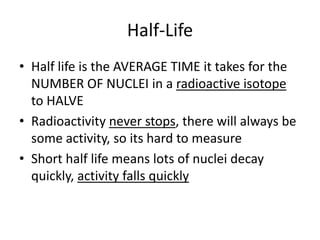
Half-Life
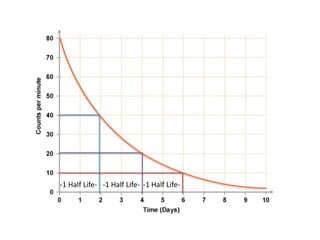
• Half life is the AVERAGE TIME it takes for the
NUMBER OF NUCLEI in a radioactive isotope
to HALVE
• Radioactivity never stops, there will always be
some activity, so its hard to measure
• Short half life means lots of nuclei decay
quickly, activity falls quickly
-1 Half Life- -1 Half Life- -1 Half Life-
Uses of Radiation
• Smoke detectors- alpha particles make and circuit
and smoke breaks the circuit, making the alarm
go off
• Sterilisation- Gamma rays are used to kill bacteria
on food or medical equipment, without harming
them
• Radiotherapy- gamma is fired at a cancer to kill all
of those cells, but damage is done
• Tracers- beta or gamma sources are
put into someone and an external
detector says where most of the
radiation is
Damage of Radioactivity
• Large amounts of radiation kill cells and leave you
with radiation sickness, but nothing else
• Small amounts cause minor damage to cells
without killing them. They then mutant and
divide uncontrollably, this is a cancer
• Alpha is very harmful inside the body because it
damages a very localised area
• Beta and gamma are dangerous outside the body
because they can penetrate the skin
Nuclear Fission
• This is what happens in nuclear power stations
and nuclear bombs
• An Neutron had to be absorbed by an
unstable nuclei
• This creates two new smaller nuclei and
releases more neutron, this makes a chain
reaction
• This gives out a lot of energy
Nuclear Fusion
• This is where two small nuclei join to create a
larger nucleus and energy
• Fusion doesn’t leave a lot of radioactive waste
and there is a bounty of fuel (hydrogen)
• It can only happen at really high temperatures
• You need at strong magnetic force to hold the
pressure and heat
2
1
H H
1
1
+ 
3
2
He + ENERGY
Life Cycle of Stars
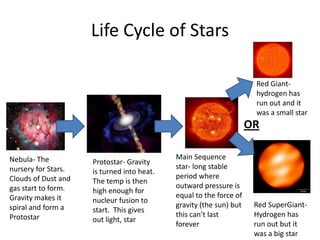
Nebula- The
nursery for Stars.
Clouds of Dust and
gas start to form.
Gravity makes it
spiral and form a
Protostar
Protostar- Gravity
is turned into heat.
The temp is then
high enough for
nucleur fusion to
start. This gives
out light, star
Main Sequence
star- long stable
period where
outward pressure is
equal to the force of
gravity (the sun) but
this can’t last
forever
Red Giant-
hydrogen has
run out and it
was a small star
Red SuperGiant-
Hydrogen has
run out but it
was a big star
OR
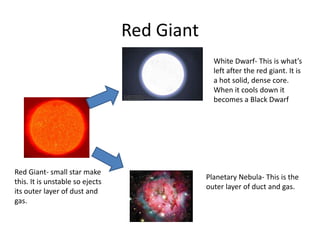
Red Giant
Red Giant- small star make
this. It is unstable so ejects
its outer layer of dust and
gas.
White Dwarf- This is what’s
left after the red giant. It is
a hot solid, dense core.
When it cools down it
becomes a Black Dwarf
Planetary Nebula- This is the
outer layer of duct and gas.
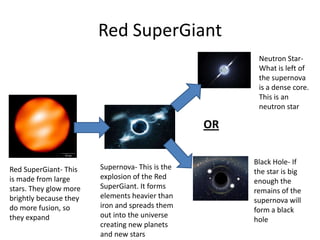
Red SuperGiant
Red SuperGiant- This
is made from large
stars. They glow more
brightly because they
do more fusion, so
they expand
Supernova- This is the
explosion of the Red
SuperGiant. It forms
elements heavier than
iron and spreads them
out into the universe
creating new planets
and new stars
Neutron Star-
What is left of
the supernova
is a dense core.
This is an
neutron star
OR
Black Hole- If
the star is big
enough the
remains of the
supernova will
form a black
hole

Physics Unit P2

  • 1.
  • 2.
    Distance Distance-Time Graphs • Gradient= Speed • Flat sections are stationary • Straight = steady speed • Curves= acceleration or deceleration
  • 3.
    Velocity and Acceleration Accelerationis how quickly velocity is changing Acceleration=Change in Velocity/Time Taken Velocity-Time Graphs • Gradient = Acceleration • Flat sections = steady speed • Area under the graph represents distance • Curve is change in acceleration
  • 4.
    Weight • MASS isthe “stuff” inside, whereas WEIGHT is the force due to gravity • Weight = Mass x Gravitational Field Strength • Earths GFS is 10N/Kg
  • 5.
    Resultant Forces • Itis the overall FORCE • The overall effect of forces which will decide the motion of an object • If two forces are acting in the same direction, the resultant force is the sum of those two • If two forces are acting along the same line, then the resultant force is found by subtracting them
  • 6.
    Driving force =1000N Pushing Force =600N ResultantForce =1600N Driving force =1000N Friction =600N Resultant Force =400N
  • 7.
    Acceleration • If theresultant force in 0 the object is stationary • It there is no resultant force on a moving object, then it will carry on moving with constant velocity • If there is an resultant force, then the object will accelerate in the direction of the force • That is until the force equal out again
  • 8.
    • Force =Mass x Acceleration Or Acceleration = Force / Mass • When two object interact, the forces they put (exert) upon each other are equal and opposite • This is called a reaction force, so if you push against something it will push back against you with equal force
  • 9.
    Friction • It actsagainst movement • If you travel at a steady speed, the driving force needs to equal the frictional force • Streamlining reduces drag or air resistance • Drag increases as speed increases, as you accelerate you hit more air particles with more force. This created more drag
  • 10.
    Terminal Velocity • Whenan object first falls, gravity (weight) has more force than frictional forces • This causes the object to accelerate downwards • As the speed increases, so does the drag • This reduces the acceleration • Weight can not get any bigger, so you reach terminal velocity (fall at a steady speed)
  • 11.
    Stopping Distance Thinking Distance •Faster you are going = Further you will go • Your Reactions- Tiredness, drugs, alcohol, bad visibility and distractions Braking Distance • Faster you are going = Further you will go • The Car- the condition of Tyres and condition of Brakes • The Road- road surface and weather condition
  • 12.
    30 mph 50 mph 70mph 9m 15m 21m 14m 38m 75m So this shows that thinking distance is directionally proportional but braking distance is squarely proportional Thinking Braking Distance Distance Stopping Dis. = Thinking Dis. + Braking Dis.
  • 13.
    Work Done • Tomove an object energy has to be transferred • The energy can be used usefully i.e. To move something or wastefully i.e. Friction • Work Done= Force x Distance Moved
  • 14.
    Gravitational Potential Energy •When an object is lifted vertically work is done against the force of gravity. This is transferred into gravitational potential energy (GPE) • GPE= Mass x Height x GFS (gravitational field strength) • The Earth has a GFS of 10N/Kg
  • 15.
    Kinetic Energy • Anything that moves has kinetic energy • Kinetic Energy = ½ Mass x Speed² • Moving car has lots of KE so to slow it down energy is lost i.e. Heat energy • Work done = KE F x d = ½ mv² • Falling objects have the potential energy lost and they gain kinetic energy
  • 16.
    Elasticity • Apply aforce = Stretch the Object • Work done is stored as ELASTIC POTENTIAL ENERGY • Then its goes back to its original shape releasing the energy as KINETIC ENERGY
  • 17.
    • Extension ofSpring is DIRECTIONALLY PROPORTIONAL to the force applied • Force = K (spring constant) x energy • There is a limit to a springs elasticity, it is normal until it reaches its maximum force • Past this point the spring will not return to its original shape
  • 18.
    Power • It isthe rate of doing work • Power = Work Done / Time Taken • Measured in Watts, which means 1 Watt is 1 joule of energy transferred every second
  • 19.
    Momentum • It’s aproperty of a moving object • Momentum = Mass x Velocity • Also P before = P after • Momentum is a vector, so has direction • When a force acts upon an object it changes its momentum • The bigger the force the faster the change of momentum
  • 20.
    Car Safety • Brakestransform the kinetic energy of the car into thermal energy on the road • Regenerative brakes don’t transform into heat the transform into electrical energy • Big change in Momentum in a short time = MASSIVE
  • 21.
  • 22.
    Static Electricity • Itis created when two object rub against each other and either lose or gain electrons • Like charges repel, so if hair had been charged then the hair would separate because their like charges repel each other • However these charges can be easily lost through a conductor
  • 23.
    Current and Voltage •Current is the rate of flow of charge • Current= Charge / Time • The Potential Difference is the work done per coulomb of charge • Voltage = Work Done / Charge
  • 24.
  • 25.
    Resistance Current through a resistor(at constant temp.) is directionally proportional to Voltage The higher the resistance the higher the potential difference However in a normal filament lamp the temperature of the filament increases this causes the curve This is a Diode. The current will only flow in one direction. The diode has a very high resistance in the opposite direction
  • 26.
    Series • All ornothing, if one component breaks ao does the circuit • Potential difference is shared out, so in 23 fairy-lights on the mains electricity they all have a voltage of 10V • Current is the same everywhere • And the Resistance builds/adds up, 5 bulbs with 10Ω so the circuit has 50Ω
  • 27.
    Parallel • Things canbe switched off separately • Voltage is the same across all components • However current is shared between each branch. The current going in is the same as going out, but the components have different currents going across them
  • 28.
    Mains Electricity • Suppliedin AC • Has 230V • And has frequency of 50Hz • It can be shown on an oscilloscope
  • 29.
    Electricity in theHome Hazards: Long Cables; Frayed cables; damaged plugs; too many plugs in 1 socket; water near sockets The wires: Live wire carries the alternating current; Neutral has 0V and Earth is attached to metal casing
  • 30.
  • 31.
    Fuses and Earthing •Fault in the LIVE WIRE causes it to touch the metal case • This causes a larger current to flow through the circuit • This surge cause the FUSE to MELT • This cuts of the live supply and breaks the circuit, THUS saving the appliance and the user
  • 32.
    Live wire touches themetal casing Big Surge of Electricity to earth Fault in the Live Wire The Fuse melts/blows The appliance is SAFE
  • 33.
    Energy and Power •All resistors produce heat when a current flows through them. The more current the more heat • To be energy efficient they have to transfer more of their total electrical energy to a useful source • Energy Transferred= Power Rating x Time
  • 34.
    Atomic Structure- Rutherford •In 1909 Rutherford fired alpha particles at gold foil to discover more about particles • He found most went straight through, this shows particles are mostly empty space • Some came straight back, the shows that most of the mass is concentration in a central nucleus • Some were deflected, this shows the nucleus is positive and there must be negative electrons not in the nucleus
  • 35.
    Radiation • Isotopes areatoms of the same element but are slightly different, they have the same number of protons but different numbers of neutrons • Radioactivity is entirely random, it comes from an unstable and decaying nuclei. This emits alpha, beta or gamma radiation • Background radiation comes from: naturally unstable isotopes like rocks and food; space like cosmic rays; Man-made places like weapons and medicine and power-stations
  • 36.
    Types of Radiation Alpharadiation is a helium nucleus, so two protons and two neutrons. Can’t penetrate much but because of its size it’s strongly ionising (bash into atoms and knock electrons off of them) Beta radiation is an electron which is emitted when a neutron turns into a proton. Can go through some things and is mildly ionising Gamma radiation is an ray. This penetrates everything but is weakly ionising.
  • 37.
    Radiation Safety • Radiationdamage depend on the type of radiation and how long you were exposed • Alpha particles are deflected slightly by magnetic field but beta particles are extremely deflected by the magnetic field • Granite release radon gas which can be trapped in peoples houses • Nuclear industry workers wear protective clothing and face masks and have radiation badges • Radiographers work behind lead screens and wear lead aprons
  • 38.
    Half-Life • Half lifeis the AVERAGE TIME it takes for the NUMBER OF NUCLEI in a radioactive isotope to HALVE • Radioactivity never stops, there will always be some activity, so its hard to measure • Short half life means lots of nuclei decay quickly, activity falls quickly
  • 39.
    -1 Half Life--1 Half Life- -1 Half Life-
  • 40.
    Uses of Radiation •Smoke detectors- alpha particles make and circuit and smoke breaks the circuit, making the alarm go off • Sterilisation- Gamma rays are used to kill bacteria on food or medical equipment, without harming them • Radiotherapy- gamma is fired at a cancer to kill all of those cells, but damage is done • Tracers- beta or gamma sources are put into someone and an external detector says where most of the radiation is
  • 41.
    Damage of Radioactivity •Large amounts of radiation kill cells and leave you with radiation sickness, but nothing else • Small amounts cause minor damage to cells without killing them. They then mutant and divide uncontrollably, this is a cancer • Alpha is very harmful inside the body because it damages a very localised area • Beta and gamma are dangerous outside the body because they can penetrate the skin
  • 42.
    Nuclear Fission • Thisis what happens in nuclear power stations and nuclear bombs • An Neutron had to be absorbed by an unstable nuclei • This creates two new smaller nuclei and releases more neutron, this makes a chain reaction • This gives out a lot of energy
  • 43.
    Nuclear Fusion • Thisis where two small nuclei join to create a larger nucleus and energy • Fusion doesn’t leave a lot of radioactive waste and there is a bounty of fuel (hydrogen) • It can only happen at really high temperatures • You need at strong magnetic force to hold the pressure and heat 2 1 H H 1 1 +  3 2 He + ENERGY
  • 44.
    Life Cycle ofStars Nebula- The nursery for Stars. Clouds of Dust and gas start to form. Gravity makes it spiral and form a Protostar Protostar- Gravity is turned into heat. The temp is then high enough for nucleur fusion to start. This gives out light, star Main Sequence star- long stable period where outward pressure is equal to the force of gravity (the sun) but this can’t last forever Red Giant- hydrogen has run out and it was a small star Red SuperGiant- Hydrogen has run out but it was a big star OR
  • 45.
    Red Giant Red Giant-small star make this. It is unstable so ejects its outer layer of dust and gas. White Dwarf- This is what’s left after the red giant. It is a hot solid, dense core. When it cools down it becomes a Black Dwarf Planetary Nebula- This is the outer layer of duct and gas.
  • 46.
    Red SuperGiant Red SuperGiant-This is made from large stars. They glow more brightly because they do more fusion, so they expand Supernova- This is the explosion of the Red SuperGiant. It forms elements heavier than iron and spreads them out into the universe creating new planets and new stars Neutron Star- What is left of the supernova is a dense core. This is an neutron star OR Black Hole- If the star is big enough the remains of the supernova will form a black hole