• PROCESSED WOOD AND 2 TYPES
• PLY
• BLOCK BOARD
• PARTICAL BOARD
• MDF BOARD
• HDF/LDF BOARD
• SURFACE TREATMENT OF WOODS AND TYPES
• LAMINATE
• PRELAMINATION
• OHT/ PAPER VENEERS
WOOD AS INTERIOR MATERIAL, USAGE,
ADVANTAGES OF EACH TYPE, USES, PROS, CORNS
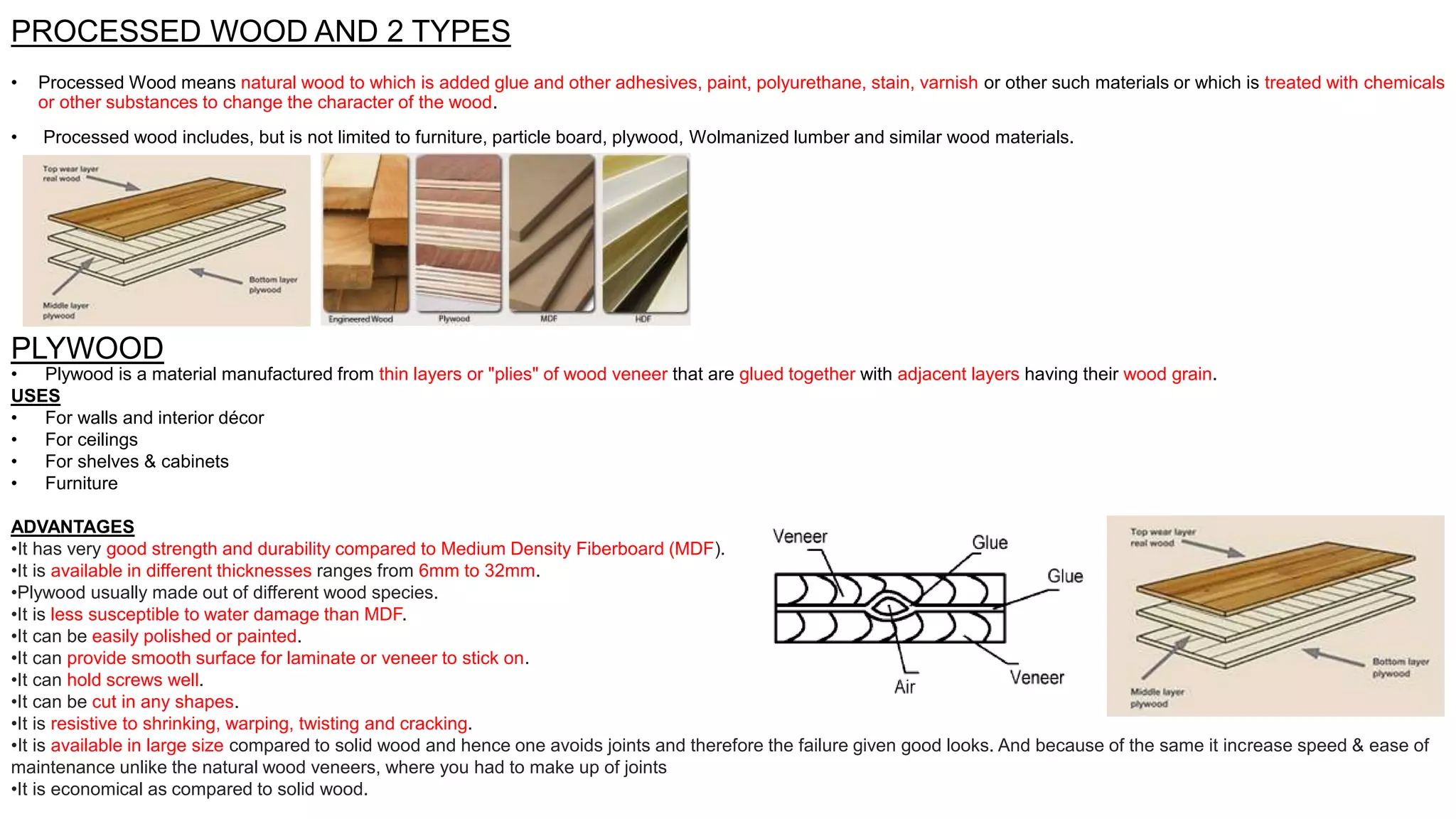
PROCESSED WOOD AND 2 TYPES
• Processed Wood means natural wood to which is added glue and other adhesives, paint, polyurethane, stain, varnish or other such materials or which is treated with chemicals
or other substances to change the character of the wood.
• Processed wood includes, but is not limited to furniture, particle board, plywood, Wolmanized lumber and similar wood materials.
PLYWOOD
• Plywood is a material manufactured from thin layers or "plies" of wood veneer that are glued together with adjacent layers having their wood grain.
USES
• For walls and interior décor
• For ceilings
• For shelves & cabinets
• Furniture
ADVANTAGES
•It has very good strength and durability compared to Medium Density Fiberboard (MDF).
•It is available in different thicknesses ranges from 6mm to 32mm.
•Plywood usually made out of different wood species.
•It is less susceptible to water damage than MDF.
•It can be easily polished or painted.
•It can provide smooth surface for laminate or veneer to stick on.
•It can hold screws well.
•It can be cut in any shapes.
•It is resistive to shrinking, warping, twisting and cracking.
•It is available in large size compared to solid wood and hence one avoids joints and therefore the failure given good looks. And because of the same it increase speed & ease of
maintenance unlike the natural wood veneers, where you had to make up of joints
•It is economical as compared to solid wood.
DISADVANTAGES
• It is more expensive than Medium Density Fiberboard (MDF).
• Because the layers of veneers are seen at the edges, edges have to be finished either with laminate or veneer.
• It often get splinter from the edges during transportation.
• It is quite difficult to cut.
• It is known to emit toxic VOC’s (Volatile Organic Compound) as it can irritates in eye.
• Water may damage Moisture Resistant (MR) grade plywood.
• For common people, it is difficult to judge which wood veneer has been used for making the plywood.
• It is costlier as compared to blockboard or particleboard.
• The most of the commercial grade plywood needs to be covered by laminates. Sunmica, so as to enhance its beauty and to increase its life. It is prone to termite effect and
may get damaged once affected.
BRANDS IN INDIA
• Globe Panel Industries
• Ply News
• Century Ply
• National Plywood Industries
• Green Ply
• Kitply Plywood
• Kridha Plywood & Laminates
• Northern Ply
• Sharen Ply
• Merino Laminates
BLOCK BOARD
Blockboard consists of a core made of wooden strips or blocks, placed edge to edge between two layers of plywood, which are then glued together under high pressure.
USES
•For making tables, benches, and wall furniture
•Used for blockboard doors and solid core flush doors
•For creating single and double beds and settees
•For making beautiful wall panels and partitions
•For woodwork in railway carriages
•For interior and exterior decoration
•It is also used in making study shelves, window shelves, etc
ADVANTAGES
1.lighter in weight
2.Block boards cost less
3.Because the interior is solid wood strip, it is convenient for on-site
construction.
4.Block boards have more strength and durability & moisture resistance.
5.Compare with MDF and particle board, block board use less glue,
6.Block board has a strong vertical bearing capacity.
DISADVANTAGES
1.Block boards are not as strong as plywood or good quality solid wood, Block boards are lighter
in weight as it is made by using softwood strips.
2.Screwing and nailing must be done carefully. If small gaps are left inside the core, then block
boards may be difficult to handle.
3.If nails are punched in the gap, there is basically no nail holding force. This may affect the
strength and durability of the furniture.
4.Block board has poor load-bearing bending strength. The solid wood strip inside the block
board is longitudinally spliced, so the vertical bending resistance is poor, and the long-term force
will cause obvious lateral deformation of the board.
5.Block board should not be used directly in a humid kitchen environment.
AVAILABLE SIZES
AVAILABLE THICKNESS
PARTICLE BOARD
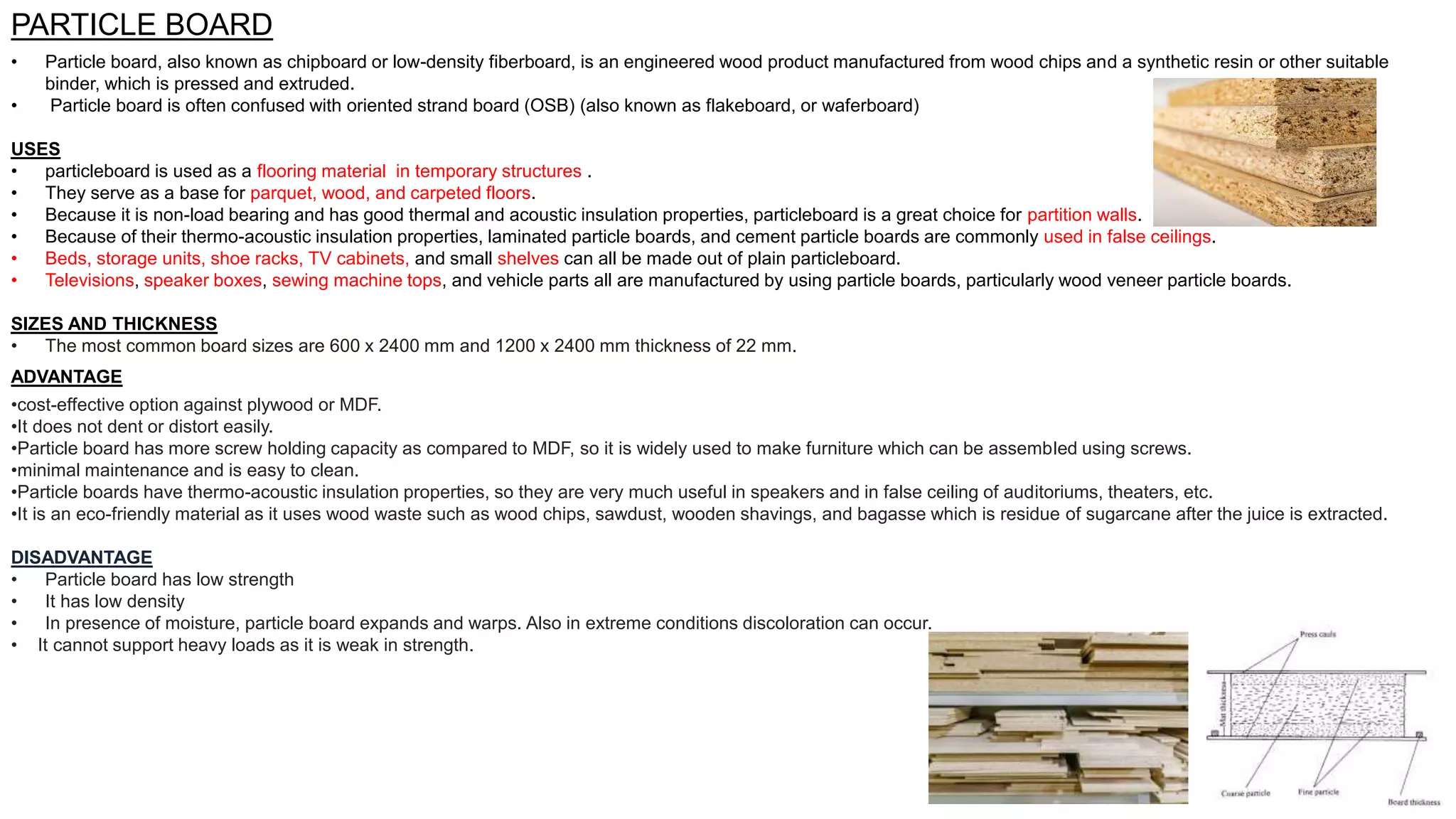
• Particle board, also known as chipboard or low-density fiberboard, is an engineered wood product manufactured from wood chips and a synthetic resin or other suitable
binder, which is pressed and extruded.
• Particle board is often confused with oriented strand board (OSB) (also known as flakeboard, or waferboard)
USES
• particleboard is used as a flooring material in temporary structures .
• They serve as a base for parquet, wood, and carpeted floors.
• Because it is non-load bearing and has good thermal and acoustic insulation properties, particleboard is a great choice for partition walls.
• Because of their thermo-acoustic insulation properties, laminated particle boards, and cement particle boards are commonly used in false ceilings.
• Beds, storage units, shoe racks, TV cabinets, and small shelves can all be made out of plain particleboard.
• Televisions, speaker boxes, sewing machine tops, and vehicle parts all are manufactured by using particle boards, particularly wood veneer particle boards.
SIZES AND THICKNESS
• The most common board sizes are 600 x 2400 mm and 1200 x 2400 mm thickness of 22 mm.
ADVANTAGE
•cost-effective option against plywood or MDF.
•It does not dent or distort easily.
•Particle board has more screw holding capacity as compared to MDF, so it is widely used to make furniture which can be assembled using screws.
•minimal maintenance and is easy to clean.
•Particle boards have thermo-acoustic insulation properties, so they are very much useful in speakers and in false ceiling of auditoriums, theaters, etc.
•It is an eco-friendly material as it uses wood waste such as wood chips, sawdust, wooden shavings, and bagasse which is residue of sugarcane after the juice is extracted.
DISADVANTAGE
• Particle board has low strength
• It has low density
• In presence of moisture, particle board expands and warps. Also in extreme conditions discoloration can occur.
• It cannot support heavy loads as it is weak in strength.
MDF BOARDS
• MDF (Medium Density Fibreboard) is an engineered material made by breaking down hardwood or softwood residuals into
fine particles, combining it with wax and a resin binder and applying high temperature and pressure
ADVANTAGES
• MDF is generally cheaper than plywood.
• The surface of MDF is very smooth which makes it a great surface for painting.
• MDF is very consistent throughout, so cut edges appear smooth and won’t have voids or splinters.
• Because of the smooth edges, you can use a router to create decorative edges.
• The consistency and smoothness of MDF allow for easy cutting of detailed designs (such as scrolled or scalloped designs)
using a scroll saw, band saw or jigsaw.
DISADVANTAGES
• MDF will soak up water and other liquids like a sponge and swell unless it’s very well sealed on all sides and edges.
• Because it consists of such fine particles, MDF doesn’t hold screws very well.
• Because it’s so dense, MDF is very heavy which can make it more difficult to work with.
• MDF can’t be stained. Not only does it soak up stain like a sponge but because there’s no wood grain on MDF, it looks awful
when it’s stained.
USES
• manufacturing of furniture,
• kitchen cabinets,
• moldings,
• millwork,
• door parts,
• laminate flooring.
STANDARD PANEL SIZES: 2400 x 1200 x 3mm, 4.75mm, 6mm, 9mm,
12mm, 16mm, 18mm, 25mm, 32mm.
HDF & LDF BOARDS
• HDF (High Density Fibreboard/Hardboard), sometimes referred to as HDF wood, is like MDF in that it is a man-made composite panel product that is manufactured from
compressed wood fibres.
• It is a stronger, harder product than MDF with a typical density of up to 900kg/m3.
ADVANTAGES DISADVANTAGES
• Hardboard is durable & impact resistant Hardboard itself is not waterproof
• Moisture resistant No natural wood grain aesthetic
• Relatively low cost compared to plywood Not as strong as plywood
THICKNESS
• Typical thickness of 3mm-8mm
SURFACE TREATMENT OF WOODS AND TYPES
• Wood surfaces are pre-treated and coated for decorative purposes or to increase durability.
• When formulating primers, glazes and varnishes, knowledge of the surface chemical properties of these materials and of the different types of wood is very helpful.
Surface treatment
Max. dimensions of parts
(mm)
Hard anodizing 1850 x 850 x 550
Hard black anodizing 1850 x 850 x 550
Natural anodizing 1850 x 850 x 550
Natural black anodizing 1850 x 850 x 550
Anodizing in chromic
acid
1850 x 850 x 550
LAMINATE
• Laminate sheets can be used to enhance the appeal of all types of surfaces, including walls and furniture.
• They not only offer a great way to beautify your spaces, but also provide strength and protection to your property's elements.
USES
• On furniture
• Shelves
• Modular cabinets
• Wall highlights
ADVANTAGES
01.It is easy to clean.
02. It is easier to install than many traditional surfaces.
03. It is more economical and requires less skill to install.
04. It is available in numerous designs, patterns, colors and textures and hence it is pleasing.
05. It is very durable, hygienic and relatively easy to maintain.
06. No polishing painting is required.
07. It is the best choice for heavy use environments.
08. It can be installed over almost any existing floor.
09. It is moisture resistant. Also, it is an impact, shock and pressure resistant.
10. Sweeping or vacuuming is typical, all it takes to get laminate clean.
11. It is highly resistant to scratch and abrasion.
12. Availability of huge range leads to least wastage.
TYPES
• Matte-finish laminate
• Textured laminate
• Gloss-finish laminate
• Metallic laminate
• PVC-finish laminate
• Acrylic-finish laminate
• Exterior laminate
The laminates are available in thickness 0.8 mm, 1.0
mm and 1.5 mm in standard sizes 1.2 m x 2.5 m
DISADVANTAGE
01. While it can follow the look of a veneer, laminate flooring does not come close to the feel of those textures of a veneer. No matter how high in quality, it cannot simulate the feel
of real wood under your feet.
02. Once the top layer has been worn through, the whole floor must be replaced.
04. It is difficult to be recycled.
05. It is a brittle material hence is prone to clipping.
06. Laminate flooring has been very slippery, and affecting your safety.
PRELAMINATION
• Prelaminated board is board laminated on both surfaces by synthetic resin impregnated base papers under the influence of heat and pressure; or with finished foils under the
influence of pressure or pressure and heat depending upon the type of binder used.
USES
• Partitions
• Modular Furniture
• Kitchen Cupboards
• TV Cabinets
• Wardrobes
• Shutters
• Handicrafts
THICKNESS
The thickness of prelaminated particle boards shall be 9mm, 11mm, 12mm, 17mm, 18mm, & 25mm
SIZES
9 x 6, 9 x 3, 8 x 6, 8 x 4, 8 x 3, 6 x 4, 6 x 3 (Feet’s)
OHT/ PAPER VENEERS
• A veneer is actually a "paper thin" cut of wood that's applied to both sides of a strong core surface, like furniture-grade MDF or substrate material, to seal and stabilize it.
USES
• hotels, office lobbies, reception areas, board rooms, and elevators where wall paneling
• Casework
• floors, walls, ceilings, furniture, casework, and more to project a sense of opulence and fine craftsmanship.
ADVANTAGES
• Natural Appeal at a Lower Cost. Wood veneers provide aesthetics just like hardwood, albeit at a much lower cost. ...
• Flexibility in Designs. Each wood veneer sheet is unique as each tree is unique.
• Increased Strength and Durability. ...
• Eco-Friendly. ...
• Low Wood Consumption.

WOOD AS A INTERIOR MATERIAL.pptx

  • 2.
    • PROCESSED WOODAND 2 TYPES • PLY • BLOCK BOARD • PARTICAL BOARD • MDF BOARD • HDF/LDF BOARD • SURFACE TREATMENT OF WOODS AND TYPES • LAMINATE • PRELAMINATION • OHT/ PAPER VENEERS WOOD AS INTERIOR MATERIAL, USAGE, ADVANTAGES OF EACH TYPE, USES, PROS, CORNS
  • 3.
    PROCESSED WOOD AND2 TYPES • Processed Wood means natural wood to which is added glue and other adhesives, paint, polyurethane, stain, varnish or other such materials or which is treated with chemicals or other substances to change the character of the wood. • Processed wood includes, but is not limited to furniture, particle board, plywood, Wolmanized lumber and similar wood materials. PLYWOOD • Plywood is a material manufactured from thin layers or "plies" of wood veneer that are glued together with adjacent layers having their wood grain. USES • For walls and interior décor • For ceilings • For shelves & cabinets • Furniture ADVANTAGES •It has very good strength and durability compared to Medium Density Fiberboard (MDF). •It is available in different thicknesses ranges from 6mm to 32mm. •Plywood usually made out of different wood species. •It is less susceptible to water damage than MDF. •It can be easily polished or painted. •It can provide smooth surface for laminate or veneer to stick on. •It can hold screws well. •It can be cut in any shapes. •It is resistive to shrinking, warping, twisting and cracking. •It is available in large size compared to solid wood and hence one avoids joints and therefore the failure given good looks. And because of the same it increase speed & ease of maintenance unlike the natural wood veneers, where you had to make up of joints •It is economical as compared to solid wood.
  • 4.
    DISADVANTAGES • It ismore expensive than Medium Density Fiberboard (MDF). • Because the layers of veneers are seen at the edges, edges have to be finished either with laminate or veneer. • It often get splinter from the edges during transportation. • It is quite difficult to cut. • It is known to emit toxic VOC’s (Volatile Organic Compound) as it can irritates in eye. • Water may damage Moisture Resistant (MR) grade plywood. • For common people, it is difficult to judge which wood veneer has been used for making the plywood. • It is costlier as compared to blockboard or particleboard. • The most of the commercial grade plywood needs to be covered by laminates. Sunmica, so as to enhance its beauty and to increase its life. It is prone to termite effect and may get damaged once affected. BRANDS IN INDIA • Globe Panel Industries • Ply News • Century Ply • National Plywood Industries • Green Ply • Kitply Plywood • Kridha Plywood & Laminates • Northern Ply • Sharen Ply • Merino Laminates BLOCK BOARD Blockboard consists of a core made of wooden strips or blocks, placed edge to edge between two layers of plywood, which are then glued together under high pressure. USES •For making tables, benches, and wall furniture •Used for blockboard doors and solid core flush doors •For creating single and double beds and settees •For making beautiful wall panels and partitions •For woodwork in railway carriages •For interior and exterior decoration •It is also used in making study shelves, window shelves, etc
  • 5.
    ADVANTAGES 1.lighter in weight 2.Blockboards cost less 3.Because the interior is solid wood strip, it is convenient for on-site construction. 4.Block boards have more strength and durability & moisture resistance. 5.Compare with MDF and particle board, block board use less glue, 6.Block board has a strong vertical bearing capacity. DISADVANTAGES 1.Block boards are not as strong as plywood or good quality solid wood, Block boards are lighter in weight as it is made by using softwood strips. 2.Screwing and nailing must be done carefully. If small gaps are left inside the core, then block boards may be difficult to handle. 3.If nails are punched in the gap, there is basically no nail holding force. This may affect the strength and durability of the furniture. 4.Block board has poor load-bearing bending strength. The solid wood strip inside the block board is longitudinally spliced, so the vertical bending resistance is poor, and the long-term force will cause obvious lateral deformation of the board. 5.Block board should not be used directly in a humid kitchen environment. AVAILABLE SIZES AVAILABLE THICKNESS
  • 6.
    PARTICLE BOARD • Particleboard, also known as chipboard or low-density fiberboard, is an engineered wood product manufactured from wood chips and a synthetic resin or other suitable binder, which is pressed and extruded. • Particle board is often confused with oriented strand board (OSB) (also known as flakeboard, or waferboard) USES • particleboard is used as a flooring material in temporary structures . • They serve as a base for parquet, wood, and carpeted floors. • Because it is non-load bearing and has good thermal and acoustic insulation properties, particleboard is a great choice for partition walls. • Because of their thermo-acoustic insulation properties, laminated particle boards, and cement particle boards are commonly used in false ceilings. • Beds, storage units, shoe racks, TV cabinets, and small shelves can all be made out of plain particleboard. • Televisions, speaker boxes, sewing machine tops, and vehicle parts all are manufactured by using particle boards, particularly wood veneer particle boards. SIZES AND THICKNESS • The most common board sizes are 600 x 2400 mm and 1200 x 2400 mm thickness of 22 mm. ADVANTAGE •cost-effective option against plywood or MDF. •It does not dent or distort easily. •Particle board has more screw holding capacity as compared to MDF, so it is widely used to make furniture which can be assembled using screws. •minimal maintenance and is easy to clean. •Particle boards have thermo-acoustic insulation properties, so they are very much useful in speakers and in false ceiling of auditoriums, theaters, etc. •It is an eco-friendly material as it uses wood waste such as wood chips, sawdust, wooden shavings, and bagasse which is residue of sugarcane after the juice is extracted. DISADVANTAGE • Particle board has low strength • It has low density • In presence of moisture, particle board expands and warps. Also in extreme conditions discoloration can occur. • It cannot support heavy loads as it is weak in strength.
  • 7.
    MDF BOARDS • MDF(Medium Density Fibreboard) is an engineered material made by breaking down hardwood or softwood residuals into fine particles, combining it with wax and a resin binder and applying high temperature and pressure ADVANTAGES • MDF is generally cheaper than plywood. • The surface of MDF is very smooth which makes it a great surface for painting. • MDF is very consistent throughout, so cut edges appear smooth and won’t have voids or splinters. • Because of the smooth edges, you can use a router to create decorative edges. • The consistency and smoothness of MDF allow for easy cutting of detailed designs (such as scrolled or scalloped designs) using a scroll saw, band saw or jigsaw. DISADVANTAGES • MDF will soak up water and other liquids like a sponge and swell unless it’s very well sealed on all sides and edges. • Because it consists of such fine particles, MDF doesn’t hold screws very well. • Because it’s so dense, MDF is very heavy which can make it more difficult to work with. • MDF can’t be stained. Not only does it soak up stain like a sponge but because there’s no wood grain on MDF, it looks awful when it’s stained. USES • manufacturing of furniture, • kitchen cabinets, • moldings, • millwork, • door parts, • laminate flooring. STANDARD PANEL SIZES: 2400 x 1200 x 3mm, 4.75mm, 6mm, 9mm, 12mm, 16mm, 18mm, 25mm, 32mm. HDF & LDF BOARDS • HDF (High Density Fibreboard/Hardboard), sometimes referred to as HDF wood, is like MDF in that it is a man-made composite panel product that is manufactured from compressed wood fibres. • It is a stronger, harder product than MDF with a typical density of up to 900kg/m3.
  • 8.
    ADVANTAGES DISADVANTAGES • Hardboardis durable & impact resistant Hardboard itself is not waterproof • Moisture resistant No natural wood grain aesthetic • Relatively low cost compared to plywood Not as strong as plywood THICKNESS • Typical thickness of 3mm-8mm SURFACE TREATMENT OF WOODS AND TYPES • Wood surfaces are pre-treated and coated for decorative purposes or to increase durability. • When formulating primers, glazes and varnishes, knowledge of the surface chemical properties of these materials and of the different types of wood is very helpful. Surface treatment Max. dimensions of parts (mm) Hard anodizing 1850 x 850 x 550 Hard black anodizing 1850 x 850 x 550 Natural anodizing 1850 x 850 x 550 Natural black anodizing 1850 x 850 x 550 Anodizing in chromic acid 1850 x 850 x 550
  • 9.
    LAMINATE • Laminate sheetscan be used to enhance the appeal of all types of surfaces, including walls and furniture. • They not only offer a great way to beautify your spaces, but also provide strength and protection to your property's elements. USES • On furniture • Shelves • Modular cabinets • Wall highlights ADVANTAGES 01.It is easy to clean. 02. It is easier to install than many traditional surfaces. 03. It is more economical and requires less skill to install. 04. It is available in numerous designs, patterns, colors and textures and hence it is pleasing. 05. It is very durable, hygienic and relatively easy to maintain. 06. No polishing painting is required. 07. It is the best choice for heavy use environments. 08. It can be installed over almost any existing floor. 09. It is moisture resistant. Also, it is an impact, shock and pressure resistant. 10. Sweeping or vacuuming is typical, all it takes to get laminate clean. 11. It is highly resistant to scratch and abrasion. 12. Availability of huge range leads to least wastage. TYPES • Matte-finish laminate • Textured laminate • Gloss-finish laminate • Metallic laminate • PVC-finish laminate • Acrylic-finish laminate • Exterior laminate The laminates are available in thickness 0.8 mm, 1.0 mm and 1.5 mm in standard sizes 1.2 m x 2.5 m DISADVANTAGE 01. While it can follow the look of a veneer, laminate flooring does not come close to the feel of those textures of a veneer. No matter how high in quality, it cannot simulate the feel of real wood under your feet. 02. Once the top layer has been worn through, the whole floor must be replaced. 04. It is difficult to be recycled. 05. It is a brittle material hence is prone to clipping. 06. Laminate flooring has been very slippery, and affecting your safety.
  • 10.
    PRELAMINATION • Prelaminated boardis board laminated on both surfaces by synthetic resin impregnated base papers under the influence of heat and pressure; or with finished foils under the influence of pressure or pressure and heat depending upon the type of binder used. USES • Partitions • Modular Furniture • Kitchen Cupboards • TV Cabinets • Wardrobes • Shutters • Handicrafts THICKNESS The thickness of prelaminated particle boards shall be 9mm, 11mm, 12mm, 17mm, 18mm, & 25mm SIZES 9 x 6, 9 x 3, 8 x 6, 8 x 4, 8 x 3, 6 x 4, 6 x 3 (Feet’s) OHT/ PAPER VENEERS • A veneer is actually a "paper thin" cut of wood that's applied to both sides of a strong core surface, like furniture-grade MDF or substrate material, to seal and stabilize it. USES • hotels, office lobbies, reception areas, board rooms, and elevators where wall paneling • Casework • floors, walls, ceilings, furniture, casework, and more to project a sense of opulence and fine craftsmanship. ADVANTAGES • Natural Appeal at a Lower Cost. Wood veneers provide aesthetics just like hardwood, albeit at a much lower cost. ... • Flexibility in Designs. Each wood veneer sheet is unique as each tree is unique. • Increased Strength and Durability. ... • Eco-Friendly. ... • Low Wood Consumption.