DONE BY-
A.BVN SUPRADIKA-19C11C4006
CH.JAGATH-19C11C4010
K.DSVNLT ANISHA-19C11C4018
K.LAVANYA PRIYA-19C11C4020
K.RAMESH-19C11C4023
MOHANANJALI.DONEPUDI-19C11C4026
U.LAKSHMI KOUSHIKA-19C11C4037
TOPICS
PLYWOOD
HIGH DENSITY BOARD[HDF]
MEDIUM DENSITY BOARD[MDF]
BLOCK BOARD
• PANELS COMPRISING OF AT LEAST THREE LAYERS OFTHIN WOOD
BONDED TOGETHER WITH AN ADHESIVE.
• EACH PLY IS UAUALLY ORIENTATED AT A RIGHT ANGLETO THE
ADJACENT LAYER IN ORDER TO IMPROVESTRENGTH AND REDUCE
THE PROBABILITY OFSHRINKAGE.
• PLYWOOD IS A MANUFACTURED WOOD EQUALLY PANELFROM
THIN SHEET OF WOOD VENEER. IT IS ONE OFTHE MOSTLY USED
WOOD PROUDUCTS.
INTRODUCTION
DEFINATION-
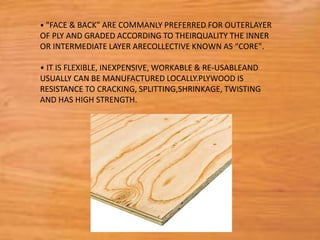
• "FACE & BACK" ARE COMMANLY PREFERRED FOR OUTERLAYER
OF PLY AND GRADED ACCORDING TO THEIRQUALITY THE INNER
OR INTERMEDIATE LAYER ARECOLLECTIVE KNOWN AS “CORE".
• IT IS FLEXIBLE, INEXPENSIVE, WORKABLE & RE-USABLEAND
USUALLY CAN BE MANUFACTURED LOCALLY.PLYWOOD IS
RESISTANCE TO CRACKING, SPLITTING,SHRINKAGE, TWISTING
AND HAS HIGH STRENGTH.
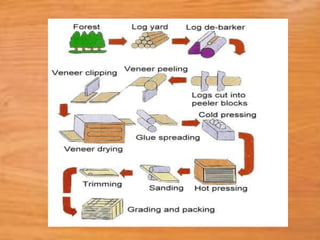
• FIRST LOG IS SELECTED.
• THEN FROM1“ THK WOOD 32 CHIPS ARE REMOVED.
• LAYERS ARE STACK.
• FIRSTLY FACE IS PLACED THAN CORE IS KEPT ON IT AND ON IT FALIIS
KEPT THEN AGAIN CORE AND FACE IS KEPT THIS THINGS AREGLUED
WITH THE HELP OF PHENOLIC RESIN AND UREA.
• THEY ARE PRESSED AT 1200 °C.
• WHITE PART IS MADE OF SILVER OAK AND DARK PART IS MADE
OFPOPLAR.IF ONLY POPLAR IS USED PLYWOOD GETS SPLIT BY USING
SILVEROAK IT HELP IT GET PROTECTED WHILE NAILING.
• GURJAN AND HOLLONG WOOD ARE USED IN MAKING PLYWOOD
PROCESS
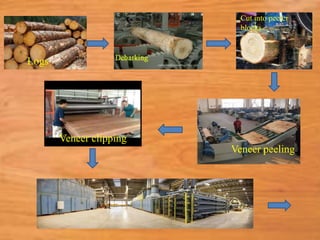
Logs
Veneer peeling
Veneer clipping
Cut into peeler
blocks
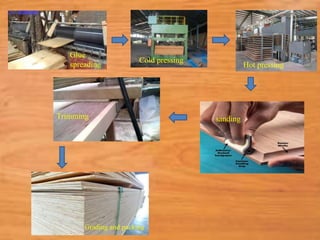
Glue
spreading
Cold pressing
Hot pressing
sandingTrimming
Grading and packing
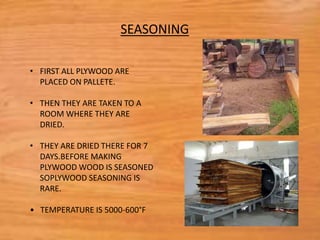
• FIRST ALL PLYWOOD ARE
PLACED ON PALLETE.
• THEN THEY ARE TAKEN TO A
ROOM WHERE THEY ARE
DRIED.
• THEY ARE DRIED THERE FOR 7
DAYS.BEFORE MAKING
PLYWOOD WOOD IS SEASONED
SOPLYWOOD SEASONING IS
RARE.
• TEMPERATURE IS 5000-600°F
SEASONING
• COMMERCIAL PLYWOOD
• WATERPROOF PLYWOOD
• FLEXO PLYWOOD
• MARINE PLYWOOD
• SOFTWOOD PLYWOOD
• HARDWOOD PLYWOOD
• TROPICAL PLYWOOD
• AIRCRAFT PLYWOOD
• DECORATIVE PLYWOOD
TYPES
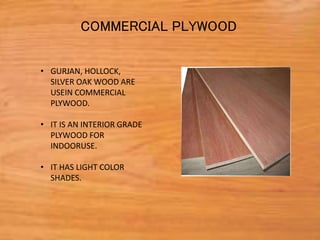
• GURJAN, HOLLOCK,
SILVER OAK WOOD ARE
USEIN COMMERCIAL
PLYWOOD.
• IT IS AN INTERIOR GRADE
PLYWOOD FOR
INDOORUSE.
• IT HAS LIGHT COLOR
SHADES.
COMMERCIAL PLYWOOD
• WATERPROOF PLYWOOD IS
MOSTLY USED IN MR
GRADE(MOISTURE
RESISTANT).
• IT REACTS WITH BOTH
ALUMINIUMAND MARINE
PLYWOOD.
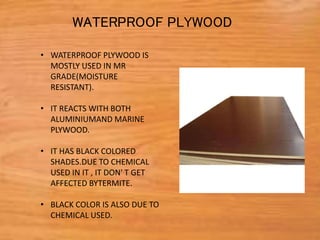
• IT HAS BLACK COLORED
SHADES.DUE TO CHEMICAL
USED IN IT , IT DON' T GET
AFFECTED BYTERMITE.
• BLACK COLOR IS ALSO DUE TO
CHEMICAL USED.
WATERPROOF PLYWOOD
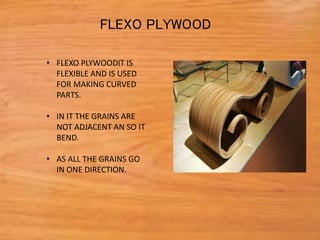
• FLEXO PLYWOODIT IS
FLEXIBLE AND IS USED
FOR MAKING CURVED
PARTS.
• IN IT THE GRAINS ARE
NOT ADJACENT AN SO IT
BEND.
• AS ALL THE GRAINS GO
IN ONE DIRECTION.
FLEXO PLYWOOD
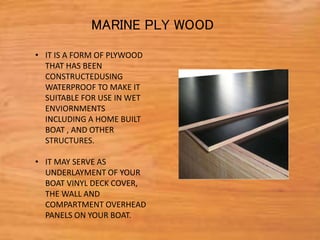
• IT IS A FORM OF PLYWOOD
THAT HAS BEEN
CONSTRUCTEDUSING
WATERPROOF TO MAKE IT
SUITABLE FOR USE IN WET
ENVIORNMENTS
INCLUDING A HOME BUILT
BOAT , AND OTHER
STRUCTURES.
• IT MAY SERVE AS
UNDERLAYMENT OF YOUR
BOAT VINYL DECK COVER,
THE WALL AND
COMPARTMENT OVERHEAD
PANELS ON YOUR BOAT.
MARINE PLY WOOD
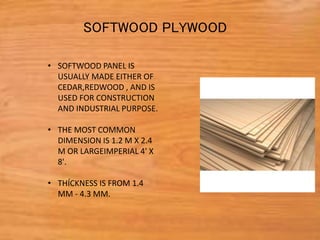
• SOFTWOOD PANEL IS
USUALLY MADE EITHER OF
CEDAR,REDWOOD , AND IS
USED FOR CONSTRUCTION
AND INDUSTRIAL PURPOSE.
• THE MOST COMMON
DIMENSION IS 1.2 M X 2.4
M OR LARGEIMPERIAL 4' X
8'.
• THÍCKNESS IS FROM 1.4
MM - 4.3 MM.
SOFTWOOD PLYWOOD
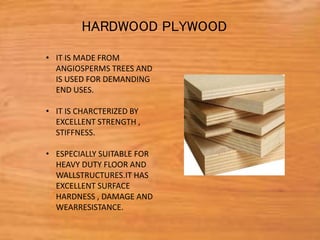
• IT IS MADE FROM
ANGIOSPERMS TREES AND
IS USED FOR DEMANDING
END USES.
• IT IS CHARCTERIZED BY
EXCELLENT STRENGTH ,
STIFFNESS.
• ESPECIALLY SUITABLE FOR
HEAVY DUTY FLOOR AND
WALLSTRUCTURES.IT HAS
EXCELLENT SURFACE
HARDNESS , DAMAGE AND
WEARRESISTANCE.
HARDWOOD PLYWOOD
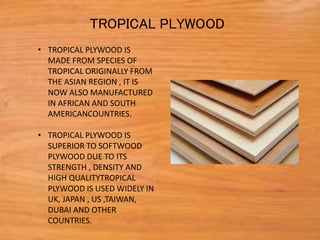
• TROPICAL PLYWOOD IS
MADE FROM SPECIES OF
TROPICAL ORIGINALLY FROM
THE ASIAN REGION , IT IS
NOW ALSO MANUFACTURED
IN AFRICAN AND SOUTH
AMERICANCOUNTRIES.
• TROPICAL PLYWOOD IS
SUPERIOR TO SOFTWOOD
PLYWOOD DUE TO ITS
STRENGTH , DENSITY AND
HIGH QUALITYTROPICAL
PLYWOOD IS USED WIDELY IN
UK, JAPAN , US ,TAIWAN,
DUBAI AND OTHER
COUNTRIES.
TROPICAL PLYWOOD
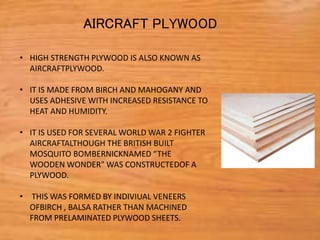
• HIGH STRENGTH PLYWOOD IS ALSO KNOWN AS
AIRCRAFTPLYWOOD.
• IT IS MADE FROM BIRCH AND MAHOGANY AND
USES ADHESIVE WITH INCREASED RESISTANCE TO
HEAT AND HUMIDITY.
• IT IS USED FOR SEVERAL WORLD WAR 2 FIGHTER
AIRCRAFTALTHOUGH THE BRITISH BUILT
MOSQUITO BOMBERNICKNAMED “THE
WOODEN WONDER" WAS CONSTRUCTEDOF A
PLYWOOD.
• THIS WAS FORMED BY INDIVIUAL VENEERS
OFBIRCH , BALSA RATHER THAN MACHINED
FROM PRELAMINATED PLYWOOD SHEETS.
AIRCRAFT PLYWOOD
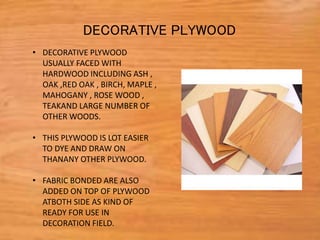
• DECORATIVE PLYWOOD
USUALLY FACED WITH
HARDWOOD INCLUDING ASH ,
OAK ,RED OAK , BIRCH, MAPLE ,
MAHOGANY , ROSE WOOD ,
TEAKAND LARGE NUMBER OF
OTHER WOODS.
• THIS PLYWOOD IS LOT EASIER
TO DYE AND DRAW ON
THANANY OTHER PLYWOOD.
• FABRIC BONDED ARE ALSO
ADDED ON TOP OF PLYWOOD
ATBOTH SIDE AS KIND OF
READY FOR USE IN
DECORATION FIELD.
DECORATIVE PLYWOOD
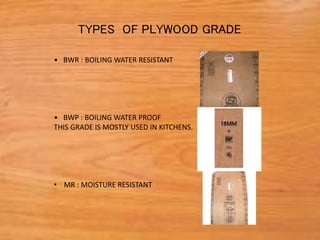
• BWR : BOILING WATER RESISTANT
• BWP : BOILING WATER PROOF
THIS GRADE IS MOSTLY USED IN KITCHENS.
• MR : MOISTURE RESISTANT
TYPES OF PLYWOOD GRADE
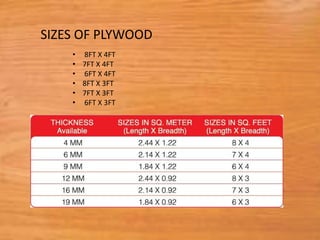
• 8FT X 4FT
• 7FT X 4FT
• 6FT X 4FT
• 8FT X 3FT
• 7FT X 3FT
• 6FT X 3FT
SIZES OF PLYWOOD
• It has very good strength and durability compared to Medium
Density Fiberboard (MDF).
• It is available in different thicknesses ranges from 6mm to
32mm.
• Plywood usually made out of different wood species.
• It is less susceptible to water damage than MDF.It can be easily
polished or painted.
• It can provide smooth surface for laminate or veneer to stick
on.It can hold screws well.
• It can be cut in any shapes.It is resistive to shrinking, warping,
twisting and cracking.
• It is available in large size compared to solid wood and hence
one avoids joints and therefore the failure given good looks. And
because of the same it increase speed & ease of maintenance
unlike the natural wood veneers, where you had to make up of
jointsIt is economical as compared to solid wood.
ADVANTAGES OF PLYWOOD-
• It is more expensive than Medium Density Fiberboard (MDF).
• Because the layers of veneers are seen at the edges, edges
have to be finished either with laminate or veneer.
• It often get splinter from the edges during transportation.It is
quite difficult to cut.
• It is known to emit toxic VOC’s (Volatile Organic Compound)
as it can irritates in eye.Water may damage Moisture
Resistant (MR) grade plywood.
• For common people, it is difficult to judge which wood
veneer has been used for making the plywood.It is costlier as
compared to blockboard or particleboard.T
• he most of the commercial grade plywood needs to be
covered by laminates. Sunmica, so as to enhance its beauty
and to increase its life. It is prone to termite effect and may
get damaged once affected.
DISADVANTAGES OF PLYWOOD-
• If anywhere firm, strong material is needed then it is
necessary.
• As high quality layered wood material it is used.
• Resistance to bend, split, break, crack, twist, warping made
it important for construction and furniture making.
• For outdoor uses. For space shipping, aviation since 1939.
• Low moisture plywood used for different purposes like
ship making.
• For making surfaces shaped curved, u, or folded plywood is
used as the grains of plywood is easy to make bend than
normal wood.
• To make the interior surface of skating ground this is used.
USES AND APPLICATIONS-
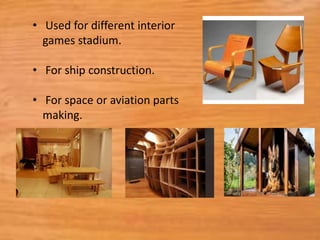
• Used for different interior
games stadium.
• For ship construction.
• For space or aviation parts
making.
INTRODUCTION
• Medium-density fiberboard (MDF) is a
composite wood product made of compressed
wood fibers, mixed with wax and resin.
• MDF is similar to particleboard and
hardboard, it is known for its strength, smooth
surface and edges and affordable pricing.
• MDF has many applications and various sizes and
comes with its share of advantages and
disadvantages , and is overall a very popular
choice for many woodworkers.
• Usually the panel will compressed to density of
0.5 to 0.8 specific gravity in a hot press.
• It varies in color from tan to chocolate brown.
• Common thick ness range from ¼ in. to 1 in., but
most home centers carry only ½ in. and ¾ in.
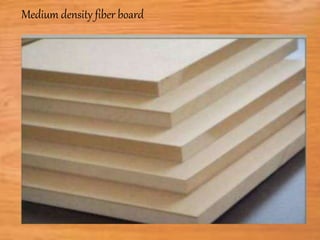
Medium density fiber board
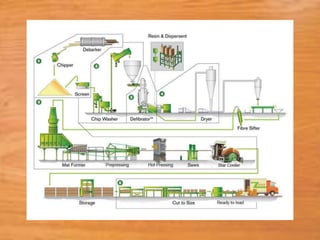
• IT BEGN WITH THE SELECTION AND REFINEMENT OF
RAWMATERIALS, MOST OF WHICH ARE RECYCLED
FROMSHAVINGS AND CHIPS RECLAIMED FROM SAW
MILLS ANDPLYWOOD PLANTS.
• FIRST ALL METAL IMPURITIES ARE REMOVED BY
MAGNET.THEN LARGE CHUNKS AND SMALL FLAKES
ARE SEPARATED .
• MATERIAL IS SENT THROUGH ELECTRIC DETECTOR
AGAIN,WITH REJECTED MATERIAL TO BE REUSED FOR
FUEL.
• GOOD MATERIAL IS COLLECTED AND SENT TO
PRESTEAMINGBIN.
• IN BIN, STEAM IS INJECTED AND MATERIAL IS
SOFTEN.
Process-
• FIBERS ARE THEN FED INTO SCREW FEEDER AND THEN
INTOPLUG SCREW FEEDER WHICH COMPRESSES IT AND
REMOVESMOISTURE.
• THE COMPRESSED MATERIAL IS FED INTO REFINER
WHICHTEARS THE MATERIAL INTO USUABLE FIBRES.
• RESIN IS ADDED BEFORE REFINING STEP TO
CONTROLFORMALDEHYDE TOLERANCE IN MIXTURE.
• FIBRES ARE THEN FED IN FLASH TUBE DRYER , WHICH
ISHEATED EITHER BY OIL OR GAS.
• NEXT, FIBER IS PUSHED INTO SCALP ROLLS TO MAKE MAT
OFUNIFORM THICKNESS.
• THIS MAT GOES THROUGH SEVERAL PRESSING STEPS
TOPRODCE MORE USABLE SIZE AND THEN IS TRIMMED
TODESIRED WIĐTH BEFORE FINAL PRESSING STEP.
• A CONTINUOUS PRESS EQIPPED WITH A LARGE
DRUMCOMPRESSES THE MAT AT A UNIFORM RATE BY
MONITORINGTHE MAT HEIGHT.
• TO ACHIEVE A SMOOTH FINISH THE PANELS ARE
SANDEDUSING BELTS COATED WITH ABRASIVES.
• EIGHTHEAD SANDING EQUIPMENT AND DOUBLE
SIDEDGRADING IMPROVES SURFACE SMOOTHNESS
CONSISTENCY.
• LASTLY FINISHING IS DONE.LACQUER COLORS CAN BE
APPLIED , AS WELL AS WOODGRAIN PATTERNS CAN BE
CREATED.MAT , GLOSSY , COATING ETC… CAN ALSO BE
DONE.
• GUILLOTINE CUTTING IS USED TO CUT FIBREBOARDS
INTOLARGE SHEETS.
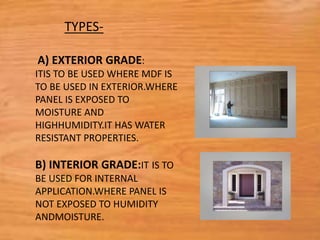
A) EXTERIOR GRADE:
ITIS TO BE USED WHERE MDF IS
TO BE USED IN EXTERIOR.WHERE
PANEL IS EXPOSED TO
MOISTURE AND
HIGHHUMIDITY.IT HAS WATER
RESISTANT PROPERTIES.
B) INTERIOR GRADE:IT IS TO
BE USED FOR INTERNAL
APPLICATION.WHERE PANEL IS
NOT EXPOSED TO HUMIDITY
ANDMOISTURE.
TYPES-
• IT IS DENSE, FLAT, STIFF, AND HAS NO KNOTS.
• MDF HAS NO GRAIN (AS IT IS MADE UP OF FINE
PARTICLES) SOIT CAN BE CUT, DRILLED,
MACHINED AND FILED WITHOUTDAMAGING
THE SURFACE.
• IT IS AN ENVIRONMENTALLY FRIENDLY
PRODUCT (AS IT'S ARECYCLED MATERIAL).
• IT DOESN'T SPLIT (BECAUSE THERE IS NO
GRAIN).
• IT'S NOT EXPENSIVE.
ADVANTAGES-
• MDF CAN BE DANGEROUS TO USE IF THE CORRECT
SAFETYPRECAUTIONS ARE NOT TAKEN AS MDF CONTAINS
A SUBSTANCE CALLED FORMALDEHYDE, WHICH MAY
BERELEASED FROM THE MATERIAL THROUGH CUTTING
ANDSANDING.
• IT COULD CAUSE IRRITATION TO THE EYES ANDLUNGS.
• MDF CONTAINS A LOT OF GLUE, WHICH CAN DAMAGE
ORBLUNT TOOLS WITH CUTTING EDGES.
• NAILS AND SCREWSCAN BE USED TO ATTACH THE
MATERIALS TOGETHER, BUTTHEY CAN ALSO EASILY SPLIT
AND DAMAGE THE FIBREBOARD.
DISADVANTAGES-
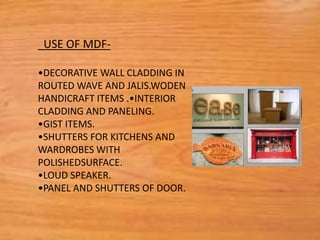
USE OF MDF-
•DECORATIVE WALL CLADDING IN
ROUTED WAVE AND JALIS.WODEN
HANDICRAFT ITEMS .•INTERIOR
CLADDING AND PANELING.
•GIST ITEMS.
•SHUTTERS FOR KITCHENS AND
WARDROBES WITH
POLISHEDSURFACE.
•LOUD SPEAKER.
•PANEL AND SHUTTERS OF DOOR.
MDF SIZES, THICKNESS ,
PRICE-
• SIZES : 8' X 4‘
• THICKNESS : 4 MM , 6 MM , 8
MM , 10 MM,12 MM , 15 MM ,
18 MM , 25 MM , 30 MM35
MM.
• PRICE: 23 RS SQ / FT.MADE OF
TEAK WOOD – 1000 RS – 3500
RSSQ / FT.
HDF-High Density Fibre Board:
RAW METERAL
HDF is High density fiberboard and is similar to particle board
and medium-density board but it is much denser and stronger.
It is made by compressing wood fibers mechanically.
Style/Finishing
HDF is a much stronger board compared to MDF and it gives a
smooth and uniform surface wherever it is applied. HDF does
not have any grain and it can be finished by applying paint on it.
If you want wood grain finishing then you would need to put a
veneer or teak ply on the HDF board.
Maintenance
• To protect HDF the steps below should be
taken.
• Make sure that the board does not get in
touch with water as it can damage it.
• Clean the board with a clean soft cloth to
remove the dust.
• Do not mop with damp cloth.
• Once you finish the HDF with paint or veneer
wood then the maintenance steps for those
finishes should be followed accordingly.
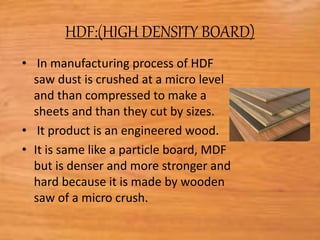
HDF:(HIGH DENSITY BOARD)
• In manufacturing process of HDF
saw dust is crushed at a micro level
and than compressed to make a
sheets and than they cut by sizes.
• It product is an engineered wood.
• It is same like a particle board, MDF
but is denser and more stronger and
hard because it is made by wooden
saw of a micro crush.
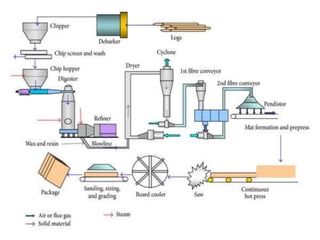
PROCESS:
• First a log is selected.
• Then bark is removed .
• Then t is chipped.
• Then chips are wash to remove impurities.
• Then it is steamed and resin is mixed in it.
• After steam it comes out in the form of sheet.
• Sheet is kept on fiber mat and through this hot
pressing is done at 260°c.
• Then sheets are cut into appropriate sizes and
cooled.
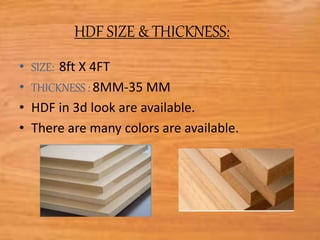
HDF SIZE & THICKNESS:
• SIZE: 8ft X 4FT
• THICKNESS : 8MM-35 MM
• HDF in 3d look are available.
• There are many colors are available.
HDF board Advantages :
• HDF comes with a smooth Surface .
• HDF is High density board has more Strength
compared to MOF and particle board.
• Great Solution for indoor and Outdoor
furniture, wall paneling furniture ,room
partitions and doors.
HDF disadvantages:
• HDR is the best board when compared with
particle board and MOF.
• Still a lot of Carpenters prefer Wood block
board compared to HOF as they are most
Confident about the nail holding Capabilities
of Natural wood . whose blocks used to build
the block board.
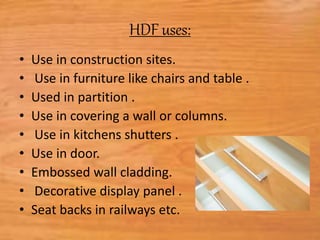
HDF uses:
• Use in construction sites.
• Use in furniture like chairs and table .
• Used in partition .
• Use in covering a wall or columns.
• Use in kitchens shutters .
• Use in door.
• Embossed wall cladding.
• Decorative display panel .
• Seat backs in railways etc.
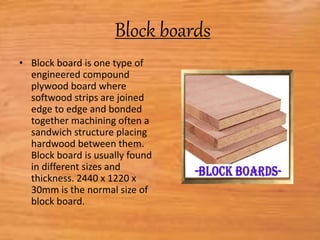
Block boards
• Block board is one type of
engineered compound
plywood board where
softwood strips are joined
edge to edge and bonded
together machining often a
sandwich structure placing
hardwood between them.
Block board is usually found
in different sizes and
thickness. 2440 x 1220 x
30mm is the normal size of
block board.
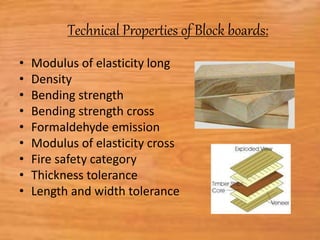
Technical Properties of Block boards:
• Modulus of elasticity long
• Density
• Bending strength
• Bending strength cross
• Formaldehyde emission
• Modulus of elasticity cross
• Fire safety category
• Thickness tolerance
• Length and width tolerance
Types of Block boards:
The classification of block boards depend on
different properties such as quality, use, raw wood
used for the core. Followings are the type of block
board:
A. Depending on quality and use:
1.Interior Grade Block board
2.Exterior Grade Block board
B. Depending on the raw wood used in the core:
1.Softwood Block board
2.Hardwood Block board
Different aspects of these types are briefly discussed below:
Interior Grade Block board
These grades are made for indoor uses which are
resistant to moisture and called MR (Moisture
Resistant)
eg. Furniture, door, window shutter.
Exterior Grade Block board
This variety of block board is manufactured for
outdoor uses. These are called BWP (Boiling Water
Proof) or as BWR (Boiling Water Resistant). This
high quality of resistance is because of the
adhesives used here are also good in quality.
Softwood Block board
Solid blocks of wood are used to make each
block board sheet those are attached together
using glue. The sheets are called strips or
battens. The surface is covered with hardwood
veneers.
Hardwood Block board
Hardwood is dense, heavy, costly, strong as the
core is made from hard sheets. The coating is
also by hardwood.
Followings are the steps of block board processing:
1. Slicing
The logs of timber are sliced at first for making the raw of
blocks. Strips may be 25 mm.
2. Rotary Cutting
For outer layer, logs are cut at rotary cutting. Thus veneer
for coating is obtained.
3. Gluing
To attach the slices glue or adhesives are used eg. Urea
formaldehyde, Phenol formaldehyde which is called
plastic resin. Exterior grade block board requires phenol
formaldehyde. Gluing is done under high pressure.
4. Drying
The blocks are dried to reduce the moisture as well as
water content left inside blocks. For drying the blocks are
kept before the sun. The moisture content is reduced to
10-12%. After proper drying, they are ready for making a
sandwich.
5. Attaching
Blocks are attached together used softwood or
hardwood as required for interior or exterior grade
required.
6. Finishing
Final finishing giving lamination, a coating is done.
Advantages of block board:
• The stability of block boards are well enough
stability, These can even show stability in humid
environment those have moisture resistance.
• They are inexpensive.
• It can take varnish, paint, and laminate coat on
the surface by using glue. Block boards are good
for screwing and nailing.
• For warping or twisting this is a good choice for
its resistance quality.
• They can hold screw, nail and laminating coat and
for this, it is easy to work on it.
• Carpenters can easily use their wood
processing tools also for block boards.
• The lightweight of block board made it
convenient to use. The bulk of the board
made up of core block are also popular for its
light weight as made from softwood and easy
for transportation.
• BWP, one variety of block board are stronger
enough and resistant to both water and
humidity.
Disadvantages of Blockboard:
• Block boards are lighter in weight so not much
dependable hard material.
• They are weaker, don’t have long durability.
• The unwanted gap between softwood strips
make them difficult to work for carpenters
• Screwing and nailing must be done carefully
otherwise it may crack.
• Shrinkage and swelling of the board may occur.
• Deterioration of block board is not guaranteed.
• If the strips inside are from cheap, low quality
wood, may be attacked by insects.
Uses of block board:
Block board is a kind of engineered compound plywood
board. It is used for various purposes . Followings are the
main uses of block board.
• For shelving such as long book sheve ,worktops as
heavier structure.
• For furniture making such as table, bench , bed etc.
• For window, door shutter , flush door.
Block board does not slag in the middle or does not bend
easily, so it is a choice for carpenters.
• For making wall furniture.
• For wall panels, partition.
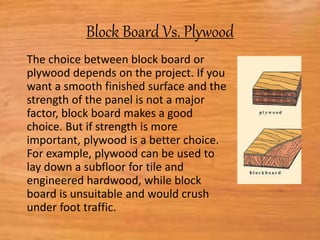
Block Board Vs. Plywood
The choice between block board or
plywood depends on the project. If you
want a smooth finished surface and the
strength of the panel is not a major
factor, block board makes a good
choice. But if strength is more
important, plywood is a better choice.
For example, plywood can be used to
lay down a subfloor for tile and
engineered hardwood, while block
board is unsuitable and would crush
under foot traffic.
Block board is a piece of wood with a plywood core
and thin veneer panels on the top and bottom sides.
The plywood core is made of solid wood strips, and
a finished block board panel typically ranges in
depth from about 3/8-inch to 1 3/16-inches. Block
board is made for interior use, only, because the
wood strips are glued with interior glues and the
layers are hot-pressed to form a solid panel. As a
result, if block board is used outdoors, the layers
will, over time, delaminate and become unglued.
Block board is often used for furniture pieces such
as desks and tabletops.
Plywood is one of the most versatile wood materials
available. It is composed of thin sheets of wood
which are glued together under pressure. Plywood is
used for interior purposes such as flooring and
making furniture, and for exterior purposes such as
sheathing a roof. Plywood is graded with two letters
from A to D, based on the appearance of the front
and back panels. For example, a panel with an "AC"
grade has a smooth front side and minimal knots on
the front, representing the A-grade, while the C-
grade indicates that the back side has visible knots
and imperfections.
Plywood and block board are both sold in panels
and readily available at lumber and home
improvement stores. You can use either one for
interior projects such as furniture and cabinets.
However, they are not pliable materials and cannot
be used for applications that require a curved edge,
for example, or one that requires routing to create
grooves. Plywood and block board are only suitable
to use for a flat surface such as a cabinet door or
table surface. You can also prime and paint them or
add a veneer laminate to the surface if you want a
wood-finish look for your project. Both are easy to
saw and cut with common tools, such as a circular
saw or jig saw. They also take to adhesives well,
including contact cement and liquid nail products.
A plywood panel displays the grain
characteristics of the wood while a block board
panel does not display grain. Therefore, if you
use block board and want it to display a grain,
you need to apply a veneer laminate sheet to
one or both sides of the panel. Block board has
a smooth surface so you don't have to sand it. If
you want to avoid sanding, you need to use
plywood with an A-grade on the side of the
panel that will be showing. Block board is not
graded.
THANK YOU

Building materials

  • 1.
    DONE BY- A.BVN SUPRADIKA-19C11C4006 CH.JAGATH-19C11C4010 K.DSVNLTANISHA-19C11C4018 K.LAVANYA PRIYA-19C11C4020 K.RAMESH-19C11C4023 MOHANANJALI.DONEPUDI-19C11C4026 U.LAKSHMI KOUSHIKA-19C11C4037
  • 2.
    TOPICS PLYWOOD HIGH DENSITY BOARD[HDF] MEDIUMDENSITY BOARD[MDF] BLOCK BOARD
  • 3.
    • PANELS COMPRISINGOF AT LEAST THREE LAYERS OFTHIN WOOD BONDED TOGETHER WITH AN ADHESIVE. • EACH PLY IS UAUALLY ORIENTATED AT A RIGHT ANGLETO THE ADJACENT LAYER IN ORDER TO IMPROVESTRENGTH AND REDUCE THE PROBABILITY OFSHRINKAGE. • PLYWOOD IS A MANUFACTURED WOOD EQUALLY PANELFROM THIN SHEET OF WOOD VENEER. IT IS ONE OFTHE MOSTLY USED WOOD PROUDUCTS. INTRODUCTION DEFINATION-
  • 4.
    • "FACE &BACK" ARE COMMANLY PREFERRED FOR OUTERLAYER OF PLY AND GRADED ACCORDING TO THEIRQUALITY THE INNER OR INTERMEDIATE LAYER ARECOLLECTIVE KNOWN AS “CORE". • IT IS FLEXIBLE, INEXPENSIVE, WORKABLE & RE-USABLEAND USUALLY CAN BE MANUFACTURED LOCALLY.PLYWOOD IS RESISTANCE TO CRACKING, SPLITTING,SHRINKAGE, TWISTING AND HAS HIGH STRENGTH.
  • 5.
    • FIRST LOGIS SELECTED. • THEN FROM1“ THK WOOD 32 CHIPS ARE REMOVED. • LAYERS ARE STACK. • FIRSTLY FACE IS PLACED THAN CORE IS KEPT ON IT AND ON IT FALIIS KEPT THEN AGAIN CORE AND FACE IS KEPT THIS THINGS AREGLUED WITH THE HELP OF PHENOLIC RESIN AND UREA. • THEY ARE PRESSED AT 1200 °C. • WHITE PART IS MADE OF SILVER OAK AND DARK PART IS MADE OFPOPLAR.IF ONLY POPLAR IS USED PLYWOOD GETS SPLIT BY USING SILVEROAK IT HELP IT GET PROTECTED WHILE NAILING. • GURJAN AND HOLLONG WOOD ARE USED IN MAKING PLYWOOD PROCESS
  • 7.
  • 8.
  • 9.
    • FIRST ALLPLYWOOD ARE PLACED ON PALLETE. • THEN THEY ARE TAKEN TO A ROOM WHERE THEY ARE DRIED. • THEY ARE DRIED THERE FOR 7 DAYS.BEFORE MAKING PLYWOOD WOOD IS SEASONED SOPLYWOOD SEASONING IS RARE. • TEMPERATURE IS 5000-600°F SEASONING
  • 10.
    • COMMERCIAL PLYWOOD •WATERPROOF PLYWOOD • FLEXO PLYWOOD • MARINE PLYWOOD • SOFTWOOD PLYWOOD • HARDWOOD PLYWOOD • TROPICAL PLYWOOD • AIRCRAFT PLYWOOD • DECORATIVE PLYWOOD TYPES
  • 11.
    • GURJAN, HOLLOCK, SILVEROAK WOOD ARE USEIN COMMERCIAL PLYWOOD. • IT IS AN INTERIOR GRADE PLYWOOD FOR INDOORUSE. • IT HAS LIGHT COLOR SHADES. COMMERCIAL PLYWOOD
  • 12.
    • WATERPROOF PLYWOODIS MOSTLY USED IN MR GRADE(MOISTURE RESISTANT). • IT REACTS WITH BOTH ALUMINIUMAND MARINE PLYWOOD. • IT HAS BLACK COLORED SHADES.DUE TO CHEMICAL USED IN IT , IT DON' T GET AFFECTED BYTERMITE. • BLACK COLOR IS ALSO DUE TO CHEMICAL USED. WATERPROOF PLYWOOD
  • 13.
    • FLEXO PLYWOODITIS FLEXIBLE AND IS USED FOR MAKING CURVED PARTS. • IN IT THE GRAINS ARE NOT ADJACENT AN SO IT BEND. • AS ALL THE GRAINS GO IN ONE DIRECTION. FLEXO PLYWOOD
  • 14.
    • IT ISA FORM OF PLYWOOD THAT HAS BEEN CONSTRUCTEDUSING WATERPROOF TO MAKE IT SUITABLE FOR USE IN WET ENVIORNMENTS INCLUDING A HOME BUILT BOAT , AND OTHER STRUCTURES. • IT MAY SERVE AS UNDERLAYMENT OF YOUR BOAT VINYL DECK COVER, THE WALL AND COMPARTMENT OVERHEAD PANELS ON YOUR BOAT. MARINE PLY WOOD
  • 15.
    • SOFTWOOD PANELIS USUALLY MADE EITHER OF CEDAR,REDWOOD , AND IS USED FOR CONSTRUCTION AND INDUSTRIAL PURPOSE. • THE MOST COMMON DIMENSION IS 1.2 M X 2.4 M OR LARGEIMPERIAL 4' X 8'. • THÍCKNESS IS FROM 1.4 MM - 4.3 MM. SOFTWOOD PLYWOOD
  • 16.
    • IT ISMADE FROM ANGIOSPERMS TREES AND IS USED FOR DEMANDING END USES. • IT IS CHARCTERIZED BY EXCELLENT STRENGTH , STIFFNESS. • ESPECIALLY SUITABLE FOR HEAVY DUTY FLOOR AND WALLSTRUCTURES.IT HAS EXCELLENT SURFACE HARDNESS , DAMAGE AND WEARRESISTANCE. HARDWOOD PLYWOOD
  • 17.
    • TROPICAL PLYWOODIS MADE FROM SPECIES OF TROPICAL ORIGINALLY FROM THE ASIAN REGION , IT IS NOW ALSO MANUFACTURED IN AFRICAN AND SOUTH AMERICANCOUNTRIES. • TROPICAL PLYWOOD IS SUPERIOR TO SOFTWOOD PLYWOOD DUE TO ITS STRENGTH , DENSITY AND HIGH QUALITYTROPICAL PLYWOOD IS USED WIDELY IN UK, JAPAN , US ,TAIWAN, DUBAI AND OTHER COUNTRIES. TROPICAL PLYWOOD
  • 18.
    • HIGH STRENGTHPLYWOOD IS ALSO KNOWN AS AIRCRAFTPLYWOOD. • IT IS MADE FROM BIRCH AND MAHOGANY AND USES ADHESIVE WITH INCREASED RESISTANCE TO HEAT AND HUMIDITY. • IT IS USED FOR SEVERAL WORLD WAR 2 FIGHTER AIRCRAFTALTHOUGH THE BRITISH BUILT MOSQUITO BOMBERNICKNAMED “THE WOODEN WONDER" WAS CONSTRUCTEDOF A PLYWOOD. • THIS WAS FORMED BY INDIVIUAL VENEERS OFBIRCH , BALSA RATHER THAN MACHINED FROM PRELAMINATED PLYWOOD SHEETS. AIRCRAFT PLYWOOD
  • 19.
    • DECORATIVE PLYWOOD USUALLYFACED WITH HARDWOOD INCLUDING ASH , OAK ,RED OAK , BIRCH, MAPLE , MAHOGANY , ROSE WOOD , TEAKAND LARGE NUMBER OF OTHER WOODS. • THIS PLYWOOD IS LOT EASIER TO DYE AND DRAW ON THANANY OTHER PLYWOOD. • FABRIC BONDED ARE ALSO ADDED ON TOP OF PLYWOOD ATBOTH SIDE AS KIND OF READY FOR USE IN DECORATION FIELD. DECORATIVE PLYWOOD
  • 20.
    • BWR :BOILING WATER RESISTANT • BWP : BOILING WATER PROOF THIS GRADE IS MOSTLY USED IN KITCHENS. • MR : MOISTURE RESISTANT TYPES OF PLYWOOD GRADE
  • 21.
    • 8FT X4FT • 7FT X 4FT • 6FT X 4FT • 8FT X 3FT • 7FT X 3FT • 6FT X 3FT SIZES OF PLYWOOD
  • 22.
    • It hasvery good strength and durability compared to Medium Density Fiberboard (MDF). • It is available in different thicknesses ranges from 6mm to 32mm. • Plywood usually made out of different wood species. • It is less susceptible to water damage than MDF.It can be easily polished or painted. • It can provide smooth surface for laminate or veneer to stick on.It can hold screws well. • It can be cut in any shapes.It is resistive to shrinking, warping, twisting and cracking. • It is available in large size compared to solid wood and hence one avoids joints and therefore the failure given good looks. And because of the same it increase speed & ease of maintenance unlike the natural wood veneers, where you had to make up of jointsIt is economical as compared to solid wood. ADVANTAGES OF PLYWOOD-
  • 23.
    • It ismore expensive than Medium Density Fiberboard (MDF). • Because the layers of veneers are seen at the edges, edges have to be finished either with laminate or veneer. • It often get splinter from the edges during transportation.It is quite difficult to cut. • It is known to emit toxic VOC’s (Volatile Organic Compound) as it can irritates in eye.Water may damage Moisture Resistant (MR) grade plywood. • For common people, it is difficult to judge which wood veneer has been used for making the plywood.It is costlier as compared to blockboard or particleboard.T • he most of the commercial grade plywood needs to be covered by laminates. Sunmica, so as to enhance its beauty and to increase its life. It is prone to termite effect and may get damaged once affected. DISADVANTAGES OF PLYWOOD-
  • 24.
    • If anywherefirm, strong material is needed then it is necessary. • As high quality layered wood material it is used. • Resistance to bend, split, break, crack, twist, warping made it important for construction and furniture making. • For outdoor uses. For space shipping, aviation since 1939. • Low moisture plywood used for different purposes like ship making. • For making surfaces shaped curved, u, or folded plywood is used as the grains of plywood is easy to make bend than normal wood. • To make the interior surface of skating ground this is used. USES AND APPLICATIONS-
  • 25.
    • Used fordifferent interior games stadium. • For ship construction. • For space or aviation parts making.
  • 26.
    INTRODUCTION • Medium-density fiberboard(MDF) is a composite wood product made of compressed wood fibers, mixed with wax and resin. • MDF is similar to particleboard and hardboard, it is known for its strength, smooth surface and edges and affordable pricing.
  • 27.
    • MDF hasmany applications and various sizes and comes with its share of advantages and disadvantages , and is overall a very popular choice for many woodworkers. • Usually the panel will compressed to density of 0.5 to 0.8 specific gravity in a hot press. • It varies in color from tan to chocolate brown. • Common thick ness range from ¼ in. to 1 in., but most home centers carry only ½ in. and ¾ in.
  • 28.
  • 29.
    • IT BEGNWITH THE SELECTION AND REFINEMENT OF RAWMATERIALS, MOST OF WHICH ARE RECYCLED FROMSHAVINGS AND CHIPS RECLAIMED FROM SAW MILLS ANDPLYWOOD PLANTS. • FIRST ALL METAL IMPURITIES ARE REMOVED BY MAGNET.THEN LARGE CHUNKS AND SMALL FLAKES ARE SEPARATED . • MATERIAL IS SENT THROUGH ELECTRIC DETECTOR AGAIN,WITH REJECTED MATERIAL TO BE REUSED FOR FUEL. • GOOD MATERIAL IS COLLECTED AND SENT TO PRESTEAMINGBIN. • IN BIN, STEAM IS INJECTED AND MATERIAL IS SOFTEN. Process-
  • 30.
    • FIBERS ARETHEN FED INTO SCREW FEEDER AND THEN INTOPLUG SCREW FEEDER WHICH COMPRESSES IT AND REMOVESMOISTURE. • THE COMPRESSED MATERIAL IS FED INTO REFINER WHICHTEARS THE MATERIAL INTO USUABLE FIBRES. • RESIN IS ADDED BEFORE REFINING STEP TO CONTROLFORMALDEHYDE TOLERANCE IN MIXTURE. • FIBRES ARE THEN FED IN FLASH TUBE DRYER , WHICH ISHEATED EITHER BY OIL OR GAS. • NEXT, FIBER IS PUSHED INTO SCALP ROLLS TO MAKE MAT OFUNIFORM THICKNESS. • THIS MAT GOES THROUGH SEVERAL PRESSING STEPS TOPRODCE MORE USABLE SIZE AND THEN IS TRIMMED TODESIRED WIĐTH BEFORE FINAL PRESSING STEP.
  • 31.
    • A CONTINUOUSPRESS EQIPPED WITH A LARGE DRUMCOMPRESSES THE MAT AT A UNIFORM RATE BY MONITORINGTHE MAT HEIGHT. • TO ACHIEVE A SMOOTH FINISH THE PANELS ARE SANDEDUSING BELTS COATED WITH ABRASIVES. • EIGHTHEAD SANDING EQUIPMENT AND DOUBLE SIDEDGRADING IMPROVES SURFACE SMOOTHNESS CONSISTENCY. • LASTLY FINISHING IS DONE.LACQUER COLORS CAN BE APPLIED , AS WELL AS WOODGRAIN PATTERNS CAN BE CREATED.MAT , GLOSSY , COATING ETC… CAN ALSO BE DONE. • GUILLOTINE CUTTING IS USED TO CUT FIBREBOARDS INTOLARGE SHEETS.
  • 33.
    A) EXTERIOR GRADE: ITISTO BE USED WHERE MDF IS TO BE USED IN EXTERIOR.WHERE PANEL IS EXPOSED TO MOISTURE AND HIGHHUMIDITY.IT HAS WATER RESISTANT PROPERTIES. B) INTERIOR GRADE:IT IS TO BE USED FOR INTERNAL APPLICATION.WHERE PANEL IS NOT EXPOSED TO HUMIDITY ANDMOISTURE. TYPES-
  • 34.
    • IT ISDENSE, FLAT, STIFF, AND HAS NO KNOTS. • MDF HAS NO GRAIN (AS IT IS MADE UP OF FINE PARTICLES) SOIT CAN BE CUT, DRILLED, MACHINED AND FILED WITHOUTDAMAGING THE SURFACE. • IT IS AN ENVIRONMENTALLY FRIENDLY PRODUCT (AS IT'S ARECYCLED MATERIAL). • IT DOESN'T SPLIT (BECAUSE THERE IS NO GRAIN). • IT'S NOT EXPENSIVE. ADVANTAGES-
  • 35.
    • MDF CANBE DANGEROUS TO USE IF THE CORRECT SAFETYPRECAUTIONS ARE NOT TAKEN AS MDF CONTAINS A SUBSTANCE CALLED FORMALDEHYDE, WHICH MAY BERELEASED FROM THE MATERIAL THROUGH CUTTING ANDSANDING. • IT COULD CAUSE IRRITATION TO THE EYES ANDLUNGS. • MDF CONTAINS A LOT OF GLUE, WHICH CAN DAMAGE ORBLUNT TOOLS WITH CUTTING EDGES. • NAILS AND SCREWSCAN BE USED TO ATTACH THE MATERIALS TOGETHER, BUTTHEY CAN ALSO EASILY SPLIT AND DAMAGE THE FIBREBOARD. DISADVANTAGES-
  • 36.
    USE OF MDF- •DECORATIVEWALL CLADDING IN ROUTED WAVE AND JALIS.WODEN HANDICRAFT ITEMS .•INTERIOR CLADDING AND PANELING. •GIST ITEMS. •SHUTTERS FOR KITCHENS AND WARDROBES WITH POLISHEDSURFACE. •LOUD SPEAKER. •PANEL AND SHUTTERS OF DOOR.
  • 37.
    MDF SIZES, THICKNESS, PRICE- • SIZES : 8' X 4‘ • THICKNESS : 4 MM , 6 MM , 8 MM , 10 MM,12 MM , 15 MM , 18 MM , 25 MM , 30 MM35 MM. • PRICE: 23 RS SQ / FT.MADE OF TEAK WOOD – 1000 RS – 3500 RSSQ / FT.
  • 38.
    HDF-High Density FibreBoard: RAW METERAL HDF is High density fiberboard and is similar to particle board and medium-density board but it is much denser and stronger. It is made by compressing wood fibers mechanically. Style/Finishing HDF is a much stronger board compared to MDF and it gives a smooth and uniform surface wherever it is applied. HDF does not have any grain and it can be finished by applying paint on it. If you want wood grain finishing then you would need to put a veneer or teak ply on the HDF board.
  • 39.
    Maintenance • To protectHDF the steps below should be taken. • Make sure that the board does not get in touch with water as it can damage it. • Clean the board with a clean soft cloth to remove the dust. • Do not mop with damp cloth. • Once you finish the HDF with paint or veneer wood then the maintenance steps for those finishes should be followed accordingly.
  • 40.
    HDF:(HIGH DENSITY BOARD) •In manufacturing process of HDF saw dust is crushed at a micro level and than compressed to make a sheets and than they cut by sizes. • It product is an engineered wood. • It is same like a particle board, MDF but is denser and more stronger and hard because it is made by wooden saw of a micro crush.
  • 41.
    PROCESS: • First alog is selected. • Then bark is removed . • Then t is chipped. • Then chips are wash to remove impurities. • Then it is steamed and resin is mixed in it. • After steam it comes out in the form of sheet. • Sheet is kept on fiber mat and through this hot pressing is done at 260°c. • Then sheets are cut into appropriate sizes and cooled.
  • 43.
    HDF SIZE &THICKNESS: • SIZE: 8ft X 4FT • THICKNESS : 8MM-35 MM • HDF in 3d look are available. • There are many colors are available.
  • 44.
    HDF board Advantages: • HDF comes with a smooth Surface . • HDF is High density board has more Strength compared to MOF and particle board. • Great Solution for indoor and Outdoor furniture, wall paneling furniture ,room partitions and doors.
  • 45.
    HDF disadvantages: • HDRis the best board when compared with particle board and MOF. • Still a lot of Carpenters prefer Wood block board compared to HOF as they are most Confident about the nail holding Capabilities of Natural wood . whose blocks used to build the block board.
  • 46.
    HDF uses: • Usein construction sites. • Use in furniture like chairs and table . • Used in partition . • Use in covering a wall or columns. • Use in kitchens shutters . • Use in door. • Embossed wall cladding. • Decorative display panel . • Seat backs in railways etc.
  • 47.
    Block boards • Blockboard is one type of engineered compound plywood board where softwood strips are joined edge to edge and bonded together machining often a sandwich structure placing hardwood between them. Block board is usually found in different sizes and thickness. 2440 x 1220 x 30mm is the normal size of block board.
  • 48.
    Technical Properties ofBlock boards: • Modulus of elasticity long • Density • Bending strength • Bending strength cross • Formaldehyde emission • Modulus of elasticity cross • Fire safety category • Thickness tolerance • Length and width tolerance
  • 49.
    Types of Blockboards: The classification of block boards depend on different properties such as quality, use, raw wood used for the core. Followings are the type of block board: A. Depending on quality and use: 1.Interior Grade Block board 2.Exterior Grade Block board B. Depending on the raw wood used in the core: 1.Softwood Block board 2.Hardwood Block board
  • 50.
    Different aspects ofthese types are briefly discussed below: Interior Grade Block board These grades are made for indoor uses which are resistant to moisture and called MR (Moisture Resistant) eg. Furniture, door, window shutter. Exterior Grade Block board This variety of block board is manufactured for outdoor uses. These are called BWP (Boiling Water Proof) or as BWR (Boiling Water Resistant). This high quality of resistance is because of the adhesives used here are also good in quality.
  • 51.
    Softwood Block board Solidblocks of wood are used to make each block board sheet those are attached together using glue. The sheets are called strips or battens. The surface is covered with hardwood veneers. Hardwood Block board Hardwood is dense, heavy, costly, strong as the core is made from hard sheets. The coating is also by hardwood.
  • 52.
    Followings are thesteps of block board processing: 1. Slicing The logs of timber are sliced at first for making the raw of blocks. Strips may be 25 mm. 2. Rotary Cutting For outer layer, logs are cut at rotary cutting. Thus veneer for coating is obtained. 3. Gluing To attach the slices glue or adhesives are used eg. Urea formaldehyde, Phenol formaldehyde which is called plastic resin. Exterior grade block board requires phenol formaldehyde. Gluing is done under high pressure.
  • 53.
    4. Drying The blocksare dried to reduce the moisture as well as water content left inside blocks. For drying the blocks are kept before the sun. The moisture content is reduced to 10-12%. After proper drying, they are ready for making a sandwich. 5. Attaching Blocks are attached together used softwood or hardwood as required for interior or exterior grade required. 6. Finishing Final finishing giving lamination, a coating is done.
  • 54.
    Advantages of blockboard: • The stability of block boards are well enough stability, These can even show stability in humid environment those have moisture resistance. • They are inexpensive. • It can take varnish, paint, and laminate coat on the surface by using glue. Block boards are good for screwing and nailing. • For warping or twisting this is a good choice for its resistance quality. • They can hold screw, nail and laminating coat and for this, it is easy to work on it.
  • 55.
    • Carpenters caneasily use their wood processing tools also for block boards. • The lightweight of block board made it convenient to use. The bulk of the board made up of core block are also popular for its light weight as made from softwood and easy for transportation. • BWP, one variety of block board are stronger enough and resistant to both water and humidity.
  • 56.
    Disadvantages of Blockboard: •Block boards are lighter in weight so not much dependable hard material. • They are weaker, don’t have long durability. • The unwanted gap between softwood strips make them difficult to work for carpenters • Screwing and nailing must be done carefully otherwise it may crack. • Shrinkage and swelling of the board may occur. • Deterioration of block board is not guaranteed. • If the strips inside are from cheap, low quality wood, may be attacked by insects.
  • 57.
    Uses of blockboard: Block board is a kind of engineered compound plywood board. It is used for various purposes . Followings are the main uses of block board. • For shelving such as long book sheve ,worktops as heavier structure. • For furniture making such as table, bench , bed etc. • For window, door shutter , flush door. Block board does not slag in the middle or does not bend easily, so it is a choice for carpenters. • For making wall furniture. • For wall panels, partition.
  • 58.
    Block Board Vs.Plywood The choice between block board or plywood depends on the project. If you want a smooth finished surface and the strength of the panel is not a major factor, block board makes a good choice. But if strength is more important, plywood is a better choice. For example, plywood can be used to lay down a subfloor for tile and engineered hardwood, while block board is unsuitable and would crush under foot traffic.
  • 59.
    Block board isa piece of wood with a plywood core and thin veneer panels on the top and bottom sides. The plywood core is made of solid wood strips, and a finished block board panel typically ranges in depth from about 3/8-inch to 1 3/16-inches. Block board is made for interior use, only, because the wood strips are glued with interior glues and the layers are hot-pressed to form a solid panel. As a result, if block board is used outdoors, the layers will, over time, delaminate and become unglued. Block board is often used for furniture pieces such as desks and tabletops.
  • 60.
    Plywood is oneof the most versatile wood materials available. It is composed of thin sheets of wood which are glued together under pressure. Plywood is used for interior purposes such as flooring and making furniture, and for exterior purposes such as sheathing a roof. Plywood is graded with two letters from A to D, based on the appearance of the front and back panels. For example, a panel with an "AC" grade has a smooth front side and minimal knots on the front, representing the A-grade, while the C- grade indicates that the back side has visible knots and imperfections.
  • 61.
    Plywood and blockboard are both sold in panels and readily available at lumber and home improvement stores. You can use either one for interior projects such as furniture and cabinets. However, they are not pliable materials and cannot be used for applications that require a curved edge, for example, or one that requires routing to create grooves. Plywood and block board are only suitable to use for a flat surface such as a cabinet door or table surface. You can also prime and paint them or add a veneer laminate to the surface if you want a wood-finish look for your project. Both are easy to saw and cut with common tools, such as a circular saw or jig saw. They also take to adhesives well, including contact cement and liquid nail products.
  • 62.
    A plywood paneldisplays the grain characteristics of the wood while a block board panel does not display grain. Therefore, if you use block board and want it to display a grain, you need to apply a veneer laminate sheet to one or both sides of the panel. Block board has a smooth surface so you don't have to sand it. If you want to avoid sanding, you need to use plywood with an A-grade on the side of the panel that will be showing. Block board is not graded.
  • 63.