INTERIOR MATERIALS AND FINISHES
INTRODUCTION TO MATERIALS
UNIT-1
Wood, soft wood & hardwood, plywood, laminated wood &particle boards, properties manufacturing and
uses, synthetic materials – types of glass, properties, manufacturing & uses. Plastic – injection molding &
other manufacturing methods. Fabric – textile, jute, leather and etc, different types and their uses.
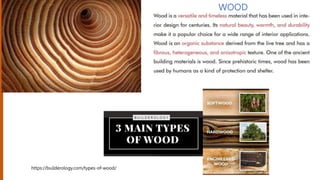
WOOD
https://builderology.com/types-of-wood/
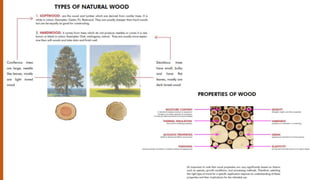
TYPES OF WOOD
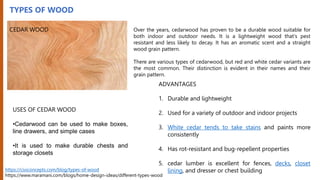
CEDAR WOOD Over the years, cedarwood has proven to be a durable wood suitable for
both indoor and outdoor needs. It is a lightweight wood that's pest
resistant and less likely to decay. It has an aromatic scent and a straight
wood grain pattern.
There are various types of cedarwood, but red and white cedar variants are
the most common. Their distinction is evident in their names and their
grain pattern.
USES OF CEDAR WOOD
•Cedarwood can be used to make boxes,
line drawers, and simple cases
•It is used to make durable chests and
storage closets
ADVANTAGES
1. Durable and lightweight
2. Used for a variety of outdoor and indoor projects
3. White cedar tends to take stains and paints more
consistently
4. Has rot-resistant and bug-repellent properties
5. cedar lumber is excellent for fences, decks, closet
lining, and dresser or chest building
https://civiconcepts.com/blog/types-of-wood
https://www.maramani.com/blogs/home-design-ideas/different-types-wood
TYPES OF WOOD
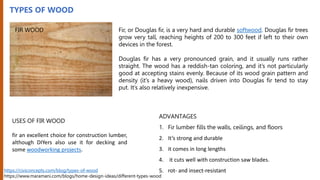
Fir, or Douglas fir, is a very hard and durable softwood. Douglas fir trees
grow very tall, reaching heights of 200 to 300 feet if left to their own
devices in the forest.
Douglas fir has a very pronounced grain, and it usually runs rather
straight. The wood has a reddish-tan coloring, and it’s not particularly
good at accepting stains evenly. Because of its wood grain pattern and
density (it’s a heavy wood), nails driven into Douglas fir tend to stay
put. It’s also relatively inexpensive.
USES OF FIR WOOD
fir an excellent choice for construction lumber,
although DIYers also use it for decking and
some woodworking projects.
ADVANTAGES
1. Fir lumber fills the walls, ceilings, and floors
2. It’s strong and durable
3. it comes in long lengths
4. it cuts well with construction saw blades.
5. rot- and insect-resistant
https://civiconcepts.com/blog/types-of-wood
https://www.maramani.com/blogs/home-design-ideas/different-types-wood
FIR WOOD
TYPES OF WOOD
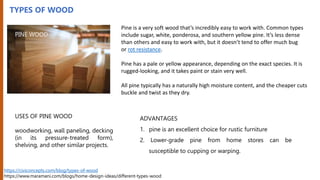
Pine is a very soft wood that’s incredibly easy to work with. Common types
include sugar, white, ponderosa, and southern yellow pine. It’s less dense
than others and easy to work with, but it doesn’t tend to offer much bug
or rot resistance.
Pine has a pale or yellow appearance, depending on the exact species. It is
rugged-looking, and it takes paint or stain very well.
All pine typically has a naturally high moisture content, and the cheaper cuts
buckle and twist as they dry.
USES OF PINE WOOD
woodworking, wall paneling, decking
(in its pressure-treated form),
shelving, and other similar projects.
ADVANTAGES
1. pine is an excellent choice for rustic furniture
2. Lower-grade pine from home stores can be
susceptible to cupping or warping.
https://civiconcepts.com/blog/types-of-wood
https://www.maramani.com/blogs/home-design-ideas/different-types-wood
PINE WOOD
PLYWOOD
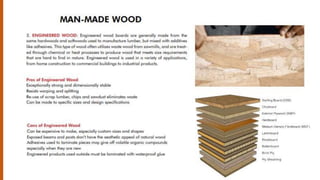
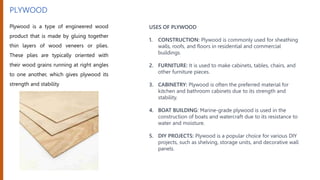
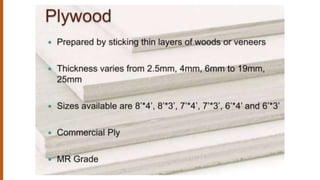
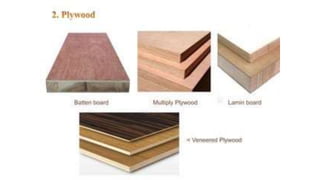
Plywood is a type of engineered wood
product that is made by gluing together
thin layers of wood veneers or plies.
These plies are typically oriented with
their wood grains running at right angles
to one another, which gives plywood its
strength and stability
USES OF PLYWOOD
1. CONSTRUCTION: Plywood is commonly used for sheathing
walls, roofs, and floors in residential and commercial
buildings.
2. FURNITURE: It is used to make cabinets, tables, chairs, and
other furniture pieces.
3. CABINETRY: Plywood is often the preferred material for
kitchen and bathroom cabinets due to its strength and
stability.
4. BOAT BUILDING: Marine-grade plywood is used in the
construction of boats and watercraft due to its resistance to
water and moisture.
5. DIY PROJECTS: Plywood is a popular choice for various DIY
projects, such as shelving, storage units, and decorative wall
panels.
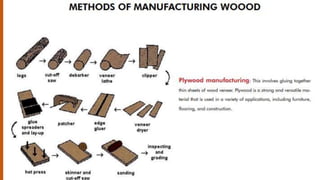
1. Log Selection: High-quality logs are selected for veneer production.
2. Peeling or Slicing: The logs are either rotary-cut (peeled) or sliced into thin veneer sheets.
3. Drying: The veneer sheets are dried to reduce moisture content.
4. Gluing: Adhesives, typically phenol-formaldehyde or urea-formaldehyde, are applied to the
veneer sheets.
5. Layering: The veneer sheets are stacked, with the wood grain of adjacent layers oriented at right
angles to one another to create a balanced panel.
6. Pressing: The stacked veneer sheets are pressed together under heat and pressure, causing the
adhesive to bond them into a solid panel.
7. Trimming and Finishing: The plywood sheets are trimmed to size, sanded, and finished as needed.
MANUFACTURING METHODS OF PLYWOOD
TYPES OF PLYWOOD
1.Interior Plywood: This type of plywood is designed for use in dry, indoor environments. It is commonly used
for furniture, cabinets, paneling, and other interior applications.
2.Exterior Plywood: Exterior plywood is treated to withstand exposure to moisture and weather conditions. It is
used for outdoor construction, such as sheathing, roofing, and siding.
3.Marine Plywood: Marine plywood is specially designed for use in wet or marine environments. It has
excellent resistance to water and is used in boat building, docks, and other water-related applications.
4.Structural Plywood: Structural plywood is engineered for load-bearing purposes. It meets specific strength
and stiffness requirements and is used in framing, beams, and subflooring.
5.Aircraft Plywood: This high-quality plywood is used in the construction of aircraft and other applications
where lightweight and strong materials are required.
PROPERTIES OF PLYWOOD
1. STRENGTH: Plywood is strong and can distribute loads evenly across its surface due to the cross-grain orientation of
its layers.
2. DURABILITY: Depending on the type, plywood can be highly durable and resistant to moisture, making it suitable for
various environments.
3. STABILITY: Plywood is less prone to warping and shrinking compared to solid wood because of its layered
construction.
4. VERSATILITY: It can be cut, shaped, and finished in various ways to suit different applications and designs.
5. COST-EFFECTIVE: Plywood is often more affordable than solid wood of similar quality and dimensions.
PLYWOOD IN INTERIOR DESIGN
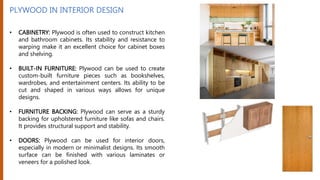
• CABINETRY: Plywood is often used to construct kitchen
and bathroom cabinets. Its stability and resistance to
warping make it an excellent choice for cabinet boxes
and shelving.
• BUILT-IN FURNITURE: Plywood can be used to create
custom-built furniture pieces such as bookshelves,
wardrobes, and entertainment centers. Its ability to be
cut and shaped in various ways allows for unique
designs.
• FURNITURE BACKING: Plywood can serve as a sturdy
backing for upholstered furniture like sofas and chairs.
It provides structural support and stability.
• DOORS: Plywood can be used for interior doors,
especially in modern or minimalist designs. Its smooth
surface can be finished with various laminates or
veneers for a polished look.
PLYWOOD IN INTERIOR DESIGN
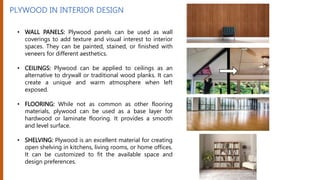
• WALL PANELS: Plywood panels can be used as wall
coverings to add texture and visual interest to interior
spaces. They can be painted, stained, or finished with
veneers for different aesthetics.
• CEILINGS: Plywood can be applied to ceilings as an
alternative to drywall or traditional wood planks. It can
create a unique and warm atmosphere when left
exposed.
• FLOORING: While not as common as other flooring
materials, plywood can be used as a base layer for
hardwood or laminate flooring. It provides a smooth
and level surface.
• SHELVING: Plywood is an excellent material for creating
open shelving in kitchens, living rooms, or home offices.
It can be customized to fit the available space and
design preferences.
PLYWOOD IN INTERIOR DESIGN
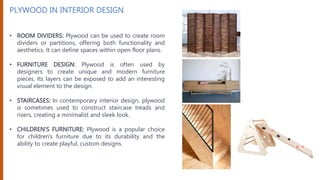
• ROOM DIVIDERS: Plywood can be used to create room
dividers or partitions, offering both functionality and
aesthetics. It can define spaces within open floor plans.
• FURNITURE DESIGN: Plywood is often used by
designers to create unique and modern furniture
pieces. Its layers can be exposed to add an interesting
visual element to the design.
• STAIRCASES: In contemporary interior design, plywood
is sometimes used to construct staircase treads and
risers, creating a minimalist and sleek look.
• CHILDREN'S FURNITURE: Plywood is a popular choice
for children's furniture due to its durability and the
ability to create playful, custom designs.
PLYWOOD IN INTERIOR DESIGN
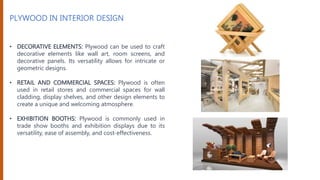
• DECORATIVE ELEMENTS: Plywood can be used to craft
decorative elements like wall art, room screens, and
decorative panels. Its versatility allows for intricate or
geometric designs.
• RETAIL AND COMMERCIAL SPACES: Plywood is often
used in retail stores and commercial spaces for wall
cladding, display shelves, and other design elements to
create a unique and welcoming atmosphere.
• EXHIBITION BOOTHS: Plywood is commonly used in
trade show booths and exhibition displays due to its
versatility, ease of assembly, and cost-effectiveness.
LAMINATED WOOD
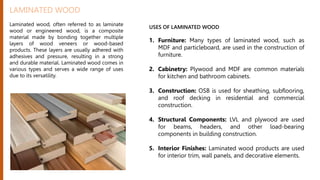
Laminated wood, often referred to as laminate
wood or engineered wood, is a composite
material made by bonding together multiple
layers of wood veneers or wood-based
products. These layers are usually adhered with
adhesives and pressure, resulting in a strong
and durable material. Laminated wood comes in
various types and serves a wide range of uses
due to its versatility.
USES OF LAMINATED WOOD
1. Furniture: Many types of laminated wood, such as
MDF and particleboard, are used in the construction of
furniture.
2. Cabinetry: Plywood and MDF are common materials
for kitchen and bathroom cabinets.
3. Construction: OSB is used for sheathing, subflooring,
and roof decking in residential and commercial
construction.
4. Structural Components: LVL and plywood are used
for beams, headers, and other load-bearing
components in building construction.
5. Interior Finishes: Laminated wood products are used
for interior trim, wall panels, and decorative elements.
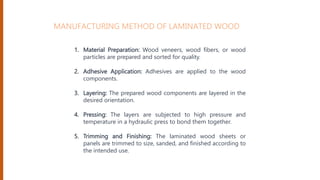
1. Material Preparation: Wood veneers, wood fibers, or wood
particles are prepared and sorted for quality.
2. Adhesive Application: Adhesives are applied to the wood
components.
3. Layering: The prepared wood components are layered in the
desired orientation.
4. Pressing: The layers are subjected to high pressure and
temperature in a hydraulic press to bond them together.
5. Trimming and Finishing: The laminated wood sheets or
panels are trimmed to size, sanded, and finished according to
the intended use.
MANUFACTURING METHOD OF LAMINATED WOOD
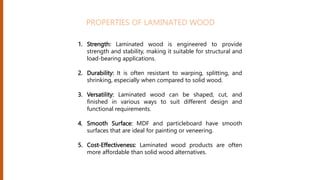
1. Strength: Laminated wood is engineered to provide
strength and stability, making it suitable for structural and
load-bearing applications.
2. Durability: It is often resistant to warping, splitting, and
shrinking, especially when compared to solid wood.
3. Versatility: Laminated wood can be shaped, cut, and
finished in various ways to suit different design and
functional requirements.
4. Smooth Surface: MDF and particleboard have smooth
surfaces that are ideal for painting or veneering.
5. Cost-Effectiveness: Laminated wood products are often
more affordable than solid wood alternatives.
PROPERTIES OF LAMINATED WOOD
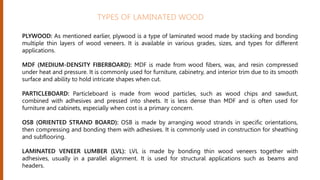
PLYWOOD: As mentioned earlier, plywood is a type of laminated wood made by stacking and bonding
multiple thin layers of wood veneers. It is available in various grades, sizes, and types for different
applications.
MDF (MEDIUM-DENSITY FIBERBOARD): MDF is made from wood fibers, wax, and resin compressed
under heat and pressure. It is commonly used for furniture, cabinetry, and interior trim due to its smooth
surface and ability to hold intricate shapes when cut.
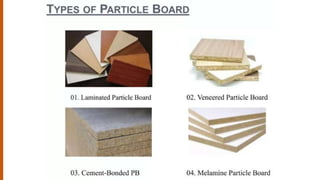
PARTICLEBOARD: Particleboard is made from wood particles, such as wood chips and sawdust,
combined with adhesives and pressed into sheets. It is less dense than MDF and is often used for
furniture and cabinets, especially when cost is a primary concern.
OSB (ORIENTED STRAND BOARD): OSB is made by arranging wood strands in specific orientations,
then compressing and bonding them with adhesives. It is commonly used in construction for sheathing
and subflooring.
LAMINATED VENEER LUMBER (LVL): LVL is made by bonding thin wood veneers together with
adhesives, usually in a parallel alignment. It is used for structural applications such as beams and
headers.
TYPES OF LAMINATED WOOD
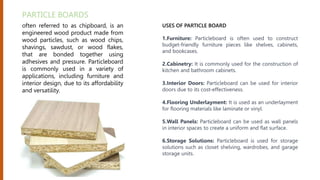
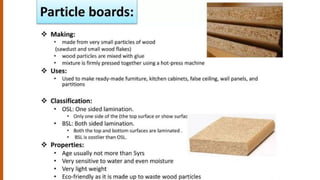
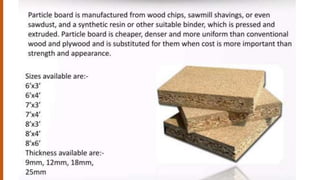
often referred to as chipboard, is an
engineered wood product made from
wood particles, such as wood chips,
shavings, sawdust, or wood flakes,
that are bonded together using
adhesives and pressure. Particleboard
is commonly used in a variety of
applications, including furniture and
interior design, due to its affordability
and versatility.
PARTICLE BOARDS
USES OF PARTICLE BOARD
1.Furniture: Particleboard is often used to construct
budget-friendly furniture pieces like shelves, cabinets,
and bookcases.
2.Cabinetry: It is commonly used for the construction of
kitchen and bathroom cabinets.
3.Interior Doors: Particleboard can be used for interior
doors due to its cost-effectiveness.
4.Flooring Underlayment: It is used as an underlayment
for flooring materials like laminate or vinyl.
5.Wall Panels: Particleboard can be used as wall panels
in interior spaces to create a uniform and flat surface.
6.Storage Solutions: Particleboard is used for storage
solutions such as closet shelving, wardrobes, and garage
storage units.
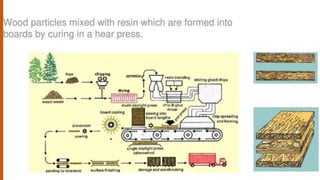
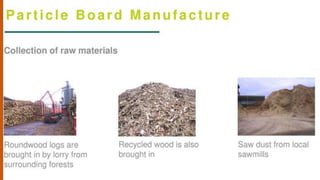
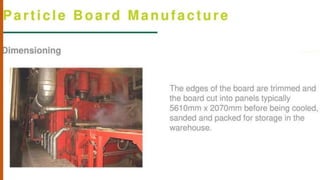
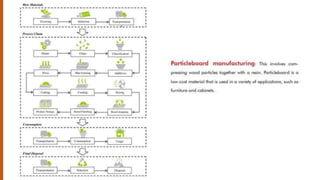
1. Material Preparation: Wood particles, such as wood chips and shavings, are sorted and
prepared for processing.
2. Mixing: The wood particles are combined with adhesives, typically urea-formaldehyde
or melamine-formaldehyde, in a blender or mixer.
3. Forming: The adhesive-coated wood particles are spread onto a conveyor belt and
formed into a mat of the desired thickness.
4. Pressing: The mat is subjected to high pressure and temperature in a hydraulic press,
causing the adhesive to cure and bond the particles together.
5. Cooling and Trimming: The freshly pressed particleboard is cooled, trimmed to the
desired dimensions, and sanded to achieve a smooth surface finish.
MANUFACTURING METHOD OF PARTICLE BOARD
1. Affordability: Particleboard is typically more affordable than other engineered wood products like
MDF or plywood.
2. Smooth Surface: It has a smooth and even surface, which makes it suitable for laminating with
veneers, laminates, or paints.
3. Consistency: Particleboard offers uniform thickness and density across the entire sheet.
4. Density Variability: The density of particleboard can vary, with higher-density boards being stronger
and more durable.
5. Moderate Strength: While not as strong as plywood or MDF, particleboard still has sufficient strength
for many applications.
6. Limited Resistance to Moisture: Standard particleboard is not moisture-resistant and can swell or
deteriorate when exposed to water for extended periods.
PROPERTIES OF PARTICLE BOARD
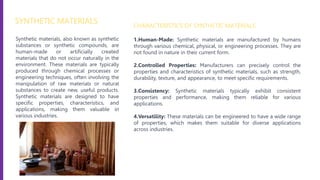
Synthetic materials, also known as synthetic
substances or synthetic compounds, are
human-made or artificially created
materials that do not occur naturally in the
environment. These materials are typically
produced through chemical processes or
engineering techniques, often involving the
manipulation of raw materials or natural
substances to create new, useful products.
Synthetic materials are designed to have
specific properties, characteristics, and
applications, making them valuable in
various industries.
SYNTHETIC MATERIALS
CHARACTERISTICS OF SYNTHETIC MATERIALS
1.Human-Made: Synthetic materials are manufactured by humans
through various chemical, physical, or engineering processes. They are
not found in nature in their current form.
2.Controlled Properties: Manufacturers can precisely control the
properties and characteristics of synthetic materials, such as strength,
durability, texture, and appearance, to meet specific requirements.
3.Consistency: Synthetic materials typically exhibit consistent
properties and performance, making them reliable for various
applications.
4.Versatility: These materials can be engineered to have a wide range
of properties, which makes them suitable for diverse applications
across industries.
EXAMPLES OF SYNTHETIC MATERIALS
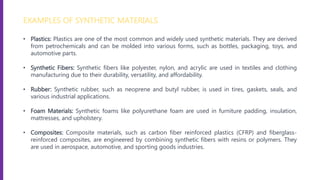
• Plastics: Plastics are one of the most common and widely used synthetic materials. They are derived
from petrochemicals and can be molded into various forms, such as bottles, packaging, toys, and
automotive parts.
• Synthetic Fibers: Synthetic fibers like polyester, nylon, and acrylic are used in textiles and clothing
manufacturing due to their durability, versatility, and affordability.
• Rubber: Synthetic rubber, such as neoprene and butyl rubber, is used in tires, gaskets, seals, and
various industrial applications.
• Foam Materials: Synthetic foams like polyurethane foam are used in furniture padding, insulation,
mattresses, and upholstery.
• Composites: Composite materials, such as carbon fiber reinforced plastics (CFRP) and fiberglass-
reinforced composites, are engineered by combining synthetic fibers with resins or polymers. They
are used in aerospace, automotive, and sporting goods industries.
EXAMPLES OF SYNTHETIC MATERIALS
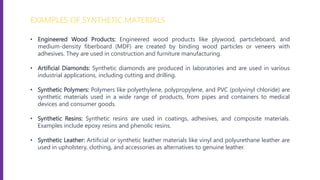
• Engineered Wood Products: Engineered wood products like plywood, particleboard, and
medium-density fiberboard (MDF) are created by binding wood particles or veneers with
adhesives. They are used in construction and furniture manufacturing.
• Artificial Diamonds: Synthetic diamonds are produced in laboratories and are used in various
industrial applications, including cutting and drilling.
• Synthetic Polymers: Polymers like polyethylene, polypropylene, and PVC (polyvinyl chloride) are
synthetic materials used in a wide range of products, from pipes and containers to medical
devices and consumer goods.
• Synthetic Resins: Synthetic resins are used in coatings, adhesives, and composite materials.
Examples include epoxy resins and phenolic resins.
• Synthetic Leather: Artificial or synthetic leather materials like vinyl and polyurethane leather are
used in upholstery, clothing, and accessories as alternatives to genuine leather.
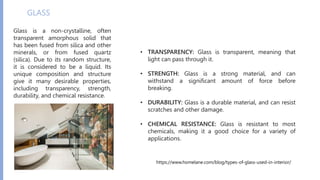
GLASS
Glass is a non-crystalline, often
transparent amorphous solid that
has been fused from silica and other
minerals, or from fused quartz
(silica). Due to its random structure,
it is considered to be a liquid. Its
unique composition and structure
give it many desirable properties,
including transparency, strength,
durability, and chemical resistance.
• TRANSPARENCY: Glass is transparent, meaning that
light can pass through it.
• STRENGTH: Glass is a strong material, and can
withstand a significant amount of force before
breaking.
• DURABILITY: Glass is a durable material, and can resist
scratches and other damage.
• CHEMICAL RESISTANCE: Glass is resistant to most
chemicals, making it a good choice for a variety of
applications.
https://www.homelane.com/blog/types-of-glass-used-in-interior/
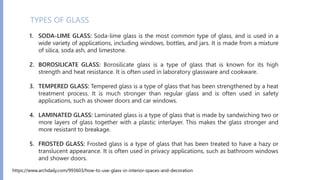
1. SODA-LIME GLASS: Soda-lime glass is the most common type of glass, and is used in a
wide variety of applications, including windows, bottles, and jars. It is made from a mixture
of silica, soda ash, and limestone.
2. BOROSILICATE GLASS: Borosilicate glass is a type of glass that is known for its high
strength and heat resistance. It is often used in laboratory glassware and cookware.
3. TEMPERED GLASS: Tempered glass is a type of glass that has been strengthened by a heat
treatment process. It is much stronger than regular glass and is often used in safety
applications, such as shower doors and car windows.
4. LAMINATED GLASS: Laminated glass is a type of glass that is made by sandwiching two or
more layers of glass together with a plastic interlayer. This makes the glass stronger and
more resistant to breakage.
5. FROSTED GLASS: Frosted glass is a type of glass that has been treated to have a hazy or
translucent appearance. It is often used in privacy applications, such as bathroom windows
and shower doors.
TYPES OF GLASS
https://www.archdaily.com/993603/how-to-use-glass-in-interior-spaces-and-decoration
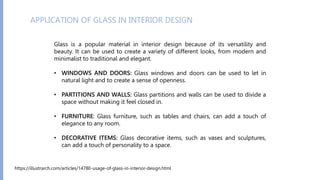
Glass is a popular material in interior design because of its versatility and
beauty. It can be used to create a variety of different looks, from modern and
minimalist to traditional and elegant.
• WINDOWS AND DOORS: Glass windows and doors can be used to let in
natural light and to create a sense of openness.
• PARTITIONS AND WALLS: Glass partitions and walls can be used to divide a
space without making it feel closed in.
• FURNITURE: Glass furniture, such as tables and chairs, can add a touch of
elegance to any room.
• DECORATIVE ITEMS: Glass decorative items, such as vases and sculptures,
can add a touch of personality to a space.
APPLICATION OF GLASS IN INTERIOR DESIGN
https://illustrarch.com/articles/14780-usage-of-glass-in-interior-design.html
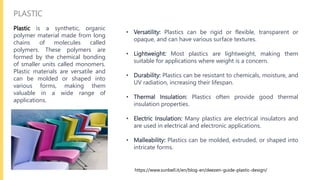
PLASTIC
Plastic is a synthetic, organic
polymer material made from long
chains of molecules called
polymers. These polymers are
formed by the chemical bonding
of smaller units called monomers.
Plastic materials are versatile and
can be molded or shaped into
various forms, making them
valuable in a wide range of
applications.
• Versatility: Plastics can be rigid or flexible, transparent or
opaque, and can have various surface textures.
• Lightweight: Most plastics are lightweight, making them
suitable for applications where weight is a concern.
• Durability: Plastics can be resistant to chemicals, moisture, and
UV radiation, increasing their lifespan.
• Thermal Insulation: Plastics often provide good thermal
insulation properties.
• Electric Insulation: Many plastics are electrical insulators and
are used in electrical and electronic applications.
• Malleability: Plastics can be molded, extruded, or shaped into
intricate forms.
https://www.sunbell.it/en/blog-en/deezen-guide-plastic-design/
1.Polymerization: Monomers are chemically bonded together to form polymer chains through a
process called polymerization.
2.Compounding: Polymers are mixed with additives such as stabilizers, plasticizers, and colorants
to achieve desired properties and appearance.
3.Molding: The plastic material is heated and shaped into the desired form using various
molding techniques, including injection molding, extrusion, blow molding, and compression
molding.
4.Cooling and Finishing: The molded products are cooled, trimmed, and finished to meet specific
requirements.
5.Quality Control: Products undergo quality control measures to ensure they meet safety and
performance standards.
MANUFACTURING METHOD PLASTIC
https://www.scribd.com/presentation/513612239/Plastic-in-Interior-Designing
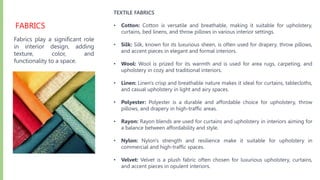
FABRICS
Fabrics play a significant role
in interior design, adding
texture, color, and
functionality to a space.
TEXTILE FABRICS
• Cotton: Cotton is versatile and breathable, making it suitable for upholstery,
curtains, bed linens, and throw pillows in various interior settings.
• Silk: Silk, known for its luxurious sheen, is often used for drapery, throw pillows,
and accent pieces in elegant and formal interiors.
• Wool: Wool is prized for its warmth and is used for area rugs, carpeting, and
upholstery in cozy and traditional interiors.
• Linen: Linen's crisp and breathable nature makes it ideal for curtains, tablecloths,
and casual upholstery in light and airy spaces.
• Polyester: Polyester is a durable and affordable choice for upholstery, throw
pillows, and drapery in high-traffic areas.
• Rayon: Rayon blends are used for curtains and upholstery in interiors aiming for
a balance between affordability and style.
• Nylon: Nylon's strength and resilience make it suitable for upholstery in
commercial and high-traffic spaces.
• Velvet: Velvet is a plush fabric often chosen for luxurious upholstery, curtains,
and accent pieces in opulent interiors.
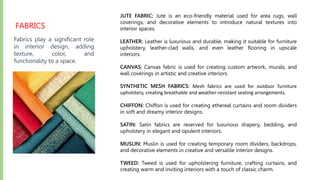
FABRICS
Fabrics play a significant role
in interior design, adding
texture, color, and
functionality to a space.
JUTE FABRIC: Jute is an eco-friendly material used for area rugs, wall
coverings, and decorative elements to introduce natural textures into
interior spaces.
LEATHER: Leather is luxurious and durable, making it suitable for furniture
upholstery, leather-clad walls, and even leather flooring in upscale
interiors.
CANVAS: Canvas fabric is used for creating custom artwork, murals, and
wall coverings in artistic and creative interiors.
SYNTHETIC MESH FABRICS: Mesh fabrics are used for outdoor furniture
upholstery, creating breathable and weather-resistant seating arrangements.
CHIFFON: Chiffon is used for creating ethereal curtains and room dividers
in soft and dreamy interior designs.
SATIN: Satin fabrics are reserved for luxurious drapery, bedding, and
upholstery in elegant and opulent interiors.
MUSLIN: Muslin is used for creating temporary room dividers, backdrops,
and decorative elements in creative and versatile interior designs.
TWEED: Tweed is used for upholstering furniture, crafting curtains, and
creating warm and inviting interiors with a touch of classic charm.

unit1- intro to materials.pptx

  • 1.
    INTERIOR MATERIALS ANDFINISHES INTRODUCTION TO MATERIALS UNIT-1 Wood, soft wood & hardwood, plywood, laminated wood &particle boards, properties manufacturing and uses, synthetic materials – types of glass, properties, manufacturing & uses. Plastic – injection molding & other manufacturing methods. Fabric – textile, jute, leather and etc, different types and their uses.
  • 2.
  • 5.
    TYPES OF WOOD CEDARWOOD Over the years, cedarwood has proven to be a durable wood suitable for both indoor and outdoor needs. It is a lightweight wood that's pest resistant and less likely to decay. It has an aromatic scent and a straight wood grain pattern. There are various types of cedarwood, but red and white cedar variants are the most common. Their distinction is evident in their names and their grain pattern. USES OF CEDAR WOOD •Cedarwood can be used to make boxes, line drawers, and simple cases •It is used to make durable chests and storage closets ADVANTAGES 1. Durable and lightweight 2. Used for a variety of outdoor and indoor projects 3. White cedar tends to take stains and paints more consistently 4. Has rot-resistant and bug-repellent properties 5. cedar lumber is excellent for fences, decks, closet lining, and dresser or chest building https://civiconcepts.com/blog/types-of-wood https://www.maramani.com/blogs/home-design-ideas/different-types-wood
  • 6.
    TYPES OF WOOD Fir,or Douglas fir, is a very hard and durable softwood. Douglas fir trees grow very tall, reaching heights of 200 to 300 feet if left to their own devices in the forest. Douglas fir has a very pronounced grain, and it usually runs rather straight. The wood has a reddish-tan coloring, and it’s not particularly good at accepting stains evenly. Because of its wood grain pattern and density (it’s a heavy wood), nails driven into Douglas fir tend to stay put. It’s also relatively inexpensive. USES OF FIR WOOD fir an excellent choice for construction lumber, although DIYers also use it for decking and some woodworking projects. ADVANTAGES 1. Fir lumber fills the walls, ceilings, and floors 2. It’s strong and durable 3. it comes in long lengths 4. it cuts well with construction saw blades. 5. rot- and insect-resistant https://civiconcepts.com/blog/types-of-wood https://www.maramani.com/blogs/home-design-ideas/different-types-wood FIR WOOD
  • 7.
    TYPES OF WOOD Pineis a very soft wood that’s incredibly easy to work with. Common types include sugar, white, ponderosa, and southern yellow pine. It’s less dense than others and easy to work with, but it doesn’t tend to offer much bug or rot resistance. Pine has a pale or yellow appearance, depending on the exact species. It is rugged-looking, and it takes paint or stain very well. All pine typically has a naturally high moisture content, and the cheaper cuts buckle and twist as they dry. USES OF PINE WOOD woodworking, wall paneling, decking (in its pressure-treated form), shelving, and other similar projects. ADVANTAGES 1. pine is an excellent choice for rustic furniture 2. Lower-grade pine from home stores can be susceptible to cupping or warping. https://civiconcepts.com/blog/types-of-wood https://www.maramani.com/blogs/home-design-ideas/different-types-wood PINE WOOD
  • 8.
    PLYWOOD Plywood is atype of engineered wood product that is made by gluing together thin layers of wood veneers or plies. These plies are typically oriented with their wood grains running at right angles to one another, which gives plywood its strength and stability USES OF PLYWOOD 1. CONSTRUCTION: Plywood is commonly used for sheathing walls, roofs, and floors in residential and commercial buildings. 2. FURNITURE: It is used to make cabinets, tables, chairs, and other furniture pieces. 3. CABINETRY: Plywood is often the preferred material for kitchen and bathroom cabinets due to its strength and stability. 4. BOAT BUILDING: Marine-grade plywood is used in the construction of boats and watercraft due to its resistance to water and moisture. 5. DIY PROJECTS: Plywood is a popular choice for various DIY projects, such as shelving, storage units, and decorative wall panels.
  • 12.
    1. Log Selection:High-quality logs are selected for veneer production. 2. Peeling or Slicing: The logs are either rotary-cut (peeled) or sliced into thin veneer sheets. 3. Drying: The veneer sheets are dried to reduce moisture content. 4. Gluing: Adhesives, typically phenol-formaldehyde or urea-formaldehyde, are applied to the veneer sheets. 5. Layering: The veneer sheets are stacked, with the wood grain of adjacent layers oriented at right angles to one another to create a balanced panel. 6. Pressing: The stacked veneer sheets are pressed together under heat and pressure, causing the adhesive to bond them into a solid panel. 7. Trimming and Finishing: The plywood sheets are trimmed to size, sanded, and finished as needed. MANUFACTURING METHODS OF PLYWOOD
  • 13.
    TYPES OF PLYWOOD 1.InteriorPlywood: This type of plywood is designed for use in dry, indoor environments. It is commonly used for furniture, cabinets, paneling, and other interior applications. 2.Exterior Plywood: Exterior plywood is treated to withstand exposure to moisture and weather conditions. It is used for outdoor construction, such as sheathing, roofing, and siding. 3.Marine Plywood: Marine plywood is specially designed for use in wet or marine environments. It has excellent resistance to water and is used in boat building, docks, and other water-related applications. 4.Structural Plywood: Structural plywood is engineered for load-bearing purposes. It meets specific strength and stiffness requirements and is used in framing, beams, and subflooring. 5.Aircraft Plywood: This high-quality plywood is used in the construction of aircraft and other applications where lightweight and strong materials are required.
  • 14.
    PROPERTIES OF PLYWOOD 1.STRENGTH: Plywood is strong and can distribute loads evenly across its surface due to the cross-grain orientation of its layers. 2. DURABILITY: Depending on the type, plywood can be highly durable and resistant to moisture, making it suitable for various environments. 3. STABILITY: Plywood is less prone to warping and shrinking compared to solid wood because of its layered construction. 4. VERSATILITY: It can be cut, shaped, and finished in various ways to suit different applications and designs. 5. COST-EFFECTIVE: Plywood is often more affordable than solid wood of similar quality and dimensions.
  • 15.
    PLYWOOD IN INTERIORDESIGN • CABINETRY: Plywood is often used to construct kitchen and bathroom cabinets. Its stability and resistance to warping make it an excellent choice for cabinet boxes and shelving. • BUILT-IN FURNITURE: Plywood can be used to create custom-built furniture pieces such as bookshelves, wardrobes, and entertainment centers. Its ability to be cut and shaped in various ways allows for unique designs. • FURNITURE BACKING: Plywood can serve as a sturdy backing for upholstered furniture like sofas and chairs. It provides structural support and stability. • DOORS: Plywood can be used for interior doors, especially in modern or minimalist designs. Its smooth surface can be finished with various laminates or veneers for a polished look.
  • 16.
    PLYWOOD IN INTERIORDESIGN • WALL PANELS: Plywood panels can be used as wall coverings to add texture and visual interest to interior spaces. They can be painted, stained, or finished with veneers for different aesthetics. • CEILINGS: Plywood can be applied to ceilings as an alternative to drywall or traditional wood planks. It can create a unique and warm atmosphere when left exposed. • FLOORING: While not as common as other flooring materials, plywood can be used as a base layer for hardwood or laminate flooring. It provides a smooth and level surface. • SHELVING: Plywood is an excellent material for creating open shelving in kitchens, living rooms, or home offices. It can be customized to fit the available space and design preferences.
  • 17.
    PLYWOOD IN INTERIORDESIGN • ROOM DIVIDERS: Plywood can be used to create room dividers or partitions, offering both functionality and aesthetics. It can define spaces within open floor plans. • FURNITURE DESIGN: Plywood is often used by designers to create unique and modern furniture pieces. Its layers can be exposed to add an interesting visual element to the design. • STAIRCASES: In contemporary interior design, plywood is sometimes used to construct staircase treads and risers, creating a minimalist and sleek look. • CHILDREN'S FURNITURE: Plywood is a popular choice for children's furniture due to its durability and the ability to create playful, custom designs.
  • 18.
    PLYWOOD IN INTERIORDESIGN • DECORATIVE ELEMENTS: Plywood can be used to craft decorative elements like wall art, room screens, and decorative panels. Its versatility allows for intricate or geometric designs. • RETAIL AND COMMERCIAL SPACES: Plywood is often used in retail stores and commercial spaces for wall cladding, display shelves, and other design elements to create a unique and welcoming atmosphere. • EXHIBITION BOOTHS: Plywood is commonly used in trade show booths and exhibition displays due to its versatility, ease of assembly, and cost-effectiveness.
  • 19.
    LAMINATED WOOD Laminated wood,often referred to as laminate wood or engineered wood, is a composite material made by bonding together multiple layers of wood veneers or wood-based products. These layers are usually adhered with adhesives and pressure, resulting in a strong and durable material. Laminated wood comes in various types and serves a wide range of uses due to its versatility. USES OF LAMINATED WOOD 1. Furniture: Many types of laminated wood, such as MDF and particleboard, are used in the construction of furniture. 2. Cabinetry: Plywood and MDF are common materials for kitchen and bathroom cabinets. 3. Construction: OSB is used for sheathing, subflooring, and roof decking in residential and commercial construction. 4. Structural Components: LVL and plywood are used for beams, headers, and other load-bearing components in building construction. 5. Interior Finishes: Laminated wood products are used for interior trim, wall panels, and decorative elements.
  • 23.
    1. Material Preparation:Wood veneers, wood fibers, or wood particles are prepared and sorted for quality. 2. Adhesive Application: Adhesives are applied to the wood components. 3. Layering: The prepared wood components are layered in the desired orientation. 4. Pressing: The layers are subjected to high pressure and temperature in a hydraulic press to bond them together. 5. Trimming and Finishing: The laminated wood sheets or panels are trimmed to size, sanded, and finished according to the intended use. MANUFACTURING METHOD OF LAMINATED WOOD
  • 24.
    1. Strength: Laminatedwood is engineered to provide strength and stability, making it suitable for structural and load-bearing applications. 2. Durability: It is often resistant to warping, splitting, and shrinking, especially when compared to solid wood. 3. Versatility: Laminated wood can be shaped, cut, and finished in various ways to suit different design and functional requirements. 4. Smooth Surface: MDF and particleboard have smooth surfaces that are ideal for painting or veneering. 5. Cost-Effectiveness: Laminated wood products are often more affordable than solid wood alternatives. PROPERTIES OF LAMINATED WOOD
  • 25.
    PLYWOOD: As mentionedearlier, plywood is a type of laminated wood made by stacking and bonding multiple thin layers of wood veneers. It is available in various grades, sizes, and types for different applications. MDF (MEDIUM-DENSITY FIBERBOARD): MDF is made from wood fibers, wax, and resin compressed under heat and pressure. It is commonly used for furniture, cabinetry, and interior trim due to its smooth surface and ability to hold intricate shapes when cut. PARTICLEBOARD: Particleboard is made from wood particles, such as wood chips and sawdust, combined with adhesives and pressed into sheets. It is less dense than MDF and is often used for furniture and cabinets, especially when cost is a primary concern. OSB (ORIENTED STRAND BOARD): OSB is made by arranging wood strands in specific orientations, then compressing and bonding them with adhesives. It is commonly used in construction for sheathing and subflooring. LAMINATED VENEER LUMBER (LVL): LVL is made by bonding thin wood veneers together with adhesives, usually in a parallel alignment. It is used for structural applications such as beams and headers. TYPES OF LAMINATED WOOD
  • 26.
    often referred toas chipboard, is an engineered wood product made from wood particles, such as wood chips, shavings, sawdust, or wood flakes, that are bonded together using adhesives and pressure. Particleboard is commonly used in a variety of applications, including furniture and interior design, due to its affordability and versatility. PARTICLE BOARDS USES OF PARTICLE BOARD 1.Furniture: Particleboard is often used to construct budget-friendly furniture pieces like shelves, cabinets, and bookcases. 2.Cabinetry: It is commonly used for the construction of kitchen and bathroom cabinets. 3.Interior Doors: Particleboard can be used for interior doors due to its cost-effectiveness. 4.Flooring Underlayment: It is used as an underlayment for flooring materials like laminate or vinyl. 5.Wall Panels: Particleboard can be used as wall panels in interior spaces to create a uniform and flat surface. 6.Storage Solutions: Particleboard is used for storage solutions such as closet shelving, wardrobes, and garage storage units.
  • 33.
    1. Material Preparation:Wood particles, such as wood chips and shavings, are sorted and prepared for processing. 2. Mixing: The wood particles are combined with adhesives, typically urea-formaldehyde or melamine-formaldehyde, in a blender or mixer. 3. Forming: The adhesive-coated wood particles are spread onto a conveyor belt and formed into a mat of the desired thickness. 4. Pressing: The mat is subjected to high pressure and temperature in a hydraulic press, causing the adhesive to cure and bond the particles together. 5. Cooling and Trimming: The freshly pressed particleboard is cooled, trimmed to the desired dimensions, and sanded to achieve a smooth surface finish. MANUFACTURING METHOD OF PARTICLE BOARD
  • 34.
    1. Affordability: Particleboardis typically more affordable than other engineered wood products like MDF or plywood. 2. Smooth Surface: It has a smooth and even surface, which makes it suitable for laminating with veneers, laminates, or paints. 3. Consistency: Particleboard offers uniform thickness and density across the entire sheet. 4. Density Variability: The density of particleboard can vary, with higher-density boards being stronger and more durable. 5. Moderate Strength: While not as strong as plywood or MDF, particleboard still has sufficient strength for many applications. 6. Limited Resistance to Moisture: Standard particleboard is not moisture-resistant and can swell or deteriorate when exposed to water for extended periods. PROPERTIES OF PARTICLE BOARD
  • 36.
    Synthetic materials, alsoknown as synthetic substances or synthetic compounds, are human-made or artificially created materials that do not occur naturally in the environment. These materials are typically produced through chemical processes or engineering techniques, often involving the manipulation of raw materials or natural substances to create new, useful products. Synthetic materials are designed to have specific properties, characteristics, and applications, making them valuable in various industries. SYNTHETIC MATERIALS CHARACTERISTICS OF SYNTHETIC MATERIALS 1.Human-Made: Synthetic materials are manufactured by humans through various chemical, physical, or engineering processes. They are not found in nature in their current form. 2.Controlled Properties: Manufacturers can precisely control the properties and characteristics of synthetic materials, such as strength, durability, texture, and appearance, to meet specific requirements. 3.Consistency: Synthetic materials typically exhibit consistent properties and performance, making them reliable for various applications. 4.Versatility: These materials can be engineered to have a wide range of properties, which makes them suitable for diverse applications across industries.
  • 37.
    EXAMPLES OF SYNTHETICMATERIALS • Plastics: Plastics are one of the most common and widely used synthetic materials. They are derived from petrochemicals and can be molded into various forms, such as bottles, packaging, toys, and automotive parts. • Synthetic Fibers: Synthetic fibers like polyester, nylon, and acrylic are used in textiles and clothing manufacturing due to their durability, versatility, and affordability. • Rubber: Synthetic rubber, such as neoprene and butyl rubber, is used in tires, gaskets, seals, and various industrial applications. • Foam Materials: Synthetic foams like polyurethane foam are used in furniture padding, insulation, mattresses, and upholstery. • Composites: Composite materials, such as carbon fiber reinforced plastics (CFRP) and fiberglass- reinforced composites, are engineered by combining synthetic fibers with resins or polymers. They are used in aerospace, automotive, and sporting goods industries.
  • 38.
    EXAMPLES OF SYNTHETICMATERIALS • Engineered Wood Products: Engineered wood products like plywood, particleboard, and medium-density fiberboard (MDF) are created by binding wood particles or veneers with adhesives. They are used in construction and furniture manufacturing. • Artificial Diamonds: Synthetic diamonds are produced in laboratories and are used in various industrial applications, including cutting and drilling. • Synthetic Polymers: Polymers like polyethylene, polypropylene, and PVC (polyvinyl chloride) are synthetic materials used in a wide range of products, from pipes and containers to medical devices and consumer goods. • Synthetic Resins: Synthetic resins are used in coatings, adhesives, and composite materials. Examples include epoxy resins and phenolic resins. • Synthetic Leather: Artificial or synthetic leather materials like vinyl and polyurethane leather are used in upholstery, clothing, and accessories as alternatives to genuine leather.
  • 39.
    GLASS Glass is anon-crystalline, often transparent amorphous solid that has been fused from silica and other minerals, or from fused quartz (silica). Due to its random structure, it is considered to be a liquid. Its unique composition and structure give it many desirable properties, including transparency, strength, durability, and chemical resistance. • TRANSPARENCY: Glass is transparent, meaning that light can pass through it. • STRENGTH: Glass is a strong material, and can withstand a significant amount of force before breaking. • DURABILITY: Glass is a durable material, and can resist scratches and other damage. • CHEMICAL RESISTANCE: Glass is resistant to most chemicals, making it a good choice for a variety of applications. https://www.homelane.com/blog/types-of-glass-used-in-interior/
  • 40.
    1. SODA-LIME GLASS:Soda-lime glass is the most common type of glass, and is used in a wide variety of applications, including windows, bottles, and jars. It is made from a mixture of silica, soda ash, and limestone. 2. BOROSILICATE GLASS: Borosilicate glass is a type of glass that is known for its high strength and heat resistance. It is often used in laboratory glassware and cookware. 3. TEMPERED GLASS: Tempered glass is a type of glass that has been strengthened by a heat treatment process. It is much stronger than regular glass and is often used in safety applications, such as shower doors and car windows. 4. LAMINATED GLASS: Laminated glass is a type of glass that is made by sandwiching two or more layers of glass together with a plastic interlayer. This makes the glass stronger and more resistant to breakage. 5. FROSTED GLASS: Frosted glass is a type of glass that has been treated to have a hazy or translucent appearance. It is often used in privacy applications, such as bathroom windows and shower doors. TYPES OF GLASS https://www.archdaily.com/993603/how-to-use-glass-in-interior-spaces-and-decoration
  • 41.
    Glass is apopular material in interior design because of its versatility and beauty. It can be used to create a variety of different looks, from modern and minimalist to traditional and elegant. • WINDOWS AND DOORS: Glass windows and doors can be used to let in natural light and to create a sense of openness. • PARTITIONS AND WALLS: Glass partitions and walls can be used to divide a space without making it feel closed in. • FURNITURE: Glass furniture, such as tables and chairs, can add a touch of elegance to any room. • DECORATIVE ITEMS: Glass decorative items, such as vases and sculptures, can add a touch of personality to a space. APPLICATION OF GLASS IN INTERIOR DESIGN https://illustrarch.com/articles/14780-usage-of-glass-in-interior-design.html
  • 42.
    PLASTIC Plastic is asynthetic, organic polymer material made from long chains of molecules called polymers. These polymers are formed by the chemical bonding of smaller units called monomers. Plastic materials are versatile and can be molded or shaped into various forms, making them valuable in a wide range of applications. • Versatility: Plastics can be rigid or flexible, transparent or opaque, and can have various surface textures. • Lightweight: Most plastics are lightweight, making them suitable for applications where weight is a concern. • Durability: Plastics can be resistant to chemicals, moisture, and UV radiation, increasing their lifespan. • Thermal Insulation: Plastics often provide good thermal insulation properties. • Electric Insulation: Many plastics are electrical insulators and are used in electrical and electronic applications. • Malleability: Plastics can be molded, extruded, or shaped into intricate forms. https://www.sunbell.it/en/blog-en/deezen-guide-plastic-design/
  • 43.
    1.Polymerization: Monomers arechemically bonded together to form polymer chains through a process called polymerization. 2.Compounding: Polymers are mixed with additives such as stabilizers, plasticizers, and colorants to achieve desired properties and appearance. 3.Molding: The plastic material is heated and shaped into the desired form using various molding techniques, including injection molding, extrusion, blow molding, and compression molding. 4.Cooling and Finishing: The molded products are cooled, trimmed, and finished to meet specific requirements. 5.Quality Control: Products undergo quality control measures to ensure they meet safety and performance standards. MANUFACTURING METHOD PLASTIC https://www.scribd.com/presentation/513612239/Plastic-in-Interior-Designing
  • 44.
    FABRICS Fabrics play asignificant role in interior design, adding texture, color, and functionality to a space. TEXTILE FABRICS • Cotton: Cotton is versatile and breathable, making it suitable for upholstery, curtains, bed linens, and throw pillows in various interior settings. • Silk: Silk, known for its luxurious sheen, is often used for drapery, throw pillows, and accent pieces in elegant and formal interiors. • Wool: Wool is prized for its warmth and is used for area rugs, carpeting, and upholstery in cozy and traditional interiors. • Linen: Linen's crisp and breathable nature makes it ideal for curtains, tablecloths, and casual upholstery in light and airy spaces. • Polyester: Polyester is a durable and affordable choice for upholstery, throw pillows, and drapery in high-traffic areas. • Rayon: Rayon blends are used for curtains and upholstery in interiors aiming for a balance between affordability and style. • Nylon: Nylon's strength and resilience make it suitable for upholstery in commercial and high-traffic spaces. • Velvet: Velvet is a plush fabric often chosen for luxurious upholstery, curtains, and accent pieces in opulent interiors.
  • 45.
    FABRICS Fabrics play asignificant role in interior design, adding texture, color, and functionality to a space. JUTE FABRIC: Jute is an eco-friendly material used for area rugs, wall coverings, and decorative elements to introduce natural textures into interior spaces. LEATHER: Leather is luxurious and durable, making it suitable for furniture upholstery, leather-clad walls, and even leather flooring in upscale interiors. CANVAS: Canvas fabric is used for creating custom artwork, murals, and wall coverings in artistic and creative interiors. SYNTHETIC MESH FABRICS: Mesh fabrics are used for outdoor furniture upholstery, creating breathable and weather-resistant seating arrangements. CHIFFON: Chiffon is used for creating ethereal curtains and room dividers in soft and dreamy interior designs. SATIN: Satin fabrics are reserved for luxurious drapery, bedding, and upholstery in elegant and opulent interiors. MUSLIN: Muslin is used for creating temporary room dividers, backdrops, and decorative elements in creative and versatile interior designs. TWEED: Tweed is used for upholstering furniture, crafting curtains, and creating warm and inviting interiors with a touch of classic charm.