WOOD AND BY
PRODUCTS
TYPES OF WOOD
Hard wood
Hardwood is used for making
cupboards, desks, wooden panels,
door-frames and window fittings. It is
extremely durable and resistant to rot,
heat, pressure and can withstand
changes in weather. Therefore, it can be
used for the construction of floors, walls
and ceilings as well. Types of hardwood
commonly used in Pakistan are Mango
tree ,Deodar, walnut tree wood and
teak.
Soft wood
Softwood is lighter and more flexible
than the hardwood but is more or less
similar to it in strength. It is derived
from evergreen trees and can be used
for the construction of wooden floors,
walls, desks, furniture, door and
wooden panels. However, softwood
might not be an ideal choice for walls
and ceilings in urban houses.
Softwood is mainly used in the
making of doors, door panels, window
frames and furniture. Some types of
softwood can also be used as a
flooring material. Commonly used
softwoods in Pakistan are Pine (chir
GENERAL PROPERTIES OF WOOD
• Generally materials expand in heat or summer while contract in winter. In case of
wood this is not the case. The wood expands in winter acnd contracts in summer.
SEASONING OF WOOD
SEASONING IS DONE TO REMOVE SAP AND WATER FROM THE WOOD.
• KILEN SEASONING;
Introducing steam to sealed container with wood in it by this sap is replaced by
water steam followed by air Seasoning
• ELECTRIC SEASONING;
Negative and positive charge are introduces on both side of the log and then
electric current is passed. This dries the sap in the wood.
• CHEMICAL SEASONING;
Wood is dipped into ammonium sulphate , the sap dissolves in it , afterwards
wood is dried
DEFECTS IN WOOD
KNOT ;
Found mostly in soft woods. It is formed at the point of attatchment of
branch
SHAKE;
It is the dead part of the tree as a result of a cut.
1. STAR SHAKE; Throughout hollow
2. CUP SHAKE ; When annual ring is effected due to a dead part in it
3. RADIAL SHAKE ; In tree radial modular rays are present in which the
sap moved. If any part of this radial sap is effected at any point it
forms radial shake
DECAY OF WOOD
• TERMITE ; f
• eeds on sap of the wood rest of the wood becomes like powder. When termite is exposed to air it dies.
Due to this reason it moves in tunnels
• WOODBORER ;
• The insect maked through and through hole in the wood.
Cure ; pesticides
• FUNGUS;
• Develops in damp areas resulting in surface of wood that in not breathable
• PARASITE;
• Feeds on tree such as wines.
BY PRODUCTS OF WOOD
By product ; the leftover used to make
something useful.
Or
Things made out of the leftover wood
Due to scarcity of trees and wood and
due to high cost of pure wood. The
by-products of wood are used
• HARD BOARD
• PLYWOOD
• CHIPBOARD
• VENEER BOARD
• SOFT BOARD
• BLOCK BOARD
• MDF
• HDF
• VENEER BOARD
PLY BOARD
• Ply means layers
• It is made by layers of veneer ; thing sheet of wood
• Veneer is hard to break in the direction of its fibres but in opposite direction it is easily breakable
• So in case of ply wood the veneer sheets are put together in a way that each sheet has opposite
direction of fibres attached parallel to each other .
• Usually the number of veneer used in ply is 3 and 5
• Due to added strength the formation of ply makes it possible to provide wood for 2 to 3 homes from
one log
• It give finish of solid wood
• On doors mostly grained ply is used
• In-between the veneer sheet a low quality wood veneer is used such as sumbal
• The thickness of ply available in market are 1/8” , ¼” and 0.5 inches
• Its strength is 4 to 5 times greater than hard board
• It can be painted polished and lacquered
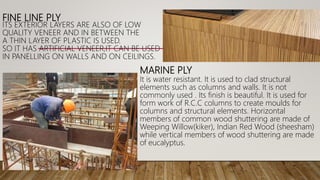
FINE LINE PLY
ITS EXTERIOR LAYERS ARE ALSO OF LOW
QUALITY VENEER AND IN BETWEEN THE
A THIN LAYER OF PLASTIC IS USED.
SO IT HAS ARTIFICIAL VENEER,IT CAN BE USED
IN PANELLING ON WALLS AND ON CEILINGS.
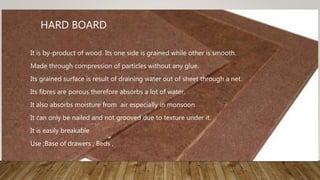
MARINE PLY
It is water resistant. It is used to clad structural
elements such as columns and walls. It is not
commonly used . Its finish is beautiful. It is used for
form work of R.C.C columns to create moulds for
columns and structural elements. Horizontal
members of common wood shuttering are made of
Weeping Willow(kiker), Indian Red Wood (sheesham)
while vertical members of wood shuttering are made
of eucalyptus.
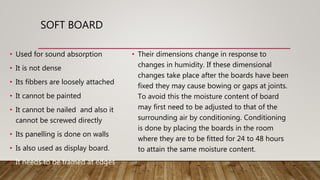
HARD BOARD
• It is by-product of wood. Its one side is grained while other is smooth.
• Made through compression of particles without any glue.
• Its grained surface is result of draining water out of sheet through a net.
• Its fibres are porous therefore absorbs a lot of water.
• It also absorbs moisture from air especially in monsoon
• It can only be nailed and not grooved due to texture under it.
• It is easily breakable
• Use ;Base of drawers , Beds ,
SOFT BOARD
• Used for sound absorption
• It is not dense
• Its fibbers are loosely attached
• It cannot be painted
• It cannot be nailed and also it
cannot be screwed directly
• Its panelling is done on walls
• Is also used as display board.
• It needs to be framed at edges
• Their dimensions change in response to
changes in humidity. If these dimensional
changes take place after the boards have been
fixed they may cause bowing or gaps at joints.
To avoid this the moisture content of board
may first need to be adjusted to that of the
surrounding air by conditioning. Conditioning
is done by placing the boards in the room
where they are to be fitted for 24 to 48 hours
to attain the same moisture content.
MDF BOARD
MDF is also regularly used in the making of furniture, cabinetry, wall panels, shelving, storage
units, decorative molding, and doors. Due to its insular qualities in sound and heat, MDF, is also
used in acoustic enclosures such as loudspeakers and sub-woofers.
Sizes of standard board sheet are 4’-0”x8’-0” , 4’-0”x6’-0” and 4’-0”x12’-0”. The reason for these
sizes that when the MDF board are placed in stores its ends become rough and need to be
removed during making of a product such as doors.
Even on its edges carving can be done.
On its sides veneer is also used
Its thickness ranges from 3mm to 25mm
It is easy to paint
A layer of emulsion is applied before painting it or sealer can be applied alternatively
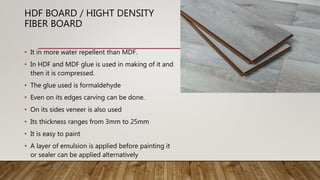
HDF BOARD / HIGHT DENSITY
FIBER BOARD
• It in more water repellent than MDF.
• In HDF and MDF glue is used in making of it and
then it is compressed.
• The glue used is formaldehyde
• Even on its edges carving can be done.
• On its sides veneer is also used
• Its thickness ranges from 3mm to 25mm
• It is easy to paint
• A layer of emulsion is applied before painting it
or sealer can be applied alternatively
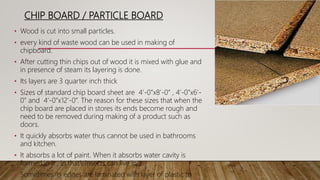
CHIP BOARD / PARTICLE BOARD
• Wood is cut into small particles.
• every kind of waste wood can be used in making of
chipboard.
• After cutting thin chips out of wood it is mixed with glue and
in presence of steam its layering is done.
• Its layers are 3 quarter inch thick
• Sizes of standard chip board sheet are 4’-0”x8’-0” , 4’-0”x6’-
0” and 4’-0”x12’-0”. The reason for these sizes that when the
chip board are placed in stores its ends become rough and
need to be removed during making of a product such as
doors.
• It quickly absorbs water thus cannot be used in bathrooms
and kitchen.
• It absorbs a lot of paint. When it absorbs water cavity is
formed in it , in that’s insects can live in it.
• Sometimes its edges are laminated with layer of plastic to
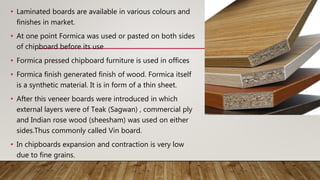
• Laminated boards are available in various colours and
finishes in market.
• At one point Formica was used or pasted on both sides
of chipboard before its use
• Formica pressed chipboard furniture is used in offices
• Formica finish generated finish of wood. Formica itself
is a synthetic material. It is in form of a thin sheet.
• After this veneer boards were introduced in which
external layers were of Teak (Sagwan) , commercial ply
and Indian rose wood (sheesham) was used on either
sides.Thus commonly called Vin board.
• In chipboards expansion and contraction is very low
due to fine grains.

Wood and by products

  • 1.
  • 2.
    TYPES OF WOOD Hardwood Hardwood is used for making cupboards, desks, wooden panels, door-frames and window fittings. It is extremely durable and resistant to rot, heat, pressure and can withstand changes in weather. Therefore, it can be used for the construction of floors, walls and ceilings as well. Types of hardwood commonly used in Pakistan are Mango tree ,Deodar, walnut tree wood and teak. Soft wood Softwood is lighter and more flexible than the hardwood but is more or less similar to it in strength. It is derived from evergreen trees and can be used for the construction of wooden floors, walls, desks, furniture, door and wooden panels. However, softwood might not be an ideal choice for walls and ceilings in urban houses. Softwood is mainly used in the making of doors, door panels, window frames and furniture. Some types of softwood can also be used as a flooring material. Commonly used softwoods in Pakistan are Pine (chir
  • 3.
    GENERAL PROPERTIES OFWOOD • Generally materials expand in heat or summer while contract in winter. In case of wood this is not the case. The wood expands in winter acnd contracts in summer.
  • 4.
    SEASONING OF WOOD SEASONINGIS DONE TO REMOVE SAP AND WATER FROM THE WOOD. • KILEN SEASONING; Introducing steam to sealed container with wood in it by this sap is replaced by water steam followed by air Seasoning • ELECTRIC SEASONING; Negative and positive charge are introduces on both side of the log and then electric current is passed. This dries the sap in the wood. • CHEMICAL SEASONING; Wood is dipped into ammonium sulphate , the sap dissolves in it , afterwards wood is dried
  • 5.
    DEFECTS IN WOOD KNOT; Found mostly in soft woods. It is formed at the point of attatchment of branch SHAKE; It is the dead part of the tree as a result of a cut. 1. STAR SHAKE; Throughout hollow 2. CUP SHAKE ; When annual ring is effected due to a dead part in it 3. RADIAL SHAKE ; In tree radial modular rays are present in which the sap moved. If any part of this radial sap is effected at any point it forms radial shake
  • 6.
    DECAY OF WOOD •TERMITE ; f • eeds on sap of the wood rest of the wood becomes like powder. When termite is exposed to air it dies. Due to this reason it moves in tunnels • WOODBORER ; • The insect maked through and through hole in the wood. Cure ; pesticides • FUNGUS; • Develops in damp areas resulting in surface of wood that in not breathable • PARASITE; • Feeds on tree such as wines.
  • 7.
    BY PRODUCTS OFWOOD By product ; the leftover used to make something useful. Or Things made out of the leftover wood Due to scarcity of trees and wood and due to high cost of pure wood. The by-products of wood are used • HARD BOARD • PLYWOOD • CHIPBOARD • VENEER BOARD • SOFT BOARD • BLOCK BOARD • MDF • HDF • VENEER BOARD
  • 8.
    PLY BOARD • Plymeans layers • It is made by layers of veneer ; thing sheet of wood • Veneer is hard to break in the direction of its fibres but in opposite direction it is easily breakable • So in case of ply wood the veneer sheets are put together in a way that each sheet has opposite direction of fibres attached parallel to each other . • Usually the number of veneer used in ply is 3 and 5 • Due to added strength the formation of ply makes it possible to provide wood for 2 to 3 homes from one log • It give finish of solid wood • On doors mostly grained ply is used • In-between the veneer sheet a low quality wood veneer is used such as sumbal • The thickness of ply available in market are 1/8” , ¼” and 0.5 inches • Its strength is 4 to 5 times greater than hard board • It can be painted polished and lacquered
  • 9.
    FINE LINE PLY ITSEXTERIOR LAYERS ARE ALSO OF LOW QUALITY VENEER AND IN BETWEEN THE A THIN LAYER OF PLASTIC IS USED. SO IT HAS ARTIFICIAL VENEER,IT CAN BE USED IN PANELLING ON WALLS AND ON CEILINGS. MARINE PLY It is water resistant. It is used to clad structural elements such as columns and walls. It is not commonly used . Its finish is beautiful. It is used for form work of R.C.C columns to create moulds for columns and structural elements. Horizontal members of common wood shuttering are made of Weeping Willow(kiker), Indian Red Wood (sheesham) while vertical members of wood shuttering are made of eucalyptus.
  • 10.
    HARD BOARD • Itis by-product of wood. Its one side is grained while other is smooth. • Made through compression of particles without any glue. • Its grained surface is result of draining water out of sheet through a net. • Its fibres are porous therefore absorbs a lot of water. • It also absorbs moisture from air especially in monsoon • It can only be nailed and not grooved due to texture under it. • It is easily breakable • Use ;Base of drawers , Beds ,
  • 11.
    SOFT BOARD • Usedfor sound absorption • It is not dense • Its fibbers are loosely attached • It cannot be painted • It cannot be nailed and also it cannot be screwed directly • Its panelling is done on walls • Is also used as display board. • It needs to be framed at edges • Their dimensions change in response to changes in humidity. If these dimensional changes take place after the boards have been fixed they may cause bowing or gaps at joints. To avoid this the moisture content of board may first need to be adjusted to that of the surrounding air by conditioning. Conditioning is done by placing the boards in the room where they are to be fitted for 24 to 48 hours to attain the same moisture content.
  • 12.
    MDF BOARD MDF isalso regularly used in the making of furniture, cabinetry, wall panels, shelving, storage units, decorative molding, and doors. Due to its insular qualities in sound and heat, MDF, is also used in acoustic enclosures such as loudspeakers and sub-woofers. Sizes of standard board sheet are 4’-0”x8’-0” , 4’-0”x6’-0” and 4’-0”x12’-0”. The reason for these sizes that when the MDF board are placed in stores its ends become rough and need to be removed during making of a product such as doors. Even on its edges carving can be done. On its sides veneer is also used Its thickness ranges from 3mm to 25mm It is easy to paint A layer of emulsion is applied before painting it or sealer can be applied alternatively
  • 13.
    HDF BOARD /HIGHT DENSITY FIBER BOARD • It in more water repellent than MDF. • In HDF and MDF glue is used in making of it and then it is compressed. • The glue used is formaldehyde • Even on its edges carving can be done. • On its sides veneer is also used • Its thickness ranges from 3mm to 25mm • It is easy to paint • A layer of emulsion is applied before painting it or sealer can be applied alternatively
  • 14.
    CHIP BOARD /PARTICLE BOARD • Wood is cut into small particles. • every kind of waste wood can be used in making of chipboard. • After cutting thin chips out of wood it is mixed with glue and in presence of steam its layering is done. • Its layers are 3 quarter inch thick • Sizes of standard chip board sheet are 4’-0”x8’-0” , 4’-0”x6’- 0” and 4’-0”x12’-0”. The reason for these sizes that when the chip board are placed in stores its ends become rough and need to be removed during making of a product such as doors. • It quickly absorbs water thus cannot be used in bathrooms and kitchen. • It absorbs a lot of paint. When it absorbs water cavity is formed in it , in that’s insects can live in it. • Sometimes its edges are laminated with layer of plastic to
  • 15.
    • Laminated boardsare available in various colours and finishes in market. • At one point Formica was used or pasted on both sides of chipboard before its use • Formica pressed chipboard furniture is used in offices • Formica finish generated finish of wood. Formica itself is a synthetic material. It is in form of a thin sheet. • After this veneer boards were introduced in which external layers were of Teak (Sagwan) , commercial ply and Indian rose wood (sheesham) was used on either sides.Thus commonly called Vin board. • In chipboards expansion and contraction is very low due to fine grains.