WOOD
PRESENTED BY:
VINITHA
HASNA
MORIS
Wood is widely used in construction, furniture making, crafting, and various
other applications due to its versatility, availability, and aesthetic appeal.
TYPES OF WOOD
• NATURAL WOOD
HARD WOOD
SOFT WOOD
SOFT WOOD
• Softwood is a type of wood that is derived from trees with needle-like or scale-like leaves,
such as conifers.
• Softwoods are typically lighter in weight.
• Commonly used in construction, furniture making, and as raw materials for paper
production.
• The main characteristics of softwood is its lower density, which makes it easier to work with
and more affordable than hardwood.
• Softwood is also typically lighter in color, with a pale yellow or reddish hue. This makes it
easy to transport and handle during construction and woodworking projects.
HARDWOOD
• Hardwood is a type of wood that is derived from deciduous trees.
• Hardwood is a dense and heavy wood that is known for its strength
and durability.
• Hardwoods have a more complex structure and are generally more
difficult to work with.
QUALITIES
• Strength
• Durability
• Versatility
• Aesthetic Appeal
• Sound Absorption
PROPERTIES
• Strength: Wood is renowned for its strength-to-weight ratio, making it a
durable and reliable material for structural applications in construction and
furniture making
• Density: Wood density varies among species and affects its overall strength,
durability, and workability. Hardwoods tend to be denser than softwoods.
• Hardness: Wood hardness is a measure of its resistance to indentation or
scratching. Hardwoods generally tend to be harder than softwoods.
• Color and Appearance: Wood exhibits a wide range of colors, from light
blondes to deep reds and browns, depending on the species and natural
variations in the wood's composition.
JOINTS IN WOOD
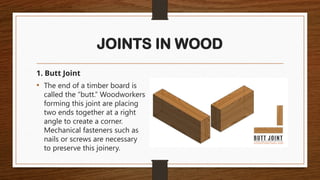
1. Butt Joint
• The end of a timber board is
called the “butt.” Woodworkers
forming this joint are placing
two ends together at a right
angle to create a corner.
Mechanical fasteners such as
nails or screws are necessary
to preserve this joinery.
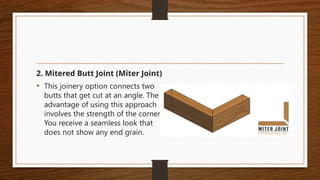
2. Mitered Butt Joint (Miter Joint)
• This joinery option connects two
butts that get cut at an angle. The
advantage of using this approach
involves the strength of the corner.
You receive a seamless look that
does not show any end grain.
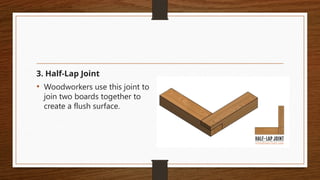
3. Half-Lap Joint
• Woodworkers use this joint to
join two boards together to
create a flush surface.
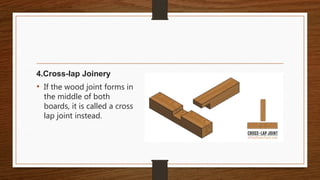
4.Cross-lap Joinery
• If the wood joint forms in
the middle of both
boards, it is called a cross
lap joint instead.
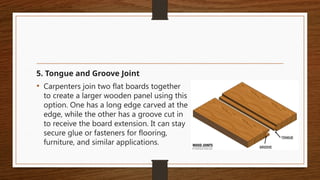
5. Tongue and Groove Joint
• Carpenters join two flat boards together
to create a larger wooden panel using this
option. One has a long edge carved at the
edge, while the other has a groove cut in
to receive the board extension. It can stay
secure glue or fasteners for flooring,
furniture, and similar applications.
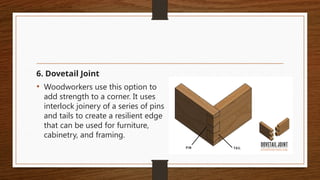
6. Dovetail Joint
• Woodworkers use this option to
add strength to a corner. It uses
interlock joinery of a series of pins
and tails to create a resilient edge
that can be used for furniture,
cabinetry, and framing.
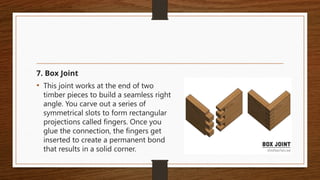
7. Box Joint
• This joint works at the end of two
timber pieces to build a seamless right
angle. You carve out a series of
symmetrical slots to form rectangular
projections called fingers. Once you
glue the connection, the fingers get
inserted to create a permanent bond
that results in a solid corner.
Don’t ask any doubts in the middle of the seminar if you have
any doubts write it down will clarify later by MORIS
INDUSTRIAL TIMBER
The timber which is prepared scientifically in a factory is termed as the
industrial timber and such timber possess desired shape, appearance, strength
etc.
PLYWOOD
BLOCK BOARD
FIBRE BOARD
PLYWOOD
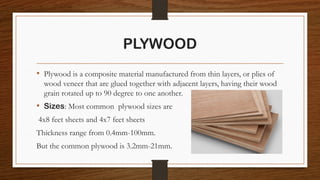
• Plywood is a composite material manufactured from thin layers, or plies of
wood veneer that are glued together with adjacent layers, having their wood
grain rotated up to 90 degree to one another.
• Sizes: Most common plywood sizes are
4x8 feet sheets and 4x7 feet sheets
Thickness range from 0.4mm-100mm.
But the common plywood is 3.2mm-21mm.
HOW THE PLYWOOD IS MADE?
• It is basically an engineered wooden sheet made with thin veneer sheets stuck
together with a resin under high pressure. This creates a thick, strong and
flexible flat sheet usually termed as plywood. It is manufactured in various
types based on type of wood used, process and its application.
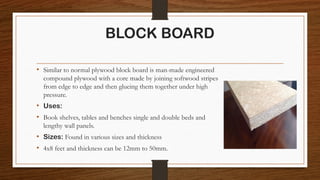
BLOCK BOARD
• Similar to normal plywood block board is man-made engineered
compound plywood with a core made by joining softwood stripes
from edge to edge and then glueing them together under high
pressure.
• Uses:
• Book shelves, tables and benches single and double beds and
lengthy wall panels.
• Sizes: Found in various sizes and thickness
• 4x8 feet and thickness can be 12mm to 50mm.
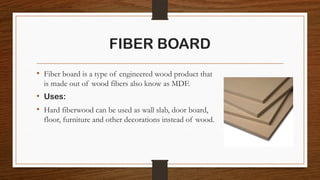
FIBER BOARD
• Fiber board is a type of engineered wood product that
is made out of wood fibers also know as MDF.
• Uses:
• Hard fiberwood can be used as wall slab, door board,
floor, furniture and other decorations instead of wood.
IMPORTANCE OF VARNISH FOR
NATURAL WOOD
• Protection
• Enhance durability
• Aesthetic appeal
• Ease of Maintenance
FINISHES FOR PLYWOOD, LAMINATES
For Plywood:
• Paint: Plywood can be painted with various types of paint, including latex,
acrylic, or oil-based paints. Painting plywood allows for customization of
color and can provide a durable finish that protects the wood from
moisture and wear.
• Varnish: Varnish is a popular finish for plywood as it provides a protective
coating that enhances the wood's natural beauty while offering resistance
to moisture, scratches, and UV damage. Varnish can be applied in various
sheens, from glossy to matte, depending on the desired look.
FOR LAMINATES:
• High-Pressure Laminate (HPL): HPL is a type of laminate that consists of multiple
layers of kraft paper saturated with resins and bonded under high pressure and heat.
It is highly durable, scratch-resistant, and available in a wide range of colors,
patterns, and textures.
• Low-Pressure Laminate (LPL): LPL is a thinner laminate material that is applied to
plywood or particleboard substrates using adhesive. It is more affordable than HPL
but offers less durability and resistance to moisture and abrasion.
• Wood Veneer Laminate: Wood veneer laminate consists of thin slices of real wood
bonded to a substrate, such as plywood or particleboard. It provides the natural
beauty of wood with added durability and stability, making it an attractive option for
furniture and cabinetry.

WOOD MATERIAL FOR INTERIORS presentation.pptx

  • 1.
  • 2.
    Wood is widelyused in construction, furniture making, crafting, and various other applications due to its versatility, availability, and aesthetic appeal.
  • 3.
    TYPES OF WOOD •NATURAL WOOD HARD WOOD SOFT WOOD
  • 4.
    SOFT WOOD • Softwoodis a type of wood that is derived from trees with needle-like or scale-like leaves, such as conifers. • Softwoods are typically lighter in weight. • Commonly used in construction, furniture making, and as raw materials for paper production. • The main characteristics of softwood is its lower density, which makes it easier to work with and more affordable than hardwood. • Softwood is also typically lighter in color, with a pale yellow or reddish hue. This makes it easy to transport and handle during construction and woodworking projects.
  • 5.
    HARDWOOD • Hardwood isa type of wood that is derived from deciduous trees. • Hardwood is a dense and heavy wood that is known for its strength and durability. • Hardwoods have a more complex structure and are generally more difficult to work with.
  • 6.
    QUALITIES • Strength • Durability •Versatility • Aesthetic Appeal • Sound Absorption
  • 7.
    PROPERTIES • Strength: Woodis renowned for its strength-to-weight ratio, making it a durable and reliable material for structural applications in construction and furniture making • Density: Wood density varies among species and affects its overall strength, durability, and workability. Hardwoods tend to be denser than softwoods. • Hardness: Wood hardness is a measure of its resistance to indentation or scratching. Hardwoods generally tend to be harder than softwoods. • Color and Appearance: Wood exhibits a wide range of colors, from light blondes to deep reds and browns, depending on the species and natural variations in the wood's composition.
  • 8.
    JOINTS IN WOOD 1.Butt Joint • The end of a timber board is called the “butt.” Woodworkers forming this joint are placing two ends together at a right angle to create a corner. Mechanical fasteners such as nails or screws are necessary to preserve this joinery.
  • 9.
    2. Mitered ButtJoint (Miter Joint) • This joinery option connects two butts that get cut at an angle. The advantage of using this approach involves the strength of the corner. You receive a seamless look that does not show any end grain.
  • 10.
    3. Half-Lap Joint •Woodworkers use this joint to join two boards together to create a flush surface.
  • 11.
    4.Cross-lap Joinery • Ifthe wood joint forms in the middle of both boards, it is called a cross lap joint instead.
  • 12.
    5. Tongue andGroove Joint • Carpenters join two flat boards together to create a larger wooden panel using this option. One has a long edge carved at the edge, while the other has a groove cut in to receive the board extension. It can stay secure glue or fasteners for flooring, furniture, and similar applications.
  • 13.
    6. Dovetail Joint •Woodworkers use this option to add strength to a corner. It uses interlock joinery of a series of pins and tails to create a resilient edge that can be used for furniture, cabinetry, and framing.
  • 14.
    7. Box Joint •This joint works at the end of two timber pieces to build a seamless right angle. You carve out a series of symmetrical slots to form rectangular projections called fingers. Once you glue the connection, the fingers get inserted to create a permanent bond that results in a solid corner.
  • 15.
    Don’t ask anydoubts in the middle of the seminar if you have any doubts write it down will clarify later by MORIS
  • 16.
    INDUSTRIAL TIMBER The timberwhich is prepared scientifically in a factory is termed as the industrial timber and such timber possess desired shape, appearance, strength etc. PLYWOOD BLOCK BOARD FIBRE BOARD
  • 17.
    PLYWOOD • Plywood isa composite material manufactured from thin layers, or plies of wood veneer that are glued together with adjacent layers, having their wood grain rotated up to 90 degree to one another. • Sizes: Most common plywood sizes are 4x8 feet sheets and 4x7 feet sheets Thickness range from 0.4mm-100mm. But the common plywood is 3.2mm-21mm.
  • 18.
    HOW THE PLYWOODIS MADE? • It is basically an engineered wooden sheet made with thin veneer sheets stuck together with a resin under high pressure. This creates a thick, strong and flexible flat sheet usually termed as plywood. It is manufactured in various types based on type of wood used, process and its application.
  • 19.
    BLOCK BOARD • Similarto normal plywood block board is man-made engineered compound plywood with a core made by joining softwood stripes from edge to edge and then glueing them together under high pressure. • Uses: • Book shelves, tables and benches single and double beds and lengthy wall panels. • Sizes: Found in various sizes and thickness • 4x8 feet and thickness can be 12mm to 50mm.
  • 20.
    FIBER BOARD • Fiberboard is a type of engineered wood product that is made out of wood fibers also know as MDF. • Uses: • Hard fiberwood can be used as wall slab, door board, floor, furniture and other decorations instead of wood.
  • 21.
    IMPORTANCE OF VARNISHFOR NATURAL WOOD • Protection • Enhance durability • Aesthetic appeal • Ease of Maintenance
  • 22.
    FINISHES FOR PLYWOOD,LAMINATES For Plywood: • Paint: Plywood can be painted with various types of paint, including latex, acrylic, or oil-based paints. Painting plywood allows for customization of color and can provide a durable finish that protects the wood from moisture and wear. • Varnish: Varnish is a popular finish for plywood as it provides a protective coating that enhances the wood's natural beauty while offering resistance to moisture, scratches, and UV damage. Varnish can be applied in various sheens, from glossy to matte, depending on the desired look.
  • 23.
    FOR LAMINATES: • High-PressureLaminate (HPL): HPL is a type of laminate that consists of multiple layers of kraft paper saturated with resins and bonded under high pressure and heat. It is highly durable, scratch-resistant, and available in a wide range of colors, patterns, and textures. • Low-Pressure Laminate (LPL): LPL is a thinner laminate material that is applied to plywood or particleboard substrates using adhesive. It is more affordable than HPL but offers less durability and resistance to moisture and abrasion. • Wood Veneer Laminate: Wood veneer laminate consists of thin slices of real wood bonded to a substrate, such as plywood or particleboard. It provides the natural beauty of wood with added durability and stability, making it an attractive option for furniture and cabinetry.