WOOD
SUBMITTED BY FAIZAN SHAFI
SUBMITTED TO MUHAMMAD ASHFAQ
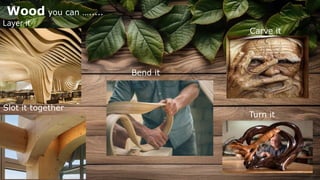
Wood you can ….....
Layer it
Bend it
Slot it together
Carve it
Turn it
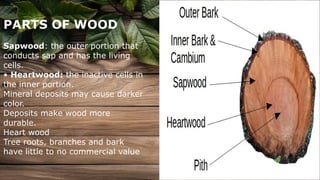
PARTS OF WOOD
Sapwood: the outer portion that
conducts sap and has the living
cells.
• Heartwood: the inactive cells in
the inner portion.
Mineral deposits may cause darker
color.
Deposits make wood more
durable.
Heart wood
Tree roots, branches and bark
have little to no commercial value
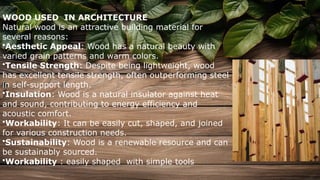
WOOD USED IN ARCHITECTURE
Natural wood is an attractive building material for
several reasons:
•Aesthetic Appeal: Wood has a natural beauty with
varied grain patterns and warm colors.
•Tensile Strength: Despite being lightweight, wood
has excellent tensile strength, often outperforming steel
in self-support length.
•Insulation: Wood is a natural insulator against heat
and sound, contributing to energy efficiency and
acoustic comfort.
•Workability: It can be easily cut, shaped, and joined
for various construction needs.
•Sustainability: Wood is a renewable resource and can
be sustainably sourced.
•Workability : easily shaped with simple tools
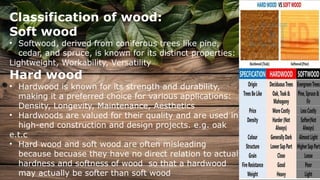
Classification of wood:
Soft wood
• Softwood, derived from coniferous trees like pine,
cedar, and spruce, is known for its distinct properties:
Lightweight, Workability, Versatility
Hard wood
• Hardwood is known for its strength and durability,
making it a preferred choice for various applications:
Density, Longevity, Maintenance, Aesthetics
• Hardwoods are valued for their quality and are used in
high-end construction and design projects. e.g. oak
e.t.c
• Hard wood and soft wood are often misleading
because becuase they have no direct relation to actual
hardness and softness of wood so that a hardwood
may actually be softer than soft wood
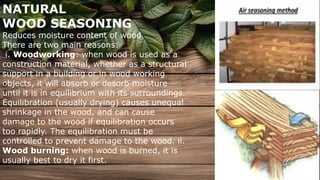
NATURAL
WOOD SEASONING
Reduces moisture content of wood
There are two main reasons:
i. Woodworking: when wood is used as a
construction material, whether as a structural
support in a building or in wood working
objects, it will absorb or desorb moisture
until it is in equilibrium with its surroundings.
Equilibration (usually drying) causes unequal
shrinkage in the wood, and can cause
damage to the wood if equilibration occurs
too rapidly. The equilibration must be
controlled to prevent damage to the wood. ii.
Wood burning: when wood is burned, it is
usually best to dry it first.
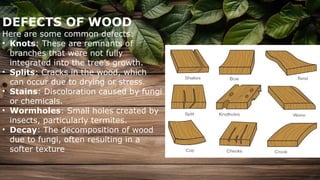
DEFECTS OF WOOD
Here are some common defects:
• Knots: These are remnants of
branches that were not fully
integrated into the tree’s growth.
• Splits: Cracks in the wood, which
can occur due to drying or stress.
• Stains: Discoloration caused by fungi
or chemicals.
• Wormholes: Small holes created by
insects, particularly termites.
• Decay: The decomposition of wood
due to fungi, often resulting in a
softer texture
WOOD COMPOSITE
Composite:Composite wood is an engineered
material made from a mixture of wood fibers,
plastics, and adhesives. It’s designed to mimic the
appearance and texture of natural wood while
offering additional properties such as durability and
sustainability
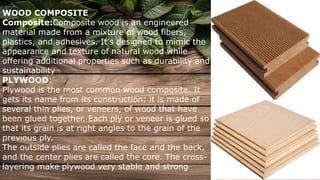
PLYWOOD:
Plywood is the most common wood composite. It
gets its name from its construction: it is made of
several thin plies, or veneers, of wood that have
been glued together. Each ply or veneer is glued so
that its grain is at right angles to the grain of the
previous ply.
The outside plies are called the face and the back,
and the center plies are called the core. The cross-
layering make plywood very stable and strong
PLYWOOD
Advantages of Plywood:
the approximate equalization of strength properties
along its length and width;
greater resistance to checking and splitting; and
less change in dimension due to moisture content
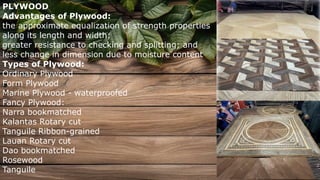
Types of Plywood:
Ordinary Plywood
Form Plywood
Marine Plywood - waterproofed
Fancy Plywood:
Narra bookmatched
Kalantas Rotary cut
Tanguile Ribbon-grained
Lauan Rotary cut
Dao bookmatched
Rosewood
Tanguile
WOOD COMPOSITES PLYWOOD
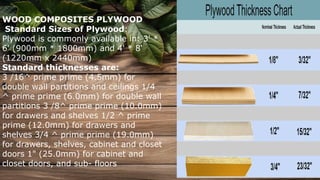
Standard Sizes of Plywood:
Plywood is commonly available in: 3' *
6' (900mm * 1800mm) and 4' * 8'
(1220mm x 2440mm)
Standard thicknesses are:
3 /16^ prime prime (4.5mm) for
double wall partitions and ceilings 1/4
^ prime prime (6.0mm) for double wall
partitions 3 /8^ prime prime (10.0mm)
for drawers and shelves 1/2 ^ prime
prime (12.0mm) for drawers and
shelves 3/4 ^ prime prime (19.0mm)
for drawers, shelves, cabinet and closet
doors 1" (25.0mm) for cabinet and
closet doors, and sub- floors
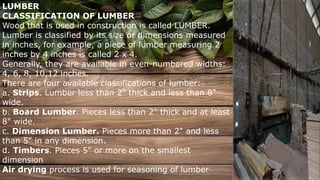
LUMBER
CLASSIFICATION OF LUMBER
Wood that is used in construction is called LUMBER.
Lumber is classified by its size or dimensions measured
in inches, for example, a piece of lumber measuring 2
inches by 4 inches is called 2 x 4.
Generally, they are available in even-numbered widths:
4, 6, 8, 10,12 inches.
There are four available classifications of lumber:
a. Strips. Lumber less than 2" thick and less than 8"
wide.
b. Board Lumber. Pieces less than 2" thick and at least
8" wide.
c. Dimension Lumber. Pieces more than 2" and less
than 5" in any dimension.
d. Timbers. Pieces 5" or more on the smallest
dimension
Air drying process is used for seasoning of lumber
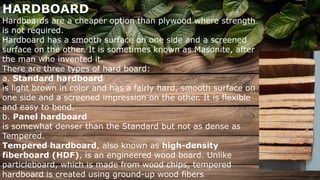
HARDBOARD
Hardboards are a cheaper option than plywood where strength
is not required.
Hardboard has a smooth surface on one side and a screened
surface on the other. It is sometimes known as Masonite, after
the man who invented it.
There are three types of hard board:
a. Standard hardboard
is light brown in color and has a fairly hard, smooth surface on
one side and a screened impression on the other. It is flexible
and easy to bend.
b. Panel hardboard
is somewhat denser than the Standard but not as dense as
Tempered.
Tempered hardboard, also known as high-density
fiberboard (HDF), is an engineered wood board. Unlike
particleboard, which is made from wood chips, tempered
hardboard is created using ground-up wood fibers.
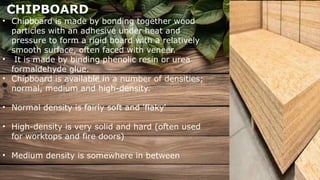
CHIPBOARD
• Chipboard is made by bonding together wood
particles with an adhesive under heat and
pressure to form a rigid board with a relatively
smooth surface, often faced with veneer.
• It is made by binding phenolic resin or urea
formaldehyde glue.
• Chipboard is available in a number of densities;
normal, medium and high-density.
• Normal density is fairly soft and 'flaky'
• High-density is very solid and hard (often used
for worktops and fire doors)
• Medium density is somewhere in between
FIBERBOARD
Fiberboard is an engineered wood product made from wood fibers.
Here are some key points about it:
• Types of Fiberboard:
• Particle Board (LDF): Low-density fiberboard, often referred
to as particle board, is the least dense type.
• Medium-Density Fiberboard (MDF): MDF has a moderate
density and is commonly used in the furniture industry. It can
be veneered to resemble conventional wood.
• Hardboard (HDF): High-density fiberboard is the densest
type. It is durable and finds applications in various fields.
• Manufacturing Process:
1.Wood Chipping 2.Cleaning 3.Defibration 4. Adhesive
Application
5.Mat Formation 6.Hot Pressing 7.Finishing
• Applications:
• Furniture Industry
• Packaging . Construction
gypsum board, also known
as drywall or plasterboard. Here’s a concise overview:
• Composition:
• Gypsum board is made from gypsum, a soft mineral
composed of calcium sulfate dihydrate.
• The manufacturing process involves grinding gypsum rock
into a fine powder and mixing it with water to form a paste.
• This paste is then sandwiched between two layers of paper
or fiberglass matting.
• Types of Gypsum Board:
• Regular Gypsum Board: Offers natural fire
resistance due to the gypsum core.
• Type X Gypsum Board: Provides enhanced fire
resistance and is commonly used in fire-rated assemblies.
• Applications:
1 Interior Walls and Ceilings 2 Soundproofing 3 Fire-
Rated Assemblies 4 Finishing
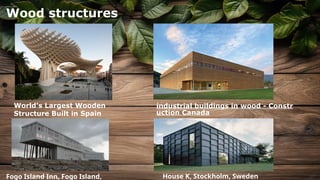
Wood structures
World's Largest Wooden
Structure Built in Spain
industrial buildings in wood - Constr
uction Canada
Fogo Island Inn, Fogo Island, House K, Stockholm, Sweden

Presentation 8.pptx for students helps

  • 1.
    WOOD SUBMITTED BY FAIZANSHAFI SUBMITTED TO MUHAMMAD ASHFAQ
  • 2.
    Wood you can…..... Layer it Bend it Slot it together Carve it Turn it
  • 3.
    PARTS OF WOOD Sapwood:the outer portion that conducts sap and has the living cells. • Heartwood: the inactive cells in the inner portion. Mineral deposits may cause darker color. Deposits make wood more durable. Heart wood Tree roots, branches and bark have little to no commercial value
  • 4.
    WOOD USED INARCHITECTURE Natural wood is an attractive building material for several reasons: •Aesthetic Appeal: Wood has a natural beauty with varied grain patterns and warm colors. •Tensile Strength: Despite being lightweight, wood has excellent tensile strength, often outperforming steel in self-support length. •Insulation: Wood is a natural insulator against heat and sound, contributing to energy efficiency and acoustic comfort. •Workability: It can be easily cut, shaped, and joined for various construction needs. •Sustainability: Wood is a renewable resource and can be sustainably sourced. •Workability : easily shaped with simple tools
  • 5.
    Classification of wood: Softwood • Softwood, derived from coniferous trees like pine, cedar, and spruce, is known for its distinct properties: Lightweight, Workability, Versatility Hard wood • Hardwood is known for its strength and durability, making it a preferred choice for various applications: Density, Longevity, Maintenance, Aesthetics • Hardwoods are valued for their quality and are used in high-end construction and design projects. e.g. oak e.t.c • Hard wood and soft wood are often misleading because becuase they have no direct relation to actual hardness and softness of wood so that a hardwood may actually be softer than soft wood
  • 6.
    NATURAL WOOD SEASONING Reduces moisturecontent of wood There are two main reasons: i. Woodworking: when wood is used as a construction material, whether as a structural support in a building or in wood working objects, it will absorb or desorb moisture until it is in equilibrium with its surroundings. Equilibration (usually drying) causes unequal shrinkage in the wood, and can cause damage to the wood if equilibration occurs too rapidly. The equilibration must be controlled to prevent damage to the wood. ii. Wood burning: when wood is burned, it is usually best to dry it first.
  • 7.
    DEFECTS OF WOOD Hereare some common defects: • Knots: These are remnants of branches that were not fully integrated into the tree’s growth. • Splits: Cracks in the wood, which can occur due to drying or stress. • Stains: Discoloration caused by fungi or chemicals. • Wormholes: Small holes created by insects, particularly termites. • Decay: The decomposition of wood due to fungi, often resulting in a softer texture
  • 8.
    WOOD COMPOSITE Composite:Composite woodis an engineered material made from a mixture of wood fibers, plastics, and adhesives. It’s designed to mimic the appearance and texture of natural wood while offering additional properties such as durability and sustainability PLYWOOD: Plywood is the most common wood composite. It gets its name from its construction: it is made of several thin plies, or veneers, of wood that have been glued together. Each ply or veneer is glued so that its grain is at right angles to the grain of the previous ply. The outside plies are called the face and the back, and the center plies are called the core. The cross- layering make plywood very stable and strong
  • 9.
    PLYWOOD Advantages of Plywood: theapproximate equalization of strength properties along its length and width; greater resistance to checking and splitting; and less change in dimension due to moisture content Types of Plywood: Ordinary Plywood Form Plywood Marine Plywood - waterproofed Fancy Plywood: Narra bookmatched Kalantas Rotary cut Tanguile Ribbon-grained Lauan Rotary cut Dao bookmatched Rosewood Tanguile
  • 10.
    WOOD COMPOSITES PLYWOOD StandardSizes of Plywood: Plywood is commonly available in: 3' * 6' (900mm * 1800mm) and 4' * 8' (1220mm x 2440mm) Standard thicknesses are: 3 /16^ prime prime (4.5mm) for double wall partitions and ceilings 1/4 ^ prime prime (6.0mm) for double wall partitions 3 /8^ prime prime (10.0mm) for drawers and shelves 1/2 ^ prime prime (12.0mm) for drawers and shelves 3/4 ^ prime prime (19.0mm) for drawers, shelves, cabinet and closet doors 1" (25.0mm) for cabinet and closet doors, and sub- floors
  • 11.
    LUMBER CLASSIFICATION OF LUMBER Woodthat is used in construction is called LUMBER. Lumber is classified by its size or dimensions measured in inches, for example, a piece of lumber measuring 2 inches by 4 inches is called 2 x 4. Generally, they are available in even-numbered widths: 4, 6, 8, 10,12 inches. There are four available classifications of lumber: a. Strips. Lumber less than 2" thick and less than 8" wide. b. Board Lumber. Pieces less than 2" thick and at least 8" wide. c. Dimension Lumber. Pieces more than 2" and less than 5" in any dimension. d. Timbers. Pieces 5" or more on the smallest dimension Air drying process is used for seasoning of lumber
  • 12.
    HARDBOARD Hardboards are acheaper option than plywood where strength is not required. Hardboard has a smooth surface on one side and a screened surface on the other. It is sometimes known as Masonite, after the man who invented it. There are three types of hard board: a. Standard hardboard is light brown in color and has a fairly hard, smooth surface on one side and a screened impression on the other. It is flexible and easy to bend. b. Panel hardboard is somewhat denser than the Standard but not as dense as Tempered. Tempered hardboard, also known as high-density fiberboard (HDF), is an engineered wood board. Unlike particleboard, which is made from wood chips, tempered hardboard is created using ground-up wood fibers.
  • 13.
    CHIPBOARD • Chipboard ismade by bonding together wood particles with an adhesive under heat and pressure to form a rigid board with a relatively smooth surface, often faced with veneer. • It is made by binding phenolic resin or urea formaldehyde glue. • Chipboard is available in a number of densities; normal, medium and high-density. • Normal density is fairly soft and 'flaky' • High-density is very solid and hard (often used for worktops and fire doors) • Medium density is somewhere in between
  • 14.
    FIBERBOARD Fiberboard is anengineered wood product made from wood fibers. Here are some key points about it: • Types of Fiberboard: • Particle Board (LDF): Low-density fiberboard, often referred to as particle board, is the least dense type. • Medium-Density Fiberboard (MDF): MDF has a moderate density and is commonly used in the furniture industry. It can be veneered to resemble conventional wood. • Hardboard (HDF): High-density fiberboard is the densest type. It is durable and finds applications in various fields. • Manufacturing Process: 1.Wood Chipping 2.Cleaning 3.Defibration 4. Adhesive Application 5.Mat Formation 6.Hot Pressing 7.Finishing • Applications: • Furniture Industry • Packaging . Construction
  • 15.
    gypsum board, alsoknown as drywall or plasterboard. Here’s a concise overview: • Composition: • Gypsum board is made from gypsum, a soft mineral composed of calcium sulfate dihydrate. • The manufacturing process involves grinding gypsum rock into a fine powder and mixing it with water to form a paste. • This paste is then sandwiched between two layers of paper or fiberglass matting. • Types of Gypsum Board: • Regular Gypsum Board: Offers natural fire resistance due to the gypsum core. • Type X Gypsum Board: Provides enhanced fire resistance and is commonly used in fire-rated assemblies. • Applications: 1 Interior Walls and Ceilings 2 Soundproofing 3 Fire- Rated Assemblies 4 Finishing
  • 16.
    Wood structures World's LargestWooden Structure Built in Spain industrial buildings in wood - Constr uction Canada Fogo Island Inn, Fogo Island, House K, Stockholm, Sweden