VERNACULAR MATERIALS
IN INTERIOR DESIGN
MUD
• While mud comes with a set of limitations
• it is thoroughly energy efficient in comparison to building materials
• Even though Indian cities are moving towards an era of fast
constructing modernization to find its place in the global scheme of
things
• It is extremely malleable
• offers better insulation than steel-and-concrete structures
• it decentralises the construction process because it utilises local
material and technology and thereby obviates the need for a
contractor,
• it costs much less to maintain mud buildings.
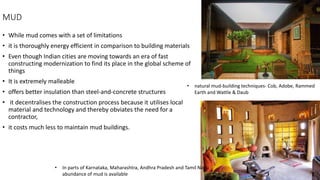
• natural mud-building techniques- Cob, Adobe, Rammed
Earth and Wattle & Daub
• In parts of Karnataka, Maharashtra, Andhra Pradesh and Tamil Nadu
abundance of mud is available
TERRACOTTA
• “Terracotta” translates to “baked earth” in Italian,
and this describes how it is manufactured as well.
• Clay is first filtered to remove dust, small stones,
and other particles, and is mixed with water to get
the right consistency that is pliable enough to be
molded without falling apart.
• Before it dries out, it is then quickly pressed into a
mold, air-dried and finally fired in a kiln- a process
that can take up to two weeks.
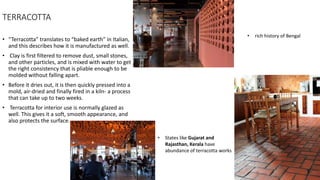
• Terracotta for interior use is normally glazed as
well. This gives it a soft, smooth appearance, and
also protects the surface.
• rich history of Bengal
• States like Gujarat and
Rajasthan, Kerala have
abundance of terracotta works
STONES
• Use of natural stones helps to maintain the man and
nature connect at home, is environment-friendly and
sustainable, low maintenance and long lasting.
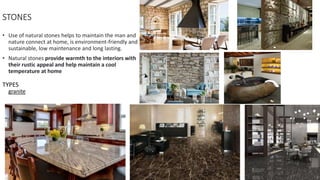
• Natural stones provide warmth to the interiors with
their rustic appeal and help maintain a cool
temperature at home
TYPES
granite
1. Andhra Pradesh-The state is known to have superb quality granites. The major districts here are Hyderabad, Chittor,
Khammam, Prakasam, and Warangal.
2. Assam-known to have enormous reserves of granite in its central and lower part. Some of these reserves have very high
grade pink granites. Besides, there is an abundance of grey and light colored granite.
3. Bihar-The northern state of India has some good varieties of granites and gneisses. Geologically, they are pink granite,
porphyritic granite, black granite, and others.
4. Gujarat-Granite stones of decorative and building values are found in Baroda, Amreli, Banaskantha, Mehsana, Sabarkantha,
and Panchmahal.
5. Karnataka-Karnataka lies in Southern India and this region is known to have ample reserves of pink granite, grey granite, and
black granite variants. The major areas where these deposits available are Tumkur, Kolar, Chickmagalur, South Kanara, Hassan,
Raichur, Bellary, Bijapur, and Gulbarga districts.
6. Orissa-Different varieties of granite are found in Jagannathpur, Kakuri Hill, Sunajheli, Kamalpur, Thirajaunju, and Ganjam
districts. The granites found here are of pink color and boast easy splitting qualities as compared to stones found in other
regions.
7. Rajasthan-The state has excellent amounts of granite deposits in the region. Granite of superb quality is primarily discovered
in Barmer, Ajmer, Bhilwara, Sirohi, Pali, and Jalore districts.
8. Tamil Nadu-This region is known to have rich amounts of black granite. The regions where it can be found are Walajah,
Tirupathur, Vellore, Chengam, Dindigal, Tanjore, Nilgiri, and Salem districts.
9.Uttar Pradesh-The grey granite which is largely used for decorative purposes can be found in the Almora district. However, the
Bundelkhand region also has some reserves of pink granite.
10. West Bengal-Granite deposits in the state can be found in the Purulia district. Birbhum district is also known to have some
granite reserves.
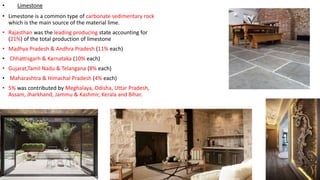
• Limestone
• Limestone is a common type of carbonate sedimentary rock
which is the main source of the material lime.
• Rajasthan was the leading producing state accounting for
(21%) of the total production of limestone
• Madhya Pradesh & Andhra Pradesh (11% each)
• Chhattisgarh & Karnataka (10% each)
• Gujarat,Tamil Nadu & Telangana (8% each)
• Maharashtra & Himachal Pradesh (4% each)
• 5% was contributed by Meghalaya, Odisha, Uttar Pradesh,
Assam, Jharkhand, Jammu & Kashmir, Kerala and Bihar.
• Travertine
• tufa
• caliche
• chalk
• sparite
• micrite
Narji Limestone – ANDRA PRADESH
Shahabad stones – MADHYA PRADESH
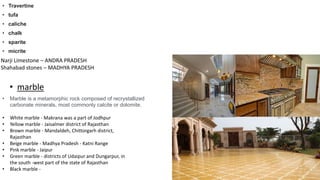
• marble
• Marble is a metamorphic rock composed of recrystallized
carbonate minerals, most commonly calcite or dolomite.
• White marble - Makrana was a part of Jodhpur
• Yellow marble - Jaisalmer district of Rajasthan
• Brown marble - Mandaldeh, Chittorgarh district,
Rajasthan
• Beige marble - Madhya Pradesh - Katni Range
• Pink marble - Jaipur
• Green marble - districts of Udaipur and Dungarpur, in
the south -west part of the state of Rajasthan
• Black marble -
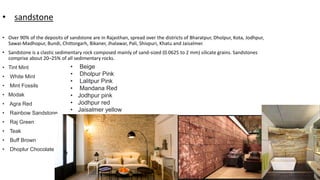
• sandstone
• Over 90% of the deposits of sandstone are in Rajasthan, spread over the districts of Bharatpur, Dholpur, Kota, Jodhpur,
Sawai-Madhopur, Bundi, Chittorgarh, Bikaner, Jhalawar, Pali, Shivpuri, Khatu and Jaisalmer.
• Sandstone is a clastic sedimentary rock composed mainly of sand-sized (0.0625 to 2 mm) silicate grains. Sandstones
comprise about 20–25% of all sedimentary rocks.
• Tint Mint
• White Mint
• Mint Fossils
• Modak
• Agra Red
• Rainbow Sandstone
• Raj Green
• Teak
• Buff Brown
• Dhoplur Chocolate
• Beige
• Dholpur Pink
• Lalitpur Pink
• Mandana Red
• Jodhpur pink
• Jodhpur red
• Jaisalmer yellow
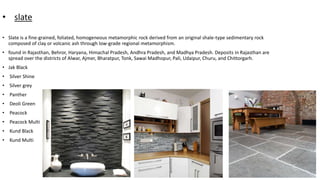
• slate
• Slate is a fine-grained, foliated, homogeneous metamorphic rock derived from an original shale-type sedimentary rock
composed of clay or volcanic ash through low-grade regional metamorphism.
• found in Rajasthan, Behror, Haryana, Himachal Pradesh, Andhra Pradesh, and Madhya Pradesh. Deposits in Rajasthan are
spread over the districts of Alwar, Ajmer, Bharatpur, Tonk, Sawai Madhopur, Pali, Udaipur, Churu, and Chittorgarh.
• Jak Black
• Silver Shine
• Silver grey
• Panther
• Deoli Green
• Peacock
• Peacock Multi
• Kund Black
• Kund Multi
FABRIC
• Silk – Silk is a classy fabric option. It is soft and flowy. You may find silk used in bed linen, curtains and upholstery.
However, it is very delicate and wrinkles quickly. It can also get stained easily and requires a lot of care.
• Rayon – In terms of texture, rayon is similar to silk. It is smooth and soft, but it is sturdier than silk. It is also
commonly used in curtains and upholstery.
• Cotton – We can’t leave cotton out of a list of fabrics, can we? Cotton is an inexpensive, easy-to-obtain fabric that
can be used for bed linens, upholstery, curtains, etc. It is quite versatile but is labelled as less elegant-looking than
silk. Cotton blends are more commonly used for interiors as pure cotton may not be sturdy enough.
• Wool – Like silk, wool is a fabulous-looking material that adds grace and class to a home. You can get beautiful woollen
rugs.
• Jute - is often found woven into carpets, window treatments, furniture coverings, and rugs. One of the more common
forms of jute in home decor, hessian cloth, is a lighter fabric used to make bags as well as wall coverings. Jute can also be
combined with other softer fibers to create textiles for making pillows, throws, linens, and upholstery.
SILK
COTTON
WOOL
JUTE
RAYON

VERNACULAR MATERIALS.pptx

  • 1.
  • 2.
    MUD • While mudcomes with a set of limitations • it is thoroughly energy efficient in comparison to building materials • Even though Indian cities are moving towards an era of fast constructing modernization to find its place in the global scheme of things • It is extremely malleable • offers better insulation than steel-and-concrete structures • it decentralises the construction process because it utilises local material and technology and thereby obviates the need for a contractor, • it costs much less to maintain mud buildings. • natural mud-building techniques- Cob, Adobe, Rammed Earth and Wattle & Daub • In parts of Karnataka, Maharashtra, Andhra Pradesh and Tamil Nadu abundance of mud is available
  • 3.
    TERRACOTTA • “Terracotta” translatesto “baked earth” in Italian, and this describes how it is manufactured as well. • Clay is first filtered to remove dust, small stones, and other particles, and is mixed with water to get the right consistency that is pliable enough to be molded without falling apart. • Before it dries out, it is then quickly pressed into a mold, air-dried and finally fired in a kiln- a process that can take up to two weeks. • Terracotta for interior use is normally glazed as well. This gives it a soft, smooth appearance, and also protects the surface. • rich history of Bengal • States like Gujarat and Rajasthan, Kerala have abundance of terracotta works
  • 4.
    STONES • Use ofnatural stones helps to maintain the man and nature connect at home, is environment-friendly and sustainable, low maintenance and long lasting. • Natural stones provide warmth to the interiors with their rustic appeal and help maintain a cool temperature at home TYPES granite
  • 5.
    1. Andhra Pradesh-Thestate is known to have superb quality granites. The major districts here are Hyderabad, Chittor, Khammam, Prakasam, and Warangal. 2. Assam-known to have enormous reserves of granite in its central and lower part. Some of these reserves have very high grade pink granites. Besides, there is an abundance of grey and light colored granite. 3. Bihar-The northern state of India has some good varieties of granites and gneisses. Geologically, they are pink granite, porphyritic granite, black granite, and others. 4. Gujarat-Granite stones of decorative and building values are found in Baroda, Amreli, Banaskantha, Mehsana, Sabarkantha, and Panchmahal. 5. Karnataka-Karnataka lies in Southern India and this region is known to have ample reserves of pink granite, grey granite, and black granite variants. The major areas where these deposits available are Tumkur, Kolar, Chickmagalur, South Kanara, Hassan, Raichur, Bellary, Bijapur, and Gulbarga districts. 6. Orissa-Different varieties of granite are found in Jagannathpur, Kakuri Hill, Sunajheli, Kamalpur, Thirajaunju, and Ganjam districts. The granites found here are of pink color and boast easy splitting qualities as compared to stones found in other regions. 7. Rajasthan-The state has excellent amounts of granite deposits in the region. Granite of superb quality is primarily discovered in Barmer, Ajmer, Bhilwara, Sirohi, Pali, and Jalore districts. 8. Tamil Nadu-This region is known to have rich amounts of black granite. The regions where it can be found are Walajah, Tirupathur, Vellore, Chengam, Dindigal, Tanjore, Nilgiri, and Salem districts. 9.Uttar Pradesh-The grey granite which is largely used for decorative purposes can be found in the Almora district. However, the Bundelkhand region also has some reserves of pink granite. 10. West Bengal-Granite deposits in the state can be found in the Purulia district. Birbhum district is also known to have some granite reserves.
  • 6.
    • Limestone • Limestoneis a common type of carbonate sedimentary rock which is the main source of the material lime. • Rajasthan was the leading producing state accounting for (21%) of the total production of limestone • Madhya Pradesh & Andhra Pradesh (11% each) • Chhattisgarh & Karnataka (10% each) • Gujarat,Tamil Nadu & Telangana (8% each) • Maharashtra & Himachal Pradesh (4% each) • 5% was contributed by Meghalaya, Odisha, Uttar Pradesh, Assam, Jharkhand, Jammu & Kashmir, Kerala and Bihar.
  • 7.
    • Travertine • tufa •caliche • chalk • sparite • micrite Narji Limestone – ANDRA PRADESH Shahabad stones – MADHYA PRADESH • marble • Marble is a metamorphic rock composed of recrystallized carbonate minerals, most commonly calcite or dolomite. • White marble - Makrana was a part of Jodhpur • Yellow marble - Jaisalmer district of Rajasthan • Brown marble - Mandaldeh, Chittorgarh district, Rajasthan • Beige marble - Madhya Pradesh - Katni Range • Pink marble - Jaipur • Green marble - districts of Udaipur and Dungarpur, in the south -west part of the state of Rajasthan • Black marble -
  • 8.
    • sandstone • Over90% of the deposits of sandstone are in Rajasthan, spread over the districts of Bharatpur, Dholpur, Kota, Jodhpur, Sawai-Madhopur, Bundi, Chittorgarh, Bikaner, Jhalawar, Pali, Shivpuri, Khatu and Jaisalmer. • Sandstone is a clastic sedimentary rock composed mainly of sand-sized (0.0625 to 2 mm) silicate grains. Sandstones comprise about 20–25% of all sedimentary rocks. • Tint Mint • White Mint • Mint Fossils • Modak • Agra Red • Rainbow Sandstone • Raj Green • Teak • Buff Brown • Dhoplur Chocolate • Beige • Dholpur Pink • Lalitpur Pink • Mandana Red • Jodhpur pink • Jodhpur red • Jaisalmer yellow
  • 9.
    • slate • Slateis a fine-grained, foliated, homogeneous metamorphic rock derived from an original shale-type sedimentary rock composed of clay or volcanic ash through low-grade regional metamorphism. • found in Rajasthan, Behror, Haryana, Himachal Pradesh, Andhra Pradesh, and Madhya Pradesh. Deposits in Rajasthan are spread over the districts of Alwar, Ajmer, Bharatpur, Tonk, Sawai Madhopur, Pali, Udaipur, Churu, and Chittorgarh. • Jak Black • Silver Shine • Silver grey • Panther • Deoli Green • Peacock • Peacock Multi • Kund Black • Kund Multi
  • 10.
    FABRIC • Silk –Silk is a classy fabric option. It is soft and flowy. You may find silk used in bed linen, curtains and upholstery. However, it is very delicate and wrinkles quickly. It can also get stained easily and requires a lot of care. • Rayon – In terms of texture, rayon is similar to silk. It is smooth and soft, but it is sturdier than silk. It is also commonly used in curtains and upholstery. • Cotton – We can’t leave cotton out of a list of fabrics, can we? Cotton is an inexpensive, easy-to-obtain fabric that can be used for bed linens, upholstery, curtains, etc. It is quite versatile but is labelled as less elegant-looking than silk. Cotton blends are more commonly used for interiors as pure cotton may not be sturdy enough. • Wool – Like silk, wool is a fabulous-looking material that adds grace and class to a home. You can get beautiful woollen rugs. • Jute - is often found woven into carpets, window treatments, furniture coverings, and rugs. One of the more common forms of jute in home decor, hessian cloth, is a lighter fabric used to make bags as well as wall coverings. Jute can also be combined with other softer fibers to create textiles for making pillows, throws, linens, and upholstery.
  • 11.