The American Woman
Suffrage Movement (1848-
1920)
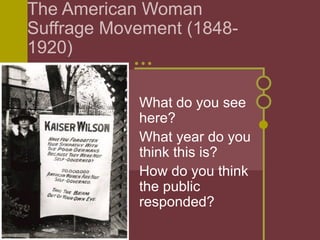
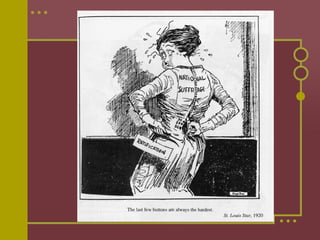
What do you see
here?
What year do you
think this is?
How do you think
the public
responded?
Terms to Know
Right to vote:
Suffrage =
Enfranchisement =
Franchise
Seneca Falls, NY 1848
 In early 1800s, women involved in abolition
(no slavery), temperance (no alcohol)
 Group of men and women gather in Seneca
Falls, NY in 1848
 Led by Elizabeth Cady Stanton and Lucretia
Mott
 Write Declaration of Sentiments: “All men
and WOMEN are created equal.”
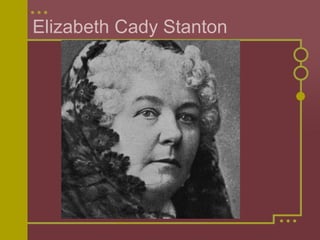
Elizabeth Cady Stanton
Fifteenth Amendment, 1870
Grants African-American men the right
to vote
Disappoints many women who thought
African American men and women
would be enfranchised together
African Americans split over whether
men should get vote before women
Frederick Douglass, 1869
“When women, because they are women, . . .
are dragged from their houses and hung
upon lamp posts; when their children are
torn from their arms, and their brains
dashed upon the pavement . . . then they
will have an urgency to obtain the ballot
equal to our own.”
But was this not true for the black woman?
“Yes, yes, yes. It is true for the black woman
but not because she is a woman but
because she is black!”
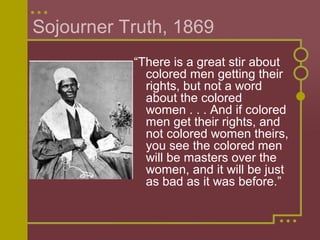
Sojourner Truth, 1869
“There is a great stir about
colored men getting their
rights, but not a word
about the colored
women . . . And if colored
men get their rights, and
not colored women theirs,
you see the colored men
will be masters over the
women, and it will be just
as bad as it was before.”
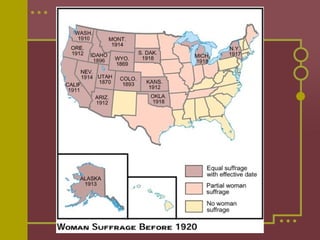
Before 1910
Women’s suffrage movement splits,
but then unites in 1890
National American Woman Suffrage
Association (NAWSA)
Big leaders: Susan B. Anthony,
Elizabeth Cady Stanton
Two big strategies:
 Try to win suffrage state-by-state
 Try to pass a Constitutional Amendment
(but this would need to be ratified by 36
states--or three-fourths)
Susan B. Anthony
Susan B. Anthony
tried several times
to introduce an
Amendment bill in
the late 1800s, but it
was always killed in
the Senate.
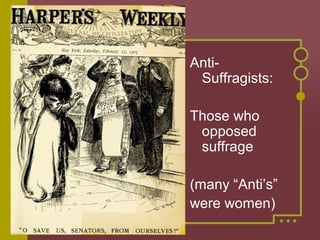
Anti-
Suffragists:
Those who
opposed
suffrage
(many “Anti’s”
were women)
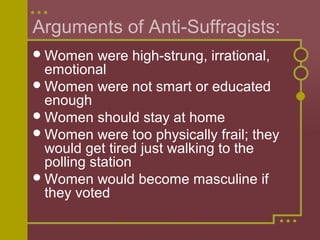
Arguments of Anti-Suffragists:
Women were high-strung, irrational,
emotional
Women were not smart or educated
enough
Women should stay at home
Women were too physically frail; they
would get tired just walking to the
polling station
Women would become masculine if
they voted
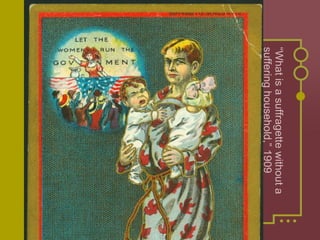
“Whatisasuffragettewithouta
sufferinghousehold,”1909
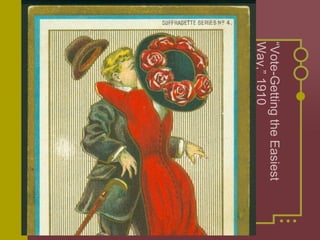
“Vote-GettingtheEasiest
Way,”1910
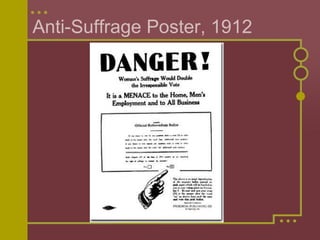
Anti-Suffrage Poster, 1912
The Next Generation
Elizabeth Cady Stanton died 1902
Susan B. Anthony died 1906
But in the early 1900s many young
middle-class women were going to
college and joining the suffrage
movement
Many working-class women also
joined the cause, hoping the right to
vote would help improve working
conditions
Safe or Sorry?
 Carrie Chapman Catt led the National
American Woman Suffrage Association.
She believed in:
Careful state-by-state strategy
Support President Wilson even if he doesn’t
outright support suffrage (because Democrats
were a safer bet than Republicans)
Act ladylike! Don’t embarrass the movement
National Woman’s Party
Alice Paul led the National Woman’s
Party; believed in more aggressive
strategies:
Focused on passing a Constitutional
Amendment
Picked up un-ladylike strategies from British
suffragists (e.g., heckling politicians,
picketing)
Refused to support President Wilson if he
wouldn’t support woman suffrage
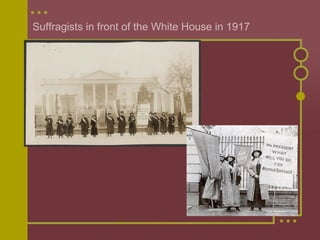
NWP members were arrested for picketing in
front of the White House; they were put in jail,
went on a hunger strike and were force-fed
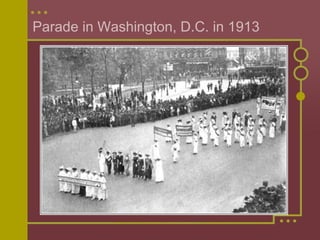
Parade in Washington, D.C. in 1913
Suffragists in front of the White House in 1917
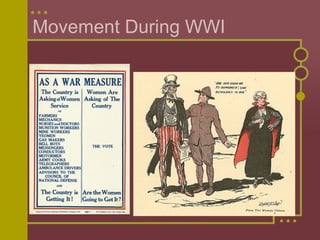
Movement During WWI
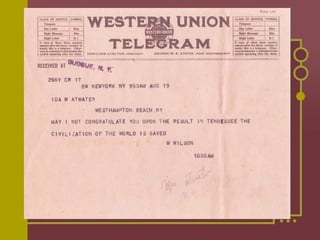
19th Amendment, 1920
“The right of citizens of the United States
to vote shall not be denied or abridged
by the United States or by any State
on account of sex.
Congress shall have power to enforce
this article by appropriate legislation.”
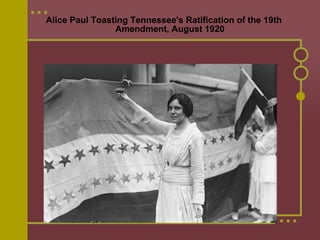
(Tennessee was the 36th state to ratify
and it passed by only 1 vote)
Alice Paul Toasting Tennessee's Ratification of the 19th
Amendment, August 1920
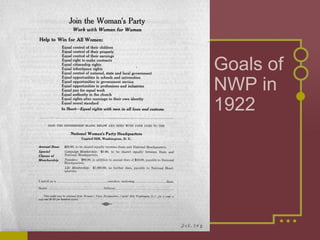
Goals of
NWP in
1922
Equal Rights Amendment
http://www.equalrightsamendment.org/
First proposed in 1923
Passed through Congress in 1972
Needs approval of 38 states, only has
35

Women's Suffrage Movement

  • 1.
    The American Woman SuffrageMovement (1848- 1920) What do you see here? What year do you think this is? How do you think the public responded?
  • 2.
    Terms to Know Rightto vote: Suffrage = Enfranchisement = Franchise
  • 3.
    Seneca Falls, NY1848  In early 1800s, women involved in abolition (no slavery), temperance (no alcohol)  Group of men and women gather in Seneca Falls, NY in 1848  Led by Elizabeth Cady Stanton and Lucretia Mott  Write Declaration of Sentiments: “All men and WOMEN are created equal.”
  • 4.
  • 5.
    Fifteenth Amendment, 1870 GrantsAfrican-American men the right to vote Disappoints many women who thought African American men and women would be enfranchised together African Americans split over whether men should get vote before women
  • 6.
    Frederick Douglass, 1869 “Whenwomen, because they are women, . . . are dragged from their houses and hung upon lamp posts; when their children are torn from their arms, and their brains dashed upon the pavement . . . then they will have an urgency to obtain the ballot equal to our own.” But was this not true for the black woman? “Yes, yes, yes. It is true for the black woman but not because she is a woman but because she is black!”
  • 7.
    Sojourner Truth, 1869 “Thereis a great stir about colored men getting their rights, but not a word about the colored women . . . And if colored men get their rights, and not colored women theirs, you see the colored men will be masters over the women, and it will be just as bad as it was before.”
  • 8.
    Before 1910 Women’s suffragemovement splits, but then unites in 1890 National American Woman Suffrage Association (NAWSA) Big leaders: Susan B. Anthony, Elizabeth Cady Stanton Two big strategies:  Try to win suffrage state-by-state  Try to pass a Constitutional Amendment (but this would need to be ratified by 36 states--or three-fourths)
  • 9.
    Susan B. Anthony SusanB. Anthony tried several times to introduce an Amendment bill in the late 1800s, but it was always killed in the Senate.
  • 10.
  • 11.
    Arguments of Anti-Suffragists: Womenwere high-strung, irrational, emotional Women were not smart or educated enough Women should stay at home Women were too physically frail; they would get tired just walking to the polling station Women would become masculine if they voted
  • 12.
  • 13.
  • 14.
  • 16.
    The Next Generation ElizabethCady Stanton died 1902 Susan B. Anthony died 1906 But in the early 1900s many young middle-class women were going to college and joining the suffrage movement Many working-class women also joined the cause, hoping the right to vote would help improve working conditions
  • 17.
    Safe or Sorry? Carrie Chapman Catt led the National American Woman Suffrage Association. She believed in: Careful state-by-state strategy Support President Wilson even if he doesn’t outright support suffrage (because Democrats were a safer bet than Republicans) Act ladylike! Don’t embarrass the movement
  • 18.
    National Woman’s Party AlicePaul led the National Woman’s Party; believed in more aggressive strategies: Focused on passing a Constitutional Amendment Picked up un-ladylike strategies from British suffragists (e.g., heckling politicians, picketing) Refused to support President Wilson if he wouldn’t support woman suffrage NWP members were arrested for picketing in front of the White House; they were put in jail, went on a hunger strike and were force-fed
  • 19.
  • 20.
    Suffragists in frontof the White House in 1917
  • 21.
  • 22.
    19th Amendment, 1920 “Theright of citizens of the United States to vote shall not be denied or abridged by the United States or by any State on account of sex. Congress shall have power to enforce this article by appropriate legislation.” (Tennessee was the 36th state to ratify and it passed by only 1 vote)
  • 25.
    Alice Paul ToastingTennessee's Ratification of the 19th Amendment, August 1920
  • 26.
  • 27.
    Equal Rights Amendment http://www.equalrightsamendment.org/ Firstproposed in 1923 Passed through Congress in 1972 Needs approval of 38 states, only has 35