 The United States expands its borders during
Thomas Jefferson’s administration.
 Election of 1800:
• Jefferson beats Adams, but ties running mate
Aaron Burr
 House of Representatives chooses president:
• Hamilton intervenes with Federalists to give
Jefferson victory
 Reveals flaw in electoral process;
• Twelfth Amendment passed
 Electors cast separate ballots for
president, vice president
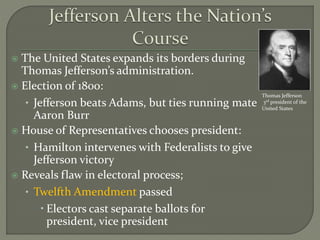
Thomas Jefferson
3rd president of the
United States
The Election of 1800 is sometimes called the
Revolution of 1800 because it is a peaceful
transition of power from one party to an
opposition party.
Convention of 1800: ends naval war with
France and restores trade. Also ends U.S.
alliance with France.
 Simplifying the Presidency
 Jefferson replaces some Federalists with Democratic-
Republicans
 Reduces size of armed forces; cuts social expenses of
government
 Eliminates internal taxes; reduces influence of Bank of
the U.S.
 Favors free trade over government-controlled trade,
tariffs
 Federalist John Marshall is chief justice for more than
30 years
 Adams pushes Judiciary Act of 1801, adding 16 federal
judges
 Appoints Federalist midnight judges on his last day as
president
 Jefferson argues undelivered appointment papers are
invalid
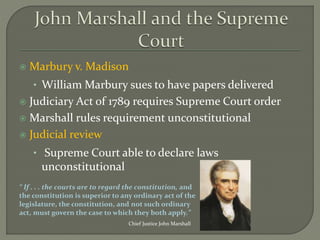
 Marbury v. Madison
• William Marbury sues to have papers delivered
 Judiciary Act of 1789 requires Supreme Court order
 Marshall rules requirement unconstitutional
 Judicial review
• Supreme Court able to declare laws
unconstitutional
Chief Justice John Marshall
“ If . . . the courts are to regard the constitution, and
the constitution is superior to any ordinary act of the
legislature, the constitution, and not such ordinary
act, must govern the case to which they both apply.”
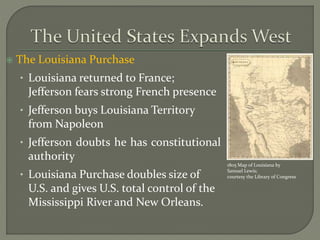
 The Louisiana Purchase
• Louisiana returned to France;
Jefferson fears strong French presence
• Jefferson buys Louisiana Territory
from Napoleon
• Jefferson doubts he has constitutional
authority
• Louisiana Purchase doubles size of
U.S. and gives U.S. total control of the
Mississippi River and New Orleans.
1805 Map of Louisiana by
Samuel Lewis;
courtesy the Library of Congress
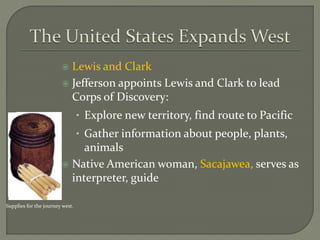
 Lewis and Clark
 Jefferson appoints Lewis and Clark to lead
Corps of Discovery:
• Explore new territory, find route to Pacific
• Gather information about people, plants,
animals
 Native American woman, Sacajawea, serves as
interpreter, guide
Supplies for the journey west.

Thomas jefferson

  • 1.
     The UnitedStates expands its borders during Thomas Jefferson’s administration.  Election of 1800: • Jefferson beats Adams, but ties running mate Aaron Burr  House of Representatives chooses president: • Hamilton intervenes with Federalists to give Jefferson victory  Reveals flaw in electoral process; • Twelfth Amendment passed  Electors cast separate ballots for president, vice president Thomas Jefferson 3rd president of the United States
  • 2.
    The Election of1800 is sometimes called the Revolution of 1800 because it is a peaceful transition of power from one party to an opposition party. Convention of 1800: ends naval war with France and restores trade. Also ends U.S. alliance with France.
  • 3.
     Simplifying thePresidency  Jefferson replaces some Federalists with Democratic- Republicans  Reduces size of armed forces; cuts social expenses of government  Eliminates internal taxes; reduces influence of Bank of the U.S.  Favors free trade over government-controlled trade, tariffs
  • 4.
     Federalist JohnMarshall is chief justice for more than 30 years  Adams pushes Judiciary Act of 1801, adding 16 federal judges  Appoints Federalist midnight judges on his last day as president  Jefferson argues undelivered appointment papers are invalid
  • 5.
     Marbury v.Madison • William Marbury sues to have papers delivered  Judiciary Act of 1789 requires Supreme Court order  Marshall rules requirement unconstitutional  Judicial review • Supreme Court able to declare laws unconstitutional Chief Justice John Marshall “ If . . . the courts are to regard the constitution, and the constitution is superior to any ordinary act of the legislature, the constitution, and not such ordinary act, must govern the case to which they both apply.”
  • 6.
     The LouisianaPurchase • Louisiana returned to France; Jefferson fears strong French presence • Jefferson buys Louisiana Territory from Napoleon • Jefferson doubts he has constitutional authority • Louisiana Purchase doubles size of U.S. and gives U.S. total control of the Mississippi River and New Orleans. 1805 Map of Louisiana by Samuel Lewis; courtesy the Library of Congress
  • 7.
     Lewis andClark  Jefferson appoints Lewis and Clark to lead Corps of Discovery: • Explore new territory, find route to Pacific • Gather information about people, plants, animals  Native American woman, Sacajawea, serves as interpreter, guide Supplies for the journey west.