+
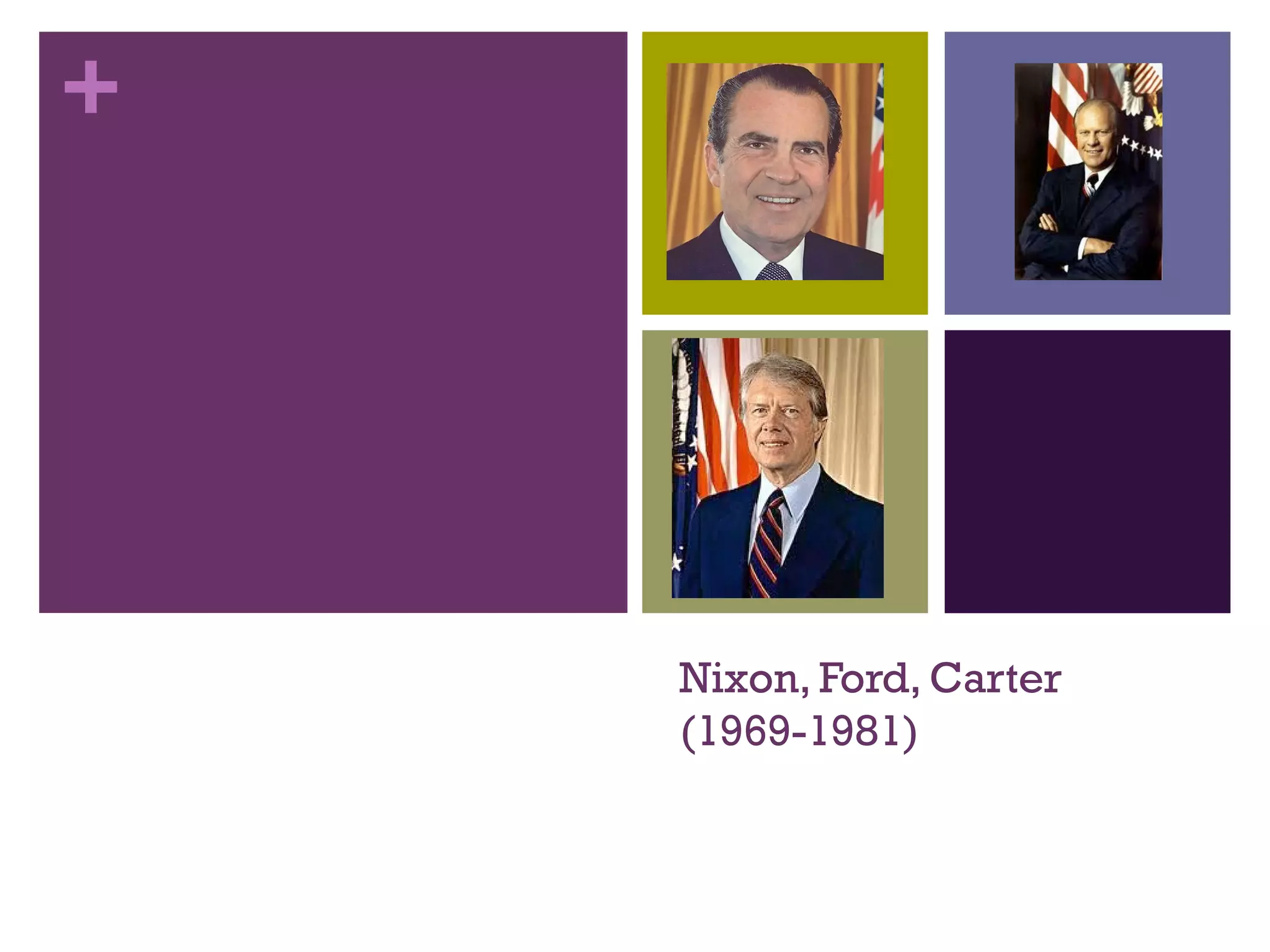
Nixon, Ford, Carter
(1969-1981)
+
Ch. 25.1:
Nixon’s Domestic Policy
pp. 826-831
+
25.1: Nixon’s Domestic Policy
 1. How did Nixon’s personality affect his relationship with his
staff, and his presidency overall?
 2.Why was the U.S. vulnerable to OPEC? How did the 1973 oil
embargo affect the U.S.?
 3. Describe the first manned moon landing.
 Complete chart on top of p. 826
+
25.1: Nixon’s Domestic Policy
(pp. 826-831)
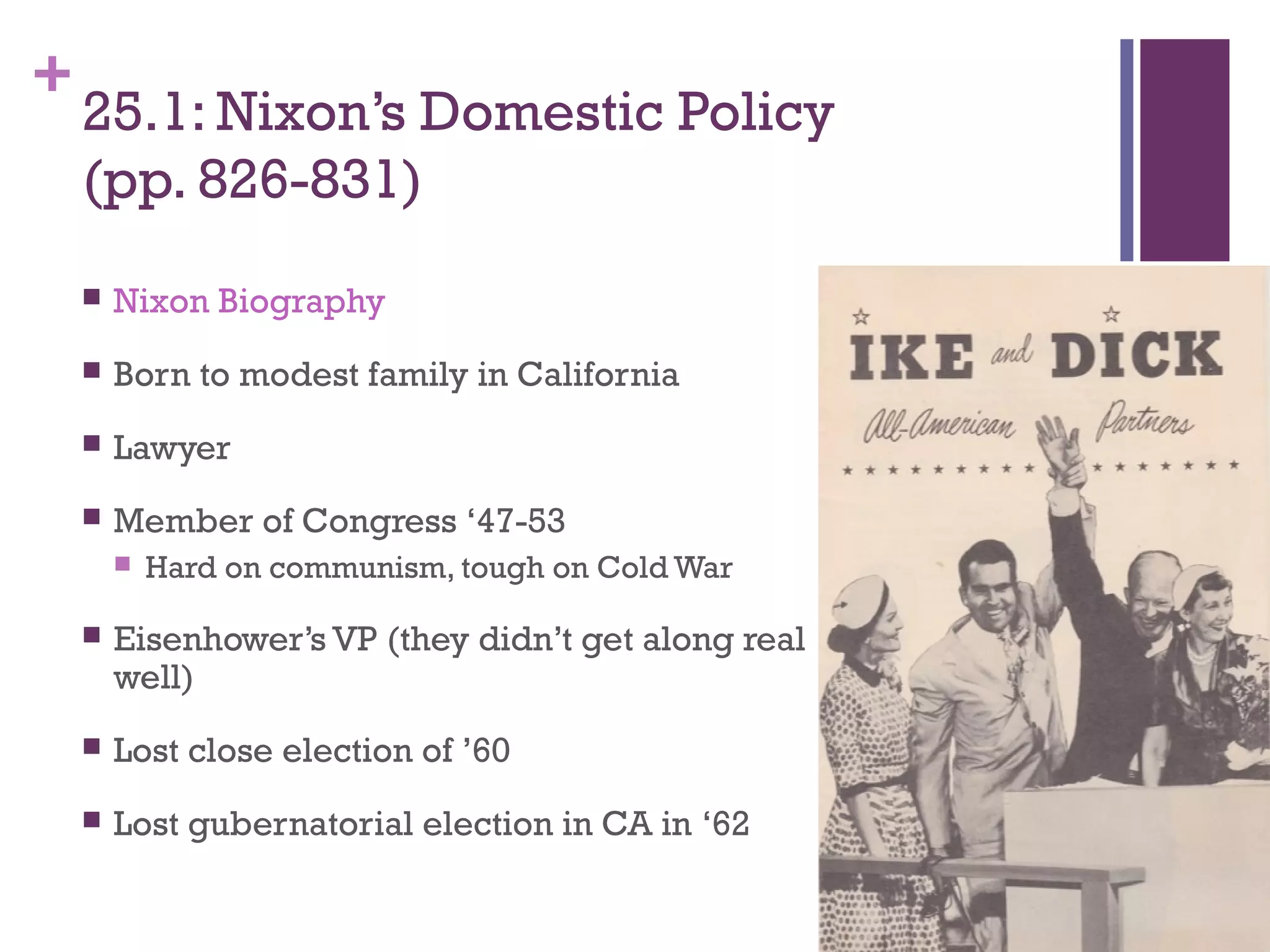
 Nixon Biography
 Born to modest family in California
 Lawyer
 Member of Congress ‘47-53
 Hard on communism, tough on Cold War
 Eisenhower’s VP (they didn’t get along real
well)
 Lost close election of ’60
 Lost gubernatorial election in CA in ‘62
+
Nixon in Person
 Reserved & remote
 Lacked charm & humor
 Not a “people person”
 Few close friends
 Found security w/ his family: wife Pat & two daughters
 Enjoyed time away to his estates in FL & CA
 Experienced politician
 Willing to win at any cost
 Anti-East coast, anti-establishment
 Believed in strong executive branch
 “Imperial presidency”
+
Nixon’s Staff
 Nixon avoided his Cabinet
 Instead relied on his White House staff
 Staffers gave extreme loyalty
 H R Haldeman (top left)—”I get done what he
wants done and I take the heat instead of him.”
 John Ehrlichman (bottom left)—Nixon’s
personal lawyer
 The two acted as Nixon’s “Berlin Wall”
 Had to pass them before speaking w/ the
President
+
Nixon’s Staff
 John Mitchell (top right)—
managed Nixon’s presidential
campaign—became Attorney
General
 Spoke w/ Nixon multiple
times/day
 Henry Kissinger (bottom right)
—former Harvard government
professor—national security
advisor and then Sec. of State
 Shaped foreign policy
+
Domestic Policy
 Vietnam War & domestic
policy were key issues of ‘68
election
 In domestic policy, Nixon
broke from JFK & LBJ
 As Nixon took office:
 Inflation had doubled
between ‘65 & ‘68
 Deficit was growing
 Unemployment on the rise
 1st
priority=halting inflation
 Hoped to get gov’t spending
under control
 Wanted to avoid price & wage
controls
 *See inflation chart on p. 828
+
Domestic Policy
 During 1st
term, Nixon
struggled to curb spending
 Additionally, unemployment &
inflation continued to rise
 Nixon was OK w/ deficit
spending; he thought it would
stimulate the economy
 Keynesian approach
 “I am now a Keynesian in
economics” (1971)
 Tried a 90-day freeze on wages, prices, &
rents in ‘71
 Tried a 60-day general price freeze in
‘73
 Lifted both after pressure from business
world
 Inflation soared
John Maynard Keynes,
British economist (1883-1946)
+
Oil Crisis
 Factors leading U.S. toward
energy crisis in ’70s:
 Growing
population=increased need
for energy
 Environmental concerns w/
coal
 Gas prices had been kept
low w/ gov’t regulations
 Oil output in U.S. declined in
’72
 When Nixon implemented
price freezes, oil refineries
let supplies run low
 When freezes lifted, demand
could not be met
 In ’73 Israel went to war w/
Egypt & Syria
 U.S. supported its ally, Israel
 Arab members of the
Organization of Petroleum
Exporting Countries (OPEC)
responded by banning all oil
trade to U.S.
 Embargo lasted from
10/1973 to 3/1974
 OPEC quadrupled prices
 $3/barrel to $12
 Higher prices worsened
inflation
 Consumers spent less & a
recession ensued
+
Social Programs
 Hoped to cut gov’t spending by cutting back or shutting
down social programs
 According to Nixon, programs were wasteful & encouraged
“welfare cheaters”
 Called for a new partnership between state & federal
governments=“New Federalism”
 States would assume greater responsibility for well-being of
citizens
 Congress passed a series of bills that granted fed. Funds to state
& local gov’ts
+
The “Southern Strategy”
 Nixon felt he had little to gain by supporting civil rights
 Very few African Americans voted for him in ‘60 & ‘68
 Didn’t want to lose white southern voters
 Promoted a slowdown in desegregation
 Wanted to find the proper “southern strategy” to win over
white southern Democrats
 Gained support from Strom Thurmond of S. Carolina
 Cut funding to enforcement of fair housing laws
 Attempted to end certain provisions of Voting Rights Act in
1970
 Openly opposed busing to end segregation in public schools
+
Nixon’s Supreme Court
 Warren Court of ‘53 to ‘69 had been criticized for
being too liberal & easy on criminals
 During Nixon’s 1st
term, 4 of the 9 justices on SC
retired or died
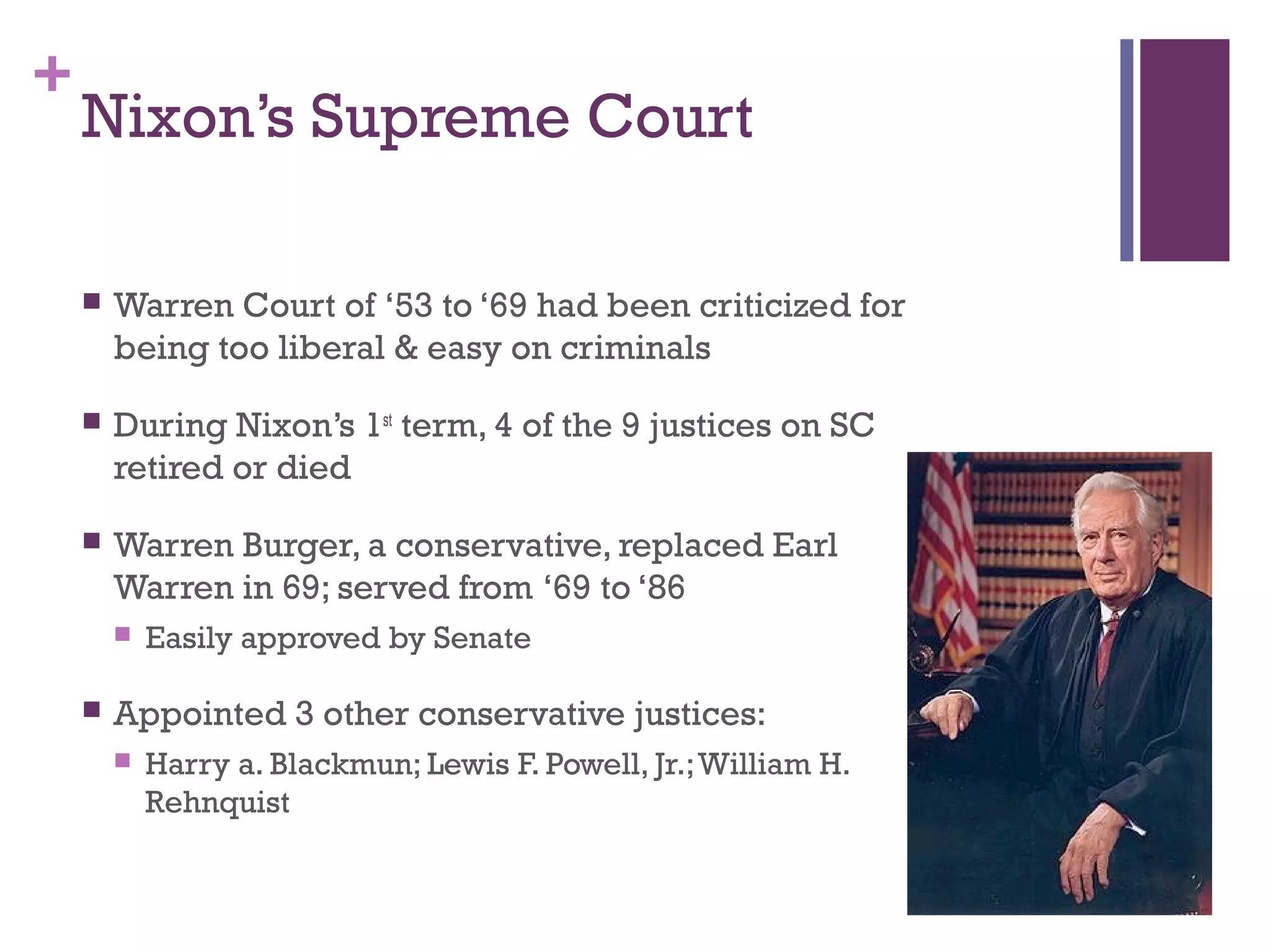
 Warren Burger, a conservative, replaced Earl
Warren in 69; served from ‘69 to ‘86
 Easily approved by Senate
 Appointed 3 other conservative justices:
 Harry a. Blackmun; Lewis F. Powell, Jr.;William H.
Rehnquist
+
The First Moon Landing
 Kennedy promised a man on
the moon by the end of the
‘60s
 July 20, 1969—Neil Armstrong
accomplished that mission
 “That’s one small step for man,
one giant leap for mankind.”
 Watch on TV worldwide
 Apollo 11 Crew=Armstrong,
Buzz Aldrin, and Michael
Colins
 Aldrin joined Armstrong on 2
hour moon walk
+
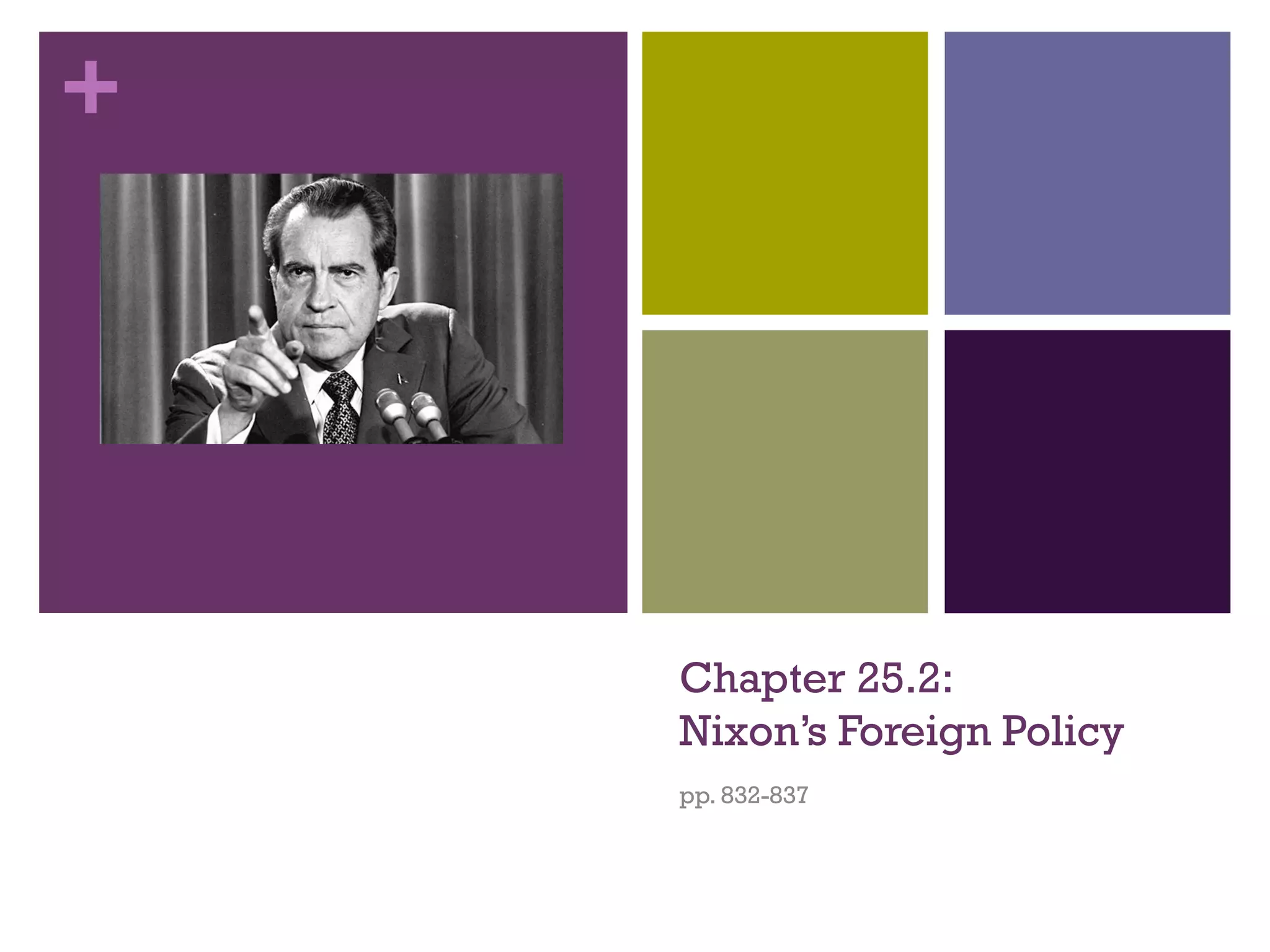
Chapter 25.2:
Nixon’s Foreign Policy
pp. 832-837
+
Nixon’s Foreign Policy
 Define: realpolitik, détente, SALT I, ping pong diplomacy
 Complete bubble chart on p. 832
 Answer following Qs:
 What role did Henry Kissinger play in relaxing tensions between
the U.S. & major communist power?
 How did Nixon reach an agreement w/ the Soviet Union on
limiting nuclear arms?
+
Setting the Scene
 Nixon set the tone for a new
direction for foreign policy in
his 1st
inaugural address on
Jan. 20, 1969
 He was able to ease Cold War
tensions
 Aided by Kissinger he est.
ties w/ China & built better
relations w/ the Soviet Union
+
Henry Kissinger
 Gained President’s confidence
 Appointed Sec. of State in ’73
 Helped end U.S. involvement in
Vietnam
 Nobel Peace Prize in ‘73
 Dominant figure in Nixon
Administration
 Talked w/ Nixon daily
 Not afraid of tough talk
 He & Nixon were both suspicious &
secretive
 *Read his bio in the sidebar on p. 833
+
Practical Politics
 Realpolitik=German term meaning “practical politics”
 Making decisions based on maintaining a country’s own
strengths rather than following moral principles
 Applied to China & Soviet Union
 How does this compare to the policy of containment?
+
Kissinger Continued
 Ability to use media to shape public
opinion
 One of the most popular public
figures of the ‘70s; became a
celebrity
 Appeared on 21 Time magazine
covers
 Gallup poll in ‘73 made him the
most-admired American
+
Relaxing Tensions
 Détente=relaxation in tensions
 Nixon’s willingness to hold talks w/ China & Soviet Union
shocked many
 Nixon had been bitter opponent of Communism in 50s
 Bypassing Congress, and sometimes his own advisors, Nixon
& Kissinger reversed the direction of postwar American
foreign policy
 Foreign affairs were more complex than a simple standoff
between the U.S. & communism
+
Relaxing Tensions
 China & the Soviet Union were once allies but had
become enemies
 The Communist Party of China denounced the Soviet
variety of Communism
 Different interpretations of Marxism
 Disagreements between Mao Zedong & Nikita Khrushchev
+
A New Approach to China
 Since Communist takeover in ‘49, the U.S. had not recognized
the Chinese government
 Politically, the U.S. acted as if China did not exist
 Instead the U.S. dealt w/ the government of Taiwan
 Nixon looked for a way to better relations w/ Communist
China; esp. since China’s relations w/ the Soviet Union had
soured
+
A New Approach to China
 Nixon’s foreign policy report to Congress in 1970:
 “The Chinese are a great and vital people who should not
remain isolated from the international community….U.S.
policy is not likely soon to have much impact on China’s
behavior, let alone its ideological outlook. But it is certainly
in our interest, and in the interest of peace and stability in
Asia and the world, that we take what steps we can toward
improved practical relations with Peking (Beijing).”
+
A New Approach to China
 Moves designed to improve relations w/ China:
 1.Feb. 1970—American & Chinese ambassadors met in Warsaw,
Poland
 2. Oct. 1970—Nixon was the first American President to refer to
China by its proper name, the People’s Republic of China
 3. March 1971—U.S. gov’t lifted restrictions on travel to China
 4. April 1971—An American table-tennis team accepted an
invitation to visit the mainland; “ping-pong diplomacy”
 5. June 1971—U.S. ended its 21 year embargo on trade w/ China
 6. July 1971—Nixon announced that he planned to travel to
China
Kissinger (left) plays ping pong in 2001, marking the 30th
anniversary of “ping pong diplomacy”
+
A New Approach to China
 Other nations were also officially recognizing the People’s
Republic of China
 In October of ’71,Taiwan lost its seat in the United Nations to
the People’s Republic of China
 Nixon realized that he could use Chinese friendship in his
dealings w/ the Soviets
 Nixon also knew his trip to China would boost his public
support at home
 He also thought the trip/friendly relations wouldn’t harm his
political career b/c of his reputation as a strong anti-
Communist
+
Nixon Goes to China
 Feb. 1972
 Met w/ Mao Zedong
 Spoke w/ premier Zhou Enlai about international problems
 Went to Great Wall & other tourist sites
 TV cameras chronicled it all
 Basis for diplomatic ties had been established
 Most members of Congress & most Americans supported the
trip & Nixon’s efforts in China
+
Nixon Goes to the Soviet Union
 In ’72, after trip to China,
Nixon went to Moscow
 Received a warm welcome
 Met w/ Premier Leonid I.
Brezhnev
 Several decisions made:
 Space exploration, eased
trade limits, & a weapons
pact
+
Balancing the Superpowers
 Limited Test Ban Treaty of ‘63
had ended above-ground
bomb testing
 Arms race continued
 Nixon hoped to end nuclear
threat & move away from arms
race
 Both U.S. & S.U. had more than
enough weapons to destroy
one another
 Strategic Arms Limitation Talks
(SALT I)—started in 1969
 In ’72, a treaty to limit nuclear
weapons
 5 year agreement to freeze
ICBMs & submarine missiles at
‘72 levels
 Also included an agreement
restricting missile defense
systems
+
Balancing the Superpowers
 SALT I was a triumph for the
Nixon administration
 Eased concerns of nuclear war
 But did not reduce # of
weapons each nation
possessed
 Paved the way for future talks
 Nixon— “Perhaps for the first time,
the evolving strategic balance allows
a Soviet-American agreement which
yields no unilateral advantages.The
fact that we have begun to discuss
strategic arms with the USSR is in
itself important. Agreement in such a
vital area could create a new
commitment to stability, and
influence attitudes toward other
issues.”

Nixon, Ford, & Carter (1969-1981)

  • 1.
  • 2.
  • 4.
    + 25.1: Nixon’s DomesticPolicy  1. How did Nixon’s personality affect his relationship with his staff, and his presidency overall?  2.Why was the U.S. vulnerable to OPEC? How did the 1973 oil embargo affect the U.S.?  3. Describe the first manned moon landing.  Complete chart on top of p. 826
  • 5.
    + 25.1: Nixon’s DomesticPolicy (pp. 826-831)  Nixon Biography  Born to modest family in California  Lawyer  Member of Congress ‘47-53  Hard on communism, tough on Cold War  Eisenhower’s VP (they didn’t get along real well)  Lost close election of ’60  Lost gubernatorial election in CA in ‘62
  • 6.
    + Nixon in Person Reserved & remote  Lacked charm & humor  Not a “people person”  Few close friends  Found security w/ his family: wife Pat & two daughters  Enjoyed time away to his estates in FL & CA  Experienced politician  Willing to win at any cost  Anti-East coast, anti-establishment  Believed in strong executive branch  “Imperial presidency”
  • 7.
    + Nixon’s Staff  Nixonavoided his Cabinet  Instead relied on his White House staff  Staffers gave extreme loyalty  H R Haldeman (top left)—”I get done what he wants done and I take the heat instead of him.”  John Ehrlichman (bottom left)—Nixon’s personal lawyer  The two acted as Nixon’s “Berlin Wall”  Had to pass them before speaking w/ the President
  • 8.
    + Nixon’s Staff  JohnMitchell (top right)— managed Nixon’s presidential campaign—became Attorney General  Spoke w/ Nixon multiple times/day  Henry Kissinger (bottom right) —former Harvard government professor—national security advisor and then Sec. of State  Shaped foreign policy
  • 9.
    + Domestic Policy  VietnamWar & domestic policy were key issues of ‘68 election  In domestic policy, Nixon broke from JFK & LBJ  As Nixon took office:  Inflation had doubled between ‘65 & ‘68  Deficit was growing  Unemployment on the rise  1st priority=halting inflation  Hoped to get gov’t spending under control  Wanted to avoid price & wage controls  *See inflation chart on p. 828
  • 10.
    + Domestic Policy  During1st term, Nixon struggled to curb spending  Additionally, unemployment & inflation continued to rise  Nixon was OK w/ deficit spending; he thought it would stimulate the economy  Keynesian approach  “I am now a Keynesian in economics” (1971)  Tried a 90-day freeze on wages, prices, & rents in ‘71  Tried a 60-day general price freeze in ‘73  Lifted both after pressure from business world  Inflation soared John Maynard Keynes, British economist (1883-1946)
  • 11.
    + Oil Crisis  Factorsleading U.S. toward energy crisis in ’70s:  Growing population=increased need for energy  Environmental concerns w/ coal  Gas prices had been kept low w/ gov’t regulations  Oil output in U.S. declined in ’72  When Nixon implemented price freezes, oil refineries let supplies run low  When freezes lifted, demand could not be met  In ’73 Israel went to war w/ Egypt & Syria  U.S. supported its ally, Israel  Arab members of the Organization of Petroleum Exporting Countries (OPEC) responded by banning all oil trade to U.S.  Embargo lasted from 10/1973 to 3/1974  OPEC quadrupled prices  $3/barrel to $12  Higher prices worsened inflation  Consumers spent less & a recession ensued
  • 13.
    + Social Programs  Hopedto cut gov’t spending by cutting back or shutting down social programs  According to Nixon, programs were wasteful & encouraged “welfare cheaters”  Called for a new partnership between state & federal governments=“New Federalism”  States would assume greater responsibility for well-being of citizens  Congress passed a series of bills that granted fed. Funds to state & local gov’ts
  • 14.
    + The “Southern Strategy” Nixon felt he had little to gain by supporting civil rights  Very few African Americans voted for him in ‘60 & ‘68  Didn’t want to lose white southern voters  Promoted a slowdown in desegregation  Wanted to find the proper “southern strategy” to win over white southern Democrats  Gained support from Strom Thurmond of S. Carolina  Cut funding to enforcement of fair housing laws  Attempted to end certain provisions of Voting Rights Act in 1970  Openly opposed busing to end segregation in public schools
  • 15.
    + Nixon’s Supreme Court Warren Court of ‘53 to ‘69 had been criticized for being too liberal & easy on criminals  During Nixon’s 1st term, 4 of the 9 justices on SC retired or died  Warren Burger, a conservative, replaced Earl Warren in 69; served from ‘69 to ‘86  Easily approved by Senate  Appointed 3 other conservative justices:  Harry a. Blackmun; Lewis F. Powell, Jr.;William H. Rehnquist
  • 16.
    + The First MoonLanding  Kennedy promised a man on the moon by the end of the ‘60s  July 20, 1969—Neil Armstrong accomplished that mission  “That’s one small step for man, one giant leap for mankind.”  Watch on TV worldwide  Apollo 11 Crew=Armstrong, Buzz Aldrin, and Michael Colins  Aldrin joined Armstrong on 2 hour moon walk
  • 17.
  • 18.
    + Nixon’s Foreign Policy Define: realpolitik, détente, SALT I, ping pong diplomacy  Complete bubble chart on p. 832  Answer following Qs:  What role did Henry Kissinger play in relaxing tensions between the U.S. & major communist power?  How did Nixon reach an agreement w/ the Soviet Union on limiting nuclear arms?
  • 19.
    + Setting the Scene Nixon set the tone for a new direction for foreign policy in his 1st inaugural address on Jan. 20, 1969  He was able to ease Cold War tensions  Aided by Kissinger he est. ties w/ China & built better relations w/ the Soviet Union
  • 20.
    + Henry Kissinger  GainedPresident’s confidence  Appointed Sec. of State in ’73  Helped end U.S. involvement in Vietnam  Nobel Peace Prize in ‘73  Dominant figure in Nixon Administration  Talked w/ Nixon daily  Not afraid of tough talk  He & Nixon were both suspicious & secretive  *Read his bio in the sidebar on p. 833
  • 21.
    + Practical Politics  Realpolitik=Germanterm meaning “practical politics”  Making decisions based on maintaining a country’s own strengths rather than following moral principles  Applied to China & Soviet Union  How does this compare to the policy of containment?
  • 22.
    + Kissinger Continued  Abilityto use media to shape public opinion  One of the most popular public figures of the ‘70s; became a celebrity  Appeared on 21 Time magazine covers  Gallup poll in ‘73 made him the most-admired American
  • 23.
    + Relaxing Tensions  Détente=relaxationin tensions  Nixon’s willingness to hold talks w/ China & Soviet Union shocked many  Nixon had been bitter opponent of Communism in 50s  Bypassing Congress, and sometimes his own advisors, Nixon & Kissinger reversed the direction of postwar American foreign policy  Foreign affairs were more complex than a simple standoff between the U.S. & communism
  • 24.
    + Relaxing Tensions  China& the Soviet Union were once allies but had become enemies  The Communist Party of China denounced the Soviet variety of Communism  Different interpretations of Marxism  Disagreements between Mao Zedong & Nikita Khrushchev
  • 25.
    + A New Approachto China  Since Communist takeover in ‘49, the U.S. had not recognized the Chinese government  Politically, the U.S. acted as if China did not exist  Instead the U.S. dealt w/ the government of Taiwan  Nixon looked for a way to better relations w/ Communist China; esp. since China’s relations w/ the Soviet Union had soured
  • 26.
    + A New Approachto China  Nixon’s foreign policy report to Congress in 1970:  “The Chinese are a great and vital people who should not remain isolated from the international community….U.S. policy is not likely soon to have much impact on China’s behavior, let alone its ideological outlook. But it is certainly in our interest, and in the interest of peace and stability in Asia and the world, that we take what steps we can toward improved practical relations with Peking (Beijing).”
  • 27.
    + A New Approachto China  Moves designed to improve relations w/ China:  1.Feb. 1970—American & Chinese ambassadors met in Warsaw, Poland  2. Oct. 1970—Nixon was the first American President to refer to China by its proper name, the People’s Republic of China  3. March 1971—U.S. gov’t lifted restrictions on travel to China  4. April 1971—An American table-tennis team accepted an invitation to visit the mainland; “ping-pong diplomacy”  5. June 1971—U.S. ended its 21 year embargo on trade w/ China  6. July 1971—Nixon announced that he planned to travel to China
  • 29.
    Kissinger (left) playsping pong in 2001, marking the 30th anniversary of “ping pong diplomacy”
  • 30.
    + A New Approachto China  Other nations were also officially recognizing the People’s Republic of China  In October of ’71,Taiwan lost its seat in the United Nations to the People’s Republic of China  Nixon realized that he could use Chinese friendship in his dealings w/ the Soviets  Nixon also knew his trip to China would boost his public support at home  He also thought the trip/friendly relations wouldn’t harm his political career b/c of his reputation as a strong anti- Communist
  • 31.
    + Nixon Goes toChina  Feb. 1972  Met w/ Mao Zedong  Spoke w/ premier Zhou Enlai about international problems  Went to Great Wall & other tourist sites  TV cameras chronicled it all  Basis for diplomatic ties had been established  Most members of Congress & most Americans supported the trip & Nixon’s efforts in China
  • 33.
    + Nixon Goes tothe Soviet Union  In ’72, after trip to China, Nixon went to Moscow  Received a warm welcome  Met w/ Premier Leonid I. Brezhnev  Several decisions made:  Space exploration, eased trade limits, & a weapons pact
  • 34.
    + Balancing the Superpowers Limited Test Ban Treaty of ‘63 had ended above-ground bomb testing  Arms race continued  Nixon hoped to end nuclear threat & move away from arms race  Both U.S. & S.U. had more than enough weapons to destroy one another  Strategic Arms Limitation Talks (SALT I)—started in 1969  In ’72, a treaty to limit nuclear weapons  5 year agreement to freeze ICBMs & submarine missiles at ‘72 levels  Also included an agreement restricting missile defense systems
  • 35.
    + Balancing the Superpowers SALT I was a triumph for the Nixon administration  Eased concerns of nuclear war  But did not reduce # of weapons each nation possessed  Paved the way for future talks  Nixon— “Perhaps for the first time, the evolving strategic balance allows a Soviet-American agreement which yields no unilateral advantages.The fact that we have begun to discuss strategic arms with the USSR is in itself important. Agreement in such a vital area could create a new commitment to stability, and influence attitudes toward other issues.”