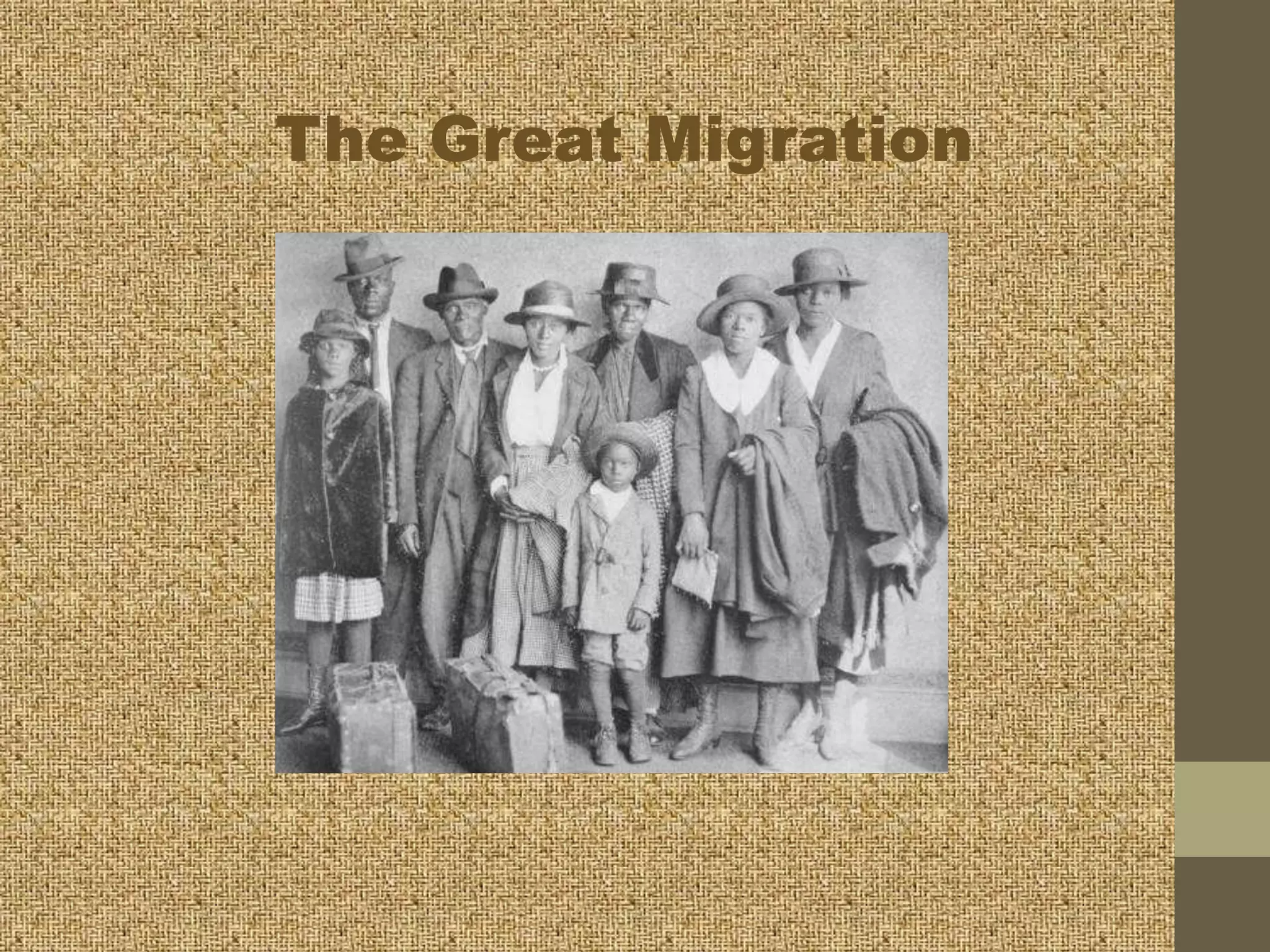
The Great Migration
What is the Great Migration?
• The Great Migration was a massive
relocation of African Americans from the
rural Southern states to cities of the North.
• The First Wave: 1910 to 1930 (1.6 million
people). After 1930 the migration slowed
down a bit because of the Great
Depression.
• Second Wave: 1940 to 1970 (5 million
people). The U.S. entered the Second World
War in 1941.
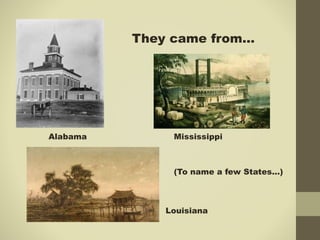
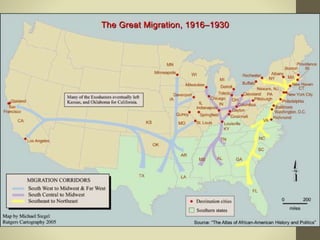
They came from…
Alabama Mississippi
Louisiana
(To name a few States…)
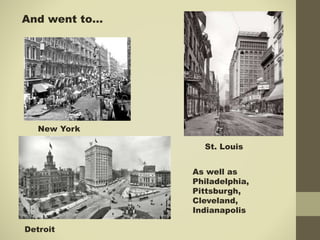
And went to…
New York
Detroit
St. Louis
As well as
Philadelphia,
Pittsburgh,
Cleveland,
Indianapolis
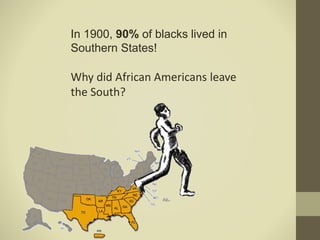
In 1900, 90% of blacks lived in
Southern States!
Why did African Americans leave
the South?
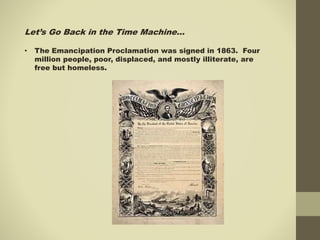
Let’s Go Back in the Time Machine…
• The Emancipation Proclamation was signed in 1863. Four
million people, poor, displaced, and mostly illiterate, are
free but homeless.
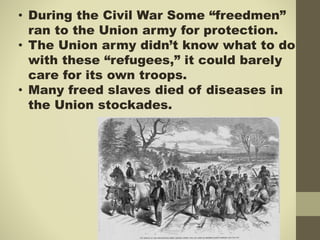
• During the Civil War Some “freedmen”
ran to the Union army for protection.
• The Union army didn’t know what to do
with these “refugees,” it could barely
care for its own troops.
• Many freed slaves died of diseases in
the Union stockades.
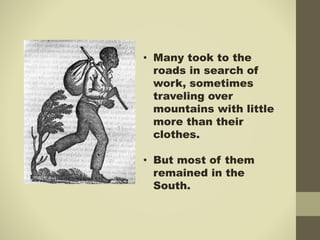
• Many took to the
roads in search of
work, sometimes
traveling over
mountains with little
more than their
clothes.
• But most of them
remained in the
South.
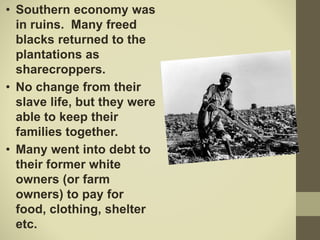
• Southern economy was
in ruins. Many freed
blacks returned to the
plantations as
sharecroppers.
• No change from their
slave life, but they were
able to keep their
families together.
• Many went into debt to
their former white
owners (or farm
owners) to pay for
food, clothing, shelter
etc.
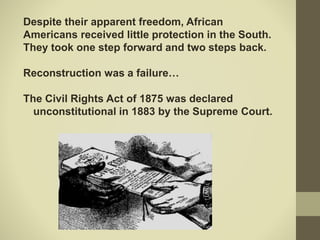
Despite their apparent freedom, African
Americans received little protection in the South.
They took one step forward and two steps back.
Reconstruction was a failure…
The Civil Rights Act of 1875 was declared
unconstitutional in 1883 by the Supreme Court.
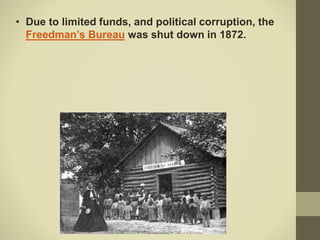
• Due to limited funds, and political corruption, the
Freedman’s Bureau was shut down in 1872.
Reconstruction was a failure….
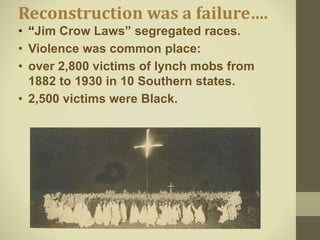
• “Jim Crow Laws” segregated races.
• Violence was common place:
• over 2,800 victims of lynch mobs from
1882 to 1930 in 10 Southern states.
• 2,500 victims were Black.
The Boll Weevil
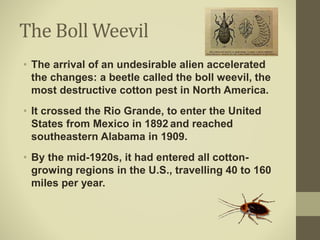
• The arrival of an undesirable alien accelerated
the changes: a beetle called the boll weevil, the
most destructive cotton pest in North America.
• It crossed the Rio Grande, to enter the United
States from Mexico in 1892 and reached
southeastern Alabama in 1909.
• By the mid-1920s, it had entered all cotton-
growing regions in the U.S., travelling 40 to 160
miles per year.
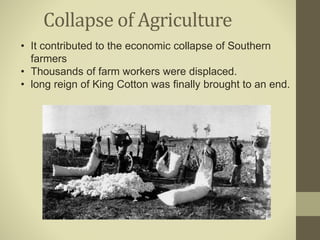
• It contributed to the economic collapse of Southern
farmers
• Thousands of farm workers were displaced.
• long reign of King Cotton was finally brought to an end.
Collapse of Agriculture
In the meanwhile
• New opportunities in the North…
Possibilities Opens Up
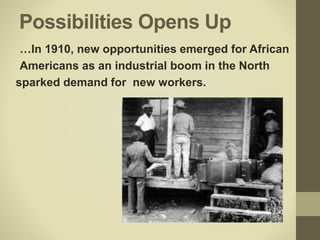
…In 1910, new opportunities emerged for African
Americans as an industrial boom in the North
sparked demand for new workers.
And Then a Miraculous
Thing Happened…
World War…
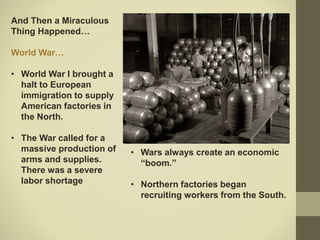
• World War I brought a
halt to European
immigration to supply
American factories in
the North.
• The War called for a
massive production of
arms and supplies.
There was a severe
labor shortage
• Wars always create an economic
“boom.”
• Northern factories began
recruiting workers from the South.
Promised Land…
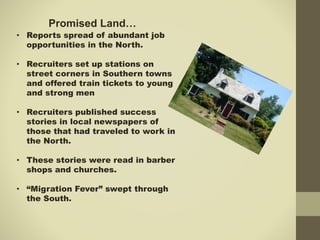
• Reports spread of abundant job
opportunities in the North.
• Recruiters set up stations on
street corners in Southern towns
and offered train tickets to young
and strong men
• Recruiters published success
stories in local newspapers of
those that had traveled to work in
the North.
• These stories were read in barber
shops and churches.
• “Migration Fever” swept through
the South.
• News of incredible opportunities in the North—
better housing, the right to vote, high-paying
jobs—became a frequent topic of conversation
in black southern homes
• Friends and family in the North described their
good fortune.
• The Chicago Defender, the major black
newspaper:
• stories about northern job opportunities,
• And about risks of staying in the South.
The Great Migration
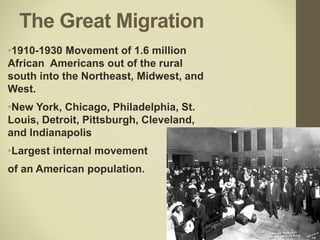
•1910-1930 Movement of 1.6 million
African Americans out of the rural
south into the Northeast, Midwest, and
West.
•New York, Chicago, Philadelphia, St.
Louis, Detroit, Pittsburgh, Cleveland,
and Indianapolis
•Largest internal movement
of an American population.
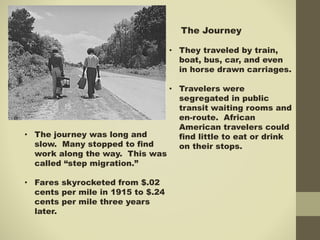
The Journey
• They traveled by train,
boat, bus, car, and even
in horse drawn carriages.
• Travelers were
segregated in public
transit waiting rooms and
en-route. African
American travelers could
find little to eat or drink
on their stops.
• The journey was long and
slow. Many stopped to find
work along the way. This was
called “step migration.”
• Fares skyrocketed from $.02
cents per mile in 1915 to $.24
cents per mile three years
later.
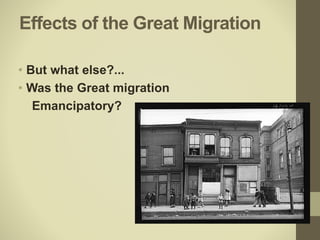
Effects of the Great Migration
• But what else?...
• Was the Great migration
Emancipatory?
Urbanization
• The effect on northern cities was
dramatic.
• Between 1910 and 1920 black population
increased by
• 66 percent in New York,
• 150 percent in Chicago,
• over 600 percent in Detroit.
Harlem and the Southside became
known as black enclaves
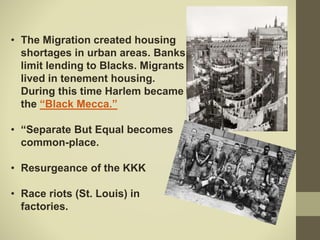
• The Migration created housing
shortages in urban areas. Banks
limit lending to Blacks. Migrants
lived in tenement housing.
During this time Harlem became
the “Black Mecca.”
• “Separate But Equal becomes
common-place.
• Resurgeance of the KKK
• Race riots (St. Louis) in
factories.
Black reception
• Were hired as scab labor, employed
either to break a local union or to force
striking whites back to work.
• snubbed by existing White immigrant
labor groups because willing to work for
lower wages.
• And by Earlier black settlers, as
problems increased with each new
arrival: job, housing & political anxieties.
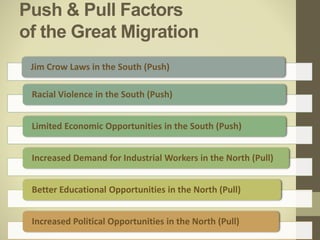
Push & Pull Factors
of the Great Migration
Jim Crow Laws in the South (Push)
Racial Violence in the South (Push)
Limited Economic Opportunities in the South (Push)
Increased Demand for Industrial Workers in the North (Pull)
Better Educational Opportunities in the North (Pull)
Increased Political Opportunities in the North (Pull)
No time for cheating, it’s quiz time 
A. The end of WW1
B. Violence in the North
C. Harlem Renaissance
D. Great Depression
Q1
The 1st wave of the Great migration
stopped in 1930 because of:
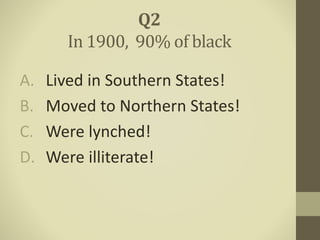
A. Lived in Southern States!
B. Moved to Northern States!
C. Were lynched!
D. Were illiterate!
Q2
In 1900, 90% of black
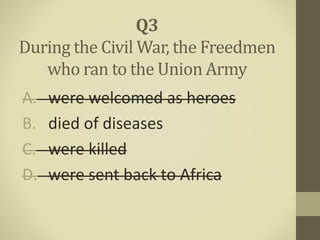
A. were welcomed as heroes
B. died of diseases
C. were killed
D. were sent back to Africa
Q3
During the Civil War, the Freedmen
who ran to the Union Army
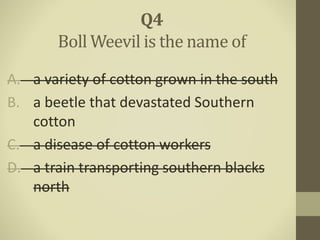
A. a variety of cotton grown in the south
B. a beetle that devastated Southern
cotton
C. a disease of cotton workers
D. a train transporting southern blacks
north
Q4
Boll Weevil is the name of
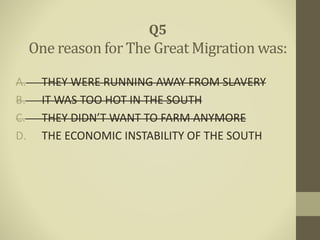
A. THEY WERE RUNNING AWAY FROM SLAVERY
B. IT WAS TOO HOT IN THE SOUTH
C. THEY DIDN’T WANT TO FARM ANYMORE
D. THE ECONOMIC INSTABILITY OF THE SOUTH
Q5
One reason for The Great Migration was:
A. Economic hardships
B. Violence
C. Segregation
D. Job opportunities in factories
Q6
One of the pull factors was
A. The Missouri Defender
B. The Louisiana Defender
C. The Chicago Defender
D. The Alabama Defender
Q7
THE MAJORBLACK NEWSPAPER
ADVERTIZINGFORJOBSWAS
A. STOP MIGRATION”
B. “TRANSIT MIGRATION”
C. “SPOT MIGRATION”
D. “STEP MIGRATION”
Q8
FORMIGRATINGBLACKS,STOPPING TO FIND
WORKALONG THE WAYWASCALLED
A. 6 MILLION
B. 5 MILLION
C. 1.6 MILLION
D. 5.6 MILLION
Q9
NUMBEROF AFRICANAMERICANSWHO
PARTICIPATEDIN THE 1ST GREATMIGRATION
A. SEGREGATION AND VIOLENCE WAS COMMON
PLACE IN THE NORTH
B. MIGRATING AFRICAN AMERICANS WERE
WELCOMED BY OLDER BLACK IMMIGRANTS
C. MIGRATING AFRICAN AMERICANS WERE
ACCUSED OF LOWERING WAGES
D. ALL OF THE ABOVE STATEMENTS
Q10
WHICH OF THE FOLLOWING STATEMENTS
IS WRONG
The great migration

The great migration

  • 1.
  • 2.
    What is theGreat Migration? • The Great Migration was a massive relocation of African Americans from the rural Southern states to cities of the North. • The First Wave: 1910 to 1930 (1.6 million people). After 1930 the migration slowed down a bit because of the Great Depression. • Second Wave: 1940 to 1970 (5 million people). The U.S. entered the Second World War in 1941.
  • 3.
    They came from… AlabamaMississippi Louisiana (To name a few States…)
  • 4.
    And went to… NewYork Detroit St. Louis As well as Philadelphia, Pittsburgh, Cleveland, Indianapolis
  • 5.
    In 1900, 90%of blacks lived in Southern States! Why did African Americans leave the South?
  • 6.
    Let’s Go Backin the Time Machine… • The Emancipation Proclamation was signed in 1863. Four million people, poor, displaced, and mostly illiterate, are free but homeless.
  • 7.
    • During theCivil War Some “freedmen” ran to the Union army for protection. • The Union army didn’t know what to do with these “refugees,” it could barely care for its own troops. • Many freed slaves died of diseases in the Union stockades.
  • 8.
    • Many tookto the roads in search of work, sometimes traveling over mountains with little more than their clothes. • But most of them remained in the South.
  • 9.
    • Southern economywas in ruins. Many freed blacks returned to the plantations as sharecroppers. • No change from their slave life, but they were able to keep their families together. • Many went into debt to their former white owners (or farm owners) to pay for food, clothing, shelter etc.
  • 10.
    Despite their apparentfreedom, African Americans received little protection in the South. They took one step forward and two steps back. Reconstruction was a failure… The Civil Rights Act of 1875 was declared unconstitutional in 1883 by the Supreme Court.
  • 11.
    • Due tolimited funds, and political corruption, the Freedman’s Bureau was shut down in 1872.
  • 12.
    Reconstruction was afailure…. • “Jim Crow Laws” segregated races. • Violence was common place: • over 2,800 victims of lynch mobs from 1882 to 1930 in 10 Southern states. • 2,500 victims were Black.
  • 13.
    The Boll Weevil •The arrival of an undesirable alien accelerated the changes: a beetle called the boll weevil, the most destructive cotton pest in North America. • It crossed the Rio Grande, to enter the United States from Mexico in 1892 and reached southeastern Alabama in 1909. • By the mid-1920s, it had entered all cotton- growing regions in the U.S., travelling 40 to 160 miles per year.
  • 14.
    • It contributedto the economic collapse of Southern farmers • Thousands of farm workers were displaced. • long reign of King Cotton was finally brought to an end. Collapse of Agriculture
  • 15.
    In the meanwhile •New opportunities in the North…
  • 16.
    Possibilities Opens Up …In1910, new opportunities emerged for African Americans as an industrial boom in the North sparked demand for new workers.
  • 17.
    And Then aMiraculous Thing Happened… World War… • World War I brought a halt to European immigration to supply American factories in the North. • The War called for a massive production of arms and supplies. There was a severe labor shortage • Wars always create an economic “boom.” • Northern factories began recruiting workers from the South.
  • 18.
    Promised Land… • Reportsspread of abundant job opportunities in the North. • Recruiters set up stations on street corners in Southern towns and offered train tickets to young and strong men • Recruiters published success stories in local newspapers of those that had traveled to work in the North. • These stories were read in barber shops and churches. • “Migration Fever” swept through the South.
  • 19.
    • News ofincredible opportunities in the North— better housing, the right to vote, high-paying jobs—became a frequent topic of conversation in black southern homes • Friends and family in the North described their good fortune. • The Chicago Defender, the major black newspaper: • stories about northern job opportunities, • And about risks of staying in the South.
  • 20.
    The Great Migration •1910-1930Movement of 1.6 million African Americans out of the rural south into the Northeast, Midwest, and West. •New York, Chicago, Philadelphia, St. Louis, Detroit, Pittsburgh, Cleveland, and Indianapolis •Largest internal movement of an American population.
  • 22.
    The Journey • Theytraveled by train, boat, bus, car, and even in horse drawn carriages. • Travelers were segregated in public transit waiting rooms and en-route. African American travelers could find little to eat or drink on their stops. • The journey was long and slow. Many stopped to find work along the way. This was called “step migration.” • Fares skyrocketed from $.02 cents per mile in 1915 to $.24 cents per mile three years later.
  • 23.
    Effects of theGreat Migration • But what else?... • Was the Great migration Emancipatory?
  • 24.
    Urbanization • The effecton northern cities was dramatic. • Between 1910 and 1920 black population increased by • 66 percent in New York, • 150 percent in Chicago, • over 600 percent in Detroit. Harlem and the Southside became known as black enclaves
  • 25.
    • The Migrationcreated housing shortages in urban areas. Banks limit lending to Blacks. Migrants lived in tenement housing. During this time Harlem became the “Black Mecca.” • “Separate But Equal becomes common-place. • Resurgeance of the KKK • Race riots (St. Louis) in factories.
  • 26.
    Black reception • Werehired as scab labor, employed either to break a local union or to force striking whites back to work. • snubbed by existing White immigrant labor groups because willing to work for lower wages. • And by Earlier black settlers, as problems increased with each new arrival: job, housing & political anxieties.
  • 27.
    Push & PullFactors of the Great Migration Jim Crow Laws in the South (Push) Racial Violence in the South (Push) Limited Economic Opportunities in the South (Push) Increased Demand for Industrial Workers in the North (Pull) Better Educational Opportunities in the North (Pull) Increased Political Opportunities in the North (Pull)
  • 28.
    No time forcheating, it’s quiz time 
  • 29.
    A. The endof WW1 B. Violence in the North C. Harlem Renaissance D. Great Depression Q1 The 1st wave of the Great migration stopped in 1930 because of:
  • 30.
    A. Lived inSouthern States! B. Moved to Northern States! C. Were lynched! D. Were illiterate! Q2 In 1900, 90% of black
  • 31.
    A. were welcomedas heroes B. died of diseases C. were killed D. were sent back to Africa Q3 During the Civil War, the Freedmen who ran to the Union Army
  • 32.
    A. a varietyof cotton grown in the south B. a beetle that devastated Southern cotton C. a disease of cotton workers D. a train transporting southern blacks north Q4 Boll Weevil is the name of
  • 33.
    A. THEY WERERUNNING AWAY FROM SLAVERY B. IT WAS TOO HOT IN THE SOUTH C. THEY DIDN’T WANT TO FARM ANYMORE D. THE ECONOMIC INSTABILITY OF THE SOUTH Q5 One reason for The Great Migration was:
  • 34.
    A. Economic hardships B.Violence C. Segregation D. Job opportunities in factories Q6 One of the pull factors was
  • 35.
    A. The MissouriDefender B. The Louisiana Defender C. The Chicago Defender D. The Alabama Defender Q7 THE MAJORBLACK NEWSPAPER ADVERTIZINGFORJOBSWAS
  • 36.
    A. STOP MIGRATION” B.“TRANSIT MIGRATION” C. “SPOT MIGRATION” D. “STEP MIGRATION” Q8 FORMIGRATINGBLACKS,STOPPING TO FIND WORKALONG THE WAYWASCALLED
  • 37.
    A. 6 MILLION B.5 MILLION C. 1.6 MILLION D. 5.6 MILLION Q9 NUMBEROF AFRICANAMERICANSWHO PARTICIPATEDIN THE 1ST GREATMIGRATION
  • 38.
    A. SEGREGATION ANDVIOLENCE WAS COMMON PLACE IN THE NORTH B. MIGRATING AFRICAN AMERICANS WERE WELCOMED BY OLDER BLACK IMMIGRANTS C. MIGRATING AFRICAN AMERICANS WERE ACCUSED OF LOWERING WAGES D. ALL OF THE ABOVE STATEMENTS Q10 WHICH OF THE FOLLOWING STATEMENTS IS WRONG