Fluid Mechanics 1 –
Arab Academy for Science, Technology
and Maritime Transportation
Dr. Aly Hassan Elbatran
Associate Professor
a.elbatran@aast.edu
aly_marine@hotmail.com
Course Assistant Lecturer:
Eng. Islam mohamed
Lecture 4:
Hydrostatic Forces on Submerged
Plane Surfaces
Fluid Mechanics 1
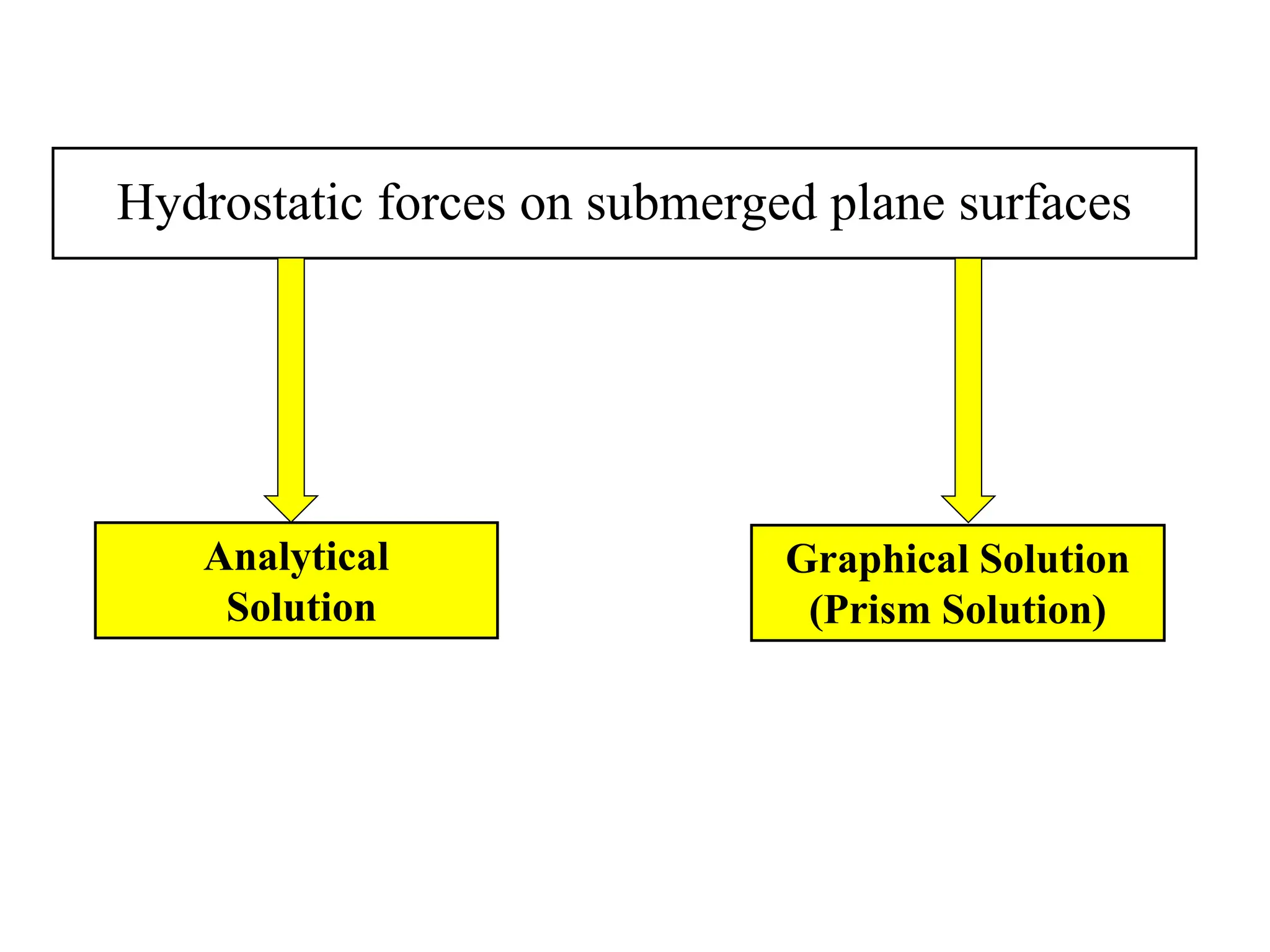
Hydrostatic forces on submerged plane surfaces
Graphical Solution
(Prism Solution)
Analytical
Solution
Hydrostatic forces on submerged plane surfaces
Analytical
Solution
Hydrostatic forces on submerged plane surfaces
A plate is subjected to fluid pressure
distributed over its surface when
exposed to a liquid; such as a gate valve
in a dam, the wall of a liquid storage
tank, or the hull of a ship at rest.
On a plane surface, the hydrostatic
forces form a system of parallel forces,
and we often need to determine the
magnitude of the Resultant force and
its point of application, which is called
the center of pressure.
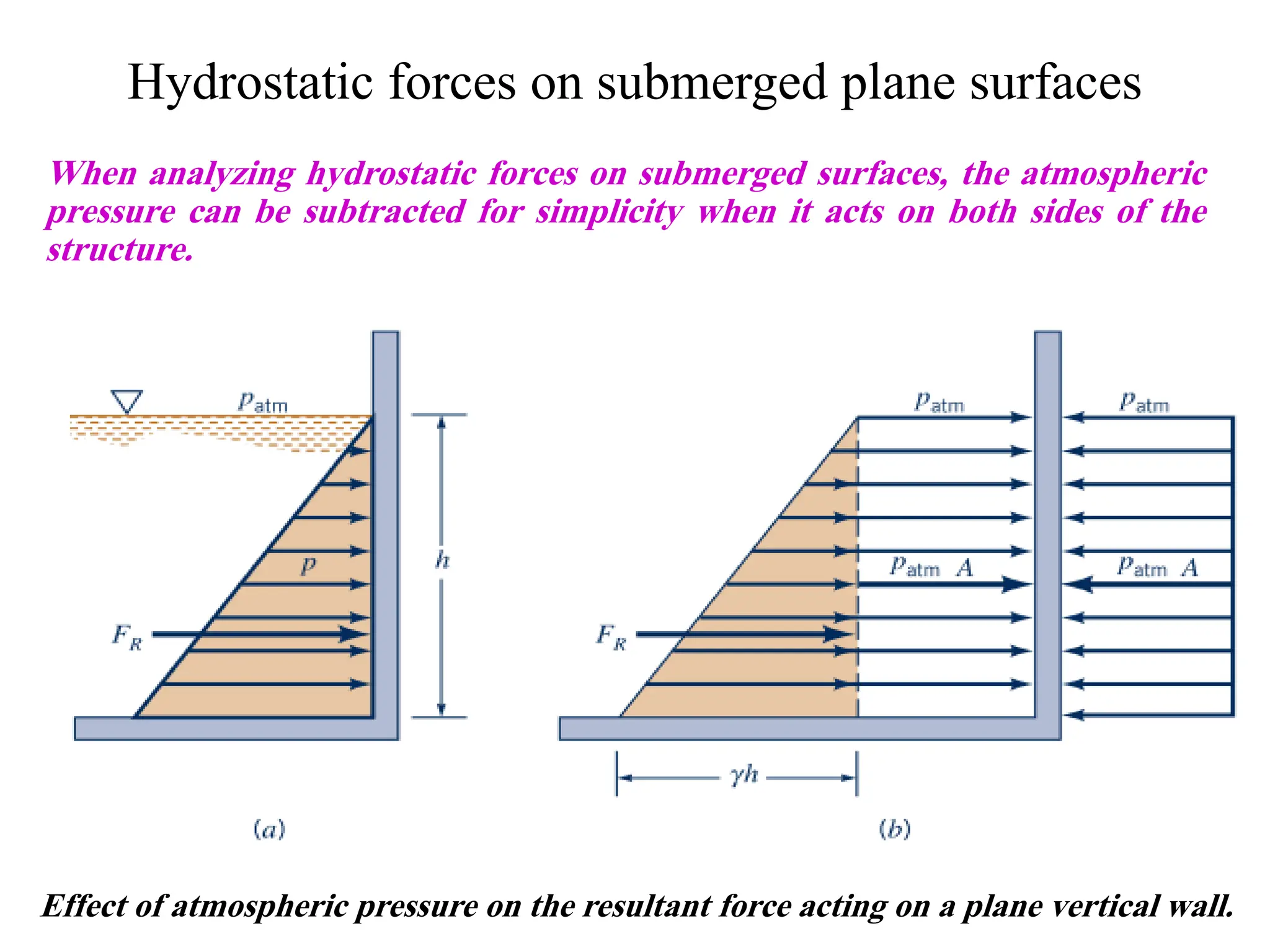
When analyzing hydrostatic forces on
submerged surfaces, the atmospheric
pressure can be subtracted for
simplicity when it acts on both sides of
the structure.
Hydrostatic forces on submerged plane surfaces
When analyzing hydrostatic forces on submerged surfaces, the atmospheric
pressure can be subtracted for simplicity when it acts on both sides of the
structure.
Effect of atmospheric pressure on the resultant force acting on a plane vertical wall.
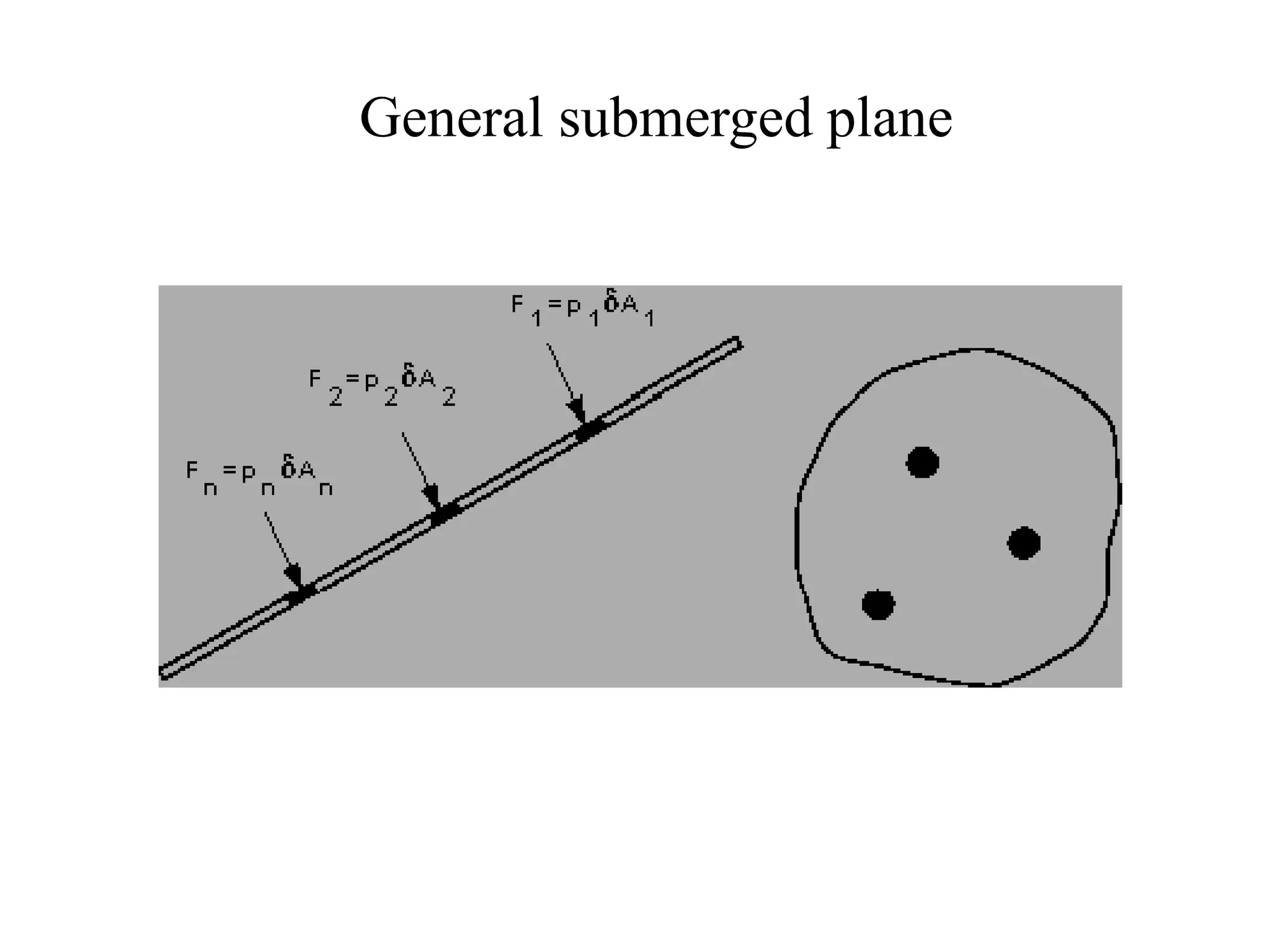
General submerged plane
The total area is made up of many elemental areas.
The force on each elemental area is always normal to the
surface but, in general, each force is of different magnitude
as the pressure usually varies.
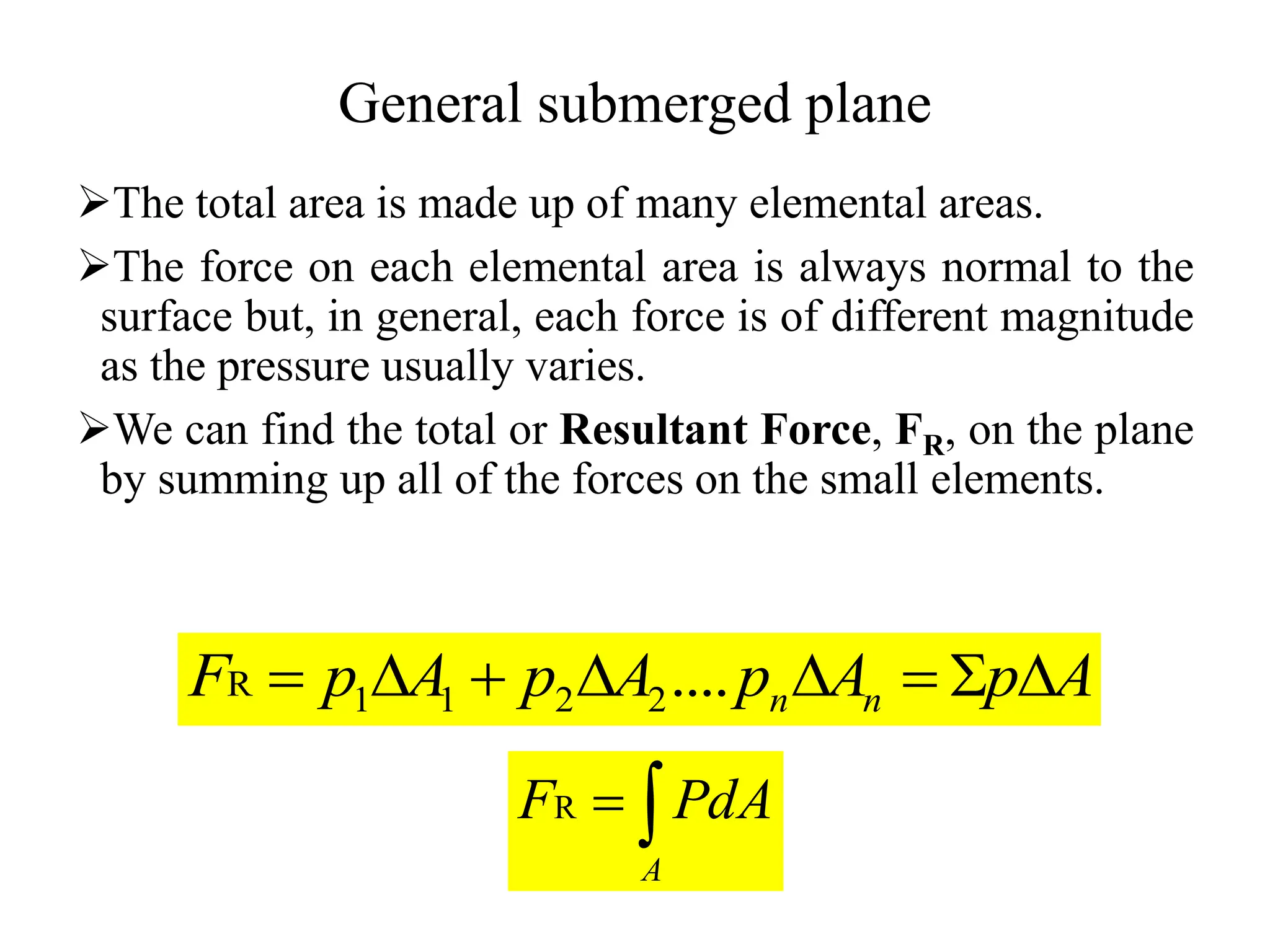
We can find the total or Resultant Force, FR, on the plane
by summing up all of the forces on the small elements.
A
p
A
p
A
p
A
p
F n
n 






 ....
2
2
1
1
R


A
PdA
FR
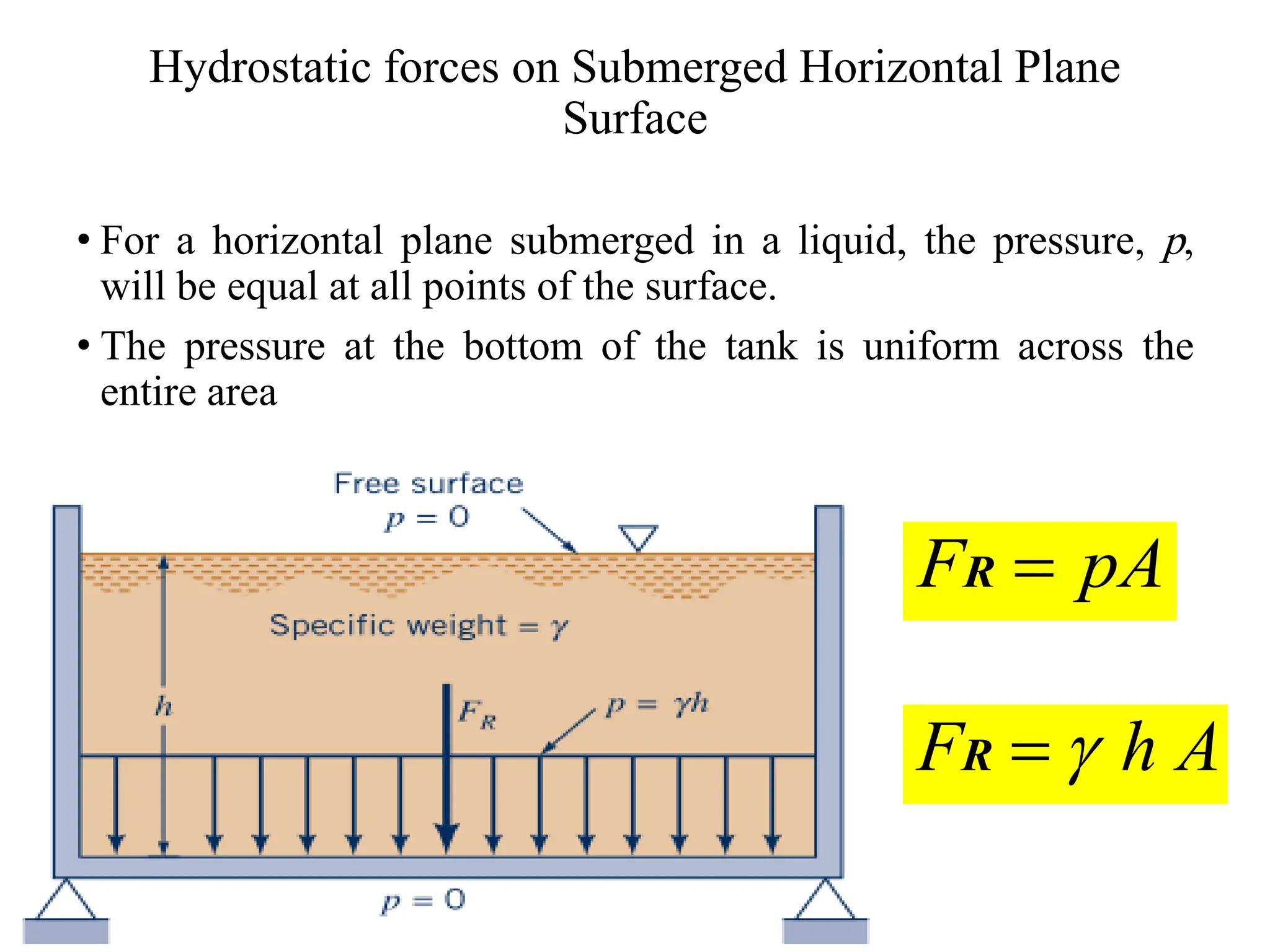
Hydrostatic forces on Submerged Horizontal Plane
Surface
• For a horizontal plane submerged in a liquid, the pressure, p,
will be equal at all points of the surface.
• The pressure at the bottom of the container is uniform across the
entire area
pA
F 
R
Hydrostatic forces on Submerged Horizontal Plane
Surface
• For a horizontal plane submerged in a liquid, the pressure, p,
will be equal at all points of the surface.
• The pressure at the bottom of the tank is uniform across the
entire area
pA
F 
R
h A
FR 


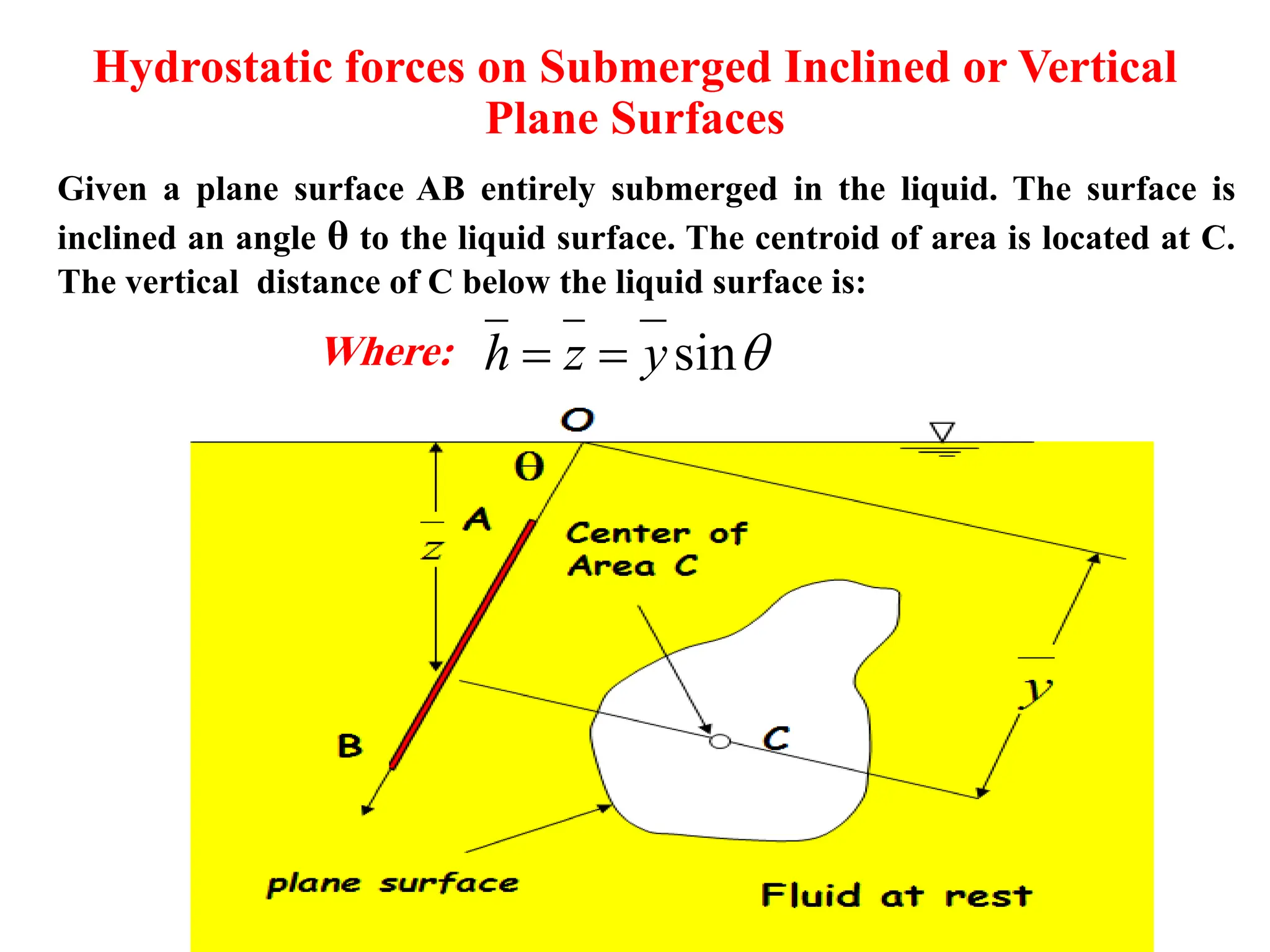
sin
y
z
h 

Where:
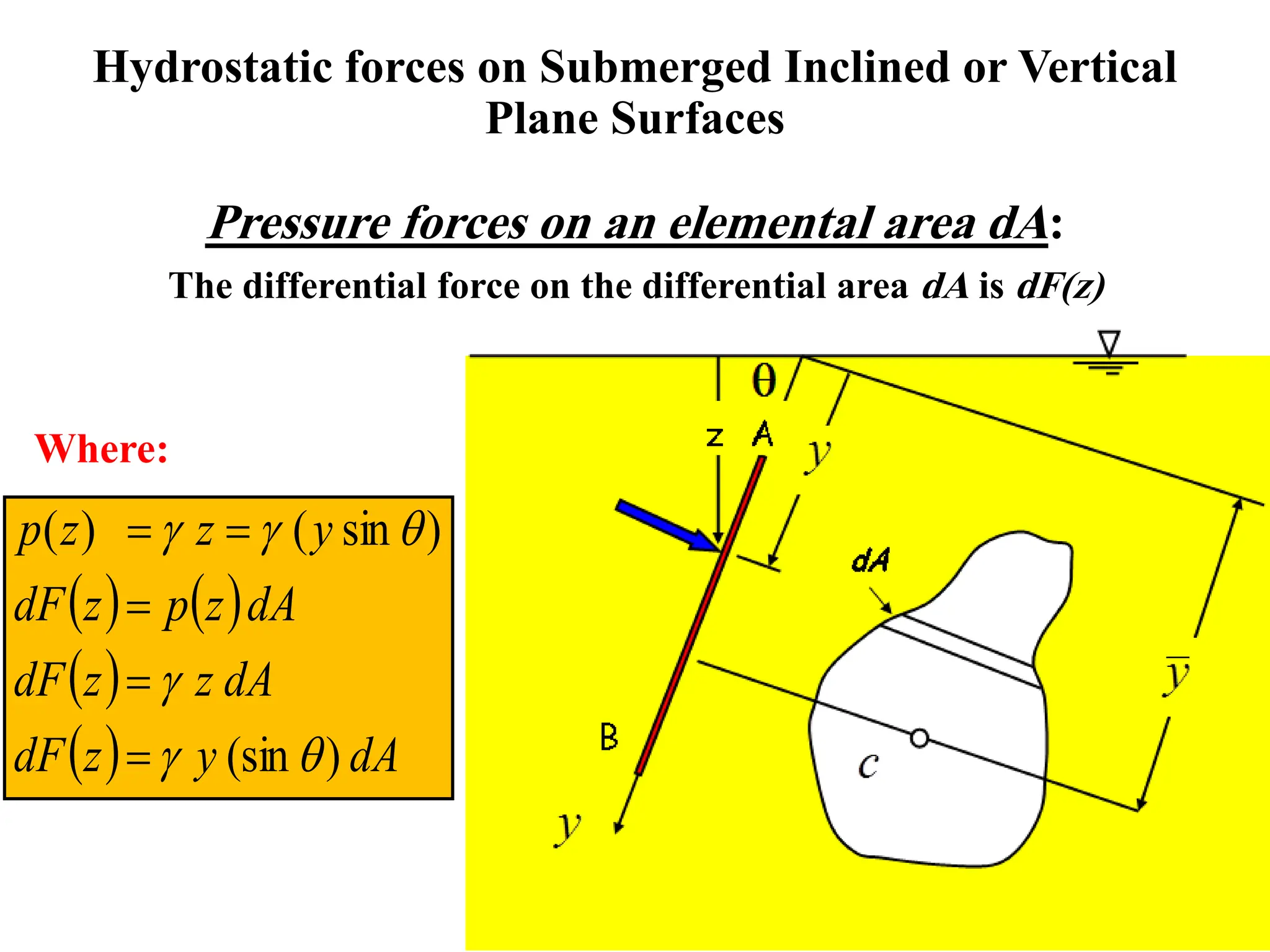
Given a plane surface AB entirely submerged in the liquid. The surface is
inclined an angle θ to the liquid surface. The centroid of area is located at C.
The vertical distance of C below the liquid surface is:
Hydrostatic forces on Submerged Inclined or Vertical
Plane Surfaces
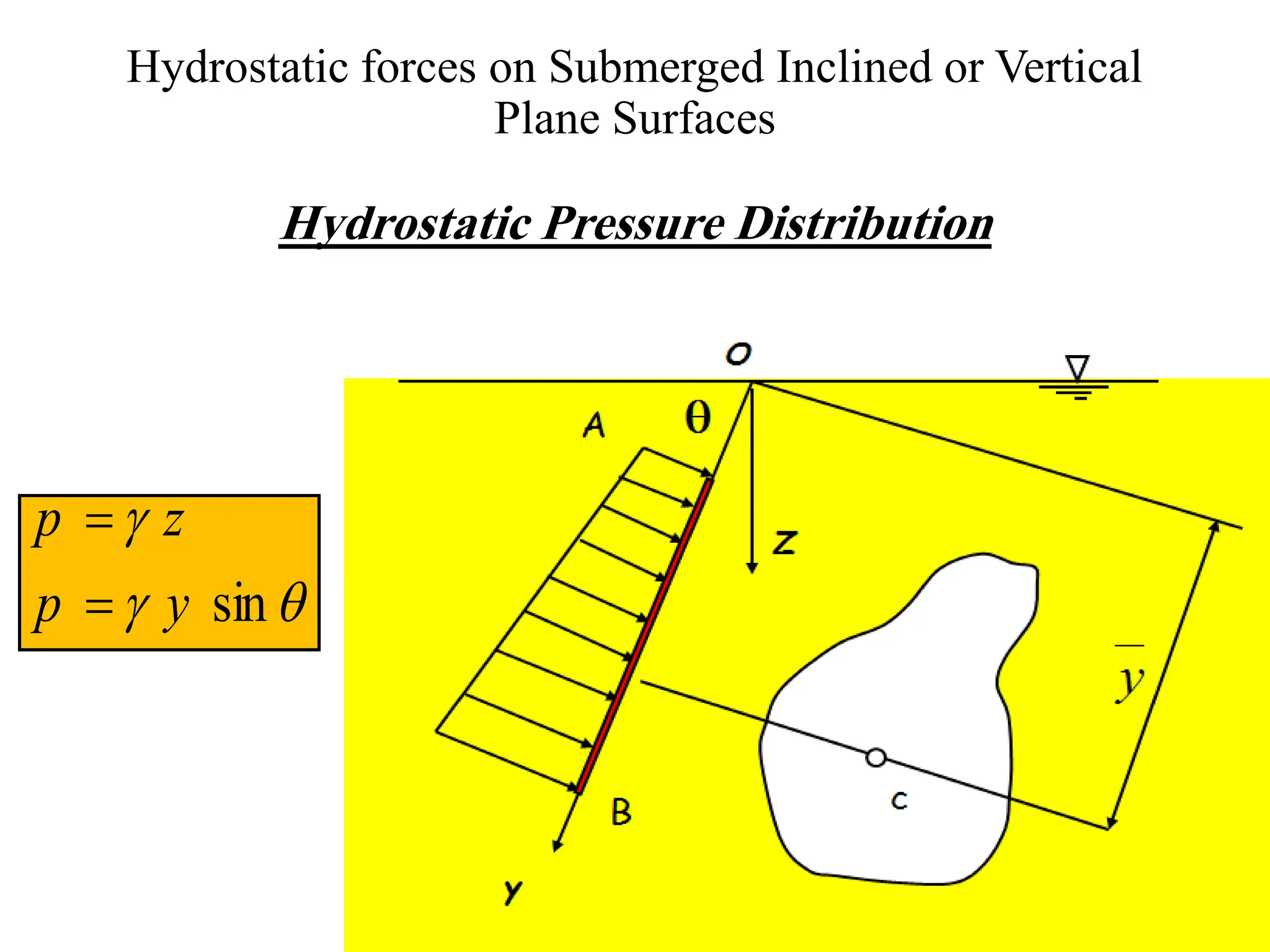
Pressure at a point at z
below the liquid surface
is:
p(z) = *z
(Gage pressure)
Or in terms of y
(distance along the plate)
pressure at point z is:
p(z) = *y*sin
The differential force
on the differential area
dA is dF(z)
Hydrostatic forces on Submerged Inclined or Vertical
Plane Surfaces
Pressure forces on an elemental area dA:
The differential force on the differential area dA is dF(z)
   
 
  dA
y
z
dF
dA
z
z
dF
dA
z
p
z
dF
y
z
z
p
)
(sin
)
sin
(
)
(











Hydrostatic forces on Submerged Inclined or Vertical
Plane Surfaces
Where:
Pressure forces on an elemental area dA:
Hydrostatic Pressure Distribution
Hydrostatic forces on Submerged Inclined or Vertical
Plane Surfaces



sin
y
p
z
p


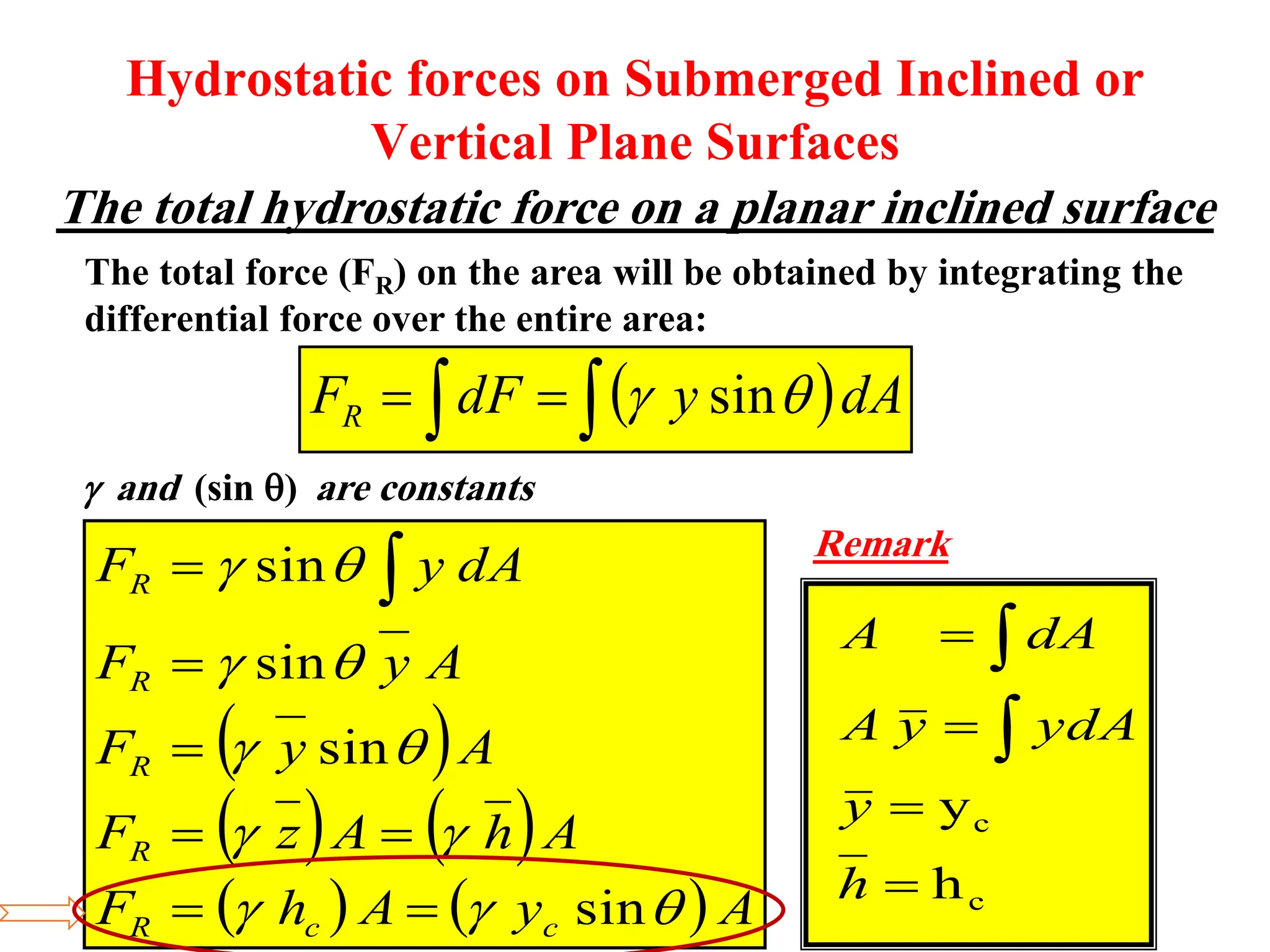
The total force (FR) on the area will be obtained by integrating the
differential force over the entire area:
 dA
y
dF
FR sin

 
 

 and (sin ) are constants
 
   
    A
y
A
h
F
A
h
A
z
F
A
y
F
A
y
F
dA
y
F
c
c
R
R
R
R
R
sin
sin
sin
sin

















 
c
c
h
y






h
y
ydA
y
A
dA
A
Remark
The total hydrostatic force on a planar inclined surface
Hydrostatic forces on Submerged Inclined or
Vertical Plane Surfaces
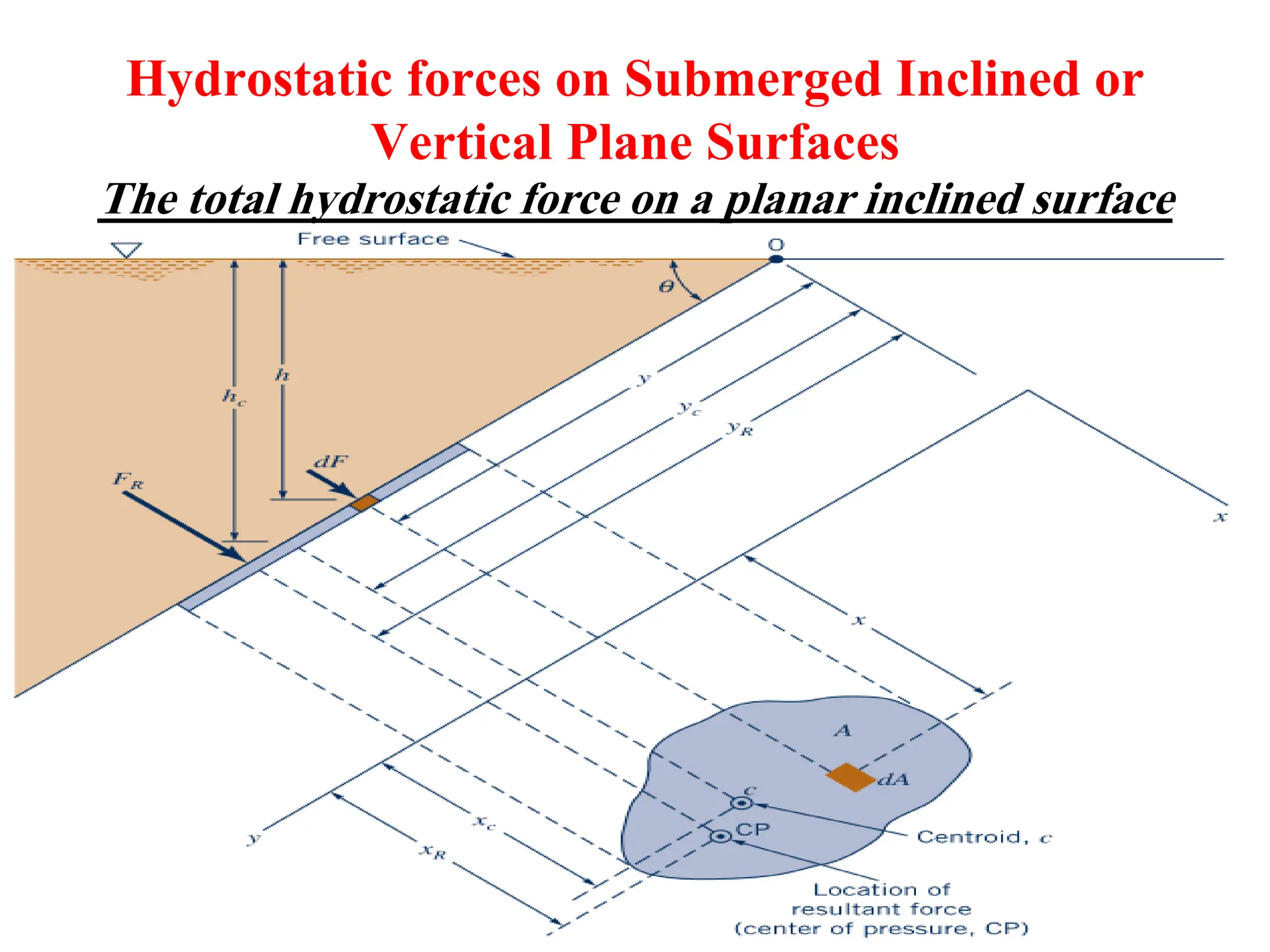
The total hydrostatic force on a planar inclined surface
Hydrostatic forces on Submerged Inclined or
Vertical Plane Surfaces
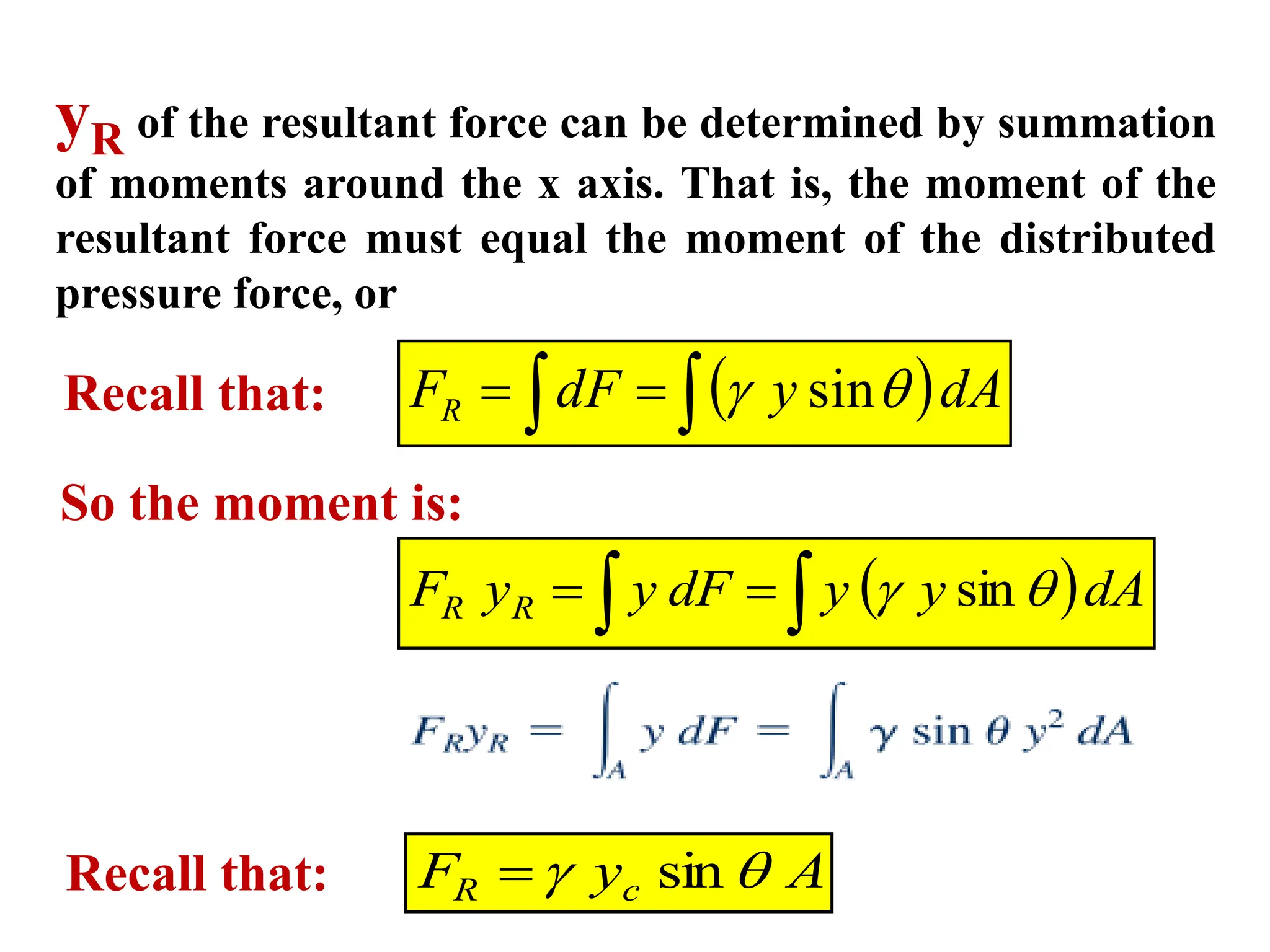
yR of the resultant force can be determined by summation
of moments around the x axis. That is, the moment of the
resultant force must equal the moment of the distributed
pressure force, or
 dA
y
dF
FR sin

 
 

Recall that:
 dA
y
y
dF
y
y
F R
R 
 
 
 sin
So the moment is:
A
y
F c
R 
 sin

Recall that:
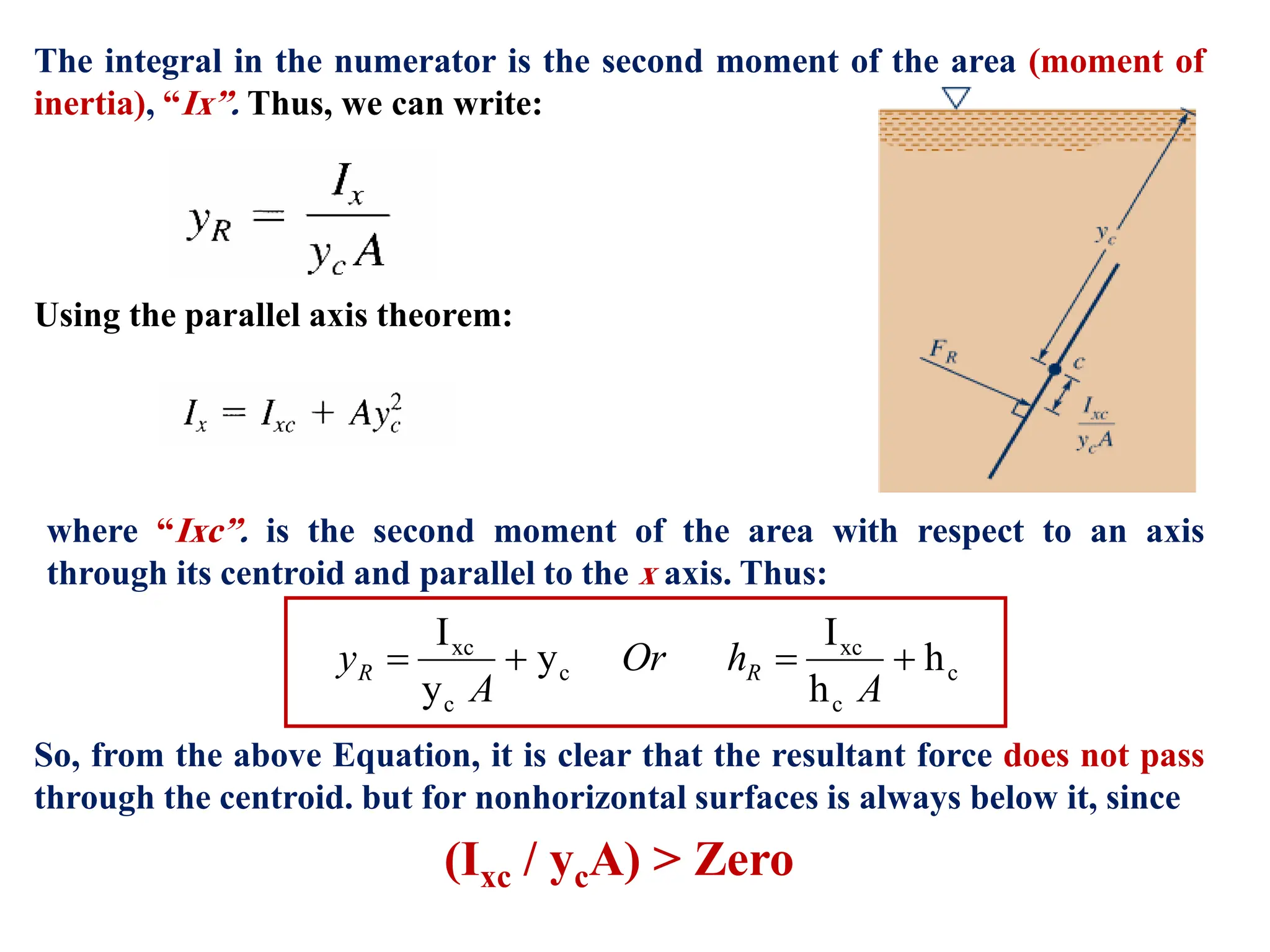
The integral in the numerator is the second moment of the area (moment of
inertia), “Ix”. Thus, we can write:
Using the parallel axis theorem:
where “Ixc”. is the second moment of the area with respect to an axis
through its centroid and parallel to the x axis. Thus:
So, from the above Equation, it is clear that the resultant force does not pass
through the centroid. but for nonhorizontal surfaces is always below it, since
(Ixc / ycA) > Zero
c
c
xc
c
c
xc
h
h
I
y
y
I




A
h
Or
A
y R
R
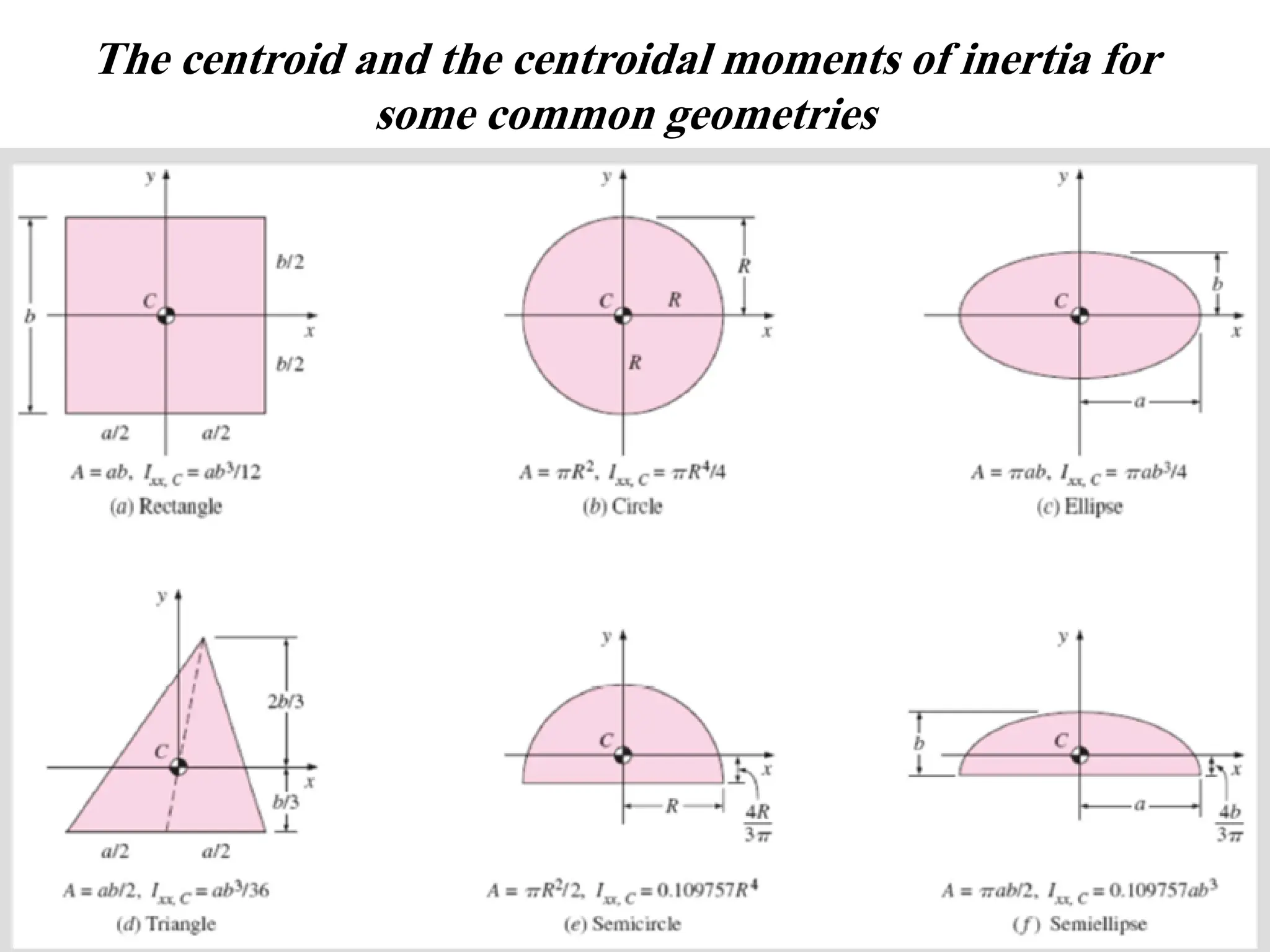
The centroid and the centroidal moments of inertia for
some common geometries
A heavy car plunges into a lake during an accident and lands at the bottom of the lake on its
wheels as shown in the Figure. The door is 1.2 m height and 1 m wide, and the top edge of
the door is 8 m below the free surface of the water. Using the analytical and prism method,
determine the hydrostatic force on the door and the location of the pressure center.
Example
m
8.61
)]
2
1.2
(
[8
1.2)
*
1
(
)]
2
1.2
(
[8
0.144
144
.
0
)
12
1.2
*
1
(
)
12
(
I
h
h
I
kN
101.24
kN
)
1
*
2
.
1
(
*
)]
2
1.2
(
[8
*
9.81
kN/m
9.81
and
4
3
3
xc
c
c
xc
3















R
R
R
R
w
c
w
R
h
m
ba
A
h
F
F
A
h
F 

Using the Analytical Method
Hydrostatic forces on submerged plane surfaces
Graphical Solution
(Prism Solution)
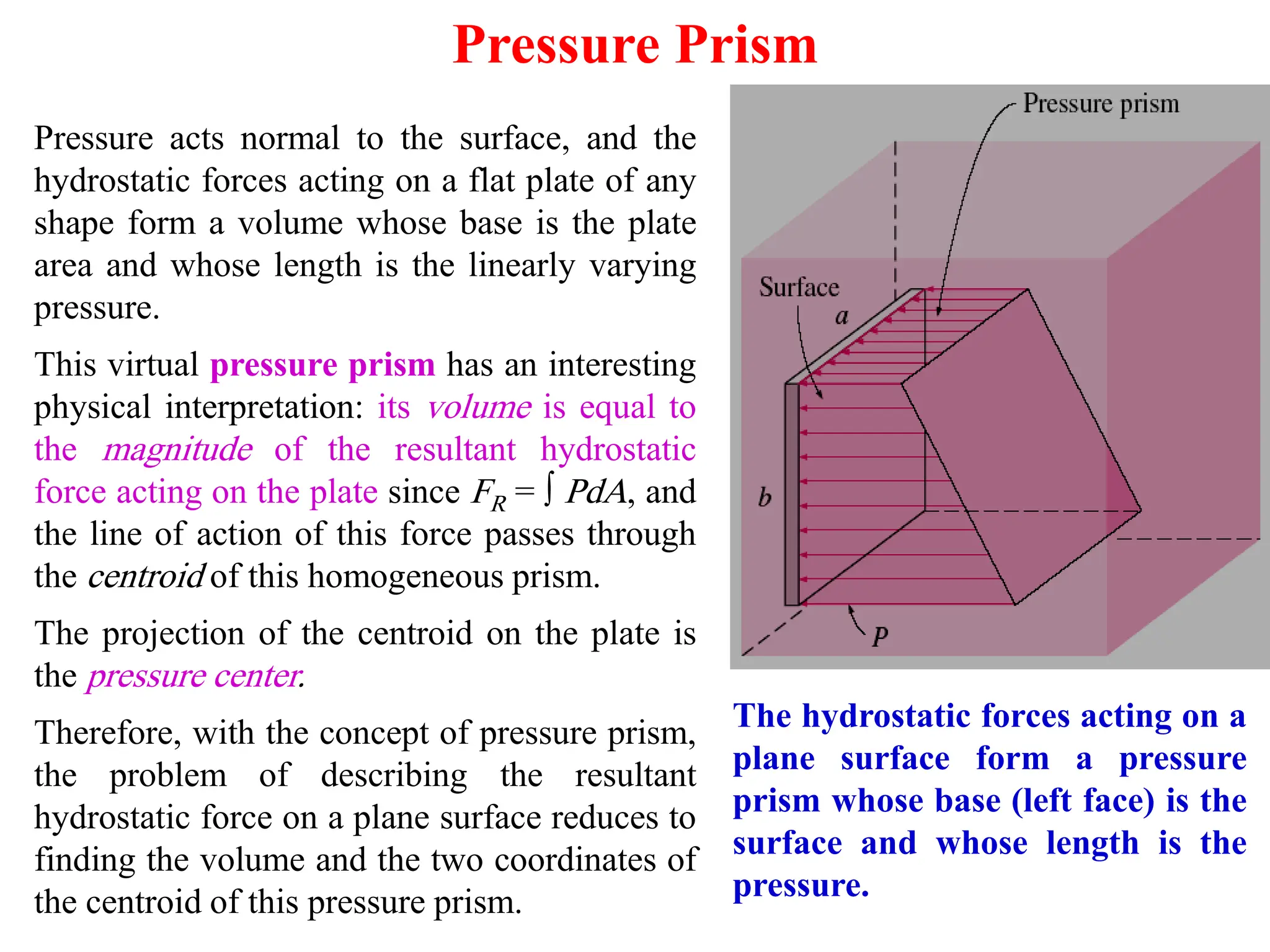
Pressure acts normal to the surface, and the
hydrostatic forces acting on a flat plate of any
shape form a volume whose base is the plate
area and whose length is the linearly varying
pressure.
This virtual pressure prism has an interesting
physical interpretation: its volume is equal to
the magnitude of the resultant hydrostatic
force acting on the plate since FR =  PdA, and
the line of action of this force passes through
the centroid of this homogeneous prism.
The projection of the centroid on the plate is
the pressure center.
Therefore, with the concept of pressure prism,
the problem of describing the resultant
hydrostatic force on a plane surface reduces to
finding the volume and the two coordinates of
the centroid of this pressure prism.
The hydrostatic forces acting on a
plane surface form a pressure
prism whose base (left face) is the
surface and whose length is the
pressure.
Pressure Prism
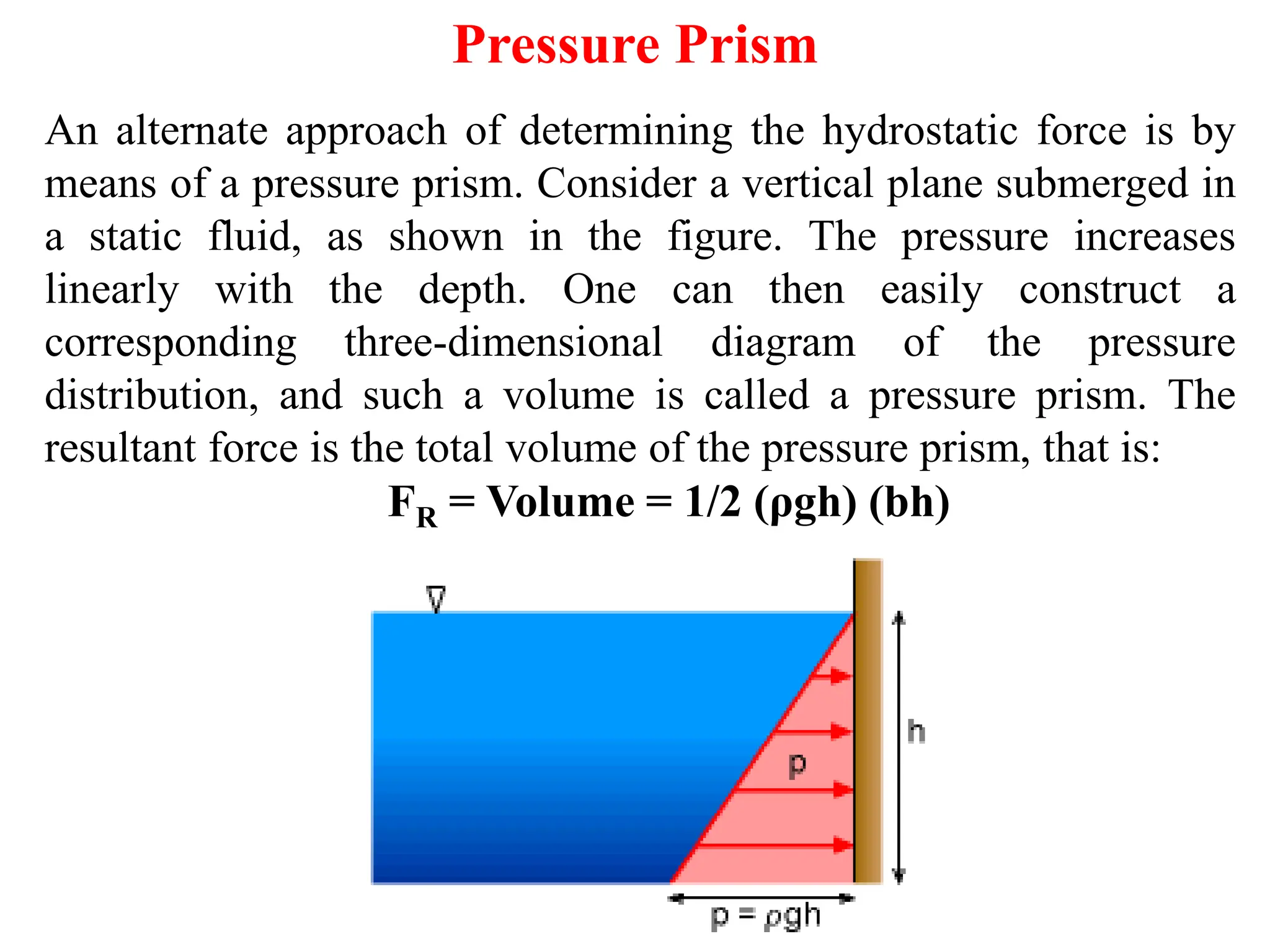
An alternate approach of determining the hydrostatic force is by
means of a pressure prism. Consider a vertical plane submerged in
a static fluid, as shown in the figure. The pressure increases
linearly with the depth. One can then easily construct a
corresponding three-dimensional diagram of the pressure
distribution, and such a volume is called a pressure prism. The
resultant force is the total volume of the pressure prism, that is:
FR = Volume = 1/2 (ρgh) (bh)
Pressure Prism
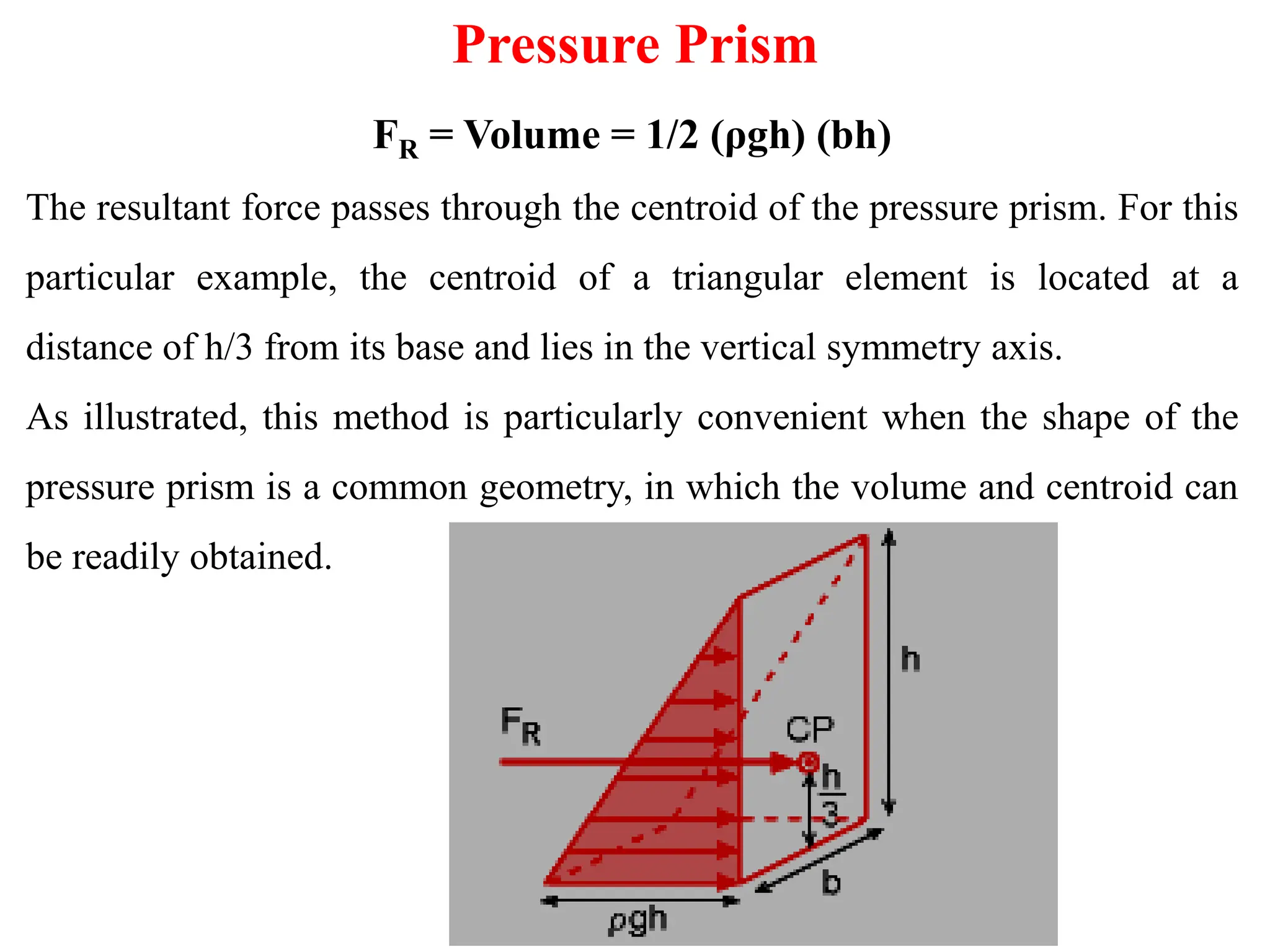
FR = Volume = 1/2 (ρgh) (bh)
The resultant force passes through the centroid of the pressure prism. For this
particular example, the centroid of a triangular element is located at a
distance of h/3 from its base and lies in the vertical symmetry axis.
As illustrated, this method is particularly convenient when the shape of the
pressure prism is a common geometry, in which the volume and centroid can
be readily obtained.
Pressure Prism
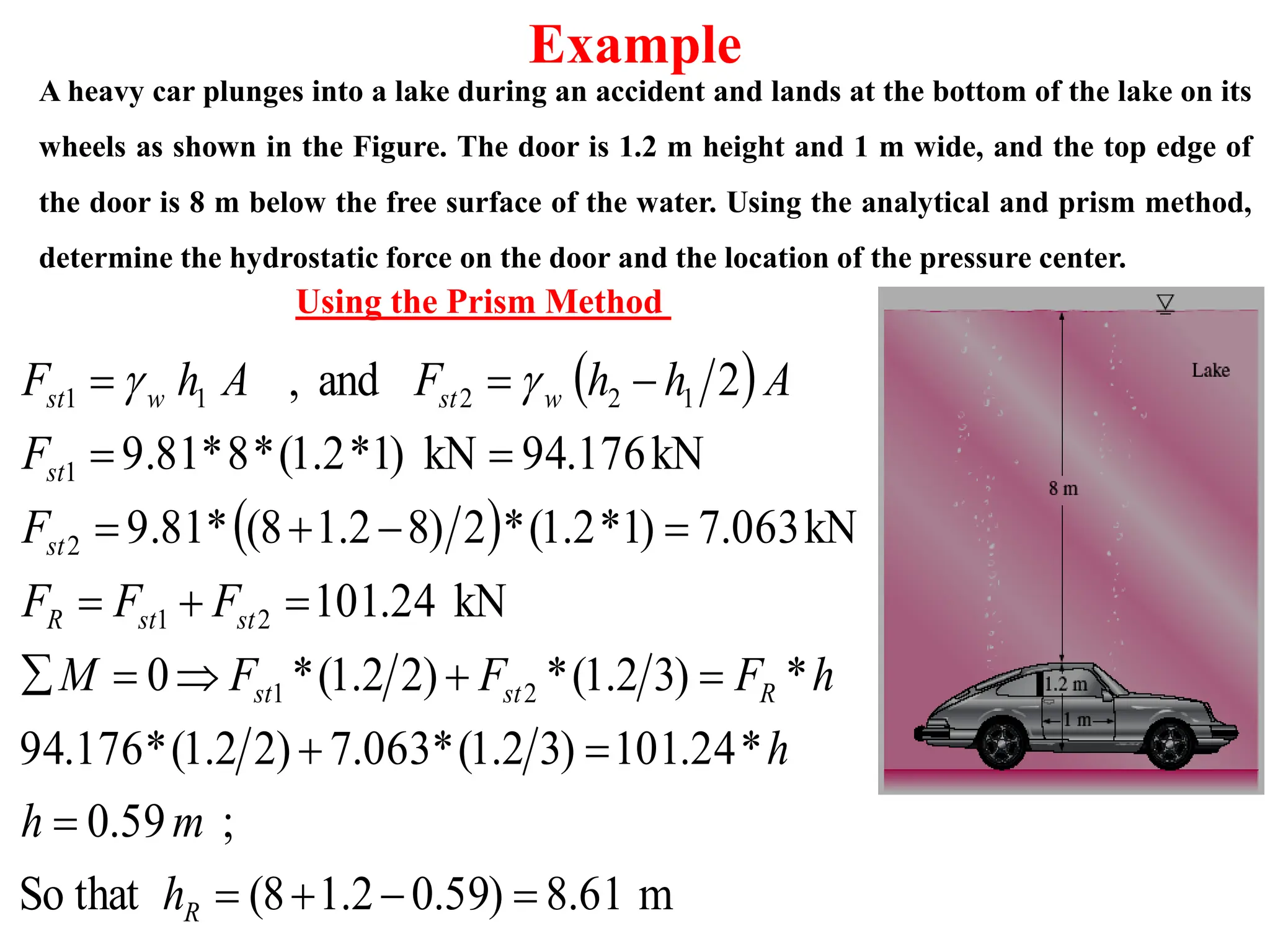
A heavy car plunges into a lake during an accident and lands at the bottom of the lake on its
wheels as shown in the Figure. The door is 1.2 m height and 1 m wide, and the top edge of
the door is 8 m below the free surface of the water. Using the analytical and prism method,
determine the hydrostatic force on the door and the location of the pressure center.
Using the Prism Method
 
 
m
61
.
8
)
59
.
0
2
.
1
8
(
that
So
;
59
.
0
*
24
.
01
1
)
3
2
.
1
(
*
063
.
7
)
2
2
.
1
(
*
176
.
94
*
)
3
2
.
1
(
*
)
2
2
.
1
(
*
0
kN
24
.
01
1
kN
063
.
7
)
1
*
2
.
1
(
*
2
)
8
2
.
1
8
(
*
9.81
kN
176
.
94
kN
)
1
*
2
.
1
(
*
8
*
9.81
2
and
,
2
1
2
1
2
1
1
2
2
1
1
























R
R
st
st
st
st
R
st
st
w
st
w
st
h
m
h
h
h
F
F
F
M
F
F
F
F
F
A
h
h
F
A
h
F 

Example
Lecture 4 - Fluid 1 - Hydrostatic Forces on Submerged Plane Surfaces.pdf

Lecture 4 - Fluid 1 - Hydrostatic Forces on Submerged Plane Surfaces.pdf

  • 1.
    Fluid Mechanics 1– Arab Academy for Science, Technology and Maritime Transportation Dr. Aly Hassan Elbatran Associate Professor a.elbatran@aast.edu aly_marine@hotmail.com Course Assistant Lecturer: Eng. Islam mohamed
  • 2.
    Lecture 4: Hydrostatic Forceson Submerged Plane Surfaces Fluid Mechanics 1
  • 3.
    Hydrostatic forces onsubmerged plane surfaces Graphical Solution (Prism Solution) Analytical Solution
  • 4.
    Hydrostatic forces onsubmerged plane surfaces Analytical Solution
  • 5.
    Hydrostatic forces onsubmerged plane surfaces A plate is subjected to fluid pressure distributed over its surface when exposed to a liquid; such as a gate valve in a dam, the wall of a liquid storage tank, or the hull of a ship at rest. On a plane surface, the hydrostatic forces form a system of parallel forces, and we often need to determine the magnitude of the Resultant force and its point of application, which is called the center of pressure. When analyzing hydrostatic forces on submerged surfaces, the atmospheric pressure can be subtracted for simplicity when it acts on both sides of the structure.
  • 6.
    Hydrostatic forces onsubmerged plane surfaces When analyzing hydrostatic forces on submerged surfaces, the atmospheric pressure can be subtracted for simplicity when it acts on both sides of the structure. Effect of atmospheric pressure on the resultant force acting on a plane vertical wall.
  • 7.
  • 8.
    General submerged plane Thetotal area is made up of many elemental areas. The force on each elemental area is always normal to the surface but, in general, each force is of different magnitude as the pressure usually varies. We can find the total or Resultant Force, FR, on the plane by summing up all of the forces on the small elements. A p A p A p A p F n n         .... 2 2 1 1 R   A PdA FR
  • 9.
    Hydrostatic forces onSubmerged Horizontal Plane Surface • For a horizontal plane submerged in a liquid, the pressure, p, will be equal at all points of the surface. • The pressure at the bottom of the container is uniform across the entire area pA F  R
  • 10.
    Hydrostatic forces onSubmerged Horizontal Plane Surface • For a horizontal plane submerged in a liquid, the pressure, p, will be equal at all points of the surface. • The pressure at the bottom of the tank is uniform across the entire area pA F  R h A FR  
  • 11.
     sin y z h   Where: Given aplane surface AB entirely submerged in the liquid. The surface is inclined an angle θ to the liquid surface. The centroid of area is located at C. The vertical distance of C below the liquid surface is: Hydrostatic forces on Submerged Inclined or Vertical Plane Surfaces
  • 12.
    Pressure at apoint at z below the liquid surface is: p(z) = *z (Gage pressure) Or in terms of y (distance along the plate) pressure at point z is: p(z) = *y*sin The differential force on the differential area dA is dF(z) Hydrostatic forces on Submerged Inclined or Vertical Plane Surfaces Pressure forces on an elemental area dA:
  • 13.
    The differential forceon the differential area dA is dF(z)         dA y z dF dA z z dF dA z p z dF y z z p ) (sin ) sin ( ) (            Hydrostatic forces on Submerged Inclined or Vertical Plane Surfaces Where: Pressure forces on an elemental area dA:
  • 14.
    Hydrostatic Pressure Distribution Hydrostaticforces on Submerged Inclined or Vertical Plane Surfaces    sin y p z p  
  • 15.
    The total force(FR) on the area will be obtained by integrating the differential force over the entire area:  dA y dF FR sin        and (sin ) are constants           A y A h F A h A z F A y F A y F dA y F c c R R R R R sin sin sin sin                    c c h y       h y ydA y A dA A Remark The total hydrostatic force on a planar inclined surface Hydrostatic forces on Submerged Inclined or Vertical Plane Surfaces
  • 16.
    The total hydrostaticforce on a planar inclined surface Hydrostatic forces on Submerged Inclined or Vertical Plane Surfaces
  • 17.
    yR of theresultant force can be determined by summation of moments around the x axis. That is, the moment of the resultant force must equal the moment of the distributed pressure force, or  dA y dF FR sin       Recall that:  dA y y dF y y F R R       sin So the moment is: A y F c R   sin  Recall that:
  • 18.
    The integral inthe numerator is the second moment of the area (moment of inertia), “Ix”. Thus, we can write: Using the parallel axis theorem: where “Ixc”. is the second moment of the area with respect to an axis through its centroid and parallel to the x axis. Thus: So, from the above Equation, it is clear that the resultant force does not pass through the centroid. but for nonhorizontal surfaces is always below it, since (Ixc / ycA) > Zero c c xc c c xc h h I y y I     A h Or A y R R
  • 19.
    The centroid andthe centroidal moments of inertia for some common geometries
  • 20.
    A heavy carplunges into a lake during an accident and lands at the bottom of the lake on its wheels as shown in the Figure. The door is 1.2 m height and 1 m wide, and the top edge of the door is 8 m below the free surface of the water. Using the analytical and prism method, determine the hydrostatic force on the door and the location of the pressure center. Example m 8.61 )] 2 1.2 ( [8 1.2) * 1 ( )] 2 1.2 ( [8 0.144 144 . 0 ) 12 1.2 * 1 ( ) 12 ( I h h I kN 101.24 kN ) 1 * 2 . 1 ( * )] 2 1.2 ( [8 * 9.81 kN/m 9.81 and 4 3 3 xc c c xc 3                R R R R w c w R h m ba A h F F A h F   Using the Analytical Method
  • 21.
    Hydrostatic forces onsubmerged plane surfaces Graphical Solution (Prism Solution)
  • 22.
    Pressure acts normalto the surface, and the hydrostatic forces acting on a flat plate of any shape form a volume whose base is the plate area and whose length is the linearly varying pressure. This virtual pressure prism has an interesting physical interpretation: its volume is equal to the magnitude of the resultant hydrostatic force acting on the plate since FR =  PdA, and the line of action of this force passes through the centroid of this homogeneous prism. The projection of the centroid on the plate is the pressure center. Therefore, with the concept of pressure prism, the problem of describing the resultant hydrostatic force on a plane surface reduces to finding the volume and the two coordinates of the centroid of this pressure prism. The hydrostatic forces acting on a plane surface form a pressure prism whose base (left face) is the surface and whose length is the pressure. Pressure Prism
  • 23.
    An alternate approachof determining the hydrostatic force is by means of a pressure prism. Consider a vertical plane submerged in a static fluid, as shown in the figure. The pressure increases linearly with the depth. One can then easily construct a corresponding three-dimensional diagram of the pressure distribution, and such a volume is called a pressure prism. The resultant force is the total volume of the pressure prism, that is: FR = Volume = 1/2 (ρgh) (bh) Pressure Prism
  • 24.
    FR = Volume= 1/2 (ρgh) (bh) The resultant force passes through the centroid of the pressure prism. For this particular example, the centroid of a triangular element is located at a distance of h/3 from its base and lies in the vertical symmetry axis. As illustrated, this method is particularly convenient when the shape of the pressure prism is a common geometry, in which the volume and centroid can be readily obtained. Pressure Prism
  • 25.
    A heavy carplunges into a lake during an accident and lands at the bottom of the lake on its wheels as shown in the Figure. The door is 1.2 m height and 1 m wide, and the top edge of the door is 8 m below the free surface of the water. Using the analytical and prism method, determine the hydrostatic force on the door and the location of the pressure center. Using the Prism Method     m 61 . 8 ) 59 . 0 2 . 1 8 ( that So ; 59 . 0 * 24 . 01 1 ) 3 2 . 1 ( * 063 . 7 ) 2 2 . 1 ( * 176 . 94 * ) 3 2 . 1 ( * ) 2 2 . 1 ( * 0 kN 24 . 01 1 kN 063 . 7 ) 1 * 2 . 1 ( * 2 ) 8 2 . 1 8 ( * 9.81 kN 176 . 94 kN ) 1 * 2 . 1 ( * 8 * 9.81 2 and , 2 1 2 1 2 1 1 2 2 1 1                         R R st st st st R st st w st w st h m h h h F F F M F F F F F A h h F A h F   Example