HEAT AND TEMPERATURE.pdf. Faculty of Basic medical sciences
1.
COLLEGE OF MEDICINEAND ALLIED
HEALTH SCIENCES-COMAHS
UNIVERSITY OF SIERRA LEONE
FACULTY OF BASIC MEDICAL SCIENCES
DEPARTMENT OF PHYSICS
PREMED/PRE-PHARMACY PROGRAM
TEMPERATURE AND HEAT
Heatis something familiar to all of us. We can feel heat entering
our bodies from the sun or from hot coffee or tea. We can also feel
heat leaving our bodies as we feel the chill of night or the cooling
effect of sweat after exercise. What is heat? How do we define it
and how is it related to temperature? What are the effects of heat
and how does it flow from place to place? However, the two
4.
Heat isdefined as the transfer of energy across the boundary of a
system due to a temperature difference between the system and its
surroundings.
There are many common phrases that use the word “heat”
incorrectly. Heat, internal energy, and temperature are all different
quantities
5.
Temperature
• The conceptof temperature has evolved from the common concepts of
hot and cold.
• Our senses provide us with a qualitative indication of temperature.
• Temperature can be thought of as the property that determines whether an
object is in thermal equilibrium with other objects.
• Two objects in thermal equilibrium with each other are at the same
temperature.
6.
Thermometers and TemperatureScales
• A thermometer is a device that is used to measure the temperature of a
system.
• Thermometers are based on the principle that some physical property
of a system changes as the system’s temperature changes.
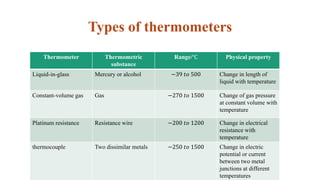
7.
Types of thermometers
ThermometerThermometric
substance
Range/℃ Physical property
Liquid-in-glass Mercury or alcohol −39 𝑡𝑜 500 Change in length of
liquid with temperature
Constant-volume gas Gas −270 𝑡𝑜 1500 Change of gas pressure
at constant volume with
temperature
Platinum resistance Resistance wire −200 𝑡𝑜 1200 Change in electrical
resistance with
temperature
thermocouple Two dissimilar metals −250 𝑡𝑜 1500 Change in electric
potential or current
between two metal
junctions at different
temperatures
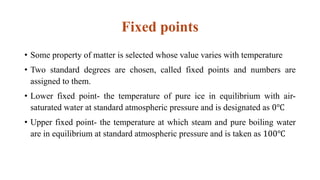
8.
Fixed points
• Someproperty of matter is selected whose value varies with temperature
• Two standard degrees are chosen, called fixed points and numbers are
assigned to them.
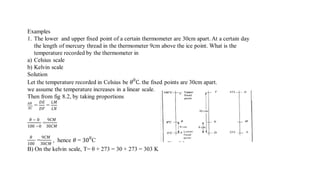
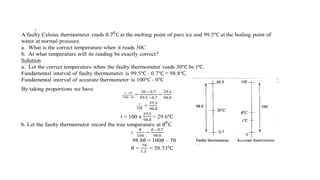
• Lower fixed point- the temperature of pure ice in equilibrium with air-
saturated water at standard atmospheric pressure and is designated as 0℃
• Upper fixed point- the temperature at which steam and pure boiling water
are in equilibrium at standard atmospheric pressure and is taken as 100℃
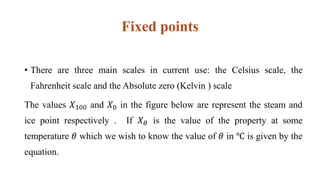
9.
Fixed points
• Thedifference between the upper fixed point and the lower fixed point
gives the fundamental interval
• There are three main scales in current use: the Celsius scale, the
Fahrenheit scale and the Absolute zero (Kelvin ) scale
The values 𝑋100 and 𝑋0 in the figure below are represent the steam and
ice point respectively . If 𝑋𝜃 is the value of the property at some
temperature 𝜃 which we wish to know the value of 𝜃 in ℃ is given by the
equation.
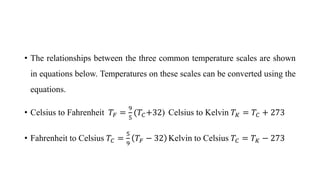
Relationship Between Scales
•The relationships between the three common temperature scales are shown
in equations below. Temperatures on these scales can be converted using the
equations.
• Celsius to Fahrenheit 𝑇𝐹 =
9
5
(𝑇𝐶+32) Celsius to Kelvin 𝑇𝐾 = 𝑇𝐶 + 273
• Fahrenheit to Celsius 𝑇𝐶 =
5
9
𝑇𝐹 − 32 Kelvin to Celsius 𝑇𝐶 = 𝑇𝐾 − 273
Liquid-in-glass Thermometer
• Acommon type of thermometer is a liquid-in-glass.
• The material in the capillary tube expands
as it is heated.
• The liquid is usually mercury or alcohol
15.
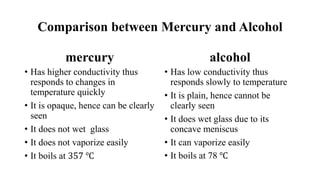
Comparison between Mercuryand Alcohol
mercury
• Has higher conductivity thus
responds to changes in
temperature quickly
• It is opaque, hence can be clearly
seen
• It does not wet glass
• It does not vaporize easily
• It boils at 357 ℃
alcohol
• Has low conductivity thus
responds slowly to temperature
• It is plain, hence cannot be
clearly seen
• It does wet glass due to its
concave meniscus
• It can vaporize easily
• It boils at 78 ℃
16.
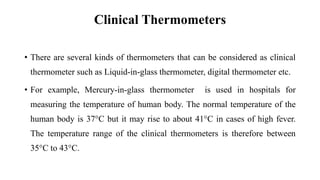
Clinical Thermometers
• Thereare several kinds of thermometers that can be considered as clinical
thermometer such as Liquid-in-glass thermometer, digital thermometer etc.
• For example, Mercury-in-glass thermometer is used in hospitals for
measuring the temperature of human body. The normal temperature of the
human body is 37°C but it may rise to about 41°C in cases of high fever.
The temperature range of the clinical thermometers is therefore between
35°C to 43°C.
17.
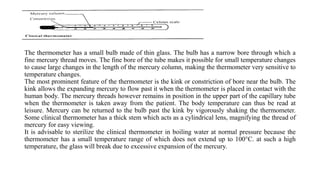
The thermometer hasa small bulb made of thin glass. The bulb has a narrow bore through which a
fine mercury thread moves. The fine bore of the tube makes it possible for small temperature changes
to cause large changes in the length of the mercury column, making the thermometer very sensitive to
temperature changes.
The most prominent feature of the thermometer is the kink or constriction of bore near the bulb. The
kink allows the expanding mercury to flow past it when the thermometer is placed in contact with the
human body. The mercury threads however remains in position in the upper part of the capillary tube
when the thermometer is taken away from the patient. The body temperature can thus be read at
leisure. Mercury can be returned to the bulb past the kink by vigorously shaking the thermometer.
Some clinical thermometer has a thick stem which acts as a cylindrical lens, magnifying the thread of
mercury for easy viewing.
It is advisable to sterilize the clinical thermometer in boiling water at normal pressure because the
thermometer has a small temperature range of which does not extend up to 100°C. at such a high
temperature, the glass will break due to excessive expansion of the mercury.
18.
Constant-volume gas thermometer
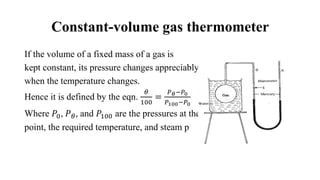
Ifthe volume of a fixed mass of a gas is
kept constant, its pressure changes appreciably
when the temperature changes.
Hence it is defined by the eqn.
𝜃
100
=
𝑃𝜃−𝑃0
𝑃100−𝑃0
Where 𝑃0, 𝑃𝜃, and 𝑃100 are the pressures at the ice
point, the required temperature, and steam point.
19.
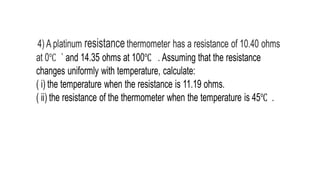
Resistance thermometer
The electricalresistance of a pure platinum wire increases
with temperature and since resistance can
be found very accurately it is a good property
on which to base a temperature scale.
It is given by the eqn.
𝜃
100
=
𝑅𝜃−𝑅0
𝑅100−𝑅0
Where 𝑅0 and 𝑅100 are the resistances at ice and
steam points respectively and 𝑅𝜃 is the resistance at the required
temperature.
20.
Thermocouple thermometer
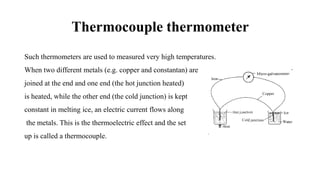
Such thermometersare used to measured very high temperatures.
When two different metals (e.g. copper and constantan) are
joined at the end and one end (the hot junction heated)
is heated, while the other end (the cold junction) is kept
constant in melting ice, an electric current flows along
the metals. This is the thermoelectric effect and the set
up is called a thermocouple.
Practice problems
1. Whiletraveling outside Sierra Leone, you feel sick. A companion
gets you a thermometer, which says your temperature is 39. What
scale is that on? What is your Fahrenheit temperature? Should you
seek medical help?
2. What is the change in length of a 3 cm long column of mercury if its
temperature changes from 37 °C to 40 °C , assuming the mercury is
constrained to a cylinder but unconstrained in length? Your answer
will show why thermometers contain bulbs at the bottom instead of
simple columns of liquid.
24.
Practice problems
3. Aperson taking a reading of the temperature in a freezer in Celsius
makes two mistakes: first omitting the negative sign and then thinking
the temperature is Fahrenheit. That is, the person reads – x °C as x °F.
Oddly enough, the result is the correct Fahrenheit temperature. What is
the original Celsius reading? Round your answer to three significant
figures.