Consider one-dimensional heat conduction through a homogeneous,
isotropic wall of thickness δ with constant thermal conductivity k and
constant cross-sectional area A. The wall is insulated on its lateral faces
and constant but different temperatures t1 and t2 are maintained at its
boundary surfaces. Obviously temperature varies only in the direction
normal to the wall and the temperature potential causes heat transfer
in the positive x-direction.
The attention is focused on an elementary strip of thickness dx
located at a distance x from the reference plane. The temperature
difference across the strip is dt and obviously the temperature
gradient is dt/dx. Since Q is constant in a steady state, the terms
of the Fourier rate equations Q = – kA (dt/dx) may be separated
and integrated directly between the limits t = t1 at x = 0 and t =
t2 at x = δ. Thus-
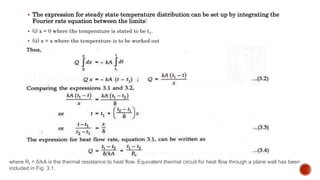
 The expression for steady state temperature distribution can be set up by integrating the
Fourier rate equation between the limits:
 (i) x = 0 where the temperature is stated to be t1.
 (ii) x = x where the temperature is to be worked out
where Rt = δ/kA is the thermal resistance to heat flow. Equivalent thermal circuit for heat flow through a plane wall has been
included in Fig. 3.1.
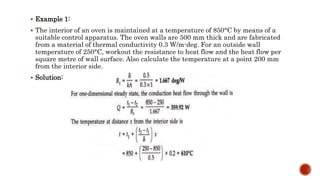
 Example 1:
 The interior of an oven is maintained at a temperature of 850°C by means of a
suitable control apparatus. The oven walls are 500 mm thick and are fabricated
from a material of thermal conductivity 0.3 W/m-deg. For an outside wall
temperature of 250°C, workout the resistance to heat flow and the heat flow per
square metre of wall surface. Also calculate the temperature at a point 200 mm
from the interior side.
 Solution:
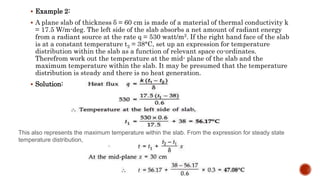
 Example 2:
 A plane slab of thickness δ = 60 cm is made of a material of thermal conductivity k
= 17.5 W/m-deg. The left side of the slab absorbs a net amount of radiant energy
from a radiant source at the rate q = 530 watt/m2. If the right hand face of the slab
is at a constant temperature t2 = 38°C, set up an expression for temperature
distribution within the slab as a function of relevant space co-ordinates.
Therefrom work out the temperature at the mid- plane of the slab and the
maximum temperature within the slab. It may be presumed that the temperature
distribution is steady and there is no heat generation.
 Solution:
This also represents the maximum temperature within the slab. From the expression for steady state
temperature distribution,
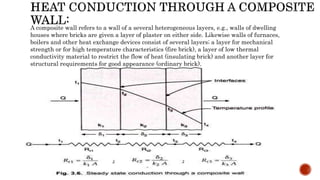
A composite wall refers to a wall of a several heterogeneous layers, e.g., walls of dwelling
houses where bricks are given a layer of plaster on either side. Likewise walls of furnaces,
boilers and other heat exchange devices consist of several layers; a layer for mechanical
strength or for high temperature characteristics (fire brick), a layer of low thermal
conductivity material to restrict the flow of heat (insulating brick) and another layer for
structural requirements for good appearance (ordinary brick).

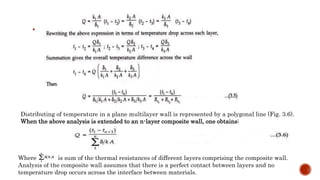
Distributing of temperature in a plane multilayer wall is represented by a polygonal line (Fig. 3.6).
When the above analysis is extended to an n-layer composite wall, one obtains:
Where is sum of the thermal resistances of different layers comprising the composite wall.
Analysis of the composite wall assumes that there is a perfect contact between layers and no
temperature drop occurs across the interface between materials.
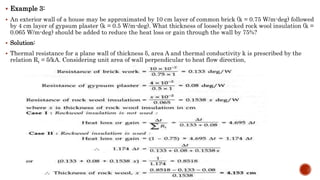
 Example 3:
 An exterior wall of a house may be approximated by 10 cm layer of common brick (k = 0.75 W/m-deg) followed
by 4 cm layer of gypsum plaster (k = 0.5 W/m-deg). What thickness of loosely packed rock wool insulation (k =
0.065 W/m-deg) should be added to reduce the heat loss or gain through the wall by 75%?
 Solution:
 Thermal resistance for a plane wall of thickness δ, area A and thermal conductivity k is prescribed by the
relation Rt = δ/kA. Considering unit area of wall perpendicular to heat flow direction,
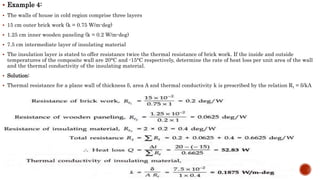
 Example 4:
 The walls of house in cold region comprise three layers
 15 cm outer brick work (k = 0.75 W/m-deg)
 1.25 cm inner wooden paneling (k = 0.2 W/m-deg)
 7.5 cm intermediate layer of insulating material
 The insulation layer is stated to offer resistance twice the thermal resistance of brick work. If the inside and outside
temperatures of the composite wall are 20°C and -15°C respectively, determine the rate of heat loss per unit area of the wall
and the thermal conductivity of the insulating material.
 Solution:
 Thermal resistance for a plane wall of thickness δ, area A and thermal conductivity k is prescribed by the relation Rt = δ/kA

Heat transfer through Wall and composite wall.pptx

Heat transfer through Wall and composite wall.pptx

  • 2.
    Consider one-dimensional heatconduction through a homogeneous, isotropic wall of thickness δ with constant thermal conductivity k and constant cross-sectional area A. The wall is insulated on its lateral faces and constant but different temperatures t1 and t2 are maintained at its boundary surfaces. Obviously temperature varies only in the direction normal to the wall and the temperature potential causes heat transfer in the positive x-direction. The attention is focused on an elementary strip of thickness dx located at a distance x from the reference plane. The temperature difference across the strip is dt and obviously the temperature gradient is dt/dx. Since Q is constant in a steady state, the terms of the Fourier rate equations Q = – kA (dt/dx) may be separated and integrated directly between the limits t = t1 at x = 0 and t = t2 at x = δ. Thus-
  • 3.
     The expressionfor steady state temperature distribution can be set up by integrating the Fourier rate equation between the limits:  (i) x = 0 where the temperature is stated to be t1.  (ii) x = x where the temperature is to be worked out where Rt = δ/kA is the thermal resistance to heat flow. Equivalent thermal circuit for heat flow through a plane wall has been included in Fig. 3.1.
  • 4.
     Example 1: The interior of an oven is maintained at a temperature of 850°C by means of a suitable control apparatus. The oven walls are 500 mm thick and are fabricated from a material of thermal conductivity 0.3 W/m-deg. For an outside wall temperature of 250°C, workout the resistance to heat flow and the heat flow per square metre of wall surface. Also calculate the temperature at a point 200 mm from the interior side.  Solution:
  • 5.
     Example 2: A plane slab of thickness δ = 60 cm is made of a material of thermal conductivity k = 17.5 W/m-deg. The left side of the slab absorbs a net amount of radiant energy from a radiant source at the rate q = 530 watt/m2. If the right hand face of the slab is at a constant temperature t2 = 38°C, set up an expression for temperature distribution within the slab as a function of relevant space co-ordinates. Therefrom work out the temperature at the mid- plane of the slab and the maximum temperature within the slab. It may be presumed that the temperature distribution is steady and there is no heat generation.  Solution: This also represents the maximum temperature within the slab. From the expression for steady state temperature distribution,
  • 6.
    A composite wallrefers to a wall of a several heterogeneous layers, e.g., walls of dwelling houses where bricks are given a layer of plaster on either side. Likewise walls of furnaces, boilers and other heat exchange devices consist of several layers; a layer for mechanical strength or for high temperature characteristics (fire brick), a layer of low thermal conductivity material to restrict the flow of heat (insulating brick) and another layer for structural requirements for good appearance (ordinary brick).
  • 7.
     Distributing of temperaturein a plane multilayer wall is represented by a polygonal line (Fig. 3.6). When the above analysis is extended to an n-layer composite wall, one obtains: Where is sum of the thermal resistances of different layers comprising the composite wall. Analysis of the composite wall assumes that there is a perfect contact between layers and no temperature drop occurs across the interface between materials.
  • 8.
     Example 3: An exterior wall of a house may be approximated by 10 cm layer of common brick (k = 0.75 W/m-deg) followed by 4 cm layer of gypsum plaster (k = 0.5 W/m-deg). What thickness of loosely packed rock wool insulation (k = 0.065 W/m-deg) should be added to reduce the heat loss or gain through the wall by 75%?  Solution:  Thermal resistance for a plane wall of thickness δ, area A and thermal conductivity k is prescribed by the relation Rt = δ/kA. Considering unit area of wall perpendicular to heat flow direction,
  • 9.
     Example 4: The walls of house in cold region comprise three layers  15 cm outer brick work (k = 0.75 W/m-deg)  1.25 cm inner wooden paneling (k = 0.2 W/m-deg)  7.5 cm intermediate layer of insulating material  The insulation layer is stated to offer resistance twice the thermal resistance of brick work. If the inside and outside temperatures of the composite wall are 20°C and -15°C respectively, determine the rate of heat loss per unit area of the wall and the thermal conductivity of the insulating material.  Solution:  Thermal resistance for a plane wall of thickness δ, area A and thermal conductivity k is prescribed by the relation Rt = δ/kA 