Tachometer
Introduction
 A tachometer (revolution-counter, tach, rev-counter, RPM
gauge) is an instrument measuring the rotation speed of a
shaft or disk, as in a motor or other machine.
 The device usually displays the revolutions per minute (RPM)
on a calibrated analogue dial, but digital displays are
increasingly common.
Types Of Tachometers
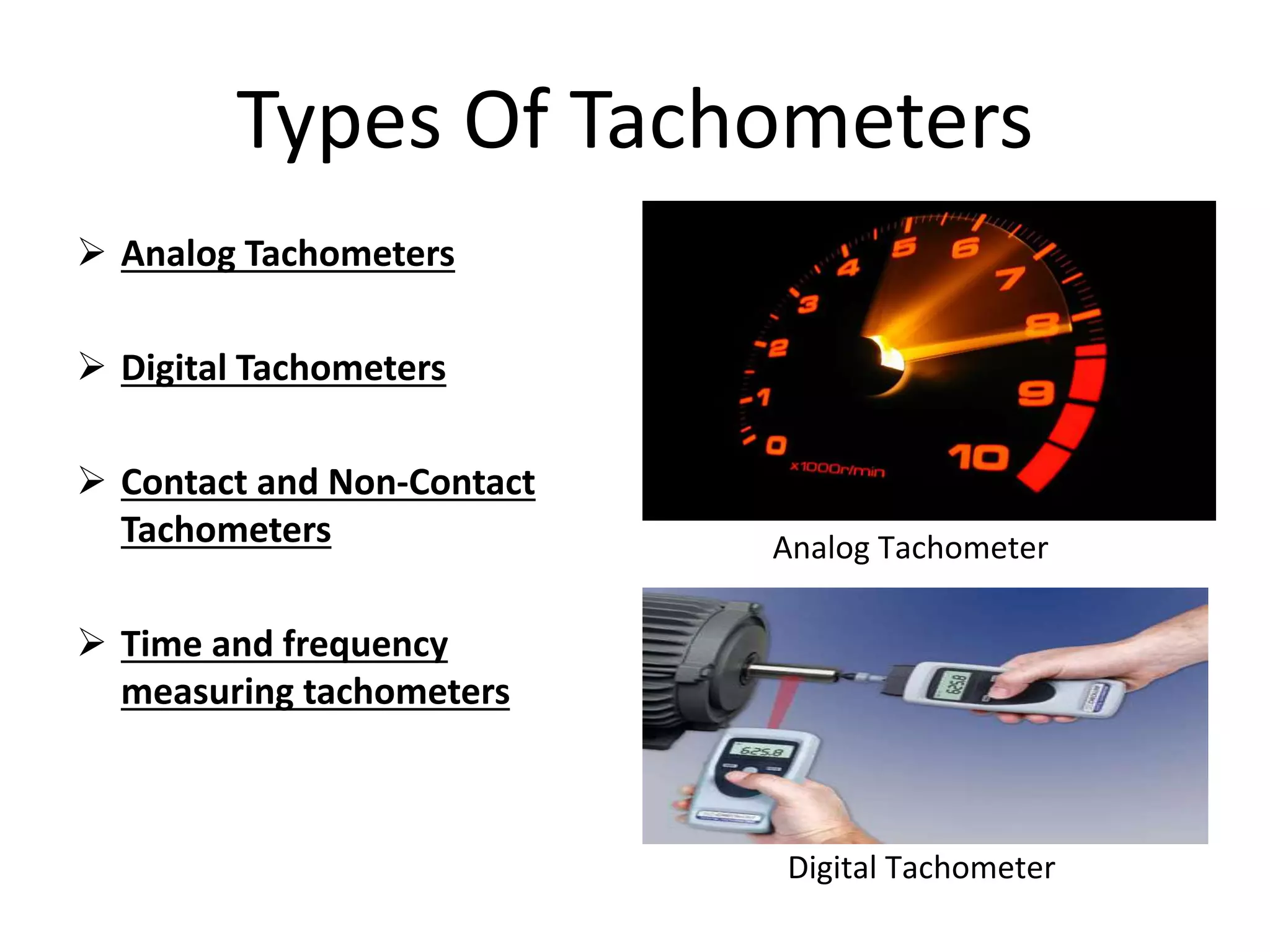
 Analog Tachometers
 Digital Tachometers
 Contact and Non-Contact
Tachometers
 Time and frequency
measuring tachometers
Analog Tachometer
Digital Tachometer
Block Diagram
Working principle
• Pulses are fed to the tachometer at the
frequency to be measured. A scale factor is
applied to produce readings of desired types
(linear speed, flow rates, etc)
• Two basic principles:-
1. Principle of fixed time based tachometer
2. Principle of reciprocal tachometer
Working Principle
 The ignition system triggers a voltage pulse at the output of
the tachometer electrochemichal part whenever the spark
plug fires.
 The electrochemical part responds to the average voltage of
the series of pulses.
 It shows that the average voltage of the pulse train is
proportional to the engine speed.
 The signal from the perception head is transmitted by
standard twin screened cable to the indicator.
 The tachometers are temperature compensated to be able to
handle operations over a range of -20 to +70 degrees.
Applications
 Automobiles
 Laser Instruments
 Analog Audio Recording
 Medical Applications
 The tachometer in a vehicle enables the driver to select suitable
throttle and gear settings for the driving conditions.
 It enables the driver to prevent exceeding speed capability of sub-
parts such as spring retracted valves of the engine, and
overheating, thereby causing unnecessary wear or permanent
damage and even failure of engines
Uses

Tachometer

  • 1.
  • 2.
    Introduction  A tachometer(revolution-counter, tach, rev-counter, RPM gauge) is an instrument measuring the rotation speed of a shaft or disk, as in a motor or other machine.  The device usually displays the revolutions per minute (RPM) on a calibrated analogue dial, but digital displays are increasingly common.
  • 3.
    Types Of Tachometers Analog Tachometers  Digital Tachometers  Contact and Non-Contact Tachometers  Time and frequency measuring tachometers Analog Tachometer Digital Tachometer
  • 4.
  • 5.
    Working principle • Pulsesare fed to the tachometer at the frequency to be measured. A scale factor is applied to produce readings of desired types (linear speed, flow rates, etc) • Two basic principles:- 1. Principle of fixed time based tachometer 2. Principle of reciprocal tachometer
  • 6.
    Working Principle  Theignition system triggers a voltage pulse at the output of the tachometer electrochemichal part whenever the spark plug fires.  The electrochemical part responds to the average voltage of the series of pulses.  It shows that the average voltage of the pulse train is proportional to the engine speed.  The signal from the perception head is transmitted by standard twin screened cable to the indicator.  The tachometers are temperature compensated to be able to handle operations over a range of -20 to +70 degrees.
  • 7.
    Applications  Automobiles  LaserInstruments  Analog Audio Recording  Medical Applications
  • 8.
     The tachometerin a vehicle enables the driver to select suitable throttle and gear settings for the driving conditions.  It enables the driver to prevent exceeding speed capability of sub- parts such as spring retracted valves of the engine, and overheating, thereby causing unnecessary wear or permanent damage and even failure of engines Uses