Dr. Ehab A. Hegazy
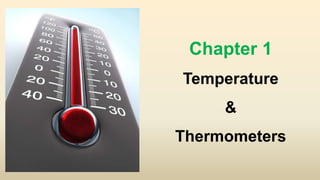
Chapter 1
Temperature
&
Thermometers
TEMERATURE
The effect of temp. on drug stability follows rule of thump
.in other words as the temp. increase ,the degradation
processes of the drug or drug material will increase. as
the temp. raise by 10o c, the degradation processes
doubled. consequently , may a hazard bi-product may be
formed and affect the health
What is Temperature?
A measure of the average kinetic energy of the particles in
a sample of matter, expressed in terms of units or degrees
designated on a standard scale.
What is mean by thermometers
It is a device to define and measure the temp. of a
system . When thermometer is in thermal equilibrium
with the system
How a Thermometer Works ?
We need :
1- Physical property that changes uniformly with change in
temperature .
2- Fixed points.
Freezing point , boiling point .
3- Temperature scale. (Celsius , Kelvin , Fahrenheit)
Basic physical ideas for making
thermometers
The variation in length of a solid;
The variation in volume of a fixed mass of gas at constant pressure;
The variation in pressure of a fixed mass of gas at constant volume;
The variation in resistance of a metal;
The variation in color of a very hot body;
The variation in electromotive force of a thermocouple.
C
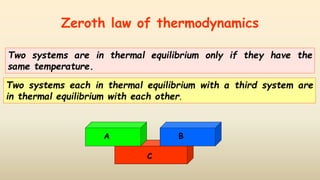
Zeroth law of thermodynamics
A B
Two systems each in thermal equilibrium with a third system are
in thermal equilibrium with each other.
Two systems are in thermal equilibrium only if they have the
same temperature.
Scales of Temperature
Lower fixed point This is the temperature of pure melting ice, at a
pressure of a standard atmosphere.
Upper fixed point This is the temperature of dry steam from water
boiling at a pressure of one standard atmosphere.
Fundamental interval This is the distance between the fixed points.
It is divided into a number of equal divisions. Each division is one
degree.
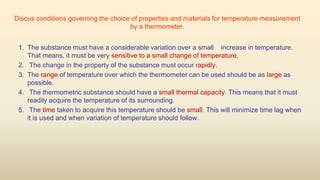
Discus conditions governing the choice of properties and materials for temperature measurement
by a thermometer.
1. The substance must have a considerable variation over a small increase in temperature.
That means, it must be very sensitive to a small change of temperature.
2. The change in the property of the substance must occur rapidly.
3. The range of temperature over which the thermometer can be used should be as large as
possible.
4. The thermometric substance should have a small thermal capacity. This means that it must
readily acquire the temperature of its surrounding.
5. The time taken to acquire this temperature should be small. This will minimize time lag when
it is used and when variation of temperature should follow.
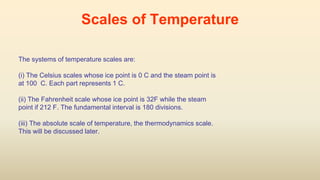
The systems of temperature scales are:
(i) The Celsius scales whose ice point is 0 C and the steam point is
at 100 C. Each part represents 1 C.
(ii) The Fahrenheit scale whose ice point is 32F while the steam
point if 212 F. The fundamental interval is 180 divisions.
(iii) The absolute scale of temperature, the thermodynamics scale.
This will be discussed later.
Scales of Temperature
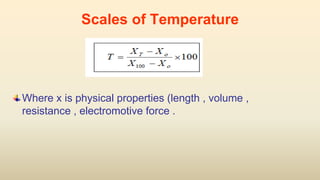
Where x is physical properties (length , volume ,
resistance , electromotive force .
Scales of Temperature
Celsius
scale
Kelvin
scale
Fahrenheit
scale
Rankine
scale
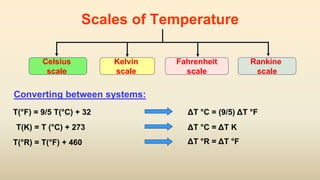
Converting between systems:
ΔT °C = (9/5) ΔT °F
T(K) = T (°C) + 273
T(°R) = T(°F) + 460
ΔT °C = ΔT K
ΔT °R = ΔT °F
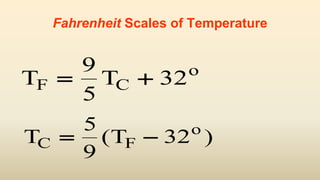
T(°F) = 9/5 T(°C) + 32
Scales of Temperature
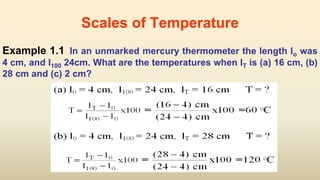
Example 1.1 In an unmarked mercury thermometer the length lo was
4 cm, and l100 24cm. What are the temperatures when lT is (a) 16 cm, (b)
28 cm and (c) 2 cm?
Fahrenheit Scales of Temperature
T TF C
o
 
9
5
32
T TC F
o
 
5
9
32( )
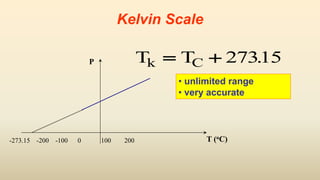
Kelvin Scale
P
T (oC)-273.15 -200 -100 0 100 200
T Tk C  27315.
• unlimited range
• very accurate
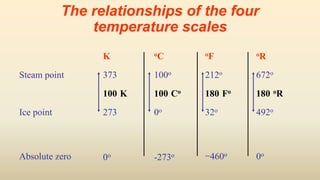
The relationships of the four
temperature scales
oRoFoCK
672o212o100o373Steam point
180 oR180 Fo100 Co100 K
492o32o0o273Ice point
0o-460o
-273o0oAbsolute zero
Fill in the blanks
ice
steam 100
273 32
212
-40
= (5/9)[TF-32] = (5/9) (-72) = - 40T TC F
o
 
5
9
32( )
233
Applications
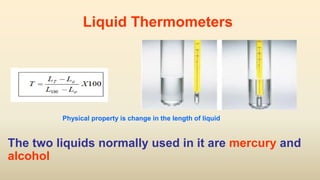
Liquid Thermometers
The two liquids normally used in it are mercury and
alcohol
Physical property is change in the length of liquid
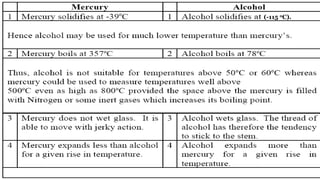
(-115 oC).
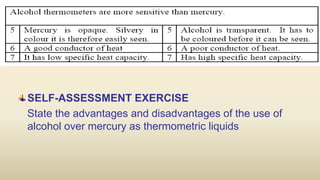
SELF-ASSESSMENT EXERCISE
State the advantages and disadvantages of the use of
alcohol over mercury as thermometric liquids
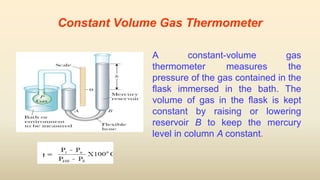
Constant Volume Gas Thermometer
A constant-volume gas
thermometer measures the
pressure of the gas contained in the
flask immersed in the bath. The
volume of gas in the flask is kept
constant by raising or lowering
reservoir B to keep the mercury
level in column A constant.
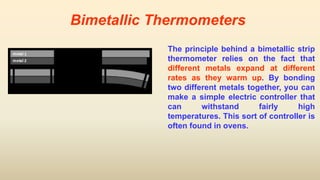
Bimetallic Thermometers
The principle behind a bimetallic strip
thermometer relies on the fact that
different metals expand at different
rates as they warm up. By bonding
two different metals together, you can
make a simple electric controller that
can withstand fairly high
temperatures. This sort of controller is
often found in ovens.
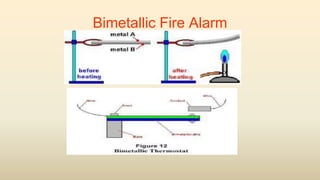
Bimetallic Fire Alarm
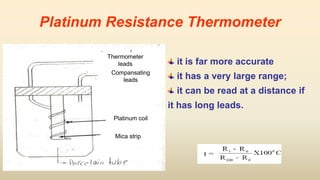
Platinum Resistance Thermometer
it is far more accurate
it has a very large range;
it can be read at a distance if
it has long leads.
Thermometer
leads
Compansating
leads
Platinum coil
Mica strip
Disadvantages of platinum thermometer
its chief disadvantage is the long time needed for it to assume the
temperature of its surroundings and the time required for making
an observation so that it cannot follow rapidly changing
temperatures.
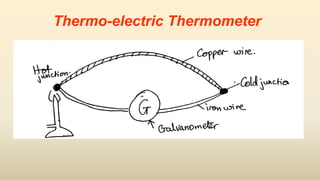
Thermo-electric Thermometer
Seebeck effect
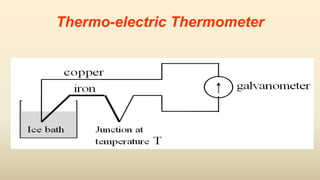
Seebeck effect simply states that if two dissimilar metals, such as copper and iron are joined
to make a complete circuit, then on heating one end of the junctions, a current flows round
the circuit
Thermo-electric Thermometer
The presence of the galvanometer is to detect and measure the magnitude of
the current that flows in the circuit.
This type of arrangement is called a thermo-couple.
The emf established round the circuits depends on the nature of the metals
used to form the couple and also on the temperature difference between the
hot and cold junctions.
Thermo-electric Thermometer
It has a low thermal capacity and can be used to :
measure fluctuating temperatures;
It has a very large range, from -200C to 1500 oC depending
upon the metals used for the thermocouple;
It can measure the temperature at a point.
Thermo-electric Thermometer
Thermopile
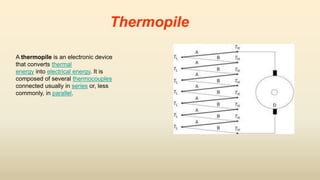
A thermopile is an electronic device
that converts thermal
energy into electrical energy. It is
composed of several thermocouples
connected usually in series or, less
commonly, in parallel.
Questions
State the five conditions necessary for the choice of properties and the
substance used for temperature measurement.
Mention four types of thermometers and their appropriate thermometric
properties used for their construction.
A body has temperature of about 1200 C. Which thermometer would you use
and why?

heat

  • 1.
  • 2.
  • 3.
    TEMERATURE The effect oftemp. on drug stability follows rule of thump .in other words as the temp. increase ,the degradation processes of the drug or drug material will increase. as the temp. raise by 10o c, the degradation processes doubled. consequently , may a hazard bi-product may be formed and affect the health
  • 4.
    What is Temperature? Ameasure of the average kinetic energy of the particles in a sample of matter, expressed in terms of units or degrees designated on a standard scale.
  • 5.
    What is meanby thermometers It is a device to define and measure the temp. of a system . When thermometer is in thermal equilibrium with the system
  • 6.
    How a ThermometerWorks ? We need : 1- Physical property that changes uniformly with change in temperature . 2- Fixed points. Freezing point , boiling point . 3- Temperature scale. (Celsius , Kelvin , Fahrenheit)
  • 7.
    Basic physical ideasfor making thermometers The variation in length of a solid; The variation in volume of a fixed mass of gas at constant pressure; The variation in pressure of a fixed mass of gas at constant volume; The variation in resistance of a metal; The variation in color of a very hot body; The variation in electromotive force of a thermocouple.
  • 8.
    C Zeroth law ofthermodynamics A B Two systems each in thermal equilibrium with a third system are in thermal equilibrium with each other. Two systems are in thermal equilibrium only if they have the same temperature.
  • 9.
    Scales of Temperature Lowerfixed point This is the temperature of pure melting ice, at a pressure of a standard atmosphere. Upper fixed point This is the temperature of dry steam from water boiling at a pressure of one standard atmosphere. Fundamental interval This is the distance between the fixed points. It is divided into a number of equal divisions. Each division is one degree.
  • 10.
    Discus conditions governingthe choice of properties and materials for temperature measurement by a thermometer. 1. The substance must have a considerable variation over a small increase in temperature. That means, it must be very sensitive to a small change of temperature. 2. The change in the property of the substance must occur rapidly. 3. The range of temperature over which the thermometer can be used should be as large as possible. 4. The thermometric substance should have a small thermal capacity. This means that it must readily acquire the temperature of its surrounding. 5. The time taken to acquire this temperature should be small. This will minimize time lag when it is used and when variation of temperature should follow.
  • 11.
    The systems oftemperature scales are: (i) The Celsius scales whose ice point is 0 C and the steam point is at 100 C. Each part represents 1 C. (ii) The Fahrenheit scale whose ice point is 32F while the steam point if 212 F. The fundamental interval is 180 divisions. (iii) The absolute scale of temperature, the thermodynamics scale. This will be discussed later. Scales of Temperature
  • 12.
    Where x isphysical properties (length , volume , resistance , electromotive force . Scales of Temperature
  • 13.
    Celsius scale Kelvin scale Fahrenheit scale Rankine scale Converting between systems: ΔT°C = (9/5) ΔT °F T(K) = T (°C) + 273 T(°R) = T(°F) + 460 ΔT °C = ΔT K ΔT °R = ΔT °F T(°F) = 9/5 T(°C) + 32 Scales of Temperature
  • 14.
    Scales of Temperature Example1.1 In an unmarked mercury thermometer the length lo was 4 cm, and l100 24cm. What are the temperatures when lT is (a) 16 cm, (b) 28 cm and (c) 2 cm?
  • 15.
    Fahrenheit Scales ofTemperature T TF C o   9 5 32 T TC F o   5 9 32( )
  • 16.
    Kelvin Scale P T (oC)-273.15-200 -100 0 100 200 T Tk C  27315. • unlimited range • very accurate
  • 17.
    The relationships ofthe four temperature scales oRoFoCK 672o212o100o373Steam point 180 oR180 Fo100 Co100 K 492o32o0o273Ice point 0o-460o -273o0oAbsolute zero
  • 18.
    Fill in theblanks ice steam 100 273 32 212 -40 = (5/9)[TF-32] = (5/9) (-72) = - 40T TC F o   5 9 32( ) 233
  • 19.
  • 20.
    Liquid Thermometers The twoliquids normally used in it are mercury and alcohol Physical property is change in the length of liquid
  • 21.
  • 22.
    SELF-ASSESSMENT EXERCISE State theadvantages and disadvantages of the use of alcohol over mercury as thermometric liquids
  • 23.
    Constant Volume GasThermometer A constant-volume gas thermometer measures the pressure of the gas contained in the flask immersed in the bath. The volume of gas in the flask is kept constant by raising or lowering reservoir B to keep the mercury level in column A constant.
  • 24.
    Bimetallic Thermometers The principlebehind a bimetallic strip thermometer relies on the fact that different metals expand at different rates as they warm up. By bonding two different metals together, you can make a simple electric controller that can withstand fairly high temperatures. This sort of controller is often found in ovens.
  • 25.
  • 26.
    Platinum Resistance Thermometer itis far more accurate it has a very large range; it can be read at a distance if it has long leads. Thermometer leads Compansating leads Platinum coil Mica strip
  • 27.
    Disadvantages of platinumthermometer its chief disadvantage is the long time needed for it to assume the temperature of its surroundings and the time required for making an observation so that it cannot follow rapidly changing temperatures.
  • 28.
  • 29.
    Seebeck effect Seebeck effectsimply states that if two dissimilar metals, such as copper and iron are joined to make a complete circuit, then on heating one end of the junctions, a current flows round the circuit Thermo-electric Thermometer
  • 30.
    The presence ofthe galvanometer is to detect and measure the magnitude of the current that flows in the circuit. This type of arrangement is called a thermo-couple. The emf established round the circuits depends on the nature of the metals used to form the couple and also on the temperature difference between the hot and cold junctions. Thermo-electric Thermometer
  • 31.
    Thermo-electric Thermometer It hasa low thermal capacity and can be used to : measure fluctuating temperatures; It has a very large range, from -200C to 1500 oC depending upon the metals used for the thermocouple; It can measure the temperature at a point.
  • 32.
  • 33.
    Thermopile A thermopile isan electronic device that converts thermal energy into electrical energy. It is composed of several thermocouples connected usually in series or, less commonly, in parallel.
  • 34.
    Questions State the fiveconditions necessary for the choice of properties and the substance used for temperature measurement. Mention four types of thermometers and their appropriate thermometric properties used for their construction. A body has temperature of about 1200 C. Which thermometer would you use and why?