Introduction to
Wireless Sensor Networks
Disclaimer:
a. Information included in this slides came from multiple sources. We have tried
our best to cite the sources. Please refer to the Table of References slide (#2)
to learn about the sources, when applicable.
b. The slides should be used only for academic purposes (e.g., in teaching a
class), and should not be used for commercial purposes.
1 Introduction to Wireless Sensor Networks
Introduction to Wireless Sensor Networks
2
Slides Source
6 www.cse.fau.edu/~jie/teaching/fall_2004_files/sensorslides1.ppt
19-23 http://web2.uwindsor.ca/courses/cs/aggarwal/cs60520/SeminarMaterial/WSN-
future.ppt
7-13 http://web.cecs.pdx.edu/~nbulusu/talks/grace-hopper.ppt
17-18,29-33 http://galaxy.cs.lamar.edu/~bsun/wsn/wsn.html
15-16 www.dsc.ufcg.edu.br/~maspohn/katia/introduction.ppt
24 http://computer.howstuffworks.com/mote1.htm
32-33 http://www.polastre.com/papers/polastre-thesis-final.pdf
Table of References
Agenda
 Introduction
 Differences with ad hoc networks
 Applications
 Characteristics
 Challenges
 Future
 Motes
 Hardware Setup Overview
3 Introduction to Wireless Sensor Networks
Introduction
 Wireless Sensor Networks are networks
that consists of sensors which are
distributed in an ad hoc manner.
 These sensors work with each other to
sense some physical phenomenon and then
the information gathered is processed to get
relevant results.
 Wireless sensor networks consists of
protocols and algorithms with self-
organizing capabilities.
4 Introduction to Wireless Sensor Networks
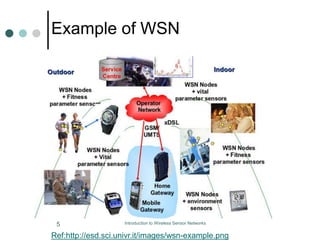
Example of WSN
5 Introduction to Wireless Sensor Networks
Ref:http://esd.sci.univr.it/images/wsn-example.png
Comparison with ad hoc
networks
 Wireless sensor networks mainly use broadcast
communication while ad hoc networks use
point-to-point communication.
 Unlike ad hoc networks wireless sensor
networks are limited by sensors limited power,
energy and computational capability.
 Sensor nodes may not have global ID because
of the large amount of overhead and large
number of sensors.
6 Introduction to Wireless Sensor Networks
Applications of Wireless Sensor
networks
The applications can be divided in three
categories:
1. Monitoring of objects.
2. Monitoring of an area.
3. Monitoring of both area and objects.
* Classification due to Culler, Estrin,
Srivastava
7 Introduction to Wireless Sensor Networks
Monitoring Area
 Environmental and Habitat Monitoring
 Precision Agriculture
 Indoor Climate Control
 Military Surveillance
 Treaty Verification
 Intelligent Alarms
8 Introduction to Wireless Sensor Networks
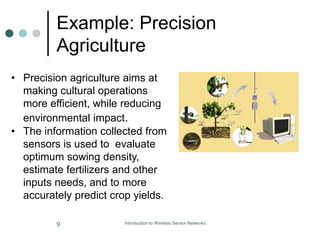
Example: Precision
Agriculture
• Precision agriculture aims at
making cultural operations
more efficient, while reducing
environmental impact.
• The information collected from
sensors is used to evaluate
optimum sowing density,
estimate fertilizers and other
inputs needs, and to more
accurately predict crop yields.
9 Introduction to Wireless Sensor Networks
Monitoring Objects
 Structural Monitoring
 Eco-physiology
 Condition-based Maintenance
 Medical Diagnostics
 Urban terrain mapping
10 Introduction to Wireless Sensor Networks
Example: Condition-based
Maintenance
 Intel fabrication plants
 Sensors collect vibration data, monitor wear
and tear; report data in real-time
 Reduces need for a team of engineers;
cutting costs by several orders of magnitude
11 Introduction to Wireless Sensor Networks
Monitoring Interactions between
Objects and Space
 Wildlife Habitats
 Disaster Management
 Emergency Response
 Ubiquitous Computing
 Asset Tracking
 Health Care
 Manufacturing Process Flows
12 Introduction to Wireless Sensor Networks
Example: Habitat Monitoring
 The ZebraNet Project
Collar-mounted sensors monitor zebra
movement in Kenya
Source: Margaret Martonosi, Princeton University
13 Introduction to Wireless Sensor Networks
Characteristics of Wireless
Sensor Networks
 Wireless Sensor Networks mainly consists of
sensors. Sensors are -
 low power
 limited memory
 energy constrained due to their small size.
 Wireless networks can also be deployed in
extreme environmental conditions and may be
prone to enemy attacks.
 Although deployed in an ad hoc manner they need
to be self organized and self healing and can face
constant reconfiguration.
14 Introduction to Wireless Sensor Networks
Design Challenges
 Heterogeneity
 The devices deployed maybe of various types and
need to collaborate with each other.
 Distributed Processing
 The algorithms need to be centralized as the
processing is carried out on different nodes.
 Low Bandwidth Communication
 The data should be transferred efficiently between
sensors
15 Introduction to Wireless Sensor Networks
Continued..
 Large Scale Coordination
 The sensors need to coordinate with each other to
produce required results.
 Utilization of Sensors
 The sensors should be utilized in a ways that
produce the maximum performance and use less
energy.
 Real Time Computation
 The computation should be done quickly as new
data is always being generated.
16 Introduction to Wireless Sensor Networks
Operational Challenges of
Wireless Sensor Networks
 Energy Efficiency
 Limited storage and computation
 Low bandwidth and high error rates
 Errors are common
 Wireless communication
 Noisy measurements
 Node failure are expected
 Scalability to a large number of sensor nodes
 Survivability in harsh environments
 Experiments are time- and space-intensive
17 Introduction to Wireless Sensor Networks
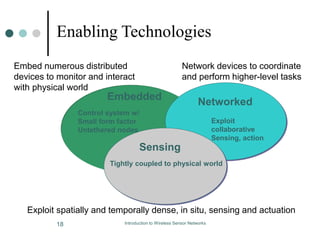
Enabling Technologies
Embedded
Networked
Sensing
Control system w/
Small form factor
Untethered nodes
Exploit
collaborative
Sensing, action
Tightly coupled to physical world
Embed numerous distributed
devices to monitor and interact
with physical world
Network devices to coordinate
and perform higher-level tasks
Exploit spatially and temporally dense, in situ, sensing and actuation
18 Introduction to Wireless Sensor Networks
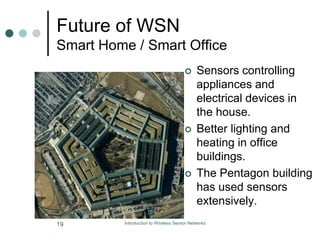
Future of WSN
Smart Home / Smart Office
 Sensors controlling
appliances and
electrical devices in
the house.
 Better lighting and
heating in office
buildings.
 The Pentagon building
has used sensors
extensively.
19 Introduction to Wireless Sensor Networks
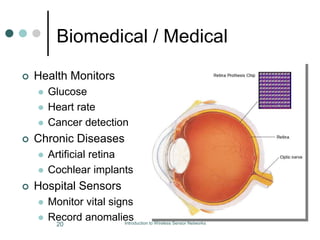
Biomedical / Medical
 Health Monitors
 Glucose
 Heart rate
 Cancer detection
 Chronic Diseases
 Artificial retina
 Cochlear implants
 Hospital Sensors
 Monitor vital signs
 Record anomalies
20 Introduction to Wireless Sensor Networks
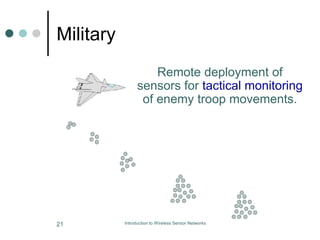
Military
Remote deployment of
sensors for tactical monitoring
of enemy troop movements.
21 Introduction to Wireless Sensor Networks
Industrial & Commercial
 Numerous industrial and commercial
applications:
 Agricultural Crop Conditions
 Inventory Tracking
 In-Process Parts Tracking
 Automated Problem Reporting
 RFID – Theft Deterrent and Customer Tracing
 Plant Equipment Maintenance Monitoring
22 Introduction to Wireless Sensor Networks
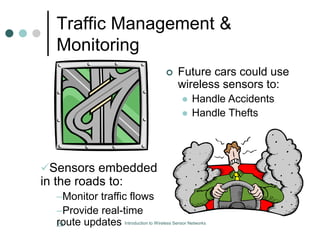
Traffic Management &
Monitoring
 Future cars could use
wireless sensors to:
 Handle Accidents
 Handle Thefts
Sensors embedded
in the roads to:
–Monitor traffic flows
–Provide real-time
route updates
23 Introduction to Wireless Sensor Networks
What are motes?
Motes mainly consist of three parts:-
 Mote basically consists of a low cost and
power computer.
 The computer monitors one or more sensors.
Sensors may be for temperature, light, sound,
position, acceleration, vibration, stress, weight,
pressure, humidity, etc.
 The computer connects to the outside world
with a radio link.
24 Introduction to Wireless Sensor Networks
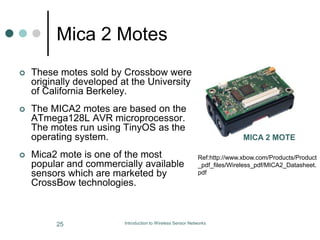
Mica 2 Motes
 These motes sold by Crossbow were
originally developed at the University
of California Berkeley.
 The MICA2 motes are based on the
ATmega128L AVR microprocessor.
The motes run using TinyOS as the
operating system.
 Mica2 mote is one of the most
popular and commercially available
sensors which are marketed by
CrossBow technologies.
MICA 2 MOTE
Ref:http://www.xbow.com/Products/Product
_pdf_files/Wireless_pdf/MICA2_Datasheet.
pdf
25 Introduction to Wireless Sensor Networks
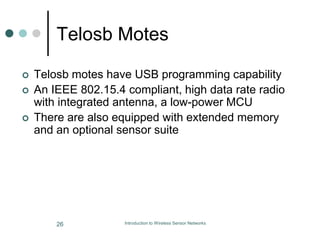
Telosb Motes
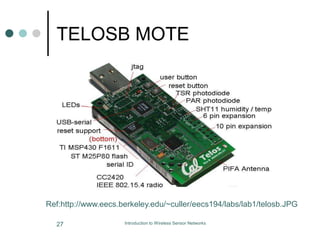
 Telosb motes have USB programming capability
 An IEEE 802.15.4 compliant, high data rate radio
with integrated antenna, a low-power MCU
 There are also equipped with extended memory
and an optional sensor suite
26 Introduction to Wireless Sensor Networks
TELOSB MOTE
Introduction to Wireless Sensor Networks
27
Ref:http://www.eecs.berkeley.edu/~culler/eecs194/labs/lab1/telosb.JPG
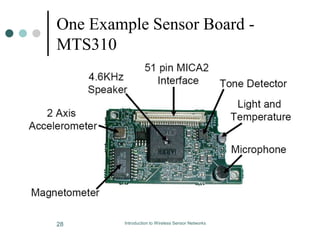
One Example Sensor Board -
MTS310
28 Introduction to Wireless Sensor Networks
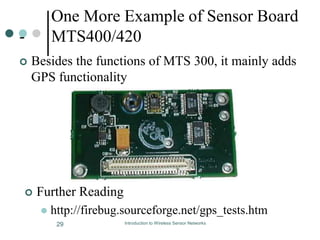
One More Example of Sensor Board
- MTS400/420
 Besides the functions of MTS 300, it mainly adds
GPS functionality
 Further Reading
 http://firebug.sourceforge.net/gps_tests.htm
29 Introduction to Wireless Sensor Networks
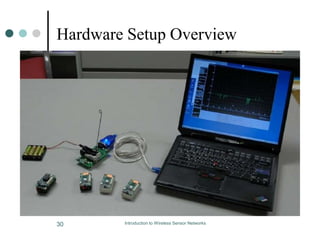
Hardware Setup Overview
30 Introduction to Wireless Sensor Networks
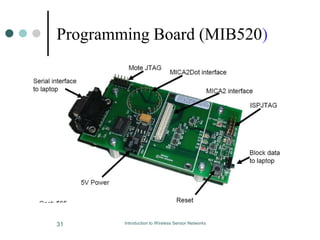
Programming Board (MIB520)
31 Introduction to Wireless Sensor Networks
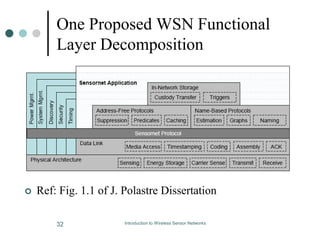
One Proposed WSN Functional
Layer Decomposition
 Ref: Fig. 1.1 of J. Polastre Dissertation
32 Introduction to Wireless Sensor Networks
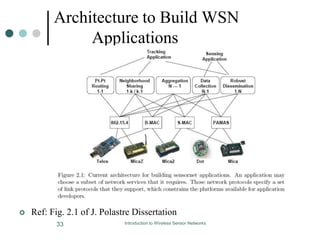
Architecture to Build WSN
Applications
 Ref: Fig. 2.1 of J. Polastre Dissertation
33 Introduction to Wireless Sensor Networks
References
1. Eschenauer, L., and V. Gligor, “A Key-Management Scheme for Distributed Sensor
Networks,” Proceedings of ACM Conference on Computer and Communications Security
(ACM CCS), Washington DC, pp. 41-47, 2002
2. http://www.xbow.com/products/Product_pdf_files/Wireless_pdf/MICA2_Datasheet.pdf
3. http://www.ece.osu.edu/~bibyk/ee582/telosMote.pdf
4. http://en.wikipedia.org/wiki/Wireless_Sensor_Networks
5. http://arri.uta.edu/acs/networks/WirelessSensorNetChap04.pdf
6. http://www.eecs.harvard.edu/~mdw/course/cs263/papers/jhill-thesis.pdf
7. http://www.polastre.com/papers/polastre-thesis-final.pdf
8. www.cse.fau.edu/~jie/teaching/fall_2004_files/sensorslides1.ppt
9. http://web2.uwindsor.ca/courses/cs/aggarwal/cs60520/SeminarMaterial/WSN-future.ppt
10. http://web.cecs.pdx.edu/~nbulusu/talks/grace-hopper.ppt
11. http://galaxy.cs.lamar.edu/~bsun/wsn/wsn.html
12. www.dsc.ufcg.edu.br/~maspohn/katia/introduction.ppt
13. http://computer.howstuffworks.com/mote1.htm
34 Introduction to Wireless Sensor Networks

Intro_to_WSN.ppt

  • 1.
    Introduction to Wireless SensorNetworks Disclaimer: a. Information included in this slides came from multiple sources. We have tried our best to cite the sources. Please refer to the Table of References slide (#2) to learn about the sources, when applicable. b. The slides should be used only for academic purposes (e.g., in teaching a class), and should not be used for commercial purposes. 1 Introduction to Wireless Sensor Networks
  • 2.
    Introduction to WirelessSensor Networks 2 Slides Source 6 www.cse.fau.edu/~jie/teaching/fall_2004_files/sensorslides1.ppt 19-23 http://web2.uwindsor.ca/courses/cs/aggarwal/cs60520/SeminarMaterial/WSN- future.ppt 7-13 http://web.cecs.pdx.edu/~nbulusu/talks/grace-hopper.ppt 17-18,29-33 http://galaxy.cs.lamar.edu/~bsun/wsn/wsn.html 15-16 www.dsc.ufcg.edu.br/~maspohn/katia/introduction.ppt 24 http://computer.howstuffworks.com/mote1.htm 32-33 http://www.polastre.com/papers/polastre-thesis-final.pdf Table of References
  • 3.
    Agenda  Introduction  Differenceswith ad hoc networks  Applications  Characteristics  Challenges  Future  Motes  Hardware Setup Overview 3 Introduction to Wireless Sensor Networks
  • 4.
    Introduction  Wireless SensorNetworks are networks that consists of sensors which are distributed in an ad hoc manner.  These sensors work with each other to sense some physical phenomenon and then the information gathered is processed to get relevant results.  Wireless sensor networks consists of protocols and algorithms with self- organizing capabilities. 4 Introduction to Wireless Sensor Networks
  • 5.
    Example of WSN 5Introduction to Wireless Sensor Networks Ref:http://esd.sci.univr.it/images/wsn-example.png
  • 6.
    Comparison with adhoc networks  Wireless sensor networks mainly use broadcast communication while ad hoc networks use point-to-point communication.  Unlike ad hoc networks wireless sensor networks are limited by sensors limited power, energy and computational capability.  Sensor nodes may not have global ID because of the large amount of overhead and large number of sensors. 6 Introduction to Wireless Sensor Networks
  • 7.
    Applications of WirelessSensor networks The applications can be divided in three categories: 1. Monitoring of objects. 2. Monitoring of an area. 3. Monitoring of both area and objects. * Classification due to Culler, Estrin, Srivastava 7 Introduction to Wireless Sensor Networks
  • 8.
    Monitoring Area  Environmentaland Habitat Monitoring  Precision Agriculture  Indoor Climate Control  Military Surveillance  Treaty Verification  Intelligent Alarms 8 Introduction to Wireless Sensor Networks
  • 9.
    Example: Precision Agriculture • Precisionagriculture aims at making cultural operations more efficient, while reducing environmental impact. • The information collected from sensors is used to evaluate optimum sowing density, estimate fertilizers and other inputs needs, and to more accurately predict crop yields. 9 Introduction to Wireless Sensor Networks
  • 10.
    Monitoring Objects  StructuralMonitoring  Eco-physiology  Condition-based Maintenance  Medical Diagnostics  Urban terrain mapping 10 Introduction to Wireless Sensor Networks
  • 11.
    Example: Condition-based Maintenance  Intelfabrication plants  Sensors collect vibration data, monitor wear and tear; report data in real-time  Reduces need for a team of engineers; cutting costs by several orders of magnitude 11 Introduction to Wireless Sensor Networks
  • 12.
    Monitoring Interactions between Objectsand Space  Wildlife Habitats  Disaster Management  Emergency Response  Ubiquitous Computing  Asset Tracking  Health Care  Manufacturing Process Flows 12 Introduction to Wireless Sensor Networks
  • 13.
    Example: Habitat Monitoring The ZebraNet Project Collar-mounted sensors monitor zebra movement in Kenya Source: Margaret Martonosi, Princeton University 13 Introduction to Wireless Sensor Networks
  • 14.
    Characteristics of Wireless SensorNetworks  Wireless Sensor Networks mainly consists of sensors. Sensors are -  low power  limited memory  energy constrained due to their small size.  Wireless networks can also be deployed in extreme environmental conditions and may be prone to enemy attacks.  Although deployed in an ad hoc manner they need to be self organized and self healing and can face constant reconfiguration. 14 Introduction to Wireless Sensor Networks
  • 15.
    Design Challenges  Heterogeneity The devices deployed maybe of various types and need to collaborate with each other.  Distributed Processing  The algorithms need to be centralized as the processing is carried out on different nodes.  Low Bandwidth Communication  The data should be transferred efficiently between sensors 15 Introduction to Wireless Sensor Networks
  • 16.
    Continued..  Large ScaleCoordination  The sensors need to coordinate with each other to produce required results.  Utilization of Sensors  The sensors should be utilized in a ways that produce the maximum performance and use less energy.  Real Time Computation  The computation should be done quickly as new data is always being generated. 16 Introduction to Wireless Sensor Networks
  • 17.
    Operational Challenges of WirelessSensor Networks  Energy Efficiency  Limited storage and computation  Low bandwidth and high error rates  Errors are common  Wireless communication  Noisy measurements  Node failure are expected  Scalability to a large number of sensor nodes  Survivability in harsh environments  Experiments are time- and space-intensive 17 Introduction to Wireless Sensor Networks
  • 18.
    Enabling Technologies Embedded Networked Sensing Control systemw/ Small form factor Untethered nodes Exploit collaborative Sensing, action Tightly coupled to physical world Embed numerous distributed devices to monitor and interact with physical world Network devices to coordinate and perform higher-level tasks Exploit spatially and temporally dense, in situ, sensing and actuation 18 Introduction to Wireless Sensor Networks
  • 19.
    Future of WSN SmartHome / Smart Office  Sensors controlling appliances and electrical devices in the house.  Better lighting and heating in office buildings.  The Pentagon building has used sensors extensively. 19 Introduction to Wireless Sensor Networks
  • 20.
    Biomedical / Medical Health Monitors  Glucose  Heart rate  Cancer detection  Chronic Diseases  Artificial retina  Cochlear implants  Hospital Sensors  Monitor vital signs  Record anomalies 20 Introduction to Wireless Sensor Networks
  • 21.
    Military Remote deployment of sensorsfor tactical monitoring of enemy troop movements. 21 Introduction to Wireless Sensor Networks
  • 22.
    Industrial & Commercial Numerous industrial and commercial applications:  Agricultural Crop Conditions  Inventory Tracking  In-Process Parts Tracking  Automated Problem Reporting  RFID – Theft Deterrent and Customer Tracing  Plant Equipment Maintenance Monitoring 22 Introduction to Wireless Sensor Networks
  • 23.
    Traffic Management & Monitoring Future cars could use wireless sensors to:  Handle Accidents  Handle Thefts Sensors embedded in the roads to: –Monitor traffic flows –Provide real-time route updates 23 Introduction to Wireless Sensor Networks
  • 24.
    What are motes? Motesmainly consist of three parts:-  Mote basically consists of a low cost and power computer.  The computer monitors one or more sensors. Sensors may be for temperature, light, sound, position, acceleration, vibration, stress, weight, pressure, humidity, etc.  The computer connects to the outside world with a radio link. 24 Introduction to Wireless Sensor Networks
  • 25.
    Mica 2 Motes These motes sold by Crossbow were originally developed at the University of California Berkeley.  The MICA2 motes are based on the ATmega128L AVR microprocessor. The motes run using TinyOS as the operating system.  Mica2 mote is one of the most popular and commercially available sensors which are marketed by CrossBow technologies. MICA 2 MOTE Ref:http://www.xbow.com/Products/Product _pdf_files/Wireless_pdf/MICA2_Datasheet. pdf 25 Introduction to Wireless Sensor Networks
  • 26.
    Telosb Motes  Telosbmotes have USB programming capability  An IEEE 802.15.4 compliant, high data rate radio with integrated antenna, a low-power MCU  There are also equipped with extended memory and an optional sensor suite 26 Introduction to Wireless Sensor Networks
  • 27.
    TELOSB MOTE Introduction toWireless Sensor Networks 27 Ref:http://www.eecs.berkeley.edu/~culler/eecs194/labs/lab1/telosb.JPG
  • 28.
    One Example SensorBoard - MTS310 28 Introduction to Wireless Sensor Networks
  • 29.
    One More Exampleof Sensor Board - MTS400/420  Besides the functions of MTS 300, it mainly adds GPS functionality  Further Reading  http://firebug.sourceforge.net/gps_tests.htm 29 Introduction to Wireless Sensor Networks
  • 30.
    Hardware Setup Overview 30Introduction to Wireless Sensor Networks
  • 31.
    Programming Board (MIB520) 31Introduction to Wireless Sensor Networks
  • 32.
    One Proposed WSNFunctional Layer Decomposition  Ref: Fig. 1.1 of J. Polastre Dissertation 32 Introduction to Wireless Sensor Networks
  • 33.
    Architecture to BuildWSN Applications  Ref: Fig. 2.1 of J. Polastre Dissertation 33 Introduction to Wireless Sensor Networks
  • 34.
    References 1. Eschenauer, L.,and V. Gligor, “A Key-Management Scheme for Distributed Sensor Networks,” Proceedings of ACM Conference on Computer and Communications Security (ACM CCS), Washington DC, pp. 41-47, 2002 2. http://www.xbow.com/products/Product_pdf_files/Wireless_pdf/MICA2_Datasheet.pdf 3. http://www.ece.osu.edu/~bibyk/ee582/telosMote.pdf 4. http://en.wikipedia.org/wiki/Wireless_Sensor_Networks 5. http://arri.uta.edu/acs/networks/WirelessSensorNetChap04.pdf 6. http://www.eecs.harvard.edu/~mdw/course/cs263/papers/jhill-thesis.pdf 7. http://www.polastre.com/papers/polastre-thesis-final.pdf 8. www.cse.fau.edu/~jie/teaching/fall_2004_files/sensorslides1.ppt 9. http://web2.uwindsor.ca/courses/cs/aggarwal/cs60520/SeminarMaterial/WSN-future.ppt 10. http://web.cecs.pdx.edu/~nbulusu/talks/grace-hopper.ppt 11. http://galaxy.cs.lamar.edu/~bsun/wsn/wsn.html 12. www.dsc.ufcg.edu.br/~maspohn/katia/introduction.ppt 13. http://computer.howstuffworks.com/mote1.htm 34 Introduction to Wireless Sensor Networks

Editor's Notes

  • #10 Ref-http://www.agrisupportonline.com/phy/index.htm