Presented By
Mehta Ishani
WAP-WML
Introduction
 WAP – Wireless Application Protocol
 The WAP is the leading standard for information
services on wireless terminals like digital mobile
phones.
 The WAP standard is based on Internet
standards (HTML, XML and TCP/IP).
What is the purpose of WAP?
 To enable easy, fast delivery of relevant
information and services to mobile users.
 It consists of a WML language specification, a
WMLScript specification, and a Wireless
Telephony Application Interface (WTAI)
specification.
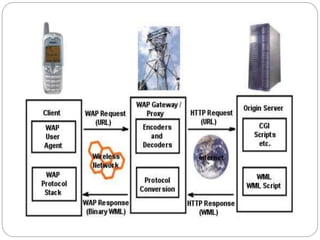
HTTP Model
WAP Gateway
 WAP Gateway/Proxy is the entity that connects
the wireless domain with the Internet. We
should make a note that the request that is sent
from the wireless client to the WAP
Gateway/Proxy uses the Wireless Session
Protocol (WSP). In its essence, WSP is a binary
version of HTTP.
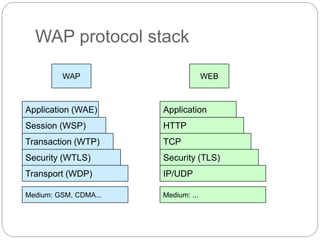
Application (WAE)
Session (WSP)
Security (WTLS)
Transport (WDP)
Transaction (WTP)
Medium: GSM, CDMA...
WAP
Application
HTTP
Security (TLS)
IP/UDP
TCP
Medium: ...
WEB
WAP protocol stack
WML
 A markup language - the Wireless Markup
Language (WML) has been adapted to develop
optimized WAP applications. In order to save
valuable bandwidth in the wireless network,
WML can be encoded into a compact binary
format. Encoding WML is one of the tasks
performed by the WAP Gateway/Proxy.
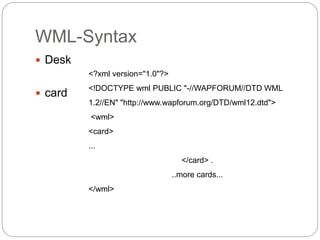
WML-Syntax
 Desk
 card
<?xml version="1.0"?>
<!DOCTYPE wml PUBLIC "-//WAPFORUM//DTD WML
1.2//EN" "http://www.wapforum.org/DTD/wml12.dtd">
<wml>
<card>
...
</card> .
..more cards...
</wml>
WAP - WML Script
 WMLScript (Wireless Markup Language
Script) is the client-side scripting language of
WML (Wireless Markup Language). A scripting
language is similar to a programming
language, but is of lighter weight. With
WMLScript, the wireless device can do some
of the processing and computation. This
reduces the number of requests and
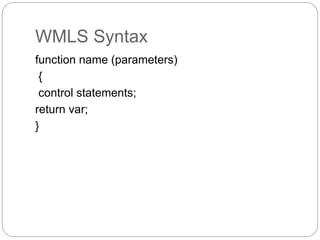
WMLS Syntax
function name (parameters)
{
control statements;
return var;
}
WAP - Core Services
Banking
Finance
Shopping
Ticketing
Entertainment
Weather
E- Messaging
Advantage
 The advantages that WAP can offer over these other
methods are the following: open standard, vendor
independent network-standard independent transport
mechanism optimised for wireless data bearers
application downloaded from the server, enabling fast
service creation and introduction, as opposed to
embedded software
Biblography
www.slideshare.net
Wap wml

Wap wml

  • 1.
  • 2.
    Introduction  WAP –Wireless Application Protocol  The WAP is the leading standard for information services on wireless terminals like digital mobile phones.  The WAP standard is based on Internet standards (HTML, XML and TCP/IP).
  • 3.
    What is thepurpose of WAP?  To enable easy, fast delivery of relevant information and services to mobile users.  It consists of a WML language specification, a WMLScript specification, and a Wireless Telephony Application Interface (WTAI) specification.
  • 4.
  • 6.
    WAP Gateway  WAPGateway/Proxy is the entity that connects the wireless domain with the Internet. We should make a note that the request that is sent from the wireless client to the WAP Gateway/Proxy uses the Wireless Session Protocol (WSP). In its essence, WSP is a binary version of HTTP.
  • 8.
    Application (WAE) Session (WSP) Security(WTLS) Transport (WDP) Transaction (WTP) Medium: GSM, CDMA... WAP Application HTTP Security (TLS) IP/UDP TCP Medium: ... WEB WAP protocol stack
  • 9.
    WML  A markuplanguage - the Wireless Markup Language (WML) has been adapted to develop optimized WAP applications. In order to save valuable bandwidth in the wireless network, WML can be encoded into a compact binary format. Encoding WML is one of the tasks performed by the WAP Gateway/Proxy.
  • 10.
    WML-Syntax  Desk  card <?xmlversion="1.0"?> <!DOCTYPE wml PUBLIC "-//WAPFORUM//DTD WML 1.2//EN" "http://www.wapforum.org/DTD/wml12.dtd"> <wml> <card> ... </card> . ..more cards... </wml>
  • 11.
    WAP - WMLScript  WMLScript (Wireless Markup Language Script) is the client-side scripting language of WML (Wireless Markup Language). A scripting language is similar to a programming language, but is of lighter weight. With WMLScript, the wireless device can do some of the processing and computation. This reduces the number of requests and
  • 12.
    WMLS Syntax function name(parameters) { control statements; return var; }
  • 13.
    WAP - CoreServices Banking Finance Shopping Ticketing Entertainment Weather E- Messaging
  • 14.
    Advantage  The advantagesthat WAP can offer over these other methods are the following: open standard, vendor independent network-standard independent transport mechanism optimised for wireless data bearers application downloaded from the server, enabling fast service creation and introduction, as opposed to embedded software
  • 15.

Editor's Notes

  • #3 application communication protocol used to access services and information from internet for handheld devices such as mobile phones protocol designed for micro browsers uses the mark-up language WML (not HTML) WAP enables the creating of web applications for mobile devices.
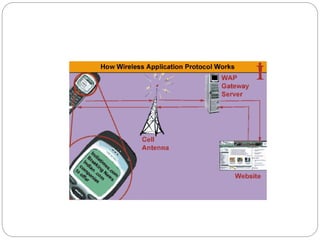
  • #8 The user selects an option on their mobile device that has a URL with Wireless Markup language (WML) content assigned to it. The phone sends the URL request via the phone network to a WAP gateway, using the binary encoded WAP protocol. The gateway translates this WAP request into a conventional HTTP request for the specified URL, and sends it on to the Internet. The appropriate Web server picks up the HTTP request. The server processes the request, just as it would any other request. If the URL refers to a static WML file, the server delivers it. If a CGI script is requested, it is processed and the content returned as usual. The Web server adds the HTTP header to the WML content and returns it to the gateway. The WAP gateway compiles the WML into binary form. The gateway then sends the WML response back to the phone. The phone receives the WML via the WAP protocol. The micro-browser processes the WML and displays the content on the screen.
  • #9 WAE- device specifications and the content development programming languages, WML and WMLScript. WSP - lightweight session layer to allow efficient exchange of data between applications. WTP - transaction support, uses UDPsuitable for low bandwidth wireless stations. WTLS - has encryption facilities that provide the secure transport service required by many applications, such as e-commerce. It includes data integrity checks, privacy, service denial, and authentication services. WDP - The WDP presents a consistent data format to the higher layers of the WAP protocol stack, thereby offering the advantage of bearer independence to application developers.