399MED Individual Project


        Submitted By: Mr. Gautam Chadda
        Roll No.      3744675
        Department: Automotive
 Automobile Aerodynamics.
 Automobile Aerodynamics includes:
      Drag
      Lift


• External Flow phenomenon
• Major factors Contributing to flow field around a vehicle
• Use of CFD as simulation tool for the analysis
• Effect of external devices which reduce drag such as
  spoilers and air dams.
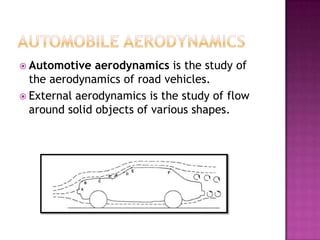
 Automotive   aerodynamics is the study of
  the aerodynamics of road vehicles.
 External aerodynamics is the study of flow
  around solid objects of various shapes.
   In vehicle aerodynamics drag is comprised
    primarily of two forces:
         Frontal pressure
         Rear vacuum


o Frontal pressure is caused by the air attempting to
  flow around the front of the car

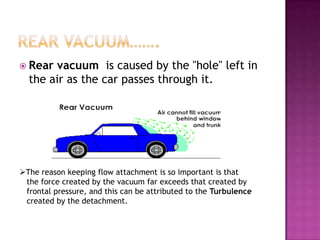
o Rear vacuum is caused by the "hole" left in the air
  as the car passes through it.
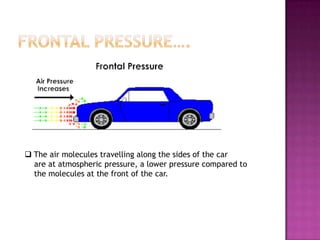
 The air molecules travelling along the sides of the car
  are at atmospheric pressure, a lower pressure compared to
  the molecules at the front of the car.
 Rear vacuum is caused by the "hole" left in
  the air as the car passes through it.


The reason keeping flow attachment is so important is that
 the force created by the vacuum far exceeds that created by
 frontal pressure, and this can be attributed to the Turbulence
 created by the detachment.
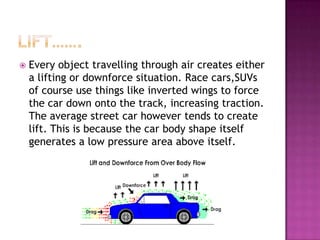
   Every object travelling through air creates either
    a lifting or downforce situation. Race cars,SUVs
    of course use things like inverted wings to force
    the car down onto the track, increasing traction.
    The average street car however tends to create
    lift. This is because the car body shape itself
    generates a low pressure area above itself.
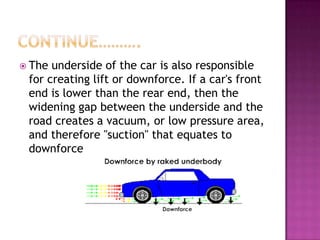
 The underside of the car is also responsible
 for creating lift or downforce. If a car's front
 end is lower than the rear end, then the
 widening gap between the underside and the
 road creates a vacuum, or low pressure area,
 and therefore "suction" that equates to
 downforce
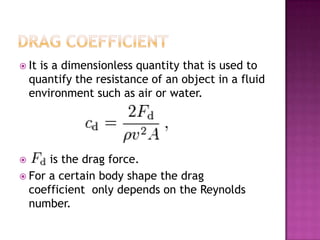
 It  is a dimensionless quantity that is used to
    quantify the resistance of an object in a fluid
    environment such as air or water.


     is the drag force.
 For a certain body shape the drag
  coefficient only depends on the Reynolds
  number.
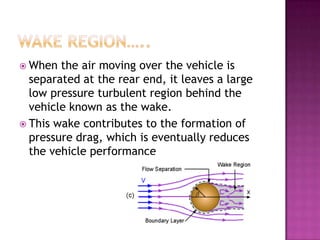
 When  the air moving over the vehicle is
  separated at the rear end, it leaves a large
  low pressure turbulent region behind the
  vehicle known as the wake.
 This wake contributes to the formation of
  pressure drag, which is eventually reduces
  the vehicle performance
 Boundary  layer
 Separation of flow field
 Friction drag
 Pressure drag
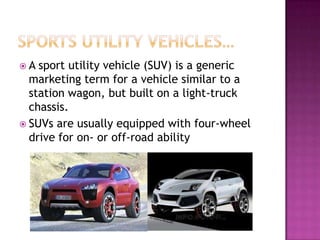
A  sport utility vehicle (SUV) is a generic
  marketing term for a vehicle similar to a
  station wagon, but built on a light-truck
  chassis.
 SUVs are usually equipped with four-wheel
  drive for on- or off-road ability
 This project is based on the design and
  developments of external devices which will
  let the manufacturers of Sport Utility Vehicle
  (especially known as ‘SUV’) make the present
  vehicles more aerodynamically attractive.
 The lowering drag coefficient shows the
  taste of competitive environment in the field
  of designing SUV
 Lowering   the front bumper and bonnet,
  inclining the front windshield.
 Rounding off the corners and sharp edges.
 Extending the front bumper
 Make small chamfers at the rear end of the
  roof and the side body, there will be a
  significant change in the drag.
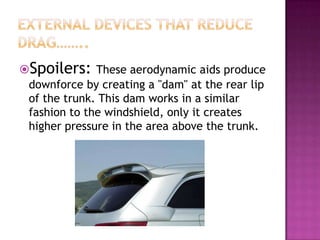
Spoilers: These aerodynamic aids produce
 downforce by creating a "dam" at the rear lip
 of the trunk. This dam works in a similar
 fashion to the windshield, only it creates
 higher pressure in the area above the trunk.
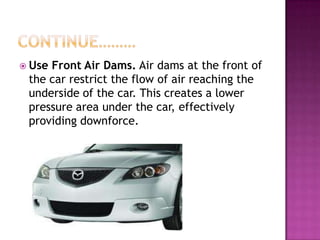
 UseFront Air Dams. Air dams at the front of
 the car restrict the flow of air reaching the
 underside of the car. This creates a lower
 pressure area under the car, effectively
 providing downforce.
 Firstly,
         we will produce various designs (4-5)
  of windscreen, hood and spoilers.
 Then we will perform the various analysis
  over the designs by using different values of
  Reynolds number in ANSYS.
 In ANSYS we will see the pressure distribution
  on the body of vehicle induced by fluid
  properties to deduce the aerodynamic drag.
Automobile aerodynamics

Automobile aerodynamics

  • 1.
    399MED Individual Project Submitted By: Mr. Gautam Chadda Roll No. 3744675 Department: Automotive
  • 2.
     Automobile Aerodynamics. Automobile Aerodynamics includes:  Drag  Lift • External Flow phenomenon • Major factors Contributing to flow field around a vehicle • Use of CFD as simulation tool for the analysis • Effect of external devices which reduce drag such as spoilers and air dams.
  • 3.
     Automotive aerodynamics is the study of the aerodynamics of road vehicles.  External aerodynamics is the study of flow around solid objects of various shapes.
  • 4.
    In vehicle aerodynamics drag is comprised primarily of two forces:  Frontal pressure  Rear vacuum o Frontal pressure is caused by the air attempting to flow around the front of the car o Rear vacuum is caused by the "hole" left in the air as the car passes through it.
  • 5.
     The airmolecules travelling along the sides of the car are at atmospheric pressure, a lower pressure compared to the molecules at the front of the car.
  • 6.
     Rear vacuumis caused by the "hole" left in the air as the car passes through it. The reason keeping flow attachment is so important is that the force created by the vacuum far exceeds that created by frontal pressure, and this can be attributed to the Turbulence created by the detachment.
  • 7.
    Every object travelling through air creates either a lifting or downforce situation. Race cars,SUVs of course use things like inverted wings to force the car down onto the track, increasing traction. The average street car however tends to create lift. This is because the car body shape itself generates a low pressure area above itself.
  • 8.
     The undersideof the car is also responsible for creating lift or downforce. If a car's front end is lower than the rear end, then the widening gap between the underside and the road creates a vacuum, or low pressure area, and therefore "suction" that equates to downforce
  • 9.
     It is a dimensionless quantity that is used to quantify the resistance of an object in a fluid environment such as air or water.  is the drag force.  For a certain body shape the drag coefficient only depends on the Reynolds number.
  • 10.
     When the air moving over the vehicle is separated at the rear end, it leaves a large low pressure turbulent region behind the vehicle known as the wake.  This wake contributes to the formation of pressure drag, which is eventually reduces the vehicle performance
  • 11.
     Boundary layer  Separation of flow field  Friction drag  Pressure drag
  • 12.
    A sportutility vehicle (SUV) is a generic marketing term for a vehicle similar to a station wagon, but built on a light-truck chassis.  SUVs are usually equipped with four-wheel drive for on- or off-road ability
  • 13.
     This projectis based on the design and developments of external devices which will let the manufacturers of Sport Utility Vehicle (especially known as ‘SUV’) make the present vehicles more aerodynamically attractive.  The lowering drag coefficient shows the taste of competitive environment in the field of designing SUV
  • 14.
     Lowering the front bumper and bonnet, inclining the front windshield.  Rounding off the corners and sharp edges.  Extending the front bumper  Make small chamfers at the rear end of the roof and the side body, there will be a significant change in the drag.
  • 15.
    Spoilers: These aerodynamicaids produce downforce by creating a "dam" at the rear lip of the trunk. This dam works in a similar fashion to the windshield, only it creates higher pressure in the area above the trunk.
  • 16.
     UseFront AirDams. Air dams at the front of the car restrict the flow of air reaching the underside of the car. This creates a lower pressure area under the car, effectively providing downforce.
  • 17.
     Firstly, we will produce various designs (4-5) of windscreen, hood and spoilers.  Then we will perform the various analysis over the designs by using different values of Reynolds number in ANSYS.  In ANSYS we will see the pressure distribution on the body of vehicle induced by fluid properties to deduce the aerodynamic drag.