DATA 
ACQUISITION 
SYSTEM 
SUMEET PATEL 
Enroll. No. - 110050111040
QUESTIONS 
What is temperature at present? 
What is your age? 
How much power the fan is consuming? 
How much force can you apply on table? 
What is the distance between x and y place? 
2
TOPICS TO DISCUSS 
 Introduction to DAS 
 Objectives of a DAS 
 Block diagram and explanation 
 Methodology 
 Hardware and software for DAS 
 Merits and Demerits of DAS/DQS 
 Conclusion 
3
INTRODUCTION 
4
INTRODUCTION 
 DATA ACQUISITION is the process of sampling 
signals that measure real world physical conditions and 
converting the resulting samples into digital numeric 
values that can be manipulated by a computer. 
 Data acquisition systems (abbreviated with the 
acronym DAS or DAQ) typically convert analog 
waveforms into digital values for easy processing. 
5
INTRODUCTION 
The components of data acquisition systems include: 
 Sensors that convert physical parameters to electrical 
signals. 
 Signal conditioning circuitry to convert sensor signals 
into a form that can be converted to digital values. 
 Analog-to-digital converters, which convert 
conditioned sensor signals to digital values. 
BACK 6
7 
OBJECTIVE 
 DAS must acquire the necessary data, at correct speed and at correct 
time. 
 It must monitor the complete plant operation to maintain on line and 
safe operations. 
 It must be able to collect, summarise and store data for diagnosis of 
operation and record purpose. 
 It must be flexible and capable of being expanded for future 
requirements. 
 It must be able to compute unit performance indices using on-line, 
real time data. 
 It must be reliable, easy to operate and must be user friendly. 
BACK
BLOCK DIAGRAM 
8
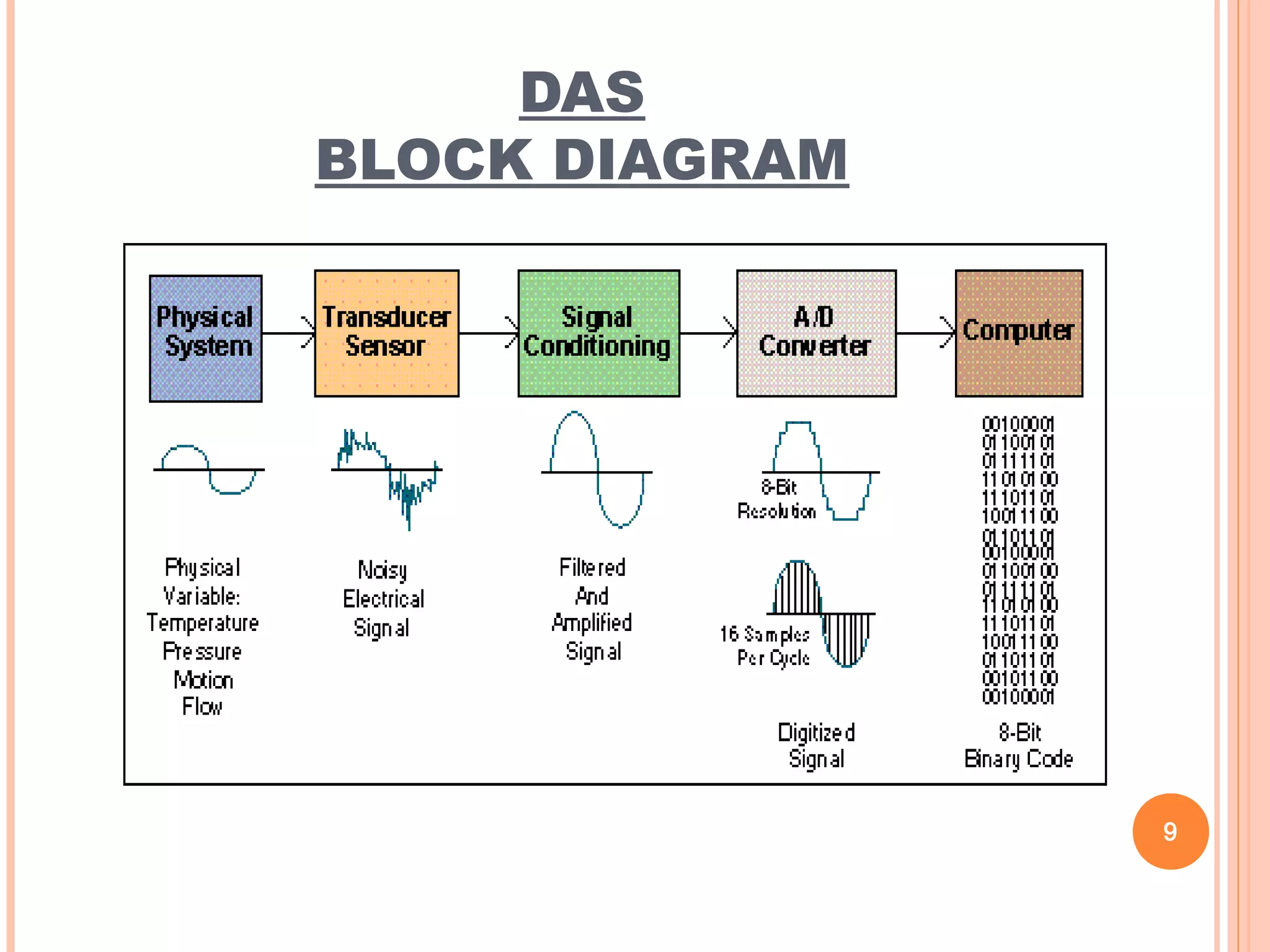
DAS 
BLOCK DIAGRAM 
9
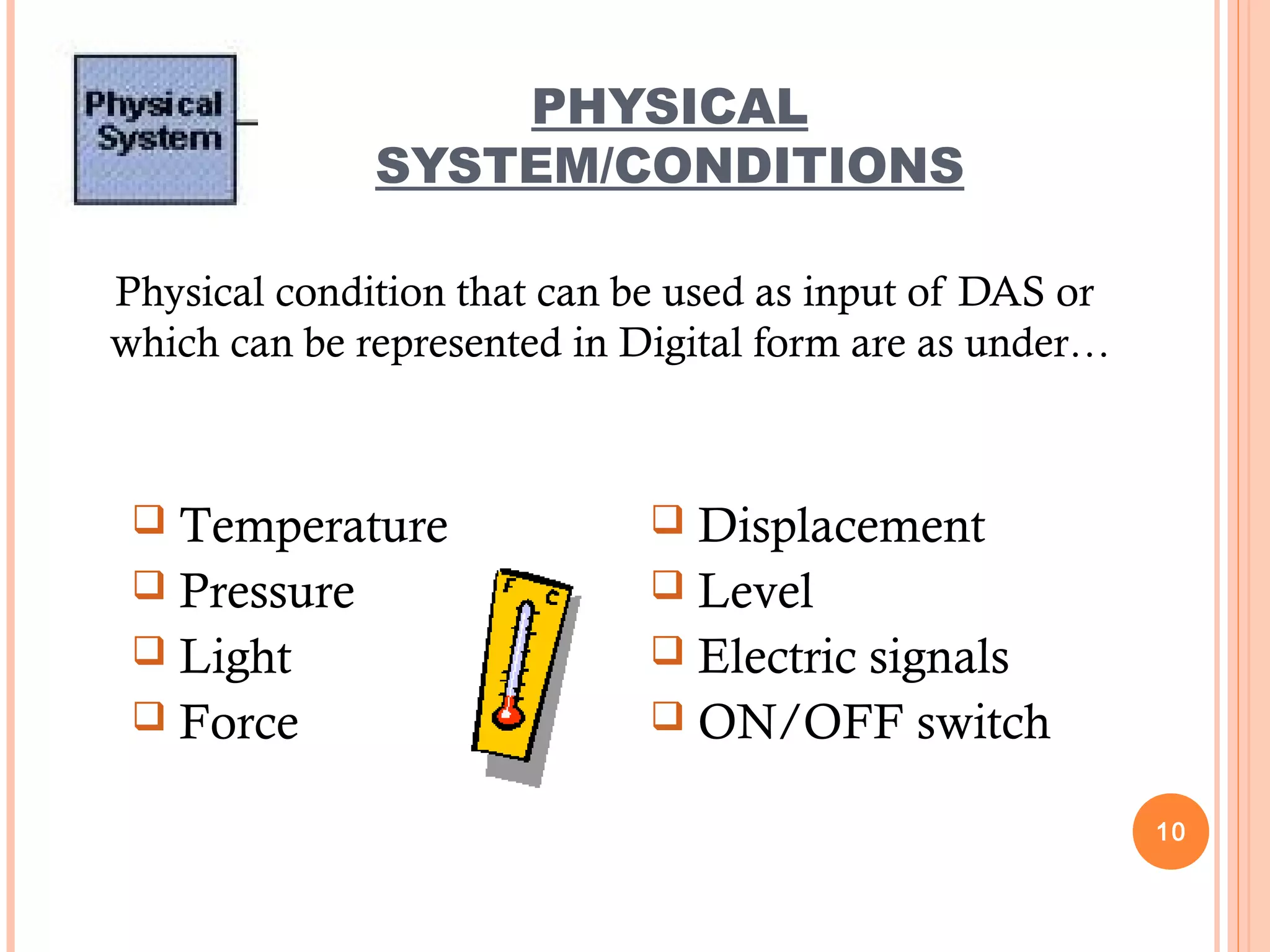
PHYSICAL 
SYSTEM/CONDITIONS 
Physical condition that can be used as input of DAS or 
which can be represented in Digital form are as under… 
10 
 Displacement 
 Level 
 Electric signals 
 ON/OFF switch 
 Temperature 
 Pressure 
 Light 
 Force
 A transducer converts temperature, pressure, level, 
length, position, etc. into voltage, current, frequency, 
pulses or other signals. 
 A transducer thus converts the physical conditions in 
electrical waveform for easy signal processing 
11 
TRANSDUCERS
SIGNAL CONDITIONING 
 Signal conditioning circuits improve the quality of 
signals generated by transducers before they are 
converted into digital signals by the PC's data-acquisition 
hardware. 
 Most common signal conditioning functions are 
amplification, linearization, cold-junction 
compensation, filtering, attenuation, excitation, 
common-mode rejection, and so on. 
12
 Analog to digital (A/D) conversion changes analog 
voltage or current levels into digital information. The 
conversion is necessary to enable the computer to 
process or store the signals. 
13 
ANALOG DIGITAL(A/D) 
CONVERTER 
BACK
14 
METHODOLOGY
METHODOLOGY 
 DAS begins with the physical property to be measured. Examples of 
this include temperature, light intensity, gas pressure, fluid flow, force 
etc. 
 A sensor, which is a type of transducer converts a physical property 
into a corresponding electrical signal 
 Signal conditioning may be necessary if the signal from the 
transducer is not suitable for the DAQ hardware being used. 
 After signal conditioning the analog wave output is converted into 
digital form using A/D converter. 
 Once digitized, the signal can be encoded to reduce and correct 
transmission errors. 
 This whole process is called as DATA ACQUISITION SYSTEM 
BACK 15
DAS HARDWARE AND 
SOFTWARE 
16
DATA ACQUISITION HARDWARE 
DAQ hardware interfaces the signal and a PC. It could be in 
the form of modules that can be connected to the computer's 
ports or cards connected to slots in the motherboard. 
Following are some hardware's…. 
 CAMAC - Computer Automated Measurement and Control 
 Industrial Ethernet 
 Industrial USB 
 LAN eXtensions for Instrumentation 
 NIM 
 PowerLab 
 VME bus 
 VXI 17
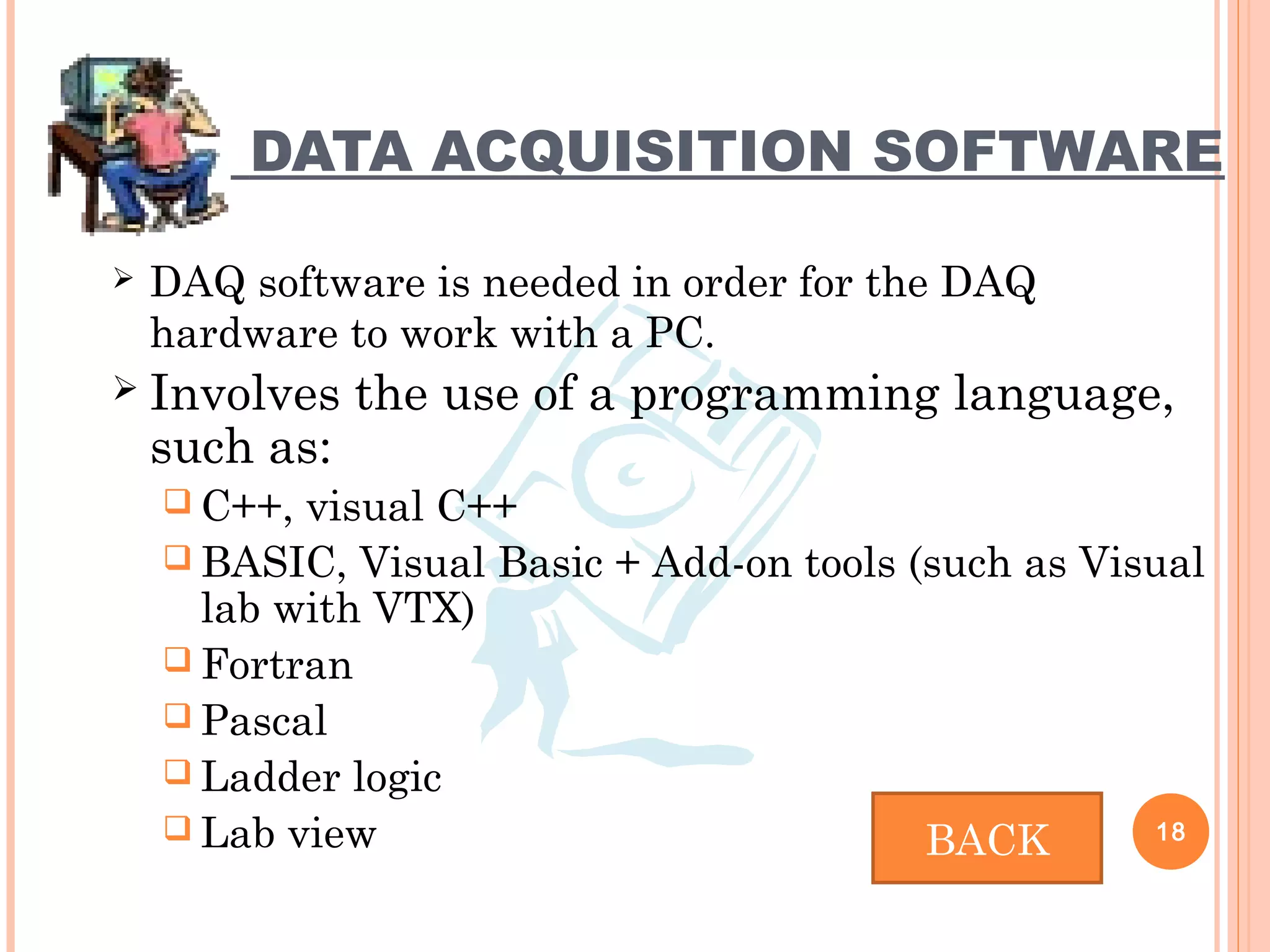
DATA ACQUISITION SOFTWARE 
 DAQ software is needed in order for the DAQ 
hardware to work with a PC. 
 Involves the use of a programming language, 
such as: 
C++, visual C++ 
BASIC, Visual Basic + Add-on tools (such as Visual 
lab with VTX) 
Fortran 
Pascal 
Ladder logic 
Lab view BACK 18
MERITS AND DEMERITS 
19
MERITS/ADVANTAGES 
 Reduced data redundancy 
 Reduced updating errors and increased 
consistency 
 Greater data integrity and independence from 
applications programs 
 Improved data access to users through use of 
host and query languages 
 Improved data security 
 Reduced data entry, storage, and retrieval costs 
 Facilitated development of new applications 
program 20
DEMERITS/DISADVANTAGES 
 Database systems are complex, difficult, and 
time-consuming to design 
 Substantial hardware and software start-up costs 
 Damage to database affects virtually all 
applications programs 
 Extensive conversion costs in moving form a file-based 
system to a database system 
 Initial training required for all programmers and 
users 
BACK 21
CONCLUSION 
 Data acquisition systems typically convert analog 
Physical condition into digital values for easy 
processing. 
 DAS is advantageous as we can store a lot of 
physical condition data in digitized form 
 DAS helps in easy processing of data as well as 
easy comparison can be done. 
 Today DAS is used in almost every field,industry 
and companies. 
22
BIBLIOGRAPHY 
 www.google.co.in 
 en.wikipedia.org 
23
24 
ANY QUESTIONS ???
THANK YOU

Data acquisition system (DAS)

  • 1.
    DATA ACQUISITION SYSTEM SUMEET PATEL Enroll. No. - 110050111040
  • 2.
    QUESTIONS What istemperature at present? What is your age? How much power the fan is consuming? How much force can you apply on table? What is the distance between x and y place? 2
  • 3.
    TOPICS TO DISCUSS  Introduction to DAS  Objectives of a DAS  Block diagram and explanation  Methodology  Hardware and software for DAS  Merits and Demerits of DAS/DQS  Conclusion 3
  • 4.
  • 5.
    INTRODUCTION  DATAACQUISITION is the process of sampling signals that measure real world physical conditions and converting the resulting samples into digital numeric values that can be manipulated by a computer.  Data acquisition systems (abbreviated with the acronym DAS or DAQ) typically convert analog waveforms into digital values for easy processing. 5
  • 6.
    INTRODUCTION The componentsof data acquisition systems include:  Sensors that convert physical parameters to electrical signals.  Signal conditioning circuitry to convert sensor signals into a form that can be converted to digital values.  Analog-to-digital converters, which convert conditioned sensor signals to digital values. BACK 6
  • 7.
    7 OBJECTIVE DAS must acquire the necessary data, at correct speed and at correct time.  It must monitor the complete plant operation to maintain on line and safe operations.  It must be able to collect, summarise and store data for diagnosis of operation and record purpose.  It must be flexible and capable of being expanded for future requirements.  It must be able to compute unit performance indices using on-line, real time data.  It must be reliable, easy to operate and must be user friendly. BACK
  • 8.
  • 9.
  • 10.
    PHYSICAL SYSTEM/CONDITIONS Physicalcondition that can be used as input of DAS or which can be represented in Digital form are as under… 10  Displacement  Level  Electric signals  ON/OFF switch  Temperature  Pressure  Light  Force
  • 11.
     A transducerconverts temperature, pressure, level, length, position, etc. into voltage, current, frequency, pulses or other signals.  A transducer thus converts the physical conditions in electrical waveform for easy signal processing 11 TRANSDUCERS
  • 12.
    SIGNAL CONDITIONING Signal conditioning circuits improve the quality of signals generated by transducers before they are converted into digital signals by the PC's data-acquisition hardware.  Most common signal conditioning functions are amplification, linearization, cold-junction compensation, filtering, attenuation, excitation, common-mode rejection, and so on. 12
  • 13.
     Analog todigital (A/D) conversion changes analog voltage or current levels into digital information. The conversion is necessary to enable the computer to process or store the signals. 13 ANALOG DIGITAL(A/D) CONVERTER BACK
  • 14.
  • 15.
    METHODOLOGY  DASbegins with the physical property to be measured. Examples of this include temperature, light intensity, gas pressure, fluid flow, force etc.  A sensor, which is a type of transducer converts a physical property into a corresponding electrical signal  Signal conditioning may be necessary if the signal from the transducer is not suitable for the DAQ hardware being used.  After signal conditioning the analog wave output is converted into digital form using A/D converter.  Once digitized, the signal can be encoded to reduce and correct transmission errors.  This whole process is called as DATA ACQUISITION SYSTEM BACK 15
  • 16.
    DAS HARDWARE AND SOFTWARE 16
  • 17.
    DATA ACQUISITION HARDWARE DAQ hardware interfaces the signal and a PC. It could be in the form of modules that can be connected to the computer's ports or cards connected to slots in the motherboard. Following are some hardware's….  CAMAC - Computer Automated Measurement and Control  Industrial Ethernet  Industrial USB  LAN eXtensions for Instrumentation  NIM  PowerLab  VME bus  VXI 17
  • 18.
    DATA ACQUISITION SOFTWARE  DAQ software is needed in order for the DAQ hardware to work with a PC.  Involves the use of a programming language, such as: C++, visual C++ BASIC, Visual Basic + Add-on tools (such as Visual lab with VTX) Fortran Pascal Ladder logic Lab view BACK 18
  • 19.
  • 20.
    MERITS/ADVANTAGES  Reduceddata redundancy  Reduced updating errors and increased consistency  Greater data integrity and independence from applications programs  Improved data access to users through use of host and query languages  Improved data security  Reduced data entry, storage, and retrieval costs  Facilitated development of new applications program 20
  • 21.
    DEMERITS/DISADVANTAGES  Databasesystems are complex, difficult, and time-consuming to design  Substantial hardware and software start-up costs  Damage to database affects virtually all applications programs  Extensive conversion costs in moving form a file-based system to a database system  Initial training required for all programmers and users BACK 21
  • 22.
    CONCLUSION  Dataacquisition systems typically convert analog Physical condition into digital values for easy processing.  DAS is advantageous as we can store a lot of physical condition data in digitized form  DAS helps in easy processing of data as well as easy comparison can be done.  Today DAS is used in almost every field,industry and companies. 22
  • 23.
    BIBLIOGRAPHY  www.google.co.in  en.wikipedia.org 23
  • 24.
  • 25.