Civil AviationCivil Aviation
ConventionsConventions
Convention for the Unification of Certain Rules
Relating to International Carriage by Air
Warsaw Convention
an international convention which
regulates liability for international
carriage of persons, luggage or goods
performed by aircraft for reward.
Warsaw Convention
In particular, the Warsaw Convention:
mandates carriers to issue passenger
tickets
requires carriers to issue baggage
checks for checked luggage;
creates a limitation period of 2 years
within which a claim must be brought
(Article 29); and
limits a carrier's liability to at
most:
250,000 Francs or
16,600 special drawing
rights (SDR) for personal
injury;
17 SDR per kilogram for
checked luggage and
cargo, or US$20 per
kilogram for non-
signatories of the
amended Montreal
Convention.
5,000 Francs or 332 SDR
for the hand luggage of a
traveler.
Clauses 17 and 18 of the Warsaw Convention
Warsaw Convention
Airline companies are liable for
any damage that occurs to passengers or
their belongings during in-flight.
Airline companies will not be held
responsible if the damage results from
the passenger's own fault or one of their
temporary servants such as doctors
assisting ill passengers on their own
initiative.
As of 2013, the Warsaw
Convention had been ratified by 152
states. The Protocol to the Convention
had been ratified by 137 states.
Chicago Convention
The Convention on International Civil Aviation
Chicago Convention
• establishes the International Civil
Aviation Organization (ICAO)
• establishes rules of airspace and
aircraft registration and safety
• details the rights of the signatories in
relation to air travel
• exempts air fuels from tax
As of 2013, the Chicago Convention
has 191 state parties, which includes
all member states of the United
Nations—except Dominica,
Liechtenstein, and Tuvalu—plus the
Cook Islands.
• established the rights of
signatory states over their
territorial airspace, and laid
down the basic principles
relating to international
transport of dangerous
goods by air
• provides freedoms 1 and 2
Convention on Offences and Certain
Other Acts Committed on Board Aircraft
Tokyo Convention
Tokyo Convention
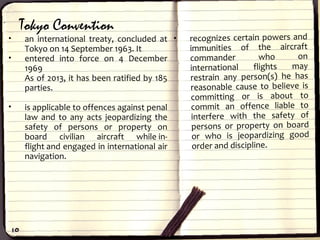
• an international treaty, concluded at
Tokyo on 14 September 1963. It
• entered into force on 4 December
1969
As of 2013, it has been ratified by 185
parties.
• is applicable to offences against penal
law and to any acts jeopardizing the
safety of persons or property on
board civilian aircraft while in-
flight and engaged in international air
navigation.
• recognizes certain powers and
immunities of the aircraft
commander who on
international flights may
restrain any person(s) he has
reasonable cause to believe is
committing or is about to
commit an offence liable to
interfere with the safety of
persons or property on board
or who is jeopardizing good
order and discipline.
Convention for the Suppression of
Unlawful Seizure of Aircraft
The Hague Convention
• regards the hijacking of aircraft,
calling for it to be an extraditable
offense among member countries.
“a State is obliged, whether or not it is the
State of registration, to take such
measures as may be necessary to
establish its jurisdiction over the
offence in the case where the alleged
offender is present in its territory and
it does not extradite him”
• The Convention requires any
Contracting State in which the
aircraft or its passengers or
crew are present to facilitate
the continuation of the journey
of the passengers and crew as
soon as possible and to return
the aircraft and its cargo to the
persons lawfully entitled to
possession without delay.
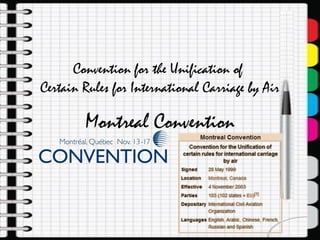
Convention for the Unification of
Certain Rules for International Carriage by Air
Montreal Convention
Montreal Convention
• multilateral treaty adopted by a
diplomatic meeting of ICAO member
states in 1999
• amended important provisions of
the Warsaw Convention's regime
concerning compensation for the
victims of air disasters
• protects passengers by introducing a
two-tier liability system and by
facilitating the swift recovery of proven
damages without the need for lengthy
litigation
• re-establishes uniformity and
predictability of rules relating
to the international carriage
of passengers, baggage and ca
rgo.
• was brought about mainly to
amend liabilities to be paid to
families for death or injury
whilst on board an aircraft.
Unlawful Interference and
General Risks Convention
Rome Convention
Rome Convention
Unlawful Interference General Risks
• applies to damage to third parties
which occurs in the territory of a
State party caused by an aircraft in
flight as a result of an act of unlawful
interference when the operator is
based in another State
• applies to damage to third parties in
a non-State party where the
operator causing the damage was
from a State party
• the operator is strictly liable for the
damage sustained by the third party
caused by an aircraft in flight; the
third party does not need to prove
the airline was at fault
• applies to damage to third
parties occurring in the
territory of a State party
caused by an aircraft in flight,
other than as a result of an act
of unlawful interference, when
the operator is based in
another State party
• operator is strictly liable up to
a threshold tentatively set at
SDR 250,000 to SDR 500,000
per claimant
• operator is liable for all
damage in excess of this limit
unless it can prove that such da
• damage was solely due to
the negligence of another
party
Convention on the International
Recognition of Rights in Aircraft
Geneva Convention
Geneva Convention
• to facilitate the financing for the
purchase of aircraft employed
The main characteristics of the
Convention are the following:
 the protection of secured creditors
who lend money on the security of
aircraft
 the protection of third parties dealing
in or with aircraft against hidden
charges
 the definition and protection of
privileged and priority claims against
aircraft
 the facilitation of the transfer of
aircraft from one nationality to
another.
Unification of Certain Rules Relating to
International Carriage by Air Performed by a
Person other than the Contracting Carrier
Guadalajara Convention
• aims to cover such arrangements as
leasing, chartering, code-sharing and
interlining
The passenger is entitled to claim
against either or both the actual or
contracting carrier for bodily injury,
loss or damage to baggage and cargo
or for delay
• Entered into force: 1 May 1964
• Total ratifications: 82

Civil Aviation Conventions

  • 1.
  • 2.
    Convention for theUnification of Certain Rules Relating to International Carriage by Air Warsaw Convention
  • 3.
    an international conventionwhich regulates liability for international carriage of persons, luggage or goods performed by aircraft for reward. Warsaw Convention In particular, the Warsaw Convention: mandates carriers to issue passenger tickets requires carriers to issue baggage checks for checked luggage; creates a limitation period of 2 years within which a claim must be brought (Article 29); and limits a carrier's liability to at most: 250,000 Francs or 16,600 special drawing rights (SDR) for personal injury; 17 SDR per kilogram for checked luggage and cargo, or US$20 per kilogram for non- signatories of the amended Montreal Convention. 5,000 Francs or 332 SDR for the hand luggage of a traveler.
  • 4.
    Clauses 17 and18 of the Warsaw Convention Warsaw Convention Airline companies are liable for any damage that occurs to passengers or their belongings during in-flight. Airline companies will not be held responsible if the damage results from the passenger's own fault or one of their temporary servants such as doctors assisting ill passengers on their own initiative. As of 2013, the Warsaw Convention had been ratified by 152 states. The Protocol to the Convention had been ratified by 137 states.
  • 5.
    Chicago Convention The Conventionon International Civil Aviation
  • 6.
    Chicago Convention • establishesthe International Civil Aviation Organization (ICAO) • establishes rules of airspace and aircraft registration and safety • details the rights of the signatories in relation to air travel • exempts air fuels from tax As of 2013, the Chicago Convention has 191 state parties, which includes all member states of the United Nations—except Dominica, Liechtenstein, and Tuvalu—plus the Cook Islands. • established the rights of signatory states over their territorial airspace, and laid down the basic principles relating to international transport of dangerous goods by air • provides freedoms 1 and 2
  • 7.
    Convention on Offencesand Certain Other Acts Committed on Board Aircraft Tokyo Convention
  • 8.
    Tokyo Convention • aninternational treaty, concluded at Tokyo on 14 September 1963. It • entered into force on 4 December 1969 As of 2013, it has been ratified by 185 parties. • is applicable to offences against penal law and to any acts jeopardizing the safety of persons or property on board civilian aircraft while in- flight and engaged in international air navigation. • recognizes certain powers and immunities of the aircraft commander who on international flights may restrain any person(s) he has reasonable cause to believe is committing or is about to commit an offence liable to interfere with the safety of persons or property on board or who is jeopardizing good order and discipline.
  • 9.
    Convention for theSuppression of Unlawful Seizure of Aircraft The Hague Convention
  • 10.
    The Hague Convention •regards the hijacking of aircraft, calling for it to be an extraditable offense among member countries. “a State is obliged, whether or not it is the State of registration, to take such measures as may be necessary to establish its jurisdiction over the offence in the case where the alleged offender is present in its territory and it does not extradite him” • The Convention requires any Contracting State in which the aircraft or its passengers or crew are present to facilitate the continuation of the journey of the passengers and crew as soon as possible and to return the aircraft and its cargo to the persons lawfully entitled to possession without delay.
  • 11.
    Convention for theUnification of Certain Rules for International Carriage by Air Montreal Convention
  • 12.
    Montreal Convention • multilateraltreaty adopted by a diplomatic meeting of ICAO member states in 1999 • amended important provisions of the Warsaw Convention's regime concerning compensation for the victims of air disasters • protects passengers by introducing a two-tier liability system and by facilitating the swift recovery of proven damages without the need for lengthy litigation • re-establishes uniformity and predictability of rules relating to the international carriage of passengers, baggage and ca rgo. • was brought about mainly to amend liabilities to be paid to families for death or injury whilst on board an aircraft.
  • 13.
    Unlawful Interference and GeneralRisks Convention Rome Convention
  • 14.
    Rome Convention Unlawful InterferenceGeneral Risks • applies to damage to third parties which occurs in the territory of a State party caused by an aircraft in flight as a result of an act of unlawful interference when the operator is based in another State • applies to damage to third parties in a non-State party where the operator causing the damage was from a State party • the operator is strictly liable for the damage sustained by the third party caused by an aircraft in flight; the third party does not need to prove the airline was at fault • applies to damage to third parties occurring in the territory of a State party caused by an aircraft in flight, other than as a result of an act of unlawful interference, when the operator is based in another State party • operator is strictly liable up to a threshold tentatively set at SDR 250,000 to SDR 500,000 per claimant • operator is liable for all damage in excess of this limit unless it can prove that such da • damage was solely due to the negligence of another party
  • 15.
    Convention on theInternational Recognition of Rights in Aircraft Geneva Convention
  • 16.
    Geneva Convention • tofacilitate the financing for the purchase of aircraft employed The main characteristics of the Convention are the following:  the protection of secured creditors who lend money on the security of aircraft  the protection of third parties dealing in or with aircraft against hidden charges  the definition and protection of privileged and priority claims against aircraft  the facilitation of the transfer of aircraft from one nationality to another.
  • 17.
    Unification of CertainRules Relating to International Carriage by Air Performed by a Person other than the Contracting Carrier Guadalajara Convention
  • 18.
    Guadalajara Convention • aimsto cover such arrangements as leasing, chartering, code-sharing and interlining The passenger is entitled to claim against either or both the actual or contracting carrier for bodily injury, loss or damage to baggage and cargo or for delay • Entered into force: 1 May 1964 • Total ratifications: 82