Freedoms of the AirFreedoms of the Air
a set of commercial
aviation rights granting a
country's airline(s) the
privilege to enter and land
in another country's
airspace
fundamental building
blocks of the international
commercial aviation route
network
** The use of the terms 'freedom'
and 'right' only confer entitlement to
operate international air services
within the scope of the multilateral and
bilateral treaties that allow them.
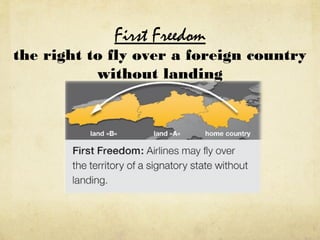
First Freedom
the right to fly over a foreign country
without landing
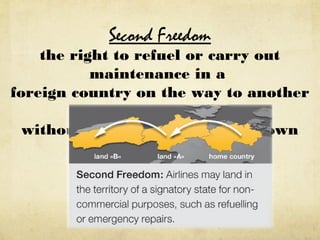
Second Freedom
the right to refuel or carry out
maintenance in a
foreign country on the way to another
country
without picking up or setting down
revenue traffic
Transit Rights
“The first and second freedoms
grant airlines the right to pass through
a country without carrying traffic that
originates or terminates there”Chicago Convention 1944- International Air
Services Transit Agreement (IASTA)
Two Freedoms Agreement
The treaty is accepted by 129
countries as of 2007
Traffic Rights
*allow commercial international
services between, through and in some
cases within the countries that are
parties to air services agreements or
other treaties
International AirTransport Agreement (IATA)
 Five Freedoms Agreement
Third Freedom
the right to fly or carry revenue traffic
from
one's own country to another
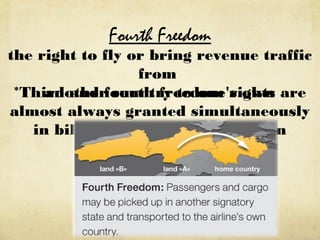
Fourth Freedom
the right to fly or bring revenue traffic
from
another country to one's own*Third and fourth freedom rights are
almost always granted simultaneously
in bilateral agreements between
countries
Beyond Rights
• allow the carriage of traffic between
(and sometimes within) countries
that are foreign to the airlines that
operate them
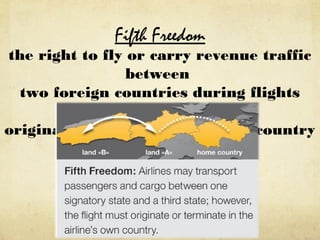
Fifth Freedom
the right to fly or carry revenue traffic
between
two foreign countries during flights
while the flight
originates or ends in one's own country
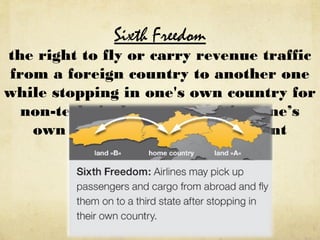
Sixth Freedom
the right to fly or carry revenue traffic
from a foreign country to another one
while stopping in one's own country for
non-technical reasons, setting one’s
own country as the transit point
Seventh Freedom
the right to fly or carry revenue traffic
between two foreign countries while
not offering flights or stopping to one's
own country
Cabotage
• transport of goods or passengers
between two points in the same
country by a vessel or an aircraft
registered in another country
• trade or navigation in coastal waters,
or, the exclusive right of a country to
operate the air traffic within its
territory
Eight Freedom
• the right to fly or pick up and set
down revenue traffic between two or
more domestic airports in a foreign
country
while continuing service to one's own
country
• Also referred as ‘continuing
cabotage’
Ninth Freedom
• the right to fly or pick up and set up
revenue traffic between two or more
domestic airports in a foreign
country
without continuing service to one's own
country
• Pure cabotage

Freedoms of the Air

  • 1.
    Freedoms of theAirFreedoms of the Air
  • 2.
    a set ofcommercial aviation rights granting a country's airline(s) the privilege to enter and land in another country's airspace fundamental building blocks of the international commercial aviation route network
  • 3.
    ** The useof the terms 'freedom' and 'right' only confer entitlement to operate international air services within the scope of the multilateral and bilateral treaties that allow them.
  • 4.
    First Freedom the rightto fly over a foreign country without landing
  • 5.
    Second Freedom the rightto refuel or carry out maintenance in a foreign country on the way to another country without picking up or setting down revenue traffic
  • 6.
    Transit Rights “The firstand second freedoms grant airlines the right to pass through a country without carrying traffic that originates or terminates there”Chicago Convention 1944- International Air Services Transit Agreement (IASTA) Two Freedoms Agreement The treaty is accepted by 129 countries as of 2007
  • 7.
    Traffic Rights *allow commercialinternational services between, through and in some cases within the countries that are parties to air services agreements or other treaties International AirTransport Agreement (IATA)  Five Freedoms Agreement
  • 8.
    Third Freedom the rightto fly or carry revenue traffic from one's own country to another
  • 9.
    Fourth Freedom the rightto fly or bring revenue traffic from another country to one's own*Third and fourth freedom rights are almost always granted simultaneously in bilateral agreements between countries
  • 10.
    Beyond Rights • allowthe carriage of traffic between (and sometimes within) countries that are foreign to the airlines that operate them
  • 11.
    Fifth Freedom the rightto fly or carry revenue traffic between two foreign countries during flights while the flight originates or ends in one's own country
  • 12.
    Sixth Freedom the rightto fly or carry revenue traffic from a foreign country to another one while stopping in one's own country for non-technical reasons, setting one’s own country as the transit point
  • 13.
    Seventh Freedom the rightto fly or carry revenue traffic between two foreign countries while not offering flights or stopping to one's own country
  • 14.
    Cabotage • transport ofgoods or passengers between two points in the same country by a vessel or an aircraft registered in another country • trade or navigation in coastal waters, or, the exclusive right of a country to operate the air traffic within its territory
  • 15.
    Eight Freedom • theright to fly or pick up and set down revenue traffic between two or more domestic airports in a foreign country while continuing service to one's own country • Also referred as ‘continuing cabotage’
  • 17.
    Ninth Freedom • theright to fly or pick up and set up revenue traffic between two or more domestic airports in a foreign country without continuing service to one's own country • Pure cabotage